Heart unites artworks

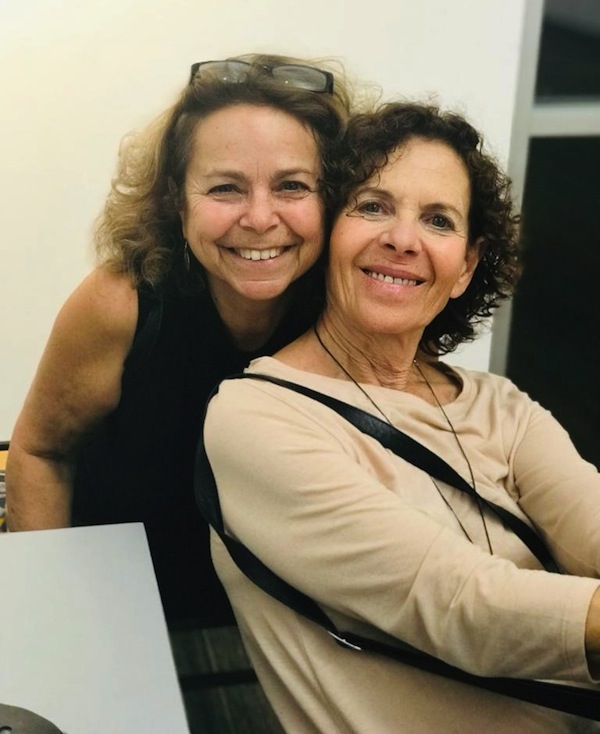
Claudie Azoulai, left, and Nicole Schouela. Their work comprises the exhibit Heart to Heart, which is at the Zack Gallery until Nov. 9. (photo from the artists)

The latest show at the Zack Gallery, Heart to Heart, presents the work of two artists in two vastly different media. Claudie Azoulai makes felt tapestries, while Nicole Schouela specializes in photography. Despite the differences in material representation, however, the colour palettes and the themes are amazingly similar – places close to their heart, places that invoke love and peace. The places and the emotions they inspire consolidate the show into a seamless, cohesive whole.

“We wanted to have a shared show forever,” Azoulai told the Independent. “We’re cousins, Nicole and I. We grew up together.”

They came up with the idea of a joint show about a year ago. “The timing is perfect,” said Azoulai. “It takes me, on average, about a month to create one piece, and there are 13 pieces of mine in this show, all new.”

photo - “Heron” by Claudie Azoulai
“Heron” by Claudie Azoulai.

All of these pieces are related to a children’s book Azoulai has written. “The book will be called The Spring Feast. It’s about the flora and fauna of Hornby Island, one of my favourite places. I will photograph every tapestry here, and they will be the illustrations for the book,” she said.

Azoulai considers herself a part of the great pageantry of life, and Hornby Island provides her with the opportunity to experience it firsthand. One of the tapestries, “Herring Run,” reflects her connection with nature.

“Every spring, herring come to Hornby Island to spawn,” she explained. “Then salmon come to eat the herring. Seals come to eat the salmon. Whales come to eat seals. Eagles fly over to eat the roe. Everything is alive, this great circle of life, and I’m part of it, too. When I come to Hornby Island in spring, I try to stay outside all day.”

Many of the tapestries depict various birds of Hornby Island. “I work from my imagination,” Azoulai said, “but when I need a particular pose or gesture, I go to the beach to watch the birds or look at photographs.”

Azoulai dyes her wool herself, and no batch comes out of the vat exactly the same, even if all the ingredients of the dye match. “Colours of the fleece always surprise me,” she said. “They influence the images. When I’m stuck, I would dye a new batch, and the new colours might affect the image, lead to a change. The colours dictate the picture more often than not.”

She frequently experiments with new materials, incorporating silk or synthetic particles into the base of wool to add a shine or a different texture. “As long as the fleece entangles the other threads, the image stays together,” she said about that technique.

Mixing and matching is also Schouela’s preferred technique, using Photoshop to work with different parts from a multitude of photographs.

“I have nine pieces in this show,” she said. “They are places I revisit often, not by traveling far away, but the places where I live and work. The places I walk. The places I love. The places that have almost a ritualistic meaning for me.… Sometimes, they are physical places. Other times, they are mental places.”

Schouela started her artistic life as a dancer, but dance is an unforgiving art form that takes its toll on the body. She switched first to ceramics, and later dedicated herself to photography. In everything she creates – a dance or a vase or a photo collage – there is movement and transformation. The images flow through each other, striving towards abstraction and emotional truth.

photo - “Perceived Threat” by Nicole Schouela
“Perceived Threat” by Nicole Schouela.

“Photo manipulation is freeing,” she said. “I could take pieces from here and there and create a new image I want, while it still retains the essence of the originals. It might take me several months to finish one picture. I would stop working with it and then, later, I would return to it again and again, until I’m satisfied.”

She photographs places that are part of her and her search for connections and understanding. By now, she has thousands of photos in her digital archives. “Sometimes, I would use a photograph or a fragment of one years after it was taken, because it would fit one particular composition or a feeling I want to explore,” she said. “I don’t want my images to resemble the real places. The original photographs are not important by themselves. They are part of the process. Sometimes, I play with pieces of 30 to 50 photos for one picture. It is fun.”

Schouela’s abstract compositions on the gallery walls lean towards pastel or black and white, with occasional splashes of bright colour. Some are geometrical. Others tell a story or convey an emotion.

“Traditional photography doesn’t interest me anymore – anyone can take a picture now with their phones,” she said. “I don’t want my imagery to be like paintings either. Photography is a separate art form. If I wanted a painting, I would paint. No, I want my collages to keep their photographic elements obvious.”

The exhibit Heart to Heart opened on Oct. 11 and continues until Nov. 9. To learn more about the artists, check out their websites: claudieazoulai.com and nicoleschouela.com.

Olga Livshin is a Vancouver freelance writer. She can be reached at olgagodim@gmail.com.

New Hornby art centre

Rae Maté is one of the many artists who have donated work to the fundraiser for a Hornby Island gallery. (photo from Rae Maté)

Hornby Island, in Georgia Straight, is known for its natural beauty. It is no surprise that many of its small population – 1,016, according to the 2016 census – are artists. While the community hasn’t had a regular exhibition space, this is about to change. On Oct. 10, the Hornby Island Arts Council is holding an auction fundraiser in support of building a new art centre.

“A full 40% of residents of Hornby are visual artists, dancers, musicians, poets, actors and writers,” Cheryl Milner, auction chair, told the Independent about the need for a permanent gallery. “For too many years, local visual artists have been using a 1967 mobile home with a small display area to show their work. Otherwise, artists have built their own studios or hung their work in the local co-op general store to get in front of the island visitors.”

About the concept for the fundraiser, Milner said, “The idea came to me because I became familiar with this amazing woman on the East Coast of Canada, Zita Cobb. She lived on Fogo Island, left after high school, made it in the high-tech business and went back home to see how she could help her native island, particularly because the cod fishery had closed. She started a foundation to create greater cultural resilience for the region.”

Milner doesn’t want anyone to compare her to Cobb, but she wants to help Hornby Island and its artists on a smaller scale. “My thought was to marry Vancouver to Hornby Island as Toronto supports Fogo Island. The auction is our first attempt, and we’ll see how it goes,” she said. “The parallel goes only as far as helping support the gallery. We don’t wish to expand things further than that for now.”

She said a gallery has been on the radar of the arts council for years. “We have some new blood in the organization and want to help make it happen,” she explained. “We are also applying for some matching grant opportunities, which means that we could potentially double the capital we have been scrimping to save. Currently, we have about $180,000 saved. This will give us a good foundation to move forward. We do have a couple of architects on board to support this venture, so there appears to be quite a lot of momentum to get this done.”

Attracting tourists is one of the reasons the auction will take place in Vancouver, not on the island itself.

“Many Vancouverites frequently visit Hornby,” Milner said. “They love the place and their special time there. We are giving Vancouver an opportunity to support the artists they love by helping to build a proper facility to house a permanent gallery, exhibition and workshop space for future generations.”

The artists of Hornby Island are excited about the gallery and the auction.

“Approximately 35 artists donated their works,” said Milner. “About 25 are in the live auction and another 10 in the silent auction, which will focus on items and services of interest to Vancouverites.”

Besides their art, some participants are offering “Hands-on Hornby” artistic experiences to bidders. Among these will be cutting a song with Marc Atkinson at the Barn Studio and a two-day workshop with ceramicist Rachelle Chinnery, which includes a rental stay.

One of the visual artists who donated their work for the auction is Vancouver Jewish community member and well-known local artist Rae Maté. In 2011, she had a solo show at the Zack Gallery, and the Independent published an interview with her at the time. Since then, much has happened in her artistic life.

“In 2015, my third book in the Crocodile series with the author Robert Heidbreder, Crocs at Work, was published by Tradewind Books. My silly crocodiles are back and, this time, they have jobs and professions, which they do in very surprising and funny ways,” she said.

Since the death of her mother in 2017, Maté has devoted herself to art full-time.

“I’m excited to be using oils again as well as acrylics,” she said. “I’m exploring new directions: abstraction, non-figurative works and landscape. This summer, I had a very successful show on Hornby during the art festival in August. I was one of the four artists invited to mentor Hornby children. The children’s art was shown alongside with the mentoring artist’s new works. It was an exciting and rewarding experience for us all.”

photo - One of the pieces she has donated is “Sunflowers”
One of the pieces she has donated is “Sunflowers.” (photo from Rae Maté)

Maté’s ties to Hornby Island are longstanding. “Our family fell in love with Hornby Island in the 1980s, when my sons were little, and we spent several summer holidays camping there,” she said. “After my daughter was born, we purchased a small cabin. Five years later, we sold it and bought a larger place with indoor plumbing. We are still there today and we have many Jewish friends who live nearby. For years, we have been having potluck Shabbat dinners at Grassy Point, a wonderful park with a meadow and a beach a short walk from us. It is famous for its sunsets.”

Maté has enjoyed the island and its artistic atmosphere for years. It feeds her creativity.

“I used to tell people that being an artist on Hornby Island is like being a Jew in New York,” she said. “Almost everyone is creative and involved or interested in the arts. I feel very inspired and at home there.”

She also contributes to the arts scene on Hornby. “I regularly sell my art cards at the co-op store and at the farmers markets in the summer. I had a few solo and group shows at the community hall.”

Not only do she and her family spend most summers on the island, but she usually manages to get there for about a week every two months. “I do so much of my painting and illustrating work there, on my deck in the garden, when the weather allows, or in the studio during the colder months,” she said.

When Maté heard about the auction, she knew she wanted to donate her works for it.

“When Cheryl approached me at the market, I said yes immediately. This is a cause I whole-heartedly support. I am offering three paintings for the auction, all new, created especially for this event.”

The Oct. 10 auction will take place at Sage Bistro, which is behind the Chan Centre for the Performing Arts at the University of British Columbia. To learn more, visit hornbyislandartscouncil.wordpress.com.

Olga Livshin is a Vancouver freelance writer. She can be reached at olgagodim@gmail.com.

Divine Sparks at the Zack

Barbara Heller’s exhibit, Divine Sparks, is at the Zack Gallery until Oct. 8. (photo by Olga Livshin)

Barbara Heller’s new solo show at the Zack Gallery, Divine Sparks, could be divided into three distinct themes, each one representative of a world culture: the Sephirot, the Mudras and the Future Reliquaries. Each of the three resonates with one of three religions, Judaism, Hinduism and Christianity, respectively, but Heller, a master weaver, sees divine sparks everywhere. Her tapestries, big and small, invite gallery guests to contemplate what unites us, no matter our ethnicity or religious affiliation.

Symbolism infuses Heller’s images, starting with the centrepiece of the show, “Tzimtzum,” or “Transcendence.” The large tapestry is a stylized ladder. The midnight blue rungs at the bottom coalesce into a dead bird, but the higher your eyes travel, the lighter the colours become. Two pairs of wings punctuate the climb of colours from dark indigo to white radiance.

“The ladder has many interpretations,” Heller told the Independent. “It can be a metaphor for our life, a liminal space between birth and death…. For me, the rungs are stepping stones on the path of spiritual attainment, of transcendence.”

Heller has shown this tapestry at several exhibitions already, to great acclaim. Recently, it won the American Tapestry Alliance Award.

photo - Barbara Heller made a series of small tapestries of her feather collection, Sephirot, specifically for the Zack show
Barbara Heller made a series of small tapestries of her feather collection, Sephirot, specifically for the Zack show.

“Originally, I wanted to display this tapestry with real feathers piled along the bottom,” the artist said about “Tzimtzum.” “I have amassed many beautiful feathers, and friends kept bringing me more, but I discovered it was almost impossible to send real feathers anywhere. I displayed the tapestry in Poland a couple years ago, and they told me that real feathers have to be quarantined for weeks before being allowed into the country. And they can’t be from endangered species. I wasn’t sure about that.”

Since the plan involving the real feathers fell through, Heller made a series of small tapestries of her feather collection, Sephirot, specifically for the Zack show.

“I already had lots of yarn died blue for the ‘Tzimtzum,’” she said. She called the series Sephirot after the kabbalah’s spiritual qualities of understanding, wisdom, love and judgment, among others.

“Some of the feathers are almost photographic,” she said. “In the others, I played with colours and sparkles.”

The second series in the show, Mudras, obtained its name from the hand gestures prevalent in Hinduism, Asian dancing, yoga and meditation.

“Typically, mudras are used as a way to direct energy flow in the body,” Heller said. “According to yoga, different areas of the hand stimulate specific areas of the brain. By applying light finger pressure to these areas of the hand, you can ‘activate’ the corresponding region of the brain. In addition, hand mudras also symbolize various feelings and emotions.”

Heller’s Mudras is a series of small, uniform-sized round images of various hand gestures. The hands are woven of golden yarn and appliquéd to dark-green fabric with a vague “computer motherboard” pattern. Parts of real electronics – wires, chips, connectors – are incorporated into the design of every gesture, as if to emphasize the similarities between computer circuits and the neuron circuitry in our brains.

“I collect old electronics and take them apart, and use them in my weaving,” said Heller. “This series was fun to make.”

The other series, Future Reliquaries, is an older one. Also depicting hands embedded with parts of electronic devices, it reflects humanity’s developing love affair with technology.

Several tapestries of the series are rather large. In each one, a human hand in golden yarn stands out from the background of an ancient traditional pattern. “Different tapestries sport different patterns: from Persia, Indonesia, Turkey, Navajo,” Heller said.

Like in the Mudras series, the interlaced computer piece are symbolic of our interconnection with machines.

Heller wrote: “This series deals with three apparently separate but, in my mind, connected histories: weaving, computing and religion. Weaving is a binary system of up/down, just as computing is a binary system of on/off…. Religion is not only a store of faith; it is a store of history and social values…. Today, we are creating a new religion. We are worshipping the technology.”

Heller’s tapestries contemplate the future status of today’s electronic remnants in the context of ancient fabrics. “As holy relics were housed in reliquaries, often made of gold and gems, I’m trying to populate my tapestries with the future relics – the computer chips and wires.”

Beside the large hands, there is also a selection of tiny ones, where each miniscule woven hand is linked to topics such as keys or clocks, science or beauty, birth or death.

Heller’s exhibit is part of larger happenings in Vancouver this month – a symposium of the Textile Society of America. The symposium takes place Sept. 19-23, and many galleries around the city besides the Zack are displaying textile or weaving exhibitions to coincide with it.

As a well-known local artist, Heller has been one of the event organizers from the beginning. “We have a wealth of local textile artists, and about 400 people are coming to the symposium from all over the world,” she said.

The planning for the symposium began three years ago. “We made sure that the hotel reservations were available on the dates that didn’t include Yom Kippur,” she said. “Unfortunately, a year ago, the hotel informed us that they had to change our reservation dates.”

So, now, the first day of the symposium falls on Yom Kippur, as other reservations were not available, and the society has posted an apology on its website.

The Zack Gallery offers a bus tour of three textile exhibitions in the city on Sept. 20. To learn more about the tour and to register, visit jccgv.com/art-and-culture/gallery. For more about Heller, visit barbaraheller.ca.

Divine Sparks opened on Sept. 6 and continues until Oct. 8.

Olga Livshin is a Vancouver freelance writer. She can be reached at olgagodim@gmail.com.

Shoes with celebrity appeal

Stuart Weitzman built up his father’s business into an empire. (photo by Phillip Pessar)

There are so many styles of women’s shoes, including the stiletto, platform, wedge, kitten, sling backs, peep toe, mule or sneakers. Unlike our favourite outfits, the fit of our shoes doesn’t change much in relation to our waistlines. A great pair of shoes can boost our confidence and turn a “shlumpy” outfit into something eye-catching. Marilyn Monroe declared, “Give a girl the right pair of shoes and she can conquer the world.”

Renowned designer Stuart Weitzman was born into a shoe business family. But, while his father had started a shoe company in Massachusetts in the 1950s, Weitzman’s goal was a career on Wall Street and he went to and graduated from the Wharton School. However, after his father died, he started to make the transition from talented hobbyist sketcher to acclaimed shoemaker. His strong work ethic coupled with an eye for style created the prevailing Weitzman empire. His designs flew off the shelves of upscale stores and filled pages of top fashion magazines.

photo - Stuart Weitzman
Stuart Weitzman (publicity photo)

In 1971, Weitzman partnered with a Spanish shoe factory, Caressa. In 1986, Weitzman bought all the shares from his Spanish partners and became independent. Success over the years led to Weitzman’s ownership of nine factories throughout Spain, which granted him the ability to keep his upscale shoe brand at a price 30% to 50% lower than that of his contemporaries. At his peak, Weitzman owned 120 private boutiques and sold globally in department stores.

Fifty years in the business has attracted a large following of shoe enthusiasts to Weitzman’s creations, including celebrities like Beyoncé, Kim Cattrall, Jennifer Aniston and Taylor Swift. In 2002, Weitzman fashioned a pair of million dollar shoes, almost literally dripping in diamonds, worn by actress Laura Harring to the Academy Awards. He also designed the most popular nude sandal worn among celebrities, which has become a classic and essential for many women.

Weitzman sold his company to Coach for an estimated $574 million in 2015. At the age of 76, he remains the creative director. It is now Weitzman’s wish to find a successor, as his two grown children, Rachel and Elizabeth, have chosen different routes.

Weitzman and his wife, Jane Gershon, worked together to build the business. Together, they also became philanthropists, donating to many causes, but also establishing the foundation Pencils of Promise, which focuses on opening schools in Ghana, Laos and Guatemala.

Weitzman and Gershon are passionate about their Jewish roots and work to ensure the future of Jewish communities and Jewish heritage. Consequently, a substantial amount of their contributions and time commitments revolve around Jewish institutes and causes around the world.

Weitzman, an avid ping-pong player, participated in the Maccabiah Games in Israel in 2009 and 2013. Also in 2013, he made a donation of $1 million to Maccabi USA. “My participation in the Maccabiah Games was one of the greatest experiences of my life!” he has said.

A man used to working 16-hour days in a creative environment doesn’t seem set on a quiet retirement. The list of projects he has planned is long. A top priority is constructing a Jewish museum in Madrid dedicated to Spanish Jewry. On the horizon is producing a Broadway musical with Sir Trevor Nunn about the life of Andy Warhol.

Just in case the wedding superstition is true, let us do as the bride is advised – whatever our footwear, let us remember to exit with our right foot first to ensure a lucky day.

Some shoe facts

  • 40,000 years ago, it seems, people began wearing shoes
  • the first women’s boot was made for Queen Victoria in 1840
  • sneakers were first made in America in 1916
  • heels were added to shoes in the Middle East to lift the shoe from the burning sand
  • Marie Antoinette had 500 pairs of shoes
  • the only shoe museum in North America is the Bata Shoe Museum, in Toronto
  • gold and silver coins placed inside a bride’s wedding shoe is an old Swedish custom
  • Chinese brides throw one of their red bridal shoes to the roof of their house to ensure the couple’s happiness
  • Altocalciphilia is the name for having a high heel fetish

Ariella Stein is a fashion writer based in Israel.

Exhibit celebrates life

The paintings of Frank Levine are on display at the Zack Gallery until Aug. 31 in a shared show, called Celebration, with Melanie Fogell. (photo by Olga Livshin)

The latest show at the Zack Gallery, Celebration, showcases two artists, Melanie Fogell and Frank Levine. At first glance, they don’t seem to have much in common.

Fogell’s art is bright and flamboyant, totally abstract, and her canvases are large, while Levine’s paintings are generally smaller, more intimate, his colours more muted and his compositions tend to have recognizable figurative patterns: people, musical instruments, landscapes, cityscapes.

However, both artists celebrate life through their paintings. For years, both approached art as a hobby – it is only recently that Fogell started painting full-time, while Levine still works as an accountant. Both artists also lived for some time in Gibsons, B.C., where they met a few years ago. Fogell still lives there, while Levine has moved to Richmond.

Levine’s life has involved several drastic moves, geographic and professional. Born in England, he received his art education in London. He majored in fashion design. Upon graduation, he opened his own fashion boutique in London, but that didn’t last long in the cutthroat industry. After that, he worked for 10 years as a clothing designer for a large factory in the city.

“The clothing industry in London is very stressful and loud. Everyone shouts and screams,” he explained in an interview with the Independent. “The designers had to produce a new design every week, two collections a year. If a particular coat sold, the owners congratulated themselves at how good they were at selling. If it didn’t sell, the designers were to blame.”

After a decade of the stress and screaming, Levine switched to accounting, which he considers an occupation much less taxing on his nerves. In 1978, he moved to Canada and settled in Vancouver. “Antisemitism in England was a consideration in my decision to move,” he said.

Wherever he has lived, and whatever his day job, he has kept on painting.

“I have always painted when I had the time,” he said. “I don’t paint every day, only when I’m inspired. Once a week, my son and his children come for a visit, and we paint together.”

One of the paintings in the show, “Prism,” came from one of those weekly sessions. The small image features a blue-and-gold cityscape, happy and bright, vaguely reminiscent of a Greek city. “My son suggested the theme of prism,” said Levine.

Many of the artist’s paintings are landscapes, but he portrays them through a mesh of geometric figures. The lines creating the geometric patterns add mysticism to the trees and lakes. “I’m drawn to the images that have passion, not something everyone would paint,” he said.

Whatever his brush depicts – his backyard in Gibsons with a visiting bear, a small café in the Luxembourg Gardens in Paris or picturesque gates in China – his love for the places shines through the canvas.

Unfortunately, not many people have seen his charming work. “I didn’t do any promotion until recently and I sell maybe two or three paintings a year,” he said. “I only joined Facebook a month ago.”

Over the years, Levine has participated in several exhibitions in Gibsons and has had his paintings displayed at a Richmond community centre. This Zack Gallery show is only the second time in Vancouver that the public has had a chance to admire them, and it is his first exhibit in a Vancouver art gallery.

photo - Melanie Fogell’s art is bright and flamboyant, totally abstract, and her canvases are large
Melanie Fogell’s art is bright and flamboyant, totally abstract, and her canvases are large. (photo from Melanie Fogell)

Unlike Levine, Fogell is well known on the Vancouver art scene. She had a solo show at the Zack in 2011 and another one in 2014. Her early art education at Emily Carr University of Art + Design could have led to a career in the arts, but, like many others, she discovered that it was extremely difficult to make a living as an artist. She became a piano teacher instead.

Years later, Fogell went back to university for a master’s in women’s studies and then did a PhD in educational research. She has taught women’s studies at the University of British Columbia and piano as a private tutor, but, throughout the years, just like Levine, she has never stopped painting. She loved art too much, and the need to express herself through imagery drove her to paint. She paints full-time now.

“I did this group of paintings, the Oval Series, over the last two years,” she said about the work in the Zack Gallery show. “It began by me doodling oval shapes. Then I started thinking of possible meanings of this particular shape. The oval could stand for an egg, which is a symbol of life, a celebration of life. Or it could be a face, the beginning of a face, not ready to be recognized. They could be faces of people in my life or people I have yet to meet.”

Fogell’s paintings burst with primal colours, and her ovals seem like gladness enclosed, surrounding the viewers like a collection of exuberant eggs, or new leaves shimmering in the sunlight, or a field of tulips swaying in a breeze. They promise renewal and hope. “I paint how it feels to be connected to everything in my life, both present and past,” she said.

The exhibition Celebration opened on Aug. 9 and continues until Aug. 31. For more information, check out the artists’ websites, melaniefogell.com and franklevineart.com.

Olga Livshin is a Vancouver freelance writer. She can be reached at olgagodim@gmail.com.

Tikkun olam through photos

With his photos, Liron Gertsman hopes to raise awareness of environmental issues. (photo by Liron Gertsman)

Recent Vancouver high school graduate and award-winning photographer Liron Gertsman is heading to the University of British Columbia to study biology. His main passion is taking photos of nature, particularly birds, in the hope of sparking in viewers feelings of love and awe for the environment, leading to improved conservation.

“I believe people need to see the natural world if they want to protect it, so I try to do that through my photos,” Gertsman told the Independent in an interview.

From as young as 5 or 6 years old, Gertsman spent a great deal of his spare time walking around his neighbourhood, keeping an open eye.

“Around that time, my parents gave me a blue miniature camera,” he recalled. “Right from the start, I began taking pictures of birds and nature … and it grew and grew until, when I was 12, I bought my first personal DSLR camera equipment. And, since the very start, I’ve loved birds and have been fascinated by their behaviours … and have done my best to photograph them.”

Gertsman’s love of nature does not seem to have come from his parents, who are both businesspeople. His dad is a real estate tax consultant and his mom is an accountant.

“It was a big combination of things,” said Gertsman. “A lot of it was self-learning things – reading on the internet, reading books, and there were [other] influences because the bird-watching community is very large…. I would go attend bird walks and meet people that way. My Grade 2 teacher was a really big environmentalist and created an environmental conservation club at school.”

photo - Cobalt-winged parakeets. “To get this photo,” said Liron Gertsman, “I waited for hours three days in a row in a blind in the hot and humid rainforest of Yasuni National Park in Ecuador”
Cobalt-winged parakeets. “To get this photo,” said Liron Gertsman, “I waited for hours three days in a row in a blind in the hot and humid rainforest of Yasuni National Park in Ecuador.” (photo by Liron Gertsman)

Now that he is heading to UBC, Gertsman is not sure if he will integrate photography with research on birds, or if he will become a professional nature photographer.

“There are a lot of biologists who use photography to document their work,” he said. “They’re doing work that is hopefully going to benefit conservation and they need photographers, or they, themselves, will document their own work … to put it into a format that is easier for people to comprehend. Hopefully, I’ll get involved in some research projects – maybe over the summers – that will allow me to do things like that…. But, I’ll see what calls me more in the years to come and make a decision in a few years.”

Gertsman posts his photos on his website and social media accounts, and some have won contests. Most recently, three of his photos were recognized by the Audubon Photography Awards, winning the youth category prize and honourable mentions.

“It’s a great way to show more people your work, show them the beauty of nature,” said Gertsman. “Some of my photos have been featured, in the past, in magazines and in web articles.

“We are at a point now in the world where, if we don’t change something big … we’re going to be heading into some dark times. The environment is at a very unstable point right now. Our actions in the next little while are going to have a big impact on whether there’s going to be nature and a natural environment to live in, in the years to come.

“Everything we have as people comes from nature,” he continued. “Without nature, we can’t survive. But, it can be hard for people to understand that. It’s not a direct link. If you cut down a tree, it’s not going to have an impact on most people’s lives.”

But, on a larger scale, it matters. “So,” he said, “what I’m trying to do is, by photographing the natural world in the most beautiful way I possibly can and showing it to as many people I possibly can, I’m trying to educate the world the best I can on how incredible the environment is and how worth protecting it is.”

photo - The talons of a wild bald eagle, photographed on the southwest coast of British Columbia. “It was sitting near a popular walking trail, so perhaps it was used to attention from its human admirers,” said Liron Gertsman
The talons of a wild bald eagle, photographed on the southwest coast of British Columbia. “It was sitting near a popular walking trail, so perhaps it was used to attention from its human admirers,” said Liron Gertsman. (photo by Liron Gertsman)

This past spring, Gertsman was in Israel, one of the most amazing places in the world for birdwatching, as “all the birds migrating from Africa to Europe pass through in Israel,” he said.

There are many ways people can help promote the environment, he added. “You can help me spread my message – tell your friends, share my website, follow me on social media, my Instagram. I post, almost every day, my latest pictures on Instagram. Hopefully, through that, I’ll be able to reach more people.

“It’s increasingly difficult to motivate people to do things individually, but individual action can have wide affect. When a government adds a regulation, it has an impact and, when regulations are taken away, that too has a huge impact. So, in the way we think about our political leaders, there’s something we can do as a nation there.

“But also, just on an individual scale, cutting down on driving, not using plastic straws … little things, like carpooling, things you do every day can make a big difference. And, just spreading the message of how amazing nature is, and getting out and enjoying nature yourself.”

For more information, visit lirongertsman.com or @liron_gertsman_photography on Instagram.

Rebeca Kuropatwa is a Winnipeg freelance writer.

Eclectic mix of art and artists

Artist Paula Mines combines photography and abstract work whenever possible. This image by Mines is part of the current group exhibit now on display at the Peretz Centre until July 22.

The current art show at the Peretz Centre for Secular Jewish Culture is reflective of the centre’s nature – it is inclusive and eclectic. The group exhibit encompasses various genres and techniques: oil paintings and watercolour, photography, textile art and even animation. The artists participating in the show are as different as their art, their only point of connection being the Peretz Centre.

Of the eight artists featured in the exhibit, JI readers are already familiar with at least three: Colin Nicol-Smith, Hinda Avery and

Simon Bonettemaker. All three took part in the inaugural Peretz Centre Art Show in 2014. For all three, art has been a hobby: Nicol-Smith was a professional engineer, Bonettemaker was an architectural technologist and Avery taught women’s studies at the University of British Columbia before retirement.

Unlike them, Avrom Osipov built his life around creative endeavours. “I grew up at the Peretz Centre,” he told the Independent. “Started coming here with my parents when I was 5. It took me 65 years to grow up,” he joked.

image - Avrom Osipov built his life around creative endeavours
Avrom Osipov built his life around creative endeavours.

At one time, Osipov made a living as an artist, producing his own line of handpainted clothing and T-shirts and selling them to department stores. “I’ve made 1,200 original T-shirts, never copied a design once,” he said.

Afterwards, he worked as an actor in film and television. “I have always been creative, but, before this show came along, I hadn’t painted in awhile,” he said. “I did some image manipulation on my computer. The show made me pick up a brush again, and it’s fantastic. Now, I paint every day.”

Paula Mines is also a regular at the centre. “I’m from Montreal,” she said. “My parents and I arrived in Vancouver in 1953 and almost immediately became involved at the Peretz. They felt at home here, and so do I.”

She has always been interested in art, even as she worked in social services. She paints and draws but, since her retirement, she has been focusing on photography. “My place is too small for an easel and paintings,” she said, laughing. “Photography just takes a computer. I combine my photography and abstract work whenever possible. My images are semi-realistic. I take a photo, clean it, crop it, change things or add things from other photos. Not all photos lend themselves to this kind of transformation. Of every 1,000 photos I take, I might keep about 25. To turn out a good image is so exciting.”

Another member of the Peretz community, Natalia Bogolepova, is an immigrant from Russia. She worked as a doctor in Russia for 20 years, specializing in plastic surgery and cosmetology, before coming to Vancouver in 2011. “I always loved art, always painted, even when I practised medicine,” she said. “I participated in several amateur art shows in Moscow. My mother was a professional artist and, since childhood, I enjoyed the smell of oil paints.”

Even though Bogolepova couldn’t work as a doctor in Canada without a licence, she didn’t try to pass the exam. Instead, she switched careers and worked in security for several years. Fortunately, serendipity took a hand in her life. Her security post at the Vancouver Art Gallery pushed her back into the arts. “I observed the art and the people who visited the gallery,” she said. “I watched children as they drew inside the gallery. I knew I had to get back to my painting.”

image - Karl Epstein’s paintings can be found in private collections throughout Belarus, Israel, Canada and the United States
Karl Epstein’s paintings can be found in private collections throughout Belarus, Israel, Canada and the United States.

Another Soviet immigrant, Karl Epstein, is a professional artist and architect. He graduated from Belarus Academy of Arts in 1972 and worked as an architect in his native Belarus before immigrating to Israel in 1990. In Israel, he painted a lot and participated in a number of exhibitions. His paintings can be found in private collections throughout Belarus, Israel, Canada and the United States. He kept on painting after he moved to Canada.

Rounding out the eight artists featured in the Peretz show is Lesley Richmond, the only one not previously connected to the centre. This exhibit will be her first appearance there.

A professional fibre artist, Richmond received her art teaching training in London, England. She taught textile art at Capilano University until 2003, when she dedicated herself full time to art. Private and corporate collections in the United States, Japan, Poland, Korea and Canada have some of her work on display.

The idea to bring eight wildly different artists together in one show was Nicol-Smith’s. “I wanted to have another show at the centre after the success of our first one in 2014,” he recalled. “I started talking about it at one of the Peretz events with food and music, and suddenly people at the other tables perked up. ‘I’m an artist,’ sounded all around me. ‘I want to be in this show, too.’” Nicol-Smith partnered with Lena Sverdlov, vice-president of the Peretz Centre for the past four years, and, together, they made the current show a reality.

The exhibit opens today, July 13, and will be on display until July 22.

Olga Livshin is a Vancouver freelance writer. She can be reached at olgagodim@gmail.com.

Art reflects constant change

Carly Belzberg’s solo show is at Zack Gallery until Aug. 3. (photo by Nathan Garfinkel)

Carly Belzberg is a Zen practitioner, and her art reflects her beliefs. Her solo show at the Zack Gallery – The Spirit of Cloud, The Spirit of River – is all about change.

“I’m frequently at the Zen Centre of Vancouver,” she said in an interview with the Independent. “I study there and I realize that everything in life is in flux. A river is always changing. Water is quiet one moment, turbulent the next. It could be playful or angry, rushing or swirling, transforming from moment to moment. There are bubbles and spray and flow. Nothing is ever constant. The same is true of clouds. You can’t say a cloud is fluffy. It’s only fluffy one moment. It’s dynamic, fluid. The same is true of humans. We change from one day to the next, under the influence of the world. That’s what I wanted to express in my paintings: the freedom of change, its boundlessness. Nothing stays ‘this way.’ Everything evolves. Everything grows, and the essence of change is clearest when watching the river or the clouds.”

Watching the river or the sky helps her meditate. “Nature comes into you,” she said. “You breathe it in, and then it comes out again.”

Part of what comes out for Belzberg is her art. Colours and lines coalesce and crisscross in her abstract images of movement and form. The paintings represent the essence of change, as she sees it.

“It is my first-ever solo show,” she said, although she has participated in several group shows at the Zack in the last few years. “My art is a joy, and I wanted to spread my joy. I’m really happy to share my vision, something I’ve been nurturing for so long.”

Her path to this exhibit was as complicated as a water drop. She grew up in Vancouver, then studied at Concordia University in Montreal, Drexel University in Philadelphia and, later, at Simon Fraser University. With a bachelor of fine arts and art education and a master’s in art psychotherapy, she started her working life in Baltimore as an art therapist.

“I painted as a school girl and loved it. Had an amazing art teacher. That’s why I decided to do a master’s in art therapy. Art helped me a lot when I was sick as a teenager, and I wanted to learn how to use art to help others.”

Her work in Baltimore was in crisis intervention and with elderly dementia patients. She loved both sides of her job.

photo - Carly Belzberg at the July 5 opening of her solo exhibit at the Zack Gallery, called The Spirit of Cloud, The Spirit of River
Carly Belzberg at the July 5 opening of her solo exhibit at the Zack Gallery, called The Spirit of Cloud, The Spirit of River. (photo by Nathan Garfinkel)

“Art gives people in crisis a voice,” she said. “It soothes. It supplies cathartic relief. Art is much better than talk because it gives people distance from their trouble and their feelings. Art provides a safe outlet.”

She also explained about the people she worked with who had dementia: “Some of them lost their memories in words, but the images are still there and they come out in the … paintings, even if they don’t remember. They draw their memories.”

While she kept on painting all that time, her focus was on building her art therapy career. Like many hobbies, her painting became relegated to the sidelines of her life.

After awhile, she moved to Winnipeg and, a few years later, around 2007, returned to Vancouver.

“I didn’t do much art, and it made me unhappy,” she said. “I wasn’t connected to who I really am. I found the lack of liveliness inside. I needed art. It is something to look forward to in the morning.”

Unfortunately, between her work for the Vancouver School Board and her private therapy practice, she couldn’t seem to find a place for her own art. Then, about three years ago, things changed.

“There was a demo at Opus, the art supply shop on Hastings in downtown,” Belzberg recalled. “It was held by a wonderful Vancouver artist, Suzan Marczak. I went there and I loved it. There were some difficult people attending that demo, and Suzan dealt well with them. I was impressed, and we talked. Suddenly, I wanted to get back to my painting. I guess I needed a push in the right direction. I started studying with Suzan. She is a very talented teacher, demanding but generous.”

Since their first meeting, the two have become such good friends that Marczak helped Belzberg hang the paintings for her Zack show.

“Suzan reminded me how much I loved painting,” said Belzberg. “It happens sometimes – you forget parts of what you are, and then you remember, and you have this desire to create again.”

About the same time, Belzberg made a serious commitment to studying Zen. This also led her back to her artistic core.

And her work for the school board helped, too. “I offer art therapy classes for the children of Vancouver elementary schools. Young kids don’t have stereotypes, their minds are free,” she said. “They see everything with fresh eyes, and it meshes with the Zen philosophy. In Zen, you let go of your preconceived ideas, of stereotypes. Eternal change means there are no stereotypes.”

This approach is what led to the current exhibit. “This show was a spontaneous exploration of change, prompted by curiosity. I never knew what would happen when I started a piece. As one of my teachers said, painting without a final product in mind is akin to driving on a dark highway, where you only see a short distance ahead of you at a time. Each decision is based on moment-by-moment input, on what you see on your canvas right now.”

Despite the prolonged period of partial withdrawal from the arts, Belzberg has had some sales and commissions over the years. One of her biggest commissions was the purchase of 14 paintings for a nursing home in Winnipeg. But she doesn’t paint for money.

“If I had to paint for money only, I think I’d get sick,” she said. “I want my paintings to go to people’s homes, make their space beautiful. You know, they say sometimes, ‘This house is so you.’ That’s how it is with me in my house. I like crystals and plants, they make me feel good, so I buy them for my home. If someone buys my paintings to make them feel good, to create an environment that resonates with their souls, that makes me happy.”

The Spirit of Cloud, The Spirit of River exhibit opened July 5 and continues until Aug. 3. For more information on Belzberg and her work, visit carlybelzberg.com.

Olga Livshin is a Vancouver freelance writer. She can be reached at olgagodim@gmail.com.

Encounters with the divine

Barbara Pelman speaks at the opening of the exhibit Encounters, which is at Congregation Emanu-El in Victoria this summer. (photo by Frances Aknai)

On June 3, the exhibit Encounters opened at Congregation Emanu-El in Victoria. It is the culmination of the most recent Calling All Artists exchange, a project that has been going on for more than a decade.

“Bible has to be interpreted to be relevant,” said Barbara Pelman, coordinator of Calling All Artists since its inception. “All Renaissance art is Bible interpretation. That’s what we do with this project.”

In 2004, Pelman was the head of the adult education committee at the synagogue.

“Rabbi Harry [Brechner] came up with the idea to gather a bunch of artists and writers for a few study sessions to teach them a particular theme and its rabbinic interpretation,” she recalled. “I thought it was a wonderful idea. The sessions were conducted once a month for five months. Afterwards, the artists would offer their own interpretations of the theme, and the synagogue would have an exhibit of their works.”

While the congregation also produced colourful chapbooks – mini catalogues of the exhibitions – in previous years, they did not do so this year.

Over the course of the project, the artists have studied a variety of subjects. The first exchange was based on the topic of Paradise, and the exhibit was held in 2005. In subsequent years, themes have included dreams and prophecies; creation; the Book of Ruth; death and afterlife; and reinventing rituals.

“We missed a few years since the beginning,” said Pelman. “Once, we thought that maybe we are finished with the project and won’t do it anymore, but everyone involved said, ‘No! No! We should continue.’ Another year, holidays interfered.”

This year’s theme examines divine-human interactions.

“What happens in these encounters? What does one look like and how is it reported and remembered? What are some examples in biblical and rabbinical tales? How do we understand divinity and how does that understanding affect our worldview? These are some of the questions the artists of different genres have been exploring,” Pelman explained.

She said that not all participating artists are members of the congregation, or even Jewish. “The project is open to the community,” she said. “This year, 30 people signed up for the project; 17 artists remained to the end to exhibit their works. Five of them are not Jewish, but all of them are interested in learning.”

Studying with the rabbi is a mandatory part of Calling All Artists, Pelman said. “This entire project is about learning from those who know more than we do. The point is not to exhibit but to learn. That’s why the art is not vetted.”

photo - Encounters features a range of artistic genres, including pottery
Encounters features a range of artistic genres, including pottery. (photo by Frances Aknai)

Participating artists represent a wide variety of media and genres, as well as skill levels. Some participants are professionals; others do art as a hobby. The exhibits feature photographs and paintings, fibre art and pottery, sculpture and poetry. Every piece is accompanied by an explanation of the work by the artist.

Pelman is a poet, so her involvement in every year’s project has been a poem. For her, divinity is not an all-knowing old guy somewhere above. “It’s the biggest and best part of you, of us all,” she said. “How do we find it? How does it inform our muse?” This is what she contemplates in her poem for this year’s explorative journey.

Pelman worked as an English teacher for many years. She taught high school, college and university classes, and she has been writing poetry for a long time. “I have three poetry books published,” she said. “The last two by Ronsdale Press, a Vancouver publisher.”

Another frequent participant in the project, artist and writer Isa Milman, said, “I participated in the first Calling All Artists, The Paradise Project, in 2005. It was a spectacular experience. The combination of Rabbi Harry Brechner’s teaching, the group of artists who gathered and learned from each other, wrestling with text that most of us were unfamiliar with, was truly energizing. The process involved five sessions spread over a few months, to learn from Harry’s teachings and engage with one another, as we entered a spiritual quest for meaning. Then we went off to put our learning into practice and create our responses.”

Milman has taken part in a number of Calling All Artists projects. “I’ve written poems as well as created paintings for these projects,” she said. “Learning with Rabbi Harry is an inspiration. He’s a gifted teacher and a wonderful spiritual guide. My Jewish education was extremely Orthodox and doctrinaire and I rebelled against it. Learning Torah with Rabbi Harry is so different. It’s an invitation to engage and converse, which I so welcome.”

Olga Livshin is a Vancouver freelance writer. She can be reached at olgagodim@gmail.com.

A chuppah for another 150

Congregation Emanu-El’s chuppah is on display throughout the summer. (photo by Janna Ginsberg Bleviss)

Congregation Emanu-El in Victoria is celebrating its 155th year. It is marking the occasion, in part, with the art exhibit Encounters, as well as by displaying a quilted chuppah that was created by a group of women in the community for the congregation’s 150th birthday.

The creation of the quilt was spearheaded by Janna Ginsberg Bleviss, who talked with the Independent about this unusual project.

“Five years ago, when Congregation Emanu-El was celebrating its 150th anniversary, I was active with a couple of projects,” she said, “and I was looking for a specific art project. Rabbi Harry Brechner suggested a new chuppah.”

The original chuppah of Emanu-El has a long history. According to Ginsberg Bleviss, it dated from 1864. Made in England from Chinese silk with gold embroidery, it was donated to the synagogue by the Hebrew Ladies of Victoria. Throughout the intervening century and a half, it had been used repeatedly. Of course, by 2013, it was showing its age. “It was frayed and tired looking,” said Ginsberg Bleviss.

The congregation needed a new chuppah, but was unsure how to approach the making of a new one. “Rabbi Harry directed me to Colleen Golumbia, a gifted quilter and fabric artist,” recalled Ginsberg Bleviss. “I had seen her work at the shul’s Calling All Artists displays and I thought that a fabric project would be suitable for the chuppah, as I already knew many textile artists. Colleen agreed to work with me, to coordinate putting the pieces together and make it look like a chuppah. She was absolutely the right person to be involved.”

Golumbia decided the chuppah would feature a central panel surrounded by 12 squares. “Colleen designed the gorgeous centre piece, resembling the stained glass window in the sanctuary ceiling, with colours of gold, red, white and blue,” said Ginsberg Bleviss.

Meanwhile, Ginsberg Bleviss put out a call and found 12 women interested in creating the surrounding panels. In the end, 14 women worked on the project.

“These women ranged in ages, the oldest [then] being 86. They came from Victoria, [elsewhere on] Vancouver Island and even as far away as Washington, D.C. Some were professional artists, some were experienced sewers or quilters or knitters, some worked in fabric from time to time and some took it on as a challenge. They were all pleased to participate in this project. Although not all were synagogue members, all were connected in some way to Congregation Emanu-El.”

Golumbia gave snatches of fabric to everyone in the colours of her portrayal of the stained glass window, thus linking the whole composition by colour; other than that, every participating woman had full creative freedom. Ginsberg Bleviss recalled: “I was frustrated at first because I kept asking Colleen: ‘Don’t you want to give them some directions?’ She didn’t.”

The artists got together a few times anyway, to share and learn from one another. Since they didn’t all live in Victoria, they mostly communicated through emails circulated by Ginsberg Bleviss.

photo - Each panel was created by a different artist. Annette Wigod sewed Shabbat candles, using an antique doily as the tablecloth and Phyllis Serota painted fish coming toward a Magen David (acrylic on canvas)
Each panel was created by a different artist. Annette Wigod sewed Shabbat candles, using an antique doily as the tablecloth and Phyllis Serota painted fish coming toward a Magen David (acrylic on canvas). (photos by Janna Ginsberg Bleviss)

“When the squares came in, the diversity and similarities were quite amazing. Many used the Magen David in various forms. There were images of Judaism, nature, light and colour. Some of the squares were abstract. Only one had words on it – the last piece that came in was from Washington, D.C. It said, ‘I am my beloved and my beloved is mine,’ which is often said at weddings. Done by Nancy Micklewright, it was a stunning gold stencil on a white background…. Phyllis Serota, known for her early fish paintings, painted fish coming into a Magen David centre. Annette Wigod, our oldest contributor, sewed Shabbat candles and used an antique doily as the tablecloth. Enid Elliot created a West Coast theme of oceans, mountains and sky. Arlene Ackerman, another experienced quilter, created pomegranates.”

The other participants included Narcis Kellow, Isa Milman, Jackie Saunders Ritchie, Natalie Beher, Charlotte Sutker, Gail Steinberg, Janis Diner Brinley and Barbara Horowitz.

“It was truly a communal effort, vibrant and colourful, meticulously sewn together,” Ginsberg Bleviss said. “Some squares were hand-stitched, some machine-stitched, some reflected quilting traditions, and some used appliqué. It was extremely varied. Colleen put all the pieces together and did the quilting lines. Several months later, in March 2013, we handed it to the synagogue as a donation from all the women…. It was too beautiful not to let others see it. We decided to place it in the sanctuary, where it has been ever since. Its first proper use came that same summer for the wedding of one of the artists and her partner.”

The old chuppah now resides at Royal B.C. Museum, although it was brought out for the 150th historical exhibit at Emanu-El.

Five years have passed since the new chuppah’s creation, and Ginsberg Bleviss thought it was time to display it to a wider audience.

“It was hanging in the sanctuary, with no explanation,” she said. “It kind of looked like a wall-hanging. I wanted to acknowledge the shul’s 155th anniversary this year and felt that there was still something to be learned about the chuppah and the process that went on in 2013. I wanted to move the chuppah to a more visible spot and give it some attention.”

Besides, everyone was getting older, she added. The oldest participant, Annette Wigod, is now 91. Ginsberg Bleviss wanted to give each woman a chance to talk about their pieces and what inspired them.

The new exhibit consists of the chuppah, the creators’ photographs and a story of each square.

“It is modern and beautiful, something that we could all be proud of,” said Ginsberg Bleviss. “I hope it might last as long as the original chuppah.”

Olga Livshin is a Vancouver freelance writer. She can be reached at olgagodim@gmail.com.