Victoria is alive and kicking!

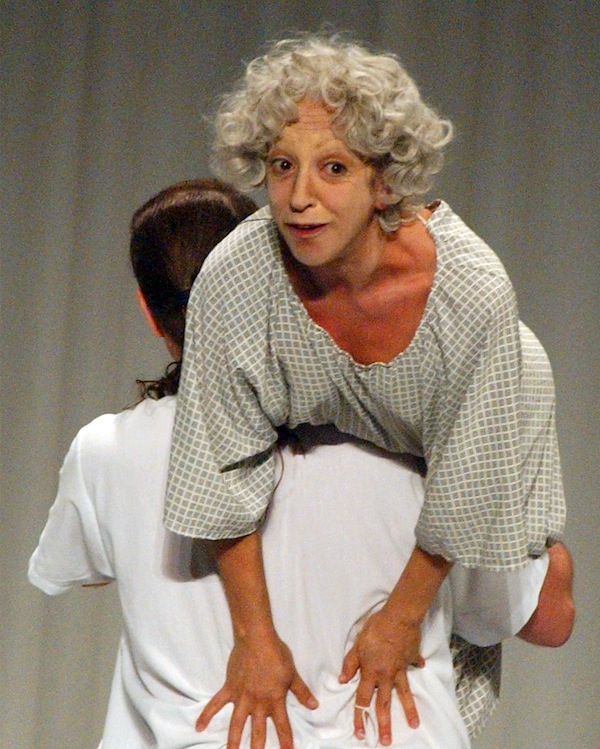
Dulcinea Langfelder, being carried by Eric Gingras, in Victoria, which is at Massey Theatre for two shows only next week. (photo from Dulcinea Langfelder & Co.)

Victoria is coming to New Westminster next week for two shows only. Created and performed by Dulcinea Langfelder, a versatile dancer, multimedia performer and award-winning choreographer from Montreal, Victoria is about old age and young spirit, about laughter in the face of tragedy.

Langfelder started her life in New York. She studied ballet and pantomime, singing and acting. After a few years in Europe, including London and Paris, she moved to Montreal in 1978 to join La Troupe Omnibus. Since then, Montreal has been her home. In 1985, she founded her own company, Virtuous Circle Dance Theatre. In 1997, the company changed its name to Dulcinea Langfelder & Co.

Langfelder loves Montreal and can’t imagine living anywhere else. “The city is effervescent, young culturally compared to New York or Paris,” she said. “Fewer boundaries between categories, and close enough to New York to visit my mom. Why on earth would I want to live elsewhere?”

The same philosophy applies to her choreography and performing. Why on earth would she do anything else? “For the moment, I can still do what I love to do, and I believe that it’s important to see older people on stage. Art has always been the most effective way to influence our attitudes. Victoria gives voice to those who have ‘disappeared’ through aging – but we are still alive and kicking!”

Although it’s hard to pinpoint Victoria’s exact theatrical classification, Langfelder said, “It is a multidisciplinary and multimedia work for the stage. There really is no major discipline. I work with the elements on my palette: movement (I guess I do always put that one first), text, humour, dramatic – through line, projected imagery, music and a bit of puppetry. Everything is choreographed, not just the movement.”

The heroine, Victoria, is “a wheelchair-bound 90-year-old, suffering from the loss of memory, autonomy and just about everything else,” reads the press release. But Langfelder melds poignant and funny in this show of an elderly woman’s courage. Victoria premièred in 1999, and Langfelder told the Independent about its origins.

“In 1994, an actor friend of mine, Charles Fariala, who also worked as an orderly and knew that I have a penchant for tragicomedy, called me to say, ‘You must meet Victor, an old man in a wheelchair who’s lost his memory; sometimes I wonder if he’s just gaga or if he’s discovered Nirvana.’ I immediately responded, ‘We’ll call her Victoria!’ I was intrigued by the question: Where do we find our mental victory when we we’ve lost our physical power?”

Inspired by the concept, Fariala and Langfelder started working on the project. “Charles wrote pages of text, which I re-worked,” said Langfelder. “I also incorporated a lot of text that came from Angel Petrilli, a woman who became the principal model for the character, although there were other people as well, including my own father. But this piece is multidisciplinary and multimedia, so the ‘script’ is composed of text, choreography, song and projected imagery. It was written in concert with all of my collaborators; I created the choreography.”

One of the most unusual aspects of the show is that the protagonist is bound to her wheelchair. “It is hard to tame the wheelchair beast,” Langfelder admitted, “but fascinating for a mover!”

The show’s success and longevity – 18 years now – surprises even its creator. “I didn’t think it would fly at all, with such taboo subject matter,” she said. “But I discovered that audiences had been starving to have this conversation in a non-depressing way. While treating this subject as accurately as I can, Victoria is an uplifting piece, because there really are rich, poetic and hilarious moments when dealing with dementia and the end of life. We just underline those moments, without taking the subject matter lightly.”

Like every performer, Langfelder knows that art must change with time, that an actor should be flexible in her communication with different audiences. Victoria is no exception to this rule. “It changed a lot in the first years,” Langfelder explained, “then subtle changes. It adapted to different languages and cultures, though it clearly reminds us of what we have in common around the world. We’ve done this piece everywhere from Japan to Zimbabwe, in seven languages.”

One of the latest changes was adding another actress to play the title role. “I recently realized that this piece could live longer than I will,” said Langfelder. “I trained Anne Sabourin in the role. She plays Victoria in French.”

Langfelder herself plays Victoria in English in every show, in every country, and the reception has been overwhelmingly favourable, but that is not enough for the actress. “The Victoria project is about touring the piece for the general audience it was designed for,” she said. “Plus, we work hard to get those who can most benefit, and are the least likely to frequent the theatre: seniors and family/professional caregivers. The way we get them to the theatre, and Victoria can’t be done anywhere else, is that we go to them first. We offer workshops that answer their immediate needs, like non-verbal communication, movement for seniors and seminars on creativity, humour and dementia. Then we use the opportunity to make them understand that theatre can actually be useful, even more useful than workshops. We invite them to the theatre.”

Like her heroine, Langfelder meets her challenges with a smile. “I love making people laugh at difficult situations,” she said. “It makes me feel useful. My father’s last words to me, before his stroke, were in response to me complaining about my challenges. He said, ‘You mustn’t get discouraged, because what you do is so important! You put human dilemma on stage and allow us to laugh at it; what could be more important than that?’ I had just begun working on Victoria, and he never saw it. I become him when I play Victoria.”

Victoria is at the Massey Theatre in New Westminster on Oct. 27 and 28. For tickets, visit ticketsnw.ca or call 604-521-5050.

Olga Livshin is a Vancouver freelance writer. She can be reached at olgagodim@gmail.com.

“M” magicians will mystify

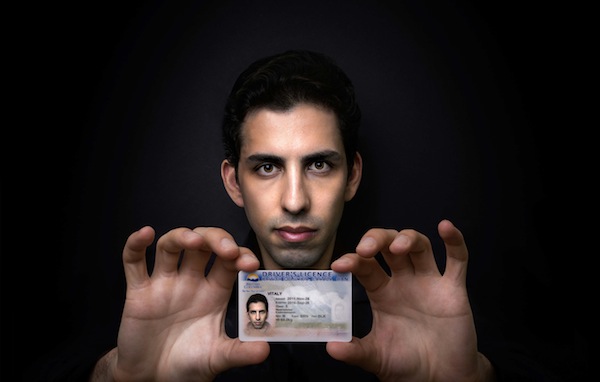
Illusionist Vitaly Beckman can make people’s images disappear from their driver’s licences. Beckman will take part in “M” – The Magic Show at Michael J. Fox Theatre Oct. 21. (photo from eveningofwonders.com)

Vitaly Beckman can make objects levitate. He can transport the image of a person in a photograph to another photograph. And he can predict the future. I know this because I’ve seen him do all those things, and more.

In 2014, the Jewish Independent participated with Beckman in what he would probably call an illusion, but what seemed magical to me. On March 21, 2014, at Havana restaurant, he locked his predictions of what the news would be a few weeks hence – and what I and co-witness Mia Zimmerman, a radio and TV host, would be wearing – in a small box. I held the key to the box, which remained chained up in public view at the restaurant. At Beckman’s April 10 show, the vast majority of his predictions were proven correct, including my and Zimmerman’s chosen outfits.

Beckman is a consummate performer, and his busy schedule and numerous accolades are proof of that. But the best proof is to see one of his shows. He uses humour and charm to involve as many audience members as possible, and even the shy among the crowds seem to want to join in, though many may not get the chance at his next show, just for its sheer size – and that he’ll be one of five performers.

At “M” – The Magic Show on Oct. 21 at Michael J. Fox Theatre, Beckman will be sharing the stage with four other acclaimed and award-winning magicians: Kel, Wes Barker and the team of Trevor and Lorena Watters. The promotional material assures “cutting-edge illusions, mystery, music, comedy, audience participation (you’ve been warned!) and precision sleight of hand.”

It’s not very often that there’s a performance of this magnitude, Beckman told the Independent. “We all have our own shows but this is the first time we have a chance to collaborate,” he said. “Each of us has a different style and it’s exciting to combine into one show.”

In addition to the illusions already mentioned, Beckman’s An Evening of Wonders show includes “Super Vision,” where he reads books and newspapers from a 50-feet away. He writes all of his material and has invented all of his tricks.

“The latest illusion involves turning back time, as an old branch becomes young and fresh again, while I become old,” he shared.

Beckman has been practising magic since the age of 14, when he was inspired, he said, “by a David Copperfield special and started performing for friends and family, and inventing my own illusions. I felt like magic brings out all of my strengths and talents and that I can express myself in the best possible way by creating and performing illusions, by bringing my imagination to life and sharing it with an audience.”

However, notes his bio, it would only be years later, that Beckman “would abandon a career in engineering to focus on rebuilding people’s childlike sense of wonder and bridging the gap between dreams and reality.”

“I am naturally an optimist but also a realist,” he told the Independent. “I believe in good news but also stay grounded. Every new idea I conceive seems impossible at first, but then I can find a way to achieve it. I think that makes me think that it can be true for anything and, with effort and imagination, anything is possible.”

Partial proceeds from “M” – The Magic Show will be donated to the YMCA; funds will go to helping people of all ages access community programs, including swimming, childcare and education. “M” starts at 8 p.m. on Oct. 21 and Michael J. Fox Theatre is at 7373 Macpherson Ave., in Burnaby. Tickets are $39 (plus tax and service charges) from vtixonline.com or 604-241-7292.

Magic to amaze and educate

Partial proceeds of Randy Charach’s Oct. 14 show at the Rothstein will be donated to the Canadian Mental Health Association. (photo from Randy Charach)

Anyone who has seen Randy Charach perform will swear he can read people’s minds. He certainly is attuned and sensitive to his audience, and those brave and lucky enough to become part of his high-energy, humour-filled show, which he will be bringing to the Rothstein Theatre Oct. 14, at 7 and 9 p.m.

“It has been five years since I’ve done a public show in Vancouver,” Charach told the Independent. “Most of my work is in the United States, as a corporate speaker and entertainer. The performances I’ll be doing at the Rothstein Theatre on Oct. 14th is my newest show. I’ll be blending my life’s work as a comedian, mentalist, magician and hypnotist. I’m looking forward to providing a memorable experience for my Vancouver audience.”

According to the press material, Charach has been entertaining people since he was 5 years old, “inspired by his uncle, a Las Vegas magician.” He has performed around the world, including on major television networks and even in film. A certified practitioner of neuro-linguistic programming and a certified hypnotist, Charach invites people to join him on stage: “As the excitement grows, the crowd watches in amazement as other audience members enter a hypnotic state and become stars of the show.”

“I love to amaze people,” said Charach about what he enjoys most about performing. “The art of magic has been a passion since childhood, and something I see as analogous to life. As a society, we constantly thrive to have our expectations met. When we are surprised, delighted and amazed, we often become elated. This feeling occurs in performance, in personal interactions and in business. When we surprise people, we become memorable.

“I write of this in my latest business growth book on Amazon, Client Centric,” he said. “I teach it in the book and at my corporate presentations, All Business is Show Business and All Life is Show Business. When we continue to amaze others by exceeding their expectations, it’s not magic, but it works like magic. This is an example of how art imitates life and my analogy of how magic is present in all our lives.

“Performing magic has evolved for me to the point where I have taken my interpretation of the art to a new level. While on stage, I am in a heightened state of consciousness, which I am unable to replicate any other way. Magic is present in every aspect of my life, and it pleases me to share it during my performances.”

Despite this love of entertaining, Charach said there were years when he didn’t perform at all.

“My decision to return to the stage,” he said, “was made at a group event hosted by Rabbi Yechiel Baitelman of Chabad in Richmond. The rabbi stated we must share our talent with others. It was at that moment I looked at my wife Chana and said I would be performing again. I suppose it’s in my blood. Entertaining and educating is part of my life’s purpose.”

Partial proceeds of the Oct. 14 show will be donated to the Canadian Mental Health Association.

“Mental illness is prevalent in our society, and I don’t feel this condition receives the attention it requires,” said Charach. “I’ve personally dealt with depression over the years, and am aware I am not alone. I do my best to raise awareness and plan to do more. I hope the stereotypes, prejudice and discrimination stop.”

For more information, videos and to reserve your seats at one (or both) of the Oct. 14 shows at the Rothstein, visit randytickets.com or call 1-800-838-3006. Tickets are $36 (plus service charge).

Relatable dysfunction

The Beacham family. Back row, left to right: Seth Little as Guy, Nick Beacham’s partner; Jordon Navratil as Nick; Mia Ingimundson as Norris Beacham, the daughter; and Chris Walters as Kevin, Norris’ husband. Seated are Howard Siegel as the patriarch of the family, Glen, and Anna Hagan as the matriarch, Bonnie. (photo by Ellie O’Day)

Homeward Bound by Elliott Hayes is about death and relationships. And family dynamics. Jewish community member Howard Siegel plays the father, Glen Beacham, in Western Gold Theatre’s production that opens today, Oct. 6, and runs until Oct. 29 at Pal Studio Theatre.

Set in 1990, Glen and Bonnie Beacham have invited their adult children (a son and a daughter) and their respective partners for dinner – and an announcement, publicist and Jewish community member Ellie O’Day told the Independent. Homeward Bound “is a dark comedy,” she said, “but also plays with the ways we talk to each other but don’t always really listen.”

“Every family has a time when they get together. Ours was Shabbat,” said Siegel. “No matter where we were or how busy our week was we had to be home Friday for dinner. We ate at the dining room table instead of our usual place in the kitchen, and talked, or argued, but that was our family time. If there was chicken soup, we were having roast chicken; if it was vegetable soup, it was brisket. While the Beachams are getting together on a Sunday and it may not be as regular as my childhood was, dinner with the family is no less important and the news of the week is going to change all their lives.”

Of the plot, O’Day added, “Dad, who happily distracts himself with crossword puzzles, is apparently not well…. Mother distracts herself by constant chatter (where will they go on their next holiday? Dad is totally noncommittal)…. Meanwhile, the gay son’s partner is late for this Sunday dinner … and the daughter is trying unsuccessfully to hide the deterioration of her marriage.”

Siegel described the character of Glen as a “glib, funny, highly educated” man who “has provided a substantial middle-class standard of living for his family.” He said, “My father aspired to these qualities, but it was his struggle, so I wasn’t able to model Glen after my dad. However, finding the love for his family that perhaps isn’t so clear in the text is important to me and to the play. That was very apparent in my experience in my parents’ home.”

He added about the Beachams, “This is a family like so many families we know or grew up in. The parents have to accept choices their children make whether they like or understand them; they accept them out of love and perhaps duty. The kids bicker, but would defend their sibling to anyone if push came to shove. Deep in this family’s dysfunction is a connection that we all should be able to understand.”

Homeward Bound runs Oct. 6-29, Tuesday-Saturday, 7:30 p.m.; Saturday-Sunday, 2 p.m.; and Oct. 19, 2 p.m., at Pal Studio Theatre, 581 Cardero St. Tickets are $32/$27 from 604-363-5734 or homeward. brownpapertickets.com.

Poetry inspired by abstract art

On Sept. 25, a group of writers gathered to write and share poems sparked by the paintings of Waldemar Smolarek, now on display at Zack Gallery. (photo by Olga Livshin)

Poetry events at the Sidney and Gertrude Zack Gallery have become a regular feature in the last few years. Every couple of months, writers of Pandora’s Collective meet at the gallery to read their poems inspired by the art. They held their latest gathering on Sept. 25.

The abstract paintings currently on display at the Zack seem to have been created to inspire poetry. Waldemar Smolarek’s work is known to gallery patrons. Smolarek’s first show at the Zack, in 2012, was posthumous – he died in 2010 – but his art is alive, infused with vibrant colours and the artist’s unique frenetic energy.

Smolarek, a proponent of purely abstract compositions, filled his canvasses with dynamic currents. His lines, in every imaginable hue, fly like arrows. His multicoloured balls dance like polka dots. His vivid splashes of blue and peach flow into each other, seemingly at random, but there is logic in the twists and turns of the artist’s brush. His art invites people to delve into their own psyche, and the poets of the evening responded to the paintings’ visual challenge with a wide variety of works: long and short, light-hearted and lamenting. Some poems were inspired by one specific painting, while other rhyming flights of fancy encompassed the entire gallery.

As the event was a collaboration between the Zack Gallery and the Isaac Waldman Jewish Public Library, Helen Pinsky, the head librarian, gave a short introduction before passing the microphone to Leanne Boschman, the host of the evening.

Although it was her first time as host, Boschman has participated in the Zack Gallery poetry evenings twice before. “The first time, the exhibition included the artist’s journal and sketches, and I found it fascinating to see the artistic journey in progress,” she told the Independent. “The second time, it was a show of abstract photographs…. I like abstract art in connection to my poetry. I can play loosely with colours and shapes and words. It’s harder when the art shows specific people or places. With abstract art, the poet is free to follow her own associations. Sometimes, it’s a story; sometimes, a feeling or a question.”

Most of the participating poets agreed with her assessment, and Smolarek’s art was a rich source for many pieces. The audience, although not large, was extremely generous in support of anyone at the mic, both the listed readers and the brave volunteers who took part in the open mic portion of the event. The friendly atmosphere, combined with the bright paintings and Boschman’s humorous but factual introductions of every reader, made the evening a joyful celebration of colours and words.

The first poet who read, Suzy Malcolm, has been writing poetry since she was a teenager. “It’s my fifth time at the Zack,” she said. “I prefer abstract art for my poetry. It feels like a gift to write about colours and shapes.” She writes poetry for children as well as adults, and her poems at this event reflected both sides of her poetic endeavours.

Eva Waldauf, the next reader, started writing poetry when she was around 40. “I’m a visual artist,” she said. “Once, I had to write a poem for a class, and I liked it. I thought it was fun; thought, ‘I could do it,’ so I began writing poetry.” Her poems were not written on the spot. “I visited the gallery last week to see the paintings, so I would have time to write and edit my poems. I like to come prepared.” Although she admitted to always being nervous before reading her poems, one wouldn’t have guessed it from her performance. Her reading, relaxed and expressive, enhanced by expansive gestures, revealed a good actress as well as an original poet.

The next presenter, David Geary, staged his poems as letters to Smolarek. His presentation was comical. As if playing a game, he strode around the gallery and enrolled everyone in the audience and all the paintings as his willing and laughing playmates.

As a counterpoint to his irreverent show, Sita Carboni’s poetry resonated with mournful tunes. One of the co-founders of Pandora’s Collective, Carboni noted that, with art like Smolarek’s, a poet is free to explore in any direction. Her poetry, contemplative and deep, included a goodbye to someone she lost recently, and she couldn’t finish her reading because of the tears that choked her.

Warren Dean Fulton also prefers abstract art for his poetry. “Abstract art allows you to project your own feeling and emotions. It is speaking to your subconscious. The poet is much less free with portraits or landscape.”

Fulton has participated in the poetry readings at the Zack before. “It is interesting to hear how the same paintings could inspire such different interpretations,” he mused. As he likes to improvise with his poetry, he hadn’t seen Smolarek’s work before that evening.

The last poet of the night, Amanda Wardrop, is also an experienced writer and reader. A schoolteacher, Wardrop said she finds poetry everywhere: in her interactions with students, in figurative art and in abstract art. “Different poetry, that’s all,” she said. “Figurative art often results in a narrative, while abstract art pushes one to a more emotional response.” She did her research before coming to the reading that night, and her poetry touched on the artist’s technique: layers and textures, as they related to our lives.

The night concluded with a lively musical performance by Kempton Dexter, who played his guitar, sang and joked to the delight of the audience.

Olga Livshin is a Vancouver freelance writer. She can be reached at olgagodim@gmail.com.

***

Balls collide and come apart,
Lines zigzag and soar,
Feeding moxie to my heart
Fields awash with colour.

Reds and blues and greens explode
Shards and doodles frolic,
Polka dots in quirky mode,
Joyful and symbolic.

– Olga Livshin, inspired by the artwork of Waldemar Smolarek


Spotlight on the Sylvia

Advah Soudack and Anna-Mae Wiesenthal rehearse the song “Building a Dream” for Two Views from the Sylvia, which runs Nov. 8-12. (photo by Adam Abrams)

With the upcoming theatrical production of Two Views from the Sylvia, author Diana Stevan interviewed Sue Cohene, a founder of the show’s producers, Kol Halev Performance Society. The new play, based on the Sylvia Hotel, runs Nov. 8-12 at Waterfront Theatre on Granville Island.

DS: What inspired you to do the play?

SC: The answer is insanity.

DS: Tell me more about that. How did you get the idea?

SC: About five years ago, I was attending one of our monthly Jewish psychology network meetings. During our introductions, welcoming new attendees, I did a quick version of my background as a psychotherapist and the latest news about Kol Halev. After the introductions, Marsha Ablowitz, another psychotherapist, who I had known for many years, came up to me and said, “Do you want to do a story about my aunt?”

My response was, “Your aunt?”

She said, “Yes, my Aunt Sylvia.”

Not particularly keen, I replied, “Your Aunt Sylvia?”

“Yes, Aunt Sylvia of the Sylvia Hotel.”

I was hooked and said, “Tell me more.”

DS: So she told you the story of her aunt. Was there anything you were surprised about?

SC: Yes, but you have to come see the play to find out. But, I have to say, the Jewish Vancouver backstory is quite fascinating. I’ll tell you one tidbit. There was a connection between Sylvia Goldstein Ablowitz and another legendary Vancouver figure, Joe Fortes, the lifeguard at English Bay.

DS: Interesting. I’ve heard about him. I understand from the title of your play, that there are two views from the Sylvia. Can you tell me more about that?

SC: One view is from the outside, from English Bay, looking in; the other is from the inside, looking out. And those are just the literal views I’m talking about.

DS: I understand there’s some music. Is this a musical?

SC: We have two one-act plays. The first one, named Sylvia’s Hotel, is a musical about the building of the hotel by the family and the obstacles they found. The second one-act play, named The Hotel Sylvia, is a play with music, focusing on the period of time after the hotel was built.

DS: I heard that the Jewish Museum and Archives of British Columbia showed an interest.

SC: Yes, the Jewish Museum is one of our partners in this project. They will be presenting a historical photography exhibit at the theatre.

For tickets ($28) to Two Views from the Sylvia, visit kolhalev.ca or tickets.theatrewire.com.

Diana Stevan is a writer, who previously worked as a family therapist, teacher, model, actress and freelance writer broadcaster for CBC TV’s Sports Journal. Her novels – A Cry from the Deep, a romantic mystery/adventure, and The Rubber Fence, psychological fiction – and her coming-of-age novelette, The Blue Nightgown, draw on both her experience and imagination. This interview was published by Theatrewire.

Win free dance tickets!

Hasta Dónde…? is one of two works Compañía Sharon Fridman brings to Vancouver Oct. 12-14. (photo by Gerardo Sanz)

The work of Israeli choreographer Sharon Fridman comes to the West Coast for the first time, with a program featuring Hasta Dónde…? and All Ways. And Jewish Independent readers can win two tickets to the Oct. 14, 8 p.m., performance at Scotiabank Dance Centre – simply email editor@jewishindependent.ca by Wednesday, Oct. 4, 5 p.m., to be entered in a draw. The winner will be contacted.

Fridman has taken the dance world by storm since establishing his company in Spain in 2006: his athletic, adventurous work is rooted in contact improvisation, filtered through an innate musicality and an eye for design. Hasta Dónde…? explores the relationship between two dancers as it evolves through dependency, struggle and harmony. The endlessly fluid lifts and tumbles are propelled by a surging score. All Ways is a meditation on the multiple paths before us: seven dancers power through a physical and emotional spectrum, which ranges from fierce urgency to calm contemplation.

Hasta Dónde…? premièred in 2011 and has toured to more than 30 cities worldwide, receiving several prizes and audience awards. Fridman describes the work as: “A struggle between two sides, the inner sides we all somehow contain. How far can you transmit? How far can you pull or let yourself be pulled?.… No side is a winner.” All Ways is Fridman’s latest work, and it premièred in 2016. The company visits Halifax prior to Vancouver, in its first North American tour.

Fridman was a dancer with leading companies including the Tadmor Dance Company, the Vertigo Company and Kibbutz Contemporary Dance Company, before moving to Spain and forming Compañía Sharon Fridman in Madrid in 2006. His works have toured to countries including France, Italy, Germany, Belgium, the United Kingdom, the Netherlands, Colombia, South Korea and Singapore, receiving multiple awards. The work of the company is based on the language of contact improvisation, deconstructing and exploring the technique to create a dramatic language that evolves in the hands of the dancers. In addition to many works for the stage, Fridman has created large-scale, open-air, site-specific performances for as many as 70 participants. Fridman’s works are also in the repertoires of companies including Ballet Nacional de Paraguay, Vertigo Dance Company (Israel), Compagnie Jus de la Vie (Sweden) and Compañía Nacional de Danza (Spain).

Compañía Sharon Fridman’s performance is part of the Dance Centre’s Global Dance Connections series. There are shows Oct. 12-14, 8 p.m., at the centre, with a post-show talkback Oct. 13. For tickets ($32/$24), call 604-684-2787 or visit ticketstonight.ca. For a chance to win two free Oct. 14 tickets, email editor@jewishindependent.ca.

Bar mitzvah is musical’s hook

Clockwise from the top: Jason Sakaki (Brett), Julia Mclean (Patrice), Graham Verchere (Evan), Julian Lokash (Archie), Emma Leblanc (ensemble) and Rachel Valentina (ensemble). (photo by Anita Alberto)

Jason Robert Brown’s 13: The Musical, a show that centres around the bar mitzvah of its young hero, Evan Goldman, will première in Vancouver on Sept. 28, presented by Bring On Tomorrow Co.

Concerned both with authenticity and sensitivity with regards to the show’s Jewish content, director Chris Adams invited Congregation Beth Israel Rabbi Adam Stein to meet with the cast and crew after a rehearsal Aug. 29. The Jewish Independent was invited to attend.

13 was the first-ever Broadway show to feature an all-teenage cast when it debuted in 2008. The cast of the local production is an accomplished team of professional young actors who have appeared on such networks as ABC, NBC, CBC, Disney and FX. They were dynamic, cheerful and attentive throughout Stein’s visit, laughing at his jokes and making a few of their own as well. The rabbi, who himself has a background in theatre, seemed right at home.

The musical follows 12-year-old Evan Goldman, a Jewish kid from New York who moves to a small town in Indiana after his parents’ divorce. A fish out of water, the story details his struggle to adapt to his new community and make friends, with a key plot point centring around him trying to get the cool kids to come to his bar mitzvah, and the rite of passage that results as Evan’s perspective matures.

Stein explained the meaning of the bar mitzvah ritual to the cast, saying that the passage into adult moral responsibility is at its core. He also described some of the details of the synagogue ceremony. In 13, Goldman is heard singing one line of his Haftarah and Stein explained its meaning and checked the trope in the script, which was correct.

The rabbi also explained the meaning of the tallit and tefillin the bar mitzvah boy would begin wearing, and advised the cast about how the tallitot in the show should be handled – for starters, don’t hold them by the tzitzit (fringes). They also discussed how to stage and choreograph the synagogue scene, and debated how to costume the actors who appear in a dancing rabbis scene. Stein helped the cast imagine the layout of a synagogue, and suggested that having all the rabbis look like Chassidim would be stereotyping.

13: The Musical was penned by young adult novelist Dan Elish with TV producer and writer Robert Horn. Starring as Evan is Graham Verchere, 15, whose recent credits include Theatre in the Raw’s The Raymur Mothers and Arts Club Theatre’s A Christmas Story. Graham is a regular on the FX series Fargo and will appear in ABC’s The Good Doctor, which premières Sept. 25.

The Bring On Tomorrow cast also includes Jewish community member Julian Lokash, who just had his own bar mitzvah 15 months ago. “I first heard about the play at my own bar mitzvah,” Julian told the Jewish Independent. “Friends of mine who were there are now in the cast for this production.”

Asked if he played an ambassadorial role as the only Jewish actor in the play, Julian said he wouldn’t quite say that, but he did feel called to a certain degree of leadership. “Everyone turned to me when they had a question,” he admitted.

Julian’s acting credits include Theatre Under the Stars’ Shrek, Oliver! and Beauty and the Beast; the lead role of James in Carousel Theatre for Young People’s James and the Giant Peach; and roles in Gateway Theatre’s Music Man and Famous Artists Ltd.’s Mrs. Claus’ Kitchen.

13 director Adams is joined by vocalist Monique Creber as musical director. The production company, Bring On Tomorrow Co., is a collective of artists founded in 2016. The group “aims to assemble the city’s brightest professional theatre talent with award-winning musical artists to mount productions monumental in scale, energy and sound.”

Asked why Bring On Tomorrow was inspired to produce this show, Adams told the JI that it was all based “around the kids.”

“We knew we had the talent out there to present this show,” he said. “We wanted to give these professionals an opportunity to be leads…. Often kids in this city play the ‘kids’ roles. Well, in 13, every role is made for kids. They have to step it up because there isn’t a cast of professional adults driving their own show. It really is a wonderful challenge and something that a lot of them don’t get to experience every day.”

13 runs Sept. 28-Oct. 1 and Oct. 4-8 at the Waterfront Theatre. For tickets and more information, visit bringontomorrowco.com.

Matthew Gindin is a freelance journalist, writer and lecturer. He writes regularly for the Forward and All That Is Interesting, and has been published in Religion Dispatches, Situate Magazine, Tikkun and elsewhere. He can be found on Medium and Twitter.

What does future hold?

Jewish community member mia amir is the dramaturg of Wypsa, which is at the Fringe Festival until Sept. 16.

While the plot of Wyspa may bring to mind William Golding’s Lord of the Flies, the book was not a direct inspiration for this work, co-writer and director Julia Siedlanowska told the Independent.

The creation of the play, which opened at the Vancouver Fringe Festival Sept. 7, began with the reading and discussion of an original story written by Siedlanowska and Kanon Hewitt.

“Our team includes five collaborators between the ages of 11 and 16,” said Siedlanowska. “They have all been involved directly in the creation of this piece through world-building, research, writing text, improvisation, creating soundscapes, costumes and props. They are all also performing in the piece.”

Siedlanowska and Kanon’s story “tells the tale of a walled-in community that has sustained itself through oil extraction for centuries,” Siedlanowska explained. “When fires start raging within the walls, the mothers of the community make the decision to send their children away through the only opening to the outside world – an opening to the ocean.

“After days of drifting, they finally arrive on an island. Here, they must decide whether they will live by the rigid rules of their old society or create their own.

“We separated the experience into three worlds,” she continued. “The home world, the world of the boat and the world of the island. From there, we collectively decided the specific circumstances of each of these, including what rules apply in the home world and the island world. The youth created their own characters and decided on each of their relationships to each other. Text and movement were all generated by the collaborators, with myself and Kanon making decisions about the show structure with the help of our dramaturg mia amir. There are some improvisational aspects – much of the show takes place within an improvised structure with scenes changing depending on the audience.”

The end result came from research of instances in which children were removed from their homes during the Second World War, said Siedlanowska, “including Japan after the Tokyo bombings and the Kindertransport of Jewish children in Europe, as well as the Sixties Scoop in Canada.

“One piece of literature that I did directly mention in the initial phases of brainstorming was the story of King Matt the First, written by Polish-Jewish playwright Janusz Korczak. Korczak ran an orphanage in Second World War Poland. He was a pedagogue, writer and children’s rights activist. The orphanage was called Our House, and the children living there published their own newspaper and held their own court when conflicts arose among them. King Matt the First was about a child who becomes king, and what might happen if children were rulers.”

However, the idea of the story first arose, she said, “from questions around the rise in domestic violence in Alberta as a result of the economic downturn and job loss in the oil and gas industry. This violence is predominantly towards women.

“This then led to questions around how raising youth within rigid gender identities might enforce these patterns of violence. Instead of writing what we think youth might have to say about these themes, we decided to ask directly. In relation to climate change, we also wanted to ask the question, how do we – as an adult audience – react to dialogue around the climate crisis when those who will inherit the planet stand directly in front of us?”

Wyspa is being presented as part of Generation Hot, a mentorship initiative of the Only Animal and the Fringe Festival, which presents the work of seven writer-directors between the ages of 17 and 24. This year’s program is called Waterborne. “Each participant has found a personal response to a chosen site on Granville Island and the theme of water,” explains the press release. “Two programs of these short works will run in rep during the 2017 Vancouver Fringe Festival…. Wyspa is paired with Citlali: A Fantastic Tale About Water by a Mexican Poet by Brenda Muñoz.”

Wyspa runs Sept. 8, 10, 13-14 and 16, 8 p.m., at Ron Basford Park on Granville Island. For tickets ($12) and the full Fringe schedule, visit vancouverfringe.com.

Dramatic Fringe work

Jewish community membersGina Leon and Michael Germant co-star in Island Productions’ presentation of Gruesome Playground Injuries at the Vancouver Fringe Festival Sept. 8-17. (photo by Jayme Cowley)

Playwright Rajiv Joseph describes Gruesome Playground Injuries as being “about missed love, it’s about pain and regret. These are things that almost everyone in humanity has some experience with.”

Jewish community member Michael Germant, who co-stars in Island Productions’ presentation of Gruesome at the Vancouver Fringe Festival with fellow community member Gina Leon, also highlights the universal elements of Joseph’s play.

“Everyone has either wanted to be in, or has been in, or has come out of a relationship, therefore, there is something for everyone to relate to,” Germant told the Independent. “The show is rich in humour, empathy and tenderness. Internal and external pain are a measure of everything vulnerable when it comes to intimacy, timing and love.”

Gruesome Playground Injuries is part of the Fringe’s Dramatic Works Series celebrating playwrights of Asian descent. Germant said that he and Leon – who together produced and performed the play A Weekend Near Madison in the 2015 Fringe’s Dramatic Works Series – “had read Gruesome Playground Injuries a few years ago and I think it’s always been in the back of our minds to do it one day, and so this turned out to be the perfect opportunity.”

The press material calls the play “a harrowing and humorous story about love.” The description reads, “Over the course of 30 years, the lives of Kayleen and Doug intersect at the most bizarre intervals, leading the two childhood friends to compare scars and the physical calamities that keep drawing them together.”

It seems like pretty heavy fare for the Fringe, or is it?

“The foundation of the Fringe usually is to do experimental and challenging work,” said Germant. “Gruesome Playground Injuries’ non-linear structure, raw subject matter, and bloody and bruised characters – both figuratively and literally – we feel are representative of the aims of the festival. We chose the play because of the way we felt about this unique perspective of a love relationship. The play is realized through humour and drama.”

The humour, which is dark, “is expressed through the naivety of the characters and the comedy of misconnection,” he said.

In his remarks on Island Productions’ website, director Mel Tuck notes that the play “demanded much from the actors.”

“The demands of the play are numerous, reconnecting with a prism of memories,” Leon told the Independent. “What’s it like to be a child, a teenager, a young adult; how does one authentically play it? This part is close to the bone for me, and giving myself permission to be vulnerable – really vulnerable, and go to all the places I need to, to bring Kayleen to life – that’s scary and exciting.”

For Germant, “I’ve never experienced the physical injuries of Doug, but I do have emotional and psychological parallels. My challenge has been to open myself up to express these psychological and emotional injuries.”

Working on his character, said Germant, “has caused me to confront my own behaviour and address some of my foibles. I’ve learned to laugh at myself.”

Both Leon, who was born in Johannesburg, and Germant, who was born in Moscow, know what it is like to be an immigrant, to straddle more than one culture. They can relate to Gruesome’s theme of alienation.

“Growing up in Montreal as a Russian-Jewish immigrant, I realized very early how different and apart I was,” said Germant. “As such, I viscerally know alienation and separateness. Doug is experiencing being separate and alienated throughout the play – we play these characters from ages 8 to 38 – and he suffers from self-esteem issues because of it. He feels obligated to perform for approval, which, in his case, causes gruesome injuries.”

Gruesome Playground Injuries runs at the Cultch’s Vancity Culture Lab Theatre Sept. 8-17. For tickets ($14) and the whole Fringe lineup, visit vancouverfringe.com.