The Fringe is coming soon!

Seattle comedy couple Clayton Weller and Sophie Lowenstein are bringing Naturally to the festival. (photo from Amanda Smith)

Fear of death, making comedy and fighting prejudice are but a few of the topics Jewish community members will be exploring in their productions at this year’s Vancouver Fringe Festival, which runs Sept. 7-17.

Seattle comedy couple Sophie Lowenstein and Clayton Weller are bringing Naturally to the festival. It’s not one show, but two, with audiences deciding which they want to see: the one about grief, which also contains a dating scene, “the worst theatrical audition ever” and more; or the one about what sketch comedy is, how to make it – and why to bother making it.

“We have a variety of choosing activities at the top of the show, which culminates in the audience throwing paper airplanes at the stage for the show they’d most like to see. It’s going to be bonkers,” explained Weller. “As far as seeing both shows – how flattering would that be?! – the final two performances we’re locking in which show will happen.” So, Good Grief (Heart) will be on Sept. 14 and Understanding Sketch (Head) on Sept. 16; for the other performances, you’ll have to take your chances. Though, having seen them on video in preparing for this interview, it’s not much of a risk – both shows will have you laughing, and crying. There is a reason they dub Naturally “serious comedy.”

“As a duo, this has always pretty much been our style,” said Weller. “We’ve both done a bunch of plays, both serious and completely frivolous…. We thought that a laugh never feels as good as after you’re done crying. The contrast makes both the dark and light pop out more.”

“I would also say that we find a lot of beauty in that line between joy and pain because it’s not a very thick line. It’s blurred and sometimes nonexistent,” added Lowenstein, who is part of the Jewish community. “When you’re working with comedy, experiencing other emotions besides happiness while you laugh is sort of taboo – at least rare. We play in that playground. I think, individually, we are both curious about people’s emotions and we investigate them in our own ways, so we came together to run a joint study.”

According to the press material, Lowenstein and Weller have been performing comedy together for more than 12 years.

“Sophie and I went to the same college, University of Puget Sound, and both got cast in our college sketch comedy group,” Weller told the Independent. “We performed in several shows before we actually started living together as roommates, then we started living together, with feelings and stuff. Humour and comedy definitely permeate every part of our lives. Lots of laughter keeps our hearts light.”

With the comedy group Ubiquitous They, the couple produced about 15 shows. However, said Weller, the group “is more of an alumni network at this point. Several members have moved on to work in L.A., or across the country. We produced really regularly from 2007 to 2014, but, for the most part, it’s more of a club that hangs out every couple of months, and goes, ‘Wow, it’s tough to be an adult, am I right?’”

For the past few years, Lowenstein and Weller have been focusing on their performances as a duo. “Basically, Naturally is the only comedy project Sophie and I do now,” said Weller. “We’ll do a variety show or small play here and there on our own, but, because our lives are so crazy, we’ve pared the work we do down and this is where we put our real artistic push. I’ve never made work I’m more proud of than what I’m currently making with Sophie. She’s awesome. (Secret: This is all just an excuse for me to hang out with her more!)”

“Other secret: I feel the same way about him,” added Lowenstein. “He makes this process happen.”

In addition to Naturally, Weller runs two performance venues – the Pocket Theatre and the Slate Theatre – and Lowenstein works as a nurse practitioner.

“I look at it like this: some NPs have kids and they can do it. I have theatre and I can do it,” said Lowenstein about balancing her careers. Her recipe for success? “Save as many of your nights for rehearsals as possible. Dinner no earlier than 10 p.m. most nights. Make sure the other member of your group does all the administrative stuff and keeps you motivated when you’re dragging your butt and snarling. And, if the project doesn’t give you deep joy, don’t do it.”

In one of the Naturally shows, Weller mentions that he once had a lucrative high-tech job that he gave up for comedy. Does he have any regrets?

“I started a company called Freak’n Genius in 2012,” he said. “We made animation software, and we raised over half a million dollars in financing. At first, I was working with cool creative people and helping them make awesome things – then we slowly turned into an iPhone app for tweens. I learned a ton, but I 100% do not regret leaving. I give about three hours a week’s worth for tweens. Not the 60 hours a week I was putting in. Artists are who I really care about!”

About how he became one, or at least got into comedy, Weller said he had terrible stage fright until eighth grade. “I decided I was tired of being scared, and did improv comedy. After the first laughing crowd, I got bit by the bug, and I’ve been doing it ever since. There’s no better way to make friends than to make art together. Our relationship is proof to the point! I’m super lucky.”

For her part, Sophie said she first got into comedy “by loving that feeling of making my friends laugh. So, I practised how to do that more and more. I also had very funny friends. Now, I’m friends with the funniest human I know, and he also has a heart and mind. Bonus. As for the theatre part, I started performing when I was a little kid then throughout school: musicals, Shakespeare, etc. Stuck with it.”

The couple has been doing Naturally for a couple of years now. “After every performance,” said Weller, “we can’t help but do the ‘Oh man, next time why don’t we blah blah blah.’ The script is never permanent, and every remounting of the material we go through a rewrite and punch up all the scripts. Also, finding new ways to fit it together is a whole other way to make the thing new for us. Mostly, we just like hanging out and this is a great excuse.” Lowenstein agreed.

Naturally runs Sept. 8-16, at various times, in the gym at False Creek Community Centre on Granville Island. The 55-minute show is rated 14+ for coarse language and sexual content. Running Sept. 7-17 at the Firehall Arts Centre, also at various times, is the Canadian première of Cry-Baby: The Musical!, which is being presented by Awkward Stage Productions. It, too, is rated 14+ for the same reasons.

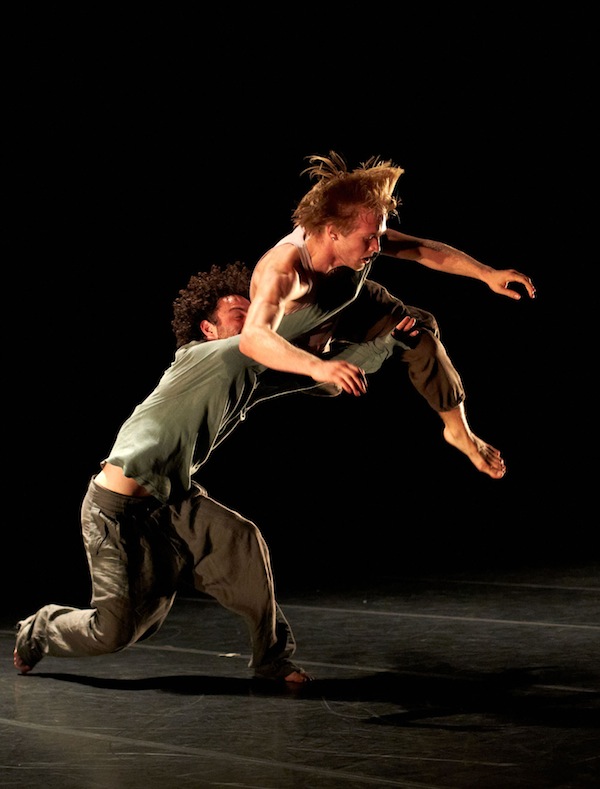
Jewish community member Erika Babins, who is artistic associate of Awkward Stage, choreographed the Fringe production, which features “a cast of 16 emerging artists” and runs 90 minutes.

photo - Erika Babins choreographed Awkward Stage’s production of Cry-Baby: The Musical!
Erika Babins choreographed Awkward Stage’s production of Cry-Baby: The Musical! (photo from Awkward Stage)

“It’s 1950s Baltimore, the conservative squares face off against the leather-clad delinquents in this rockabilly musical based on John Waters’ cult film,” reads the press release. The 2008 Broadway show was nominated for four Tony Awards, including best choreography, and won a Drama Desk Award for outstanding choreography. So, where does Babins begin?

“I start my choreographic process by obsessively listening to the music of the show so that it can live in my body,” Babins told the Independent. “Before we start rehearsals, I’ll meet with the director and we’ll talk through the shape of the show so that we know what purpose each song serves in the show, where we’re coming from and where we’re going, and how we’re going to get there.

“Then, when I get the cast in the room, I can take the story I know I’m going to tell and use them to tell it, using movement and music as my storytelling techniques. If I’m really stuck about how to tell a part of the story, I might look up a video or two on YouTube to see how a different company made something work, but I’m careful to only watch it once so that it only ever is for inspiration and I don’t accidentally steal something.”

Awkward Stage decided to mount Cry-Baby for several reasons. “Awkward has made a tradition out of presenting hilarious, and culturally relevant, full-scale musicals at the Fringe Festival,” said Babins. “Cry-Baby: The Musical came to us via artistic director Andy Toth. He brought it forward as a show that features a mostly young cast, great music and a lot of interesting and fleshed out female characters. Not only that, the messages in the show about systematic prejudices, classism and living your own truth so long as it’s not hurting anyone else, are still so relevant today.”

This is Awkward’s eighth musical at the Fringe Festival. “In that time,” noted Babins, “we’ve won three Pick-of-the-Fringe’s and the Joanna Maratta Award. We are committed to bridging the gap for emerging artists coming into the professional theatre scene in Vancouver and paying our artists for their efforts.”

For the full Fringe schedule and tickets ($14), visit vancouverfringe.com. (Note: a $5 Fringe membership is required for all shows.)

One of best TUTS seasons

Man in Chair (Shawn Macdonald) with the cast of The Drowsy Chaperone. (photo by Tim Matheson)

“Look, I know it’s not a perfect show: the spit-take scene is lame and the monkey motif is laboured. But none of that matters. It does what a musical is supposed to do: it takes you to another world, and it gives you a little tune to carry with you in your head. A little something to help you escape from the dreary horrors of the real world. A little something for when you’re feeling blue. You know?”

The irony of Man in Chair’s comments is that the spit-take scene and the monkey motif are hilarious in The Drowsy Chaperone and, for the lover of musicals, this parody is perfect. Or, as Mary Poppins would say, “practically perfect.”

Theatre Under the Stars is presenting both The Drowsy Chaperone and Mary Poppins this summer and, without a doubt, this is one of the best TUTS seasons yet. Both shows are excellent – the scripts, the acting, the sets, the music, the choreography, the directing, the costumes, the lighting, etc., etc. Both shows will take you to another world, escaping the real one for a few hours.

photo - Ranae Miller as Mary Poppins and Victor Hunter as Bert have a magical song and dance in the park
Ranae Miller as Mary Poppins and Victor Hunter as Bert have a magical song and dance in the park. (photo by Tim Matheson)

The season opened with Mary Poppins on July 11. I saw it a couple of days later and, while there were still some sound issues to be sorted out with individual actors’ microphones, the performance was spot on. Led by Victor Hunter as Bert the chimney sweep (artist, lamplighter and an assortment of other jobs) and Ranae Miller as the magical, stern-yet-loving nanny with great posture who puts all other nannies (and caregivers) to shame, the TUTS production is in more than capable hands. Both of these performers are fantastic actors and singers, and the rest of the cast matches their talent and energy.

Lola Marshall, 11, and Nolen Dubuc, 9, deserve a shout-out for their portrayals of Jane and Michael Banks, the two unruly children Mary Poppins ostensibly comes to help. But Mary arrives at their house on Cherry Tree Lane as much for their parents – their mother, a former actress who is having trouble adapting to life in high society, and their father, a banker whose work consumes him, neither of whom has time for their kids.

As The Drowsy Chaperone’s Man in Chair notes – he’s a wealth of pithy and astute observations – “Everything always works out in musicals,” and Mary Poppins is no exception. However, a lot of effort goes into making everything work out onstage and the TUTS team really added their own unique touch to both musicals.

For Mary Poppins, the Cherry Tree Lane house that Brian Ball built is like a huge Fisher Price toy that opens and closes to reveal the kids and Mary’s bedrooms on one side and the kitchen and dining room on the other, plus various hidden compartments. The other sets – that take the audience to the park and its statues that come alive, to a kitchen in which a broken table and shelves can fix themselves, and to the rooftops of London – invite the audience into Mary’s world. The starry nights and Mary’s flights elicit awe, not to mention the flying kites.

The choreography is also inspired, with the problem of how to have dancing penguins join Bert in “Jolly Holiday” smartly solved, with the crowd-pleasing flag-less semaphore in “Supercalifragilisticexpialidocious” that reaches a feverish pitch and the raucous rooftop tap-dancing in “Step in Time.” It was sometimes a wonder how music director and conductor Wendy Bross Stuart kept the cast and orchestra in sync, but she did.

While the energy slowed a bit as the musical neared its end – the child behind me wondered, with about two songs remaining, “How long is this musical?” – for the most part, director Shel Piercy has done a masterful job of pacing. He takes the audience on an emotional journey, with many laughs but also many touching moments. No one will be unmoved by Cecilia Smith’s performance (as Bird Woman) of “Feed the Birds” – the lessons of compassion and seeing beyond appearances that Mary teaches the Banks children are lessons we cannot learn often enough.

Joining Bross Stuart in this production are fellow Jewish community members Kat Palmer, as part of the talented and enthusiastic ensemble, and Andrea Minden in the orchestra. In The Drowsy Chaperone, community member Stefan Winfield plays Broadway producer Feldzieg, while his and wife (choreographer) Shelley Stewart Hunt’s 5-year-old son Wesley plays a couple of adorable, if superfluous, parts near the musical’s end in an over-the-top number that pokes fun at the extravagant finales of many musicals, not just Man in Chair’s favourite, The Drowsy Chaperone.

Having just come home to his rundown apartment, this lonely bachelor – played extremely well by Shawn Macdonald, as if the role was written for him – announces, “I hate theatre,” and proceeds to tell us why. It’s really current works that he dislikes; once upon a time, “you knew that when the show began you would be taken to another world, a world full of colour and music and glamour.”

“Remember?” he asks the audience of the (fictitious) “musical within a comedy,” as The Drowsy Chaperone is described. “Music by Julie Gable, lyrics by Sidney Stein. It’s a two-record set, re-mastered from the original recording made in 1928. It’s the full show with the original cast including Beatrice as the Chaperone. Isn’t she elegant? And this is a full 15 years before she became Dame Beatrice Stockwell. Can you believe it? Let me read to you what it says on the back – it says, ‘Mix-ups, mayhem and a gay wedding!’ Of course, the phrase gay wedding has a different meaning now, but back then it just meant fun. And that’s just what the show is – fun. Would you … would you indulge me? Would you let me play the record for you now? I was hoping you would say yes.”

And, with that, Man in Chair puts the record he has just unsleeved onto the player and, as the static sounds, he introduces us not only to his beloved musical but its actors and the era. Throughout the show, which he imagines (and that we can see) taking place in his apartment, he gives a running commentary, sharing a little about his life, factoids about the actors in the play and explanatory notes about certain scenes. He both extols the virtues of the musicals of the 1920s and exposes their weaknesses, including some poor writing – the aforementioned spit-take scene and monkey motif, as examples – and some not-so-subtle racism. An example of the latter is the incomparable first scene of Act 2 – Oriental Palace, Day – which the TUTS cast performs superbly.

Man in Chair’s dialogue is absolutely brilliant and Macdonald delivers it with such excitement, as if he – and not just his character – so wants you to love the musical as much as he does, despite its flaws. He seems to barely contain his joy when certain songs come up and when he just can’t stay in his chair and joins the dancing, it is almost contagious. (Though the incredible closeness of the rows at this year’s TUTS barely allows you to reach your seat, let alone get up and dance.)

As with Mary Poppins, there isn’t a weak link in The Drowsy Chaperone. The entire cast – leads and ensemble – bring everything they have to the stage, and it shows.

Ball’s set design once again amazes, as people pop in and out of almost anywhere, and Stewart Hunt’s dance numbers use every inch of the apartment’s kitchen and living room space. Music director and conductor Kevin Michael Cripps does double duty as the Chaperone’s bartender and director Gillian Barber delivers a fast-paced, larger-than-life contemporary musical that would even please Man in Chair.

Chris Sinosich was the costume designer for both The Drowsy Chaperone – which seems to have countless costume changes – and Mary Poppins. She is to be commended for the period dress in both, evoking the late-1920s and silliness of the former and the Edwardian period of the latter; as well as the stark contrasts, with Man in Chair obviously of a different era than his favourite musical and Mary Poppins’ colour-rich realm standing out from the darker, more sombre tones of the bankers’ reality.

While the Chaperone may stumble along, martini glass in hand, there is no stumbling in either TUTS production this year. See both if you can. They alternate nights, with Mary Poppins closing Aug. 18 and The Drowsy Chaperone Aug. 19. For tickets and more information, visit tuts.ca.

Modern-day Merchant

Warren Kimmel (Shylock), left, with Charlie Gallant (Bassanio) in Bard on the Beach’s Merchant of Venice. (photo by David Blue)

It is always hard as a Jew to watch Shakespeare’s Merchant of Venice, which has been characterized at one end of the spectrum as purely antisemitic and at the other as sympathetic to the plight of outsiders. Each vicious epithet hurled at Shylock, the Jewish protagonist, hits you in the gut like a ton of bricks. However, the play has to be considered in the context that Shakespeare likely had never even met a Jew.

Jews were expelled from England in 1290 and not invited back until the 1650s, by Oliver Cromwell. England was judenrein (“free of Jews”) for almost 400 years. Merchant was written between 1594 and 1599. How, then, could Shakespeare write such virulent diatribes against Jews? Was he influenced by the zeitgeist of his time or was he trying to preach a morality lesson to Elizabethan audiences? Bard on the Beach takes on the daunting task of presenting this “sinister parable of our times,” as director Nigel Shawn Williams calls it in his director’s notes.

The story revolves around Bassanio (Charlie Gallant), a Venetian lord and bankrupt fortune hunter, who needs 3,000 ducats (apparently close to three-quarters of a million in today’s dollars) to woo Belmont heiress Portia (Olivia Hutt) so that he can wed wealthily. His friend, Antonio (Edward Foy), a successful shipping merchant, urges him to borrow the sum from Shylock (Jewish community member Warren Kimmel) and agrees to stand surety for the loan. Shylock, who has been humiliated and abused by Antonio and his ilk, sees an opportunity for revenge and agrees to lend the money on the condition that if there is a default he gets a pound of Antonio’s flesh. Antonio’s ships run aground, he cannot repay the loan and Shylock demands his bond in a dramatic court room scene that includes the “Quality of Mercy” speech and, unfortunately, a not-so-happy ending for Shylock.

Fast-forward several centuries and enter cosmopolitan Venice as presented in Bard’s contemporary take on this play. It is a world inhabited by self-centred metrosexuals with a sense of entitlement, where money and power carry the day. These guys are not very nice and anyone who does not fit their worldview is an outsider deserving of contempt. The play opens with a frenetic scene as actors bustle to and fro. Shylock enters the melee, is tripped by Antonio and falls flat on his face amid the jeering crowd – a harbinger of what is to come.

I have seen all four of Bard’s productions of Merchant since it was first presented in 1996 – this one raises the bar, although there are some shaky bits along the way. While purists decry taking Shakespearean works out of period, putting Merchant in a contemporary business setting full of suits will resonate with audiences.

photo - Warren Kimmel is sublime in his dignified portrayal of Shylock in Bard on the Beach’s Merchant of Venice
Warren Kimmel is sublime in his dignified portrayal of Shylock in Bard on the Beach’s Merchant of Venice. (photo by David Blue)

Despite the fact that I cringed every time Shylock was spat upon or called a Jew dog, I was moved by Kimmel’s “Hath a Jew not eyes” soliloquy, his heartbreak on learning that his daughter Jessica (Carmela Sison) had eloped with gentile Lorenzo (Chirag Naik), his soulful rendition of the Kaddish and his isolation as he sat alone in the courtroom facing his antagonists. Kimmel is sublime in his dignified portrayal of Shylock. You really care about what happens to him.

While Antonio is the merchant of Venice and Shylock the victim, this Bard version is very much about Portia and her plight as a woman facing stereotypical and misogynistic restrictions. We first see this when she has to endure the indignity of being the prize (wife) in a game devised by her now-deceased father for three would-be suitors. Each has the chance to pick one of three caskets (gold, silver and lead) that contains her photograph. The first two, Prince of Morocco (Nadeem Phillip) and Prince of Aragon (Paul Moniz de Sa), are brilliant in their cameo roles. In other productions, they are played as buffoons. Here they are elegantly dressed but smarmy and unctuous and, thank goodness, ultimately unsuccessful in their casket choices. Then along comes Bassanio, who picks the right casket (“all that glimmers is not gold”) and wins fair lady.

Portia’s next trial is the real one, where she disguises herself as a young lawyer and listens carefully to Shylock’s pleas for justice. It is in this scene that Hutt truly shines as the quick-witted and resourceful heroine Shakespeare intended her to be.

As good as the production is, there are some problems. Many of the actors spend a lot of time yelling their lines, which is distracting. I was offended by the Nazi salute Solania (Kate Besworth) made when mocking Shylock. It adds nothing to the story and should be taken out. There is a short homoerotic scene between Bassanio and Antonio, including a full-on mouth-to-mouth kiss, that seemed out of place, and Shylock’s forced conversion to Christianity is played down – he is told he must convert and simply walks off the stage, leaving the audience to wonder what happened to the bankrupt and humiliated moneylender.

Production values are high, including some interesting freeze-frame moments. The stage is at floor level, making for a very intimate audience experience. The stark minimalist set allows the focus to be on the dialogue. High-tech gadgets like cellphones, laptops and iPads seamlessly fit into the mix, and Drew Facey’s stylishly chic costumes are structured and fitted for urban Venice, and softer and looser for coastal Belmont. Conor Moore’s projections, Adrian Muir’s lighting and Patrick Pennefather’s sound, a mélange of contemporary and classical music, provide the finishing touches.

This is an intelligent, moving production. See it, consider it, discuss it. Tickets for this and other Bard shows can be purchased at bardonthebeach.org or 604-739-0559.

Tova Kornfeld is a Vancouver freelance writer and lawyer.

***

Also on stage …

Running on the Main Stage at Bard on the Beach is Much Ado About Nothing with The Winter’s Tale. Director John Murphy has transported the comedy of Much Ado into a 1950s Italian film studio. Think Fellini, Sophia Loren, Vespas and fabulous cocktail dresses.

The story is boy meets girl, they profess to hate each other and then realize (with a little nudging from family and friends) that maybe they are right for each other. Of course, to get to the final epiphany, there are lots of misadventures, including mistaken identities, a young bride left at the altar and a faked death. As the program guide notes, “Friendships are tested, secrets are revealed but will love conquer all?” Amber Lewis and Kevin MacDonald are stellar as in the main roles of Beatrice (one of Shakespeare’s feistiest female characters) and Benedick. Community member Tara Cheyenne Friedenberg’s choreography is featured in this fun foray.

The Two Gentleman of Verona, which is on the Howard Family Stage, is also very good. Friedenberg choreographed some of the movement in this production as well, and her work is lovely. This production also stars a real dog, a basset hound named Gertie, who almost steals the show without doing anything but coming out on stage and mournfully looking at the audience.

– TK

Bittergirl is seriously funny

In Bittergirl, Cailin Stadnyk, Katrina Reynolds and Lauren Bowler play women who have just been dumped by their boyfriends – maybe they can get back their men if they lose some weight? (photo by Emily Cooper)

Have you ever taken part in an aerobics class and wondered how many of the women in it were trying to lose weight to get a boyfriend back? The sad truth is, there are probably many, eagerly trying anything to return to the way things were, even if the way things were wasn’t all that great.

Bittergirl: The Musical takes aim at countless breakup truisms from the perspectives of three different women, reminiscent of the sharp wit in Mom’s the Word and the relationship charades of Sex in the City. Their varied responses to being dumped are hilariously insightful.

The progress of the play loosely follows the five stages of death: denial, anger, bargaining, depression and acceptance. The stages of the breakups are denial (he made a mistake), second-guessing (I could have done something differently), manipulation (I’m going to make him love me), reflection (I should have seen the warning signs) and acceptance (I’m over him, I’ve moved on).

The three women – played by Lauren Bowler, Katrina Reynolds and Cailin Stadnyk – are known only as A, B and C, as though these trials and tribulations are those that belong to every woman, not a specific person. Jewish community member Josh Epstein plays D, all three of the dumpers – the husband who wants to join the RCMP, the live-in partner who just “has to go” and the boyfriend who’s lost his “magic.”

Epstein delivers the stereotypical reasons why he needs to get out of each relationship: “I feel trapped,” “I can’t give you what you want” and the ridiculous “We’ve got to be birds flying higher.”

The lame rationales elicit howls of laughter at the familiarity, especially when one of the women initially thinks that the “talk” her boyfriend wants to have will lead to a proposal.

Not surprisingly, the women stand there, stunned into silence, not demanding further explanation, but meekly mumbling things like, “I understand,” even though they don’t – another conventional reaction it is sadly not surprising to see depicted.

After their men leave, the women think about what they might have done differently to save their relationships – “Maybe if I wore plum eyeshadow,” “Maybe if I didn’t talk to my mother so much” and “Maybe if I worked out more.” This last statement segues into an hysterical scene of the three women working out with various gizmos and in different types of classes in a desperate bid to get in shape and win back their men.

photo - Katrina Reynolds and Josh Epstein in Bittergirl, at the Arts Club Granville Island Stage until July 29
Katrina Reynolds and Josh Epstein in Bittergirl, at the Arts Club Granville Island Stage until July 29. (photo by Emily Cooper)

The women also reflect on the warnings signs they missed. He wears socks with sandals. He cries at Celine Dion songs. He growls during sex.

Especially comical is a scene where the women run into friends and they are forced to admit they were dumped. The standard, “You’re better off without him” or “If you guys couldn’t make it work, what chance do the rest of us have?” hit the mark on how insensitive people can be, much to the enjoyment of the audience. The rapid-fire delivery of the lines, the women playing off each other brilliantly, is a sight to see and hear.

As the musical progresses, classic girl-group songs of the 1960s and ’70s complement the dialogue. Thinking about their first dates leads into “And Then He Kissed Me.” The initial breakups prompt a rendition of “Mama Said There’d Be Days Like This.” When the women hope they’ll have a chance to renew the relationship, they sing “When Will I See You Again?” And who hasn’t felt the difficulty of moving on because there’s “Always Something There to Remind Me”?

The strength of the play is in how the writing spotlights those moments we all know so well and that sound so absurd when depicted one after the other. Being reminded of one’s own failed relationships, watching the play is like watching a good comedian – often funny and, despite being cringeworthy at times, you want to stay to the finale.

As with the different stages of death, the women finally accept their situations and move on with their lives, singing such lyrics as “you don’t really love me; you just keep me hanging on,” there are “too many fish in the sea” and “I will survive.”

Bittergirl is actually an autobiographical play written by three Toronto actresses who had, indeed, just gotten dumped by a husband, live-in boyfriend and short-term partner. The positive reaction to the play led to the 2005 book Bittergirl: Getting Over Getting Dumped. After that, the writers added the songs, accompanied by an all-female band onstage, and the musical was born.

Besides the sharp, insightful writing, these women (and Epstein) can all belt out a tune, making the performance a hit from the beginning to the (not so) bitter end.

Bittergirl runs at the Arts Club Granville Island Stage until July 29. For tickets and more information, visit artsclub.com.

Baila Lazarus is Vancouver-based writer and principal media strategist at phase2coaching.com.

DOTE dances across the street

LINK Dance Foundation will perform Why did the Chicken Cross the Road? at a few intersections in Vancouver during Dancing on the Edge. (photo from DOTE)

As part of this year’s Dancing on the Edge festival, which takes place July 6-15, LINK Dance Foundation will explore the age-old question, “Why did the chicken cross the road?”

“The idea for Why did the Chicken Cross the Road? came about through various stages, like all things do,” said Gail Lotenberg, founding artistic director of LINK. “The germination to the actual realization was a process and it is still in development for the future.”

DOTE producer Donna Spencer invited Lotenberg to be involved in this year’s festival with a specific piece, but the timing wasn’t right. “So, I told her I had another idea for this year if she was open to it. We had a meeting and together we cooked up this piece,” said Lotenberg.

Leading up to the 2013 provincial election, she said, “I wanted to help attract young people to exercise their right to vote, so I spearheaded a dance performance at the intersection of Davie Street and Granville Street with signage from Rock the Vote BC.

“The dance did not deliver overt messages about voting (though there were subtle motifs in the choreography), rather it aimed to stop people in their daily lives to enjoy viewing a quick dance by an ensemble of dancers as they crossed a busy intersection. We had people stationed at the corners to hand out pamphlets with more specific information about voting day.”

The concept was introduced to Lotenberg in 2005 by a “close friend and colleague, Cara Siu, who came to Whitehorse, Yukon, when I used to live there. At that time, I was producing an annual festival called Dancing in the Streets. She came from Vancouver to make a dance at the intersection of two main streets in Whitehorse as part of the week of outdoor dance performances. I loved the idea and always knew I would use it again.”

For the 2017 incarnation, Lotenberg said she wanted to “include a large pool of less-well-known dancers in the community in a site-based work at intersections” and Spencer was all for it.

“In fact,” said Lotenberg, “it was her idea to involve young dancers from pre-professional training programs in the project. She also saw the benefit of having DOTE volunteers on the corners to provide more information to people about other shows they could see during the annual summer festival. Donna really helped to make the idea crystallize into what it is now, a work for eight dancers – mostly young dancers in the final stages of their training with the exception of two professionals. The two dancers who would normally be considered out of their training stage … will perform my core idea of a duet between pieces of white cloth to complete the show.”

Lotenberg, however, won’t be performing. “I will not be dancing in this work,” she said, “unless I’m wearing a chicken costume.”

She hopes “Intersection Interventions” will become “an annual part of DOTE, in the way Dusk Dances were a signature aspect of the festival for almost a decade.”

She said, “I believe in public art. I see myself as someone who evolved from the same fabric as the public frivolity movement of the 1990s – Unsilent Night, flashmobs, etc. These are acts of art that enhance our civic arena.

“I like art that engages people in community and invites people briefly into the humanizing experience of co-creating art. I don’t like art that does this by ignoring the principles of composition and virtuosity and esthetics, meaning they are inclusive but not very entertaining. So, I strive to find the duality that makes work provocative and pleasing to view, while at the same time offering some type of invitation to be an active rather than a passive participant.”

From 2008 to 2012, Lotenberg was an associated artist with Simon Fraser University’s Centre for Dialogue. The academic director of the centre then, Mark Winston, supported many of her endeavours, she said, “because he saw my work as a model for how to employ art as part of public engagement and how to construe social engagement as fertile soil for making art. I am grateful to Mark for that period of cross-pollination of ideas and expertise. He, too, is a Jewish person and together we mined the depths of what it meant to be Jewish and engaged in our mutual professions, he as a scientist and director of the CFD, me as a dance artist and director of a dance company.”

She said, “When I was a younger artist, there was a hierarchy in my mind that put work onstage above public-engaged art practice. Then I met Liz Lerman, a famous populist choreographer from the U.S., and I shifted my perspective to a less hierarchical model.

“I love seeing how dance can enter the public domain and engage people in something that lives between the opposing ends of a spectrum. On the one hand, you have pure social dancing that is non-performative but fully inclusive and, on the other end, you have very formal dance performance, which occurs on a stage with no apparent involvement from the audience except as witness. I love the in-between.”

Over the course of her dance performance and choreography career, Lotenberg has created many works that combine dance and activism.

“I’m a political person,” she said. “I grew up that way. As a Jewish person, I was taught to think in terms of how I could contribute to making the world a better place. I use my attributes as a choreographer to bring people together in a way that feels beautiful or powerful or profound or just fun.

“Take the Occupy Movement, for instance. I see something like that and I think, ‘Oh, imagine how easy it would be to occupy more space by getting people to not just stand around and chant but rather to do a square dance, which inherently takes up a lot more space.’ In occupying space with a square dance, people are using dance politically and the results are varied. People are having more fun. Authorities may not feel so threatened because the impulse is to relish life, not to be destructive, which is true of most political movements that are not hate-based. So, dance for me is an interface between the institutions we hope to shift and the people who are trying to have sway in shifting those institutions.”

Being Jewish has informed Lotenberg’s way of engaging with the world in various ways.

She said, “Being Jewish made me a political person and that feeds an aspect of my choreographic interests…. Being Jewish also surrounded me with people who embrace ritual and ritual is an important aspect of art. Being Jewish led to many opportunities to be in community through song and dance, and there is nothing more uplifting than that. In fact, I would say that these acts of sharing voice and song are what do connect me to my spirituality.

“And finally, I grew up as a New York Jew and my parents were very involved in the Civil Rights Movement of the 1960s. We moved to a town that was emerging as a leader in desegregation of schools, so I went to a school right from Grade 1 that was racially mixed.”

Lotenberg earned her bachelor’s degree at University of Michigan, was a dance teacher and skier in Crested Butte, Colo., for about five years and then did her master’s degree in history at University of Washington. In Seattle, she said, “I met a Vancouver boy, graduated, sold everything, moved here and then, within a year, we left for the Yukon.”

While Yukon was home from 1993, Lotenberg returned to Vancouver often for dancing. In 2007, she and her family moved to Bowen Island – “bad for my dancing career but otherwise wonderful,” she said.

Lotenberg took an approximately three-year break from dancing to be more present for her daughter, who has a learning disability, she said. “She’s good now. She’s strong and knows how to self-advocate for learning support that allows her to perform well in school. And, she basically is my happy place. But, I missed dance and being with other dancers – people who see and sense the world through a different lens.

“I feel gratitude at the opportunity to re-enter the dance milieu from the place I am today. I am grounded; I have a good job as a pilates instructor; I want to have my work seen and appreciated but that desire does not define me anymore. I am eager to share my work, but I feel strong and I feel confident and I trust that my work is valuable because it is honest and well-crafted and unique.”

Lotenberg is in the midst of developing a new stage work for next year’s DOTE in which she will be dancing.

“It is a piece I am challenging myself to take on because it feels important for me to step back into the dancing body to tell my story in a real and vulnerable way,” she said. “In fact, the application to show this work I’m describing is what actually led to having Why did the Chicken Cross the Road? happen at this year’s festival. Life is a beautiful journey that way. You sow seeds but you don’t always know how they will bear fruit.”

The promotional material for Why did the Chicken Cross the Road? asks the question, “Rather than walk, why not dance to get to the other side?” What can be gained from dancing, even if only across the street?

“Dancing is liberating,” said Lotenberg. “Dancing is frivolity and elemental connection (at the same time). Dancing is one of the first forms of art and, in some cultures, it is the glue that defines who they are, how they touch the earth with their feet and what is the rhythm of their heartbeat.

“I tried to leave dance and choreography to become a better mother. I did become a better mother but I also realized in that period that dance is essential to who I am.

“Dancing across the street,” she said, “is a way of celebrating life, is a way of being part of making the world a more beautiful place, is an invitation to be part of a happening that makes today just a bit more rich than yesterday or tomorrow.”

For the times and locations of Why did the Chicken Cross the Road?, visit dancingontheedge.org/program/chicken-cross-road. For the full DOTE schedule, visit dancingontheedge.org.

Kimmel plays Shylock

Bard on the Beach’s The Merchant of Venice is set in modern times, where the character of Shylock, played by Warren Kimmel, is a high-powered businessman. (photo by David Cooper)

Among the Shakespearean works being presented by Bard on the Beach this season is The Merchant of Venice, which is being complemented with a short run of local playwright and Jewish community member Mark Leiren-Young’s one-man show Shylock. Fellow Jewish community member Warren Kimmel has taken on the daunting task of playing Shylock in both the main production and its eponymous companion piece.

There is continuing controversy over whether or not theatrical companies should produce Merchant. There are those who say the play should be relegated to the dustbin of history while others champion it as an opportunity for meaningful dialogue about outsiders and otherness.

In Merchant, Bassanio, an eligible Venetian bachelor, wishes to “wed wealthily” and woo the beautiful heiress Portia. To do so, he needs money. Enter his friend, Antonio, a successful merchant of Venice, who can guarantee a loan. Jewish moneylender Shylock is approached. Shylock, who has been ridiculed and despised by the citizens of Venice, especially Antonio, sees an opportunity for revenge and agrees to make the loan in return for Antonio’s bond, which, if forfeit, would give Shylock a “pound of Antonio’s flesh.”

Meanwhile, Portia’s father has devised a test for eligible suitors to win his daughter’s hand. The antics of the three suitors vying for the prize provide some comic relief for the tragedy that follows. Bassanio wins his lady but learns that Antonio’s ships have all been wrecked at sea and that the merchant cannot pay back the loan. Shylock is insisting upon his “pound of flesh” so Bassanio makes haste back to Venice.

This leads to a powerful courtroom scene where Portia, disguised as a young lawyer, makes an emotional plea in her “quality of mercy” speech. However, Shylock insists upon his legal rights and wins the suit. Just as he is about to take his “prize,” Portia points out to him that he is restricted to exactly one pound of flesh and not one drop of Christian blood is to be shed, or else Shylock will forfeit his own life. Shylock agrees to walk away but is nonetheless systematically stripped of all his possessions and forced to convert to Christianity.

“I was very flattered when Christopher Gaze, the artistic director, asked me to play Shylock in both plays,” Kimmel told the Independent. “This will be my Bard debut and the first time that I have played a really serious dramatic role in Canada, as my background has mostly been in musicals.”

Kimmel, born in South Africa, was trained in classical theatre at the Royal Academy of Dramatic Art in London, England. He compared Shakespeare’s iambic pentameter verses to the rhythm in songs, so there is no problem there, but he has been grappling with how to present this iconic character to audiences.

“The problem I have with the play is the portrayal of Shylock,” he said. “It is very complicated because it is antisemitic. But, at the same time, it is not just black and white. Shylock is not a nice guy, he is a piece of work – but a complicated one. On one side, he is an aggressive businessman but, on the other, he lost his wife, had a hell of a life and loves his daughter more than anything, perhaps too much … to the point that she wants to escape and does so by taking his money and running off with a gentile. So, I have an inner conflict to resolve to get into the character so that it makes sense to me.”

“That really is the central question, isn’t it – is this play sympathetic or not? This is the first time a Jew on stage has been portrayed as anything close to human and we can say Shakespeare is amazing for doing this. Or, let’s be honest, it is an antisemitic piece and the guy is basically cast as the villain for whom you have absolutely no sympathy.”

Some productions portray Shylock in a sympathetic light, while others paint him as the quintessential villain. “That really is the central question, isn’t it – is this play sympathetic or not? This is the first time a Jew on stage has been portrayed as anything close to human and we can say Shakespeare is amazing for doing this. Or, let’s be honest, it is an antisemitic piece and the guy is basically cast as the villain for whom you have absolutely no sympathy.”

This is the fourth time Bard will have produced Merchant and Kimmel is the third Jewish actor to take on the role. “You don’t have to be Jewish to play Shylock, just like you don’t have to be black to play Othello. However, I do believe there is a cultural sensitivity that a Jewish actor brings to the role,” said Kimmel.

Many with even only a passing knowledge of literature know who Shylock is, and the iconic “Hath not a Jew eyes” soliloquy is as well known as Hamlet’s “To be or not to be.”

“Funnily enough,” said Kimmel, “doing that soliloquy is not what worries me about the piece…. You can do it as a plea for justice or you can do it with more of an aggressive tone,” he said, paraphrasing the speech’s main point, “But what about us? We are the same as you, so we don’t need to take this from you anymore.”

“I have decided that I am not going to play it as a victim,” said Kimmel.

As to the courtroom scene where Shylock demands his “pound of flesh,” he said, “I think I have to play him there as a vengeful kind of guy, I just don’t see any other way to do it. Some productions try to show the struggle between the good soul and the bad soul, but I see him as unrelenting in his quest for the forfeit, even though he has been offered up to three times the original amount of the loan and even though he is aware that what he is doing is wrong, fully aware, but he can’t stop himself.

“That is what happens with big emotions like revenge – one gets tunnel vision. I sing a piece of the [Maurice] Ravel Kaddish, which is very ornate, just before the courtroom scene. The point of that is to show Shylock’s mindset, ‘Look, my wife is dead, my daughter is dead [to me], I have nothing left to live for, I am going to take this man’s pound of flesh.’ I think that I would like to play the character as sinister but understandable – that this is a steely, powerful guy who is saying, just because people are prejudiced against you, does not mean you have to be a victim.”

Bard on the Beach’s Merchant is being set in modern-day Venice.

“It is a pretend world, it has to be,” said Kimmel. “It is a corporate banking world of suits that centres around a group of high-powered businessmen. Shylock is one of them. He is savvy and a very powerful guy by virtue of the fact that he has a lot of money. There is a tension there in the play itself as, despite his money, he is treated as a second-class citizen. We are not playing up the religious aspect in terms of costuming so that the only outwardly visible sign of his Judaism will be the yarmulke that I will be wearing – he is a modern Jew.”

On the issue of whether or not the play is too offensive for contemporary sensitivities, Kimmel is thoughtful.

“I don’t think you should look at it with post-Holocaust eyes,” he said. “The fact that this version is set in modern times makes it even more difficult to digest. In the actual period, 1500, Jews were essentially reviled wherever they lived, and Shakespeare was just reflecting the animus of the time.”

Despite the antisemitism, Kimmel feels that the play is one of the great works of literature and that it is important to see it.

“I feel that, as actors, if we are not doing something that is offending someone, why are we doing it? We are supposed to provoke dialogue and conversation.”

Noting that “there is way too much political correctness in the world right now,” he said, “I feel that, as actors, if we are not doing something that is offending someone, why are we doing it? We are supposed to provoke dialogue and conversation. For example, when people are spitting on Shylock and calling him a dirty Jew, that has to be part of the story so you get what is going on. You can’t ask, does it offend you because people are spitting on you? That’s the story and that is part of why he goes and tries to cut someone’s heart out. You have to be driven to that, so what would drive you to do that? Once you get the back story, then you see the context of his actions.”

Kimmel believes audiences will get something different out of this version of the play than from the three previous productions. One of the reasons for this belief, he said, is that the director, Nigel Shawn Williams, is playing on the theme that we are all outsiders at one point or another. Kimmel wants people to leave the theatre challenged to sort out their feelings about what they have just seen.

Shylock will run for one week in September. In this work, the actor who plays Shylock comes out after the final performance of Merchant – the play has been shut down due to public pressure and, as part of a talk-back, the actor defends his participation in it as a Jew and explains why it is important to stage Shakespeare’s play.

“I am more excited about that piece because, with it, I know exactly where I am at and I get the arguments from both sides,” said Kimmel. “It was written specifically for Bard and Vancouver to run alongside its 1996 Merchant production with local community member David Berner playing the Jewish actor.”

Kimmel said, “The play seems to say that you can’t censor something just because it offends you. Why can’t you have a Jewish villain? Why don’t we just stop doing anyone who is in any way compromised?”

Audiences will be exposed to a range of perspectives on history, censorship, identity and the meaning of art in this intensive 90-minute offering, which is being directed by first-time Bard director Sherry Yoon, who will be fleshing (pun intended) out the play with projections and sound effects.

“Shylock is a character that has endured for over 400 years. He is the best-known Jewish character in literature. There are people the world over who know what a shylock is. That is because he is so fascinating. Jews are fascinating people.”

“This is the first great Shakespearean character,” said Kimmel of Merchant’s Shylock. “After this comes Othello, Hamlet and Lear. It is really the first time Shakespeare goes from silly comedies with twins with mistaken identities to serious roles that fascinate humanity through time. Shylock is a character that has endured for over 400 years. He is the best-known Jewish character in literature. There are people the world over who know what a shylock is. That is because he is so fascinating. Jews are fascinating people.”

The play had been used to incite hatred against Jews – the Nazis in particular promoted it because it fit in with their worldview.

“That is exactly why it is important for everyone to see Merchant for themselves,” said Kimmel, “so you don’t get the story secondhand – you should be exposed to it, not told about it.”

Bard on the Beach runs until Sept. 24. Its other productions this season are Much Ado About Nothing, Winter’s Tale and Two Gentleman of Verona. For the full schedule and tickets, visit bardonthebeach.org.

Tova Kornfeld is a Vancouver freelance writer and lawyer.

Hand for Hand to God

Oliver Castillo plays both the human, Jason, and the puppet, Tyrone. (photo by David Cooper)

Supplementary education programs, or “afternoon schools,” as they’re commonly referred to, instil teens with an understanding of their Jewish heritage, including Hebrew language teaching, Judaic curricula, social activities and an opportunity to connect meaningfully with other Jewish teens. While Hand to God does not take place in a Jewish-oriented environment (in fact, it’s in the basement of a church), it still addresses the common issues of how to teach teens the value of their religion and heritage – and it does so hilariously.

Teacher Margery (the wonderful Jennifer Lines) tries to get three students – Jason, Timothy and Jessica – to pull together a hand-puppet show based on stories of the Hebrew Bible. The play starts with the youths creating their puppets and, at first, all things appear normal, but the disruptive bunch has other ideas.

The brash Timothy has little interest in the puppets but attends the classes because he has a crush on Margery (and is not shy about expressing his feelings) and Jessica seems relatively engaged with the concept. The timid and introverted Jason, Margery’s son, not only embraces the use of puppets but creates a second persona – Tyrone – within his doll.

Margery’s husband has recently died and Jason uses Tyrone to express the feelings of anger and abandonment he has toward his mother. While this dual identity seems rather innocuous at first – and Margery even pleads with Jason to support her in the puppet idea – it gets out of hand. Tyrone’s personality begins to overwhelm that of Jason’s until the unruly mannequin takes over entirely. At times, Jason’s extroverted alter ego is a benefit, helping him convey his attraction to Jessica. At other times, it becomes a raving maniac capable of serious destruction.

As the children deal with their own issues, Margery is dealing with hers. Devastated by the loss of her husband, she feels rudderless and alone. She hopes to find some fulfilment and pleasure in her work with the teens, but that disintegrates quickly as Timothy’s advances and Jason’s/Tyrone’s shenanigans descend into chaos and violence.

Meanwhile, the minister also has feelings for Margery, which puts her in an awkward position, feeling manipulated and lacking support from the one person she feels should be understanding.

Lines gives a credible performance as the confused Margery; and Oliver Castillo is amazing as he carries out the simultaneous roles of Jason and Tyrone.

The play is somewhat autobiographical in that playwright Robert Askins lived in a small town of conservative and religious family values. His mother actually did have an after-school puppet theatre in which Askins participated until his mid-teens, when his father died, after which he turned his back on his faith and became cynical about all things religious.

Though the production will have you laughing from the start, it tackles serious issues, such as the loss of loved ones, the loss of faith, feelings of betrayal and resentment, love and forgiveness. The subject matter will have you wondering how you might deal with similar situations, such as how far do you let a child go in creating a second personality? Is it harmful or helpful, and how do you know when to draw the line?

Hand to God runs at BMO Theatre Centre until June 25. Visit artsclub.com for tickets and showtimes. Warning: there is serious offensive language.

Baila Lazarus is a Vancouver-based freelance writer and photographer. She teaches businesses how to get coverage in mainstream media. More information can be found at phase2coaching.com.

What is after death?

Theo Budd as CB, Eric Biskupski as Beethoven, Erika Babins as CB’s Sister and Ryan Nunez as Van in Dog Sees God: Confessions of a Teenage Blockhead, which runs June 8-11 at CBC Studio 700. (photo by Javier Sotres)

It would be interesting to know what Peanuts creator Charles M. Schultz would have thought of Bert V. Royal’s Dog Sees God: Confessions of a Teenage Blockhead, which premièred several years after Schultz passed away. Described as an “unauthorized parody” of the well-known cartoon strip, it seems more serious in its imagining of Charlie Brown, Lucy, Linus and the rest of the gang as teenagers.

photo - Erika Babins plays CB’s Sister in Awkward Stage Productions’ presentation of Dog Sees God at CBC Studio 700, which opens June 9
Erika Babins plays CB’s Sister in Awkward Stage Productions’ presentation of Dog Sees God at CBC Studio 700, which opens June 9. (photo from Awkward Stage)

Presented by Awkward Stage Productions next week, June 8-11, the show isn’t part of Awkward Stage’s regular season, said Jewish community member Erika Babins, who plays the character CB’s Sister. “This project sprung from a night of hanging out with friends and we were all lamenting the lack of opportunity to really sink our teeth into a meaty and relevant piece of theatre,” she explained. “I’m an artistic associate for Awkward Stage and I was chatting with artistic director Andy Toth, who more or less said, ‘This sounds like a show that Awkward Stage should be a part of.’ So, we’ve had the benefit of the support and connections that Awkward Stage has in the theatre community and as a not-for-profit, but we are producing it as a collective of emerging artists.”

The Wikipedia entry on the play goes into detail about the plot. In short, after CB (Charlie Brown) and his sister (Sally) hold a funeral for their dog (Snoopy), which degenerates into an argument, CB goes on a mission to determine what happens to us after we die. Among many other things, we find out that CB loves Beethoven (Schroeder) and they hook up, but Matt (Pig-Pen) can’t accept the relationship, so he harasses Beethoven, who eventually commits suicide. Also part of the story is that Van’s Sister (which would be Lucy, with Van being Linus) has been “institutionalized for setting the Little Red-Haired Girl’s hair on fire.”

“The only thing I would add,” said Babins about the Wiki synopsis, “is that the whole play is bookended within the context of CB writing a letter to his old pen pal.” The pen pal has the initials CS, referring to Schultz.

“The target audience for this play is anyone who is a teenager now or remembers being a teenager,” said Babins. “There is a lot of swearing and heavy subject matter so parental guidance is advised and it is probably not appropriate for elementary school-aged children.”

The promotional material for the Awkward Stage production notes, “Dog Sees God shines a light on homophobia, drug use, pedophilia, suicide, eating disorders, teen violence, rebellion, sex, mental illness and self-identity. And it’s funny!”

“I was taught at theatre school that comedy comes from the characters not realizing they’re doing something funny, and these characters definitely don’t know they’re being funny,” Babins said. “For them, everything that is happening to their group of friends is the worst thing ever but, for the audience, it’s an opportunity to look back and laugh at the dramatic highs and lows that are adolescence.”

photo - Theo Budd as CB and Erika Babins as CB's Sister
Theo Budd as CB and Erika Babins as CB’s Sister. (photo by Javier Sotres)

She describes her character as “a bit of an outcast herself. She’s younger than the other characters and, as such, is not included in their tight-knit group. She spends the course of the play drastically altering her persona in an attempt to figure out where she actually belongs. Without giving too much of the story away, she does find her way back to a close relationship with her brother, who she grew up admiring.”

Babins added, “One of CB’s big arcs in the play is trying to decide on what he thinks happens after you die, and each of his friends has a very different answer for him. Though none of the of the answers is expressly Jewish, it’s an interesting lens to look at how these teenagers interpret religion in a secular small town.”

Directed by Sarah Harrison, Dog Sees God previews at CBC Studio 700 on June 8, 8 p.m., and opens there June 9, 8 p.m., with performances June 10, 7 and 9:30 p.m., and June 11, 2 p.m. Tickets are $21, with $1 of every ticket sold going into the profit share for the cast and creative team (the preview is two-for-one). For tickets, visit dogseesgodvancouver.brownpapertickets.ca.

Celebrate 150 with laughter

Canadian-born, U.K.-based Tanyalee Davis will make a special appearance in Comedy on Wheels, which features many contributors. (photo from Comedy on Wheels)

Realwheels celebrates Canada’s 150th birthday with laughter. Their new show, Comedy on Wheels, will play for only three days but, hopefully, the levity will stay with audiences much longer. The show will present members of the Vancouver disability community in performances that capitalize on people’s greatest common asset: the ability to use humour to cope with life’s trials and tribulations.

“What better way to celebrate Canada’s 150th than with laughter?” said Jewish community member Rena Cohen, the director of the show, in a press release. “A shared laugh strengthens our bonds and dissolves barriers. Whether you self-identify as able-bodied or as having a disability, come giggle and be entertained. And be prepared for a challenge to any and all preconceptions.”

Cohen joined Realwheels as managing artistic director in 2009. Before her, the company, which was founded in the late 1990s, had produced one show, Skydive, in 2007. Featuring Realwheels founder James Sanders, a professionally trained actor with quadriplegia, the play was regarded as an important and innovative contribution to changing perceptions of disability.

“I joined Realwheels after meeting its brilliant founder, James Sanders,” Cohen told the Independent. “I transitioned into arts management six years earlier and, when James invited me to discuss the company’s next steps, I was curious to learn about the lived experience of disability. I was also well aware of the company’s enormous success with their Skydive project. I saw an opportunity to bridge Realwheels’ early success into a more stable future. The mandate of the company – to create and produce performances that deepen people’s understanding of disability – quickly internalized and became a passion of mine.”

Since Cohen became part of the company, Realwheels has been producing new shows steadily every year, sometimes more than once a year. “We produced Creeps this past winter at the Cultch and we’re currently creating Comedy on Wheels. That’s two productions this season, plus another show in development, and two side projects that are centred on increasing people with disabilities’ inclusion in the arts…. In total, we’ve mounted five professional productions and six community shows to date,” she said. (For more on Creeps and Realwheels, see jewishindependent.ca/creeps-is-a-canadian-classic.)

Realwheels’ ultimate goal is to fully integrate creative people with disabilities into the performing arts.

“A trained actor with a disability can play many roles,” said Cohen. “Absolutely, an actor with a disability can perform in classical plays. Why not?… Every actor brings their own range of experience; every actor accesses their emotional life a little differently.”

About directing, she said, “Our professional shows are typically integrated, a combination of professional actors with and without disabilities. I’m always trying to bring out the truth, looking to the script for what’s called for in the role. Working with different casts and talents is one of the joys of this work.”

In addition to professional shows, Realwheels also produces community shows. “For our community shows,” said Cohen, “we invite anyone who self-identifies as having a disability to participate. We offer training, coaching, a meaningful and considerable theatre experience.”

Comedy on Wheels falls into the community show category.

“We have great stand-up acts, and these are augmented with scenes, live music and projections, making it far more theatrical than an average nightclub or comedy club,” said Cohen. “We touch on the theme of Canada’s 150th birthday, but, more than anything, that’s an excuse to get together, talk about what we think is hilarious, learn about the structure of comedy and celebrate the amazing talents of the people who live with disabilities.”

According to Cohen, the idea for this show – like the ideas for many Realwheels shows – came out of an ongoing dialogue with the community.

“Last season, we explored sexuality from a disability perspective in a large burlesque show. That was in response to the demand to break down the stigmas surrounding sexuality and disability in playful and dazzlingly unexpected ways,” she said. “There was tremendous humour in that show and there appeared to be a growing desire to further explore comedy. One of our regular community cast members is an emerging comic star. I threw the idea over to him, and we came up with Comedy on Wheels.”

To make the show punchier, Cohen invited Canadian-born comic star Tanyalee Davis, who is now based in the United Kingdom, to appear.

“Tanyalee will be integrating her comedy with our show and emceeing it. Very exciting!” said Cohen.

As is customary for stand-up comedy, the cast members have written their own jokes. “Our only ground rule was nothing sexist, racist or homophobic,” Cohen explained. “The only filter being applied is whether it’s funny or not. Of course, comedy is subjective, but we have a pretty good idea when something works or not.”

Another person has been instrumental in bringing Comedy on Wheels to life – fellow Jewish community member David Granirer.

Granirer is a counselor, stand-up comic, writer and speaker on mental-health issues. He teaches comedy classes at Langara College and founded Stand Up for Mental Health, which, according to his website, is “a program that teaches stand-up comedy to people with mental illness or mental-health issues, as a way of building confidence and fighting public stigma.”

“The cast members have created this work with the support and guidance of David Granirer,” said Cohen. “David has an elegant system for creating comedy, the system he’s honed over the years. He breaks the process into very clear and workable steps.”

“Rena Cohen brought me in – she’d heard about me from one of the participants who had taken my Langara Stand-Up Comedy Clinic course,” said Granirer.

For him, it was a small step from his students to the actors. “All of the performers in Comedy on Wheels are disabled in some way,” he said. “Their ages range from 20 to 60. Some have theatrical training and others don’t, but my job was similar. It’s about helping everyone find their comic voices. Most, but not all, of their jokes concern disability. Some of the jokes are also about Canada, but all of the jokes stand on their own (pardon the pun) as good comedy. Everyone will appreciate them.”

Comedy on Wheels is at Performance Works May 18-20. Audio description is provided by VocalEye and all performances are also accessible through American Sign Language. For more information, visit realwheels.ca. For tickets, go to comedy-on-wheels.bpt.me.

Olga Livshin is a Vancouver freelance writer. She can be reached at olgagodim@gmail.com.

A little music … a few trysts

Katey Wright and Warren Kimmel co-star in A Little Night Music, which opens at Anvil Centre Theatre on May 13. (photo by David Cooper)

“The end of Act One may just be the most brilliant piece of musical theatre writing ever,” actor Warren Kimmel told the Independent when asked about Stephen Sondheim’s A Little Night Music, which will have a limited run at the Anvil Centre Theatre, starting next week.

And Jewish community member Kimmel knows of what he speaks when it comes to musical theatre. To name only some of the super-well-known musicals he’s been in – Billy Elliot, Fiddler on the Roof, Les Misérables, My Fair Lady, Mary Poppins, Sound of Music, Beauty and the Beast.

In A Little Night Music, which takes place around the turn of the last century, Kimmel plays Fredrik Egerman, who has just married 18-year-old Anne, many years his junior. One problem is that Fredrik’s son also loves Anne. Two other problems are that Anne is reluctant to give herself to Fredrik and Fredrik hasn’t quite doused the fire that exists between him and Desiree, a former girlfriend. Then there’s Desiree’s jealous (and married) lover. “All of these trysts and twists come to a head,” reads the promotional material, “when Desiree convinces her mother to host Fredrik and his family for a weekend on her lavish estate – where the count [Desiree’s lover], with his wife … crash the party.”

“Apart from its sheer entertainment value – the incredible music and genius lyrics of Stephen Sondheim – A Little Night Music is based on a film by Ingmar Bergman – Smiles of a Summer Night – so the themes are eternal,” said Kimmel. “How do you find love? How do you find the right person to love? How do you love the person you are with? How do you get the person you are with to love you? How do you remain faithful? Should you remain faithful? Like all great works of art, it doesn’t so much speak to a modern audience as whisper and shout!”

“I don’t know if I can adequately state the importance of Stephen Sondheim and his work,” director Peter Jorgensen told the Independent. “No other single artist has thought more deeply about composition as a tool for telling stories. No other lyricist gives characters such distinctive, rich language. As a musical dramatist, he has set the gold standard for artistry and craftsmanship.”

“Sondheim has a special place in the heart of all singer/actors,” agreed Kimmel. “His material is, without doubt, the most challenging and also the most satisfying to perform of anyone in the musical theatre canon. It’s really hard to get right but thrilling every time you do. Fredrik has some particularly complicated and expressive songs, and that’s the best and worst thing about this role.”

The Broadway musical – with music and lyrics by Sondheim and book by Hugh Wheeler – won six Tony Awards, a Golden Globe and a Grammy. In the local Patrick Street Productions mounting of the show, Kimmel co-stars with Katey Wright, who plays Desiree.

Real-life husband-wife team Wright and Jorgensen founded Patrick Street Productions in 2007. Their mandate: “to offer great productions of great plays and musicals for Metro Vancouver, with an emphasis on contemporary musicals that have not yet been professionally produced in the region.”

“For Patrick Street Productions,” said Jorgensen, “it is important for us to program musicals that challenge conceptions of what a musical is and what a musical can do. That aspiration is never better matched than with a Sondheim musical.

“As to why A Little Night Music,” he continued, “in many ways it is similar to why Hal Prince (the show’s original director) and Sondheim chose to create the show: we wanted to program something romantic and light that had a broad appeal, but that was still sharp and biting. Hal Prince described the show as ‘whipped cream and knives.’ There is no better statement that sums up the show’s appeal than that.”

Kimmel added, “Apart from ‘Send in the Clowns,’ which is perhaps Sondheim’s best known song, A Little Night Music is not as well-known as some of his other stuff, and certainly not as well known as Phantom of the Opera or something like that, but this piece is a real gem. The end of Act One may just be the most brilliant piece of musical theatre writing ever. The brilliance of the material forces you to really step up – and everyone has. From the costumes to the lighting, from the orchestrations to the casting, the level of work and attention to detail in this production are quite wonderful. It’s just worth seeing on every level.”

A Little Night Music opens at Anvil Centre Theatre in New Westminster on May 13, 8 p.m., with previews on the nights of May 11 and 12. Show times are Wednesday through Saturday, 8 p.m., with 2 p.m. matinées May 14, 20-21. Tickets are $25.50 for the previews and range from $25.50 to $39.50 for the run; they can be purchased at ticketsnw.ca or 604-521-5050.