Life, beginning to end

Love is at the heart of three new children’s books that would make great Hanukkah gifts.

image - Mazel Toes! book coverMany different types of families welcome their newborns in Mazel Toes!, written by Dr. Audrey Barbakoff and illustrated by Annita Soble. Each set of pages is a work of art with a rhyming poem that highlights playful gestures of love, like a kiss on the pupik (belly button), and more serious ones, like making sure baby is safe and warm in their schmatte (rag or, in this case, “a well-loved baby blanket”). Multiple generations of Jews are depicted, multiple family configurations and multiple cultures. It is a fun board book for both reader and listener – and can be as interactive as you want it to be. You can read it quietly, all snuggled up, or more raucously, with tickles of “mazel toes” and other giggles.

image - Waiting for Max book coverA more serious but equally  adorable and educational book is Waiting for Max: A NICU Story, written by Emily Rosen and illustrated by Esther Diana. Based on Rosen’s own experiences of having had a baby who had to spend 16 days in the hospital’s neonatal intensive care unit (NICU), Waiting for Max centres around Louise, Max’s big sister, who is very keen to meet her new baby brother and doesn’t really understand why Max, who was born premature, can’t come home yet. So, she puts her mind to figuring out ways to help him escape from the “little plastic box” (incubator) he’s in. She puts a lot of imagination and work into drawing out her ideas. Each one she comes up with, she gives to her parents to take to Max, so that he can follow her instructions. She shows great perseverance, always thinking up a new idea when one doesn’t work. She keeps at it until Max eventually makes it home – no doubt, because of her idea.

Apparently, one in 10 babies in the United States must spend time in an NICU, and Rosen will donate a portion of her book’s proceeds, as well as copies of Waiting for Max, to NICU hospitals and nonprofits across the States.

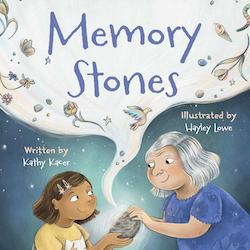
image - Memory Stones book coverAt the other end of the life spectrum, author Kathy Kacer, who specializes in writing books to educate younger readers about the Holocaust, has come out with a different kind of lesson. In Memory Stones, which is beautifully illustrated by Hayley Lowe, we meet Sophie, who has just lost her beloved grandmother. We see some of the many fun things Sophie and Granny would do together, and how heartbroken Sophie is when Granny dies. Sophie brings flowers to Granny’s grave, but they never last long. When Sophie’s mom shares that people in some cultures, including Jews, place stones on loved one’s graves, Sophie figures out a special way to remember her grandmother.

Memory Stones, published by Second Story Press, is intended for readers 6 to 8 years old. Published by the Collective Book Studio, Waiting for Max is for readers 4 to 8 years old, and Mazel Toes!, for babies to toddlers.

Music to build bridges

On Nov. 29, sopranos Jaclyn Grossman, left, and Miriam Khalil will perform Salam-Shalom: Echoes of Home, a program they put together in an effort “to build bridges between our communities.”

Salam-Shalom: Echoes of Home grew out of countless conversations between Miriam and me over the past few years – conversations that gave me a lot of hope during a difficult time,” Jaclyn Grossman told the Independent about her upcoming concert with fellow soprano Miriam Khalil.

“We shared what we were each experiencing, what our communities were going through, and how we might better understand and support one another,” said Grossman. “We both felt a deep need to do something meaningful and to use our voices and our art to foster empathy, connection and healing. This project is deeply meaningful to me because I hope it can create a space for reflection, healing and understanding for our communities, and for anyone who connects with its themes of home, acceptance and belonging. I truly believe we are stronger when we stand together, and I hope this concert helps build bridges that make that possible.”

Grossman and Khalil will be accompanied on piano by Gordon Gerrard, artistic director of City Opera Vancouver, which is presenting the concert. Idan Cohen (Ne.Sans Opera & Dance) will lend his experience in stage and movement, and Avideh Saadatpajouh has created projections that, among other things, highlight some of the textual elements.

“Jaclyn is a beautiful person and has always been someone that I have connected with,” said Khalil about why she wanted to be involved with the production. “Through many of our conversations, our shared dialogue grew and became something we realized we both needed in order to find healing. Jaclyn had mentioned that she had spoken to Gordon about the possibility of creating something together. What made this project so special was our dialogue from the very beginning. Through numerous meetings, we spoke about finding a way through song, language and poetry to create a space for healing and shared empathy and, most importantly, to build bridges between our communities. We longed for the same thing, peace and human connection – this recital is an extension of that longing and an expression of hope.”

As for his participation, Gerrard said he became interested after a conversation with Grossman more than a year ago. “I was distressed to hear that she had had several concert appearances canceled over recent months,” he said. “It seemed to me that many organizations seemed hesitant to present Jewish and Arab artists out of fear of controversy. The program was suggested by Jaclyn as a direct way to counteract this.”

photo - Pianist Gordon Gerrard, artistic director of City Opera Vancouver
Pianist Gordon Gerrard, artistic director of City Opera Vancouver. (photo from City Opera Vancouver)

About the risk of City Opera Vancouver being “canceled” for presenting Salam-Shalom, Gerrard said, “Certainly, we have committed to this special event after careful consideration of the charged environment that we are all a part of right now. We wanted to be sure that we acted responsibly, and that we would be able to create a respectful space for everyone involved. Because I trust Jaclyn, Miriam and Idan entirely, we’ve been able to have many helpful conversations about this event and how to go about it. This has given us at City Opera confidence that we are doing something that intends to create better understanding and, for us, this remains the priority.”

“Our goal with this project is to create a space for nuanced dialogue, where all voices can be heard and where empathy and understanding can grow,” said Grossman. “While this kind of work isn’t always easy, I believe it’s essential. In times like these, it’s more important than ever for communities to come together, listen to one another, and foster compassion. To me, standing together in empathy and respect for all people feels like the only path forward.”

“My concern,” said Khalil, “is that we have a responsibility to one another. If we keep being afraid, then no change will ever take place. We must unite and listen to each other. As Jaclyn mentioned, without compassion and empathy, the way forward feels unattainable. There is great growth in seeing and appreciating one another’s perspective.”

Grossman and Khalil chose the repertoire, and the result will be a concert of “beautiful and seldom performed works entirely curated by the two of them,” said Gerrard.

The hour-long program comprises melodies from myriad musical heritages, including Arabic, Hebrew, Ladino, Spanish and Yiddish. The concert’s press release highlights “Eli, Eli,” an arrangement of a poem by Jewish-Hungarian resistance fighter Hannah Szenes during the Second World War; “Mermaid Songs” by Palestinian-American composer Felix Jarrar; “Ukolebavka,” a lullaby by Jewish composer Ilse Weber, who wrote and performed songs to comfort children when she was interned in Terezín; “Ayre,” by Argentine Jew Osvaldo Golijov, which explores the themes of exile and belonging using the words of a Hebrew prayer and those of Palestinian writer Mahmoud Darwish; and “The New Colossus,” a setting of Emma Lazarus’s poem (inscribed on the Statue of Liberty) by pianist and composer Nate Ben-Horin, who is part of Grossman’s duo, the Likht Ensemble. Another of the songs on the program is “Mi Lo Yeshalach,” by contemporary Israeli composer Hana Ajiashvili. The complete repertoire, with all the lyrics, has been posted on cityoperavancouver.com.

“To me, Salam-Shalom: Echoes of Home is an urgent expression of a voice that feels increasingly silenced,” said Cohen. “I believe the growing calls to silence or divide rather than engage in dialogue are deeply troubling. When Jaclyn, Miriam and Gordon reached out, I immediately said yes. 

“This project also speaks to my responsibility to uphold these values and address the horrors we are living through, through art,” Cohen added. “It’s easy to see conflict in simple opposites – right and wrong, us and them – but true understanding asks us to face complexities.

“Art,” he said, “should remain a space for reflection and critical thought, not moral posturing. I believe in its power to unite, to reveal our shared humanity, and to keep hope for peace alive.”

For tickets to Salam-Shalom, go to cityoperavancouver.com. 

Telling the story of an icon

Ronnie Marmo brings his one-man show I’m Not a Comedian … I’m Lenny Bruce to the Chutzpah! Festival Nov. 18. (photo from dorensorellphotography.com via Chutzpah!)

In 2017, with the expectation of a six-week run, creator and performer Ronnie Marmo and director Joe Mantegna brought I’m Not a Comedian … I’m Lenny Bruce to the stage. Now, celebrating eight years and 468 performances, Marmo told the Independent, “we can not wait to bring it up to Vancouver for 469!”

I’m Not a Comedian … I’m Lenny Bruce is part of this year’s Chutzpah! Festival, which runs Nov. 12-23. It’s being presented on Nov. 18, 7:30 p.m., at the Rothstein Theatre.

Bruce, a groundbreaking standup comedian and satirist, was born Leonard Alfred Schneider in Mineola, on Long Island, NY, in 1925. He consistently pushed social and legal boundaries, being arrested more than once for what was considered obscenity in his day, including a conviction in 1964 for a performance he gave at Café Au Go Go in New York City. Bruce died two years later, at age 40, from an accidental overdose. He was bankrupt, basically not having been employable after the conviction. It would be 37 years before he was posthumously pardoned, by then-governor George E. Pataki.

In I’m Not a Comedian … I’m Lenny Bruce, Marmo told the Independent, “We bookend the show with the final moments of his life and take you on a journey through his first performance all the way to his demise. We learn about his family, we see his charm and success, his struggle with addiction, his long-standing fight with the judicial system. We don’t hold back. You really get a full theatrical experience of his entire life.”

Bruce is one of Marmo’s heroes.

“What inspires me about Lenny is how ahead of his time he was and how passionate he was about his pursuit of the truth. I have so much respect for someone who is willing to sacrifice everything and put it all on the line just to make sure he didn’t fall into suit with everyone else. I’m proud to be entrusted by the family to be the one to tell his story to the next generation.”

Marmo landed on the title for the show after hearing Bruce say, in an audio clip, “I’m sorry I wasn’t funny tonight … I’m not a comedian, I’m Lenny Bruce.” For Marmo, that comment resonated. “He wasn’t a comedian – he was so much more than that,” said Marmo of Bruce. “He was a satirist, a social commentator and a true advocate for the freedom of expression.”

The show has evolved a lot since its creation.

“As the writer, I am always tinkering with the script,” said Marmo. “For example, I removed the famous ‘N-word’ bit when we came back after the pandemic. I felt as though, even though the bit itself was in support of removing power from words so we don’t give them the chance to harm us, I knew that people might have a hard time hearing what Lenny was actually trying to say. Plus, even though I loved the impact it had on an audience, it kept me up at night thinking about it even before events like what happened to George Floyd. I have a responsibility as an artist to tell the absolute truth but also to not be tone deaf to the world around me. I don’t believe Lenny would have done that bit today. 

“I also had long discussions with Kitty [Bruce, Lenny’s daughter] and my director, Joe Mantegna, who both agreed that it was best to remove it. So, I replaced it with ‘The Meaning of Obscenity,’ which, in my opinion, supports the show even more. So, I’m happy to make the switch, knowing it is not only the best fit culturally in this climate but also the strongest choice for the show overall. As a performer, my portrayal of Lenny evolves as I explore my own life and how I tell his story resonates differently depending on where I am in my life. I think it takes passion, dedication and an openness to watch it grow and evolve along with me.”

While I’m Not a Comedian … I’m Lenny Bruce premiered in 2017, Marmo said, “I’ve actually been with Lenny since 2005, when I did another show about him, called Lenny’s Back and Boy is He Pissed. On stage, I don’t separate us – it is my job as an actor to find where we meet in the middle. I try to focus on all the similarities that I identify with for Lenny. It is easy to keep it fresh because it is such an emotional ride and massive performance. I don’t feel like I ‘have it’ yet, which is refreshing, because it always feels just slightly out of reach.”

When Marmo did Lenny’s Back, which was brought to him by comedian Charlie Brill, he became “intimately involved with Lenny Bruce and his life.

“In getting to know him, I realized that there was so much of his story we weren’t telling. I wanted to get into the nitty gritty, I wanted to do his bits,” said Marmo. “So, I set out to write my own show. 

“We initially started the show anticipating a six-week run,” he said. “This thing has caught fire in the most incredible way. It is a testament to just how relevant Lenny is today – perhaps even more than he was over 60 years ago! It truly has been a perfect storm: free speech, first amendment, cancel culture and not to mention the success of the Amazon series The Marvelous Mrs. Maisel. They really helped catapult Lenny’s name back into pop culture and have sold thousands of tickets for us. We have, in some ways, come very far and, in others, not far at all.”

Marmo described Bruce as “a very proud Jewish man,” who often incorporated Judaism and his Jewish heritage into his material. “He openly incorporated his Yiddish vocabulary into his bits and there is quite a bit of familiar references sprinkled throughout the show,” said Marmo. “His relationship with religion overall was complex but, rather than hiding his heritage, he celebrated it.”

As for what he thought gave Bruce the courage to run up against the country’s obscenity laws, Marmo said, “The truth. He held a mirror up to society and asked questions that everyone wondered about but never found any resolution to. He also fervently believed in our judicial system and always believed that it would prevail and he would be redeemed – something that he, unfortunately, didn’t see in his lifetime, but did come to fruition with his posthumous pardon in 2003 – the first in New York history, in fact. He spoke out loud what everyone whispered to themselves and his popularity was proof of how profound he was.”

Even though Bruce wasn’t alive to receive the pardon, Marmo still believes it was an important action.

“It was a landmark symbolic victory for free speech,” he said. “I think it was redemption. It was validation that Lenny had something to say to this society and that we are free-thinking creatives entitled to our artistic expression.”

For tickets to I’m Not a Comedian … I’m Lenny Bruce or any other Chutzpah! show, go to chutzpahfestival.com or call 604-257-5145. 

Crawl bigger than ever

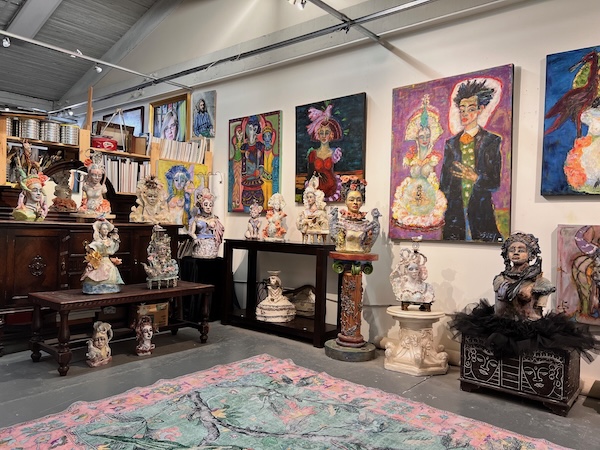
Suzy Birstein, who creates out of Parker Street Studios, is among the many artists – including Esther Rausenberg, Ideet Sharon, Lauren Morris and others – who are opening their doors to the public during the Eastside Culture Crawl Visual Arts, Design & Craft Festival Nov. 20-23. (photo from Suzy Birstein)

More than 500 artists – including Esther Rausenberg, Ideet Sharon, Lauren Morris, Suzy Birstein and other Jewish community members – are participating in the Eastside Arts Society’s 29th annual Eastside Culture Crawl Visual Arts, Design & Craft Festival Nov. 20-23. 

The festival will welcome visitors into the studios and workshops of Eastside artists in more than 80 registered buildings, including 20 buildings new to the Crawl – marking a 25% increase in options for exploring all that is on display across the Eastside Arts District (EAD). This year also marks the beginning of a three-year partnership with the Audain Foundation as the Crawl’s presenting partner, recognizing the importance of creative spaces and experimentation to a vibrant and healthy arts ecosystem.

“Vancouver is home to a growing number of artists who continue to create in the face of tremendous economic hardships and reduced access to studio space,” said Rausenberg, who is artistic director of the Eastside Arts Society (EAS). “Their unwavering passion, ingenuity and resourcefulness results in a richness of unique and diverse production and working artist spaces, creating exciting new opportunities for art lovers to explore, to discover and to be inspired.”

Encompassing the region bounded by Columbia Street, 1st Avenue, Victoria Drive and the Waterfront, the festival offers visitors a window into the artistic practices of artists living and/or working in Vancouver’s EAD, representing creators specializing in painting, jewelry, sculpture, furniture, leather goods, photography, glass works, textiles, and more.

As part of the Crawl, EAS will host a series of ancillary events, including the 2025 Preview Exhibition, a multi-venue, salon-style curated exhibition that explores a variety of media, formats, techniques and styles. This year’s theme of “Passion, Reason, Idiocy” invited participating artists to submit works that speak to the emotional, rational and foolish elements of their lived experience as working artists. The exhibition features juried works from 78 artists at three venues – Pendulum Gallery, the Cultch Gallery and Alternative Creations Gallery – until Nov. 30.

The 12th Annual Eastside Culture Crawl Film and Video Exhibition, in partnership with the Lumière Festival, will be projected outdoors nightly Nov. 13-16. Short films from eight participating artists – Ethan White, Garrett Andrew Chong, Cheree Lang, Fatima Travassos, Debra Gloeckler, Rashi Sethi, Isaac Forsland and Nisha Platzer – explore the theme of “Unity,” selected by Moving Art curators Rausenberg, Kate MacDonald and Sierra MacTavish.

This year’s series of Talking Art panels will be shared online, with two remaining. On Nov. 12, curated and moderated by Samantha Mains, artists Mackenzie Perras and Jes Hanzelkova will talk about artist practices that rely on the use of place, whether as a source for their concepts, art medium and materials, or site for performance. On Nov. 13, Mains will moderate while artists Jai Sallay-Carrington and Gina D’Aloisio explore artists whose practices have been changed by the influence of others, through participation in artist residencies or social media.

During the Nov. 20-23 festival, artists’ studios will be open 5-10 p.m. on Thursday and Friday, and 11 a.m.-6 p.m. on Saturday and Sunday. Full details of all the events, artists, talks and locations can be found at culturecrawl.ca. 

– Courtesy Eastside Culture Crawl

Reminder of humanity’s light

The passage across the Øresund, the body of water that separates the Danish peninsula from Sweden, is, at its narrowest, about the same distance as Horseshoe Bay to Bowen Island. But the waters can be treacherous – especially when it’s 1943 and the waters are swarming with Gestapo Kriegsmarine boats. Yet, for two weeks at the beginning of October 1943, 7,000 Danish Jews – about 95% of Danish Jewry (including the wonderful Victor Borge) – were safely transported across the Øresund in small fishing boats to the “sacred soil” of neutral Sweden.

In his new book, A Light in the Northern Sea: Denmark’s Incredible Rescue of Their Jewish Citizens During WWII, Tim Brady, author of the popular story of the Dutch Resistance Three Ordinary Girls, uses his excellent narrative skills to outline in detail how Danish Jews were warned about Nazi deportation plans, how they escaped and how they were treated when they arrived in Sweden. 

image - A Light in the Northern Sea book coverBrady has described himself as a storyteller, rather than as a professional historian, but he has done his research and he tells this story in great detail. As he did with Three Ordinary Girls, Brady brings history alive with the telling of stories through the eyes of participants, rather than simply cold facts. The eyes here are, for the most part, those of the remarkable Dutch resistance fighter Jurgen Kieler, whose recently published memoirs (encouraged by Elie Wiesel) would not have been available to earlier rescue historians.

Readers might be surprised that the “light in the northern sea” of the title refers to welcoming Sweden, not, as you might expect, given the book’s subtitle, Denmark. But, as Brady is quick to point out, the Swedish “light” was not always bright – before, and early in the war, Sweden had demanded that Germany mark the passports of Jewish emigrés with a “J” so they could be more easily refused, and Sweden refused potential Jewish immigrants who were not financially independent. 

However, as Brady notes, largely due to the enormously influential intercession of the great Danish Nobelist Niels Bohr (a dedicated Nazi-hater) with the Swedish government, Sweden’s position regarding the Jewish immigrants changed radically by October 1943, when it decided to admit all 7,200 Jews fleeing the recently occupying Nazis in Denmark. 

Swedes almost universally opened their homes to the Danish Jews. The refugees were also made to feel comfortable in churches, community centres, hotels and schools, as welfare agencies constructed camps, provided clothing and household items, and helped them find employment. Also, as Brady notes, during the post-rescue months of the Danish resistance, Sweden provided a 25 million kroner (about $70 million in today’s dollars) credit to help Denmark train and organize the Danish Brigade revolutionary group. 

Interestingly, the “rescue of Denmark’s Jewish citizens” referred to in the book’s subtitle has a double reference for Brady. On the one hand, there is the escape across the Øresund. But there is a second “rescue” described in the ending chapters of the book. These chapters deal with the 1943-45 undertakings of the Danish resistance, including detailed accounts of both their successful and non-successful sabotage activities. However, most of these Danish fighters were ultimately captured, and Brady carefully narrates their terrible experiences in German concentration camps. But, once again, the Danish Jews were “rescued.” Thanks to a coordinated effort of the Swedish Red Cross and the Danish government, most of the Danish concentration camp prisoners were returned to Denmark in the remarkable “White Bus Rescue” that was made possible in March 1945 by negotiations instigated between the Swedish diplomat Folke Bernadotte and Heinrich Himmler, which Brady describes at the end of his book. 

When put into historical perspective, as Brady is careful to do, the rescue of 95% of Danish Jewry, while utterly unique in Europe, was not completely surprising. At no time had Danish Jews been required to wear a yellow star. Moreover, King Christian X, while greeting his Danish subjects, would never salute the occupying Nazis, and would habitually visit Denmark’s Great Synagogue on Rosh Hashanah. (King Christian, in contradiction to popular myth, never wore the yellow star – but he would later be placed under house arrest.) As well, Jews lived comfortably in Copenhagen; for 100 years, they had enjoyed full human rights and become very active in arts, politics and philanthropy. For these reasons, as Brady explains, and also because the Danish population was, in his words, “peculiarly democratic,” Germany hesitated to “twist the arms of Denmark regarding its Jewish problem” (no less was Denmark anxious to “poke the Third Reich bear,” as Brady puts it).

But how did the Danish Jews know about the Nazis’ plans to deport them? To answer this question, Brady emphasizes the courageous actions of Nazi diplomat Georg Duckwitz, whom history should celebrate as a kind of Raoul Wallenberg- or Oskar Schindler-type figure. With his life on the line, Duckwitz tipped off Danish authorities when, in September 1943, the Nazis decided to solve the Danish “Jewish problem” in the way history shows they “solved” other problems. Duckwitz also, after tipping off Danish authorities, courageously traveled to Stockholm to tell Sweden’s prime minister about the impending roundup of Danish Jews.

As a result of Duckwitz’s actions, Danes were warned in time of the impending roundup and, when the Gestapo came calling, there was no one home. Almost all (except the very ill and disabled who did end up deported) were in neighbours’ homes or schools, churches, hospitals or safe houses, preparing for their trip to Sweden. 

Once the fishing boats were assembled, the flight to Sweden began in earnest. The boats were usually crammed; children and babies were usually sedated; and the passage was often rough, as high winds would often raise waves four to six metres high. 

As an aside, in 1989, the annual Holocaust Symposium at the University of British Columbia arranged by the Vancouver Holocaust Education Centre focused on the Danish rescue. The speakers were a Danish Jewish woman who was rescued and a Danish fisherman who was among the rescuers. In the Q&A portion of their presentation, the fisherman admitted that he and the other rescuers charged as much as 1,000 kroner ($5,000 in today’s Canadian money) per “Jewish ticket.” Brady notes this, but finds it “understandable,” since the fishermen’s livelihood was at stake in crossing the Gestapo-infested Øresund.

All in all, the Danish rescue, as Brady presents it, is truly a remarkable story – and a welcome reminder that, even in the roughest seas and at the darkest times, the basic light of humanity can shine brightly. 

Graham Forst, PhD, taught literature and philosophy at Capilano University until his retirement and now teaches in the continuing education department at Simon Fraser University. From 1975 to 2010, he co-chaired the symposium committee of the Vancouver Holocaust Education Centre.

A journey beyond self

“The Valley of the Shadow” by Michal Tkachenko.

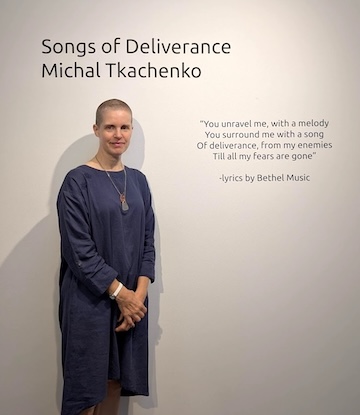
Songs of Deliverance, a solo exhibit by Michal Tkachenko, opened last month at the Zack Gallery and is on display until Nov. 10. While its title is inspired by the lyrics of a Bethel Music song – “You unravel me, with a melody / You surround me with a song / Of deliverance, from my enemies / Till all my fears are gone” – its focus derives from three psalms.

“I really wanted to have a subject for the exhibition that would bind communities together and so I came to rest on the psalms, which span both Judaism and Christianity, but are also used in secular society as a means to reach out to a greater being beyond ourselves,” Tkachenko told the Independent. “For me, this is a huge departure from previous work in both subject and vulnerability. It is my most honest work so far and, as the exhibition falls on the two-year anniversary of everything I saw with my spirit, I feel myself rising from the anguish and am ready to speak about my experience now, to move towards creating what I saw was possible.”

Lacking the exact words to describe it, Tkachenko said she had a near-death, or mystical, experience two years ago, and she was in that state for more than a week.

“It instantly changed my entire outlook on life and death and it completely changed me,” she said. “I was so excited about it until I began to realize how isolated it made me and how those I reached out to didn’t always have a helpful response. I quickly spiraled into the dark night of the soul and have been traveling that road…. Two very deep things came to rest in me during this time. The first was a deep longing in my spirit for something greater than myself, to draw and stay extremely close to God. The second was a deep grief that all that I had seen with my spirit, particularly an unseen solid force of love that is everywhere and how we are meant to love and be vulnerable with each other as our primary purpose in life, were things I could not make happen however hard I tried.”

Psalm 23 – “As I walk through the valley of the shadow of death, I will fear no evil” – was with Tkachenko throughout this two-year period. “For me,” she said, “it was a psalm about my journey and how, in the midst of the darkness, God was always with me and more vivid than I had ever experienced outside of that extraordinary week.”

photo - Michal Tkachenko’s solo exhibit, Songs of Deliverance, is at the Zack Gallery until Nov. 10
Michal Tkachenko’s solo exhibit, Songs of Deliverance, is at the Zack Gallery until Nov. 10. (photo by Andrea Lee)

As she approached the one-year anniversary of that week, Tkachenko asked two people to write her a blessing, as she made a vow to God and shaved her head. “One of the blessings,” she said, “included Psalm 63 and it reflected my own deep longing for God, ‘I thirst for you, my whole being longs for you, in a dry parched land where there is no water.’… My hair that I shaved off is part of the exhibition in an aged box that is meant to suggest a holy relic of the past, when people had more vivid experiences with God.

“Psalm 139 is such a beautiful expression of God’s love and absolutely full of beautiful imagery as an artist,” she continued. “It is a psalm that has also kept me company on my two-year journey and moves me every time I read it. 

“For this psalm,” she said, “I made a pile of sketches of different verses and the images that came to me. Of those, I chose seven to do larger pieces on mylar. In many of the pieces, the spirit of God is represented by the white negative space. In ‘You Hem Me in Behind and Before, You Lay Your Hand Upon Me,’ the image of a human is abstracted in a long, dark column down the centre of the page, but the figure is not the focus. Instead, the white empty space is the representation of God hemming that figure in from ‘behind and before.’”

Songs of Deliverance marks Tkachenko’s return to drawing and painting after this two-year period, during which she spent a lot of time writing. “My goal is to make short, layered videos using these writings,” she said.

She also took a break from painting during COVID, making art out of dollhouses that people were getting rid of in the decluttering that took place then. In these dollhouses, she created COVID lockdown scenes in miniature.

“My interest is not held by one medium or one style alone, although I do have a style that often emerges naturally,” she said. “The older I get, the less interested I am in creating what I think others will like or want to buy and more about what I want to say and what I am excited about making and expressing through the medium that seems best suited to that particular message.”

Tkachenko was born in Victoria but grew up in Vancouver. Her dad, an architectural technician, builder and musician, was a Ukrainian immigrant to Canada after the Second World War, while her mom, a teacher, music teacher and musician, was a second-generation Canadian with a Scottish/British background.

“My parents were part of the hippy movement in the ’60s and ’70s and, when I was young, we lived in communal housing,” said Tkachenko, who is the oldest of four sisters.

“Growing up in a big creative household, there were always guests and cooking parties (Ukrainian food), live music and all sorts of art projects going on,” she said. “My parents didn’t push the academics as much because they wanted to make sure we found what gave us excitement and joy and they invested in building our self-esteem instead.”

That said, Tkachenko has a bachelor’s and a master’s in fine arts. For her schooling, she has lived in Vancouver, Victoria, Calgary, Toronto, Florence and London (England). She has lived and volunteered in Haiti, Kenya, Malawi and Liberia, among other places. She has studios in both Vancouver and Manchester, as she, her husband and kids travel between Canada and the United Kingdom.

Despite knowing from a young age that she was going to be an artist, it took time for Tkachenko to recognize her skill and justify making art – “I considered it a luxury item, when the poor existed in the world,” she said.

“My hippy parents had driven us down to Mexico a number of times when my sister and I were young children (we are the oldest two) and we had been taken to the slums to understand how most of the world lived and how, despite our modest life in Canada, we were rich compared to rest of the world. It had made a huge and lasting impression on me as a child.”

At 18, she moved to Haiti to volunteer for a year, she said, “but before the year was out, I was in a life-altering car accident in which a friend died, my skull was shattered and my face smashed in on one side. I was flown back to Canada for reconstructive surgery and to recover.”

She volunteered for a spell in Kenya a few years later, but then finally decided to follow her calling in art.

Tkachenko works out of Parker Studios in Vancouver. She is also on the advisory committee for the DTES Small Arts Grant. “Being on this committee and working out of Carnegie [Community Centre] in the Downtown Eastside joins two things I value – the arts and working among the less fortunate,” she said.

Tkachenko’s husband is Jewish on his mother’s side – “her parents fled Czechoslovakia and Germany for the UK during WWII,” Tkachenko shared.

“Although they purposefully lost a lot of their Jewish heritage during the shift for safety reasons, my kids and I have become interested in it,” she said. “I came from a very open faith background because my parents were hippies that were part of the Jesus People Movement. They always encouraged us to find our own way to God and faith and, as a result, the people I am drawn to with my spirit are varied, from Jewish to Muslim, from Buddhist to Eastern Awakenings. The value of community does go beyond a single group [an idea she explores in one of The Journey series videos she is currently working on] and the more open and loving we become with each other, the more we can appreciate the differences that we each were gifted. And the more we see the bigger picture and what we all have in common.” 

Etgar Keret comes to Vancouver

(PR photos)

Israeli author and filmmaker Etgar Keret will be at the Rothstein Theatre Oct. 30, 7 p.m., in conversation with author and columnist Marsha Lederman. The JCC Jewish Book Festival event is sponsored by the Ronald S. Roadburg Foundation.

Keret, who also teaches creative writing at Ben-Gurion University of the Negev, is known for writing short stories that are lean and accessible in style, but whimsical, surrealist and darkly funny in subject. His work explores life’s smallest, most unremarkable interactions in ways that are profound and unusual, and his seventh story collection, Autocorrect: Stories (translated by Jessica Cohen and Sondra Silverston), is no different – it is vast in reach yet grounded in the bewildering absurdity of modern life. Books will be available for purchase at the Oct. 30 event and the author will be signing. For tickets ($36), go to jccgv.com/jewish-book-festival.

– Courtesy Cherie Smith JCC Jewish Book Festival

Doc on Zapiro screens Nov. 6

The South African Film Festival, which takes place Nov. 6-17, is primarily a streaming festival, but there are a few in-person cinematic experiences, including a screening of The Showerhead on Nov. 6, 6:30 p.m., at SFU Goldcorp Centre for the Arts.

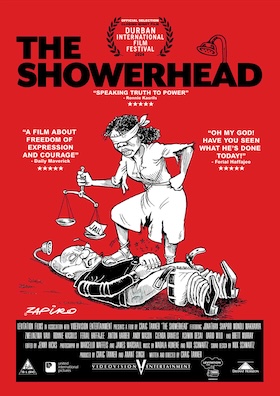
image - The Showerhead film posterThe Showerhead is a feature-length documentary that examines the work of political cartoonist Jonathan Shapiro, aka Zapiro, tracing his journey from anti-apartheid activist and struggle artist to “conscience of the nation” and champion of freedom of expression in democratic South Africa.

The documentary delves into the origins, relevance and impact of an iconic feature in Zapiro’s work that gives the film its title: the plumbing hardware fixed to the head of Jacob Zuma, the former president of South Africa. Through Zapiro’s cartoons, the film explores Zuma’s scandal-ridden rise to power, his turbulent presidency and eventual downfall.

Zapiro’s cartoons also capture a range of critical issues that have plagued South Africa in the post-Mandela era: failures of leadership during the AIDS pandemic, corruption, chauvinism, cronyism, self-enrichment, subversion of the constitution and the rule of law, and escalating threats to freedom of expression.

For tickets to The Showerhead, go to southafricanfilmfest.com.

– Courtesy South African Film Festival

Joy of shared existence

Omer Backley-Astrachan and Jana Castillo present the North American premiere of their work Common Place on Nov. 20, as part of this year’s Chutzpah! Festival. (photo by Wendell Levi Teodoro)

Intoxicating, moving, compelling, exhilarating – these are just some of the words that have been used to describe Common Place by Australian dancers and choreographers Omer Backley-Astrachan and Jana Castillo, which premiered in March at Riverside Theatres in Sydney. The work will have its North American premiere on Nov. 20, 7:30 p.m., at the Rothstein Theatre, as part of this year’s Chutzpah! Festival.

Common Place is described as “a physical exploration of belonging and togetherness, delving into shared action, collaboration and transcendent synchronization.” It is the first work that Backley-Astrachan and Castillo have created together.

In an interview with The Scoop arts review website, Backley-Astrachan explained, “We started by not knowing what the work was going to be about. We just danced together and, through that process, found the essence of what it means to find common ground.

“Jana and I could have spent time talking about our histories and our backgrounds,” he said. “Instead, we just created the work with movement at the centre and tried to find moments where we clicked together.”

He pointed out the title of the piece also invokes that which is commonplace, or ordinary.

“We tried to find a sense of exhilaration or a profound experience through very simple, very commonplace beginnings,” he told The Scoop. “So, rather than trying to create something complicated and highly technical, we took on a sensibility, almost inspired by folk, where it is something that anyone could do.”

“What we tried to avoid is creating the story first and then moulding ourselves into a preexisting narrative,” Backley-Astrachan told the Independent. “Instead, we wanted to stay curious and let the story unfold through the meeting between the bodies. It was important to us not to obey structured archetypes, rather to allow our shared physicality to weave the drama and the intimacy.”

Common Place, for me, is the coming together of two people,” said Castillo. “It’s feeling the ease, frustration and joy of a shared existence. The audience could be witnessing a single day of a relationship, or a lifetime of reflection.”

The dancers met at a colleague’s birthday party, Backley-Astrachan said. “Jana flipped me off from across the room, giving me the finger, which obviously caught my attention – little did I know about Jana’s Tourette’s at the time. Jana immediately explained and apologized, which turned into the funniest and most endearing friendship.”

The two share a philosophy of movement and artistic practice. When Backley-Astrachan saw Castillo perform live with the Australian company Force Majeure, he said he “vowed to work with this incredible dancer, which came true.”

“Jana and I are both the same age and have had similar career journeys, which led us to a similar idea of what we are looking for in dance and dance-making – a sense of maturity, an interest in truth-making through physical storytelling,” he explained. “Working with a like-minded collaborator is non-negotiable. It’s about being able to commit wholly to the process without getting distracted by ambition.”

The creation of Common Place took a few years. The need to get the work stage-ready by its March premiere helped drive its completion. 

“But I know that, if we had more time, we would probably continue to change and evolve the work, so it’s good we were limited,” acknowledged Backley-Astrachan. “That said, we made sure the work follows an emotional structure that makes tonal sense and goes through the full life cycle during the duration of the work. That said, choreography is a living thing that starts and ends again and again every time we do it.”

“This piece was quite unique because we had a lot of space in between development phases to allow the qualities of the movement to be digested into the body,” Castillo said. “It became clear very early on – this piece is about a relationship between two people. The premise of the work was to bring our whole selves. So, naturally, our outside experiences influenced what we brought into the space. We weren’t dictated by a creative brief, which can be terrifying as a creator because there are too many options. Just like in a relationship, you figure it out, but it takes time. You learn … when to rein it in and when to trust and let go.”

“I truly believe in the ability of dance and physical language to transcend an ordinary sense of meaning,” said Backley-Astrachan. “I have had the pleasure of being left speechless at the end of works by [Israeli choreographer] Ohad Naharin – his work changed my life in a deep way. I try in my own work to allow a certain state where several, sometimes opposing, forces can be true at the same time. Dance as a medium can give space for interpretation and, within that, there is also clarity and detail.”

In addition to the Nov. 20 performance, Backley-Astrachan and Castillo will lead a masterclass for dancers on Nov. 21, at 10 a.m.

This year’s Chutzpah! Festival runs Nov. 12-23, opening with Modi at the Vogue Theatre, where Chutzpah! is the community partner of MRG Live for the comedian’s Pause for Laughter Tour, and closing with the Golden Thread Septet’s Yiddish Songs of Social Change at the Rothstein Theatre.

Most single tickets for Chutzpah! are offered at a pay-what-you-will price, with the levels at $18, $36, $52 and $70 (+ gst/sc). I’m Not a Comedian … I’m Lenny Bruce is $40 (students/seniors), $54 (general) and $72 (VIP) (+gst/sc). ChutzPacks are also available: see four different regular-price shows of your choice for $136. Tickets for Modi can be purchased through admitone.com/events. All tickets can be purchased at chutzpahfestival.com or 604-257-5145. 

New bio gives Vrba his due

Rudolf Vrba, left, and author Alan Twigg at the University of British Columbia in 2001. Twigg’s new book on Vrba, Holocaust Hero: The Life & Times of Rudolf Vrba, breaks much new ground. (photo by Beverly Cramp)

Celebrated German factory owner Oskar Schindler is estimated to have saved the lives of about 1,200 Jews during the Holocaust. Carl Lutz, a Swiss vice-consul in Budapest, is credited with organizing protective documents and “safe houses” that helped between 50,000 and 62,000 Jews survive. Raoul Wallenberg, a Swedish envoy in Budapest issued passports and sheltered people in buildings, saving somewhere between 20,000 and more than 30,000 Jews. Chiune Sugihara, a Japanese consul in Kaunas, Lithuania, wrote thousands of transit visas, enabling about 6,000 Jews to escape via the Soviet Union and Japan, some of whom came to Canada and settled in Vancouver.

But few outside certain circles know of Rudolf Vrba. The late University of British Columbia professor of pharmacology escaped from Auschwitz and alerted the world to what was happening there. Estimates of the number of Jews saved by Vrba’s report vary, but a consensus among historians worldwide suggests he helped halt the mass deportation of more than 200,000 of Hungary’s Jews to Auschwitz. The late eminent historian Sir Martin Gilbert said of Vrba: “No other single act in the Second World War saved so many Jews from the fate that Hitler and the SS had determined for them.”

And yet, Vrba’s name remains largely unknown. This is not a coincidence. After the war, especially in Israel, there was a deliberate effort to downplay Vrba’s perspective of events. 

image - Holocaust Hero book coverA new book – the first of a meticulous two-volume assessment of Vrba’s life – has just been released by Vancouver author Alan Twigg. It goes great lengths to broadening awareness of Vrba’s heroism and correcting the many misconceptions around his legacy. In the process, Holocaust Hero: The Life & Times of Rudolf Vrba breaks much new ground. 

Coincidental to the release of this publication, a monument to Vrba’s memory is to be unveiled later this month at Schara Tzedeck Cemetery, righting what many locals see as an unjust historic oversight. 

While Vrba wrote his own memoirs, somewhat incredibly, Twigg’s book is the first real Vrba biography. 

“There’s never been an in-depth biography of Rudolf Vrba,” said Twigg, who deliberately did not replicate the contents of Vrba’s own 1963 book, written with Alan Bestic, titled I Cannot Forgive and re-released in the 1980s as Escape from Auschwitz. “I tried to concentrate on information that was not available anywhere.”

While this first volume is an eye-opener for those who know nothing of Vrba, it contains bombshells and fascinating depth even for those who have read Vrba’s book or who otherwise know something about his story. And Twigg promises more to come in the next volume.

“The really revealing material is going to be in Volume Two,” Twigg told the Independent. “That volume will be almost entirely original material and it will show the evolution of Rudi’s character.”

Those who know of Vrba are aware of his daring escape. But that was, in many ways, the beginning of his historic story. He joined the Partisans and was a decorated war hero. He was an extraordinary intellectual, a difficult personality, had a dark humour many people didn’t understand, and carried anger throughout his life.

“I think it’s so important if you’re writing a biography to get across his character, not just the events of his life,” said Twigg. The participation of Vrba’s widow, Robin, was invaluable and the book includes extended transcriptions of Twigg’s engaging conversations with her.

Rudolf Vrba was originally a false name that came on the forged papers given to Walter Rosenberg soon after he filed his report and then joined the Czechoslovakian resistance after his escape from Auschwitz.

Born in Slovakia, Rosenberg/Vrba was transported to Auschwitz in June 1942. He steadfastly viewed the plunder of Jewish assets – not antisemitism as its own accelerant – as the motive for the Holocaust.

Vrba is said to have had a near-photographic memory, which allowed him to store away data that would change the course of history. It is believed that he greeted almost every train arriving at Auschwitz for 10 months, mentally noting estimated numbers and places of origin.

Eventually, he gained the coveted job of registrar of Birkenau’s quarantine camp, allowing him unusual access to additional information and limited freedom of movement. He learned that plans were afoot to liquidate the last remaining large population of European Jews – the 800,000 in Hungary – whose destruction would be streamlined by the construction of a new rail line to expedite transportation to the crematoria.

Vrba connected with Alfréd Wetzler, another Slovakian Jew who was registrar of the morgue.

On April 7, 1944, Vrba and Wetzler hid in a woodpile, still on the Birkenau site but outside the barbed wire prisoner encampment. Gasoline-soaked tobacco threw search dogs off their scent. They hid there for three days and nights as search parties worked 24/7 to find the escapees. After the intensive search was called off, they made their move.

The pair made an 11-day trek by foot through Poland to the border with Slovakia, where they connected with the Jewish community. 

“Their feet were bloodied and misshapen,” Twigg reports. “A doctor was summoned. The malnourished pair recovered and soon cooperated with Jewish Council officials to produce an anonymous report that would be so detailed and emotionless that it could not not be believed.”

The Vrba-Wetzler Report, as it became known, was the first to have any significant reverberations, apparently because of the mathematical tallies and objective, scientific-like writing. 

With the report, pressure came down on Admiral Miklós Horthy, the Hungarian leader viewed by most as a Nazi collaborationist, to halt the deportations of Hungarian Jews to Auschwitz. By 1944, the tide had begun to turn against the Nazis and so it was not moral considerations, Twigg suggests, that turned Horthy against the deportations, but the fear of war crimes charges after the war. Regardless of Horthy’s motivations, it was this impact of the Vrba-Wetzler Report that is believed to have saved at least 100,000 and as many as 200,000 lives.

The deportations did not end permanently, though. And here Vrba’s history is inescapably tied up with that of another Rudolf – Rudolf (Rezső) Kasztner, one of the most polarizing figures in Holocaust history.

“A controversy persists to this day as to the extent prominent Jewish and Zionist leaders should be held accountable for a myriad of failures to adequately inform Jews about the lethal dangers of boarding the trains,” Twigg writes. “For the rest of his days, Vrba would chiefly lay the blame for the failure to adequately inform approximately 800,000 Jews in Hungary about the Holocaust on Kasztner, the Zionist leader from northern Transylvania.”

Kasztner was the first non-Slovakian official to see the Vrba-Wetzler Report and a harsh dispute rages still around what happened next.

In meetings among the leadership of Hungarian Jewry, it was apparently Kasztner who pressed for an approach in which, rather than alerting the Jewish population, the leadership would keep the information to themselves and negotiate directly with Adolf Eichmann for favourable terms that made it possible for Kasztner and other senior Jewish figures to save themselves and a number of others.

Kasztner (and those sympathetic to his narrative) would have seen some logic in the fact that the Nazi war effort was foundering and the Germans desperately needed goods and money, something Kasztner and his associates believed they could access through Jewish channels internationally. With the Soviets approaching from the east, they may have thought they could buy time and save more than their limited numbers.

Eventually, Kasztner negotiated with Eichmann that a trainload of about 1,684 Jews, many or most of Kasztner’s own choosing, would set off for Switzerland. It is estimated that the passage for each passenger had been “bought” from Eichmann for about $1,000. 

The passengers did not go directly to Switzerland, though, but were rerouted to Bergen-Belsen. Unlike the other Hungarian Jews arriving at the concentration camps, however, these 1,600 or so were kept separate and eventually did make it to Switzerland, in two transports, later in the year.

In the meantime, 400,000 Hungarian Jews were sent to Auschwitz, where almost all of them were murdered. 

The title of Vrba’s book, I Cannot Forgive, is assumed to refer to the Nazis. Twigg, among others, believes it is simultaneously a reference to Kasztner and his coterie of Jewish leaders.

Vrba was openly critical of the Jewish leadership, particularly those in Hungary and especially Kasztner, who by this time had risen to a moderately senior post in the Israeli government, along with other Hungarian Jewish leaders who were senior or mid-level figures in the governing party, Mapai. To some extent, put simply, the Hungarian Jews who had negotiated with Eichmann and who Vrba blamed for preventing his report from saving exponentially more Jewish lives, became integrated into the nascent elite of the new Jewish state. It was decidedly not in their interests to have the provocative professor, now halfway around the world in Vancouver, obtain any wider audience for his book.

Ruth Linn, an Israeli scholar of moral psychology and Holocaust memory at the University of Haifa, has Vancouver connections and stumbled onto Vrba’s story a couple of decades ago. She could not understand why his name was almost completely unknown in Israel. She spearheaded the first publication of the Vrba-Wetzler Report in Hebrew, in 1998, and, in 2004, wrote Escaping Auschwitz: A Culture of Forgetting, which examined why Vrba’s account had been marginalized in Israel and how politics and memory shaped Holocaust historiography.

Capturing the dichotomy of the debate around Kasztner’s role in the Hungarian Holocaust, Twigg juxtaposes two quotes. An Israeli judge, Benjamin Halevi, said of Kasztner, “He didn’t sell his soul to the devil; he was the devil.” Canadian author and publisher Anna Porter, who has written about the subject, said, “If you’re in hell, who do you negotiate with but the devil?”

A 1955 libel trial instigated by Kasztner proved his undoing. Ostensibly a case against Malkiel Gruenwald, who publicized the wartime actions of Kasztner, the trial turned into an examination of the facts of the case. Halevi, the judge who deemed Kasztner the devil himself, ruled that, by saving a chosen few, Kasztner had sacrificed the majority of Hungarian Jews. More than two years later, Israel’s Supreme Court overturned the judgment, but Kasztner did not live to see his legal redemption. He was assassinated outside his home in March 1957.

Twigg came to the Vrba story more by happenstance than design. Twigg edited BC Bookworld, a newspaper about books and authors, for more than three decades. 

“I used to keep track of all the books of British Columbia and I had categories,” he said. He could cross-reference, for example, all books on Japanese-Canadians or forestry. 

Based on this knowledge, in 2022, Twigg wrote Out of Hiding: Holocaust Literature of British Columbia. (See jewishindependent.ca/a-roadmap-to-remembering.) Its largest, though still necessarily brief, section is on Vrba. However, this was inadequate for Twigg, who decided to expand the project – first as a comprehensive website (rudolfvrba.com) – now as this book.

Not directly related to Holocaust Hero but timely, if profoundly overdue, an ad hoc group of friends and admirers of Vrba will erect the world’s only monument to him on Sunday, Oct. 26, beginning with a ceremony in the chapel at Schara Tzedeck Cemetery at 2 p.m. The program will feature reflections on Vrba’s life, legacy and enduring impact from Dr. Robert Krell, Dr. Joseph Ragaz and Prof. Chris Friedrichs, and will conclude with the dedication of the memorial monument.