Joy brighter than ever

Gila Münster, left, Yan Simon and Sarah Freia bring 8 Gays of Channukah: The Musical to the Chutzpah! Festival Nov. 13. (photo by Jamie Marshalls)

At this year’s Chutzpah! Festival, which runs Nov. 12-23, Jewish drag queen entertainer Gila Münster presents the Western Canadian debut of 8 Gays of Channukah: The Musical.

Calling Chutzpah! “one of the city’s most beloved celebrations of music, theatre and culture,” Münster wrote in a recent Facebook post: “What began in Toronto as the largest annual queer Jewish event in Canada is now coming West, bringing music, comedy and unapologetic queer Jewish joy to the stage.

“And it couldn’t come at a more important time,” she adds. “As antisemitism and anti-LGBTQ backlash continue to rise across North America, spaces that celebrate and centre our communities are not just entertainment – they are acts of resilience, visibility and solidarity. This show is about more than laughter: it’s about lighting the menorah together in defiance of hate and letting our joy shine brighter than ever.”

8 Gays of Channukah takes place Nov. 13, 7:30 p.m., at the Rothstein Theatre. “Eight stories are brought to life by the show’s creators, Gila Münster, Sarah Freia and Yan Simon, who reimagine holiday traditions with camp, sparkle and pride,” reads the Chutzpah! blurb. Local artist Joylyn Secunda opens the event with an excerpt from their show, The Routine, and there is a holiday shuk (market) during intermission and after the performances. People can pick up some gifts – made by local artisans – for the holidays.

First performed in December 2019, 8 Gays of Channukah started out as a variety show, said Münster. Last year, it evolved into a full-length musical created by Münster, Freia and Simon, and directed by Hershel Blatt.

“Now, 8 Gays of Channukah: The Musical is a 90-minute theatrical extravaganza with original songs, storytelling and dazzling costumes by queer Jewish designer Dan Dwir of House of Dwir,” said Münster. “The premise is that the three of us – Yan, Sarah and I – find ourselves on stage without a plan. We decide to share our experiences as queer Jewish people, but, as tensions rise, our bickering begins to twist the message. Over the course of the show, we learn how to coexist despite our differences and discover how much we truly share.

“The stories we tell touch on everything from coming out, to losing a loved one, to first crushes – and, of course, the joys and challenges of being an intersectional minority.”

It was from one of those challenges that 8 Gays of Channukah came into existence.

“In 2019, I was an undergrad at York University, getting ready to perform a drag show for the school’s 2SLGBTQIA+ affinity club,” Münster said. “Two days before the show, I got a voicemail from the club’s coordinator saying the event was canceled and I was banned from the club. The reason? I had mentioned that I was planning to go on Birthright to Israel that summer, and some members said it made them uncomfortable.

“I wasn’t given a chance to explain why that reaction was antisemitic, or even to defend myself. It was devastating. I felt erased – like there was no room for me to be both queer and Jewish.

“But I didn’t want to give up,” she said. “I reached out to Hillel Ontario and started a campus group called Rainbow Jews, a space where queer Jewish students of all stripes could show up fully as themselves. At our very first meeting, people asked me if I could put together a holiday party for queer Jews. That’s when the idea hit me: 8 Gays of Channukah. It started as a scrappy variety show with eight local queer Jewish performers – and now, seven years later, it’s grown into a tradition I’m so proud of.”

Over the years, singers, instrumentalists, comedians, dancers, burlesque and visual artists have participated. “Some highlights include legendary performers like 78-year-old drag queen Fontaine and Jamaican-Jewish comic Tamara Shevon, alongside rising stars such as dancing diva Josie and punk rock princess Alissa Brink,” said Münster. “In recent years, the show has found a kind of ‘core cast.’ Yan Simon – a Russian-Israeli singer-songwriter now based in Ottawa – first performed with us in 2019 and has been part of every show since 2023. Sarah Freia – an actress, singer and poet splitting her time between Toronto and London [England] – also joined, in 2023, and has been with us ever since. Together, we’ve built on the variety show tradition while adding our own creative chemistry into the mix.”

With Münster in Kingston, Ont., Simon in Ottawa and Freia in Toronto and London, the building of the musical required tenacity – hours in transit for in-person rehearsals and hours more in digital meetings, including with director Blatt, who traveled back and forth from New York.

“Because the show is rooted in personal storytelling, we had to really learn how to listen to each other and trust each other’s artistic instincts,” said Münster. “We were also lucky to have amazing rehearsal assistants, Olivia Daniels and Jesse Levy, who helped us shape the movement on stage.

“When we premiered the musical in December 2024, it was both thrilling and terrifying. We’d spent a year and $25,000 developing an entirely new format with all original material and we knew our loyal audience was counting on us to deliver. Of course, there were a few inevitable hiccups, but the energy in the theatre was electric. One moment I’ll never forget was after the show, when the non-Jewish partner of a Jewish audience member told us that, for the first time, he truly understood how antisemitism feels. That conversation reminded me that every person in the audience will connect to the show in their own way – and that’s the real magic of it.”

Münster’s first drag performance was at an event organized by the Centre for Israel and Jewish Affairs for Pride. Called Jew-Paul’s Drag Race, it was hosted by drag legend Divine Darlin’, said Münster.

“I had spent weeks putting together my outfit, inspired by the Wicked Witch of the West. On the day of, it took me three hours to do my makeup, and then my friend Diana drove me to the Drink, where the show was happening. She practically had to drag me up the stairs – I was so nervous.

“The first song I ever performed in drag was Carrie Underwood’s ‘Blown Away’ – a nod to The Wizard of Oz – followed by Netta Barzilai’s ‘Toy,’ which had just won Eurovision 2018. The crowd went wild for that second number, and, in that moment, I realized there might be a space for me to bring my queer, Jewish and Israeli identities together on stage,” said Münster, who ended up winning the competition. 

“From that night on, I was hooked,” she said.

Some JI readers will know Münster from her having been one of JQT Vancouver’s Hanukkah Hotties in 2022. She’s also on JQT’s Wall of Artists.

“I first connected with JQT’s founder and executive director, Carmel Tanaka, about four years ago,” explained Münster. “She found me online, and we bonded quickly over our intersectional identities.

“Looking back at the Hanukkah Hotties video … always makes me laugh,” she said, “because it takes me right back to the era of ‘Zoom drag.’ That meant getting into full glam, setting up lights and lip syncing in my living room – all to a silent, invisible audience on the other side of the screen. It was bizarre, a little lonely, and yet so wonderfully camp at the same time.”

Drag isn’t just an art form for Münster, but her business.

“It’s helped me pay my way through law school and beyond,” she said. “Having signature events that only I can deliver – especially those built around original music that doesn’t exist anywhere else – sets me apart from entertainers who focus mainly on lip syncing to existing tracks.

“Alongside 8 Gays of Channukah, another one of my signature offerings is Drag Queen Story Time. I’m proud to be the only drag performer officially approved as a vendor for the Toronto District School Board.”

Münster is also adept at cross-stitching, and sells her creations and other artwork on Etsy.

“My mom first taught me to cross-stitch when I was a kid, but I really picked it back up during the pandemic lockdowns,” she said, adding that “stitching became both a way to connect with people when we couldn’t leave our homes and a way to pass time that actually felt productive.”

Münster, Freia and Simon are excited to bring 8 Gays of Channukah: The Musical to Vancouver. “More than anything,” said Münster, “we hope the show helps build bridges between queer, Jewish and allied communities – especially in this moment of deep polarization.”

For the full Chutzpah! lineup and tickets to all the shows, go to chutzpahfestival.com or call 604-257-5145. 

Granirer returns to Carnegie

From Oct.31 to Nov. 8, the Heart of the City Festival features more than 100 events – music, stories, poetry, theatre, ceremony, film, dance, readings, workshops, discussions, art talks, history walks and more – all rooted in Vancouver’s Downtown Eastside (DTES). Among the performers is award-winning counselor and stand-up comic David Granirer, founder of Stand Up for Mental Health, which teaches stand-up comedy to people with mental illness as a way of building confidence and fighting stigma. 

photo - Counselor and stand-up comic David Granirer will perform, with other comedians from Stand Up for Mental Health, on Nov. 5, as part of the Dowtown Eastside Heart of the City Festival
Counselor and stand-up comic David Granirer will perform, with other comedians from Stand Up for Mental Health, on Nov. 5, as part of the Dowtown Eastside Heart of the City Festival. (photo from Heart of the City Festival)

On Nov. 5, 4 p.m., at Carnegie Community Centre’s theatre, Granirer, with comedians from Stand Up for Mental Health, will look at the lighter side of taking meds, seeing counselors, getting diagnosed and surviving the mental health system.

The festival kicks off on Oct. 31 at Carnegie’s theatre with a Halloween event. Dress in costume, walk the red carpet, enter the costume contest to win a prize, and gear up for disco-ball dancing with DJ Maxi and crew spinning tunes. Hosted by Lance Lim of the Pigeon Den Art Collective, there will be masquerade magic and community fun for friends and families alike, refreshments provided.

Some other highlights in the upcoming festival are:

• Gerardo Avila’s theatrical performance Spirit Encounters celebrates Día de Muertos and features shadow puppetry, comedy, flamenco and Mexican dancing and music.

• Indigenous Cultural Exhibition with dancing, drumming and community, featuring Two-Spirit grass dancer Larissa Healey and Powwow dancer Pavel Desjarlais.

Finding My Own Voice, a new folk opera work-in-progress presentation by Beverly Dobrinsky.

• Theatre in the Raw presents staged readings of two award-winning plays from their Biennial One-Act Playwriting Contest.

For more about this year’s festival, visit heartofthecityfestival.com. 

– Courtesy Heart of the City Festival

Seeking middle ground

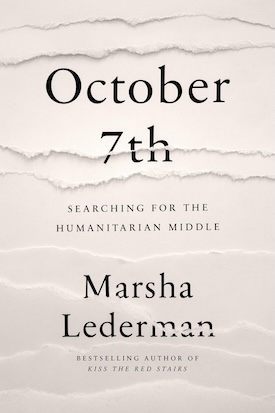
At the local launch for her new book, October 7th: Searching for the Humanitarian Middle, Globe & Mail columnist Marsha Lederman admitted she’s “not doing great.”  

“A lot of us in this room can say that,” she said in her opening remarks at the Jewish Community Centre of Greater Vancouver Sept. 18. “It’s been another terrible week with terrible news.” 

Lederman was the Western arts correspondent for the Globe for 15 years, before moving to the opinion section in 2022. Her memoir, Kiss the Red Stairs: The Holocaust, Once Removed, was published that same year. (See jewishindependent.ca/a-story-of-two-families.)

image - October 7th book coverOn Oct. 9, 2023, Lederman began writing columns on the aftermath of the Oct. 7 massacre in Israel and the tide of antisemitism that followed it. When an editor suggested she publish a book containing a full year of those columns, together with other material she’d written on Jewish identity, she began working on October 7th.

The process of collecting material for the book was emotionally wrenching, said Lederman, a child of Holocaust survivors whose intergenerational trauma was triggered by the Hamas attack. 

“It was really hard to relive those early days, rereading the columns and remembering what was happening in the world at that time. When I read through older articles I’d written about my Jewish identity, I was shocked at how many times that subject matter had come up and the extent to which they foreshadowed what would happen in the war.”

When she filed that first column on Oct. 9, Lederman said she wrote it in a haze of shock, emotion, upset and fear. “I knew it wasn’t what had just happened, but what would happen next: retaliation, that it would be terrible for Palestinians, and that there would be anti-Israel sentiment. But I could never have predicted that all things would have exploded the way they have and that it would still be there, almost two years later.”

Describing herself as a “progressive Zionist,” Lederman said she believes the state of Israel has a right to exist but is “strongly against the war and the occupation. I’m horrified by what some of the settlers are doing in the West Bank, but I love Israel and Israelis – though not the ones in power right now. I don’t blindly approve of everything Israel does and part of my caring for Israel is what has led me to speak out.”

In an hour-long talk moderated by Kathryn Gretsinger, a journalist and associate professor at the University of British Columbia, Lederman discussed her hope for a two-state solution, her annoyance at how people speaking out in favour of Palestinians have been branded antisemitic, and the threats she has received in response to her columns.

“My trauma is nothing compared to what people in the war zone are experiencing, but it’s still a horrible experience,” she said.

Prior to Oct. 7, Lederman said she saw herself as a journalist who happened to be Jewish. After Oct. 7, as she began writing about the attack and subsequent war, she said she put herself on the page, explaining her Jewish background. When she wrote about plastic surgery recently, the Globe received a letter to the editor stating, “how dare Lederman write about that when children are dying in Gaza!”

The book’s subtitle, Searching for the Humanitarian Middle, deals with the quandary of holding several feelings simultaneously: concern for Israel and the Israeli soldiers, as well as Palestinians who are being killed.

“I believe the humanitarian middle is essential, and there are a lot of caring people who want to see an end to this war. The numbers are terrible: 60,000 Gazans have been killed in this war,” she said, citing numbers released by the Hamas-controlled Ministry of Health. 

“That’s appalling to me,” she continued. “Hostages are still underground and antisemitism has reached a level that’s shocking, even to me, as a pessimistic catastrophizer. The word genocide carries so much weight for us as Jewish people. Israel was born out of the ashes of the worst genocide we have known. So, for Israel to be accused of that very crime is heartbreaking.” 

Asked what her solution to the war would be, Lederman said a ceasefire deal is the way to go. “I believe what we’re seeing from Israel is an over-

reaction and I would urge the government of Israel to consider a two-state solution. I believe that’s the answer.”

She said, “My heart aches for the hostages and their families, and for all the people in Gaza. When I think about the intergenerational trauma from this time, it’s shattering. I feel a responsibility to write about this as a Jewish person, a journalist, a mother, as someone who cares about other human beings, and as a child of Holocaust survivors, but I’m feeling the weight of the world in my fingers.” 

Lauren Kramer, an award-winning writer and editor, lives in Richmond.

Impacts of oppression

Franz was shot in Prague, including near Franz Kafka’s birthplace. (still from film)

Troubled father-son relationships, both literally and metaphorically, are themes of Franz and Orphan, the former a biopic with some quirks and the latter a more old-school period piece. The two movies are part of this year’s Vancouver International Film Festival, which runs Oct. 2-12.

Director Agnieszka Holland’s Franz is an imaginative film that flits between the “present,” Franz Kafka’s adult years, until his death, at age 40, in 1924, and some formative childhood moments (mostly highlighting his domineering and dismissive father), while also jumping into the future, where tour guides at various institutions and parks tell modern-day tourists all about the influential writer. 

In one of these future moments, we learn that the ratio of words written by Kafka and those written by others about him is approximately one to 10 million. Some of these millions of words were written by Kafka’s friend and literary executor, novelist Max Brod, who rescued much of Kafka’s work. Brod’s Franz Kafka: A Biography is apparently a primary source of what we know about Kafka’s life, and he is featured in Holland’s film.

While Idan Weiss, who plays the tortured writer (and insurance lawyer) has gotten kudos from other reviewers for his performance, Peter Kurth, who plays Hermann Kafka, Franz’s father, stands out even more. Kurth plays stubborn and unlikeable well, but also shows Hermann’s vulnerability and how he uses meanness to cover it up.

Franz Kafka was born in Prague, in 1883, and he is witness to world-changing events, including the First World War and the subsequent collapse of the Austro-Hungarian Empire. Kafka was drafted, but his employers successfully argued that he was an indispensable worker – according to the movie, they did so at Hermann’s behest. The creation of Czechoslovakia and several other independent states after the war is not an explicit aspect of Franz, but the oppressiveness of the empire (the fatherland, in the metaphor) comes out in Kafka’s depictions of bureaucracy, alienation, anxiety, etc. While Franz doesn’t add any new knowledge to what’s known about Kafka, his upbringing (harsh on many levels), writing (most of it published after his death), love life (engaged for a period, then involved with a married woman), religion (not an observant or believing Jew) and illness (tuberculosis), but it might bring a new generation to his ideas, which remain important.

As Holland told Variety: “the dehumanization of society, the despisal of [certain groups of people] and alienation are once again becoming the main communicative tools,” but, not wanting to “give an interpretation like that,” she said, “Kafka has been interpreted in so many ways, as is shown in the film, but when you compare what he wrote with what was written about him they are poles apart. So, we didn’t want to reinterpret Kafka; we wanted to make him alive.”

And Franz is a success in those terms. It is entertaining and thought-provoking, though sometimes the thoughts are about odd creative choices. There is a lot of male nudity and it’s not always clear why. For example, in one scene at a sanitorium, naked men, some wearing animal head masks, engage in a game of tug-o-war.

László Nemes’s Orphan, which takes place in Hungary, is a more linear and literal form of storytelling, also focusing on a time of upheaval and oppression. While most of the film takes place in 1957 – a year after the Soviet Union crushed the people’s revolt against the country’s communist government – the young Jewish protagonist, Andor (played by a brooding Bojtorján Barábas), was put into an orphanage during the Second World War. We witness his mother and a reluctant Andor reunited after the Holocaust. Her “saviour” was a non-Jew, Berend (played by Grégory Gadebois with nuance), who Andor absolutely hates. 

photo - Bojtorján Barábas and Grégory Gadebois in Orphan
Bojtorján Barábas and Grégory Gadebois in Orphan. (photo © Mostra internazionale d’arte cinematografica­)

Andor cannot forgive his mother for giving up on the possibility of his father’s survival, even years after the war, and, when Berend claims that Andor is actually his biological son (and Andor’s mother never clarifies), Andor’s anger is barely containable and the tension mounts to a climatic Ferris wheel ride. While Berend is an abusive brute, he also seems to genuinely want Andor’s filial affection. Andor and Berend not only represent son and (possible) father, but Hungary’s desire for freedom from its Soviet oppression. 

Orphan is slow-paced, capturing the heaviness of the period, the incapacitating fear and oppression of 1957 Hungary. Twelve-year-old Andor doesn’t go to school, roams the streets, amuses himself at home, seems bored silly at times, and has nowhere positive to channel his frustrations and his feelings of abandonment.

While Franz and Orphan are two very different movies, they cover overlapping themes that are sadly all too relevant. Franz screens Oct. 7 and 11, and Orphan plays Oct. 2 and 4.

For tickets to either film and the entire festival line-up, go to viff.org. 

Flawed drama popular

A scene from Annemarie Jacir’s Palestine 36, which screens at the Vancouver International Film Festival Oct. 9-10. (still from film)

Bethlehem-born filmmaker Annemarie Jacir’s historical epic Palestine 36 had its world premiere Sept. 5 at the Toronto International Film Festival. It screens at the Vancouver International Film Festival Oct. 9-10.

While Jacir is an accomplished filmmaker and spokesperson for her people, her flawed drama is unlikely to bring clarity to events then – or now.

Shot in Israel, the West Bank and Jordan, and incorporating colourized archival footage from the 1930s, Palestine 36 tells the story of the Arab Revolt against the British Mandate from 1936 to 1939 through the eyes of Yusuf, played by Karim Daoud Ananya. Other stars include Jeremy Irons, Hiam Abbass and Liam Cunningham.

Depicted in Palestine 36 are characters like British High Commissioner Sir Arthur Wauchope and anti-insurgency experts Maj.-Gen. Orde Wingate and Sir Charles Tegart. Alas, they are all depicted as cartoon characters protecting Britain’s imperial interests even as they violently suppress the revolt and implement the emergency measures acts still used in Israel today. While Wingate was a Bible-quoting, onion-chomping eccentric, Jacir’s depiction of his behaviour and absurd haircut are egregious.

What struck this reviewer most was the lack of nuance about Arab society in 1930s Palestine. (At the time, Jews called themselves Palestinians while Arabs avoided that name.)  The country’s foremost leader in the years before the bloody revolt, Hajj Amin al-Husseini, does not appear in the film. Nor does rebel leader Fawzi al-Qawukji. Both escaped the British dragnet and made their way to Iraq, where they staged a pro-Nazi coup in 1941, then fled to Berlin during the war. Their bitter rivalry is well documented.

Since neither man graced Jacir’s film, there was no need to explain the clan divisions, mutual contempt and assassinations that characterized Palestine and prevented the country’s Arabs from uniting. A militant Muslim triumphalist and genocidaire, al-Husseini aimed to destroy Palestine’s Sunday People once he had dealt with the Saturday People. Perhaps surprisingly, given that Jacir is Christian, this detail was omitted. Instead, the film falsely gives the impression that, rather than being marginalized, her co-religionists fought alongside their Muslim neighbours as equals.

The natural hero of Izz ad-din al-Qassam is also missing from Palestine 36. A teacher from Syria who bravely faced the British soldiers and their bloodhounds until hunted down in the Galilee, al-Qassam’s name graces the missiles today’s Gaza terrorists lob at Israel.

Typical of Jacir’s striving for accurate details while omitting the big picture, she depicts British customs officers in Jaffa Port uncovering a barrel of smuggled Mauser rifles, but fails to mention the guns’ German source. Indeed, there’s the rub of this movie – while correctly pursuing the policy that the enemy of my enemy is my friend, the Palestinians’ alliance with Nazi Germany and Fascist Italy is not part of the story.

Judging from the 10-minute standing ovation at Roy Thompson Hall, such a huge omission is unlikely to spoil the impact of Palestine 36 in Vancouver and elsewhere. In Pallywood – and the rest of the film industry, for that matter – facts can’t stand in the way of  a good story. Indeed, Zionist mega-hits like Exodus and Cast A Giant Shadow are both kitsch films with a huge impact. Palestine 36 is likely to join them. 

Survival in the forest

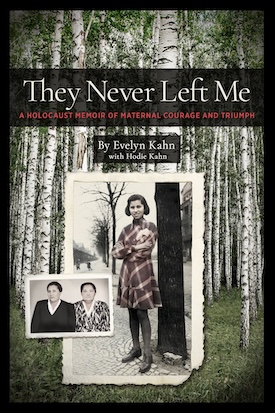
The harrowing new memoir by Vancouver’s Evelyn Kahn, They Never Left Me: A Holocaust Memoir of Maternal Courage and Triumph, written with her daughter Hodie Kahn, tells of a family’s survival while hiding in the forests of Eastern Europe.

They Never Left Me includes some of the most debasing inhumanity imaginable. Perhaps most shocking, though, is that human beings can withstand what the author and her family experienced and somehow endure and begin again in a post-Holocaust world, to raise a successful family and find meaning and happiness.

image - They Never Left Me book cover
Evelyn Kahn wrote They Never Left Me: A Holocaust Memoir of Maternal Courage and Triumph with her daughter, Hodie Kahn. On Oct. 19, at Schara Tzedeck Synagogue, Evelyn Kahn will talk about the book with Dr. Robert Krell.

Stories of Chava’s (Evelyn’s) early years, typical of traditional Eastern European Jewish shtetl life – her father’s preparations for morning prayers, her mother baking round challah for Rosh Hashanah, a live fish floating around in preparation for gefilte – read as ominously ordinary, knowing as we do a little of what is to come. 

From their hometown of Eishyshok, a shtetl in Poland that historically had shifted between Lithuania, Poland and then, tragically, between the Nazis and the Soviets, the family moved a few dozen kilometres to Lida, in what is now Belarus. This relocation, an economic move driven by her father’s proficiency in the Russian language, was the least dramatic move of Chava Landsman’s young life. Nonetheless, that move might have been the first of many near-miracles that saved the lives of Chava and the women in her family.

“On the eve of Rosh Hashanah 1941, Eishyshok’s Jews were rounded up and locked in the synagogue and two schools. After three days, they were herded to the horse market.… Over the next two days, the Jews were taken in groups of 250 – first the men and then the women and children – to the old Jewish cemetery. They were ordered to undress and stand at the edge of large open ditches, where they were shot to death by Lithuanian police. Babies were bashed to death against headstones or tossed into the air for sharpshooting practice led by the chief of police, Ostrauskas, before their tiny lifeless or quivering bodies were thrown into the killing pits to join their parents. Everyone was murdered.”

The final victim of the massacre was the town rabbi, “shot after being forced to witness the murder of his entire flock.”

As the Nazis invaded Lida, the family witnessed the aerial bombardment and made the decision to flee. They headed south, and sought refuge in another shtetl, Zhetel. But this was a brief refuge – not an escape. Death was chasing them. 

Chava’s father was rounded up during a cull of intelligentsia on July 23, 1941, barely a month after they arrived. 

“We watched in misery as Papa climbed into the back of a truck and was driven away,” she writes. “I never saw my father again.”

Chava’s Uncle Chaim and Rivke’s husband Shael were conscripted into the Red Army, leaving the women as the only family together in the Zhetel ghetto, which was created in February 1942. Chaim was captured by the Nazis, but incredibly escaped a POW camp and returned to Zhetel, where he became a Partisan in the forest and was killed. On April 30, 1942, the first liquidation began in the Zhetel ghetto.

“My own memory of the procession along the street is of being corralled into a narrow funnel and of feeling smothered by the crush of human bodies around me,” she writes. “I remember telling my mother I could not breathe. I was worried I might pass out and be trampled. People were on top of one another – on top of me – crying and tearing their hair out. I wanted Mama to pick me up, but it was impossible. We were compressed like livestock in a cattle chute. I just held onto Mama’s hand and prayed that mine would not slip out of hers.”

In terror, Chava told her mother she was being suffocated.

“She bent down close to me and I will never forget her tearful words,” Kahn writes. “My child, it is better that you should suffocate here than my eyes should witness you being murdered.

“I took in what she said and then simply asked, ‘Does it hurt to die, Mama?’ She assured me it was a peaceful experience. ‘Neyn mayn kind, es iz vey a feygele, git a brum’ (‘No my child, it is like a chirp of a bird’).

“Her answer quieted my fears and calmed me. I was never afraid of death from that moment on. I never remember feeling despair. On the contrary, I was exceptionally calm and clear throughout the nightmare to come.”

Somehow, the women survived the first liquidation. When the second and what would be the final liquidation of the ghetto began on Aug. 6, 1942, 3,000 Jews were herded to the Jewish cemetery and murdered. Knowing what was to come, Chava’s mother Basia decided to risk going into hiding – a choice between instant death and likely later death for disobedience. Again, it was a lifesaving decision.

Basia, Chava and her grandmother (Bobe) Hoda fled to the forest. Miraculously, with the help of a non-Jewish friend of the family, they were reunited with Chava’s Aunt Rivke, and the three adult women and Chava would endure the horrors of life in the woods for two years. (Shael fought with the Red Army through the war and survived, but he and Rivke did not reunite.)

The women largely fended for themselves with some assistance from Partisans and the occasional righteous non-Jew. Like other Jews in the forests at the time, they formed fluctuating ad hoc survival “family groups” of a dozen or as many as 20 people.

“We had learned the rules of the ghetto and we had survived. Now we would have to learn the rules of the forest. And we would have to learn them very, very well and very, very quickly. We could either adapt and hopefully live or not adapt and definitely die.

“We lived with the constant nervous anticipation of being discovered and killed at any moment. We were careful to speak quietly. We were always alert. We became as hypersensitized and wary as the creatures of the forest.”

In winter, they sheltered in holes in the ground. 

“Needless to say, hygiene and maintaining our health in the forest was hugely challenging,” Kahn writes. “We were malnourished and vitamin deficient. We were unwashed and unkempt. We wore the same clothes day after day with no relief. We were filthy skeletons, bulked up only by the layers of our lice-infested clothing, which we wore 24 hours a day. I often wonder how we managed to survive those two years without bathing.”

Basia’s doggedness saved her family. Even at 40 degrees below zero and with snow to her thighs, she would trudge out of the woods to beg or steal provisions from local farmers. 

“It is true that many (most) farmers were unfeeling or, worse, informers. But it is important to acknowledge that there were those who hung onto their humanity during the war, righteous gentiles who were sympathetic and compassionate and gave us food and other necessities,” Kahn writes.

It is estimated that only one-half to one-third of the Jews who hid in forests survived to liberation. And, when “liberation” did come, and the Nazis were defeated, antisemitism remained. Many ordinary Russians, Poles, Lithuanians and Belarusians thought they had seen the last of the Jews and were not welcoming to the few straggling remnants who found their way back home.

The three generations of women – Bobe Hoda, mother Basia, Aunt Rivke and Chava, as well as Rivke’s baby, Joseph, who was born in and knew life only in the forest – remarkably survived and proceeded through a series of displaced persons camps, with schooling and vocational training for the young survivors. They had no family in the new state of Israel and so America seemed the more logical destination. At age 16-and-a-half, Chaya/Evelyn, her mother, aunt, cousin and grandmother were greeted at New York by the Statue of Liberty and a coterie of cousins. Eventually, Evelyn reconnected with a young man from Eishyshok, Leon (Leibke) Kaganowicz, who would become Leon Kahn and, because of American migration quotas, a Canadian who lived in Vancouver. Together, they became stalwarts of the Vancouver community.

Leon Kahn passed in 2003. His memoir, No Time To Mourn: The True Story of a Jewish Partisan Fighter, was published in 1978 and reissued in 2004. It will be released again this fall.

Evelyn has two sons, Mark and Saul, and daughter Hodie, as well as seven grandchildren and three great-grandchildren.

The idyllic start of Chava’s life, surrounded by a tight and loving family and community, juxtaposes horrifically with the abrupt cataclysm of history that would follow. The survival of three generations of women in the forests of Eastern Europe is a monument to human resolve and resilience. They Never Left Me is a momentous contribution to the literature of the Holocaust.

An event featuring Evelyn Kahn in conversation about the memoir with Dr. Robert Krell will take place on Oct. 19, 2 p.m., at Schara Tzedeck Synagogue, presented by the Vancouver Holocaust Education Centre, Ronsdale Press and Schara Tzedeck. 

Milestone performance

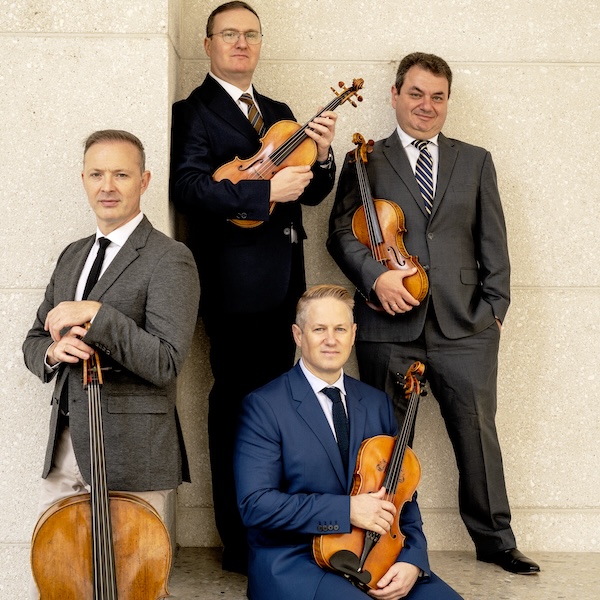
photo - The Jerusalem Quartet, left to right: Kyril Zlotnikov, Alexander Pavlovsky, Ori Kam and Sergei Bresler
The Jerusalem Quartet, left to right: Kyril Zlotnikov, Alexander Pavlovsky, Ori Kam and Sergei Bresler. (photo © Felix Broede)

The Vancouver Recital Society welcomes the multiple-award-winning Jerusalem Quartet back to the city for a concert at the Vancouver Playhouse Oct. 19. The program features works from Hadyn, Janácek and Beethoven.

This year marks the 30th anniversary of the establishment of the Jerusalem Quartet. Since their first appearance for the VRS in 2001, the ensemble has become a regular and beloved presence on the world’s concert stages. They have appeared many times in Vancouver, and a highlight in the annals of the VRS was their five-concert performance of all the Shostakovich string quartets in the Telus Theatre at the Chan Centre in 2006. They are returning to Vancouver to perform the same program they played in their Wigmore Hall debut 25 years ago, an appearance that launched them to international fame. It features Hadyn’s Quartet in B-flat major, Op. 76, No. 4 (“Sunrise”); Janácek’s Quartet No. 1 (“Kreutzer Sonata”); and Beethoven’s Quartet in B-flat major, Op. 130, with the Grosse Fugue finale, Op. 133.

The Jerusalem Quartet is Alexander Pavlovsky (first violin), Sergei Bresler (second violin), Kyril Zlotnikov (cello) and Ori Kam (viola). Both individually and as the quartet, the musicians have performed around the world, garnering numerous accolades.

Born in Ukraine, Pavlovsky immigrated with his family to Israel in 1991, and is a graduate of the Jerusalem Academy of Music and Dance.

Bresler was also born in Ukraine. He started to play violin in age of 5 and, at the age of 12, gave his first recital. He immigrated to Israel in 1991, where he studied at the Rubin Academy of Music and Dance in Jerusalem.

Zlotnikov also studied at the Rubin Academy, having begun his studies at the Belarusian State Music Academy, and Kam, who was born to Israeli parents in La Jolla, Calif., grew up in Israel and studied there, as well as in the United States and Germany. Kam started his musical education at the age of 6, began playing the viola at 15 and had his debut at age 16. 

The Jerusalem Quartet has found its core in a warm, full, human sound and an egalitarian balance between high and low voices. This approach allows them to maintain a healthy relationship between individual expression and a transparent and respectful presentation of the composer’s work. It is also the drive and motivation for the continuing refinement of their interpretations of the classical repertoire, as well as exploration of new epochs.

In 2019, the quartet released an album exploring Jewish music in Central Europe between the wars and its far-reaching influence, featuring a collection of Yiddish cabaret songs from 1920s Warsaw, as well as works by Schulhoff and Korngold. The second instalment of their Bartok quartet recording was released in 2020. Starting this year, the quartet began recording exclusively for BIS records, with their first release featuring three quartets by Shostakovich: Nos. 2, 7 and 10.

Although the Quartet No. 2 was composed in 1944, it makes no direct reference to the war; yet, this is a substantive work, dark, powerful and, at times, dissonant. Quartet No. 7, consisting of three short movements played without interruption, is an enigmatic and deeply personal work dedicated to the memory of the composer’s wife. For all its questioning and complex inner references, Quartet No. 10 is among the most immediately appealing of Shostakovich’s later works. By this stage in his life, his music tended to speak in a quieter voice and to a more intimate audience.

The Jerusalem Quartet’s performance at the Playhouse on Oct. 19 starts at 3 p.m., but there is also a pre-concert talk, at 2:15 p.m. For tickets, visit vanrecital.com. 

– from vanrecital.com and jerusalem-quartet.com

Chutzpah! opens on Nov. 12

Lorin Sklamberg, left, Sasha Lurje and Craig Judelman close the 10-day festival of comedy, music, theatre, dance and storytelling on Nov. 23 with Yiddish Songs of Social Change. (photo from Chutzpah! Festival)

The Chutzpah! Festival returns for its 25th anniversary with a mix of festival favourites and new discoveries in a lineup of performances Nov. 12-23, showcasing music, theatre, comedy, dance and storytelling through a multicultural Jewish lens.

“This Chutzpah! Festival is one of collaboration and celebration, combining past artistic managing director Jessica Gutteridge’s vision and my own,” said the festival’s new artistic managing director, Shayna Goldberg. “Chutzpah!’s legacy over the last 25 years has been to share diverse work from a multitude of Jewish perspectives, and the offerings this year are just as thrilling and exciting as any other. For 10 days this November, come and experience the best of what Canadian and international artists have to offer.”

photo - Israeli-American comedian Modi Rosenfeld brings his Pause for Laughter Tour to Vancouver on Nov. 12 to open the festival
Israeli-American comedian Modi Rosenfeld brings his Pause for Laughter Tour to Vancouver on Nov. 12 to open the festival. (photo from Chutzpah! Festival)

The festival opens Nov. 12, 8 p.m., at the Vogue Theatre with Modi Rosenfeld, presented in partnership with MRG Live. The Israeli-American comedian brings his Pause for Laughter Tour here for the festival. 

Erik Angel, also an Israeli-American comedian, brings his project Comedy for Peace to Chutzpah! on Nov. 22, 7:30 p.m., at the Rothstein Theatre. Aimed at uniting communities through humour and mutual understanding, Comedy for Peace brings together stand-up comedians – Jewish, Christian, Muslim – for a show of “no politics. just laughs.” Joining Angel will be Ashley Austin Morris, Natan Badalov and Zara Khan. (See jewishindependent.ca/comedy-can-unite-and-heal.)

Chutzpah presents the West Coast debut of 8 Gays of Channukah: The Musical (Canada) at the Rothstein Theatre Nov. 13, 7:30 p.m. Blending Broadway-style musical numbers with comedy, drag artistry and Jewish joy, eight stories are brought to life by show creators Gila Münster, Sarah Freia and Yan Simon. The show includes an opening act by a local artist and there will be an 8 Gays of Channukah Shuk, featuring the work of local artisans, where you can pick up some gifts for the holidays.

Lea Kalisch’s Shtetl Cabaret (Switzerland/United States/Canada) is a night of collaborations featuring Tobias Moss and local Vancouver artists including Mike Braverman and Jason Overy. This show, which takes place Nov. 19, 7:30 p.m., at the Beaumont Studios (19+ venue), presents Jewish music, from forgotten melodies to original songs, and mashups from rap to rumba and folk to feminism. 

Yiddish Songs of Social Change (United States/Germany/Latvia), presented by the Golden Thread Septet, explores Yiddish music as a tool for and reflection of social change, and features Lorin Sklamberg and Sasha Lurje, with arrangements by Craig Judelman. Judelman has arranged the Yiddish and English songs in a style that reflects the context of the songs themselves and honours the centuries-old tradition of using all these influences to inform the creation of new Yiddish music. In addition to the performance on Nov. 23, 7:30 p.m., at the Rothstein, Sklamberg, Lurje and Judelman will lead a free workshop about Yiddish music and dance that same day, at 2 p.m. Come explore both traditional and contemporary versions of Yiddish music and learn how you can dance along.

Back by popular demand, Chutzpah! and Vancouver Opera present Ne. Sans Opera & Dance’s Take This Waltz: Celebrating the Music of Leonard Cohen (Canada/Israel). This operatic and contemporary dance performance inspired by Canadian singer-songwriter Leonard Cohen was originally presented in 2022 as a Chutzpah! Plus event. Created by local choreographer Idan Cohen and bass-baritone Daniel Okulitch, it features Okulitch alongside dancer/musician Ted Littlemore and a virtuoso live ensemble of strings and accordion. Take This Waltz is at the Rothstein Theatre Nov. 15 and 16, 7:30 p.m. (See jewishindependent.ca/celebrating-leonard-cohen.)

On Nov. 20, 7:30 p.m., at the Rothstein Theatre, Chutzpah! presents the North American premiere of Common Place (Australia/Israel) by power-duo dancer/choreographer Omer Backley-Astrachan and multiple-award-winning dancer Jana Castillo. Common Place is a physical exploration of belonging and togetherness, delving into shared action, collaboration and synchronization. 

Deb Williams returns to Chutzpah! with the Flame, an evening of storytelling, on Nov. 17, 7:30 p.m., at the Rothstein Theatre. The Flame is a grassroots series where real people share their personal, true stories in front of an audience under Williams’s direction. This edition will feature a multicultural group including Karen Segal, Dhana Musil and others. Williams will also host an in-depth weekend workshop prior to the event (Nov. 15 and 16, at the Post at 750) to help storytellers hone their craft. 

On Nov. 18, 7:30 p.m., at the Rothstein, Chutzpah! presents I’m Not a Comedian … I’m Lenny Bruce (United States), a one-man show exploring the life and battles of one of the most groundbreaking comedians of all time, Lenny Bruce. Created and performed by Ronnie Marmo and directed by Tony Award-winner Joe Mantegna, this show threads Bruce’s original comedic bits with insights from his writings. 

Other workshops and talkbacks with festival artists, facilitated by members of the Vancouver arts community, will run throughout the festival. Visit the festival website for updates and registration information.

Most single tickets for Chutzpah!’s live performances are offered at a pay-what-you-will price, with the levels at $18, $36, $52 and $70 (+ gst/sc). I’m Not a Comedian … I’m Lenny Bruce is $40 (students/seniors), $54 (general) and $72 (VIP) (+gst/sc). ChutzPacks are also available, for $136: see four different regular-price shows of your choice. Tickets for Modi can be purchased through admitone.com/events. For tickets to any of the performances and more information about any of the events, visit chutzpahfestival.com or call 604-257-5145. 
– Courtesy Chutzpah! Festival

Both personal & cosmic

Eric Goldstein and Jenny Judge are different in their backgrounds and creative philosophies, in their media and techniques, but they have two characteristics in common: their images are abstract, and strings drive their artistic perceptions. (photo by Jenny Judge)

A string is a simple, utilitarian object. Usually, it connects things, but rarely is it associated with beauty. However, String Theory, the current two-artist exhibition at the Zack Gallery, definitely brings beauty to gallery patrons.

The artists participating in the show – Jenny Judge and Eric Goldstein – are different in their backgrounds and creative philosophies, in their media and techniques, but they have two characteristics in common: their images are abstract, and strings drive their artistic perceptions.

Judge has been an installation artist for decades.

“I received a BFA in sculpture and printmaking in 1983 and completed an MFA in sculpture in 1991,” she told the Independent. “I often integrate a variety of craft-based material and processes in my installations, and I have exhibited them in Canada and abroad, but I have never exhibited my drawings before this show. I’ve been drawing for a long time, but my drawings were never the focus of my art. They were for clearing my head, as was my writing, which is also essential to my practice. Both helped me understand my own concepts better. I guess it is time for my drawings to be in the foreground of a show.”

photo - Jenny Judge
Jenny Judge (photo by Mads Colvin)

Like her installations, Judge’s drawings have depth, displaying multiple layers of texture and meaning.

“The heart of these drawings is transition, the two different sides coming together, connected by lines or strings,” she explained. “Light versus dark. Old age versus youth. Northern hemisphere versus southern. Sky versus water. My family lives in Canada and New Zealand, and I’m often traveling from there to here and back. My drawings help me to make sense of these transitions.”

All her pieces in the show are a wash of muted paint in the background overlaid by a network of strings and nodes in faintly contrasting colours. The web of strings and their junctions is complex and delicate, the lines gossamer-thin, reflecting the artist’s contemplation of belonging to the emotional and physical landscape of both Canada and New Zealand. 

“My drawing are like landscapes,” she said. “There is even a horizon line in most of them, the line where two different worlds meet, the areas of constant shifting and negotiations. But there is much more to the story I want to tell. That’s why I paint in the abstract style. A simple landscape is just that – a landscape, a forest or a mountain. But an abstract picture always leaves room for interpretation. Everyone can come up with their own story.”  

Like her images, Judge’s titles are also open to interpretation: “Crossing,” “Striations,” “Pass Through,” for example.

“They underscore my feelings of not always knowing where I am in time and space, of always seeking connections,” she said.     

Inspired by the concepts of meeting points, of confluence and repetition, Judge also sees parallels between her compositions and knitting.

“I learned to knit from my mother when I was 10. I remember sitting with her as we talked, knitted and counted stitches. I still enjoy knitting. When you knit, you have one string of yarn and you repeat the same pattern over and over again. And, suddenly, you have something else: a scarf or a sweater. That’s what I do when I draw. I repeat endless variations of the same pattern until something meaningful emerges,” she said.  

Another link between her drawings and her knitting is the tool she employs. She draws with a bamboo skewer (very like a knitting needle), dipped in acrylic ink. “It is a very domestic item,” she said. “But it has a sharp point, sharper than any brush. It allows me to draw very thin lines. I build those webs of lines over one another, rows and layers, until I’m satisfied with the result. Sometimes, it takes several layers until the whole starts making sense. Of course, it takes a long time to draw all the lines I visualize for even one painting.”

Perhaps the length of time it takes her to create her pieces contributes to the fact that she doesn’t take commissions. “I tried,” she said. “But I didn’t like the clients’ constant demands. I don’t create art for the money.”     

Goldstein, however, does take commissions and he relishes seeing his pieces in people’s homes.

“I create mixed media collages,” he said. “I use coloured fibres, gold foil, glass, paint, plaster.”

While Judge’s web-like pictures imply multiple dimensions, Goldstein’s fibre string collages tend to one-directional geometries, either horizontal or vertical, their colour patterns cheerful and dazzlingly bright. The gold foil and the glass fragments provide even more pizzazz to his deceptively simple compositions. “I build my canvasses like an architect builds a building,” he said. 

Goldstein came to the visual art from the movie industry. Over the past three decades, he has been the director of photography for more than 75 film projects, from Hollywood features to documentaries. Creating gorgeous, highly decorative fibre collages for the last 15 years has provided him with a different outlet for his artistic vision. 

“I’m inspired by nature, by the West Coast landscape,” he said. “Not as it appears on the surface. Instead, I want to capture how it feels to experience it – often chaotic, often incomprehensible. I try to convey feelings. As a mixed-media artist, I delve into the intricate, visual storytelling of people and the world around us.”  

The pieces Goldstein presents in this show have rather mundane titles, in contrast to the elaborate poetry of the images themselves. “I call my paintings ‘Poetic narratives with kinetic energy,’” he said. 

One of the paintings, “View of the Bay,” is a symphony of blue, where glass tiles twinkle among the strings like windows on the far shore. “No Curtains Needed,” on the other hand, is a subtler image, hinting at an open window and a playful light. The artist offers a short description for every canvas, and this one reads: “The absence of curtains allows for unfiltered light to dance freely upon the walls. It creates a sense of freedom and awe. Reminding us to let go of our barriers, both physical and cerebral, so we can.” 

One of his most notable pieces in the exhibit – the white and blue “What Remains” – feels like a scream of the artist’s soul.

“The colours are the deconstructed Israeli flag,” he said. And his description of the image reads like a part of a poem: “This is my way of bearing witness to the horror unfolding in Israel and Gaza. It expresses my profound sense of conflict and loss of a meaningful identity. This piece isn’t about right or wrong or even resolution; it’s about holding space for complexity, for grief and empathy, and hope that something sacred remains.”  

Goldstein exhibits a lot, and his works are in demand. “Next month, I’ll have a show at the Queen Elizabeth Theatre,” he said. “I’ll have 12 paintings there.”

Judge and Goldstein didn’t know each other before Sarah Dobbs, the gallery curator, decided that their works were complementary. “Together,” she said, “Judge and Goldstein show that both our lives and the universe are shaped by invisible threads – of memory, matter and meaning. String Theory is … about the poetic links between the personal and the cosmic, reminding us that everything is connected.” Both artists agree.  

String Theory is at the Zack Gallery until Sept. 22. To learn more, check the artists’ websites: ericgoldsteinart.com and jennyjudge.com. 

Olga Livshin is a Vancouver freelance writer. She can be reached at olgagodim@gmail.com.

Problematic work in exhibit

“Delible (poppy, watermelon, wheat, walnut, blackberry)” is on display at the Art Gallery of Greater Victoria until Oct. 26, as part of the Architectures of Protection exhibition. (photo by Toni Hafkenscheid, courtesy Susan Hobbs Gallery)

Beth Stuart’s “Delible (poppy, watermelon, wheat, walnut, blackberry)” is part of the Architectures of Protection exhibition, which opened at the Art Gallery of Greater Victoria (AGGV) on May 24 and ends Oct. 26.

In each of the five “Delible” pieces, a black ledge has replicas of food items on top of it and a length of black mesh suspended below. Stuart used plaster, iron oxide pigment, dyed silk, steel and Sumi ink to create the works. The replicas are casts of halved walnuts, pizza crusts, poppy hulls, blackberries and watermelon seeds. According to the artist, each original mold was made from the source itself, except for the watermelon seeds, which were cast from clay originals.

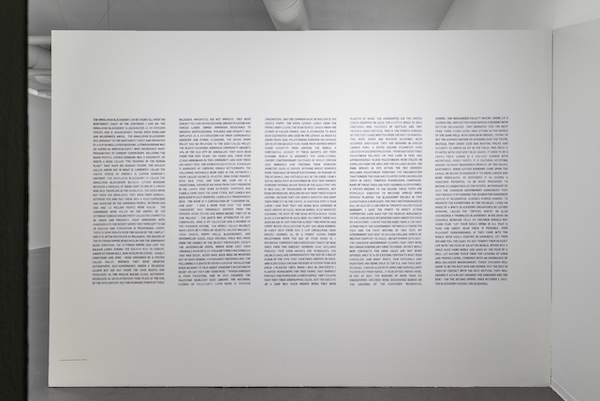
On a wall leading to the five pieces, there is a several-square-foot textual display featuring more than 1,600 words, written entirely in capital letters, with the thoughts seeming to randomly jump from one topic to another; there are no paragraphs, but the words cover five columns. The text, an integral element of the overall artwork, was hand-stenciled by Stuart and relates to the physical pieces. 

photo - Beth Stuart’s “Delible (poppy, watermelon, wheat, walnut, blackberry)” installation comprises a wall of text and five structures
Beth Stuart’s “Delible (poppy, watermelon, wheat, walnut, blackberry)” installation comprises a wall of text and five structures. (photo by Mike Andrew McLean, courtesy Art Gallery of Greater Victoria)

The text begins with mention of the Himalayan blackberry, an invasive species in British Columbia, and then moves to Luther Burbank, an American botanist, horticulturist and eugenicist, before discussing the Armenian Genocide (1915-16) and Canada’s residential schools.

In the middle portion of the textual display, Stuart describes what she sees as the plight of Gazans and the attitudes of certain Israelis.

“AS I WRITE, THERE HAS BEEN NO AID OF ANY KIND FOR ALMOST TWO MONTHS AND EVERY WATER DESALINATION PLANT HAS BEEN BOMBED,” Stuart writes. “IN EARLY 2024 THERE WAS A CLIP CIRCULATING FROM ISRAELI CHANNEL 14, OF A PUNDIT SAYING EVERY PALESTINIAN OVER THE AGE OF FOUR YEARS IS A POTENTIAL TERRORIST AND A NECESSARY TARGET OF WAR. SINCE THEN TWO KNESSET MEMBERS HAVE DECLARED PUBLICLY THAT EVEN INFANTS ARE TERRORISTS. THE DELIBLES BAGS ARE APPROXIMATELY THE SIZE OF A BAG OF FLOUR OF THE TYPE THAT SOMETIMES ARRIVES IN GAZA, AND ALSO COULD CONTAIN THE BODY OF A FOUR-YEAR-OLD CHILD.”

Stuart then talks about tree-planting, which she apparently did in university, then writes: “THIS IS THE FOURTH VERSION OF THIS TEXT I HAVE WRITTEN OVER THE PAST 20 MONTHS. THIS WEEK THERE ARE MASSIVE WILDFIRES NEAR OCCUPIED JERUSALEM. THEY ARE BURNING IN AYALON CANADA PARK, A SEVEN SQUARE KILOMETER PARK LOCATED IN OCCUPIED PALESTINE. THERE HAD BEEN THREE PALESTINIAN VILLAGES ON THIS LAND IN 1948. AND APPROXIMATELY 10,000 PALESTINIANS WERE KILLED OR EXPELLED FROM THE AREA AND THE VILLAGES RAZED.”

She talks more about “THE ORGANIZATION THAT FUNDED THE PARK” without naming it and then raises the issue of the Canadian government’s involvement with Israel and, specifically, its military.

“BETWEEN OCTOBER 7TH 2023 AND THE FIRST WRITING OF THIS TEXT, MY GOVERNMENT HAD SENT 30 MILLION DOLLARS WORTH OF MILITARY SUPPORT TO ISRAEL,” she writes. “ON SEPTEMBER 10TH 2024 THE CANADIAN GOVERNMENT CLAIMED THAT THEY WERE NO LONGER SENDING ANY ARMS TO ISRAEL. IN FACT, WHILE CONTRACTS FOR ARMS SALES ARE NOT BEING OFFERED, ONLY 12% OF EXISTING CONTRACTS HAVE BEEN CANCELLED, AND MANY PARTS, RAW MATERIALS AND MUNITIONS ARE BEING SOLD TO THE U.S. AND THEN SENT TO ISRAEL. CANADA ALSO BUYS ARMS AND SURVEILLANCE TECHNOLOGY FROM ISRAEL.”

The text moves into Stuart’s comments on residential schools before she concludes with the sentence: “FOR THE SECOND SPRING SINCE OCTOBER 7, 2023 THE BLACKBERRY HEDGES ARE BLOOMING.”

To at least one member of the Victoria Jewish community, Stuart’s work is an example of “artfully coded antisemitism – all the more reprehensible for its coyness.”

“In itself, ‘Delibles’ are very beautiful, evocative works,” Maurice Yacowar, a professor emeritus (English and film studies) of the University of Calgary, wrote in a letter to the art gallery that was also sent to the Independent.

“What renders the work problematic is the full-wall text – in spectral grey – that accompanies the sculptures,” Yacowar said. 

He said,“As a whole, the work contrasts the self-renewal of nature’s produce with humans’ murderousness. Unfortunately, the art is undermined by the artist’s ignorance and prejudice in its Palestinian references.”

He said Stuart misrepresents Israel and its media by choosing to reference a news outlet “that even in Israel is considered extremist.” And, he argues,“She omits the Oct. 7 context. A Hamas spokesman flatly stated, ‘There are no civilians in Israel’ – ie., only targets in war.”

Stuart’s exhibit does not include the word “Hamas.”

In a statement to the Independent, the AGGV said:

“The gallery is aware that some members of the community disagree with the subject matter of a current work of art on display. We are always interested to hear how the public, and our members, respond to our exhibitions. We also embrace learning, new ideas and critical perspectives.

“At the AGGV, we respect the artists and curators who work with us to create exceptional exhibitions. As an arts institution, our role is to amplify artists’ voices and create space for conversation and learning. We encourage an exchange of ideas that results in meaningful dialogue and understanding through art.”

The Architectures of Protection exhibition, in the synopsis posted by the AGGV, is supposed to reflect “on ideas and modes of protection and refuge – with regards to oneself, to community, knowledge, culture, identity and land. What are these spaces and practices? What is protection for some and not for others? 

Together, in the wake of the COVID-19 pandemic and in the current global social and political climate, the artworks in Architectures of Protection direct critical attention towards systems and structures that shape and impact everyday and sacred environments and encounters, alongside individual and collective relationships with the land.”

The exhibit also features the artwork of Dana Claxton, Jessica Karuhanga, Emilio Rojas and France Trépanier. 

Sam Margolis has written for the Globe and Mail, the National Post, UPI and MSNBC.