Victoria Fringe has started

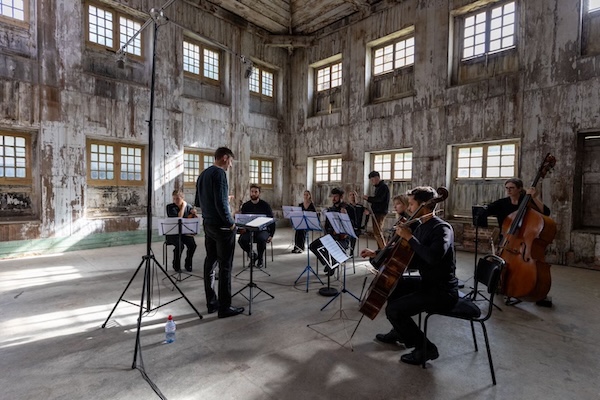
Director Francis G. Matheu, right, with actors Nolan Fidyk and Dan Landry rehearsing Alan Segal’s Shade Apparel. (photo by Sarah Nicole Faucher)

This year’s Victoria Fringe Festival, billed as “12 days of madcap fun this summer,” started on Aug. 20 and runs to Aug. 31. Included in the lineup are pieces by two local Jewish community members, Alan Segal and David Heyman.

Segal describes his play, Shade Apparel, as “comedy, drama and absurdity.” It features Danver, a playwright rooted in daily routine, who tries to find answers to questions he never knew he had. And, Segal told the Independent, “He is not prepared for the answers. Shade Apparel is a play about wanting to know more and not knowing where to find anything.”

In Segal’s words, our society is “heavily psychologized,” in that everything is given a psychological or emotional origin story, he said.  “But, if we breathe, we absorb culture, ideas, ideals and assumptions.

“Most of the time, we have a slight awareness of the precise origin of these. Their origin tale, however, is found in the social cauldron of daily life. This, too, is our apparel. We are clothed in more than material fabric,” he said.

From an early age, Segal has had an interest in how people become, well, anything; for example, how are allegiance, assurance, belonging, anger, dissent, happiness, or its opposite, created?

Segal’s first Victoria Fringe experience was not as a playwright but as a supporter of the arts who was captivated by the aura and array of creativity he observed. Last year, he founded Imbroglio Theatre, which will put on Shade Apparel.

“Beyond headlines and supposed fame, people venture into many realms of expression. I loved it from the start, and I expect many will be enlivened by what is approaching in Victoria at the end of August,” he said.

The creative team for the Fringe show comprises Dan Landry, Nolan Fidyk and Kendra Bidwell (cast), Alan Segal (writer), Francis G. Matheu (director), Elaine Montgomery (stage manager), Luke Weston and Andrea Gregg (lighting design), Phil Letourneau (music and sound design), Sarah Nicole Faucher (costume design) and Doug Wills (poster and program).

Shade Apparel is the second play I have written – a project I never intended to write and had no inkling of, until it leaped into my mind as a single scene,” said Segal.

His first play, Frey’s Anguish, premiered in March 2024 at Paul Phillips Hall in Victoria.

photo - David Heyman’s Ducks co-stars, right to left, Gloria Snider, Lorene Cammiade, Ryan Kniel and Danielle Greschner
David Heyman’s Ducks co-stars, right to left, Gloria Snider, Lorene Cammiade, Ryan Kniel and Danielle Greschner. (photo from David Heyman)

Heyman’s play, Ducks, takes place in the aftermath of an incident in which 1,600 ducks flew into an oilsands tailings pond in northern Alberta and died – a true event that caused international criticism of the provincial government. Years later, the oil company that owned and operated the pond was fined and the government promised tighter restrictions; however, the damage to Alberta’s reputation was significant.

The fictionalized theatrical story centres on a government communications director who has 20 minutes to retrieve an embarrassing, career-ending invitation erroneously sent out in his name before the media or public find out about it.

“I was communications manager for the premier of Alberta at the time [of the real-life incident] and, although I was not involved in managing the issue …  I was able to observe the crisis-management efforts from up close,” Heyman said.

“The characters and events in the play are entirely made up but are informed by my inside knowledge of how communications offices work, and how the media deal with such situations,” he said. “Before joining the Alberta Premier’s Office, I was a political reporter at the Calgary Herald for many years. Many people who work in governments in Alberta and BC have told me that the play feels authentic, which was my goal.”

When Ducks premiered at the Victoria One-Act Play Festival in 2023, it won the prize for outstanding original script. When it was performed at the 2024 Edmonton Fringe Festival, five of eight shows sold out and the play received stellar reviews. The play has also been performed at the Nanaimo Fringe Festival and in Tofino.

Heading into the Victoria Fringe, Heyman said, “We’ve got a top-notch cast, a great director and a great stage manager this year. The rehearsals are going very well and I’m confident it will be a hit.”

Heyman is the show’s producer and, joining him in mounting the Fringe show are Ryan Kniel, Lorene Cammiade, Gloria Snider and Danielle Greschner (cast), Francis G. Matheu (director), Andrea Gregg (stage manager) and Sarah Heyman (associate producer).

David Heyman has written an as-yet-unperformed sequel, Rhymes with Ducks, that he hopes to put on at next year’s festival. “The sequel is designed also to be a second (and final) act, and perhaps one day both will be performed as a single show,” he said.

For the Fringe, Shade Apparel is at Victoria Conservatory of Music’s Wood Hall, while Ducks is at James Bay United Church. Both plays are 45 minutes long. For tickets and more information, visit victoriafringe.com. 

Sam Margolis has written for the Globe and Mail, the National Post, UPI and MSNBC.

The Dark Lady enlightens

Arghavan Jenati as Emilia Bassano and Nathan Kay as William Shakespeare in Jessica B. Hill’s The Dark Lady, now playing at Bard on the Beach. (photo by Tim Matheson)

There has always been a controversy over whether William Shakespeare was the sole author of all his works. He penned 37 plays and 154 sonnets, with 25 of the sonnets referencing a “Dark Lady,” with raven black brows and wiry hair. Perhaps she contributed to his writing in more tangible ways?

Current thinking is that the Dark Lady was Emilia Bassano, a Jewish woman whose father was Italian and mother Moroccan. She was headstrong and wanted to find success in her own right – something unheard of in Elizabethan England. She was the first woman there to have a work published, her Salve Deus, Rexum Judaeum (Hail G-d, King of the Jews). 

In The Dark Lady, playwright Jessica B. Hill invites audiences to imagine what could have happened if Bassano and Shakespeare had met, particularly early on in his career, around 1589. At that time, Bassano was also starting on her quest to be a published poet. Hill postulates that Bassano enchanted Shakespeare and became his muse, collaborator and lover – and bore his child. 

Bard on the Beach brings this Canadian work to the Douglas Campbell Stage under the steady hand of director Moya O’Connell. With only two characters and 90 minutes long with no intermission, it is an opportunity for the audience to invest in the all-consuming tension, both intellectual and sexual, between the protagonists.

photo - Arghavan Jenati as Emilia Bassano and Nathan Kay as Shakespeare. The opening scene of Jessica B. Hill’s The Dark Lady, with the couple’s Elizabethan pas de deux is a precursor to their complex relationship dance
Arghavan Jenati as Emilia Bassano and Nathan Kay as Shakespeare. The opening scene of Jessica B. Hill’s The Dark Lady, with the couple’s Elizabethan pas de deux is a precursor to their complex relationship dance. (photo by Tim Matheson)

Bassano is an intelligent match for Shakespeare and has no difficulty exchanging witty repartee with him. She challenges him to portray his female characters in a stronger light. At one point, he tells her, “Collaborate with me, I need your mind.” And she willingly gives him the benefit of it. However, despite her contributions, she watches his career flourish while her work remains unrecognized. Ironically, her influence becomes apparent in Shakespeare’s later works, where he does pen female characters who defy traditional stereotypes. 

After Shakespeare’s death in 1616, Bassano comes across his folio of published works and is surprised to find that many of his female characters are named Emilia – clearly a tribute to her – which surprisingly appears to satisfy her thirst for recognition. 

Arghavan Jenati plays Bassano with passion and fury, while Nathan Kay infuses the Bard with the right mix of angst and joy. The opening scene with their Elizabethan pas de deux is a precursor to their complex relationship dance and its inherent power struggle. One memorable scene is their experiment with cross-dressing, as trousered Jenati becomes an aggressive alpha male and Kay an innocent maiden.

While I enjoyed both performances, Jenati was more one-dimensional in her presentation, while Kay provided a more varied interpretation. The dialogue, while mostly classical, is peppered with modern jargon. Throughout, there are references to Bassano’s Judaism, including her grandfather’s forced conversion to Catholicism, his translation of the New Testament into Hebrew, the persecution of her people and her placing of a stone on Shakespeare’s grave in the final scene. 

Ryan Cormack’s sparse set is simple, a series of stacked crates containing various props and costumes. Flowing red silks become bed sheets for the lovers while a cape morphs from a picnic blanket to a shawl to a baby’s coverlet to a shroud. The lighting plays dark or light as needed. Bespoke music by composer and sound designer Anju Singh becomes the third actor in the play, as it accompanies the couple through their 30-year relationship. Alaia Hamer, the costumer, outfits Bassano in a whimsical white frock covered with a suede drawstring bodice while Kay is given a period look for a gentleman of his time. 

This is a production well worth seeing. As artistic director Christopher Gaze notes in the press release, “The Dark Lady invites us to consider how stories are shaped and who gets to shape them.” Director O’Connell sees the play as “an opportunity to shine a light on Bassano and spend time in her orbit.”

Running on alternate nights with The Dark Lady on the small stage is the fast-paced, slapstick romp through all of Shakespeare’s plays and sonnets, The Complete Works of William Shakespeare (abridged) [revised][again]. Jenati and Kay, along with Craig Erickson and Tess Degenstein, share duties with a different combination of three of them taking the stage each night. Director Mark Chavez is at the helm of this irreverent take on the Bard’s repertoire.

On opening night, Kay, Erickson and Degenstein were on stage and were hilarious in their efforts to cover all of the Bard’s works in 90 minutes to avoid a penalty (an offstage voice counts down the minutes). Rife with contemporary references to all things Vancouver and Bard, the audience was in nonstop laugh mode from the start. The second act is all Hamlet, done forwards, backwards and upside down – a credit to the talented, energetic thespian trio. Warning: audience participation is part of the shtick, so you may not want to sit in the front rows.

Cormack’s set is lined with shelves of props from past Bard productions and Hamer brings back statement pieces from the past for the show. Jewish community member Anton Lipovetsky provides the sound design.

This show is probably the most fun you will have at Bard this season. And, if you’ve hated Shakespeare since your high school English classes, it might just change your mind. 

For tickets to all the Bard shows, which run to Sept. 19/20, go to bardonthebeach.org or call 604-739-0559. 

Tova Kornfeld is a Vancouver freelance writer and lawyer.

Broadway for a good cause

(photo from omershaish.com)

Omer Shaish brings My Broadway Shpiel to Vancouver Aug. 21, 7:30 p.m., at Temple Sholom. In addition to offering a night of Broadway tunes, popular Hebrew songs and his own original music, the performance will raise money for Temple Sholom’s campership program. To read more, see jewishindependent.ca/enjoy-the-best-of-broadway.

For tickets, visit tickettailor.com/events/templesholom/1702794. Buy now to make sure you don’t miss out on this fun evening for a good cause. Won’t be in town? Consider buying a ticket or two for someone who can’t afford it. 

– Courtesy Temple Sholom

The Mousetrap run extended

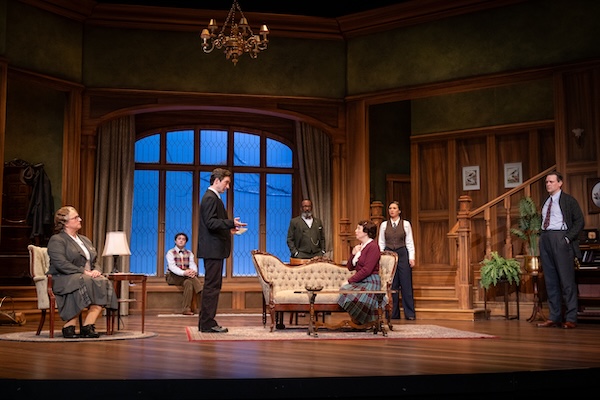
Beatrice Zeilinger, Zander Eke, Charlie Gallant, Anthony Santiago and Melissa Oei in The Mousetrap, which runs to Aug. 24 at Arts Club Theatre’s Granville Island Stage. (photo from Moonrider Productions)

You would be hard-pressed to find someone who did not know who Agatha Christie was, the most prolific mystery writer of all time. She gave the world those iconic detectives Hercule Poirot and Miss Marple. She also gave us The Mousetrap, the longest-running play, having been presented at St. Martin’s in London’s West End for 73 years (with only a brief hiatus during the pandemic) with 30,000 performances and more than 10 million tickets sold. 

The Mousetrap is the quintessential 1950s British whodunit, and Arts Club Theatre Company has brought the production to its Granville Island Stage so Vancouver audiences can be part of its legacy – which includes an audience promise to keep the identity of the murderer a secret.

The action takes place in a remote, snowbound English guest house, Monkswell Manor, run by newlyweds Mollie (Ming Hudson) and Giles Ralston (Jay Clift). Five guests arrive to stay for a weekend amid the news of a woman strangled 30 miles away in London. When Detective Sergeant Trotter (Charlie Gallant) arrives on skis to advise the vacationers that the murder is somehow connected to them and one of them could be next, suspicions and accusations abound. 

The guests are a cross-section of eccentric characters, starting with the verbose but vulnerable Christopher Wren (Zander Eke), a young wannabe architect; demanding former magistrate, middle-aged Mrs. Boyle (Beatrice Zeilinger), for whom nothing is good enough; Miss Casewell (Melissa Oei), a diehard feminist; and the retired Major Metcalf (Anthony Santiago). Add to the mix the unexpected guest, foreigner Mr. Paravicini (Andrew McNee), whose Rolls Royce just happens to break down on the road leading to the manor, and the drama begins. Staircases are tramped, doors slammed, curtains yanked, phones go dead and, as the stage darkens, one of the guests is murdered in the parlour.

Trotter starts the usual questioning of all suspects – including the now cliché, “Where were you when the lights went out?” – and sets out to reconstruct the crime in the hope of trapping the murderer. Dribs and drabs of information trickle out regarding each of the guests’ pasts, confirming that any one of them could have “dunit” but who did do it? And it’s possible there could be a third murder – cue the children’s nursery tune “Three Blind Mice,” which hauntingly reverberates throughout the play.

This is a real ensemble cast and all the actors are terrific in their roles; all have mastered their English accents, which provides added authenticity to the production. However, special mention must be made of Gallant, as well as Eke, with his quirky mannerisms; McNee, with his Italian accent, whose witty comments inject light-hearted levity into what appears to be an ominous situation; and Hudson, with her quiet but determined demeanour as she strives to be the perfect hostess amid the chaos.

The set by Patrick Rizzotti is spot on as a posh country house, with its rich, brown wall paneling; large, curtained windows; an ornate chandelier; potted ferns; brick fireplace, with the obligatory roaring fire; and plush brocade furniture. 

Jewish community member Itai Erdal’s lighting design spans the spectrum, from warm light to dark voids, providing the right mood for the right moments.

Nancy Bryant’s costumes reflect the classic elegance of the 1950s, with three-piece suits, long overcoats and fedoras for the men and tailored suits, dresses or pants for the women. 

In a YouTube interview, director Stephen Drover said he wanted to keep the play as authentic as possible, without any adaptations, and so was just doing it as written. His advice to the audience: don’t just watch it, solve it. At the end of the play, one of the actors exhorts the audience to keep the murderer’s identity a secret so that others can have the experience of figuring out the puzzle.

I saw The Mousetrap at St. Martin’s in London 20 years ago and I can say that this production is just as good. You don’t have to go abroad to see good theatre. You can stay right here at home. The play has had its run extended to Aug. 24. Tickets can be purchased at artsclub.com or from the box office at 604-687-1644. 

Don’t miss this opportunity to be part of history and enjoy an evening of gentle entertainment – and please remember to keep the ending a secret. 

Tova Kornfeld is a Vancouver freelance writer and lawyer.

* * *

Fun facts about Mousetrap

The Mousetrap was originally written by Agatha Christie as a short radio production for Queen Mary’s 80th birthday in 1947, and titled Three Blind Mice.

Christie, when asked about The Mousetrap’s potential longevity, thought the play would only run for about six months before it closed. 

Christie’s estate has a provision that no movie can be made of the play until it stops running in London. That may not happen for a very long time.

– TK

Bard mounts two comedies

Jennifer Lines as Beatrice and Sheldon Elter as Benedick in Bard on the Beach’s production of Much Ado About Nothing. (photo by Tim Matheson)

For a Vancouver summer experience, almost nothing beats an evening at Bard on the Beach. The appearance of the red and white tents in Vanier Park signals the start of the Shakespearean season. This year, two comedies – Much Ado About Nothing, done in its proper period, and Two Gentlemen of Verona, set in the 1980s – are featured alternating days on the BMO Mainstage.

There was much excitement in the air on Much Ado’s opening night. From the moment I walked into the tent and saw the stunning set (kudos to Pam Johnson), I knew I was in for a treat. The scene is 17th-century Mediterranean Messina with an elevated balcony, vined pillars, terraced gardens and a flagstone wishing well, all drenched in a cornucopia of brilliant colours. 

One of the Bard’s most entertaining comedies, the story revolves around two couples, one young and naïve, for whom love is just one romantic whisper away, and one mature and skeptical of what love can bring into their lives. Jennifer Tong and Angus Yam play the young Hero and Claudio while Jennifer Lines and Sheldon Elter, the more experienced Beatrice and Benedick. 

The action starts off with a trio of soldiers, Don Pedro (Matthew Ip Shaw), Benedick and Claudio, who, upon returning from battle, stop to rest at the home of Lord Leonato (David Marr), Hero’s father and the governor of Messina. There is instant chemistry between Claudio and Hero, but, while it initially appears that the younger couple will be the main protagonists, it becomes apparent that the play is really about the older two. Lines, with her mass of red hair, comes across as a fiery feminist and is sublime in her role as she exchanges witty bons mots with Elter’s Benedick, a confirmed bachelor. They both mock love and he makes it very clear that marriage is not on his agenda. However, they both “doth protest too much” and it really comes down to “will they or won’t they?”

The journey to their final epiphany is a furious romp through a masked ball (with an erotic pas de deux), mistaken identities, athletic eavesdropping, false allegations of infidelity and a faked death. The language is peppered with double entendres. 

Don Pedro attempts to play cupid (“some cupids kill with arrows some with traps”) for both couples but is hindered by his dastardly half-brother Don John (deliciously played by Karthik Kadam), who tries to sabotage the Hero/Claudio nuptials. Cue a motley crew of the local watch, helmed by Bard veteran Scott Bellis as the inept Constable Dogberry, who are tasked with bringing Don John and his co-conspirators, Borachio (Tanner Zerr) and Conrad (Kristi Hansen), to justice. Steffanie Davis, as one of the watch team, entertains with priceless facial expressions and physical antics and, along with her cohorts, injects slapstick comedy into this rom-com.

A prologue precedes the first act, with the inclusion of text written by Erin Shields that is meant to provide a counterpoint to 400-year-old misogyny, including with respect to a woman’s supposed holy grail – the snaring of a husband. Lines challenges the audience with her passionate monologue while Tong mimes the actions from the balcony. As Shields notes in the program, “this additional text both gives an opportunity for a limited character to reach her heroic potential and provides a framework for this incredibly successful comedy to reach contemporary audiences in an even deeper way today.” 

In addition to the gorgeous set, the show boasts fabulous costumes by designer Mara Gottler – leather doublets and earth-toned breeches for the men, corset frocks for the women, including frothy gowns and veils for the wedding scene. Jewish community member Mishelle Cuttler provides the sound design.

The production is fun – and it makes a powerful statement. But I have a problem with the script and the suggestion that virginal Hero might risk her marriage to Claudio by having a pre-wedding night tryst with someone else, and with Claudio’s readiness to believe the gossip, leading him to abandon her at the altar. Her subsequent fainting “death” and ultimate resurrection, leading to their reunion, does not account for the wrong that was so easily done to her. Even her final monologue, describing her pain and path to reconciliation, does not ease the blow.

The Much Ado cast shifts gears on alternating nights and pivots to 1980s Verona, with all the colour and decadence that entails.

photo - Matthew Ip Shaw as Valentine, Agnes Tong as Silvia, and Tanner Zerr as Turio in Bard’s production of Two Gentlemen of Verona
Matthew Ip Shaw as Valentine, Agnes Tong as Silvia, and Tanner Zerr as Turio in Bard’s production of Two Gentlemen of Verona. (photo by Tim Matheson)

In Two Gentlemen of Verona, best friends Proteus (Jacob Leonard) and Valentine (Ip Shaw) separate, as Valentine goes to Milan to find excitement while Proteus stays behind to be with his girlfriend Julia (Tess Degenstein). However, Proteus’s parents, Antonio (Craig Erickson) and Ursula (Jennifer Clement), think it best that he follow his friend to Milan, to stay out of trouble. So, off he goes with his manservant Launce (a terrific Bellis) in tow and Crab, Launce’s dog (Mason in real life and artistic director Christopher Gaze’s own yellow Lab). As expected, Crab steals every scene he is in, without making a sound. On opening night, he even stopped to nuzzle some front row patrons as he exited the stage. 

Valentine, on arrival in Milan, is immediately smitten with Silvia (Tong), the daughter of the Duke (a mafiosi-like Elter). When Proteus arrives, he conveniently forgets about his girlfriend Julia and is equally taken with the glamorous femme. So, when Valentine tells his best bud that he intends to elope with the duchess, Proteus, to have Silvia for himself, tells the Duke. After all, as Proteus states, “in love, who respects friends?” Meanwhile, the Duke wants Silvia to marry Trurio (Zerr), although who knows why, because he comes across as a big, dumb athlete. 

Valentine is banished from Milan and Proteus attempts to woo Silvia, who makes it quite clear that she is not interested. Julia arrives, disguised as a man, to check up on her boyfriend and the fun/intrigue begins with swapped rings, torn love letters and a gang of Gothic outlaw rockers armed with various weapons, including a chainsaw, who intervene and provide for a surprising ending.

The production values are high and the designers have done a great job in creating a 1980s vibe, from Johnson’s multi-arched set to Gerald King’s lighting design. Costume designer Carmen Altorre highlights exercise leotards and leggings à la Jane Fonda, padded shoulders, caftans and tennis whites, as well as Miami Vice pastel-coloured suits to clothe the posh crowd. Of course, there is the hair – voluminous back-combed dos for the women and mullets for the men. A lot of the action takes place around the pool house, with props including a floating pink swan, multi-coloured beach balls, boom boxes and skateboards.

Malcolm Dow’s sound design brings back all the 1980s oldies and goldies, including theme songs from Dallas and St. Elmo’s Fire, with some funky choreography courtesy of Nicole Spinola.

Director Dean Paul Gibson has taken liberties with the script and not just a nip and tuck here and there, but major surgery, particularly with the ending. Purists may be appalled but the #MeToo generation will applaud the final scene.

Running on the smaller Douglas Campbell stage are The Complete Works of William Shakespeare (abridged) [revised] [again], a 90-minute romp through all 38 Shakespeare plays and 150-plus sonnets, including a version of Hamlet done backwards, and The Dark Lady, about Shakespeare’s supposed muse, collaborator and lover, Emilia Bassano, a Crypto-Jew.

For tickets, visit the website bardonthebeach.org or call 604-739-0559. The festival runs to Sept. 20. 

Tova Kornfeld is a Vancouver freelance writer and lawyer.

Jacob Samuel’s new special

Jacob Samuel self-produced his newest comedy special, Big Talk. (Chelsey Stuyt Photography)

Jacob Samuel’s second comedy special, Big Talk, premiered on YouTube last month and already it has racked up more than 20,000 views. The Vancouver-based comedian filmed the 52-minute special in front of live audiences at the city’s China Cloud Studio. In addition to writing and performing, Samuel gets producing, directing and editing credits. 

Much of the material in Big Talk was worked out over five years, a period punctuated by Samuel’s winning a 2021 Juno Award for best comedy album for his first special, Horse Power. And that win was not the first time the comedian was recognized for his work.

At 25 years old, Samuel submitted some of his original single-panel cartoons to The New Yorker magazine, which published some of them – a notable achievement, especially at such a young age. Several other publications have featured his humorous illustrations, as well, including the Jewish Independent. He has published two books of single-panel cartoons.

Samuel has been performing stand-up for years – at clubs, on stages, television and radio, at festivals. He’s a regular on CBC Radio’s The Debaters.

His drive to perform started early in life.

“Honestly, I’m still trying to convince myself I can competently tell a joke,” he told the Independent. “Growing up, my parents and their friends revered clever comedians. I always felt that being funny was a difficult thing that people valued. As far as I can remember, I have always been driven to get up and talk in front of people even though I wasn’t naturally great at it – when I was young, I had some minor speech impediments.”

As for his gutsy New Yorker submissions, he said, “It seemed like a fun thing to try. I’ve always had a certain misplaced confidence about going after things … I’m not sure why. I think I was blessed with a certain level of obliviousness and an audacity to go for things that I found interesting/exciting.”

Samuel’s new special shows off his rapid delivery and finely honed comedic timing, and the material supports his affable relationship with the audience. The jokes in Big Talk run the gamut, covering the joys and challenges of welcoming a new puppy, the mental health benefits of knitting, the absurdity of the Honda Odyssey, being newly married (Big Talk’s jokes are “officially approved” by his spouse), and other very funny bits.

Being successful requires more than just comedic writing talent and good timing.

“Being a comedian now is like running a small business,” he said. “I have a manager now, but I still manage much of my booking, touring, and sometimes I even produce my own shows. So, I spend just as much time doing ‘comedy admin work’ as I do writing and performing material. You can’t really advance your career now by being exclusively an ‘artist.’ I maintain many comedy spreadsheets, which maybe sounds like an oxymoron.”

Even after all the commercial elements have been satisfied, there are still obstacles to confront. Being an artist who is driven to perform does not mean there are no pre-show jitters, Samuel shared. “The fact that people are coming to see me now actually makes me a bit nervous because I hope I’m as good as what they expect.”

Big Talk feels more personal than Samuel’s previous work, while also featuring plenty of material about everyday human struggles and absurdity.

“I still feel like my comedy is pretty observational but maybe I’m digging more into my personal life subconsciously now,” he acknowledged. “I think maybe I’m gravitating towards more personal material because that is what people tend to connect with more. Maybe I’m getting more inspired to do personal material because, as I get older, I think I’ve gotten a better sense of myself. I think it’s a natural part of maturing, to go from observing the world around to becoming more self-conscious. Having said that, I still love observational comedy. I think my favourite type of comedy weaves both together.”

The use of social media has its benefits, like building an audience, but it comes with costs, too. 

“The pressure to produce more content has grown exponentially…. Many of the comedians who are now gaining the most fans are just churning out content,” said Samuel. “So, I do feel more pressure to do that, to keep up, but I’m pretty good at keeping it to a reasonable level so as to not burn out. I need to make sure I’m still having fun writing and performing, so I limit how much I’m going to indulge those pressures.”

But he can’t completely avoid them, as social media has the power to make or break projects in this era.

“The benefits of social media are pretty enormous, in that you can gain an audience without having to go through any gatekeepers,” said Samuel. “The risk is that you start ‘creating for the algorithm only’ and start trying to make content based on what you think will go viral as opposed to what you find funny. Then I think you just end up sounding like other comedians who are doing the same.”

Asked about the potential impacts of artificial intelligence, Samuel said. “If you asked me this a year ago, I would say I was not at all afraid of AI. It seemed that it would write jokes that were very basic, crude and pretty unfunny. However, since then, it’s gotten a lot better. I think AI can be useful in comedy but I’m also pretty worried about it. I was playing around with AI a few weeks ago and it’s getting pretty good at writing comedy that is formulaic or follows a basic structure. I’ve heard of some other comedians using it to see if their idea is creative enough – if the AI can think of it, then it’s not. It could also be useful as a brainstorming tool. I think AI will change comedy, but I don’t think it will put comics out of business because people crave human connection. Will it make comedy worse or better? It could go either way.”

AI is not the only complexity these days.

“I don’t think any topics are beyond the pale … but some are a lot harder to make an audience laugh at than others,” said Samuel. “When people complain that certain topics should not be joked about, it’s often that the jokes they’ve heard about that topic just were not clever or nuanced enough. I think the more intense and heavier the world is, the more important comedy is…. Comedy is a great way to cope with uncertainty, but I’m also concerned about the increasing amount of comedy that is just feeding off of and confirming disinformation and catering to specific groups’ political views rather than challenging them.”

Asked about what it is like to be a Jew in comedy, particularly during the events of the last couple of years, Samuel said, “I’m not sure I have a great answer…. I don’t think it’s really impacted my career. It has impacted how I feel about being a Jewish performer. I do think that it’s more important now to talk and joke about being Jewish. I definitely feel like a form of antisemitism that was previously contained has now been unleashed in several forms. My only response to that as an individual is to find more ways to joke about being Jewish on stage and not to shy away from talking about being Jewish.”

Big Talk is dedicated to the memory of Samuel’s mother, who passed away in 2021.

“It probably wouldn’t surprise people to know that my mom was my biggest supporter,” he said. “I’m sure she would’ve become a full-time press agent for this special. When I published my second book of cartoons, in 2017, she managed to get a copy to the prime minister somehow (true story). Justin Trudeau sent me a signed letter about it – he was more popular then….

“My mom made a significant professional contribution to Canada’s Jewish community,” added Samuel. “She was the executive director of Toronto’s Jewish affordable housing agency for two decades and was very proud of her work and the impact it had on helping people access affordable housing.

“When I won the Juno Award, I was in the midst of dealing with my mom being very ill. It was the most difficult thing I’ve ever had to deal with. Although I don’t talk about it explicitly, I developed most of the material for this special in the wake of losing my mom. Building this act was something I could work on to process my grief. There’s also something about losing a family member that makes you want to take action in life. It definitely contributed towards my drive to produce this show as an actual comedy special and take the risk of self-producing and self-releasing it.”

Big Talk can be seen on YouTube, which is “the only place to watch [it,] unless someone reading this owns a streaming network and wants to make a deal,” Samuel said.

As for the near future, Samuel has another “special” to produce.

“My wife and I are expecting our first child very soon,” he shared. “So, I’m going on a hiatus from touring and performing for a few months. After that, I will probably be back on the local circuit, likely with some new material about how relaxing it is to have a new baby.” 

Sharing a personal journey

Son of a Seeker follows Kai Balin’s search for where he fits within Judaism and Jewish community. (still from Son of a Seeker)

Kai Balin’s documentary Son of a Seeker, which screened to a sold-out Rothstein Theatre last month, is an official selection of the 2026 Vancouver Jewish Film Festival, which will take place next April.

The very personal work that follows Balin’s search for where he fits within Judaism and Jewish community will be thought-provoking for viewers, generating questions about what religion, family and belonging mean to them.

“I think my mother, sister and even my brother have a more innate sense of security in who they are and in who they are as Jews,” Balin told the Independent. “My dad and I, on the other hand, have a more complex identity. It makes it harder to fully fit in or feel completely rooted. However, I see it – and I know my dad does too – as a kind of blessing. It’s ultimately who we are. And, while it comes with plenty of challenges, being a seeker is also a beautiful way to live.”

Balin dedicates the documentary to his grandparents, who survived the Holocaust. “But survival is not the same as security,” he narrates in the film. “My father and I have spent our lives trying to understand what it means to continue.”

Having grown up in a Jewish but not religious home, where his deeper questions were not answered, Balin’s father, Jeffrey, began looking for answers elsewhere, notably, in Buddhism. And, while Balin’s mother, Jennifer Shecter, grew up in a traditional Jewish family and attended Jewish school, “bringing a strong sense of Judaism into the home wasn’t a priority, but I knew I was a Jew,” says Kai Balin in the film. “And I got to create a version of Judaism that I owned and I loved.”

The home video clips in the film highlight this love. As a child, Balin plays at being a rabbi, wants to be one when he grows up. But, over the years, he loses this connection, just as his father begins to return to Judaism. How the father and son negotiate their respective paths, while being respectful of the other’s journey, is a key aspect of the documentary.

“When I first started making Son of a Seeker, I had no idea what the title would be, or even what the story really was,” said Kai Balin. “I knew I wanted to explore Judaism and what it means to be Jewish, but I didn’t expect it to become so personal. Early on, I interviewed a few dozen Jewish people from across the spectrum on camera. But, in the end, I realized I wanted this film to be something much more intimate.

“My dad initially thought he’d just be one of many voices in the film. He didn’t expect to become such a central figure in the story. It pushed him far beyond his comfort zone, but he ultimately believed in the project and gave me his full blessing to be a part of my documentary.”

Balin’s sister, Justine, and brother, Jackson, are also in the film, his brother in the background, while his sister is featured more prominently.

“My sister was my right-hand woman throughout the entire process – I truly couldn’t have made this film without her,” said Balin. “She filmed what’s arguably the most important scene in the movie, when I’m walking through the town where our grandfather was born and raised until he was sent away to a forced labour camp and had everything taken from him and his family. My sister also spent countless hours in the editing room, helping make the tough calls about what to cut and what to keep. Without her input, the film would’ve easily been two hours long and a lot less focused.

“My whole family really stood behind me on this project,” he said. “They gave me the strength, courage and confidence to see it through.”

Balin came to filmmaking somewhat organically.

“I was studying kinesiology at Western University. After my second year, I worked on an indie film, Volition, as part of the swing crew, helping with lighting and grip. Later that summer, I was the program director at Camp Hatikvah (2017), where the videographer/photographer, Denis Lipman, brought some super cool gear…. Right before my third year, I bought a camera – and, from then on, I started dedicating less and less time to what I was actually studying, and more time learning how to shoot and edit. 

“I was running a nonprofit at school that threw club and bar events for local charities, and the first video I ever made was a recap of one of those nights,” said Balin. “I started getting more involved on campus and around the city (London, Ont.), looking for any chance to shoot videos.

“My first paid gig was filming a club event that featured a guy in a robot suit on stilts. I was also on the rugby team, so I made a few hype-up videos for them whenever I was injured (which was quite a bit). Over the last two years at my time in university, I got more invested in videography and less focused on kinesiology. I ended up shooting videos for all sorts of events and student clubs.”

After graduating, Balin pursued videography full time. Not wanting to make corporate videos, he started making a documentary about his dad’s work.

“He was a leadership development coach working mostly with heads of NGOs and social enterprises,” explained Balin. “I lined up a plan to travel to different countries, mostly in East Africa and India, to film these organizations and their leaders. I started shooting, but I didn’t have a clear direction. Eventually, I lost the passion for the project – and for filmmaking altogether. I just wanted to travel.”

It would be almost five years before Balin made another video.

“It took about three months to put My 5 Year Video Project together – I wasn’t working any other job at the time – and we held a small premiere in August 2024 with around 70 people,” he said about the film, which can be seen on YouTube.

“I didn’t expect people to be so moved by what I had created,” he said. “That experience gave me the confidence to pursue my next film project. At the time, it was just a rough idea, and I had no clue it would eventually become something so personal – and so deeply centred around my father’s story as well.”

But, for Balin, it’s the personal aspects of art, films and books that draw him in, “even if I can’t directly relate to what the creator is going through,” he said. “I remember hearing years ago, from a few directors I really respect, that you ultimately have to make the film for yourself – something you’d enjoy watching a hundred times over, and something that excites you to work on every day.

“For me, that excitement comes from sharing something personal. It’s my life, my questions, my struggles, and I find them interesting. So maybe others will too.”

As for what comes next, Balin said, “One side of me just wants to let the river flow, follow life as it comes without getting too attached to any future outcomes. But the other side of me dreams of being a famous, successful filmmaker making big-budget movies. There’s still something in me that maybe wants to be a rabbi one day as well.”

He added, “I know my relationship with Judaism will continue to evolve, but, for now, I’ve found a sense of peace. I feel like I have a steady relationship with it, and I’m much more secure in who I am as a Jew than I was when I started this film.

“These days,” Balin said, “I find myself seeking something else: my soulmate. That might even be the focus of my next documentary – exploring the journey to find ‘the one’ – if that concept even exists.” 

Forgotten music performed

Through a chance conversation with a curator at the Auschwitz Memorial and Museum, conductor and composer Leo Geyer came across musical scores composed by concentration camp prisoners during the Holocaust. June 3 to 7, at London’s Bloomsbury Theatre, the music Geyer documented was played for the first time in 80 years. (photo from Sky Arts)

In 2015, London-based musician and composer Leo Geyer was commissioned to write a tribute honouring British historian Sir Martin Gilbert, who had recently died. Visiting Oświęcim, Poland, to better understand the Holocaust historian’s research, a chance conversation with a curator at the Auschwitz Memorial and Museum led Geyer to a trove of forgotten musical scores composed by prisoners who had been forced to perform in the SS-run orchestras in the Nazi concentration camp, where more than 1.1 million died in gas chambers, mass executions, torture, medical experiments, exhaustion and from starvation, disease and random acts of violence.

The deteriorating and fragile sheets of music, written in pencil, were faded and ripped. Many had burn damage. Intrigued, Geyer devoted nearly a decade of detective work to studying the documents and filling in missing gaps, and the music formed the basis for his doctorate at Oxford University. From June 3 to 7, at London’s Bloomsbury Theatre, the music Geyer documented was played for the first time in 80 years, to commemorate the liberation of Auschwitz in January 1945. The opera ballet included the unfinished scores that Geyer completed and choreography by New York-born choreographer Claudia Schreier.

“The musicians took incredible risks to make brazen acts of rebellion. When good news of the war [of the Allies’ June 6, 1944, D-Day landings] reached the men’s orchestra in Auschwitz I, they performed marches not by German composers but by American composers,” Geyer said in an interview with France 24’s daily broadcast Perspective.

The guards couldn’t distinguish between a Strauss waltz and a John Philip Sousa march.

The musicians “would also weave in melodies from Polish national identity such as St. Mary’s Trumpet Call (a five-note Polish bugle call closely bound to the history of Kraków). We also know of secret performances [that] would take place, which would principally encompass Polish music, but we also know Jewish music was performed as well,” said Geyer.

The story of the orchestras at Auschwitz was popularized by Fania Fénelon, née Fanja Goldstein (1908-1983), a French pianist, composer and cabaret singer whose 1976 memoir Sursis pour l’orchestre, about survival in the women’s orchestra at the Nazi concentration camp, was adapted as the 1980 television film Playing for Time. The orchestra, active from April 1943 to October 1944, consisted of mostly young female Jewish and Slavic prisoners of varying nationalities. The Germans regarded their performances as helpful in the daily running of the camp in so far as they brought solace to those trapped in unimaginable horror. As well, the musicians held a concert every Sunday for the amusement of the SS.

Geyer explained that the SS organized at least six men’s and women’s orchestras at Auschwitz, and perhaps as many as 12. The groups principally played marching music as prisoners trudged to the munitions factories and other industrial sites, where they worked as slave labourers, he explained.

“Musicians had marginally better conditions than other prisoners,” he noted. Nonetheless, he said, “The vast majority of the musicians and composers did not survive the war.” Most of their names are lost. Geyer was able to track down the composer of one unsigned composition by comparing the handwriting to a document found at a conservatory in Warsaw.

Adding poignancy to the performances in London, the musicians played from copies of the original scores.

“We poured our heart and soul into these performances,” said Geyer. “I am neither Jewish nor Romani. But I am human.” 

Gil Zohar is a writer and tour guide in Jerusalem.

* * *

A replica of Auschwitz

Due to conservation issues, the Auschwitz Memorial and Museum no longer permits the filming of movies at the historic site. Using advanced spatial scanning technology, the museum employed a team of specialists, led by Maciej Żemojcin, to create a digital replica of the Auschwitz I camp. The project was recognized at the Cannes Film Festival.

Museum spokesperson Bartosz Bartyzel told Euronews Culture that the replica was created “out of the growing interest of directors in the history of the German camp.”

“The Auschwitz Museum has been working with filmmakers for many years – both documentary filmmakers and feature film directors,” he said. “However, due to the conservation protection of the authentic memorial site, it is not possible to shoot feature films [there]. The idea to create a digital replica was born out of the need to respond to the growing interest in the history of the Auschwitz German camp in cinema and the daily experience of dealing with the film industry. This tool offers an opportunity to develop this cooperation in a new, responsible and ethical formula.”

– GZ

Enjoy the best of Broadway

“It may sound like a cliché, but I really believe that music is a unique language. You don’t have to know how to read it, you might not understand the lyrics, but it can still touch your heart and soul,” Omer Shaish told the Independent. “At the end of the day, it doesn’t matter what genre you listen to, it will always make you feel something. That’s what I always hope to do when I get on stage – use the music to touch people’s hearts and souls.”

photo - Omer Shaish brings My Broadway Shpiel – stories, Broadway tunes, popular Hebrew songs and original music – to Vancouver Aug. 21
Omer Shaish brings My Broadway Shpiel – stories, Broadway tunes, popular Hebrew songs and original music – to Vancouver Aug. 21. (photo from omershaish.com)

Shaish brings My Broadway Shpiel to Vancouver Aug. 21, 7:30 p.m., at Temple Sholom. In addition to offering a night of Broadway tunes, popular Hebrew songs and his own original music, the performance will raise money for Temple Sholom’s campership program.

While Shaish never attended summer camp growing up, he did talk about growing up in the Jewish community.

“We’re one big family and I love that about us,” said the singer, who was born and raised in Rishon LeZion, which is about 20 minutes south of Tel Aviv.

“I spent most of my teenage years and my early 20s in Tel Aviv, where I was surrounded by great art, amazing people and incredible food!” said Shaish, who knew from a young age that he was going to be a singer.

“My parents say that, as a toddler, I’d pick up anything that could resemble a microphone and sing at the top of my lungs – everywhere. I always loved having an audience,” he said. “Even though, in real life, I sometimes come across as a bit shy and introverted, having an audience to sing for always made me feel at home. Up until today, having an audience, no matter how big or small, brings me to life.”

Shaish started his career as a vocalist in the Israeli Air Force Band, performing on military bases and in Jewish communities in Europe and Canada. He also is an actor, performing in Israel before moving to New York City in 2007 and graduating from the American Musical and Dramatic Academy. He has numerous theatre, vocalist and soloist credits to his name, but mainly has been touring internationally as part of the classical vocal trio Kol Esperanza and with his self-produced, one-person show My Broadway Shpiel.

“Even though I love acting, I’ve been focusing on singing in the past few years,” he told the Independent. “I realized, throughout the years, that I feel more at home just being myself on stage. I enjoy sharing these moments with the audience and it makes every show feel different and so alive. Playing a character can be interesting, too, but, for me, there’s nothing better than simply being myself.”

At the moment, Shaish calls Baltimore, Md., home. Previously, he toured the United States for many years, and lived a few years in Los Angeles and in Miami.

“I absolutely love traveling, seeing the world and meeting lovely, interesting people,” he said. “My friends always make fun of me and say that they never know where I’m at, to which I reply with, ‘neither do I.’ It can be exhausting at times, but it’s always worth it. I feel very lucky to do what I love and that gives me a lot of energy to keep at it.”

He’s looking forward to performing here.

“I love Vancouver!” said Shaish. “I’ve been there many times and I think it’s one of the most beautiful places on earth. The last time was only a few months ago, for rehearsals and a recording session. I’ve performed in Vancouver before and I can’t wait to be back and enjoy the views, the fresh air and, of course, the wonderful people!”

About the show he’s bringing with him, My Broadway Shpiel, he said, “As I tell my story and share some anecdotes about the Jewish story of Broadway, I sing some classics from Fiddler on the Roof and West Side Story, and all the way to some surprises by ABBA and Elvis Presley!”

One of his favourite moments in the performance is when he shares the experience of living in the United States with a foreign name. 

“I have heard so many variations of my name from so many people that I have met,” he said. “‘Omer’ apparently isn’t very easy to pronounce. So, one day, I thought, why not write a song about it? I took Liza Minelli’s ‘Liza with a Z’ and turned it into ‘Omer with an E.’ At first, I wanted that to be the name of my show, but My Broadway Shpiel felt more fitting.”

As for the importance of music, he said, “This brings me back to how I see music as a language. It has superpowers. It can take us away from one reality and bring us to a completely different one within a split second. It triggers our emotions in such a powerful way. When people talk to me after a show and say that I made them laugh, made them cry, or made them forget about their day, I know I did something right.”

For tickets to My Broadway Shpiel, visit tickettailor.com/events/templesholom/1702794. 

Two visions that complement

Kim Rosin, left, and Alejandra Morales’s shared exhibit, Parallel Visions, is at the Zack Gallery until July 21. (photo from the artists)

The double exhibit Parallel Visions opened at the Zack Gallery on June 25. It introduces two artists – Kim Rosin and Alejandra Morales – who have different backgrounds, are different ages and had never met before. But their art is amazingly compatible.

“When Alejandra submitted the photos of her pieces, they were mostly of fruit, along with a fruit stand. I thought that it would be interesting to pair her with Kim’s allotments,” said gallery curator Sarah Dobbs about why she combined both artists in one show. “However, when I saw Alejandra’s work at her studio, there was so much more, so I had to rethink. 

“Upon reflection, I realized that both Kim and Alejandra turn to the natural world as more than just subjects of beauty. For Kim, painting from a community garden in West Vancouver becomes a way to reflect on growth, nourishment and the fragility of food systems in times of scarcity. Alejandra, working from northern Mexico, uses natural imagery as well, but in a dreamier way – exploring how Latin America is romanticized by outsiders. Though grounded in different geographies and experiences, both artists explore how abundance can hold layers of tension between beauty and critique, comfort and resistance. Hence the title, Parallel Visions.”

Rosin’s paintings are of her plot in a community garden. “I have always been interested in growing food,” she said. “From nothing, just a little seed, wonderful, nourishing plants grow. It feels almost magical. It makes me happy but also a little sad, because not everybody can grow their own food. Some people have to go without, when they don’t have a garden and can’t buy their vegetables because of high prices. When I look at my plot, I think of the food chain on our planet.”

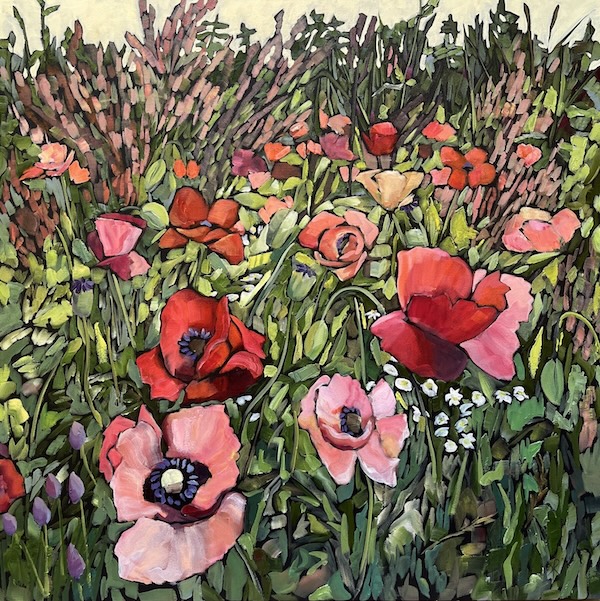
Her paintings are full of edible green things: kale and lettuce, beets and carrots. One can imagine the labour that went into growing such a lush garden and the tasty dishes after the harvest. The images reflect the artist’s love for the plants she grows, as well as her longing to share her cornucopia with everyone. Her painting of red poppies is a worthy companion to the vegetable plots, adding beauty to the nutritional component. “Many people grow poppies in our plots,” she said. 

photo - “Plot 5: Poppies and Pollinators” by Kim Rosin
“Plot 5: Poppies and Pollinators” by Kim Rosin. (photo from the artist)

Rosin also enjoys painting still life. “It is like a recording of a moment in time,” she said. “And the decorative element is there, too. People often appreciate such paintings, especially if they could ask me to include their favourite objects in the image.” 

She likes working on commissions, which she describes as “collaborations with the clients.”

“Commissions take a different mindset from making art of my own, less creative freedom,” she acknowledged. “Some clients have a certain vision, and my job is to bring that vision to life. One example is dog portraits. Dog owners want them realistic, almost photographic. I don’t have to interpret anything, as I do in my own paintings. It is easier in some way, like a mechanical exercise. My creativity is not as important as my skills as a painter. Of course, it is not that simple. When I paint, the image occasionally changes on its own, it has its own demands. Then I worry. What if the client doesn’t like the end result? What if they won’t buy this painting? Fortunately, that has never happened to me.”   

People’s stories have always served as an inspiration for her art. “I’m curious about everything – traveling, music, nature. Before I moved to Vancouver, I lived in Seattle,” she said. “I worked on theatre sets for several fringe theatres there…. After I moved here, I created a set for a musical on Granville Island. Teaming up with theatre companies was always a fabulous experience, despite the low budgets.” 

Like Rosin, Morales also likes working on commissions. “Some people are very relaxed. ‘You’re the artist. You know what to do.’ Other people are very involved. They want exactly what they envision and you, the artist, need to give them what they want,” she said.          

On the other hand, unlike the serene greenery in Rosin’s paintings, Morales’s paintings emphasize her unease with society’s contradictions and paradoxes. Her flowers are colourful and gorgeous, but unrealistic. “I wanted them too beautiful for this world, almost uncomfortable,” she said. “And the animals in my paintings – they fight, like humans do. There are conflicts there.”    

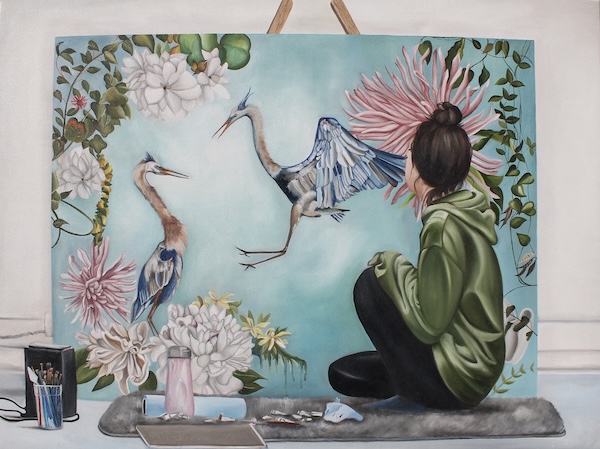
In her self-portrait, which is on display, the dichotomy between the pastel tones, the elaborate, narcissistic flowers, the birds in the middle of an angry confrontation and the pensive woman facing the painting echoes the artist’s contemplation on the incongruities of life. 

The self-portrait is titled “Will Happiness Find Me?” Many of Morales’s other paintings also sport titles that add a verbal facet to the art’s visual impact. “My titles come from books or songs. Or, I remember someone saying something, and it is relevant for this painting. Or a title could be a quote from an old show,” she said. Her tranquil landscape of a Vancouver shoreline is called “Nothing Mattered More Than Anything Else.”     

photo - “Will Happiness Find Me?” by Alejandra Morales
“Will Happiness Find Me?” by Alejandra Morales. (photo from the artist)

Morales moved to Vancouver four years ago from Mexico. “I received my BA from McGill University in 2016 and studied for my master’s degree in visual arts at UBC.”

Besides Canada, she studied art in Spain and in her native Mexico. “When I took art classes in Mexico, many students were housewives,” she recalled. “North Mexican culture is different than here. Women are supposed to follow a traditional path of a wife and a mother. The women that took art classes were anxious because they deviated from that path. I wanted to show their anxiety, their inner struggle in my paintings.”

According to Morales, women are freer here in Canada, the entire society more relaxed, and her art reflects the difference. “I painted a jungle in Mexico – and it was very bright and colourful. But when I painted a jungle here, the colours became less vivid, more muted. Maybe because it was raining outside,” she said.

Morales taught fine art as a teacher’s assistant, while she studied at UBC. “I liked teaching. I would like to do more of that,” she said. 

Her latest artistic project is rather unusual. She painted a series of cityscapes featuring dumpsters around Vancouver. “Some of them have amazing graffiti. It was such fun,” she said. 

Parallel Visions is on until July 21. Rosin’s website is kimthings.com; Morales’s is moralesalejandra.com. 

Olga Livshin is a Vancouver freelance writer. She can be reached at olgagodim@gmail.com.