A lifelong love of performing

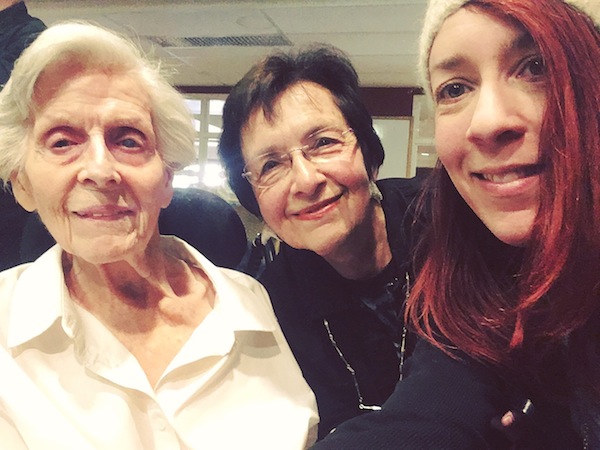
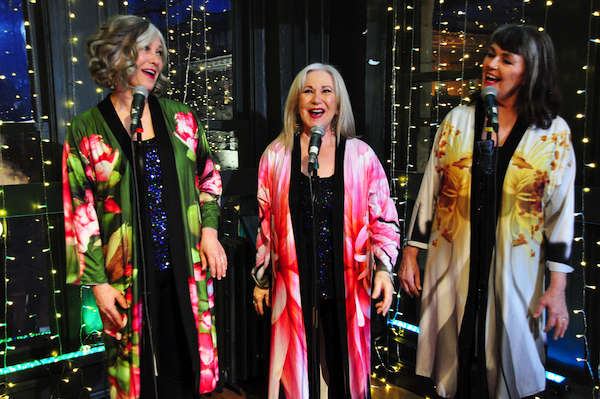
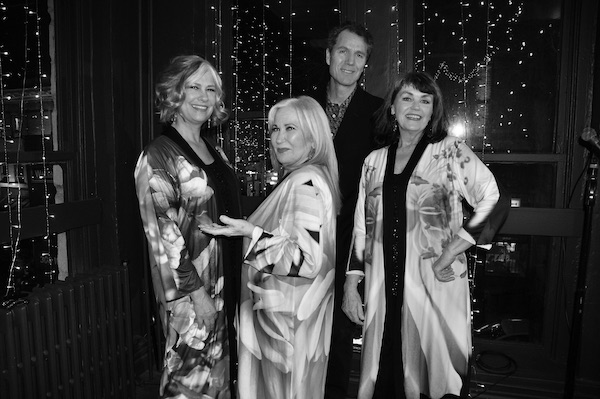
Left to right, the Hot Mammas are Mary Ella Young, Julie Brown, Georgina Arntzen. (photo by Dee Lippingwell)

The Hot Mammas are busy this holiday season – and year round. With three albums to their credit, they perform at venues ranging from jazz clubs to shopping malls. Readers can next see them at Robson Square Skating Rink on Dec. 15, and then at Water Street Café Dec. 18.

One of the holiday songs the group performs is “Mamma Julie’s Hanukkah Song,” so dubbed by Georgina Arntzen and Mary Ella Young because the third member of the Hot Mammas, Julie Brown, wrote it, and “too many songs are called ‘The Hanukkah Song’ or ‘Festival of Lights.’” (A video of it can be found via facebook.com/thehotmammas.)

Brown’s Jewish heritage is Ashkenazi. “My maternal grandfather, who I’m named after (Julius Cohen), was a rabbi,” she told the Independent. “My father always followed our traditions. My mother was a phenomenal cook and it’s because of her I’m able to make latkes, matzo balls, knishes, chicken soup, etc. When she didn’t want me to understand something she and her sisters were talking about over the phone, she’d suddenly switch from English to Yiddish. That’s where and how I picked up some fun expressions, which I use to this day.”

Born and raised in Montreal, Brown said she has been performing music since she could walk.

“My older, late, great brother Martin Overland was the founding member of the Canadian folk group the Raftsmen,” she said. “Your readers may recall the song ‘Something to Sing About,’ which was one of their hits. Martin had perfect pitch and the voice of an angel. He was also a terrific guitarist and accordionist. Eleven years my senior, we would sing together in harmony when I was a very young child. I still recall performing ‘Buttons and Bows’ in front of a roomful of relatives and friends.

“When the opportunity arose as a 10-year-old to actually sing on camera, I jumped at the chance. The Montreal kids show was called Small Fry Frolics and there I was with my cousin Shirley singing the Everly Brothers’ ‘Bye Bye Love’! At 15, I joined a rock band, while singing lead as Carmen in high school.

“The singing/performing didn’t stop at teacher’s college either,” she added. “McGill’s Macdonald College offered a two-year teaching diploma program at the time and, much to my delight, also had yearly talent shows.”

During her teaching days, Brown brought her ukulele to class. “The kids were as crazy about the Beatles as I was and we sang our buttinsky’s off to start the day,” she said.

While at university, Brown performed in stage plays and film. She recalled working on a movie directed by John Huston, which featured Sophia Loren – “and I was fortunate enough to garner a wee speaking role when Ms. Loren walked over to a table of background performers of which I was one, and asked me a question. I wasn’t supposed to answer her as a silent on-camera person but spontaneously blurted out a comment because I didn’t want to be rude. (Out of my peripheral vision, I noticed John Huston smacking his forehead.) And that was how I got my first ACTRA permit! Even after moving out to Vancouver and doing radio full time, I still continued to audition for film, TV and did a lot of voice work. In fact, I was the Telus voice for nearly 15 years – ‘We’re sorry, the number you have dialed is not in order. Please hang up and try your call again. Thank you, from Telus.’ That was me and one of 40 or so prompts I did for them.”

Brown left Montreal after the Front de libération du Québec “raised its ugly head in Quebec” and the Parti Québécois was in power.

“My child came home in tears from school with a notice that all English-speaking children had to be educated in French the following year,” she explained. “French didn’t come easy to my son but it was more than that. We lived in Canada, or so I thought. Stop signs had Nazi slogans scrawled across them. Shop windows in the English and Jewish communities were smashed and vandalized. An elderly Jewish woman who couldn’t speak French and wanted to order flowers for a friend was disgustingly treated over the phone because she was trying to place her order in English. The clerk hung up on her.

“As a teaching friend once said to me, if you say, ‘ich bin a Yid,’ you get it from both sides. I still don’t think the rest of Canada realized just how dangerous and revolting that regime was. Well, I did…. We came out to Vancouver for a visit and, with tears in his eyes, my son asked if we could move. And we did just that in 1978.”

Within a week, Brown got a job as a news broadcaster at CFMI, the sister station to CKNW.

“Not long after that, the program director allowed me to develop an interview show as well. I had been doing interviews at the Montreal radio station, along with news, so this was a huge relief to me. I love people and am a naturally curious person, so interviewing was, and still is, a good fit.  My radio career blossomed here in Vancouver. Eventually, I co-wrote, co-produced and co-hosted Vancouver at Noon on KISS-FM for 11 years.”

In her more than two decades as a broadcaster, Brown interviewed hundreds of people, including Bob Hope, Paul Newman, Shirley MacLaine, Johnny Depp, Leonard Cohen, Eartha Kitt, Sarah McLachlan, Neil Diamond, Buffy Sainte-Marie, François Truffaut, Jackie Collins, Jim Byrnes, Rick Hansen and Dee Lippingwell.

For Brown, singing in choirs has always fed her soul, and it was in one of those choirs she met Arntzen and in another that they met Young. The Hot Mammas have been together now for 11 years.

“They are both family to me – my sisters,” said Brown. “All three of us love performing because we give to our audiences and they give back. Something magical and marvelous happens, no matter where we are or how many or how few people are in that audience. Synergy. Energy. Love. Music heals. It is the ‘universal language.’

“We sing songs we love. That’s how we choose our repertoire. Jazz, pop, rock ’n’ roll, folk, show tunes, you name it. We don’t just cover groups. We also write originals. In fact, one of our tunes is called ‘The Hot Mammas’ Song,’ and it’s quite amusing – all about being mothers who love their kids but have ‘traded in their aprons for a microphone.’”

For more, visit thehotmammas.com.

London’s Ghetto Songs

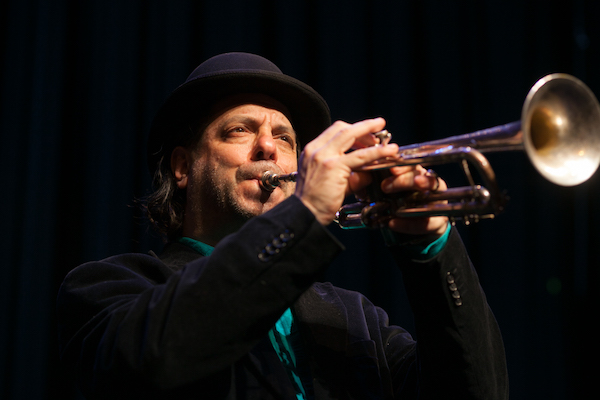
Frank London recently released a new album, Ghetto Songs (Venice and Beyond). (photo by Chuck Fishman)

Trumpeter and composer Frank London, an unwavering presence in numerous musical genres for more than four decades, released a new album, Ghetto Songs (Venice and Beyond), on Felmay Records earlier this year. The project incorporates music from around the world and delves into the history of “ghetto music.”

Coming out this past April – to coincide with the anniversary of the Warsaw Ghetto Uprising in 1943 – the concept for Ghetto Songs began in 2016, when the Grammy Award-winning London found himself in Venice on a residency with Beit Venezia, a foundation that aims to promote Jewish thought and culture, and serve as a bridge between people of all cultures and religions.

“It all started with my being invited by Dr. Shaul Bassi and Beit Venezia to go to Venice and conceive a special way to commemorate the 500th anniversary of the opening of the Venice Ghetto, the first segregated urban area to be called a ghetto,” London told the Independent. “The particularity of the Venice Ghetto and the universality of ghettos themselves inspired Ghetto Songs.”

The Jewish ghetto in Venice was situated in the polluted grounds of an ancient copper foundry, or geto. By the early 20th century, the term ghetto came to signify the crowded urban quarters of any minority group.

As London sees it, ghettos are historically complex phenomena. They offer both freedom and restriction, protection and imperilment. By isolating specific groups from the outside world, they become cultural “petri dishes” in which the ghettoized group’s culture can thrive.

Ghetto Songs celebrates the music and poetry that emerges from and about the world’s many ghettos. The playlist for the new release includes 17th-century music and poetry from the Venice ghetto (works from Salomone Rossi, Benedetto Marcello and Sara Copia Sullam); a piyyut (Jewish liturgical poem) from a mellah, a Moroccan Jewish quarter; kwela, street music from South Africa’s townships; and works by Cantor Gershon Sirota, who lived and died in the Warsaw Ghetto. There is also version the 1972 hit by the band War, “The World is a Ghetto.”

When it came to selecting what pieces would be the best fit for an album covering ghetto music encompassing five centuries and numerous locations, London recounted, “This is my favourite part of the process! I do the deep dive: tons of research into music from the world’s ghettos throughout history, across time and place. I pick out songs that I love, but that also tell a story, that inform each other, that complement each other, and that work together as a unified whole despite their incredible differences.”

London has assembled an array of talent for the release. Among the vocalists are tenor Karim Sulayman, Cantor Svetlana “Sveta” Kundish, Yaakov “Yanky” Lemmer (considered one of the best in the new generation of chazzans) and singer/guitarist Brandon Ross. They are joined by drummers Kenny Wollesen and Zeno De Rossi, cellists Francesca Ter-Berg and Marika Hughes, bassists Greg Cohen and Gregg August, and multi-instrumentalist Ilya Shneyveys.

“What might have been seen as challenging – getting the right musicians who can play such a diverse, variegated set of musics, styles, genres, etc., was really no problem. I am blessed to know and work with some of the world’s finest musicians and, with them, there were really no big challenges,” said London. “I have worked with each of these fantastic musicians in different projects and situations – mine, theirs, and as side musicians for others – over my 40-year career.”

To summarize London’s career in the space of an article, let alone a paragraph of two, is not an easy task. Among the artists he has worked with are Itzhak Perlman, Allen Ginsberg, LL Cool J, Mel Tormé, Iggy Pop, John Cale and Jane Siberry. He is a member of the Klezmatics and Hasidic New Wave, as well as leader of the Frank London’s Klezmer Brass All Stars and the Glass House Orchestra, a band that plays Austro-Hungarian Jewish music. London has made 30 solo recordings, is featured on more than 400 CDs and is the recipient of the Hungarian Order of Merit.

The veteran musician is working on several projects at present. These include Ich Bin Eine Hexe, a dance/theatre spectacle about pioneering performance artist Valeska Gert; “Rube G (Music for Brass Trio and Percussion,” a dance score for choreographer and filmmaker Jody Oberfelder; ESN: Songs from the Kitchen, a cooking and music video with Lorin Sklamberg and Sarah Gordon; Salomé: Woman of Valor, a CD with poet Adeena Karasick (jewishindependent.ca/salome-cd-launched); and Transliminal Rites, a CD of improvised music with Eyal Maoz and Guy Barash, who, together with London, make up the EFG Trio.

Sam Margolis has written for the Globe and Mail, the National Post, UPI and MSNBC.

Remembrance Day Revue

The Hot Mammas – left to right, Mary Ella Young, Julie Brown and Georgina Arntzen – with Tom Arntzen. (photo by Dee Lippingwell)

The Hot Mammas – Mary Ella Young, Julie Brown and Georgina Arntzen – with Tom Arntzen perform a Remembrance Day Revue on Nov. 10 and 11 at the Corner Stone Bistro in North Vancouver. With careers spanning decades, they have done it all, from folk to jazz, radio to musical theatre, Vancouver to New York; these women know how to work a room. Long-time friends Arntzen, Brown (who is a member of the Jewish community) and Young formed the Hot Mammas in 2004 and they entertain audiences with the kinds of stories and harmonies that can only come from such a friendship. For reservations, call 604-990-3602 or visit thehotmammas.com.


New song for the holidays

Haley K. Turner has made a parody of her own Chanukah song, in an effort to get Adam Sandler’s attention.

On Nov. 3, local singer-songwriter Haley K. Turner is releasing what might be the only original Chanukah song set for release this year, and one of only a few in the last 25 years. Inspired by a recent plea from Adam Sandler for “someone out there” to write a new Chanukah song, Turner did just that.

In the tradition of nostalgic, sentimental classics such as “Have Yourself a Merry Little Christmas,” “Intangible Things (A Hanukkah Song)” features a string orchestra with lyrics that were completed early this year, on the very last snow day of last winter.

image - CD cover of Intangible Things parodySince Sandler asked for the song, Turner decided he should know about it. In an attempt to garner his support, she wrestled an alligator in a Happy Gilmore parody video, which can be seen on YouTube; created a tutorial on “How to Get in Touch with Adam Sandler”; and recorded a parody of her own new song, “Intangible Things.”

The videos showcase Turner’s spirited side, one that may not have been recognizable from the vulnerable storytelling displayed on her debut LP in from the dark, which was released early 2020. (See jewishindependent.ca/find-comfort-in-music.) It was recorded at Monarch Studios with Juno-nominated producer and musician Tom Dobrzanski (Said the Whale, the Zolas). Her 2011 EP, Ready or Not, was produced by Ben Kaplan (Mother Mother, Five Alarm Funk).

It may take a miracle to get Sandler’s attention but, as Chanukah shows us, miracles do happen.

To hear “Intangible Things” once it’s released, as well as its parody and the Happy Gilmore video, visit facebook.com/haleykmusic. 

– Courtesy Haley K. Turner

Tzimmes celebrates 35 years

The Tzimmes sextet, in 2019. Left to right are Saul Berson, Phil Belanger, Tim Stacey, Amy Stephen, Yona Bar-Sever and Moshe Denburg. Also part of the ensemble in the new recording, but not pictured here, is Fabiana Katz. (photo from Tzimmes)

Vancouver Jewish musical ensemble Tzimmes celebrates its 35th anniversary this year. To mark the occasion, the group, led by Moshe Denburg, has released a new album, The Road Never Travelled, its first in 23 years.

Denburg, who is also a classical composer, founded Tzimmes in Victoria in 1986. Throughout that time, the ensemble’s modus operandi has been to incorporate as many types of Jewish music as possible – traditional Ashkenazi, Sephardi and Mizrahi, along with more contemporary and secular styles.

The new album is comprised of two discs. Disc 1 offers secular pieces, while Disc 2, Liturgy Lane, presents listeners with original music based on sacred texts.

The repertoire includes “Hahmi-ini” (“Let Me Hear Your Voice”), which was written in 1966, when Denburg was in his teens; the title track, “The Road Never Travelled,” from 2005; and “other original arrangements of more recent vintage,” such as “Oyfn Veg” (“On the Way”). Some of the songs on Disc 1, including the title track, are English pop/folk/world music. And not all the songs on the album are Jewish. There is, for example, a rendition of the Beatles’ “In My Life.”

image - The Road Never Travelled album coverThe recording and mixing history for the collection stretches 28 years. When it became clear that this was more material than could fit on one album, Denburg decided to turn it into two.

“For a number of years,” he told the Independent, “we had some tracks that were on the back burner, so to speak – unfinished recordings that were begun in 2005-06. Tzimmes kept working in general – some concerts, lots of simchas, but completing a new recording was not in the cards, mainly because my own work was focused on founding and husbanding the Vancouver Inter-Cultural Orchestra (VICO).

“A few years ago, I wound down my administrative duties with the VICO, and started considering, in earnest, completing a new Tzimmes recording. The final impetus occurred when I turned 70, in 2019. I brought the group together, worked on a lot of new, and older, material, and took them into the studio to complete the older tracks and to lay down some fresh ones,” he said.

The Road Never Travelled features many past members, and several other musicians who have collaborated over the past 20 years, to become the Tzimmes of today. Denburg (voice, guitar) is joined by Fabiana Katz (voice), Yona Bar-Sever (lead guitar, voice, electric bass), Saul Berson (clarinet, flute, saxophone), Amy Stephen (voice, accordion, whistle, lever harp), Tim Stacey (bass, electric bass) and Phil Belanger (drums) to form the ensemble. A dozen other musicians, including guitarist Itamar Erez, cellist Finn Manniche and vocalist Myrna Rabinowitz – as well as international instrumentalists Joseph “Pepe” Danza, Yuji Nakagawa and Adel Awad – also appear, among others.

Tzimmes’ last album, KlezMyriad, was released in 1998, though the ensemble has performed at concerts and larger-scale projects since then. While changes have taken place over the past many years, it continues to be a tight-knit group of musicians.

When asked about the ensemble’s longevity and how it has maintained its cohesion, Denburg explained, “I believe Tzimmes has steered clear of the more difficult conflicts that are legion where artistic collaborations are concerned. But, as a bandleader, it has taken the wisdom that comes only with much experience to keep one’s passion alive while allowing for the artistic expression of one’s colleagues. This is what a good bandleader ought to do.

“Tzimmes is more a family than an enterprise, at least that’s the way I look at it,” he continued. “So, as in all families, there is the joy of knowing that everyone is basically rooting for each other and, yet, at the same time, conflicts do occur. We have lived long enough together, and have matured as people together, to have buried most of the hatchets and be guided by our natural affections for each other, and our love of our common purpose – the making of music.”

About the ensemble’s history, Denburg said, “Over 35 years, ensemble members come and go, and, actually, no one who was with me in 1986, when Tzimmes was formed in Victoria, is with me today. Tzimmes has changed and evolved over the years. Of today’s members, some have been with the ensemble for 30 years, some for over 20, and others are newer additions. One of the hallmarks of the new recording is that almost all Tzimmes members, of yesterday and today, are part of the recording.

“Tzimmes has always been dedicated to presenting Jewish music in all its facets,” Denburg concluded. “The challenge has always been to deal with the variety of these musical expressions in a non-superficial way, to make an original contribution to Jewish music-making.”

As the pandemic eventually fades, there are plans for a concert to herald the release of the CD and celebrate the ensemble’s 35 years. And Denburg sees many possibilities in providing musical services of various kinds.

“Speaking for myself, in the longer term, it would be nice to see Tzimmes continue with some next-generation musicians,” he said, “to carry on the tradition of original Jewish music-making in Vancouver.”

For information on buying tracks and sheet music, visit tzimmes.net.

Sam Margolis has written for the Globe and Mail, the National Post, UPI and MSNBC.

Khazzoom has new EP

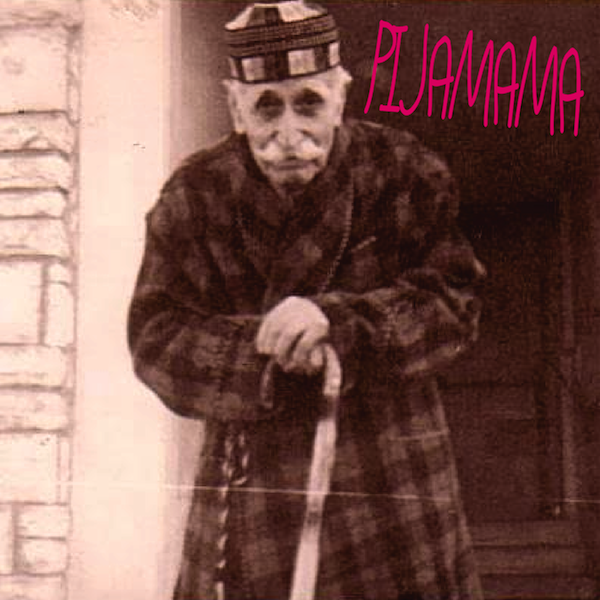
The cover of Iraqis in Pajamas’ new album, Pijamama, features Loolwa Khazzooom’s grandfather, Abraham Khazzoom.

The multifaceted, multicultural and impossible-to-pigeonhole Loolwa Khazzoom is back, along with her band, Iraqis in Pajamas, with a studio-produced album, Pijamama, that was released on July 16.

The new album by the Seattle-based musician honours her mother, E.J., who passed away on July 16, 2019, and who encouraged Khazzoom to pursue her music. Khazzoom credits E.J. with demonstrating that we all have “the ability to radically transform ourselves and our relationships – and to stop the crushing boulder of intergenerational trauma – when are willing to face and go through the darkness together.”

A photo of Khazzoom’s grandfather, Abraham Khazzoom, who she describes as “the original Iraqi in pajamas,” graces the album’s cover. The band’s name, she explained, derives from an uncomplimentary reputation Iraqi expatriates had in the Israeli city of Ramat Gan for putting on their pajamas when they had arrived home and the work of the day was completed.

The EP features Khazzoom on vocals and bass, Robbie Morsehead on drums, Cali Hackmann on keyboard and backup vocals, and Alden Hackmann on guitar. The melodies and lyrics were written by Khazzoom. Pijamama showcases three songs.

“Mahalnu” explores the  Jewish practice of asking forgiveness ahead of Yom Kippur. It then raises the question of what happens when someone asks for forgiveness, without changing their behaviour, especially in the case of violence. “What is the difference between forgiveness of you and erasure of me?” Khazzoom asks.

“The Fixer,” a declarative prayer, advocates the rejection of compensating for another person’s not doing necessary work in a relationship. The chorus, “ashir shir hadash” (“I will sing a new song”), comes from “Ezer Musarai,” an Iraqi Jewish song for Purim, which inspired Khazzoom as a child.

“Fireball” looks at being a caregiver in spite of emotional violence. The lyrics proclaim: “You can be downright vicious / Throwing a fireball / At the one who cares most about you / The one who is always there for you….”

photo - Loolwa Khazzoom
Loolwa Khazzoom (photo from Iraqis in Pajamas)

Khazzoom has had a varied career. Among other things, she has been an educator, writer and health coach, all of which share, she says, the central principle of individual and collective healing. Ultimately, Khazzoom says she “ditched her power suit and Powerpoint in favour of combat boots and cat glasses to offer bold songwriting as the catalyst for deep and heart-centred conversation.”

The connections between her diverse activities have been subjects she has long contemplated.

“I have been keenly aware of interconnectedness since I was very young, partly because I was highly sensitive and thinking about things deeply, and partly because my identities were a crisscross of those considered at odds or even at war with each other – making it obvious to me that many social constructs and divisions were false,” Khazzoom explained.

“My songs reflect this awareness – explicitly or implicitly connecting dots between things that most people don’t initially recognize as being related to each other, and inviting listeners to rethink their notions and paradigms.”

Khazzoom said she likes to play with this crisscross of identities. For example, people may react one way if she tells them she is Iraqi, and another way if she tells them she is Jewish.

“People generally like shortcuts or scripts in determining what to think about someone, instead of doing the work of getting to know someone, with all the complexity and nuance involved…. I am the same person, yet an entirely different set of assumptions are projected on to me. Standing at the intersection of identities and experiences, I can poke fun at the absurdity of it all,” she said.

Khazzoom refers to her music as “conscious rock,” a way of exploring all our emotions, especially those that allow us to be loud in a healthy way.

“As a collective, we fear intense emotions like rage and grief, and we suppress those feelings in ourselves and others, leading to astronomical levels of addiction and a host of other social and personal ills,” she said. “I believe that all of our emotions are a gift, a GPS system of sorts, pointing us in the direction of that which is true and good, and I find it tremendously liberating, healing and transformative, to express the spectrum of emotions in healthy and constructive ways.”

Khazzoom’s songs are written in English, Judeo-Arabic and Hebrew, and blend Iraqi Jewish prayers, alternative rock and personal storytelling about subjects ranging from cancer, racism and mental illness to national exile.

For more information, visit iraqisinpajamas.com. To participate in the evolution of Loolwa’s work, from poem to spoken word performance to song, go to patreon.com/khazzoom?fan_landing=true.

Sam Margolis has written for the Globe and Mail, the National Post, UPI and MSNBC.

Libby Yu plays music for soul

Libby Yu performed A Concert for the Soul on June 28, hosted by Jewish Seniors Alliance and the Kehila Society of Richmond. (screenshot)

On June 28, Jewish Seniors Alliance and the Kehila Society of Richmond presented classical pianist Libby Yu in performance via Zoom. A Concert for the Soul was the last session of the 2020-21 JSA Snider Foundation Empowerment Series.

Toby Rubin, coordinator of Kehila Society, welcomed everyone to the concert and introduced Yu, who was born and grew up in Richmond. An accomplished performer, collaborator, teacher and adjudicator, Yu has graced international stages and has appeared as soloist with major symphony orchestras. She brings her passion for music to audiences of all ages and venues. She is an artist for the Health Arts Society’s Concerts in Care, which allows her to share her music in residential care homes and hospitals. Rubin encouraged us all to watch Yu’s fingers as they moved on the keyboard.

Yu greeted everyone from her home, saying how much she enjoys performing for JSA and Kehila and that she looks forward to playing for us in person in the future. She told us that she would be playing Ludwig van Beethoven, Franz Schubert and Frédéric Chopin.

The first piece was Beethoven’s Moonlight in three movements. The first was slow, the second light and happy, while the third was dramatic with many runs and chords.

The next piece was Schubert’s Impromptu, 4th Opus in A Flat Major. This piece is full of cascades, arpeggios, with a beautiful melody. It is in the ABA format, where the third movement returns to the melody of the first.

This was followed by two of Chopin’s Etudes, the first in F minor and the second his well-known revolutionary étude that reflects his turmoil over the instability of his native Poland.

Yu ended her performance with a Chopin Ballade, in G minor. The main theme is a quiet, still melody that builds in virtuosity and then flourishes to huge dramatic chords. The coda is fast and exciting.

It is indeed a pleasure to watch Yu in her intensity and concentration. After her performance, she thanked us and said she hoped the music brought us all joy.

Gyda Chud, co-president of JSA, thanked Yu for the program. She reminded everyone that, in the past, events with Kehila have included lunch and, hopefully, we will all be able to enjoy both lunch and a performance in person soon.

Chud again thanked Yu, saying the concert was not only an inspiration for the soul, but also for the heart and mind.

The Empowerment Series will continue with the theme “Be Inspired” for the 2021-22 season.

Shanie Levin is program coordinator for Jewish Seniors Alliance and on the editorial board of Senior Line magazine.

Six Jewish musical journeys

Amber Woods and Gary Cohen are the musical duo Kouskous. They were among the speakers in the six-part Journeys in Jewish Music series. (photo from Kouskous)

In ordinary times, the Victoria Jewish Community Choir meets in person at the synagogue building of Congregation Emanu-El. Unable to do so during the pandemic, the choir has instead been offering Zoom presentations on a diverse array of Jewish music.

Throughout the spring, the six-part Journeys in Jewish Music series, funded by the Jewish Federation of Victoria and Vancouver Island, has brought in an audience from around the world. It has featured talks on biblical cantillation by Vancouver’s Moshe Denburg; the songs of Sefarad, with Prof. Judith Cohen of the University of Toronto; Chassidic meditative melodies (niggunim) with Emanu-El’s Rabbi Matt Ponak; and Sing a New Song to G-d: New Prayer Compositions, with Rabbi Hanna Tiferet Siegel, who lives on Hornby Island. The last event in the series, which takes place June 20, will see Denburg return, to speak on the topic The Way of the Klezmer: Klezmer and Yiddish Song.

The Jewish Independent attended the May 23 musical voyage, which was guided by Gary Cohen and Amber Woods, who form the Victoria-based duo Kouskous. It explored Mizrahi music and how it differs from other Jewish musical styles. To demonstrate this, Cohen and Woods took the liturgical song “Lecha Dodi” and sang it with Ashkenazi, Sephardi and Mizrahi interpretations.

“In general, we see the Mizrahi world being divided into three major geographical blocks: North Africa, Turkey and the Middle Eastern (Arabic) countries,” said Cohen.

Following their expulsion from Spain in 1492, Sephardi Jews migrated to many countries in Europe, as well as going to North Africa, Greece, Turkey and Middle Eastern/Arabic countries. “Wherever Jews went, they blended their own musical traditions with those of the countries to which they moved. For example, the Sephardim combined their own musical style with Moroccan rhythms, Arabic instrumentation and Middle Eastern vocal expressions,” he explained.

“The Sephardim in Turkey and Greece often incorporate odd-metered rhythms such as 7/8, 9/8 in their music. In addition to traditional Arabic instruments, Greek instruments like the bouzouki were commonly used,” Cohen said.

Sephardi musicians who moved to Middle Eastern/Arabic countries were heavily influenced by Arabic musical styles, including “a wide melodic range, as well as vocal and instrumental embellishments,” he said. “Lyrics were often in Arabic, Hebrew or Judeo-Arabic.”

Throughout the presentation, Cohen and Woods performed some musical selections – including a few hot and spicy numbers – from the aforementioned genres for the assembled Zoom audience.

Carol Sokoloff, who co-directs the Victoria Jewish Community Choir with Kenny Seidman, is the person who came up with the idea for the lecture series.

“It has been so well-received it seems natural to repeat it and I hope to do that in the fall, going deeper into many of the subjects, as well as exploring new territory, such as Jewish composers of popular songs, Jewish women’s music, the music of the hidden Jews of Spain and Portugal, cantorial traditions and more,” Sokoloff told the Independent.

“Jewish music has so many flavours and is so rich and varied we have only begun to scratch the surface. Through our conversations, we are learning about other people with knowledge to share and, so far, everyone has been very generous in their enthusiasm for this series,” she said.

The shift from live venues to Zoom since the start of the pandemic has allowed the choir to expand its audience outside of Victoria.

“The series has been wonderful in that people who never knew about the Victoria Jewish Community Choir are now aware of us,” said Sokoloff, “and I believe that, when we finally can meet again to sing together, we shall likely attract many new members or new audiences for our performances and concerts. So, the series has allowed the choir to weather this challenging period and likely emerge stronger than ever! I think it has also generally increased interest in Jewish music in our region as well – all very happy outcomes.”

In non-pandemic times, the choir sings a variety of Jewish music: Psalms and prayers in Hebrew and Aramaic, niggunim, Yiddish songs, Sephardi music in Judeo-Spanish, Israeli songs, Broadway tunes, Yemenite music and contemporary compositions. For more information or to support the choir, send an email to jewishmusictalks@gmail.com or visit their Facebook page, where you can also learn how to receive the link for the June 20, 7:30 p.m., talk.

Sam Margolis has written for the Globe and Mail, the National Post, UPI and MSNBC.

Superstein plays at jazz fest

Andrea Superstein performs July 4 from Pyatt Hall during this year’s TD Vancouver International Jazz Festival, which starts June 25. (photo from Wendy D Photography)

Vancouver vocalist, composer and arranger Andrea Superstein has a new song out. It’s cheerful, upbeat. And she will perform “Every Little Step,” which was released in March, live for the first time at this year’s TD Vancouver International Jazz Festival, which starts June 25 and runs to July 4.

“‘Every Little Step’ was my saving grace during the pandemic,” Superstein told the Independent. “I wrote it at a time when I was feeling really overwhelmed by the uncertainty that living through a pandemic brings. I was emotionally exhausted from listening to the daily press conferences and I just needed something good. I received a Digital Originals grant from the Canada Council for the Arts and that was the impetus.

“The song was inspired by the beautiful landscapes of B.C., which I experienced on a family camping trip to Nelson,” she explained. “We live in such a beautiful place and being able to spend so much time in nature really saved me during the pandemic. In a way, it’s my homage to B.C.”

Of course, Superstein couldn’t meet in-person with musicians to workshop the composition, so, she said, “I had this crazy idea to reach out to musicians across Canada (some of whom I’d worked with before and others who to this day I still haven’t met in person) to write, arrange, record and make a music video completely in isolation. It was wild! We didn’t have one rehearsal – we didn’t even have a group Zoom meeting. Elizabeth Shepherd and I wrote and arranged the song together over Zoom and we communicated some ideas to each specific player and they self-recorded (audio and video) from their home studios. And we made a super-fun music video for it, as well.

“The more I think about it, I can’t even believe what we accomplished. I love the song so much! The vibe is a super feel good ’90s groove but, symbolically, it was so meaningful because, despite all being trapped at home, we found a way to be together in this weird virtual way. It was transformative for me.”

On the video, Superstein and Shepherd’s song is performed by them, with Superstein on vocals, Shepherd on keys, Carlie Howell on bass, Isaac Neto on guitar, Colin Kingsmore on drums and Liam MacDonald on percussion. For the jazz festival performance, Superstein will be joined by Chris Gestrin (keys), Nino DiPasquale (drums) and Jodi Proznick (bass).

“I’m so happy to be playing with them,” said Superstein. “They each offer such a unique perspective to the music and they’re all wonderful humans!”

The show is on July 4, 7 p.m., at Pyatt Hall and will be streamed on Coastal Jazz & Blues Society’s YouTube channel, she said. “Regarding a possible audience,” she added, “the festival is closely monitoring all provincial health orders and will make a decision on indoor audiences after the next provincial health update on June 15.”

Superstein is looking forward to being able to perform live again.

“I miss that special relationship that is forged during live performance,” she said. “There is something truly magical about collectively experiencing a moment in time that can never be recreated. That being said, I am blown away by the digital innovation that has emerged during the last year-and-a-half to keep the arts alive, and I attended some amazing concerts and theatre this year.

“As for me, it’s been relatively quiet on the performance front. I did a livestream concert through Or Shalom’s Light in Winter series in early 2021, which was so incredible. Other than a few other small things, I’ve been keeping it pretty low key, slowly working away at composing new music and taking my time with life.”

Playing at the jazz festival, she said, “I think it will be an incredible way to give momentum to many of the creative ideas I’ve been sitting with these past two years and a great chance for music lovers to reconnect, seeing as it’s been some time since my last performance.”

The last time that the Independent interviewed Superstein was in January 2020, just before the pandemic hit in full force. Among other things, she spoke about her then-new album, Worlds Apart, which she had described to CBC as having the themes of “the pain of being in a one-sided relationship, the loneliness of technology, and positivity in times of destruction.”

“As an artist, I like to observe life and then transform those observations into stories. I think this was helpful for me at the beginning of the pandemic because my curiosity was heightened, there was so much unknown,” she explained. “I found that to be both scary and exhilarating. I was also trying to figure out how to homeschool a 5-year-old while teaching full-time online without completely unraveling. So, creativity, flexibility and leaning in helped me survive most of 2020. Those are definitely skills that I use a lot as an artist. Truthfully, though, I don’t think anything could have prepared us for the pandemic.”

In addition to the new song “Every Little Step,” Superstein has started working on a new album, which she is hoping to release in late 2022.

“It’s a huge undertaking,” she shared, “with lots of moving parts, culminating in a multimedia performance. It will showcase collaborations with Elizabeth Shepherd, whom I treasure, and my dear friend Ayelet Rose Gottlieb (who you have featured before), among others. There’s also upcoming opportunities for non-musicians to be involved in the process, so people can stay in touch with me over social media if they want to know when and where that’s happening.”

As for her upcoming performance, she said, “In terms of what people can expect from the show, we’ll be doing some brand-new arrangements and compositions, a few gems from Worlds Apart, as well as a few old favourites. Like a true Superstein show, I’m going to take the audience on a sonic journey, whether that’s direct from Pyatt Hall or from their living rooms, it’s going to be a celebration!

For tickets ($11) to Superstein’s July 4 concert or any of the jazz festival’s more than 100 virtual events, visit coastaljazz.ca. There will be performances by local artists, as well as streams from New York, Chicago, Philadelphia, Amsterdam and Paris; free online workshops; club performances; and a continued partnership with North Shore Jazz. All streams will be available until midnight on July 6.

Worshipping with joy

On May 2, Kolot Mayim Reform Temple in Victoria welcomes singer, songwriter, teacher, music producer and cantorial soloist Len Udow to speak on Worship with Joy. Drawing on both secular and cantorial music, Udow will recall his journey from 1960s coffee-house folk singer to cantorial soloist at Temple Shalom, Winnipeg’s Reform congregation, where he helps to officiate and teach.

photo - Cantor Len Udow
Cantor Len Udow (photo from Kolot Mayim)

By sharing both his own story and performing live with vocals and guitar, Udow wants to show how we can “carry our ancient narratives to other hearts and souls … respecting the old traditions while introducing innovation in prayer and spirituality.” As he describes it, “In Judaism, we see ourselves enlivening prayer with breath and melody, revealing the joy, praise and gratitude embedded in our heritage.”

For Udow, the phrase iv’du b’simchah (worship with joy) has been “a call to service, putting this musician on the bimah (altar) of a little prairie shul … where I have been privileged to lead a kahal (assembly) to a closer musical fellowship and learning.”

With humour, Udow quotes his mentor, the late Rabbi Lord Jonathan Sacks, the former chief rabbi of the United Kingdom: “When Jews talk they argue; when they sing, they sing together.” To Sacks, “Words are the language of the Jewish mind; music is the language of the Jewish soul.”

Udow has performed on concert stages, at festivals, on radio and television, and on numerous recordings. As well as playing the piano, banjo and guitar, he was a featured vocalist and music producer with fellow Winnipegger, Fred Penner, for more than two decades.

Worship with Joy is the final lecture of Kolot Mayim’s six-part series called Building Bridges: Language, Song and Story. It starts on Zoom at 11 a.m. and registration is via kolotmayimreformtemple.com.