Celebrate joy of music

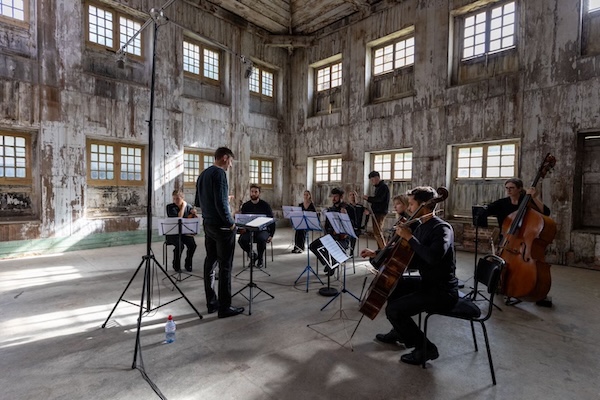
The annual North American Jewish Choral Festival brings hundreds of singers together to enjoy a musical experience of Jewish identity and community. This year’s festival takes place Aug. 2-6 in Stamford, Conn. (photo by Jennifer Weisbord)

The annual North American Jewish Choral Festival (NAJCF) brings hundreds of singers together to enjoy a musical experience of Jewish identity and community. The five-day event, led by world-class conductors, takes place this year in Stamford, Conn., from Aug. 2 to 6. Registration to attend is now open, and all singers are welcome, from beginners to professionals.

“The festival is for anyone who wants to celebrate the joy of Jewish music,” said Maestro Matthew Lazar, festival founder and director. “This summer, we are highlighting American Jewish music, which beautifully intertwines US history, Jewish history and a range of genres. It is important to note that America is the first place where Jews had the freedom to be composers as Jews, opening up unlimited musical opportunities.”

NAJCF – which is a program of Zamir Choral Foundation – works to provide an environment of creativity and camaraderie, as well as a feeling of hope, unity and Jewish identity, to encourage singers to share a bonding experience and forge new friendships.

“The North American Jewish Choral Festival is my happy place,” said Cantor Mira Davis of New York City. “It’s a community of people who are like-minded, love each other, love Israel and love Jewish music – a place where you can be yourself.  The friends I’ve made at NAJCF will last a lifetime.”

NAJCF participants include amateur singers, professionals, cantors, conductors and lovers of Jewish music of all ages. Attendees have the unique opportunity to interact with and learn from top experts in Jewish choral music in a supportive setting. There are a variety of uplifting musical 

activities, including daily community sings; workshops and seminars on a wide range of topics; and evening concerts featuring guest choirs and notable performers.

“Being able to connect to this type of music and this type of text is something you can’t get anywhere else,” said NAJCF participant Dor Kaminka, an Israeli-American composer and conductor now residing in Los Angeles, Calif.

“Whether you’re a novice or a pro, you’ll leave with new skills, new music and new friends to cherish from this transformative choral festival,” concluded Lazar.

For more information and to register for NAJCF 2026, go to go to zamirchoralfoundation.org/north-american-jewish-choral-festival.

* * *

Applications are now open for another Zamir Choral Federation program: the Jewish Choral Conducting Institute (JCCI). The institute – a long-held vision of Lazar – is the first in the world to professionally train the next generation of conductors of Jewish choral music. Its creation was helped in large measure by a major gift donated by Cantor Robert Lieberman and Rabbi Vicki Lieberman, who will be honoured at this year’s HaZamir Gala Concert on March 15 at Lincoln Centre.

“Choral music lies at the intersection of text, music and community. It implants cultural identity, history, memory and catharsis,” said Lazar. “The conductor integrates music and text with mastery, precision and excellence, creating inspiring and transformative musical moments. The institute provides the specialized, intensive training needed to make all this possible.”

Each cohort is composed of 12 to 15 conducting students from around the world. Fellows gather at in-person retreats and workshops, and monthly online meetings, and receive one-on-one mentoring sessions with Lazar, as well as guest presenters. Upon completion of the program, fellows receive a certificate in Jewish choral conducting.

Lazar brings his knowledge of Jewish and Western music and an understanding of the text/music relationship that defines choral music. He has worked with maestros Leonard Bernstein, Zubin Mehta, Carlo Maria Giulini, Daniel Barenboim and others. Through his expertise, he models, encourages and nurtures the talents of future conductors of Jewish music.

“The Jewish Choral Conducting Institute provides a pipeline of talent to ensure strong Jewish choral leadership for the Jewish future,” he said.

The JCCI’s international Lazar Fellows deepen their development through ongoing mentoring and critique. These mentoring meetings foster ongoing growth within a supportive international community of Jewish choral conductors.

Applications for the fall 2026 cohort of the JCCI’s Lazar Fellowship are now open and due by 5 p.m. EST on April 30. For more information, visit zamirchoralfoundation.org/conducting-institute-2,  or email conducting@zamirchoralfoundation.org to request the application details.

– Courtesy Zamir Choral Foundation

Women share experiences 

Left to right, at CHW Vancouver Centre’s SHE DAY event March 8: Ruthi Akselrod, Laura Lewko (kneeling a bit), Pam Wolfman, Toby Rubin, Jocelyn Brown, Ruth M’Rav Jankelowitz, Tamara Shenkier and Laura Mossey. (photo by Shula Klinger)

On March 8, CHW (Canadian Hadassah-WIZO) launched its first SHE DAY event. Hosted at the Jewish Community Centre of Greater Vancouver, the celebration of International Women’s Day included a panel discussion, a shuk (market) of women-led businesses and kosher refreshments.

CHW Vancouver Centre president Toby Rubin, who introduced the panel, also shared that, starting in October, the Vancouver CHW team would be under the joint leadership of Pamela Wolfman and Jocelyn Brown, who moderated the discussion between Dr. Tamara Shenkier, Ruth M’Rav Jankelowitz and Laura Mossey.

Shenkier, who is an oncologist, educator and advocate, recently retired. Her 30-year career included numerous leadership roles in medical education and governance, and she spent the last decade-plus focusing on breast cancer. She is a founding member of the Jewish Medical Association of British Columbia.

Jankelowitz has spent three decades in commercial and hospitality design, and her portfolio includes many household names, including DKNY, Timberland and Nike. Her company, Janks Design Group, has created the spaces of such eateries as OEB, Nando’s and Tap and Barrel.

Mossey brought her voice as a non-Jewish Zionist and educator to the panel, sharing some of the influences that have helped frame her identity and worldview.

The conversation was dominated by the topic of antisemitism and its marked increase since the Oct. 7, 2023, Hamas terror attack on Israel.

“Things were bubbling in the cauldron but, since then, I have felt as though I am ‘the Jew,’” said Shenkier, who spoke of feeling more exposed and more vulnerable in recent months than ever before. She talked about changes to medical curricula that followed consultation with “thought leaders,” rather than medical experts, and how students were being encouraged to contemplate their practice through the lens of race – though, she noted, “Jews were never mentioned as a marginalized, persecuted community.”

Mossey, too, has seen efforts to erase Jewish identity. For example, the Coquitlam school district now asks parents to share their identity in questionnaires, she said, and “Jewish wasn’t included.”

Brown asked panelists about the biggest challenges they have faced – as Jews and/or Zionists – in their personal and professional lives.

“The hardest thing for me was the silence – from colleagues, friends, employees,” said Jankelowitz. “I gave them countless chances to learn and nobody asked. It was pretty astounding. So, I made my voice louder.”

Mossey addressed the dangers of misinformation and disinformation, highlighting the need for strong leadership.

“We are all vulnerable,” she said, describing a history lesson she gave to Grade 10 students. She taught them about the origins of Black Friday: when, on Nov. 18, 1910, suffragists protesting at Parliament in London, England, for the right to vote were physically and sexually abused. Given that today’s students can graduate without being taught about democracy, she said, “it’s imperative that they hear about the challenges that have been faced by women, somehow, from anyone who’ll show leadership.”

Mossey pointed to the hypocrisy of “safe classrooms” after the provincial teachers’ federation donated $50,000 to UNWRA, many of whose teachers and doctors have been shown to be Hamas operatives.

Asked to speak about resilience, all three women talked about the importance of setting boundaries. Jankelowitz said she had let go a client of 10 years. “I designed all of their stores. They had unionized and the team made a statement about genocide and apartheid, citing Amnesty International and Francesca Albanese [of the United Nations]. I don’t want to create spaces that will alienate my own community,” she said.

Jankelowitz also shared a positive experience: meeting a woman at a Business Network International event who asked to be educated about Zionism. “In one week,” said Jankelowitz, “I put together a historical dossier, links, books … to this day, she’ll come and ask me to verify what she’s heard, she tells me, ‘So I can fight it.’”

Mossey also has not been shy about living according to her values. She has worn emblems in support of Israel and shows her solidarity with Jewish students in various ways. When a principal asked her to hide her social media feed from public view, her response was unequivocal: “No.”  

She recalled a conversation with a Jewish student, where she explained her purpose: creating a safe learning environment for all kids.

Asked to offer their advice to other women, Shenkier talked about her own life, cautioning against falling into unhelpful extremes: “being in denial, moving ahead as if nothing has happened,” and, on the other side, “absolute paralysis, anxiety, rumination, catastrophizing.” Find a middle ground where healing can really be possible, she said. “You need to acknowledge and sit with your pain. The community will sit with you, without trying to fix it.”

Shenkier advised people to “separate who you are as a human being from your thoughts, feelings and projections.” She added, “expunge the word, ‘should,’ from your vocabulary. Focus on your strengths. Say ‘no.’ Stop comparing yourself to others, do what brings you joy.”

Earlier in the discussion, Shenkier had spoken of the mythical person who can “have it all,” and the damage caused by such a mindset, which she described as “oppressive.” She stressed the importance of “self-awareness gained through introspection.”

Mossey recommended: “carry your burden, share it, talk and let friends help you. Be physical to get through the stress.”

“Focus on what you can control,” said Jankelowitz. “You don’t need permission to use your voice. The room doesn’t decide if you belong to it.”

Mossey asks one question when she is challenged on her position on Israel: “Do you believe in the Jews’ right to self-determination?” She said the response helps her decide, in an instant, whether the conversation is worth pursuing.

“Don’t waste your time talking to people who aren’t interested in learning,” said Mossey, who has read dozens of books about Judaism and Israel, yet said she would not call herself an expert on the topics.

The panelists explored the theme of resilience at some length. 

“What does resilience look like in the current climate?” Brown asked.

“Showing up for the community, for my team at work, being consistent in my beliefs,” Jankelowitz shared. “Equip yourself with the facts.”

Mossey responded with stories about her mother – a 17-year survivor of a high-risk cancer surgery –  who taught her the word’s meaning: “Lean into your faith, keep your family close, and do something every day” to stand up for your cause. 

Commitment to personal values and professional ethics are also vital, added Mossey. “I’m not going to make myself smaller to avoid offending a kid who knows nothing about history,” she said.

Brown asked panelists to share an example of when their identity had felt like a strength as opposed to something they “needed to explain, manage and protect.”

Shenkier’s happy childhood in Montreal was a “grounding, not a cloak I can put on and take off,” she said. She considers herself lucky to have been a physician, a career where “the constant questions, the examination of one’s ethics and the practice of empathy were all congruent with my faith.”

Mossey recalled a meeting where she was asked to “identify herself.” She felt that traditional labels, such as “white,” “heterosexual” and “cisgendered woman,” were unhelpful. On that day, she said, “What differentiates me is my character. So, now I identify as a Zionist.”

Jankelowitz, who was once a logistics officer in the Israel Defence Forces, agreed: “owning the identity is more powerful than hiding it,” she said.

As the questions came to an end, the audience rose in a standing ovation.

Toby Rubin reminded attendees that, if anyone faces antisemitism, they can find support through CHW.

Event sponsors included Sylvia Cristall, Laura Lewko, Ruth Freeman, Brown (Acubalance Wellness Centre), Rubin and Wolfman; the national corporate partner was real estate development company Israel Canada. The afternoon was catered in part by Ricci Leigh-Smith’s team at Perfect-Bite, and organized by Amanda Aron Chimanovitch, community engagement and event officer for CHW, Western Canada.

Proceeds from SHE DAY events – which took place in Montreal, Calgary, Edmonton and Delray Beach, Fla. – went to the Eden Association Trauma Therapy Centre. Founded in 1997, the centre provides trauma care to young women and girls in southern Israel, where the need has increased greatly since Oct. 7.

The next CHW Vancouver Centre event is Games Day on May 6 at Richmond Country Club. Proceeds from it will go to supporting post-traumatic stress disorder therapy at Shamir Medical Centre and psychological rehabilitation at Hadassah Hospital in Israel. To register, go to chw.ca/region/western-region. 

Shula Klinger is an author and journalist living in North Vancouver.

Raising funds for Survivors

Artists Claire Kujundzic and Bill Horne have created a Bondi Beach memorial shirt. Monies raised are being donated to Bema Productions’ high school Holocaust education tours of Wendy Kout’s Survivors. (photo from Amazing Studios)

After the terror attack at Bondi Beach, Australia, on Dec. 14, in which two gunmen killed 15 people and wounded some 40 others who had gathered to celebrate the first night of Hanukkah, Victoria artist Bill Horne hosted a print-your-own glow-in-the-dark menorah shirt event at his and partner Claire Kujundzic’s Amazing Space Studio.

“Claire and I were very distressed by the antisemitic murders at Bondi Beach, and wanted to do something,” Horne told the Independent. “I’ve screen-printed with glow-in-the-dark ink before, e.g. images of aurora borealis, and the image of a glowing menorah popped into my mind. I thought it could symbolize the spirits of those killed at Bondi Beach, as well as literally ‘light up’ a menorah on a shirt this way.”

On Facebook, Horne invited anyone who wanted to print their own glow-in-the-dark menorah to bring a shirt to the Saanich studio before one of the Hanukkah light-up events in Victoria.

image - The front of the shirt features a menorah that glows in the dark
The front of the shirt features a menorah that glows in the dark. (photo from Amazing Studios)

“I had a few spare, unprinted black shirts in the cupboard, so I printed them,” he said. “When our visitors saw them, they asked if they were for sale. I hadn’t conceived of this as a commercial project, and that would have felt completely wrong, so I thought it could be a fundraiser. With Zelda Dean’s permission, I announced through word-of-mouth and our studio’s newsletter that we would be printing the shirts to raise funds for the high school tours of Bema theatre’s production of Survivors, as part of BC’s Holocaust education.”

Horne and Kujundzic, neither of whom is Jewish, have seen the play.

“It was an excellent production,” said Horne.

“The first production we attended at Bema was Si Kahn’s Stranger in a Strange Land,” he said. “I had heard Si sing at the Vancouver Folk Music Festival many years ago, and didn’t know he wrote plays. We saw a poster for this play of his at the [Victoria] Jewish Community Centre one day when we went for lunch. The musical was great, and Si was in attendance, which was a bonus.”

That was when the couple first met Dean, the founder and managing artistic director of Bema Productions, which is based in Congregation Emanu-El.

“We think she’s one of the best things about Victoria!” said Horne.

He and Kujundzic have since seen various plays and readings at Bema.

image - The back of the glow-in-the-dark menorah shirt lists the names of those murdered at Bondi Beach, Australia, on Dec. 14, while celebrating the first night of Hanukkah
The back of the glow-in-the-dark menorah shirt lists the names of those murdered at Bondi Beach, Australia, on Dec. 14, while celebrating the first night of Hanukkah. (photo from Amazing Studios)

The fundraising initiative is just starting, with $100 donated from that first, unplanned small batch of shirts.

“Once we receive enough orders to print and sell at least a few dozen more shirts, we’ll be able to make a larger contribution,” said Horne. “In terms of raising spirits, most people who see the shirt (especially with the lights out) have been moved or glad to see something positive in response to the Bondi Beach massacre. I also think it’s important for gentiles to wear a shirt like this in solidarity.”

“I am so grateful to my dear friends Claire and Bill for their tremendous generosity and their ongoing efforts to make the world a better place,” Dean told the Independent, noting that fundraising “becomes more difficult every year and we welcome donations toward this very important Grade 8 to 10 educational play, which is approved by the provincial government.”

Bema will be doing its fifth annual tour to BC schools with Survivors, which was written by Wendy Kout, based on recorded testimonies of 10 survivors talking about their experience as teens during the Holocaust, said Dean. “We have so far presented at 45 schools on Vancouver Island and in Greater Vancouver and hope to reach the Interior as well this year.”

Horne and Kujundzic operated Amazing Space Studio and Gallery in Wells, BC, for more than 25 years, before moving to Saanich in 2021. While not a retail gallery anymore, people can arrange a visit to the studio.

The Bondi Beach memorial shirt is completely in character for the couple, who have been involved in many causes and projects since they met in 1981. 

“Tools for Peace published two fundraising calendars of Claire’s Nicaragua-themed art in the late 1980s,” said Horne. “We’ve produced art and design for fundraising or promotion projects for groups such as BC Black History Awareness Society, the Wells Historical Society, Friends of Barkerville, families of Nicaraguan political prisoners, Ukrainian refugee families, RAVEN Trust and Treaty 8 First Nations (resisting the Site C dam), the United to End Racism delegation at the World Peace Forum (Vancouver, 2006) and the successful Wells Save Our School Campaign of 2002-2003.

“Claire has designed logos, graphics and posters for Pacific Post Partum Society, BC Organization to Fight Racism, Potters Without Borders, Nuu-Chah-Nulth Tribal Council, Kettle Friendship Society, International Women’s Day, many unions, including Union Women, and the International Metalworkers’ Federation.”

As a printmaker, Horne can silkscreen shirts, as well as editions of prints for exhibitions, he said. He has also designed books of poetry and photography. 

“Claire learned the printing trade in her 20s, worked as a designer doing layout and logos, and produced paintings, prints and sculptures as well,” he noted.

A reprint of the menorah shirts will take place this spring, with probably another run in the fall. Horne needs to first create a secure online order system.

If anyone wants a shirt, contact the studio for details of the next printing, shirt size/style options and prices: amazingspacestudio.com. To donate to Bema Productions’ high school tours of Survivors directly, go to holocausttheatre.com. 

Call for digital literacy

The federal government must develop a comprehensive national digital literacy program aimed at protecting young people from a wide range of online harms, because current efforts are fragmented and insufficient, according to B’nai Brith Canada.

The national advocacy group is proposing a major national project on this front, something that emerged after B’nai Brith’s appearance before the Parliamentary Standing Committee on Canadian Heritage last December. The committee was studying the impact of social media on young people.

In its submission, B’nai Brith focused on the risks of online extremism and radicalization. However, testimony before the committee revealed a much broader problem.

“We heard compelling testimony … from those confronting the impact of exploitation, sex exploitation, financial exploitation, misinformation, disinformation, really the gamut of online harms,” said Richard Robertson, the organization’s director of research and advocacy.

In response, B’nai Brith launched a campaign in late 2025 calling on Ottawa to fund and implement a national youth digital literacy program. The goal is to consolidate existing resources and ensure they reach young people across the country.

Robertson stressed that the issue extends beyond education policy and requires a coordinated national response.

“We don’t believe this is a curriculum issue. We don’t believe that this is an education issue. This is a national issue,” he said, adding that the problem “transcends provincial borders.”

The proposed program would bring together existing tools and expertise developed by various organizations and make them more accessible and impactful. Rather than building entirely new materials, the focus would be on refining and distributing what already exists.

photo - Richard Robertson, director of research and advocacy at B’nai Brith Canada
Richard Robertson, director of research and advocacy at B’nai Brith Canada. (photo from BBC)

“There’s a lot of great resources out there … what we need to do is ensure that those resources are getting to our youth,” Robertson said.

The campaign is also calling for federal funding – potentially through the next federal budget – to support both the development and promotion of the program. B’nai Brith envisions using the same channels that already reach young people, including social media and other digital platforms.

Campaigns targeting specific demographics “are not novel to our society,” Robertson noted, and similar strategies could be used to deliver digital literacy content effectively.

The organization has begun developing a framework for the proposed program and is seeking to collaborate with experts in Canada and internationally. Early endorsements have come from groups including the Canadian School Libraries Association and the Polarization and Extremism Research and Innovation Lab at American University.

While some jurisdictions, including Australia, have restricted young people’s access to social media, B’nai Brith argues that education remains essential regardless of regulatory approaches.

“You can try to restrict their access … but they will find their ways to interact with it,” Robertson said. He added that online harms extend beyond social media to video games, forums and other platforms that are difficult to regulate.

The organization’s position is that education should complement – not replace – regulatory efforts. B’nai Brith has been engaging with government on digital regulation and plans to participate in an upcoming parliamentary study on artificial intelligence.

Robertson said his group has received a positive initial response from policymakers and is hopeful that funding could be included in the next federal budget, either through new allocations or existing programs.

Beyond federal action, B’nai Brith is also encouraging provincial governments to take steps, particularly within school systems.

“We do an excellent job of … making sure [youth are] literate with technology,” Robertson said. “We need to make sure that their use of technology is a positive experience by also devoting attention to the dangers.”

B’nai Brith is seeking support from civil society organizations and individual Canadians as well, as it builds momentum for the initiative.

The campaign comes as concerns continue to grow about the impact of digital spaces on young people. For B’nai Brith Canada, the urgency is clear: online risks are evolving quickly, and a coordinated national response is needed to help youth navigate them safely. 

The hidden hand of hate

Warren Kinsella has spent much of his career studying the darker corners of political life. A lawyer by training, author of about a dozen books and a longtime political strategist, he has written about Holocaust denial, far-right extremism and organized hate movements. 

In his just-released book, The Hidden Hand: The Information War and the Rise of Antisemitic Propaganda, he follows these threads down the unseemly rabbit hole that has perplexed many observers since Oct. 7, 2023: the sudden and superficially spontaneous eruption of anti-Israel activism across Western campuses and cities in the aftermath of the horrendous atrocities of that day.

Kinsella’s thesis is straightforward and, to most readers of these pages, probably neither controversial nor surprising. The worldwide surge in anti-Israel protests, he argues, is not organic. Rather, it reflects a long-developed propaganda infrastructure – the “hidden hand” – involving the Iranian regime, Hamas, Hezbollah and a constellation of worldwide activist organizations that have spent years building networks capable of shaping Western public opinion.

Hamas, Kinsella argues, fights two wars simultaneously. One is the familiar military campaign conducted with rockets, bullets and suicide attacks. The other is an information war, waged through imagery, messaging and propaganda. Israel may well win the first war, he suggests, but the second – the battle for global public opinion – is far less certain.

The book opens with the immediate aftermath of the Hamas attacks of Oct. 7. While Israelis were still grappling with the scale of the massacre, demonstrations against Israel began sweeping Western campuses and cities. In the United States, a “national student walkout” took place within days of Oct. 7. Activists insisted these events were spontaneous expressions of outrage over the war in Gaza – but many of them took place before there was even a war in Gaza.

Many of the protests, Kinsella writes, appeared to have been organized rapidly with shared messaging, identical slogans and coordinated materials. Student groups that claimed to be independent grassroots organizations were often connected to larger activist networks. Manuals, posters and protest toolkits circulated almost immediately.

image - The Hidden Hand book coverThis pattern is central to the book’s argument. What looks like decentralized activism, Kinsella contends, often reveals indisputable signs of coordination.

One of the more striking anecdotes in the book involves Gary Wexler, a California professor who worked with the Ford Foundation on programs in Israel and Palestine during the Oslo peace process. Wexler recalls being warned by a leading Palestinian civil society coordinator that pro-Palestinian networks would one day rival – and surpass – the vaunted Jewish advocacy organizations in their ability to mobilize globally. Funding, the activist reportedly told him, would come from European institutions, Arab governments and wealthy donors.

Years later, Wexler began to see the prediction materialize in movements such as the push for boycott, divestment and sanctions (BDS), Israel Apartheid Week and international flotillas challenging Israel’s blockade of Gaza.

Kinsella stops short of claiming a single command centre orchestrating these movements. Instead, he suggests a looser ecosystem in which state actors, activist organizations and sympathetic nongovernmental organizations amplify one another’s messaging.

If there is a common theme running through the book, it is the power of narrative.

According to Kinsella, Hamas and its allies have been remarkably successful at shaping the language through which the conflict is discussed in the West. Terms such as “colonialism,” “apartheid” and “genocide” now dominate activist discourse, particularly among younger audiences. These ideas circulate widely on social media platforms, where emotionally charged content spreads faster than verified information.

The book devotes considerable attention to misinformation and the speed at which it travels. One example Kinsella cites is the widely circulated claim that Israel had bombed the al-Ahli Arab Hospital in Gaza, killing hundreds of civilians. The allegation ricocheted around the world within hours, sparking protests and diplomatic condemnations from the highest levels. Later evidence indicated the explosion was caused by a misfired rocket from Palestinian Islamic Jihad – and that the casualty figures had been exaggerated exponentially. The correction, of course, traveled neither as far nor as fast as the original claim.

Social media algorithms amplify this dynamic, Kinsella argues, pushing users toward increasingly extreme content. The phenomenon is not unique to Middle East politics. The same mechanisms drive conspiracy theories about vaccines, elections and countless other subjects. But, in the case of Israel, he suggests, the misinformation taps into something older and deeper: an antisemitic proclivity to believe the worst and most fantastical allegations about Jews.

In the contemporary context, antisemitic narratives often blend with modern ideological frameworks. In activist discourse, Jews are sometimes recast as embodiments of colonialism or “whiteness,” placing them on the oppressor side of social justice frameworks. The result, Kinsella suggests, is a rhetorical environment in which hostility toward Israel can slide easily into hostility toward Jews.

Polling data cited in the book underscores the generational divide in attitudes toward the conflict. Surveys in North America and Europe have found large numbers of younger respondents expressing sympathy for Hamas or believing that the 10/7 attacks were justified. Other polls show significant numbers of young people convinced that Israel is committing genocide. Such findings shocked even the pollsters who conducted them.

Kinsella argues that universities have played a significant role in shaping these attitudes. For decades, he writes, academic discourse has increasingly framed Israel through the lens of “settler-colonialism.” At the same time, foreign governments – particularly that of Qatar – have donated billions of dollars to Western universities.

The media also come under scrutiny. Western news organizations, he argues, routinely rely on casualty figures supplied by the Hamas-controlled Gaza Health Ministry, numbers that critical analysis suggests are inflated, particularly in terms of non-combatant casualties. Journalists reporting on what’s happening in Gaza frequently depend on local stringers who operate either directly under Hamas authority or in a context where anything but pro-Hamas reporting is existentially dangerous. This situation effectively grants terrorist propaganda the imprimatur of legitimate media platforms.

Because Kinsella is Canadian, The Hidden Hand is rife with Canadian content. This will be interesting to Canadian readers – and a meaningful contribution to the sad litany of incidents in this country – but it is additionally relevant because Canada has been among the worst places for these sorts of offences. Last year, an Israeli government report analyzing the problem worldwide called Canada the “champion of antisemitism.” So, while Canada may not be a major player in many of the world’s foremost competitions or concerns, when it comes to anti-Jewish discrimination, we regrettably find ourselves owning the podium. That makes what happens here – and how (or whether) we confront it – especially relevant.

The thesis of Kinsella’s book, of course, is that these problems know no boundaries (figuratively or literally).

Much of the evidence he presents is circumstantial rather than definitive. He has found no single document or intercepted communication that proves the existence of a centralized propaganda command. The accumulation of connections, coincidences and patterns is what gives the book its force, but Kinsella does not provide the proverbial smoking gun. This is partly understandable because, if there were incontrovertible proof linking ostensibly legal, legitimate activist groups in Canada and around the world with known terrorist entities, surely Western governments would have acted by now.

Ah, but there’s the rub. The very fact that someone like Kinsella, without, say, top-level security clearance, could amass such a damning catalogue of evidence begs the question of just how much effort governments and security services are devoting to this problem. That so many deeply problematic and potentially illegal cases in Canada, including here in British Columbia, have not resulted in charges or even, seemingly, any serious investigation, makes Kinsella’s book especially valuable. If there is this much smoke, where are the governmental and security agencies that are supposed to be the firefighters?

Whether one accepts all of Kinsella’s conclusions or not, The Hidden Hand forces readers to confront the possibility that the global conversation about Israel is shaped by forces far more organized and odious than many seem willing to believe.

If Hamas fights both with bombs and with words, as Kinsella argues, then the information battlefield may prove just as consequential as the physical one. And, on that battlefield, the outcome is still very much in doubt. 

Tarot as spiritual ritual

Alycia Fridkin holds the Wheel of Fortune tarot card, which features the Tetragrammaton of G-d’s name interspersed between the letters T, A, R, O. (photo from Alycia Fridkin)

I love tarot. I love how you can receive insight anywhere, anytime using only what G-d gave you and a deck of cards. It’s a perfect spiritual practice for Jews who have been wandering spiritually. Not everyone knows enough Hebrew to read our sacred texts, and not everyone feels connected through our traditional prayers or going to the synagogue. But many are yearning for deep connection. New ways of practising spirituality are needed.

Tarot has drawn me closer to Judaism, Jewish people, G-d and myself. I have come back to the cards repeatedly for guidance, with my Jewish self leading the way. I am on a journey towards loving the Torah again, and tarot is helping me get there. 

For those who don’t know, tarot is a form of divination originating in Italy in the mid-15th century. It relies on using one’s intuition to channel wisdom from the divine, using a deck of cards with meaningful images, numerology and symbols. Although tarot is not traditionally used in Jewish contexts, using intuition as a spiritual practice is not new to Judaism. It goes back to our roots, which were pagan in nature. Our women ancestors played important roles in the times of the Temple, using their intuitive wisdom as priestesses and healers. Tarot invites us to return to our spiritual roots that were lost, and to search for meaning within our own bodies and spirits. 

I use tarot every day to connect with G-d and to feel a sacred connection to my Jewish spiritual self. In my view, tarot is a spiritual tool, just like Torah, to help us connect with the divine. Reading tarot guides me in life. It feels sacred, and there is ritual around the reading. In both tarot and Torah reading, we create a sacred space, look at the same text over and over again in different ways, and draw on our own experience to arrive at new interpretations, applying the meaning to our lives in the here and now.  

Without knowing anything about tarot, you can look at the original images created by Pamela Coleman-Smith on the traditional Rider-Waite Tarot deck and see the Jewish significance of the cards. When I saw the holy Tetragrammaton of G-d’s name inscribed on the chest of the angel in Temperance, one of the 22 Major Arcana cards, I felt the Jewish connection immediately. It is also a significant synergy that the scroll in the lap of the High Priestess reads “TORA,” letters which are also found on the Wheel of Fortune but rearranged to read TARO, interwoven with the four Hebrew letters of G-d’s name. In the Minor Arcana, the Ten of Pentacles contains 10 circles with five-pointed stars in the centre, depicted in shape of the 10 sefirot, the sacred geometry also known as the Tree of Life in kabbalah. 

My curiosity with tarot began as a teenager. I somehow acquired a small deck but didn’t know how to read it. As an adult, the cards found their way to me again, and perhaps it was not a coincidence that I was gifted with a tarot deck just after I turned 40, the age that Judaism traditionally says we are spiritually mature enough for the mystical teachings of kabbalah.

I learned to read tarot through my own study, using books, podcasts and courses. Even though some talked about the kabbalist correspondences on the cards, I never learned how tarot could be used as a way of connecting with my Jewish spirituality.

Since then, I have been exploring tarot as a tool for Jewish spiritual practice in several ways. I read for myself, I read for others, and I use the cards for Jewish rituals, such as setting intentions when lighting candles for Shabbat. 

I read tarot professionally under the name Azra Silverstein, a decision I made out of fear of the stigma associated with tarot. I chose the name because of its connection to my own Hebrew name, but also because of its Jewish feel. It makes a difference knowing when a reader is Jewish, and clients have often sought me out because of this.

I was reading at a spiritual fair once and a young man saw me listed as a Jewish tarot reader. He sat down at my table and asked me, “What makes a tarot reading Jewish?” I gave him the short answer, “You and me!” It’s because of the people who are involved. When you read tarot, you use your intuition, which means using the whole of yourself to glean insight from within and the world around you. So, if you are Jewish, you will read with a Jewish lens. It’s inherent.

The longer answer is, there are many ways to make a reading Jewish. One way is to open with a blessing. When I am reading for a Jewish client who has never had a reading before, I will often recite Shehechiyanu, the traditional blessing for doing something for the first time. In my opening meditation before a tarot reading I sometimes use the word Shechinah, instead of a more secular reference to the universe. I’ve witnessed Jewish clients drop into a sacred vibration when such references are made. I can feel the powerful impact of our ancestry in the reading ritual. 

I also have done readings for Jewish people where I weave in Jewish concepts, make connections to Jewish holidays or take into account the broader context surrounding Jews today. Tarot readings can support people navigating antisemitism or conflicts related to being Jewish, and they can also provide guidance for one’s Jewish spiritual development.

If you are curious about how tarot can deepen your own spiritual practice, I invite you to pick up a deck and start reading for yourself. For those who want more formal training, you may be interested in my Jewish tarot course, which teaches how to read the cards using Jewish and secular methods, as well as how to use tarot for Jewish ritual. For Passover, I created a Haggadah (which is available online) that uses tarot to engage with various parts of the seder. For more information, please visit my website, azrasilverstein.com. 

Dr. Alycia Fridkin, PhD, is also known as Azra Silverstein, the Jewitch Tarot Reader. Get in touch at azrasilverstein.com or email her at  azra.silverstein@gmail.com.

Students create fancy meal

King David High School students prepared a high-end Italian meal for some 90 guests on March 12. (photo by Galit Lewinski Photography)

There were 90 diners in the restaurant, and Italian music played in the background as servers whisked around the room efficiently, delivering appetizers, exquisitely plated entrees, palate cleansers and mouthwatering desserts. Bouquets of rosemary and bay leaves adorned the white tablecloths; red and white checkered napkins added an extra touch. Two opera singers made a guest appearance during the meal.

photo - King David High School’s gymnasium was transformed into an Italian restaurant for this year’s Lion’s Den. Grade 10 students were responsible for every aspect of the meal, including the menu
King David High School’s gymnasium was transformed into an Italian restaurant for this year’s Lion’s Den. Grade 10 students were responsible for every aspect of the meal, including the menu. (photo from KDHS)

This was no regular Vancouver restaurant – the setting on March 12 was the auditorium at King David High School. The diners were staff members at KDHS and parents. The chefs were Grade 10 students who had spent seven months testing and perfecting recipes.

The meal, called Lion’s Den, has been a highly anticipated annual event at the school for the past 11 years. Each year, the foods class picks a theme for their Lion’s Den and spends months exploring options, menu planning and learning to think like chefs. For Hilit Nurick, the school’s home economics teacher, the seven-month prep time is transformational.

photo - On the day of the event, they entered the kitchen first thing in the morning and were hard at work until dinner service ended and the final clean-up was completed
On the day of the event, they entered the kitchen first thing in the morning and were hard at work until dinner service ended and the final clean-up was completed. (photo by Galit Lewinski Photography)

“It’s a milestone event for the foods class, and it’s incredible to see the students change from the beginning of the year to this moment,” she reflected. “They become accountable, responsible, detail-oriented and good at working in teams. At the beginning of the year, they care mostly about what they can eat, but, by the end, it’s all about putting the event together, and it’s beautiful to watch them accomplish this.”

Ask any caterer – it’s no small feat to prepare a four-course meal for 90 people. In preparation for the Lion’s Den, students spent three solid days in the kitchen, working side by side with mentors from the senior classes. On the day of the event, they entered the kitchen first thing in the morning and were hard at work until dinner service ended and the final clean-up was completed.

photo - The first page of Lion's Den 2026's menu, all prepared by King David High School students. (photo from KDHS)
The first page of Lion’s Den 2026’s menu, all prepared by King David High School students. (photo from KDHS)

The menu, in line with any high-end restaurant, featured focaccia with dips including whipped ricotta, black olive tapenade and tomato confit, a lemon sorbet palate cleanser, an entree of fish branzino with seared eggplant, fennel steak and kale salad, and a dessert trio of biscotti, stracciatella ice cream and tiramisu. 

“We heard the meal was delicious, the food was beautifully plated, the servers were very calm and efficient and that the music was fabulous,” Nurick said, describing some of the praise that came from throughout the dining room over the course of the evening. 

“The Italian meal was amazing,” said Seth Goldsweig, KDHS head of school. “We could have filled up on the delicious appetizers, but we knew that an incredible main course was on the way. The lemon sorbet palate cleanser was a really nice, professional touch. And the tiramisu found a special place in my heart!”

photo - The second page of the evening's menu
The second page of the evening’s menu. (photo from KDHS)

While diners ate and mingled, a slideshow played with photographs from the three-day preparation. Galit Lewinski took photographs during the event itself.

Only after the last dessert had exited the kitchen did the students get to eat. By then, they were joyful, exhausted and fully appreciative of what it truly takes to create a memorable meal.

As mentioned, the theme for this year’s Lion’s Den was Italian. Previous themes have included Japanese, Thai, Israeli, Korean, Bedouin and Mexican.

“Whatever the theme, we really immerse ourselves within it, learning the basics of the food and the culture and trying to make everything from scratch,” Nurick said. “It’s not always easy – Japanese especially was challenging!”

It takes a special kind of talent to pull off an evening like this, Goldsweig added. “Hilit performs magic to coordinate over 50 students who work together to prepare the meal each year, and the evening is a highlight for King David. But she’s also teaching our students the culinary skills they need to feed themselves top-notch food, which is an invaluable life skill.” 

Lauren Kramer, an award-winning writer and editor, lives in Richmond.

Encouraging young voices

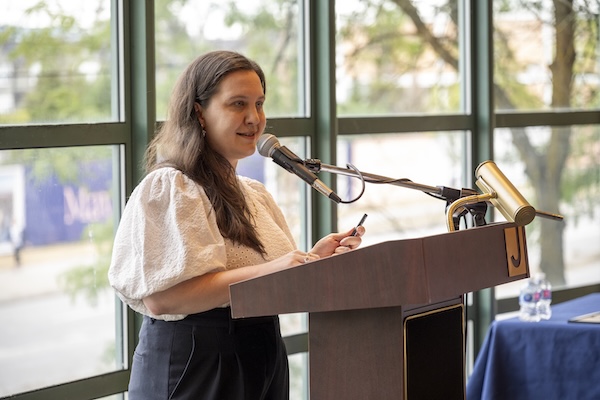
Larry Barzelai addresses those gathered for the Jewish Federation of Greater Vancouver’s Public Speaking Contest on March 5. (photo from JFGV)

On March 5, the Jewish Federation of Greater Vancouver’s annual Public Speaking Contest took place at the Jewish Community Centre of Greater Vancouver. Students in Grade 4 through Grade 7, from a range of schools, participated.

The contest, which was created more than 35 years ago by Larry Barzelai, with his wife, Rhona Gordon, is jointly presented by Federation, the JCC and Israel Bonds. 

“It provides young people with a meaningful platform to express their ideas,” wrote Jewish Federation chief executive officer Ezra Shanken in his weekly email message.

“Their confidence and creativity reflect the strength and promise of the next generation,” noted Shanken, who also spoke at the event.

Federation’s Lissa Weinberger is a key organizer, wrangling both student participants and their parents, as well as volunteer judges and moderators from the community.

Suggested topics ranged from “What is your favourite Jewish holiday and why?” to “From a Jewish perspective, should leaders be held accountable for mistakes they made in the past?” The 10 suggestions included talking about the Jewish values gained from a favourite picture book, the importance of food in Jewish culture, and the ethics of using ChatGPT; the 11th suggestion was a topic of the student’s choosing.

In each category, there were three winners. 

In Grade 7, they were Shiran Cohen (1st), Shael Singerman (2nd) and Meah Corea Reyes (3rd). 

In Grade 6, Group 1, it was David Herlin (1st), Olivia White (2nd) and Nogah Goldenberg (3rd). 

Grade 6, Group 2, saw Liz Sinderman (1st), Gilad Shortt (2nd) and Miriam Gordon (3rd) take home the top prizes. 

In Grade 5, it was Ella Zack (1st), Ben Kupfer (2nd) and Josie Prokosh (3rd).

In Grade 4, it was Levi Wenner (1st), Olivia Bregman (2nd) and Amelia Silverman (3rd). 

– Courtesy Jewish Federation of Greater Vancouver

Rose’s Angels delivers

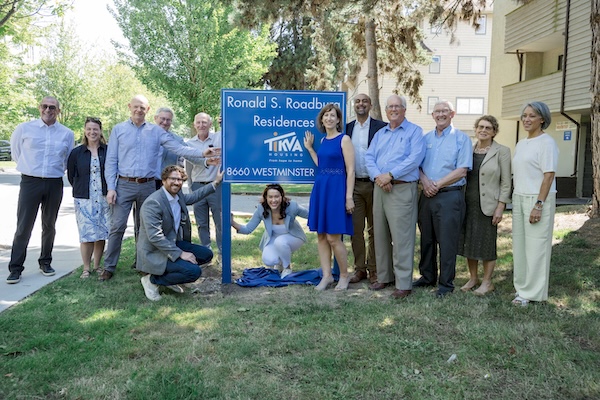
Left to right: May Stefanov, tenant relations coordinator with Tikva Housing Society, and Courtney Cohen, co-founder of Rose’s Angels. (photo from Rose’s Angels)

Eleven not-for-profits received donations from this year’s Rose’s Angels, including Mamas for Mamas, Richmond Food Bank Society, Jewish Family Services’ Grocery Program (formerly known as the Jewish Food Bank), Tikva Housing Society and Pathways Clubhouse. 

Run under the umbrella of the Kehila Society of Richmond, Rose’s Angels was created in 2012 by Courtney Cohen and Lynne Fader. It was founded in memory of Cohen’s grandmothers, Rose Lewin and Babs Cohen, who were both very philanthropic and instilled in Cohen the importance of giving back to community.

Essential personal care items, non-perishable food items, children’s arts and crafts materials, diapers and baby formula were among the donations received by Rose’s Angels this year. For many of its partner agencies, diapers and non-perishable food were among the top priority items.

“Being a mom myself, I can’t imagine what it must feel like to not have the access or means to provide essential items for your child,” said Cohen, stressing the impacts of the rising cost of living and the strain it’s putting on families and single parents.

“Supporting organizations that do such meaningful outreach for families in need is something I’m incredibly proud of,” she said.

Rose’s Angels’ success depends on the support of donors and volunteers. Letters were sent out to partner agencies, family, friends and community members in January, with donations collected in February.  Richmond Jewish Day School hosted a hygiene collection drive, and grocery gift cards were purchased last month. This month, all the donations were packaged and delivered by volunteers to the recipient agencies.

“My parents and grandparents … showed me that giving back isn’t just a kind gesture – it’s a responsibility we have to one another as part of a community,” said Cohen.

To learn more about or donate to Rose’s Angels, email rosesangelsevent@gmail.com or call the Kehila Society of Richmond at 604-241-9270. 

– Courtesy Rose’s Angels

Living life to its fullest

My Aunt Hazel is 98 years old. They call her “the Queen” at Louis Brier Home and Hospital because, when she enters a room, she commands attention. I visited her in February, and she told me about her life in India, Iraq, Canada and elsewhere.

photo - Hazel Stevens, 98, has had quite the life
Hazel Stevens, 98, has had quite the life. She still commands attention. (photo from Lisa Stevens)

Hazel Stevens (née Moses) was born in Bangalore, India, in 1928. By the time she was 18, she had five brothers and five sisters. Her parents, my grandparents, were from Baghdad, Iraq.

Despite being one of maybe five Jewish families in the whole city, they kept kosher and made their own matzah. When Passover was over, their Hindu and Muslim friends would bring them bread.

Hazel’s mother and father ran a clothing store, so, to some degree, the six girls in the family, who were born first, were brought up by the servants. The five boys who came next were brought up by the girls.

What I noticed as a child growing up was that Hazel was clearly the funniest person in the family. When we all got together, she would chant slogans from Gandhi’s National Congress Party with incredible enthusiasm. Everyone would laugh. I think that part of my love for comedy came from her.

photo - Hazel Stevens (née Moses) was born in Bangalore, India, in 1928
Hazel Stevens (née Moses) was born in Bangalore, India, in 1928. (photo from Lisa Stevens)

Hazel was also unequaled in her bravery. One day, a monkey grabbed her sister’s little girl, who was just a baby, and took her up onto the roof of the family’s home. Hazel climbed up to the roof to save her.

“I was frightened because the monkey could bite the baby or throw it off the roof,” Hazel told me. “I had to be very calm. I calmly patted myself and said, ‘Give me the baby.’ Finally, the monkey threw the baby at me.”

Luckily, no harm was done. 

A few years later, in 1946, when Hazel turned 18, she visited Baghdad with her parents. It was a time of unrest, just after the Second World War. It isn’t well documented, but my aunt says that there was one week of “hysterical mobs” trying to kill their Jewish neighbours. The Jewish community had faced increasing insecurity for years, including the Farhud (pogrom) in June 1941, during which between 150 and 180 Jews were murdered, 600-plus injured and about 1,500 stores and homes looted, according to the US Holocaust Memorial Museum. In the 1940s, about 90,000 Jews lived in Baghdad, notes the museum, making up a significant portion of the population.

During this time, Hazel and others in the Jewish community were given hand grenades by the Baghdadi government. She fearlessly carried an urn full of them on her shoulder, as she went around the city, delivering grenades to Jewish households.

photo - Hazel Stevens in Baghdad in 1946, with an urnful of hand grenades provided by the government, which she delivered to Jewish community members to use in defence against hostile neighbours
Hazel Stevens in Baghdad in 1946, with an urnful of hand grenades provided by the government, which she delivered to Jewish community members to use in defence against hostile neighbours. (photo from Lisa Stevens)

“When you are young you are not afraid … because you could run,” she told me.

One night, Hazel joined her family on the roof, throwing stones down at a malicious crowd, which eventually left. Miraculously, no one in Hazel’s immediate family was hurt during this period.

Before her stay in Baghdad, Hazel had begun dating a young British soldier named Desmond (Steve) Stevens. He lived by the YMCA where she played tennis and he would come over and tell her not to hit or throw the balls so far away because the young Indian men would have to run far to retrieve them.

Steve would visit Hazel when she worked in her parents’ store. This was dangerous because girls weren’t allowed to speak to boys in those days, she told me. Dangerous in the sense that she should have been chaperoned. 

Hazel would say to Steve, “Quickly, buy something, my parents are coming.”

The pair fell in love, but Hazel’s parents did not approve, as Steve wasn’t Jewish.

When Hazel was in Baghdad, her grandmother set her up with a man she hoped Hazel would marry. But my aunt was as smart as she was daring. She says that, when she met the man, she made all kinds of faces and threw her arms about. It was a very long 30 minutes, said Hazel, but she succeeded in turning him off.

Her daughter Lisa said: “It was her act of insanity that proved to her parents that she loved my dad. She wired him after her parents acquiesced, and he came over to Baghdad to spend some time with her.  She told me they took walks and held hands.” 

photo - Hazel and Desmond (Steve) Stevens were married in Bombay (Mumbai) in 1947.
Hazel and Desmond (Steve) Stevens were married in Bombay (Mumbai) in 1947. (photo from Lisa Stevens)

Steve promised to convert to Judaism and he did. The two were married in one of the beautiful synagogues in Bombay (Mumbai) in 1947. I remember that Steve was very knowledgeable when it came to almost anything Jewish.

Most of our family left India when it looked like there was going to be a civil war in 1948. Hazel and Steve went to England. I’m not sure of the order of their travels, but Steve remained part of the British army and so he and my aunt lived in various places in Canada and Europe. During this time, their first two children – Anita and David – were born.

Hazel told me that she was a dancer and remembers winning a $50 prize in her 30s – she can still pull one leg over her head. At the parties she threw, she would dress up in a belly dancing costume that she made, turn on Middle Eastern music and perform for everyone throughout the house. All the kids at the parties would crawl behind her, picking the shiny gold beads that would fall off her dress.

Nineteen years after her first child, Hazel gave birth to Lisa in Vancouver and soon enrolled her in dance classes. Today, Lisa is a director and choreographer, based between New York and Toronto. 

Steve was a communications engineer at BC Tel (now known as Telus). He worked with new technology and, unknown to the family until after he retired, he provided spy satellites for NORAD. He was responsible for much of the communication capabilities when NORAD was first built, says Lisa.

Hazel was the homemaker for Marpole Neighbourhood House, where she provided in-home care for seniors and for people with disabilities. She won Homemaker of the Year several times. She also spent a lot of time organizing charity events for Vancouver’s Jewish Community Centre and the Hadassah Bazaar.

Steve and Hazel spent much of their spare time in the spring and summer caring for the front and back gardens of their house on Oak Street. Lisa says they often saw people stop their cars in front of the house and take pictures of the abundance of colour and the foliage. 

Hazel ran a bed and breakfast out of her home on Oak Street and continued that after Steve passed away about 26 years ago. She also provided a room for out-of-town families who came here to visit their loved ones at Vancouver General Hospital, as the house was on that bus route.

In her late 80s, Hazel moved into Legacy Senior Living, where she says she led the exercise class at least once when the fitness instructor was away.

In a wheelchair now, Hazel lives at the Louis Brier, where she told me all about her incredible life.

I have a tendency to create funny, bold and daring characters when I improvise onstage and I think that maybe, just maybe, I get that from my aunt. 

Cassandra Freeman is a Vancouver storyteller and improviser. She wrote this article with files from the Moses family and from Hazel Stevens’ daughter, Lisa Stevens.