I’m home when my phone buzzes with a text from my son. Playing for the school basketball team in a city an hour away, his five words carry disappointment, sadness. “I’m just a benchwarmer, mom.”
I’m not one of those parents who cheers on sports games from the sidelines. Perhaps I’m still scarred from high school athletics, when my best friend and I were consistently the last members picked for any team during PE classes, a painful memory to this day. It sounds callous but, for me, sports has never held even a glimmer of interest, not even when my own children are playing.
But something changed when I learned my son had spent most of that game on the bench, watching instead of playing. What upset me was the injustice of his exclusion. He’d attended practices dutifully and loved being part of the team – until that game. “I’m not a bad player,” he insisted. “I don’t know why they didn’t give me a turn.”
The indignation of having been left out hung around the house like a damp cloud for a few days. I felt hurt on his behalf, compelled to try and make things right. So, I did what most writer-parents would do – I penned a letter to the principal. It wasn’t fair, I declared. I was under the impression that in team sports everyone gets a turn. How could the coach exclude certain players and justify that exclusion by the team’s victory? Wasn’t the victory hollow when only the best players had performed?
We don’t guarantee that every player will get to play, the principal responded. Sure, they can get a place on the team, but it’s the coach’s decision about who plays the games – and we play to win.
A friend explained it in a gentler way to me a few days later. In elementary school, the games are all about playing fair, giving everyone a turn and learning to be a good sport. Not so in high school, where the emphasis shifts to winning. “The weaker players sit on the bench so the team can have its best shot at victory,” she said. “That’s just the way it is, regardless which sport we’re talking about.”
I was astonished, but enlightened, too. As parents, we want desperately to defend our kids from insult, bruised egos and perceived injustice. Their hurt becomes our hurt, and we feel compelled, angered even, to speak out on their behalf.
But sitting on the bench might offer some important life lessons. The humility to admit you’re not the strongest player. The insight that you need to work harder to be chosen for the next game. The understanding that, as unifying as the word “team” appears to be, it’s composed of members who are not equally competent: you either shine, or are outshone.
It’s going to be the same scenario at every job interview a few years down the line. The strongest candidates will be selected while the rest will warm the bench on the sidelines until they improve their game.
So, maybe warming a bench a few times is a crucial part of the game, in that it deftly illustrates the distance between where you are and where you want to be. It’s what you do with that knowledge that makes all the difference, on the basketball court and off.
Lauren Kramer, an award-winning writer and editor, lives in Richmond, B.C. To read her work online, visit laurenkramer.net.
Bard on the Beach’s A Midsummer Night’s Dream is one cheeky dream. (photo by David Blue)
Summer in Vancouver brings the sun and, with it, things like beach time and bike rides, barbecues and picnics. It also brings the magic of Shakespeare’s Elizabethan world under the red-and-white tents of Bard on the Beach at Vanier Park.
This year marks the 25th anniversary of Bard. And, true to form, it serves up an interesting mix: re-mountings of two previous hits, A Midsummer Night’s Dream and The Tempest, under the big tent, with the lesser-known Cymbeline and the non-Shakespearean Equivocation on the newly minted Howard Family Stage at the Douglas Campbell Studio Theatre. This week, the JI reviews Dream and Cymbeline.
You can never really go wrong with presenting one of the Bard’s most beloved comedies and this year’s production of Dream is no exception, as director Dean Paul Gibson ramps up the frenzy to produce what can only be described as a very raunchy, in-your-face romp. This is one cheeky dream.
There are four story lines to follow: the wedding preparations of the duke of Athens to Hippolyta; the “looking for love” riotous journey through the fairy-studded woods of the four young star-crossed lovers; the feud of the fairy royals, Oberon and Tatiana; and, finally, the play within a play (Pyramus and Thisbe) presented by the local tradesmen in honor of the duke’s wedding and acted out under its own little red-and-white tent.
Kyle Rideout as Puck, the mischievous servant of Oberon, and Scott Bellis, as Bottom, the bucktoothed, red-nosed, nerdy know-it-all of the working class, stand out in the reprisal of their 2006 roles in this large ensemble cast. Naomi Wright breathes new life into the role of Tatiana while Ian Butcher is a very sexy Oberon. Chirag Naik, Daniel Doheny, Claire Hesselgrave and Sereana Malani beautifully play the young lovers Lysander, Demetrius, Hermia and Helena. It is refreshing to see these up-and-coming thespians make their mark on the Vancouver stage (watch them in the future!), but it is veterans Bernard Cuffling, Allan Morgan, Andrew McNee, Allan Zinyk, Haig Sutherland and Bellis (who does double duty as a lovesick ass – the animal, not the human kind) who are the hits of the show with their take on Pyramus and Thisbe. The prolonged death scene played by Sutherland and Bellis will have you in stitches, although there is a raised eyebrow moment thrown in for good measure – keep your eyes peeled.
The visuals make this production pop, from the set to the props to the costumes. Set designer Kevin McAllister has created his own dream with a large seashell-like shape framing the ocean and mountain vista that is Bard’s trademark. Umbrellas play a pivotal role in the opening scene with Tatiana’s oversized umbrella bed providing the focal point. Mara Gottler’s costumes are sartorial delights to behold, punk meets Goth meets Victorian era meets contemporary with a plethora of tutus, corsets, bustles, sheer skirts and some very interesting footwear. Then, there is the music by husband-wife sound design team Alessandro Juliani and Meg Roe, which hits the spot with the likes of “Why Do Fools Fall in Love,” “At Last My Love Has Come Along” and “I Put a Spell on You,” tunes synchronized perfectly with the action. Tara Cheyenne Friedenberg brings it all together with bespoke choreography for the doo-wapping fairy chorus.
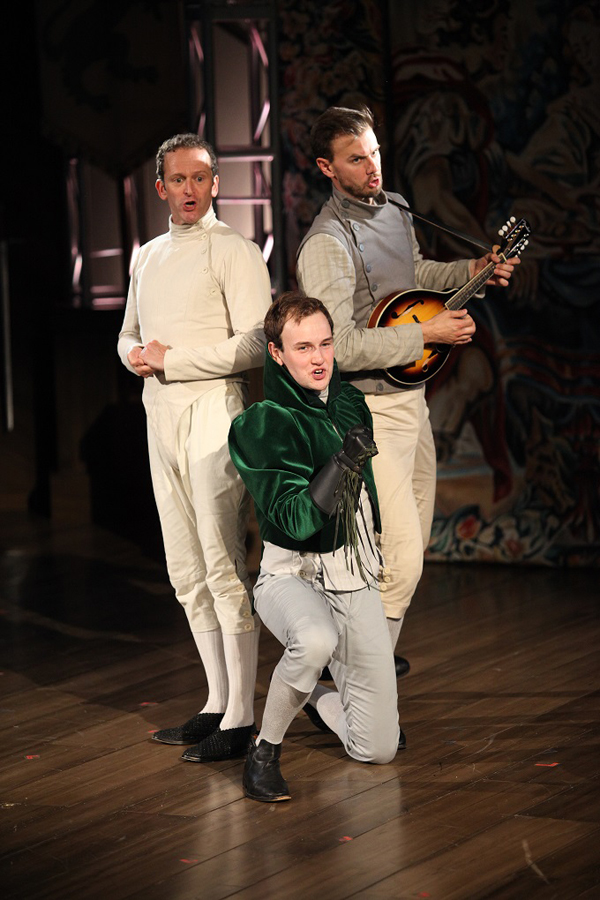
From left to right, Shawn Macdonald, Anton Lipovetsky and Benjamin Elliott in Cymbeline. (photo by David Blue)
Shakespeare wrote Cymbeline in his twilight years. It is an eclectic retrospective of his repertoire, including the allegedly unfaithful wife and villain in Othello, the sleeping potion from Romeo and Juliet, the murder plots from Hamlet and Macbeth, the heroine disguised as a boy of As You Like It, the bloody beheading in Titus Andronicus, the missing brothers of A Comedy of Errors, the list goes on. Perhaps Will thought putting these all together would be fun, but his creation is a jumbled goulash with a dizzying array of plotlines that have more twists and turns than any rollercoaster ride. This may well be why the play is so rarely produced. That being said, director Anita Rochon’s production – which she characterizes as a “tragedy gone right” – is very entertaining and hits the right balance between gravitas and farce.
Seven actors play 18 roles with all the costume changes taking place in view of the audience. Clad in beige fencing outfits, the actors signal character changes by the addition of colorful pieces to their neutral palettes – a red sash here, a green doublet or muffler there.
The story starts with the girl-meets-boy scenario. That is, royal girl (Imogen, played beautifully by the only female member of the cast, Rachel Cairns) meets plebian boy (Posthumous, played by Anton Lipovetsky) and secretly marries him. Father (King Cymbeline, played by Gerry Mackay) frowns on the relationship and banishes the boy. Meanwhile, his second wife, the wicked Queen (Shawn Macdonald) plots to have her son, the scheming Cloten (also played by Lipovetsky), marry Imogen and then poison both the girl and her father so that Cloten can become king. The speed picks up with the runaway bridegroom, a wager to test the fidelity of the chaste Imogen, disguises, a sleeping beauty, a battle, a beheading, mistaken identities and long-lost brothers. Without giving away the ending, the good news is that, measure for measure, in this production, despite much ado, all’s well that ends well.
Lipovetsky is definitely the stand out in this show as he juggles his three roles – the third being Arviragus, one of the brothers – seamlessly morphing from one character to the next. He even manages to have two of his characters on stage at the same time. Bob Frazer plays the snakelike seducer, Iachimo, who literally slithers out of a chest of drawers to do his dastardly deed. Anousha Alamian has a small but dialogue-heavy role as the long-suffering servant of Posthumous, and Benjamin Elliott also plays various smaller parts, including one of the brothers and he gets the juicy beheading bit, but his main role is as sound designer and composer of the original music played by various cast members on banjo, accordion, mandolin and drum.
Pam Johnson’s set is stark and sleek, with many pieces doing double and triple duty – a chest becomes a table, a bed, a desk. Locations are identified by flag standards, blue for England and red for Italy. Gottler’s austere costumes, in contrast to her fanciful creations in Dream, complement the simple setting, and Cheyenne Friedenberg and fight director Nicholas Harrison conspire to present some very fancy footwork.
The bottom line is that you can’t go wrong with any of Bard’s offerings for its silver anniversary year. See one or two or all, but see at least one. The festival runs to Sept. 20. For more information and tickets, visit bardonthebeach.org or call the box office at 604-739-0559.
Tova Kornfeldis a Vancouver freelance writer and lawyer.
Sarah Haniford’s granddaughter, Alice Campbell, with Schara Tzedeck Synagogue Rabbi Andrew Rosenblatt at the unveiling of Sarah’s headstone. (photo from Jewish Cemetery at Mountain View Restoration Project)
“You live as long as you are remembered.” – Russian Proverb
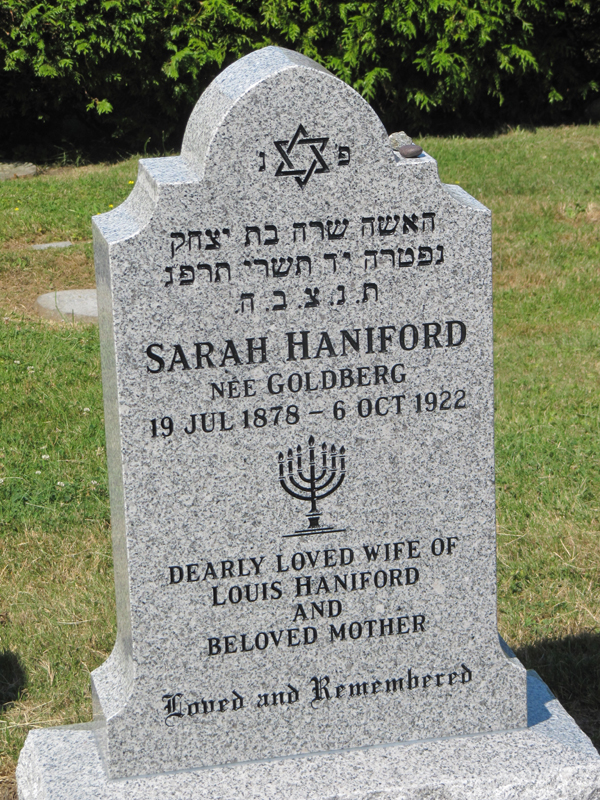
Fifty people gathered together on Aug. 3 to remember and honor the life of Sarah Goldberg-Haniford at the Jewish Cemetery at Mountain View. As Alice Campbell, Sarah’s granddaughter, said in her opening remarks to the family and friends there for the unveiling of the headstone, “a bridge to the past is a pathway to the future.”
Campbell shared some of the highlights of her grandmother’s life, which began with her birth in 1878 in Glasgow, subsequent marriage in 1890 to Louis Haniford (Ljeb Hanoft) from Poland, journey to Winnipeg in 1902, then to a farm near Hanna, Alta., in 1907.
Sarah Goldberg-Haniford’s headstone. (photo from Jewish Cemetery at Mountain View Restoration Project)
Life was very hard for Sarah and Louis, with the harsh climate and work on the farm, to which they were far from accustomed, having been in the watch-making business up until the move. In 1922, Sarah, who had by then given birth to nine children, was in very poor health, and Louis, not knowing what else to do to help her, sent her to St. Paul’s Hospital in Vancouver. Unfortunately, her health deteriorated and she passed away here, all alone, on Oct. 6, 1922.
As Jewish custom dictated, Sarah was buried in the Jewish Cemetery at Mountain View. After her death, according to Sarah’s wishes, Louis moved his family of the seven surviving children away from the farm, to the town of Hanna. With Sarah’s passing, Judaism disappeared from the Haniford family until October 2012, 90 years later, when Campbell discovered through genealogical research that Sarah was buried at Mountain View Cemetery. Beryl and Christi Cooke, Sarah’s granddaughter who lives in Kelowna and great-granddaughter who lives in Vancouver, went to the cemetery for the first time.
The timing couldn’t have been more perfect. Shirley Barnett had just embarked on her project to restore the Jewish Cemetery at Mountain View and their paths collided. In October 2013, along with 146 other unmarked burials, Sarah’s life and death were recognized, with the placing of a temporary marker as the first step in restoring the Jewish cemetery to its former significance in the community. With this mitzvah, the plan to place a permanent monument was born.
Among those attending the Aug. 3 ceremony were 25 family members, including grandchildren and great-grandchildren, none of whom had ever known Sarah – and many of whom had not seen each other in at least 15 years. Rabbi Andrew Rosenblatt and Rev. Joseph Marciano, along with members of the Vancouver Jewish community, were witness to the unveiling of Sarah’s headstone. Sarah brought everyone together and, in doing so, helped rekindle her family’s connections to each other and to Judaism.
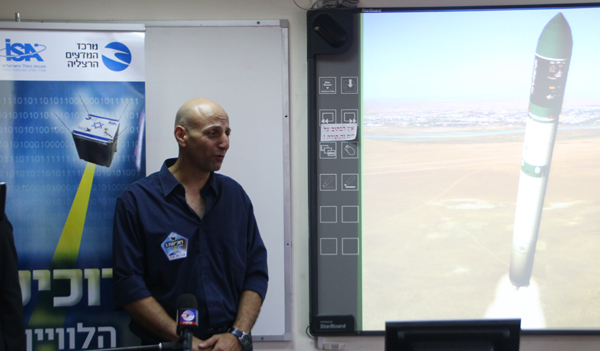
A group of Herzliya Science Centre students working on Duchifat 1 in the clean room with Dr. Ana Heller. (photo from Herzliya Science Centre)
In Israel, high school students helped launch a satellite into space – something typically reserved for university students.
“The Herzliya Science Centre (HSC) is the science campus for Herzliya’s middle and high schools,” explained Dr. Meir Ariel, the director general of the centre, which opened in 2007.
Some 1,500 students attend HSC advanced labs, studying and experimenting in physics, chemistry, electronics, biotechnology, computer science and robotics. “The jewel of the crown is our space and satellite lab, the only lab in Israel where high school students can design and build satellites and send them into space,” said Ariel.
This lab is attended by 40-50 of the brightest, most dedicated students from various schools in Herzliya and beyond.
“Duchifat 1, the first Israeli nano-satellite, weighing less than one kilogram, required multidisciplinary knowledge – from electronics to software, communications, thermodynamics and astrophysics – to construct,” he said.
Students wanting to participate began in Grade 9, with a two-year training period that provided the basic scientific knowledge needed to become candidates for membership in the space and satellite lab.
“Teenagers aren’t intimidated by technology and have little fear of failure,” said Ariel. “The success of the team relies on the ability of its members to be creative, innovative, disciplined and, most importantly, highly motivated.”
Collaboration with the Israel Aerospace Industry was crucial for the project’s success. Each team was led by an experienced engineer. Students not only learned from their mentors, but they were also exposed to state-of-the-art technology, tools and developmental procedures.
“Duchifat 1 served as a pedagogical platform, allowing high school kids from all over Israel to communicate, send commands, receive telemetry and experiment with a real satellite,” said Ariel. “Its other mission was search and rescue from space via its APRS transponder.”
Dr. Meir Ariel, HSC director, at the pre-launch briefing. (photo from Herzliya Science Centre)
Duchifat 1 was successfully launched into space aboard the Dnepr launcher a couple of months ago, on June 19.
“To reduce costs, Duchifat 1 was actually a ‘hitchhiker’ aboard a rocket that carried bigger satellites into the same orbit,” said Ariel. “Since then, Duchifat 1 has been orbiting around earth and is being tracked from the ground station at HSC by the same high school students who built it.”
Shenhav Lazarovich, 19, was one of the students who helped build Duchifat 1. She heard about the opportunity during an open day at Handasaim Herzliya High School, when learning about HSC.
“The first meeting with Dr. Anna Heller was something I won’t forget,” said Lazarovich. “She entered the room and said she’s leading a project with a goal to build a Pico satellite that will be totally designed and programmed by high school students. In that moment, I decided I want to be one of the team.”
Lazarovich had two major responsibilities in building Duchifat 1 – buying and upgrading the lab equipment (including satellite parts) and serving as the programming team’s EPS (electronic power system) programmer.
The other student on Lazarovich’s team was Ori Opher, who was responsible for finding solutions to various battery-related problems, like low battery discharge time and battery thermal issues.
“The battery is the heart of the satellite and needs to work at its best to fulfil the main goal of the satellite – saving lives (as an SOS signal transmitter),” said Lazarovich.
The satellite was launched by Dnepr 1, a Russian missile converted for space launching use. At this launch, it had 37 satellites from countries around the world.
The mission patch of Duchifat 1. (photo from Herzliya Science Centre)
“It was an amazing experience,” said Lazarovich. “We gathered around with 37 teams all over the world and watched how our ‘baby’ made its way to fulfil its destiny. Anna [Dr. Heller] has been working on this project for more than 10 years and I was there for the last four.
“When we got signals from space, all of us started crying and laughing. We’re one of the first teams to receive satellites signals from space, not to mention the youngest team in the launching program. The excitement, the energy, is something I can’t describe with words.”
Yarden Carmel, 17, decided to take part in the Duchifat 1 project about three years ago, after switching to a different high school, where one of the mandatory classes was Satellites and Space.
“We were having our guided tour and, in one of the stops, they had Dr. Anna Heller, the project lead, talking about the project,” said Carmel. “She said something I’ll always remember, that she ‘isn’t looking for mathematicians or science geniuses, but for students with fire in their eyes.’”
Carmel and his team worked on the memory management of the satellite. “Duchifat 1 got some kilobytes flash memory, like those used in the portable flash drives, but with much less memory capacity,” he said. “Our mission was to find an algorithm that would hold the information the satellites generate (like life status) and receive (like stress signals from earth) for the longest time without being overwritten by new information.
“It had to be enough time for it to be able to fly above our ground station in Israel, so we could download all the data. It might sound easy, but remember we’re dealing with much less memory capacity than in a normal PC or a Mac. We have less than one megabyte to work with and it took us a few times to get the best algorithm.”
Carmel, who also will help build Duchifat 2, still recalls being rendered speechless when seeing the live footage of the missile going up. “It even rocked the HQ building we were in,” he said. “We were all either crying with happiness, staying stressed and silent, or just repeating, ‘Here’s Duchifat!’ and ‘We made history!’”
Duchifat 2 is one of a network of 50 miniature satellites built by university teams all over the world. “The satellites will be launched in 2016, with a mission to perform atmospheric research within the lower atmosphere (between 200 and 380 kilometres altitude), which is the least explored layer of the atmosphere,” said Ariel. “Duchifat 2 is the only satellite in this network built by high school students. All [the] other 49 satellites were built by universities.”
“During these difficult times in Israel,” said Lazarovich. “I’ve wanted to say that the key for a better future is science and education. Combining these on both sides will result only in good to the whole region and the entire world. Science is an endless source for development and making the world a better place.
“When adults are asked to do a big task, they always think about why it’s not possible to do [so].… When children [are] asked to do a big task, they just do it. They don’t see the limits that adults do. And, even if they do, they are not afraid to just try it anyway.”
The launch video, and other Duchifat 1 videos, can be seen on YouTube.
On a hot Sunday in June, a grandmother climbs up to a backless seat in the bleachers of a high school gym whose air-conditioning has conked out. Students are handing out water bottles to the sweating crowd. She fans herself with a sun hat and listens to the principal testing the mic. The graduates in their caps and gowns have lined up in the corridor.
The band begins to play and the smiling graduates march in. The grandmother knows that most of them are wearing sneakers or flip-flops (except for a few girls who have saved up to buy Jimmy Choos or Manolo Blahniks). Under their robes, many wear shorts and T-shirts, not the fancy clothes she would have expected.
As the speeches begin, she waves to her grandson, who tips his cap to her. Her daughter and son-in-law hold hands as they watch the ceremony. The grandmother shifts in her uncomfortable seat and remembers the growing-up years of the young man whose achievement she has traveled 1,200 miles to celebrate.
He was such a tiny baby that the rabbi and mohel who officiated at his bris insisted on consulting a pediatrician before going ahead with the event. Now he is six feet tall. He was a friendly child who introduced himself to other kids easily at the playground when he was three or four. On holidays, he loved to lay out cookies on a platter in her kitchen but his nose barely reached the table top. Somebody had to put him on a chair to do the job.
His family moved around a lot and somehow he did not get into a Hebrew school at the right time. His great-grandfather saw to it that he was enrolled in a special program for kids who fell through the cracks and might not otherwise have received a Hebrew education. His bar mitzvah was a gala event and the grandmother remembers unexpectedly weeping with joy.
In high school, this child blossomed like a flower. His grades were excellent and he began to read voraciously, both assigned books and those she often fed him. His grandfather discussed science, astronomy, astrophysics and current events with him. His friends were children of many cultures, races and religions. He got involved in politics when the mother of a friend ran for local office and he volunteered to work on the campaign.
In the summer following his junior year, he won a scholarship to study globalization in the 21st century at Brown University. Now, he knows the facts about the issues of the day and is familiar with the problems affecting other countries. He speaks Spanish and French and is teaching himself Chinese. On a televised program with New Mexico Gov. Bill Richardson, he asked questions that prompted compliments by the governor. On his feet, the boy thinks fast and is comfortable at a lectern addressing school assemblies of 500 people.
Now, as she watches him stand with his fellow graduates and toss his cap into the air, the grandmother knows that it’s only a few months until he is gone – off to college to study international relations – probably leading to a life among people of other cultures with whom he is already quite comfortable. Undoubtedly, he will do something to make a difference in the world – something meaningful. She is proud of him. Yet, she is concerned about the economy and the job situation he will face. She worries about outside influences in the freedom of a college campus for a child who has never been on his own before. She prays that he will be safe.
Already the grandmother misses him but she has been through this leave-taking with her own three children. She missed her artistically inclined boy who drew pictures on his bedroom wall. She remembers her other little boy who stood on his bed and insisted that he saw elephants when he had a high fever. She thinks of the lovely girl who baked hamantashen from scratch in her kitchen. All three of them are married now and have children of their own, but the grandmother has not forgotten the feelings she had when they went away to college.
She remembers mailing packages of salamis, bagels and cookies. They lived in expensive dorms with cockroaches and bees. She visited them at college in sloppy rooms with all their clothing strewn across futons on the floor.
“How do you know which stuff is clean and which is dirty?” she asked. “Easy,” the boy said. “You pick it up and smell it!” He was straight-faced and serious. Yuck!
Sometimes they came home for holidays. Other times they went on trips or partied in some exotic locale that hosted spring break for young people. The grandmother had gone to college, too, but she had traveled by subway and had worked after school. At that age, she had never been anywhere but the Catskill Mountains.
Now, she looks at her daughter and son-in-law, remembering how it feels when the last child, like her grandson, goes away. There is no point in telling them that, after the child leaves, an emptiness settles on the house. The clock ticks louder. The silence in the mornings and at mealtimes is deafening. You close the door to the child’s room and do not go into it for weeks, even to clean up the mess left behind. You’re all choked up when you finally do it.
The grandmother will not tell her daughter and son-in-law that the hardest part of raising a child is the letting go.
Toby J. Rosenstrauchis an award-winning columnist and a resident of Florida. Her first novel, Knifepoint, was recently published.
The start of a new school year used to just mean dealing with the end-of-summer blues, figuring out which classes to take and which books to buy, and making sure you had a first-day-of-school outfit. For today’s kids, however, there’s another real challenge: keeping pace with all the other kids your age, from brand-name clothing to expensive gadgets.
Consider this: about one quarter of children aged 12 to 15 in the United Kingdom have their own tablet while, on this side of the pond, there’s been a five-fold increase in tablet ownership among kids. Couple those statistics with other trends, such as the percentage of children and teenagers who have mobile phones (78 percent) and toddlers who have used mobile devices (38 percent), and it’s evident that children growing up today want and have more technological gadgets than ever before – and that comes with a hefty price tag for their parents.
The struggle to keep up – to give your child what “every other” child seems to have, for fear of making them feel left out – can be daunting for parents. After all, buying your child a $100 mobile phone may not seem like much, until you factor in the cost of the monthly plan. The same goes for gaming systems like PS3 and Xbox, for which a couple hundred dollars now may not break the bank but, before you know it, the next version will come out and you’ll be shelling out more cash.
So, how can parents keep up with the demand, provide their children with some fancy gadgets, without breaking the bank and without spoiling their children?
Back to school: lessons at home
In the back-to-school rush, you may be focused on all the new things your child will learn at school this year, but it’s a great time to think about the lessons you can teach your child at home, with the first one being the value of a dollar (or two). If your child sees you spend hundreds on new smartphones and tablets every two years, they get the message that it’s a normal expense and nothing out of the ordinary, like your yearly taxes or other such payments, when these devices are luxuries, not essentials (although that could be debated).
Instead, you want to show your child that you’re happy to provide them with some of the latest trends but not all of them, all the time. Consider saving the bigger-ticket items for special occasions or milestones you want to celebrate. As well, involve your child in the discussion: how much is too much for a kid’s first phone? How long do they think it takes for you to work to earn the price of that phone?
According to Kevin Sylvester, co-author of Follow Your Money: Who Gets It? Who Spends It? Where Does It Go?, parents can and should explain the value of money to children with practical examples. For example, say your son wants the new iPhone. You buy it, but explain that the purchase means no movie tickets or outings for him for the next six months, until he’s helped pay for it. One of the reasons this can be difficult for kids to understand today is because of how little they actually see real, physical money.
“Money has moved away from the physical to the abstract. [Before] kids were forced to deal with the reality of how much something cost (they had to count coins, for example) when we needed actual money to buy things,” he writes. “But with credit cards, debit cards and automatic e-transactions, that tangible relationship with money is almost gone. So, [kids] need to know the underlying ideas about ‘value,’ ‘cost’ and so on to understand what they are spending.”
To do this, he encourages parents to give kids ownership over how much they’re spending and what they’re buying, as well as discussing why saving is important – even if it means waiting until the iPhone 15 comes out.
Quiz time: self-evaluation
Dr. Jim Taylor, author of Raising Generation Tech, reminds readers that kids pick up what they see their parents doing. The average child spends more than seven hours in front of a screen per day. If you think that’s much too high, then it’s time for a back-to-school quiz: are you any better? If you’re spending hours on your phone, computer or tablet – whether it’s watching TV, working or playing games – your child learns it’s OK to spend your day in front of a screen. However, childhood should be a time to explore, imagine and wonder, which gets lost if a child has a computer doing it for them.
“How did your children develop their relationship with technology? In all likelihood, from your relationship with technology. You influence your children’s exposure to technology in two ways,” says Taylor in a blog post about creating a healthy relationship with technology. “First, whether consciously or otherwise, you determine the technology to which your children are exposed and the frequency of its use. You buy it for them, give them permission to use it, and provide them with the time and space for its use.
“Second, and perhaps more importantly, you model the presence and use of technology in your own life. In doing so, you’re constantly sending your children messages about the role that it should play in their lives. Think about how often you, for example, watch television, play video games, surf the internet or check your email, and you’ll probably see the kind of relationship that your children have or will develop with technology.”
It’s too early to tell what impact technology will ultimately have on children who don’t know life without it, but Taylor’s points remain true nonetheless: too often we think of technology as an end itself, a way to pass time, a chance to get the kids to quiet down while we finish our day’s work, but it developed as a means to an end – a way to enhance the quality of life and do more with less.
By reminding your kids and yourself of these origins, you can instil in them the value that technology can bring – efficiency, independence, ingenuity and, perhaps, a better quality of life – while showing that they don’t have to have everything at once. And that there are other ways to work and play.
Vicky Tobianahis a freelance writer and editor based in Toronto. Connect with her on Twitter, @vicktob, or at vtobianah@gmail.com.
Last Sunday, I took my two daughters to the Vancouver Pride Parade.
Though I was certain my four- and seven-year-olds would enjoy every ounce of the many colors and sounds, and the energy of the parade itself (few events produce the same level of spirit as a Pride Parade) a day of fun wasn’t my prime motivator.
I had seen a posting on Facebook from Yad b’Yad, a community-based group that rallies local members of all sexual preferences each year to represent the Jews of Vancouver in the parade.
Pride: In so many ways!
I decided that with everything going on in Israel at the time, combined with the dramatic presence of antisemitism spreading across the globe, never was there a better time for me to teach my children about tolerance, acceptance, diversity and pride.
Yes, there were a few questions I had to be prepared to answer – like when one of the participants handing out freebies to the crowd placed a couple packs of Trojans in my seven-year-old’s hands. I responded to the expected, “What’s this, Daddy?” with an abbreviated version of how she wouldn’t be enjoying this parade if Daddy had those eight years ago. A quick shrug of the shoulders and she was back to watching “princesses” roller skate down the street to roaring cheers.
The value gained in that experience, led by the conversations I had explaining the importance of the parade, was what made me most proud. That’s because one of the scariest things I see when I look closely at Israel’s Middle East problem is the amount of education-themed hatred being passed on to children in the region. Cartoon characters who preach killing Jews and manipulated curricula that offer false truths about the Israeli-Palestinian conflict all but guarantee this crisis is not likely to end until well beyond my days.
Outside of the Middle East, the Hamas propaganda machine – which has clearly become their most powerful weapon – has helped spread hatred and bigotry around the world and, in some cases, just down the street from our own homes.
Like many other people I know, I have found myself walking around my country, my city, wondering how many people around me would like to shame me and my family because of something they once saw on TV or read on Facebook.
I’ll always do all that I can debating with and educating folks via various social media outlets. But the most important thing I can do for the future is teach my kids. Teach them to love. Teach them to accept. Teach them to continuously open their minds to the many choices free people have in this world.
It’s entirely possible that watching half-naked men and women prancing up Robson Street is not for everyone (say, what!?). But I encourage parents, aunts, uncles, cousins and friends everywhere to do something unique, outside of the box, and, especially, meaningful to provide your youth every chance to identify the difference between right and wrong. They will see it all on Facebook one day. Better they are prepared to figure it out for themselves when they do.
Gaza, July 28, 2014: An Israel Defence Forces soldier examines a newly revealed tunnel in the Gaza strip. (photo by IDF via Ashernet)
It’s been awhile since I’ve written. There’s a story I’ve been meaning to share but, unfortunately, circumstances have led me to write a different story entirely, about “the matzav.”
“The matzav” means, literally, “the situation,” but it’s used to refer euphemistically to a current bad security situation in Israel. You say it in a half whisper, the way our parents used to say, “cancer.”
“How’s business going now, with – the matzav?”
“We’re going up north for a few days because of – the matzav.”
“My mother-in-law has been with us for two weeks, thanks to – the matzav.”
It’s definitely not an easy time to be in Israel, though now, more than ever, there is no place I would rather be.
I didn’t grow up in a particularly Zionist household. Most of what I know about Judaism and Israel I learned in college. People used to say to me that being in Israel is like being with family, and making aliyah is like coming home. My family never shoved in front of me to get on buses or overcharged me for souvenirs, so I guess I just couldn’t relate.
I got a little taste of the family thing when I was visiting Israel 12 years ago on a mission during the Second Intifada, when tourism was at an all-time low. I went to the falafel stand in the Old City by the Cardo with my 10-month-old son. There were no other tourists to be found. The owner, who was usually just interested in taking orders and keeping the line moving, insisted on holding the baby while I ate. This was like my family – not always warm and fuzzy, but there for you in hard times.
These are hard times. There’s been a constant barrage of rockets in southern Israel for weeks, keeping the population within 15 seconds of a bomb shelter. As I wrote these words, four people were killed by a rocket fired from a playground in Gaza. This morning, a man on the radio was saying that he’s terrified to shower or even go to the bathroom for fear a siren will go off.
Another woman was asleep and didn’t hear a siren. She only heard the rocket hit her house. She is being treated in the hospital for wounds to the head, legs and knees, but no treatment will cure the fear you can hear in her voice, unable to speak in full sentences.
On the other side of the border, the suffering in indescribable and the media images haunting. I feel torn apart by my pain for the Palestinian losses on the one hand and the need for us to defend ourselves on the other. Then there’s the sadness for the soldiers who are trained to minimize civilian casualties, but who find themselves hurting innocent civilians, behind whom the cowardly terrorists hide.
Our “adopted” lone soldier Danna tells us stories of what her friends see who are serving in Gaza – hospitals and UN schools hiding weapons and terrorists; gunmen literally hiding behind families; terrorists shooting with a gun in one hand and a baby in the other.
As Golda Meir said to Anwar Sadat just before the peace talks with Egypt, “We can forgive you for killing our sons. But we will never forgive you for making us kill yours.”
Before the war started, I got a call one Friday afternoon.
“Hi, Emily. We’re thinking of cancelling the partnership minyan this week, but I just want to check with you, because I know you worked hard on your speech.”
“Oh, well, sure … but why?”
“We just thought it would be better for the whole community to pray together tonight because of, you know – the matzav.” (Pause) “Did you not here what happened?”
That’s how I heard about the three kidnapped soldiers.
You would think all three of them were from our kibbutz, the way people spoke of them and cried and prayed for them and organized around helping their families. The whole country was suddenly one big family. One big, sad family.
At school, the teachers held special meetings with their pupils to help them digest the news and share their feelings. They had a meeting in the evening to help parents with how to talk to their kids. All this despite the fact that the three boys were from a different part of the country and not at all connected to our school or our region, except that here everyone is connected. At these times, we’re all cousins, brothers, sons.
The news a few weeks later – that the boys were killed – hit hard. I was out for the day to Beit Shean with my son Abaye to get braces on his teeth. Abaye is very sensitive to “the matzav” and I try to keep him away from the news most of the time so we can share things with him in our own way, but there was no escape. The news was on in the dentist’s office, and staff and patients were openly crying. Afterwards, we went for ice cream and the ice cream shop was playing the tape over and over again. Everyone’s eyes were glued to the screen.
“You’re an ice cream shop!” I wanted to yell at them, but it wouldn’t have mattered. The whole country was in mourning.
Then the rockets started in the south. Everyone’s hearts turned to the families under fire. Our kibbutz Google group filled up with suggestions of where you could bring food and supplies, requests to run programs, and even invitations to drive down south into the fire to help entertain kids in bomb shelters. There were so many projects being run out of so many places that volunteers had to quickly set up a committee to manage them all.
Our area happens to be one of the safest parts of the country. We haven’t heard any sirens. We haven’t even unlocked our bomb shelters. So, everyone is opening their homes.
Several families have come to our kibbutz for a break, and our youth group organized a camp for a week with peers from a kibbutz in the south. I heard on the radio about a resort nearby that has opened its doors to another kibbutz (200 people!), feeding and housing them and running programs for the kids. And these are just a few tiny examples. Every community is doing something.
Then there are the troops fighting in Gaza.
Tel Aviv, July 29, 2014: Israeli Prime Minister Binyamin Netanyahu at the press conference announcing an extension of the Gaza operation. (photo by Ashernet)
Soldiers were sent to the border to defend our country from rocket attacks. Prime Minister Netanyahu tried to stave off a ground incursion, but the rockets kept falling and, it seems, there was work that could only be done on the ground.
When the army finally went in, they discovered a complex underground tunnel network that Hamas had built to infiltrate Israel. It seems they were planning a massive operation for the upcoming Rosh Hashanah – hundreds of terrorists were scheduled to appear from nowhere in kibbutzim and villages across the south, dressed in Israeli uniforms, for a mega terrorist attack. It’s chilling to think about what they might have done.
Several of the fatalities of this war, including the three kidnapped boys, have resulted from terrorists coming through these tunnels. They lead from private homes in Gaza right into Israeli neighborhoods, one ending directly beneath the dining hall of a kibbutz. It was reported that children on the kibbutz had been complaining they could hear someone digging under them, but adults hadn’t taken them seriously, because how could that possibly be?
So, now we are at war in Gaza until we get rid of the tunnels, of which 30 have been discovered so far, and many destroyed. Meanwhile, the number of fallen and wounded soldiers continues to rise, as well as, of course, the massive toll on both terrorist and innocent Gazans.
But I wanted to tell you about the efforts to support our troops.
Being the army of the Jewish people, the aid started with, of course, food. Fresh meals, cakes and treats – you name them. A renowned chef opened shop to provide gourmet cuisine for the soldiers.
At one point, we got the message that it’s enough food, and now could we please send personal hygiene products (soaps, deodorants, etc.) and “fresh towels with the scent of home”? In addition, children sent so many letters of love and support that the soldiers use them to wallpaper their tanks and living spaces. At the camp for Adin, my nine-year-old son, they changed the program this week so that every day was a different activity to support the soldiers – making gifts, preparing food and raising money.
And, of course, it’s difficult for soldiers to communicate with their families, so the radio has taken to running extra programs in which they can send personal messages.
“Hi Mom, Dad and, of course, my girlfriend Tal. I’m here to protect you and I’m fine, so you can sleep without worrying. I love you.”
And I’m sure Mom, Dad, Tal and half the country are crying with me.
Among the first losses of the war, we heard about the falling of two lone soldiers – people like our “adopted” daughter, who moved to Israel voluntarily to protect our country, who are here with no family. It made me sad to think these people would be buried alone, but what could anyone do? Their whole family is overseas.
A photo of one of these fallen boys, Sean Carmeli from Texas, appeared on the news in a Maccabee-Haifa soccer T-shirt. They were his favorite team. The team apparently shared my concern and made an appeal for people to attend his funeral. Twenty thousand people showed up!
You could call it a social media ploy, but I don’t think so. The next day, there was a funeral for the other lone soldier, Max Steinberg from California. I was afraid his funeral would pale in comparison to Sean’s, seeing as he wasn’t a major sports fan. But my fear was baseless. Thirty thousand people were in attendance. Those who were interviewed about why they came simply said that he made the ultimate sacrifice for them when he didn’t need to, and it was the least they could do.
Max’s family had never been to Israel before. I thought about my own mother, who did not want us to make aliyah, and who would never forgive me if, God forbid, anything happened to any of my kids. Max’s parents and siblings were overwhelmed by the turnout.
His mother Evie told the mourners, “We now know why Max fell in love with Israel. It was all because of its people. He was embraced with open arms and treated like family,” she said, “and, for that, we are eternally grateful.”
When his sister began, “We come from a very small family,” I held my breath expecting to hear her anger or sadness at having lost her brother. Instead, she continued, “But that seemed to quickly change after meeting people in Israel, who made it feel like one big family.”
This morning, I was out walking in the forest around the kibbutz when a new song came on the radio by Ariel Horowitz, son of one of Israel’s greatest singers, Naomi Shemer. The song is about the lone soldier Sean Carmeli. The writer had attended the funeral and was deeply moved. The chorus goes something like this:
20,000 people and you’re at the front. 20,00 people are behind you, Sean. Marching in silence with flowers, Two sisters and 20,000 brothers.
Sgt. Nissim Sean Carmeli and Sgt. Max Steinberg, and all our fallen soldiers will never be forgotten, because we don’t forget family.
Emily Singeris a teacher, social worker and freelance writer. Singer and her husband, Ross, were rebbetzin and rabbi of Vancouver’s Shaarey Tefilah congregation until 2004. The Singers spent two years in Jerusalem and then moved to Baltimore, Md., where Ross was rabbi at Congregation Beth Tfiloh and Emily taught Judaic studies at Beth Tfiloh High School, until they moved to Israel in 2010. They have four children, and live on Kibbutz Maale Gilboa.