Healing one’s self, the earth

Born to Ukrainian Orthodox survivors of the Holocaust, Dr. Eva Pip knows all too well the long-lasting effects of war. Her parents were imprisoned in labor and concentration camps as punishment by the Nazis for harboring Jews on their farm.

“My mother was never a fully functional human being again,” said Pip. “She had a number tattooed on her arm that she was always trying to conceal. She felt that, if someone saw it, they’d think less of her. Her greatest fear was of being sent back.

“She had terrible nightmares for the rest of her life. At least once a week, she would scream in her sleep, as though she was being murdered. I’d have to run to wake her up. She had a lot of old injuries and scars, and an improperly healed collar bone and breast bone.”
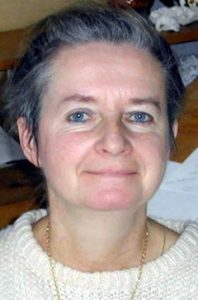
photo - Dr. Eva Pip
Dr. Eva Pip (photo from Eva Pip)

Pip’s mother came to Winnipeg by train from Halifax. Her mother did not choose to come to Canada; it was simply where that week’s ship from Germany happened to have been bound. The previous week’s ship went to Australia.

Several years later, Pip’s mother was able to sponsor her husband to come to Canada. He could not get out of Germany when the war ended and the forced labor camp in which he was held was disbanded, as he was wounded and not yet medically fit to be cleared to come to Canada. He finally came in 1949.

Pip was born the next year though her parents never wanted a child. The war had taken the humanity and warmth from them and they found it difficult to cope with basic daily life.

“In many ways, both of my parents were like children,” said Pip. “They could not make decisions, they could not take proper control of their lives, they constantly lived in some past world before the war had happened.

“There must be thousands and thousands of these silent casualties that are not recorded or even recognized. This damage did not stop with the people who personally experienced war atrocities. It affected their children, too, such as myself, who grew up in essence without parents to love and nurture them, to teach them, to respect them as human beings that they have brought into the world.

“My parents never once hugged or kissed me. We had very little food to eat. Often, we ate out of garbage cans. My mother made my clothing out of scraps and bits because she could not afford to buy me anything. My father did not want to support us, although he lived with us.”

Pip’s father worked as a painter for a billboard company, Universal Signs, which was owned by Max Gardner – who was Jewish and who Pip said took pity on her family – until he retired at the age of 66.

“The Gardners were our benefactors,” said Pip. “They gave us their old furniture for our home and did many kind things to help us out. They almost adopted me.

“Our next door neighbors on Manitoba Avenue in Winnipeg’s North End happened to be the parents of Dr. Harry Medovy [a well-known pediatrician and academic]. Although he had already left home long before we arrived, his mother was very kind to us and often shared her home-made Jewish holiday food with us.”

Later on in life, Pip has, in turn, helped out with various Jewish women’s and seniors organizations.

Growing up in a home that did not encourage friendships, Pip developed a very rich interior life, and found empathy and compassion for other beings in her North End environment.

“I developed a passion for nature, for the earth, and felt incredible sadness at what was happening to our environment,” she said. “I felt the hardships of the creatures around me that had even less than I did. I could feel their voicelessness and powerlessness from those who could kill on a whim and who were unmoved by the suffering and injustice we inflict on the companion spirits God gave us to accompany us during our brief time on this earth.”

This view led Pip to her career choice. She wanted to speak for those who could not and to raise awareness of how damaging and destructive people’s actions are for our planet.

Regarding any desire to have a family of her own, Pip said, “You cannot miss something that you have not had. I have lived alone all my life. The advantage of this is that spiritual development becomes a much more important life path, without the distractions of family and its problems and demands.

“My work became my family. I obtained my PhD from the University of Manitoba in 1977. At that time, being a woman in science was hard. I was able to go to university only because the National Research Council supported me with scholarships. I worked very hard and got good grades.”

Pip taught at the U of M for three years before transferring over to the University of Winnipeg, where she has been teaching for 37 years. This year, Pip is retiring, though by no means does she intend to spend her days resting. She plans to continue writing and publishing pieces on the environment and working in her large rural garden.

Pip grows most of her own food because she knows it will be clean and free of chemicals.

“I’ve always loved tomatoes,” she said. “That interest has grown into my trying to preserve heritage varieties, as these are rapidly disappearing and are an irreplaceable part of our collective culture. I also grow heritage potatoes and heritage varieties of flowers, giving away much of what I cannot eat. I also harvest wild foods on my land.”

Instead of having a cottage, which Pip views as harmful for the environment, she buys land of ecological value and donates it to wildlife preservation institutions. She has donated most of her land to the Manitoba Habitat Heritage Corporation.

“I hope there is never such a monstrous exhibition of human cruelty and vice in our world again [as was the Second World War],” said Pip. “I hope we never again have millions of damaged human beings in the aftermath. I hope we can make peace with each other, that we can recognize that we are all equal, that we do not look down on each other and pretend we are better, that we do not rob each other of our right to life and right to God, and that we make peace with our Mother Earth.

“For these things to happen, human nature needs to change, our values and our dollar worship need to change. I fear that it will be too late by the time we and our leaders realize this. When it is time for me to hand in my dinner pail, I wish to face God and feel confident I have done a good day’s work.”

Rebeca Kuropatwa is a Winnipeg freelance writer.
Aftermath of trauma

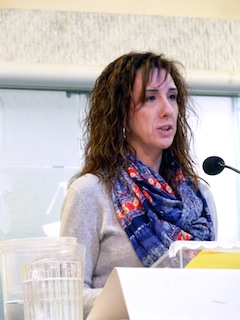
Sometimes there are jokes about how we’re all emotionally damaged to some degree. It’s a serious problem for us, because we all lived through wars and terror attacks,” shared Canadian-Israeli Yolanda Papini Pollock of Winnipeg Friends of Israel (WFI) at a lecture co-hosted by WFI on Feb. 9.

The discussion, which focused on the topic The Psychological Impact of War and Terrorism: Coping with and Minimizing Trauma, was held with the local Canadian Associates of Ben-Gurion University of the Negev chapter, the Jewish Post and News and Congregation Temple Shalom, at the synagogue.

photo - Michel Strain
Michel Strain (photo by Rebeca Kuropatwa)

“I’ve worked with refugees for the last decade,” said Michel Strain of the Manitoba Immigrant and Refugee Settlement Sector Association. “All have come from countries affected by war and many have experienced trauma and torture, many living in refugee situations for many years.

“In my role in the employment program I worked in, I was often one of the first people the refugees began to trust. And, during this trusting relationship, I had the privilege of many individuals sharing their stories with me…. Their resiliency was resoundingly evident to me.”

Holocaust survivor Edith Kimelman spoke about dealing with her personal trauma. She was 16 years old when Germany invaded her small community in Poland.

“I stood at a neighbor’s window and watched my father being led away by soldiers, only to find him later in a field – dead and riddled with bullets,” she said. “It was beyond my young comprehension to understand that no one in our non-Jewish community of neighbors would help us bring him home. My childish belief was, once he returns to our house, he would return to life.

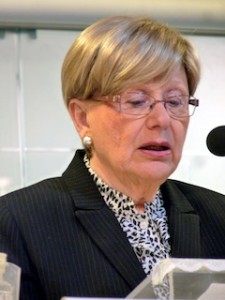
photo - Edith Kimelman
Edith Kimelman (photo by Rebeca Kuropatwa)

“To watch from our window, as Jewish neighbors were led behind a stable, shot and quickly buried gives me, to this day, nightmares. To find my mother so severely beaten that it led to her death will haunt me forever. I felt like I was punished, having to remain alive without her.

“When I had my own children, I lived in constant fear that something terrible would happen to them or to my husband, and that I would be unable to help them.”

Kimelman explained how this trauma has affected every aspect of her life, including, of course, her relationships with family and friends. While she fears she will leave her sons with the heavy baggage of her unfortunate experiences, she is confident that her fierce love for life and her survival will carry them through.

The keynote speaker of the event, BGU’s Dr. Solly Dreman, who was born and raised in Winnipeg before moving to Israel 50 years ago, was introduced by Dr. Will Fleisher, a local therapist experienced in working with traumatized youth and adults. Dreman is professor emeritus in BGU’s department of psychology.

Dreman has witnessed the long-lasting effects of terrorism. Decades later, “soldiers are having night terrors, night sweats, family difficulties, are unable to cope.”

He differentiated between war and terrorism, explaining that war is usually preceded by prior events and circumstances, while terrorism occurs suddenly, without warning, causing a different type of trauma. Unlike war, terrorism is not confined to a specific geographic arena or time dimension.

“The threat persists, the fears, uncertainty, the sense of helplessness,” he said. “Such attacks are looming over our heads all the time. You have the unbridled devils lurking in your soul forever. That’s going to serve as the trigger for anxiety, feelings of helplessness and inability to cope.

“People who have lost loved ones may have been witness to the event, and we all know the symptoms of survivor guilt,” he continued. “By escaping unscathed, they experience feelings of guilt that they came out alive. There’s research that shows that people who have been injured in a terrorism event after having lost a family member have less PTSD [post-traumatic stress disorder] than someone who comes out unscathed. Survivor guilt has been a major factor.”

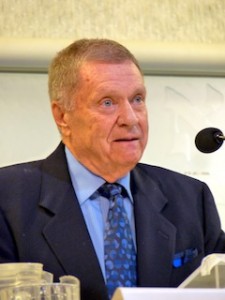
photo - Dr. Solly Dreman
Dr. Solly Dreman (photo by Rebeca Kuropatwa)

Dreman pointed to the media as an aggravator in Israel, saying they continually expose the public to the horrific events, while frequently providing information that is unreliable and unconfirmed. He also said the general public, too, is responsible for watching, reading and listening to these reports more critically.

He spoke about his experiences with two separate terror incidents.

“Our initial therapeutic attempts were designed to deal with interpersonal things, like helping teachers in their contact with the young victim students, helping integrate them into the school system,” said Dreman.

The approach seemed to have worked for the first few years, but when Dreman went back to these families 10 years after the initial contact, he found them struggling with life and their interpersonal relationships.

“It was terrible,” said Dreman. “We failed. By the way, we got published in a very prestigious journal reporting on our failure. The conclusion, for those of you who are dealing with refugees or faced the Holocaust, is that there is a need for interpersonal intervention and getting back to business as usual.”

Dreman suggested that limiting media exposure may be helpful, as the constant repetition of the horror does not allow people to heal. But, on the other hand, he said it is important to not go completely off the grid, as that can cause anxiety to a breaking point that might create more trauma. A balance is needed, he said.

Dreman further advised that it is important to embrace life, that social support is a major factor in healthy adjustment.

“Be up front with your kids, explaining that you will do your best to protect everyone,” he said, “but don’t promise that nothing bad will happen, as that is a promise you may not be able to keep. We should allow kids the opportunity to express their fears, but not to dwell on them, as that will exacerbate the sense of trauma.

“Routine is very important – schoolwork, exercise, empowerment,” he added. “The only way to get that is establishing a routine in the face of incomprehensible uncertainty and trauma. Don’t send the kid to a shrink because, by doing that, you’re telling them you can’t manage things.”

Rebeca Kuropatwa is a Winnipeg freelance writer.