Skip to content
  • Home
  • Subscribe / donate
  • Events calendar
  • News
    • Local
    • National
    • Israel
    • World
    • עניין בחדשות
      A roundup of news in Canada and further afield, in Hebrew.
  • Opinion
    • From the JI
    • Op-Ed
  • Arts & Culture
    • Performing Arts
    • Music
    • Books
    • Visual Arts
    • TV & Film
  • Life
    • Celebrating the Holidays
    • Travel
    • The Daily Snooze
      Cartoons by Jacob Samuel
    • Mystery Photo
      Help the JI and JMABC fill in the gaps in our archives.
  • Community Links
    • Organizations, Etc.
    • Other News Sources & Blogs
    • Business Directory
  • FAQ
  • JI Chai Celebration
  • JI@88! video

Recent Posts

  • Sharing her testimony
  • Fall fight takes leap forward
  • The balancing of rights
  • Multiple Tony n’ Tina roles
  • Stories of trauma, resilience
  • Celebrate our culture
  • A responsibility to help
  • What wellness means at JCC
  • Together in mourning
  • Downhill after Trump?
  • Birth control even easier now
  • Eco-Sisters mentorship
  • Unexpected discoveries
  • Study’s results hopeful
  • Bad behaviour affects us all
  • Thankful for the police
  • UBC needs a wake-up call
  • Recalling a shining star
  • Sleep well …
  • BGU fosters startup culture
  • Photography and glass
  • Is it the end of an era?
  • Taking life a step at a time
  • Nakba exhibit biased
  • Film festival starts next week
  • Musical with heart and soul
  • Rabbi marks 13 years
  • Keeper of VTT’s history
  • Gala fêtes Infeld’s 20th
  • Building JWest together
  • Challah Mom comes to Vancouver
  • What to do about media bias
  • Education offers hope
  • Remembrance – a moral act
  • What makes us human
  • המלחמות של נתניהו וטראמפ

Archives

Follow @JewishIndie
image - The CJN - Visit Us Banner - 300x600 - 101625

Tag: Okanagan

Okanagan’s New Year

The Okanagan Jewish community celebrated the High Holidays with spiritual leaders Rabbi Larry Seidman and Rabbi Linda Seidman from California officiating at the services. The husband-wife team had prepared special pamphlets for everyone in the community to be able to participate.

There was an erev Rosh Hashanah service on Oct. 2, as well as morning services the next day, which were followed by a potluck luncheon. For Yom Kippur, there were also two services, with Kol Nidre on the erev and a day-full of services on Oct. 12, which included a discussion period, Yizkor and a break-fast potluck.

The services were all well-attended and Rabbis Larry and Linda were warmly welcomed to Kelowna and to the celebrations.

Rabbi Larry has a background in research and management, encompassing communications, satellites, aerospace, wind energy and telemedicine. He holds many degrees, as well as being skilled in engineering and management, and has been sought after for presentations. He has given talks around the world.

Throughout his career, he has been dedicated to Jewish practice and study, having served as a lay leader of minyans and Torah study groups, and has continued to pursue both formal and informal Jewish education. A few years ago, he retired from his position as a senior manager in Phantom Works, the research and development organization of the Boeing Company, which has allowed him to increase his engagement in Jewish activities.

He was ordained as a rabbi by the Academy for Jewish Religion, in California, and is a member of the Southern California Board of Rabbis. His practice is dedicated to being a rabbi who combines Jewish tradition with modern thought.

A 2010 ordinee, Rabbi Linda currently serves as a prison chaplain in Orange County, Calif. Donning her uniform and bullet-proof vest, Rabbi Linda, who is certified as a deputy chaplain, works with the county jails, offering counseling and other services to 80 or 90 people per month. “If anybody had told me 10 years ago, when I was an aerospace engineer, that I would be doing this, I would have said ‘in your dreams,’ but life takes funny turns,” she said.

Admitting that she failed at retirement, she said she became interested in the Academy for Jewish Religion, which is a non-denominational rabbinical school, when she heard that it offered a part-time program. She enrolled a year after her husband. Today, in addition to the jail chaplaincy, she serves as the chaplain at a hospice, performs an occasional funeral and leads services and Bible study at a senior living facility.

Rabbi Linda believes that there is “a tremendous amount of security in knowing what to do and when to do it,” and that traditional Judaism meets the needs of some people who are happy and comfortable with their roles. But, she feels that women bring another approach to Judaism. “We see things differently than men,” she said. In other areas, however, such as women’s health and children’s issues, “our concerns are rooted in same values, and there is plenty to unite us.”

* * *

In other recent OJC news, one of the community’s newer members, Philippe Richer-Lafleche, became a bar mitzvah on Oct. 15. Not having had the opportunity to have a bar mitzvah when he was a boy, Richer-Lafleche had looked forward to the special day, which took place after many months of studying under the guidance of OJC’s religious chair, Evan Orloff. The services were followed by a potluck lunch, which included dishes provided by Richer-Lafleche.

* * *

Finally, OJC celebrated Sukkot on Oct. 17 with a mixture of 60 adults and children in attendance. The rains dispersed and the ground dried so that everyone could enjoy the experience of building and decorating the sukkah.

A special thank you to Natasha for organizing crafts, and to the parents who helped construct the sukkah without the help of Google or Siri. The construction was followed by a potluck inclusive of pizza cooked by one of the OJC Golf Classic food sponsors, Mr. Mozzarella Pizza and Wings.

* * *

The Okanagan Jewish Community Centre’s mission “is to work towards building a strong and unified Jewish community in the Okanagan Valley of British Columbia. The OJCC encourages an inclusive atmosphere of understanding and respect amongst Jews of different backgrounds, and maintains cooperative relationships with other regional and national Jewish community organizations. The OJCC also aims to promote a positive and active relationship with the Okanagan community at large.”
 

Posted on November 11, 2016November 11, 2016Author Okanagan Jewish CommunityCategories LocalTags High Holidays, Jewish life, Judaism, Okanagan
Hebrew school in Okanagan

Hebrew school in Okanagan

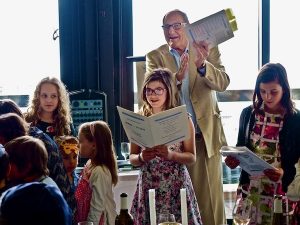
Left to right, reciting the Four Questions at the Okanagan Jewish community’s Passover celebration: Adarah Challmie, Ben Levitan, Jordan Spevakow, David Spevakow, Samara Levitan, and Kate Spevakow. (photo by Misty Smith)

Kelowna’s Jewish community may be small, but it’s poised for growth. The latest development: an expansion of its Hebrew school’s curriculum.

Led by the family of David and Natalie Spevakow, who moved to Kelowna from Calgary some 13 years ago, Hebrew classes were first provided last year. Now, more Jewish content will be added to the lessons, as well.

At the moment, the Spevakows are spearheading this task. Parents lead classes every Monday after school, with kindergarten to Grade 3 first, followed by grades 4-to-7. The parents rotate each week, teaching the kids about Jewish traditions and the Hebrew language, prayers and blessings. Currently, there are 14 students in total (two of whom are Spevakows).

“Trying to have a Jewish life in a small community can be a challenge,” said Natalie Spevakow. “I would say our congregation at the Okanagan Jewish Community Centre is about 100 members, but only 25 to 30 are active members.

“We have a visiting rabbi who comes once a month, Rabbi [Shaul] Osadchey from Beth Tzedec congregation in Calgary. We set this up to bridge the gap with our communities, and that’s been wonderful. With us having young families, we’ve all decided that it’s important that we get together, and we wanted to build a Jewish community for ourselves and our kids.”

The Spevakows are looking to hire a part-time teacher to start in September and work through June. They are searching for a creative, energetic person knowledgeable in Hebrew and the Jewish traditions to teach children ages 4 to 14. The position involves two hours of teaching a week, plus preparation time, and the teaching material is provided. In addition to an hourly wage, the teacher would receive a free annual family membership to the Okanagan JCC. (Interested readers should call Anne at the OJCC, 250-862-2305.)

“All of our parents just want our kids to be with other Jewish children and get a sense of what it is to be Jewish,” said Spevakow.

“We also try to get together with our Hebrew school every few months for a potluck,” she added. “When we have the visiting rabbi come, we do a potluck with the rabbi and do services with our children and our families as well. We make that a time to get together and bring the community together.”

photo in Jewish Independent - Dressed for Purim, left to right: in the front row, Bria Tizel, Anderson Parnes, Kate Spevakow, Ryder Golbey, Skyla Golbey and Chase Golbey; in the back, Jordan Spevakow, Abbey Parnes and a friend, and Adarah Challmie
Dressed for Purim, left to right: in the front row, Bria Tizel, Anderson Parnes, Kate Spevakow, Ryder Golbey, Skyla Golbey and Chase Golbey; in the back, Jordan Spevakow, Abbey Parnes and a friend, and Adarah Challmie. (photo by Natalie Spevakow)

As of now, all the children involved in the school are Canadian-born, but there are Israeli-born children who will be joining classes when they come of age. The class curriculum is a combination of programs that the Spevakows sourced online with guidance from Osadchey. Parents are encouraged to take material home to practise during the week.

“The learning works better if they do take stuff home,” said Natalie Spevakow. “I know, for the little guys, they’re just learning the Hebrew letters and can repeat the words they learned…. We try to make it hands-on and more fun for them.”

Looking ahead, Spevakow feels that the Jewish community is growing, anticipating that one day it will be big enough to warrant more frequent visits from Osadchey.

“But, right now, with our smaller numbers, it’s very difficult for us to finance having a rabbi here all the time,” she said. “As is, we’re making it work, getting our kids educated and getting the resources we can.”

The older students are learning to lead Friday night services, with the goal of having them lead a service by May 2017, and then again, have them lead a service with Osadchey.

“We’re not on our own, trying to make things up on our own,” she said. “It’s just a matter of people making time for their kids, so the program works. I think all the parents recognize they want this for our kids and are willing to put in their time.

“We used to do it on weekends, but, with so many of us really big into skiing, it wasn’t working out. So, weekdays are definitely working better for us.”

They also recognize there may be some older members of the community who may be interested in helping with classes, so they hope to bridge the gap and find ways to bring them in, too.

“There’s something to be said about a small community, in that you really get to know all your members,” said Spevakow. “They truly do become an extension of your family. You realize that anything you’d like to see happen, things that, in a larger community you might have taken for granted because it’s available, in a small community may not exist yet…. Connecting on a deeper level with the people in our community, figuring out the assets that each can bring to the table, has really benefited our community. Knowing everyone’s faces really helps.”

Rebeca Kuropatwa is a Winnipeg freelance writer.

Format ImagePosted on August 19, 2016August 18, 2016Author Rebeca KuropatwaCategories LocalTags continuity, education, Hebrew, Judaism, OJC, Okanagan
Update from the Okanagan

Update from the Okanagan

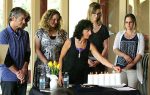
Left to right: Evan Orloff, Melina Moore, Barb Pullan lighting the candles, Rebecca Morlang and Hilla Shlomi. (photo by Roger Tepper)

The Okanagan Jewish Community has been busy over the last couple of months. They are also gearing up for their annual golf tournament, which takes place in July.

On April 22, the OJC hosted a Passover seder at Summerhill Winery. Led by Allan Holender, approximately 150 people attended, including 30 kids under 12. Dr. Jessica Strasberg organized the children’s crafts and activities, Ronit Little made the charoset for all the tables and Steven Finkleman helped with many of the food preparations and putting together the 18 seder plates; David Spevakow and Barb Druxerman volunteered a great deal of their time on preparations and planning. Steven Cipes and his family, of Summerhill Winery, hosted the event.

photo - Writer and consultant Allan Holender leads the Passover seder with some young help
Writer and consultant Allan Holender leads the Passover seder with some young help. (photo from Okanagan Jewish Community)

Also in April, Cantor Russell Jayne from Beth Tzedec in Calgary came to the Okanagan to lead services. On May 7, with special guests from the International Christian Embassy Jerusalem (ICEJ) in attendance, OJC member Evan Orloff led the services, after which there was a dairy potluck. A new rabbi has been contracted for the High Holidays this year and the OJC is looking forward to having Rabbi Lawrence Seidman and his wife Linda – who is also a rabbi – join them.

On May 15, Orloff and fellow OJC members Ed Aizen, Max and Peggy Mandelbaum, Barb Pullan, Hilla Shlomi and Seymour Zidle attended a Holocaust remembrance service held at the Lakers Clubhouse in Vernon hosted by the ICEJ. The event was put on because members of the ICEJ were greatly disturbed by the rising amount of antisemitism in the world. The ceremony included speeches, candlelighting and the presentation of a copy of the names on Schindler’s list encased in a replica suitcase which was accepted by Orloff on behalf of the OJC. Orloff is a retired teacher in Kelowna; he dedicated much of his career to educating students about the Holocaust and why it is imperative to remember. Melina Moore performed the theme song from Schindler’s List and sang Hatikvah. The service honored the lives of those who died in the Holocaust and the resilience and courage of survivors, as well as saying “never again” and “no” to antisemitism and prejudice in all its forms. The OJC is very grateful to the ICEJ, led by members Gail Mobbs and Daniel Morlang, for putting on such a touching ceremony.

During this past month, the OJC has had seven groups of students, ranging from 30 to 50 students per group from four middle and secondary schools in the area, participate in its Talks & Tours, hosted by OJC members Finkleman and Orloff. The students heard a presentation on Judaism and then enjoyed challah and grape juice with an explanation of the significance. Some of the schools attend the seminars annually, finding the presentations educational and interesting.

Last but not least, the 19th annual OJC Golf Tournament is being held on July 21. The money generated from the tournament each year enables the OJC to continue bringing in guest rabbis and cantors and to provide programming for the community; this year, part of the proceeds will also help Canadian Blood Services, a charity chosen in honor of the late Sid Segal. There is still room available for more golfers (and hole sponsors) so, if you are interested in participating in this day of golf, food, drinks and social interaction, visit ojcc.ca or contact Anne Zazuliak at the OJC office, 250-862-2305 or [email protected].

Format ImagePosted on June 3, 2016June 1, 2016Author Okanagan Jewish CommunityCategories LocalTags community, golf, Holocaust, Kelowna, OJC, Okanagan, Passover
Okanagan happenings

Okanagan happenings

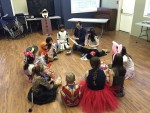
In costume and while enjoying treats, children in the Okanagan Jewish community learn about Purim. (photo from Okanagan Jewish Community Association)

Many children were part of the Okanagan Jewish community’s recent Purim celebrations. First, the children – dressed in costumes – participated in a half-hour Hebrew class with teacher Nir Light, where he shared the Megillah and translated the Purim story. Then, everyone went to the sanctuary with noisemakers to listen to the Megillah (a kid-friendly version) and partake in the mishloach manot (Purim baskets).

A potluck dinner was followed by services led by Rabbi Shaul Osadchey of Calgary’s Congregation Beth Tzedec. Kaddish was said for Irmgard Reimer, a longtime and very involved member of the Okanagan Jewish community, who passed away recently and will be dearly missed. The rabbi also acknowledged Sam Larry, who was a member of the community for many years and led services from time to time, as Debbie Larry recently donated two chairs for the synagogue in Sam’s memory.

In other news, 100 students from Okanagan Mission Secondary came to visit the OJC Centre on March 8 for a Talk & Tour session. OJCC religious committee chair Evan Orloff, a retired teacher, addressed the students and answered their questions. The OJCC has various schools that visit throughout the year, some every year. The next tour – on April 7 – will be with a group of Mount Boucherie Secondary students, with the talk given by OJC member Steven Finkleman, who has been one of the community’s main presenters.

The annual OJC Passover seder is being planned for April 22 at Summerhill Winery. For more information on the OJC, visit ojcc.ca.

Format ImagePosted on March 25, 2016July 2, 2020Author Okanagan Jewish Community CentreCategories LocalTags Debbie Larry, Nir Light, Okanagan, Purim, Shaul Osadchey
In the Okanagan

In the Okanagan

A typical day at camp is split between the waterfront, where campers learn to swim, ski, sail, canoe and kayak, and land, where campers participate in sports, drama, crafts and Jewish programming. (photo from Camp Hatikvah’s Facebook page)

Established in 1937, Camp Hatikvah in the Okanagan offers campers a summer experience that provides balanced emphasis on skill development and relationship building. Campers are immersed in a group setting where they must learn to live, cooperate with and embrace one another. In doing so, they learn a great deal about themselves and what it means to be a member of a community.

During any given summer, close to 400 campers attend Camp Hatikvah. While the bulk of participants are from the Greater Vancouver area, close to 30% come from cities such as Calgary, Los Angeles, San Diego, Seattle, New York, Edmonton, Tel Aviv and Mexico City.

At Hatikvah, campers learn of their shared culture and values, and of their homeland in Israel. During a summer at Hatikvah, campers have an opportunity to participate in Jewish cultural experiences, such as Shabbat, Israeli dancing and Hebrew singing, as well as educational programs about the history and importance of the state of Israel. A typical day at camp is split between the waterfront, where campers learn to swim, ski, sail, canoe and kayak, and land, where campers participate in sports, drama, crafts and Jewish programming.

The camp staff are comprised of approximately 70 Jewish youth from across Canada, the United States and Israel. Most were campers with Hatikvah or its Young Judaea sister camps across Canada. Indeed, when current director and head of staff Liza Rozen-Delman was hired in 2007, she was completing a circle that began years before, when she was at Hatikvah for eight summers, and went from being a first-year staff at 17 to an assistant director at 24.

For more information about Camp Hatikvah, visit the camp’s website, camphatikvah.com, or contact Rozen-Delman at [email protected] or 604-263-1200.


Format ImagePosted on January 22, 2016January 21, 2016Author Camp HatikvahCategories LocalTags Camp Hatikvah, Liza Rozen-Delman, Okanagan, Young Judaea
There are many reasons to visit Summerhill Pyramid Winery

There are many reasons to visit Summerhill Pyramid Winery

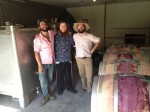
Left to right, Ari Cipes, Rabbi Shmuly Hecht and Ezra Cipes have joined forces to help make Summerhill Pyramid Winery’s Tiferet, the only kosher uncooked wine in Canada. (photo from summerhill.bc.ca)

The rolling hills and verdant valleys of British Columbia’s Okanagan region are home to more than 200 wineries, many of which are internationally renowned and award-winning. In fact, a number of Canada’s most prestigious wineries call this region home – Mission Hill, Cedar Creek, Sumac Ridge, to name a few – with one singled out as “B.C.’s most visited winery” by Tourism Kelowna.

There are several possible reasons for Summerhill Pyramid Winery’s popularity. It could be the incongruous sight of the enormous, dazzling white pyramid towering over the central terrace (more on that later). Perhaps it’s because of the estate’s Peace Park or the quality of its 100 percent organic vineyard. Then there’s the winery’s most recent offering, Tiferet (Hebrew for beauty/glory), a new, top-of-the-line kosher wine whose very name reflects the exceptional landscape from which it was created.

Summerhill Pyramid Winery was founded by native New Yorker Stephen Cipes, who moved to the Okanagan with his young family in 1986 and felt an immediate spiritual connection with the land. The developer-turned-vintner purchased Summerhill Vineyards, replanted the existing table grapes with winemaking European grapes and set to work. Located on Kelowna’s Lakeshore Wine Route, the mid-size winery has been producing organic, award-winning wines ever since, making a name for itself in European capitals.

Now, three of Cipes’ four sons are involved in managing the family business. Chief executive officer Ezra Cipes spoke with the Jewish Independent from his office, which overlooks the magnificent, blue waters of Lake Okanagan.

The immediate question at hand was why the winery had decided to produce a kosher wine, especially an extremely limited edition one (1,200 bottles) with a hefty price tag ($100 per bottle). Cipes explained that he was inspired by his friendship with Okanagan Chabad Rabbi Shmuly Hecht and a desire “to share the beauty of natural, uncooked wine with Hecht and all Sabbath observant Jews.”

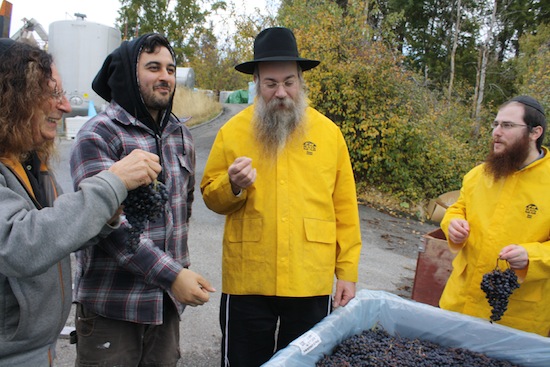
photo - Left to right, Stephen Cipes, Ari Cipes, Rabbi Levy Teitlebaum and Rabbi Shumly Hecht taste the 2012 crop of grapes
Left to right, Stephen Cipes, Ari Cipes, Rabbi Levy Teitlebaum and Rabbi Shumly Hecht taste the 2012 crop of grapes. (photo from summerhill.bc.ca)

Cipes and Hecht formed a deep bond while “studying texts together and drinking mevushal [cooked] wine together,” Cipes explained. “None of [the cooked kosher wines] can compare with living, uncooked wine, and I realized that Rabbi Hecht did not know the pleasure of living wine. There was none available to share with him, so we decided to make it ourselves, and we set out to make it as beautiful as possible. We used the best grapes of the vintage, bought the best barrels from France and now, a year and a half later, I am pleased to say that the wine we made exceeded my expectations.”

Kosher winemaking is somewhat complicated. Governed by the same kashrut laws pertaining to food (prepared under supervision of a rabbi, containing only kosher ingredients, using rabbinically certified equipment), kosher wine is further divided into two categories: uncooked and cooked. Although both are considered equal with respect to kashrut, their production and final result couldn’t be more different.

To qualify as kosher uncooked wine, the wine’s entire production – from “vine to wine” in vintner vernacular – must be handled exclusively by Sabbath-observing Jewish males. And that includes pouring. Understandably, it is well-nigh impossible for commercial producers to comply with these conditions and most opt to make the cooked category of kosher wine, if they produce such wine at all. Kosher cooked winemaking allows non-Jews of both genders to handle production and serving, however, the other regulations are no less strict. For a wine to qualify as kosher cooked, it must be heated to 1850F, which, well, cooks it. And therein lies the rub.

Exposure to such high temperatures significantly compromises the wine’s flavor and texture and, while most producers now use flash-pasteurization techniques to minimize the damage, there is simply no way around it. “Wine is a living thing…. By cooking the wine, we are destroying the wine,” Cipes’ explained matter-of-factly. The dilemma facing kosher wine vintners is best summed up as having to choose between quality and quantity, taking into account the obvious economics that accompany those choices.

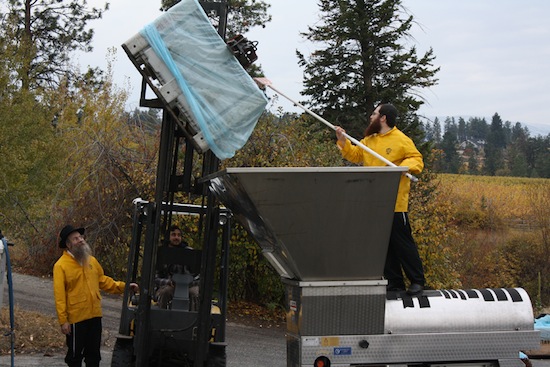
photo - Rabbi Levy Teitlebaum and Rabbi Shmuly Hecht manage the grape-crushing process
Rabbi Levy Teitlebaum and Rabbi Shmuly Hecht manage the grape-crushing process. The wine’s entire production – from “vine to wine” in vintner vernacular – must be handled exclusively by Sabbath-observing Jewish males. (photo from summerhill.bc.ca)

Which brings us back to Tiferet, whose kosher uncooked status partly explains its steep price. Cipes acknowledged the challenge of producing uncooked wine and described Tiferet’s creation as “a labor of love.”

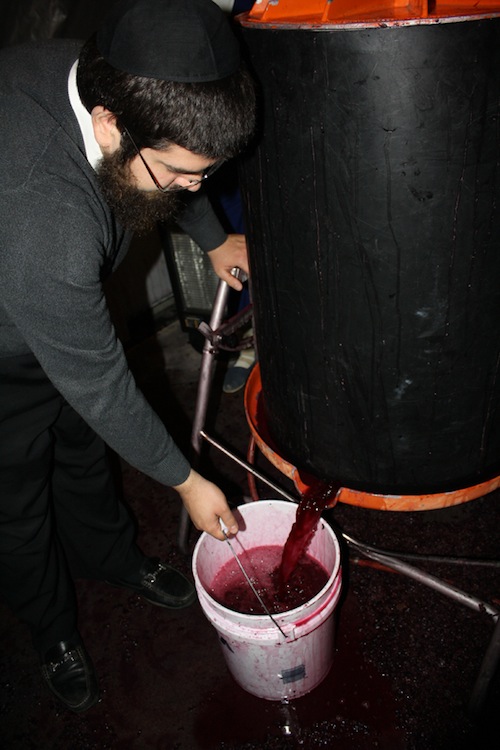
photo - Pressing of the wine post fermentation.
Pressing of the wine post fermentation. (photo from summerhill.bc.ca)

“The complication is that only the hands of Sabbath-observant Jews could touch the wine, equipment or any unsealed vessel containing the wine,” he said. “We had to make the wine away from our regular wine cellar, and without the trained hands of our regular team. But otherwise, it was the most simple and natural process: crush the grapes, allow the fermentation to happen … press the juice from the skins … age in barrels, blend the barrels … allow the solids to settle … rack the wine … and seal it in a bottle. Rabbi Shmuly or myself was there every single day except for Shabbos, checking the temperature of the room or performing some task. For such a simple process, the quality of the wine comes from the quality of the fruit, the careful handling, and creating the correct conditions for the fermentation and maturation.”

Tiferet was made with a relatively new “meritage” blend (merit/heritage), a delicate balance of Bordeaux-inspired grape varieties – merlot (60 percent), cabernet sauvignon (20 percent) and cabernet franc (20 percent) – cultivated in the semi-arid conditions of an Osoyoos organic vineyard and then brought to Summerhill to be turned into something that sounds much more than a run-of-the-mill premium wine.

“Making [Tiferet] with the rabbis changed its way,” Cipes said, trying his best to explain his sense that something else was at work during the creation of Tiferet. “In a way, the wine made itself, there was some magic that happened there. It’s hard to put my finger on it … a certain element of magic happened naturally that wouldn’t have happened otherwise … it was the work of the elements, and of natural forces beyond our control. We can only take credit for partnering with these forces to create this incredible wine.”

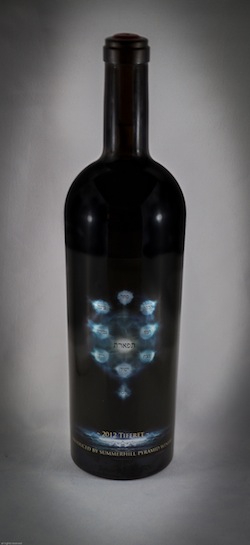
photo - Tiferet bottle
Only 1,200 bottles of Tiferet were made.

The description of Tiferet on Summerhill’s website diverts sharply from adjectives usually associated with wine flavor and aromas. Forgoing the more mundane “‘fruity” or “crisp,” Summerhill goes out on a metaphorical limb declaring, “Tiferet has the aroma of baby’s breath and the flavor of mother’s milk.” (If you’re wondering, as did I, the reference is not to genus Gypsophila, most commonly found in English country gardens!)

On the telephone, Cipes struggled to articulate the sensory sensations evoked by this wine. “It has a sweet milkiness … an unusual flavor, a sweet dairy note that doesn’t linger for long … it’s almost an effervescence. The texture is … full- bodied, soft and kind of silky in your mouth, elegant, fresh, fruity. There’s an added complexity to the wine,” before returning to the rather odd-sounding, “It’s like baby’s breath.” Tiferet wine, Cipes concluded, is for a drinker who “want[s] to have an experience of beauty.” With my request for a sample politely but firmly declined, and a price tag sadly out of reach, I’ll just have to take his word for it.

But, wait. What about the promise for more about that huge, looming pyramid, rivaling only the great pyramids of Egypt for alignment and precision? And the new-age-sounding Peace Garden? You’ll have to visit the winery in person to learn more – and, while you’re there, could you bring me back a bottle of that magic?

Nicole Nozick is a Vancouver-based freelance writer and communications specialist.

(Tiferet, $100 per 750-millilitre bottle, is available only through the winery: summerhill.bc.ca/product/2012-tiferet.)

Format ImagePosted on April 25, 2014April 27, 2014Author Nicole NozickCategories LocalTags kosher wine, Lakeshore Wine Route, mevushal, Okanagan, Shmuly Hecht, Stephen Cipes, Summerhill Pyramid Winery, Tiferet, Tourism Kelowna

Posts pagination

Previous page Page 1 Page 2
Proudly powered by WordPress