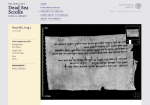
On the website deadseascrolls.org.il, visitors can explore the texts of the Dead Sea Scrolls. (screenshot)
Have you ever taped up a torn page? In our household, taping has saved many a book and article from falling apart. Seems like a practical solution, right?
Wrong! While it might do the job on faulty binding or read-it-again storybooks, it hasn’t worked well on extremely old, organic (mostly animal skin) materials, such as the Dead Sea Scrolls. Curator Pnina Shor, who heads up the Israel Antiquities Authority’s Department for the Treatment and Conservation of Artifacts, recently discussed this sticky mess.
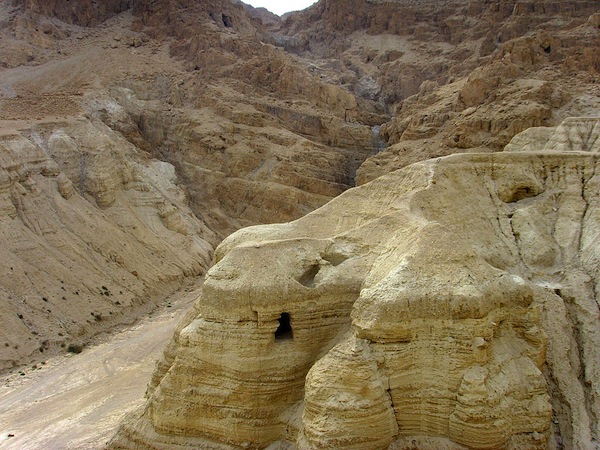
According to Shor, for some 2,000 years, the Dead Sea Scrolls had been stored in 11 dark caves below sea level in a steady climate of hot/dry days and cold/dry nights. Beginning with their first discovery in the late 1940s, archeologists transferred the scrolls from the Qumran area to open rooms at Jerusalem’s Rockefeller Museum, some 800 metres above sea level. As anyone who has ever visited Jerusalem and the Dead Sea knows, these places are geographically close, but climatically quite far apart.
At the time, archeologists eagerly wanted to piece together the enormous puzzle of 15,000 (biblical and non-biblical) fragments now at their disposal. Most manuscripts date from the first century BCE to the first century CE, the periods of the Hasmonean and Herodian rule. The archeologists did not know the risks involved in handling such fragile, ancient pieces. So, for example, they touched the parchment with their bare hands, leaving skin oil on the surfaces. They drank their tea and ate their lunch over the texts. (Like the rest of us, researchers are guilty of leaving crumbs and spills.)
In the early second half of the 20th century, archeologists were unaware of the negative consequences of taping torn texts and fragments. They did not realize that the glass panes sandwiching the pieces would put additional weight on the delicate remains.
So, what happened? Sadly, the tape’s adhesive congealed. Some of the texts (especially evident along the edges of the texts) darkened to the point where they became indecipherable to the naked eye.
Measures to contain or reverse the damage began in the 1960s. Unfortunately, this treatment inadvertently resulted in further damage. Until the 1990s, when there was consultation with U.S. preservation experts, it was not understood that the safest environment for the scrolls was a replication of their original storage conditions. Since that time, however, the scrolls have been stored in a climate-controlled laboratory, and exhibited in like conditions for extremely limited periods of time.
Between 1990-2009, the Dead Sea Scrolls Publication Project put out 32 volumes, entitled Discoveries in the Judean Desert. These reports are based on the original infrared photography conducted from the 1950s-60s. The infrared negatives are referred to as PAM (Palestine Archeological Museum).
Four full-time conservationists work on the scrolls. The specialists repair each piece separately, depending on the condition of the leather or papyrus. If you have ever tried removing Scotch tape, you have a sense of what it can do to the material underneath.
The aging adhesive is painstaking removed using a water-based adhesive. Staff members lift stains using a kind of dry poultice. The writings are then placed on acid-free cardboard, lightly covered by Japanese tissue paper. They are housed in solander boxes.
Over the past several years, the IAA has come to feel responsible for sharing these ancient finds, not just with the professional world of archeologists, biblical researchers and historians, but with the public at large. So, on the one hand, some of the scrolls are lent to foreign museums for temporary exhibition. (Currently, the Los Angeles-based California Science Centre has a show.) The more compelling outcome of the new IAA policy, however, has been the mounting of the scrolls to the internet. This undertaking goes by the name of the Leon Levy Dead Sea Scrolls Digital Library project, which has brought experts from far afield.
NASA’s Dr. Gregory Bearman was among those who served as a consultant for imaging technologies. With the assistance of various outside experts, a spectral imaging protocol was established, and it applies to the copying of all the writing:
- Displaying the “raw” image alongside the full, enhanced version so others can see both the beginning and end point of the work that has been done.
- Documenting the imaging procedure so another scholar, employing basically the same image and tools, can replicate the procedure. In that way, the investigator can better judge the degree of subjectivity involved in a given set of image manipulators.
- Labeling aggressively enhanced images as electronic reconstructions, that is, the scholar’s best judgment of what s/he thinks should be there, as opposed to what really is there.
The operating philosophy is to cause no [irreversible] harm. Bearman explained some of the benefits of applying spectral photography, namely that it can “determine the amount of water present in the parchment from which the scrolls are made. Data such as this has added value for conservation and preservation issues. If, for example, we discover that the parchments are too dry, it will be necessary to modify the conditions in which they are maintained.”
In his grey-walled photo lab, Shai Halevi spoke about how he photographs and stores the fragments using multi-spectral photography. Working with Google Research, he photographs the fragments using colors both visible (there are seven bands in this range) and invisible (there are five bands in this range) to the naked eye. Thus, letters that had been illegible are now digitally readable using infrared wavelengths in combination with spectroscopy. You have to see it to believe it:
Halevi described how he copies the fragment from a variety of angles, altering the resolution so that we (the viewing public) will be able to navigate around any part of a scanned image and magnify or reduce any section. Using different filters, Halevi allows us, for example, to see parchment folds appear and disappear at will.
He saves the images in a databank maintained by Google. For each fragment, there are 28 frontal images (referred to as “recto”), 28 back images (“verso”) and two extra color images, which the spectral imaging creates. The internet goal is twofold: first, to have all the fragments uploaded for open viewing and, second, to eventually add transcriptions and translations for all the text.
Recently, perhaps with a gesture toward Shavuot, which celebrates our receiving of the Ten Commandments, Shor brought out an ancient manuscript containing the Decalogue. This inscription is part of a very small scroll (its width is only 2.56 inches, or 6.5 centimetres) containing excerpts from the Book of Deuteronomy. It lists two reasons for keeping the Sabbath: what we know as the Masoretic text of Deuteronomy 5:15, the commemoration of the Exodus, that is, with a strong hand and outstretched arm, G-d took our ancestors from Egypt; and what we know as the Masoretic text of Exodus 20:11, the commemoration of Creation, that is, G-d created the world in six days and rested on the seventh.
This and other texts are within easy reach on the website of the Leon Levy Dead Sea Scrolls Digital Library (deadseascrolls.org.il).
Deborah Rubin Fields is an Israel-based features writer. She is also the author of Take a Peek Inside: A Child’s Guide to Radiology Exams, published in English, Hebrew and Arabic.