Refugee policy evolves

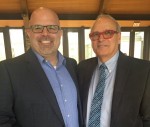
Rabbi Dan Moskovitz, left, and Dr. Harold Troper. (photo by David Berson)

The current refugee crisis – and Canada’s responses to past crises – was the topic of an interfaith panel recently, which raised issues especially relevant as Passover approaches.

Our Home and Native Land? A Multi-Faith Symposium on Refugee Settlement featured a keynote presentation by Dr. Harold Troper, co-author of None is Too Many: Canada and the Jews of Europe, 1933-1948. The event, on March 18, also included a panel discussion that featured Rabbi Dan Moskovitz of Temple Sholom. Catalina Parra brought a First Nations perspective, Imam Balal Khokhar spoke from a Muslim point of view and Rev. Dr. Richard Topping spoke as a Christian.

Troper recalled being part of a Canadian group that traveled to eastern Germany two decades ago, after the Berlin Wall fell. States in the east of the newly reunified Germany were seeing an upsurge in migration from countries further to the east. A group of Canadians was invited to listen and give advice on Canada’s experience integrating newcomers. At one point, a local official thanked Troper for his comments, but asked, “What do you do with your foreigners?”

Troper expounded on the concept of “new Canadians,” a formulation perhaps unknown in any other country, in which people arriving with the intent of making Canada their home are acknowledged not as foreigners or as migrants, but as people becoming part of our polyglot population already on a path to inclusion.

Of course, Troper acknowledged, this was not always so. None is Too Many, published in 1983, was a seminal book that has had lasting impacts on Canadian views of migration and refugees. The title comes from a quote from an anonymous Canadian immigration official who responded with these words to the question of how many post-Holocaust refugees to admit. The words have been attributed, in some tellings, to F.C. Blair, Canada’s then-director of immigration. However, while this is not provable, Blair’s actions were in line with the words.

Recounting this country’s exclusionary policies toward the desperate Jewish populations of Europe in the prewar period, but also a similar disregard after the war, the book has been held up as an object lesson in how not to respond to people in crisis. Troper said he didn’t know until years later the impact the book had had on one very significant episode in Canadian history.

In 1979, Troper and Abella sent an academic paper that preceded the book to Ron Atkey, Canada’s immigration minister. Atkey was a member of Joe Clark’s cabinet and, though that Progressive Conservative government lasted only nine months, it was during Clark’s term as prime minister that the decision was made to welcome 60,000 Vietnamese refugees, known as “boat people.” Troper said he found out later that the manuscript they sent played a role in the decision.

“We hope Canada will not be found wanting in this refugee crisis the way it was in the previous one,” the authors wrote in a note accompanying the manuscript. They expected no response and they received none. But, several years later, Troper said, Atkey told him that he had read it.

“He told us he was shocked and dismayed when he saw the political parallels between the Vietnamese and Jewish refugee crises,” Troper recalled. “Then and there, Atkey told us, he decided he was not going to go down as the F.C. Blair of the boat people.”

Already predisposed to encourage his cabinet colleagues to take a generous approach, the article stiffened his resolve to stand firm against ministers who disagreed. The government initiated a joint federal-private sponsorship program.

“It today serves as the prototype for Canada’s Syrian refugee program,” said Troper.

Now, as refugees are coming from North Africa, Asia and, most notably, the Middle East, fleeing civil war and ruin in Syria and Iraq, Troper sees parallels between the fears expressed now and those of seven decades ago.

“The fears are not only around the expenses of accommodating these refugees, but that the intake of a population of different race, religion and cultural assumptions and social expectations will destabilize destination countries,” he said.

Not dissimilar, he said, were fears that European Jews might bring socialism, communism, anarchism – even Nazism – with them.

“Foreshadowing the kind of anti-refugee arguments commonly heard today,” Troper said, “reports of persecution were dismissed as exaggerated if not bogus, fabrications designed to justify an end-run around Canadian immigration restrictions. And who were these refugees anyway? Were they really innocent victims? Surely they must have done something to turn their fellow citizens against them. Why make Europe’s problem our problem? And weren’t Jews in Canada already a pesky problem? Do we want more? And who’s to say that communists or even Nazis would not pose as refugees to infiltrate as subversives into Canada? Keeping Canada strong and united meant keeping Jews out.”

Another haunting parallel was the galvanizing photo of the 3-year-old Kurdish child who washed up on a Turkish beach and a photo Troper came across decades ago in his research for None is Too Many while going through archival boxes in the Toronto office of the Jewish Immigrant Aid Society. The boxes were filled with prewar letters from European Jewish parents who, knowing that entire families were unlikely to be granted admission to Canada, begged that their children might be taken in by a Canadian family. In each case, a terse response told the desperate parents that Canada was not admitting any Jews but that the request would be held on file in case something changed.

“Going through these files, I came across a letter that impacted me the way I imagine the photo of 3-year-old Alan Kurdi lying facedown in the sand of a Turkish beach impacted on all of us,” he said. “The letter was from a father begging for some shelter for his two daughters. A picture of two smiling children was attached. As I read this letter, my eyes began to tear; you see, I am also the father of two girls. At the time they were 3 and 5 years old. For a split moment, it was as if I was that desperate father, his children were my children and his fears were my fears.”

As part of the panel that followed, Moskovitz spoke of the bread of affliction.

“How inappropriate it might seem to hold up a matzah when we sit around a seder table filled with food, and to think that we are supposed to connect with this when we have so much,” the rabbi told the Independent after the event. “The point is to remind us that there was a time in our lives when we didn’t have so much.

“Each of the faith traditions,” he said, “spoke about that lens of empathy, of remembering historically that we once ate the bread of affliction, that we once didn’t have much and so we have to share with those who do.”

Religious perspectives are critical in this discussion, he added.

“Left to our own devices, society will often do what they think is in [their] own immediate best interest, which is often isolationism – we’re seeing that in the U.S. elections today – and fear of the other,” he said. “The role of religion is to compel us to do what is morally right and good, what is spiritually elevated, what is holy. It’s a religious foundation that is compelling us to love the stranger, because our political reality, especially in the wake of the terrorist attack in Brussels, is telling us to fear the stranger.”

For Jews, he said, the plight of refugees is not a momentary news story.

“This is not just a headline that has come and gone,” said Moskovitz. “Our Passover Haggadah makes it a headline for Jews every year, that we are reminded to see the world through the lens of a refugee every single year. It’s the most observed Jewish holiday in the Jewish calendar – that says something about how important the status of a refugee is in Jewish tradition.”

The multi-faith symposium was organized by the Inter-Religious Studies program at Vancouver School of Theology and facilitated by Rabbi Laura Duhan Kaplan, the program’s director.
Making your Haggadah unique

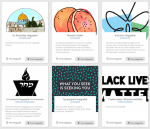
The website haggadot.com offers numerous template options.

The Hebrew word haggadah means narration or telling. As the Passover seder’s instruction manual, the Haggadah is perhaps the most important tool for fulfilling the Passover mitzvah of telling the story of the Jewish Exodus from Egypt – a mitzvah that is mentioned six times in the Torah.

The Rambam (Maimonides) in his Mishneh Torah explains that relating the miracles and wonders that were done for our ancestors in Egypt on Passover night is a positive commandment, and that it is a mitzvah to inform our children about it. Many interpret this to mean that telling the Passover story is actually two mitzvot: a mitzvah to tell the story among adults and a mitzvah to teach children about the story.

ArtScroll and Maxwell House have done their parts to make a simple seder manual accessible and inexpensive. But sometimes just reciting the words of the seder isn’t enough to engage seder participants – or even to help them understand the Passover story.

“What I learned is that my family had never really understood the service they had been using for many, many years,” said

Barbara Bayer of Overland Park, Kan., who about 30 years ago decided to write a Haggadah, which she continues to revise each year. “I went to simple sources that told the story simply and succinctly and the family loved it and still does.”

Making your own Haggadah is not as complicated as one might think. For starters, there are many web platforms that allow you to create a customized seder manual by providing curated sources from across the Jewish community. Haggadot.com, for instance, offers readings, artwork and video clips to enliven the seder. The clips can be assembled in one of the website’s templates.

Other sites, such as livelyseders.com, allow users to download an English translation of the complete traditional Ashkenazi Haggadah text, which can be cut and pasted to create your own piece. Jewishfreeware.org carries a range of editions of Haggadot, each one directed to specific interests and needs, in terms of the Haggadah’s length and rituals of choice. All the files are downloadable and some are editable.

Once you’ve found your base, personalizing the Haggadah for your seder experience can be loads of fun and really creative, according to those who do it.

Renee Goldfarb of Solon, Ohio, said one year she set up a laptop, projector and screen at the Passover table and showed a relevant video for each of the 15 steps of the seder.

Suzanne Levin-Lapides, on the other hand, compiled her family Haggadah from the texts of various seders for women she had attended in her Baltimore community, adding an orange to her seder plate as a symbol of feminism, as well as the inclusion of LGBT individuals and other marginalized groups within the Jewish community.

At the Katz family home in Kemp Mill, Md., the Passover seder has been turned into a play by their 12-year-old daughter, Abigail.

Read more at jns.org.

Ancient message of Jewish unity

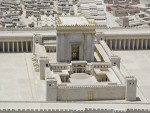
A model of King Herod I’s renovated version of the Second Temple in Jerusalem. (photo from Ariely via Wikimedia Commons)

Between 19 BCE and 4 BCE, King Herod I renovated the Jewish Temple in Jerusalem, enlarging and beautifying it. It is during this same period that we first learn of the Jewish pilgrimages to Jerusalem on what are known as the shalosh regalim, the three pilgrimage festivals.

All of the festivals – Passover, Shavuot and Sukkot – centre around the story of the Exodus in some way. But Passover is the first and foremost of the bunch.

Jerusalem always held a special place in the hearts of the Jewish people, but as the Romans built roads and as Herod expanded the Temple, the pilgrimage to Jerusalem became commonplace and served as a message of unity – “one Temple, one God, one Passover” – for all Jews, said Prof. Jonathan Klawans of Boston University’s department of religion.

Yet, detailed writings about what the pilgrimage festivals may have looked like during Temple times don’t exist. According to talmudic scholar Dr. Joshua Kulp, author of Schechter Haggadah: Art, History and Commentary, most knowledge on the subject comes from the works of the ancient historian Josephus. While later writings (such as the New Testament) describe what it was like in Jerusalem during the Second Temple era, those works were written at a much later time and some scholars doubt their accuracy.

It isn’t known where people stayed or slept when they were in Jerusalem, or how many people showed up (though most assume a large number), or what people felt at that time. What is known, Klawans explained, is that the pilgrimages were a social experience that pulled the Jewish people together.

It’s also clear that, for Passover, pilgrimage participants ate in Jerusalem as family units. A representative from each family would take an animal, bring it up to the Temple, and have it slaughtered. Then, the representative would bring the animal back, and the family would cook and eat the sacrificial meat. During this festive meal, families also drank wine, but not a specific number of glasses. They sang songs – specifically, the Hallel prayers, which is also part of the modern Passover seder.

Read more at jns.org.

Maayan Jaffe is an Overland Park-based freelance writer. Reach her at jaffemaayan@gmail.com or follow her on Twitter, @MaayanJaffe.

A Canadian Haggadah

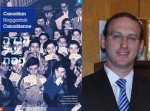
The cover of the new Haggadah, with one of its authors, Rabbi Adam Scheier. (photo from cjnews.com)

A new Haggadah in Hebrew, English and French has been created by Canadians for Canadians and celebrates the Jewish experience in this country.

The Canadian Haggadah Canadienne, compiled and edited by Rabbi Adam Scheier and Richard Marceau, has been published by Montreal’s Congregation Shaar Hashomayim. The authors of the Passover text describe it as the first of its kind, and one overdue for a Jewish community that is not only one of the largest in the world, but has a distinct identity.

All text is equally reproduced in the three languages, but what really makes this book stand out are dozens of historic photos of Canadian Jewish life from the early 20th century culled from the Canadian Jewish Congress Archives and other community archives, including those of the Canadian Jewish News.

The book also includes commentaries from 20 rabbis (and one maharat, the title for ordained female clergy in modern Orthodoxy) from across the country and the denominational spectrum.

The text is traditional, said Scheier, but it’s one he believes is familiar to almost everyone and may be used in full or abbreviated. The language is close to gender neutral.

One small addition is a prayer for Canada, alongside one for the state of Israel: “May the Merciful One bless Canada and its government, and grant fellowship and freedom to all of its inhabitants.”

Marceau and Scheier, who are friends and colleagues in community work, labored on the Haggadah for about five years, in their spare time away from busy professional and family lives. They both enjoy having diverse guests at their seder tables – anglophones and francophones – and felt the lack of a bilingual Passover text. Extemporaneous translation or using two versions proved to be awkward.

They may seem like an odd pair to produce such a proudly Canadian work. Scheier, Shaar Hashomayim’s spiritual leader, is a Rochester, N.Y., native, a fourth-generation American, who came to Canada 11 years ago.

Marceau is general counsel and senior government adviser to the Centre for Israel and Jewish Affairs, based in Ottawa. He is a convert to Judaism, a francophone from Quebec City who was a Bloc Québécois MP from 1997 to 2006. He recounted his journey to Judaism in the 2011 memoir Juif: Une histoire québécoise, which was later translated into English.

“When I came to Montreal, I was struck by the sense of pride Jews had in this country and their history in it,” said Scheier, who notes his wife Abby is Canadian and that they have “produced four Canadian citizens,” to whom he dedicates the Haggadah.

The completion of the project is bittersweet for Marceau. He dedicates the book to his late wife, Lori Beckerman, who passed away without seeing it published, and their two children.

Marceau attended his first seder in 1992 with Toronto native Beckerman’s family and friends. It was his introduction to Jewish ritual, which was totally strange to him, but it was made even more baffling because his English was not strong at the time.

“It was quite a culture shock,” he recalled.

They were married two years later, and Marceau converted in 2004. “Lori was very supportive of the [Haggadah] project. Although she was an anglophone from Toronto, she became fully bilingual, worked in French as a lawyer in Ottawa, and loved the duality of our home and the friends we invited around our table,” he said.

Both editors emphasized that the project would not have been possible without the help of many people, be it with research, proofreading, donations or advice.

“From the outset, we only encountered excitement about this project,” Scheier said. “People really responded to the idea.”

That input helped them find and select an eclectic mix of pictures, some familiar, but many rarely seen today. Some examples are the first religious service held by a Jewish farming colony in Lipton, Sask., in 1906; Philip Adelberg, the first justice of the peace in British Columbia’s Peace River district, taken in 1915; the Cornerbrook, Nfld., synagogue in the 1940s; the founding of Ecole Maïmonide in Montreal in the 1960s by the Sephardi community, the first French-language Jewish school in Montreal; and demonstrations for Soviet Jewry in the 1970s.

Marceau said he and Scheier felt it was important to highlight the relationship between Canada and Israel over the years. There are shots of visiting Israeli leaders from David Ben-Gurion to Shimon Peres in 2012, as well as then prime ministers Menachem Begin and Pierre Trudeau together in 1978. The relationship is represented in the other direction as well, such as an Inuit delegation’s visit to the Jewish state.

The Canadian Haggadah Canadienne, which weighs in at 168 pages, is tablet size in order to make it easy to use at the seder table. “It’s not supposed to be a coffee table book,” said Marceau.

It is being sold on amazon.ca and at synagogues and Jewish bookstores for $20. Any proceeds will go to charity – split 50-50 between Scheier’s and Marceau’s choices.

– For more national Jewish news, visit cjnews.com.