On being a Sar-el volunteer

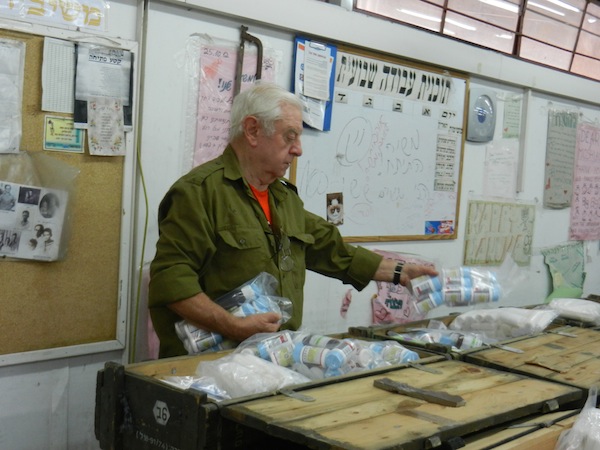
Gerald Lecovin on the production line at Matzrap Army Camp this past October. (photo from Gerald Lecovin)

Matzrap Army Camp, October 2014: It’s 8:15, time to work. Breakfast and flag raising are over. The Henna Hannahs are already on the job. This is the name I have given to the seven or eight elderly ladies who have been bused in from a senior citizens home, the color of their hair belying the rest of their bodies. They sit at a table, shmoozing while they place various combinations of medical supplies in small plastic bags, which are then sealed and placed in containers going out to the troops. They work steadily till lunch, which they are given before being bused back to their home. This is their – and our – contribution to Israel’s welfare.

We are 30 Sar-elniks, mostly Canadian, whose job it is to open containers, packs and medical vests coming back from the front. We empty them out, remove items that are no longer useable, replace the items and then repack everything. Containers are then sealed in plastic bags, put on pallets and shipped out. While they are replaced by more containers and the process repeats itself, there is a feeling of accomplishment every time a pallet leaves.

On this tour of duty, we were helped by groups of young solders training to be medics. There were 18-year-old women and, later, men who were from an elite Seal unit. The women were a reflection of Israeli society; Ashkenazim, Sephardim, Russians. Each with the ubiquitous cellphone. One day, one of the soldiers played songs for us by her favorite singers: Satchmo and Tony Bennett. Go figure! Comparing them to our kids of similar age was edifying.

Lunch is from 11:45 to 1:15. This is the big meal of the day. Salads, choice of hot meat entrée or vegetarian. By this time, the camp is jumping and we are eating with soldiers and staff. We return to work till 3 or 4 p.m., depending on the workload. Supper is at 5:45, and sometimes we have a lecture in the evening. This is our routine. Once a week, they plan an outing and we are bused to some site of interest.

Sar-el, which is an acronym for “service to Israel,” was conceived by General Aharon Davidi in 1983 when there was a need for laborers to bring in the crops as the soldiers were away fighting. Through his contacts in the United States, he managed to get 600 volunteers. Since that time, more than 50,000 people, of which 35 percent are Christian and 65 percent Jewish, have volunteered. About 3,500 from 60 countries come each year.

Originally, the age limits were 18 to 65, but when the general himself reached 65, he removed the upper limit. The oldest of our group was 92. People come for an average of two to three weeks; some for months. Of our group, only two were first timers. One was returning for his 100th time. I was a relative neophyte: this was my third time.

The feeling of being able to contribute to Israel in a meaningful way, and not just financially, is a strong magnet. I know this because I interview those volunteers that come from the West Coast and many of them contact me upon their return to share their thoughts.

For more information about Sar-el, visit sarelcanada.org.

Gerald Lecovin is a longtime resident of Vancouver, and has been active in community affairs. For the last 10 years, he has been Sar-el’s representative on the West Coast.

Israelis buy more guns

Yoram Issachar, who owns a contracting company in Jerusalem with his father and two brothers, has carried a Baretta 765 for the past 25 years. He works in Jewish communities on land Israel acquired in the West Bank, employing 15-30 Palestinian laborers, and carries the gun for his protection. Now, after the attack in Jerusalem that killed four worshippers and a police officer, he plans to upgrade to a larger gun. Immediately after that attack, he said, he took out his gun and cleaned it to make sure it was ready for use.

“I want to buy a Glock because each bullet is larger, and it shoots faster,” he said. “It will give me more security if I need it.”

He’s only used the gun once. In 1992, several young Palestinians threw stones at his car as he drove through the Palestinian town of El-Bireh, damaging his car although he was not hurt. Angry, he jumped out of the car and pursued them, opening fire at their legs, although he did not hit them.

In the wake of a series of attacks that have left 11 Israelis dead over the past weeks, Israelis are lining up to get a gun licence. Those who already have licences are carrying their guns with them more often. The Israeli government has asked everyone who has a gun to carry them in public, to help reinforce Israel’s security situation, and some who would leave their guns at work, such as security guards, are urged to bring them home.

“People are nervous after recent events, and anyone who has a gun should carry it around rather than leave it at home,” Yakov Amit, the director of the gun licensing department for the Ministry of Public Security, told the Media Line. “We want as many people as possible to be able to respond to an attack.”

Amit said there are about 300,000 guns held legally in Israel – half of them by individuals such as Issachar who carry them for self-protection, and the other half by security guards at public institutions. Israelis must demonstrate a need for the gun, and pass a psychological test as well as a shooting test before they receive a licence. The licence must be renewed every three years.

In the past decade, there have been a series of incidents in which people have been killed by guns at home, either in accidents or intentionally. At least 16 women have been killed by their partners using licensed guns, since 2002, according to women’s groups. Yet, Israelis who carry guns say they make them feel safer.

“When I moved to Israel in 1976 from Memphis, Tenn., I brought two hand guns with me,” said Alon Kirschner, a physiologist. “In Tennessee, if you don’t have a gun by the time you’re 8, you’re considered a sissy.”

Read more at themedialine.org.


Building a society together

Hand in Hand was started in 1997, with the goal of creating integrated schools wherein both Arab and Jewish kids could study together in a bilingual (Hebrew and Arabic) framework within the public school system. (photo from Hand in Hand)

Starting with just two classes in 1998 – a kindergarten and a Grade 1 class – Hand in Hand now has five schools throughout Israel, serving 1,200 students.

Hand in Hand is the brainchild of Lee Gordon and Amin Kalaf. Gordon grew up in Portland, Ore., before making aliyah; he lived in Israel for 20 years, returning to the United States a few years ago. Kalaf grew up in a small village near Afula and now lives in Jerusalem. They founded Hand in Hand in 1997, with the goal of creating integrated schools wherein both Arab and Jewish kids could study together in a bilingual (Hebrew and Arabic) framework within the public school system. The concept involves both improving the quality of education and being a model for partnership between Jewish and Arab citizens, as well as the public and private sectors.

“We have mayors in the various towns supporting our projects and giving us buildings to use and some funding … so, it’s a public-private partnership,” said Gordon. “There is public funding from Israel and also a lot of private philanthropic support [from] around the world,” he said, referring to the United States, Canada, Europe and, of course, Israel. When Gordon moved back to the United States, he created (and heads) American Friends of Hand in Hand, a nonprofit fundraising organization.

Kalaf’s oldest child graduated from Hand in Hand’s first class of Grade 12 graduates. “We’ve had four high school graduating classes now at our only high school in Jerusalem,” said Gordon. “That’s our biggest school, with 600 students from pre-k to 12th grade.”

Two years ago, Hand in Hand added another component to the organization. “We’ve been doing a community initiative, which we call Shared Communities, in which we’re working to build relationships between Jewish and Arab adults, not just kids,” said Gordon.

Today, there is a whole range of programs for adults, including language classes, holiday celebrations, discussion groups and a men’s basketball team. “We probably have about 3,000 adults in programs around each of our schools,” said Gordon. “Sometimes, the programs are at the schools in the evenings, or in other places.

“They really stood out this past summer when there was all the violence – the kidnappings, the revenge murder of the Palestinian teen, and the two-month-long war in Gaza.”

Shared Communities was active throughout Operation Protective Edge. Despite the tensions and differing views, participants found common ground. One example of this was the program organizing Jerusalem adults and kids going on evening walks together, wearing T-shirts that read, “We refuse to be enemies.”

“They weren’t really protests, but they were saying not everything about Jews and Arabs is about war and conflict,” said Gordon. “Here, we are working together in our school … and, in a little town, people came out onto the side of the roads with signs that read, ‘We are neighbors in peace,’ which is more than just saying, ‘We are peaceful neighbors.’”

photo - Today, there is a whole range of programs for adults, including language classes, holiday celebrations, discussion groups and a men’s basketball team
Today, there is a whole range of programs for adults, including language classes, holiday celebrations, discussion groups and a men’s basketball team. (photo from Hand in Hand)

At the schools, Hand in Hand works toward keeping the numbers balanced between Arabs and Jews, and between boys and girls.

“These are the main prerequisites,” said Gordon. “Earlier on, we had more Arabs than Jews. Now, we have waiting lists on both sides, though there’s a larger waiting list on the Arab side.

“Most importantly, they are growing fast. For example, in the new school in Tel Aviv (which is a preschool and kindergarten for now), last year, we had one class of 30 students. This year, we have three classes with 100 students in total. And, there was enough interest that we could’ve had 150 kids if we’d have had enough room.”

Gordon added, “There are great teachers and a wonderful curriculum. It looks at multiculturalism, backgrounds and narratives of different religions, because we have Christians, Muslims, Arabs and Jews…. In the younger grades, they have two full-time teachers in each class, one Arab and one Jewish.”

Gordon spoke of the schools’ broad reach.

“You can have an Arab friend the same way you can have a Jewish friend,” he said. “It can help you in the workplace, academia or your social life, and I think that’s a direct impact of Hand in Hand…. From the very beginning, when a Jewish child was invited to an Arab’s home for a birthday party, this involved the parents taking that child in and they’d meet each other. So, there are a lot of friendships happening beyond the walls of the schools … and sometimes the parents’ friendships were long-lasting, even if the children changed friends…. And the families aren’t just the parents. They are uncles, aunts, sister, brothers, cousins…. People hear about it and are impacted.

“We want to be visible because we want the rest of Israel to know about this and to be an example, as an alternative. Things can be different. Jews and Arabs can get along.”

Canadians can make a tax-deductible donation to Hand in Hand via the Jerusalem Foundation of Canada, with which it has a partnership.

“Our goal is to bring this model to as many places as there is interest and to work with populations to help them build a model school in the community,” said Gordon.

For more information, visit handinhandk12.org.

Rebeca Kuropatwa is a Winnipeg freelance writer.

Dogs break down barriers

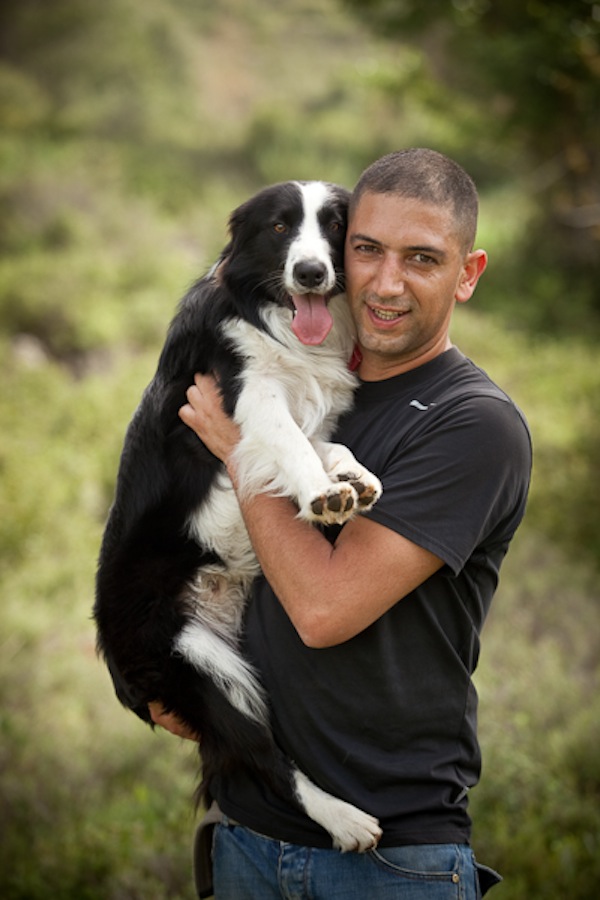
Ofer Biton with a therapy dog. (photo from Ofer Biton)

For years, therapists and other professionals have used animals to break down barriers and achieve breakthroughs in a multitude of situations. Recently, a pair of educators from Israel found a way to combine two of their passions – dogs and helping children with mental challenges.

Ofer Biton and Liat Bartov succeeded in getting recognition for the practice of canine therapy, and have since been teaching the how-to’s at universities across Israel.

Biton and Bartov met 20 years ago while working in special education. Some 10 years ago, “We started to think about dog training and teenagers [at risk],” said Bartov. “We started doing courses for teenagers in a youth group, and we had a lot of people wanting us in other schools in Jerusalem.”

Bartov and Biton found it challenging to find others to take on some of the rapidly increasing workload, which led them to teaching, beginning with one course in Jerusalem and one at Bar-Ilan University. Two years ago, they moved their base of operations to the Broshim campus of Tel-Aviv University, offering a one-year course that teaches both dog training and therapy methodology.

photo - Ofer Biton with a therapy dog. The dog is the tool for the therapist, facilitating the initial connection with the client
Ofer Biton with a therapy dog. The dog is the tool for the therapist, facilitating the initial connection with the client. (photo from Ofer Biton)

“We really like to teach the students how to deal with dogs and special education kids,” said Bartov. “The students who come to learn this dog training love animals, and dogs in particular. They come because they had a dream, they remember when they were kids, when the dog was their best friend, and now they still want to do something with dogs.”

Bartov emphasized that students learn that it is not the dog that is the therapist. The dog is the tool for the therapist, facilitating the initial connection with the client.

“The kids enjoy working with the dogs,” she said. “They feel like someone is waiting for them and they want to take care of someone else, so it gives you a very good starting point. Then, you must do what you learn in the course – build on that connection and create a triangle of trust.”

Anyone can benefit from this kind of therapy, according to Bartov. “It could be a very young child and it could be a very old man. It depends if there is connection with animals and dogs, especially. And, if you have this connection, you can do [the therapy] with anyone.”

Contrasting canine therapy to equine (horse) therapy, she explained, “The difference is in the size of the animal and the connection to it. The dog is waiting for you, wants to connect with you. You can do lots of things with him and he can come to your place, the hospital or your school.”

While schools that specialize in working with young students with attention deficit disorder (ADD) and attention deficit hyperactivity disorder (ADHD) were the initial focus for Bartov and Biton’s canine therapy, they are also doing some work with young offenders. As well, private therapists who have heard about the program are approaching Biton and Bartov for advice.

“Typically, people with the financial ability have started to use the service, because of the name of it,” said Bartov. “They like to show their kids that they’re not going to a ‘psychologist’ – that they’re taking them to a dog trainer or to play with dogs, then they move on to very long-term therapy.”

She added, “These are mainly private [clients] as well as special education schools. Regular education schools don’t have the funding to support it, so they’re not doing it yet.”

Overall, Bartov said canine therapy is currently “very trendy … and it’s been growing for the last five years. It begins with schools, and then people hear about it and are really interested. We can see it in how much work our students get. There are over 100 practising dog therapists in Israel, with over 50 students graduating every year.”

The university offers a summer and winter session course for dog therapy. The summer course has had waiting lists.

“My dream is that every school will use dog therapists,” said Bartov. “I hope we can do this and that people will understand the benefit of the school. Ideally, every place that has kids will have a small kennel with a few dogs, and the children can be with the dogs and can have this therapy.”

Bartov and Biton hope to one day bring government-supported canine therapy to public schools. Currently, no Israeli insurance provider covers the costs associated with canine therapy, although Bartov and Biton have begun working with insurance companies to one day make that part of the coverage options.

Rebeca Kuropatwa is a Winnipeg freelance writer.

Courage in Motion 2014

Fifty-four cyclists from Toronto, Vancouver, New Jersey and New York City participated in Beit Halochem Canada, Aid to Disabled Veterans of Israel’s annual Courage in Motion bike ride in Israel recently. The organization is devoted to helping the more than 50,000 Israeli disabled veterans and victims of terrorism rehabilitate. For five days, the group cycled from Jerusalem to Eilat, raising funds to support ongoing cycling programs and purchase equipment for rehabilitative sports and cultural centres in Tel Aviv, Haifa, Jerusalem, Nahariya and Beersheva. More than 50 members of the Israeli centres joined them, riding hand bikes and tandems, inspiring participants with their strength, determination and positive outlook.

Reading gut bacteria

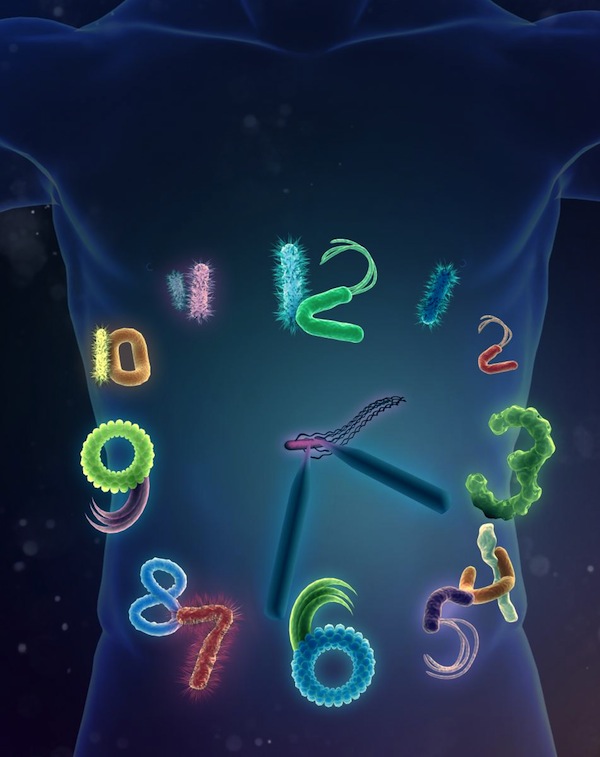
(photo from wis-wander.weizmann.ac.il)

Our species’ waking and sleeping cycles – shaped in millions of years of evolution – have been turned upside down within a single century with the advent of electric lighting and airplanes. As a result, millions of people regularly disrupt their biological clocks – for example, shift workers and frequent flyers – and these have been known to be at high risk for such common metabolic diseases as obesity, diabetes and heart disease. A new study published in Cell, led by Weizmann Institute scientists, reveals for the first time that our biological clocks work in tandem with the populations of bacteria residing in our intestines, and that these micro-organisms vary their activities over the course of the day. The findings show that mice and humans with disrupted daily wake-sleep patterns exhibit changes in the composition and function of their gut bacteria, thereby increasing their risk for obesity and glucose intolerance.

A consensus has been growing in recent years that the populations of microbes living in and on our bodies function as an extra “organ” that has wide-ranging impacts on our health. Christoph Thaiss, a research student in the lab of Dr. Eran Elinav of the Weizmann Institute’s immunology department, led this research into the daily cycles of gut bacteria. Working together with David Zeevi in the lab of Prof. Eran Segal of the computer science and applied mathematics department, and Maayan Levy of Elinav’s lab, he found a regular day-night cycle in both the composition and the function of certain populations of gut bacteria in mice. Despite living in the total darkness of the digestive system, the gut microbes were able to time their activity to the mouse’s feeding cycles, coordinating daily microbial activities to those of their host.

Does this finding have any medical significance? To further investigate, the researchers looked at “jet-lagged” mice, whose day-night rhythms were altered by exposing them to light and dark at different intervals. The jet-lagged mice stopped eating at regular times, and this interrupted the cyclic rhythms of their internal bacteria, leading to weight gain and high blood sugar levels. To verify these results, the scientists transferred bacteria from the jet-lagged mice into sterile mice; those receiving the “jet-lagged microbes” also gained weight and developed high blood sugar levels.

The research group then turned to human gut bacteria, identifying a similar daily shift in their microbial populations and function. To conduct a jet-lag experiment in humans, the researchers collected bacterial samples from two people flying from the United States to Israel – once before the flight, once a day after landing when jet lag was at its peak, and once two weeks later when the jet lag had worn off. The researchers then implanted these bacteria into sterile mice. Mice receiving the jet-lagged humans’ bacteria exhibited significant weight gain and high blood sugar levels, while mice getting bacteria from either before or after the jet lag had worn off did not. These results suggest that the long-term disruption of the biological clock leads to a disturbance in their bacteria’s function that may, in turn, increase the risk for such common conditions as obesity and imbalances in blood sugar levels.

Segal: “Our gut bacteria’s ability to coordinate their functions with our biological clock demonstrates, once again, the ties that bind us to our bacterial population and the fact that disturbances in these ties can have consequences for our health.”

Elinav: “Our inner microbial rhythm represents a new therapeutic target that may be exploited in future studies to normalize the microbiota in people whose life style involves frequent alterations in sleep patterns, hopefully to reduce or even prevent their risk of developing obesity and its complications.”

Also participating in this research were Gili Zilberman-Schapira, Jotham Suez, Anouk Tengeler, Lior Abramson, Meirav Katz and Dr. Hagit Shapiro in Elinav’s lab; Tal Korem in Segal’s lab; Prof. Alon Harmelin, Dr. Yael Kuperman and Dr. Inbal Biton of the veterinary resources department, Dr. Shlomit Gilad of the Nancy and Stephen Grand Israel National Centre for Personalized Medicine; and Prof. Zamir Halpern and Dr. Niv Zmora of the Sourasky Medical Centre and Tel Aviv University.

Weizmann Institute news releases are posted at wis-wander.weizmann.ac.il and eurekalert.org.


Jerusalem’s spooky historical spots

The Ministry of Health building in Jerusalem was the scene of a macabre wedding in 1881. (photo by Deborah Rubin Fields)

A government building, a zoological park, a bird observatory and a residential city street: What do these four Jerusalem locations have in common? In fact, each place is shrouded in mystery. Each conceals secrets. Each is part of Jerusalem’s landscape of spooky sites.

Back in 1881, the Ministry of Health building at 86 Jaffa Rd. (located across the street from the Mahane Yehuda market) was destined to be the villa of a well-to-do Christian Arab groom and his new bride. Unfortunately, the old adage “money does not buy happiness” came true. Personal wealth did not prevent personal tragedy; the young man died right before his wedding.

Making a macabre decision, the bereaved parents decided to go ahead with the gathering. At the party, the deceased groom was propped up next to his bride-to-be. Before everyone went off to the funeral, the bereaved mother supposedly honored “the couple” by performing the traditional wedding dance and dabbing the bride with henna.

Not surprisingly, this story had a chilling effect on local residents. The building remained empty for 10 years. After that, the Ottomans turned it into a general municipal hospital, a mustashfa. But because of its morbid history, even the most destitute patients were afraid to go there. It took a long time for people to forget its spooky beginnings, but eventually Jerusalemites, particularly from Lifta, Malha and Silwan, began to use the 30-bed facility.

Although financially strapped, the hospital stayed open until the British took over in 1917. They turned it into the Mandatory’s offices of the Ministry of Health. After 1948, the Israeli government made the building the Jerusalem regional offices of the Health Ministry. Today, Jerusalemites know it as the place to get their anti-rabies shots or their inoculations for the big post-army trip to South America or Asia.

Unfortunately, today the inside looks like many other old Jerusalem buildings: modern fixtures rudely stuck to old structures in utilitarian rather than esthetic fashion. Yet, some of the intriguing architectural additions remain outside: the winding, exposed staircases at the front of the building, for example, still shine. At one point, the stairs led to a roof from which guards had a good command of the comings-and-goings on Jaffa Road, at that time the main artery to the coast.

photo - Both the Jerusalem Biblical Zoo and the Jerusalem Bird Observatory offer visitors a chance to see and learn more about bats
Both the Jerusalem Biblical Zoo and the Jerusalem Bird Observatory offer visitors a chance to see and learn more about bats. (photo by Deborah Rubin Fields)

Some animals also bear the brunt of unearned labels and gossip. Take bats, for example. At one time or another, many of us will have heard fears about bats biting people, as well as the mythical association of bats with vampires.

While some might take points off due to the fact that bats are not considered kosher (see Deuteronomy 14:18), bats deserve credit for keeping our environment in check by consuming copious amounts of insects. Besides that, close up, bats are rather cute.

Strange as it may seem, if you stroll past 83-87 Bar Kochba St. in residential French Hill at dusk (or near HaChayil 41, close to midnight), you might notice some of the small, winged creatures (not larger than an adult hand) darting through the air. At this time of day, bats leave the east side of the street and head for the park on the west side. Look quickly before they disappear from view.

If this subject drives you batty, the Jerusalem Biblical Zoo offers explanation and viewing of both insect-eating bats and fruit-eating bats. The zoo takes part in the research and conservation of the dwindling insect-eating bat population. Moreover, some time ago, the zoo acquired a new male Australian fruit bat. He was apparently quite the hit with the ladies, who evidently enjoyed “hanging out” with him.

In past years, the zoo has hosted summer’s eve tours focusing on bats and other night-active animals. Pre-registration has been mandatory and there is a charge. For more information, call 972-02-675-0111. Children 8 years old and over are welcome to participate.

The Jerusalem Bird Observatory near the Knesset also offers bat- (and other night-active animal-) watching activities for children ages 5 and above. For more information, call 972-02-653-7374 or 972-052-386-9488, or email jbo@inter.net.il. There is a small fee for the walking tour.

Remember when you visit Jerusalem, keep an eye out for surprising sights and historical facts; things are not always what they appear to be and surprises are in store.

Deborah Rubin Fields is an Israel-based features writer. She is also the author of Take a Peek Inside: A Child’s Guide to Radiology Exams, published in English, Hebrew and Arabic.

Untangling the womb maze

Fluid-filled structures in the placenta. (photo from wis-wander.weizmann.ac.il)

The fetus in the womb totally depends on the blood bond with the mother. Spotting irregularities in the flow across the placenta could therefore be crucial for detecting fetal distress,

but currently no reliable method is available for monitoring the flow or detecting other signs of the distress in its early stages.

Magnetic resonance imaging, or MRI, can be safely performed during pregnancy, but currently available MRI methods are not suitable. Problems include the motion of the fetus or mothers’ breath, the varied structure of placental tissue and the tangled maze formed by maternal and fetal blood vessels.

In a new study in mice conducted with advanced MRI methods, Weizmann Institute scientists have now revealed in unprecedented detail the dynamics of the flow of fluids within the placenta. This feat was all the more impressive, as a mouse placenta is around the size of a dime. As reported recently in the Proceedings of the National Academy of Sciences, they managed to identify three different types of fluid-filled structures: maternal blood vessels, which account for two-thirds of blood flow in the placenta; fetal vessels, which account for about one-quarter of the flow; and embryo-derived cells infiltrating the mother’s vasculature, which account for the rest of the flow and in which the exchange of fluids between mother and fetus takes place. The researchers also found that in maternal vessels, blood flows by diffusion, whereas in fetal vessels, the flow, stimulated by the pumping of the growing fetus’ heart, is much faster. In the cells that have infiltrated the mother’s vasculature, the dynamics of the flow follows an intermediate pattern, driven by both diffusion and pumping.

Two sophisticated MRI methods were combined to enable the study: one geared toward monitoring diffusion and another directed at identifying structures with the help of a contrast material. They could be applied successfully in large part thanks to an innovative scanning approach, spatiotemporal encoding (SPEN), a Weizmann Institute technique. Because SPEN is ultra-fast and makes it possible to separately encode signals from such different materials as air or fat, it allowed the researchers to overcome disturbances created by movement and the variability of placental tissue. If developed further for safe and reliable use in humans, this combined approach holds great promise as a noninvasive means of detecting fetal distress caused by disruptions in the placental flow. It can be particularly valuable when fast decisions about inducing labor need to be made, for example, in such complications of pregnancy as preeclampsia.

The study was a joint effort of two laboratories: one headed by Prof. Michal Neeman of the biological regulation department and the other by Prof. Lucio Frydman of the chemical physics department. The research was performed by two graduate students, Reut Avni from Neeman’s lab and Eddy Solomon from Frydman’s lab, together with Ron Hadas and Dr. Tal Raz of the biological regulation department, and Dr. Peter Bendel of chemical research support, in collaboration with Prof. Joel Richard Garbow from Washington University in St. Louis.

For more Weizmann news, visit wis-wander.weizmann.ac.il.

No more ice scraping

Who would have thought a solution to ice stickiness would come from a semi-tropical country like Israel?

Prof. Hanna Dodiuk heads up the department of polymers and plastics engineering at Shenkar College in Ramat Gan. She specializes in adhesion and adhesives science and technology, characterization and formulation of polymer adhesives, special coatings, surface and interfaces analysis, nanotechnology and aging of polymeric materials.

photo - Prof. Hanna Dodiuk
Prof. Hanna Dodiuk heads up the department of polymers and plastics engineering at Shenkar College in Ramat Gan. (photo from Prof. Hanna Dodiuk)

Born in 1948 in Krakow, Poland, to two Schindler’s List Holocaust survivors, the family made aliyah to Israel in 1949. Dodiuk served in the air force, and then studied chemistry at Tel Aviv University. In 1979, she joined the Israeli Armament Development Authority (ADA), also known as Rafael. From September 1991 to June 1997, Dodiuk was the ADA’s director of its materials and processes department.

Her research led to the creation of a surface to which ice cannot stick, a material she created while on sabbatical with a large bio company in Germany. “They invited me to develop surfaces that don’t adhere to anything, that are easy to clean, and that have super-hydrotropic surfaces,” she said. The company needed this to develop what Dodiuk referred to as “a microfluidic machine.”

“This small machine can only work with very small water droplets at minus-12 degrees,” she said. “To take such a little amount, you have to ensure the fluid is not absorbed on the surfaces.”

In her research, Dodiuk turned to biology and nature, studying how leaves react with water.

“While most leaves are weighted by water, lotus leaves, even if in mud and water, aren’t, so they remain fresh and clean forever,” she said.

Using a high-resolution microscope, Dodiuk found that the morphology of the lotus leaf is very unique. “It has small mountains of microns that have a very small circle in the diametre of a nano range, which is 10 to minus-nine metres. A water drop cannot enter the width between two nano particles, so it begins to fall off and slide. Therefore, the water doesn’t add weight.”

Dodiuk said this is not a new chemistry concept. It has been used in Teflon-like materials for years. But, while Teflon works well with oil, water can still get it wet and weigh it down.

Early on, Dodiuk found great success with the lotus leaf. Three years into the research, ADA asked her to help create a super-hydrotropic coating usable on glass to prevent ice from interfering with navigational systems by sticking and blocking the view. Dodiuk found a lab that would allow her to imitate ice adhesion in Quebec, where she conducted the experiments.

“We’re the only [technology] in the world that can reduce the adhesion of ice,” said Dodiuk. “You cannot avoid it totally, but you can reduce by a factor of 18. If you reduce the adhesion of ice by a factor of 18, you really avoid ice adhesion.”

This surface has numerous significant applications. “Airplane wings can take off, but the special coating that was so great at reducing the adhesion of ice was simply not durable,” she said. “If, for example, they were to apply very high winds, it would start coming off and nano particles would be lost, as the adhesion of the micro and nano particles wasn’t good.

“With the lotus plant, if its surface is damaged, it will repair itself. But, technology doesn’t know [how] to repair itself, so they had to find another solution. That is when the University of Massachusetts stepped in with funding and lab facilities.”

Aided by two university students in the plastics engineering department working to create a special film with the right properties at a very low cost, Dodiuk said they are now halfway to completion. The final product will be a stick-on film, like Scotch tape, but with nano particles on one side, not visible to the naked eye. It will be able to be applied to anything, from windows and wings of airplanes to car windows during the winter.

“We always laugh at the end of the day,” said Dodiuk. “Israel [doesn’t] have an ice-adhesion problem, yet we invented the solution.

“Once you talk about super-isophobic, easy-cleaning or self-cleaning [technologies], everyone is sold.

“Even with textile, it would be one that never gets dirty. For things to get dirty, the dirt has to adhere. If you avoid adhesion, you’ll stay clean forever. Can you imagine not needing to wash your things, as nothing will adhere to [them]?”

“Can you imagine all of New York and Vancouver never needing to be cleaned?”

The potential application possibilities are endless and multi-directional, with spin-offs that can be used in elemental technology, like car or high-rise windows with no need to clean off dust or dirt. “Can you imagine all of New York and Vancouver never needing to be cleaned?” asked Dodiuk.

“With this special coating, those windows will remain totally clean. Just a little bit of rain will take off all the dust. The rain won’t stick to the window, only to the dust.”

Through it all, Dodiuk emphasized, she succeeded in accomplishing all of this work, to date, in a “male-dominated environment. I really think [women] should go into science and technology. [Many women] are going into many areas today, but not science and technology.”

Rebeca Kuropatwa is a Winnipeg freelance writer.


Liberal Zionism still critical

Israel Defence Forces soldiers debrief during the Israel-Hamas conflict. New Israel Fund of Canada’s president Joan Garson discussed the painful war of this past summer and the ongoing responsibility of liberal Zionists in Canada to push for Israel to be a model of democracy, pluralism and tolerance. (photo from IDF via Ashernet)

The Jewish state won’t survive without a Zionism that’s liberal and a liberalism that’s Zionist. Such was the recurrent assertion of Haaretz reporter and columnist Ari Shavit at the New Israel Fund of Canada’s (NIFC’s) annual symposium, held on Sept. 14.

Entitled The Future of Israel Starts Here and held at the Toronto Centre for the Arts, the free event drew almost 1,000 people and marked the fourth annual symposium for NIFC, an organization founded 29 years ago that describes itself as being committed to fostering the development of Israel as a Jewish and democratic state “as envisioned in her Declaration of Independence.”

The symposium was moderated by Joseph Rosen, who recently wrote an article called “The Israel taboo” in an issue of the Canadian magazine The Walrus.

The event featured Rosen interviewing Shavit via Skype, as well facilitating a lively discussion between Shavit and Akiva Eldar, chief political columnist at the online magazine Al-Monitor, who attended in person. NIFC president Joan Garson also spoke.

photo - Ari Shavit
Ari Shavit (photo by Sharon Bareket)

Shavit spoke passionately about how the Zionist community needs to “talk seriously and honestly about our own mistakes” and to acknowledge where the government of Israel has committed wrongs both on a moral and political level, such as with ongoing settlement building in the West Bank. He argued this must be frozen to give the Palestinians space economically and geographically and “to move toward a two-state solution.”

It’s imperative that Zionists stop treating Israel as being above criticism, he stressed. Zionists must look its sins in the face, address the arguments made on the other side of the conflict and “limit injustice to Palestinians as much as possible.”

Further, Shavit spoke about restoring Israel to its former “state of wonder,” its promise to serve as a refuge for Jews – “a home for our homeless” – and to be as just as possible.

“What happened in 1948 [when thousands of Arabs ran from or were driven from their homes and villages during the country’s founding] was in the context of the brutal history of the 1940s,” he said. “But after that, after we secured our existence at a terrible human cost for us and for them [the Palestinians], to go into the other 22 percent of the land and to try to co-opt it [through occupation and settlement building] is a huge mistake.”

But Shavit also argued that it’s unacceptable to exclusively demonize Israel for its injustices, as its critics often do, or to use the history of its founding to delegitimize it.

“Some of the world’s best democracies were founded on the terrible treatment of indigenous people. Israel can’t be singled out,” he said. “But let us remember our democratic past and try to build a future for the Palestinians.”

Garson discussed the painful war of this past summer and the ongoing responsibility of liberal Zionists in Canada to push for Israel to be a model of democracy, pluralism and tolerance.

“As liberals, we are activists,” she said. “We think it’s our job not just to sit on the sidelines, but to engage … to make Israel the country of its founders dreams…. When we see [Israeli] policies in need of change, we speak and we act.”

She added: “We must be honest with ourselves, our children and our congregations … to bring intelligence and clear thinking to Israel as we do to other issues … and to commit to telling the truth about the country to ensure there will be another generation of lovers of Israel.”

Rosen subsequently posed questions to Eldar and Shavit about whether liberal Zionism is “dead” and about the position of Israeli left-wing “peaceniks.”

Eldar, who described himself as a “radical peacenik,” argued that liberal Zionism is crucial to the future of Israel, but that it can’t coexist with the Israeli occupation of Palestinian territories.

It’s not enough to decry the settlements, he said, “we have to do something about it and call on every government in the world to do something.”

Eldar explained that he, therefore, does not buy products made in the settlements.

“If, God forbid, one of your friends was about to commit suicide, you would do everything to stop it,” he said “This [settlement expansion] is a suicidal project.”

Shavit later spoke about how many Israelis feel that Israeli “peaceniks” don’t care about them, that they’re more concerned with the well-being of the Palestinians than that of their own countrymen.

“We Israelis who advocate for peace need to love all our people, to go out and canvas and tell them why their future is connected to peace,” he said.

Eldar said the central problem is that fear seems to have become more effective than hope in addressing the Israeli-Palestinian conflict.

“We on the left are trying to sell hope,” he said. “I’m upset that people are trying to sell fear. Why not look at the glass half full? Look, for example, at how Egypt has worked with us [in the latest ceasefire negotiation between Israel and Hamas] instead of injecting more fear and saying we don’t have partners for peace in the region?”

He said that Israel needs to withdraw from the settlements, but not unilaterally. “We need to do it by making peace.”

 – For more national Jewish news, visit cjnews.com.