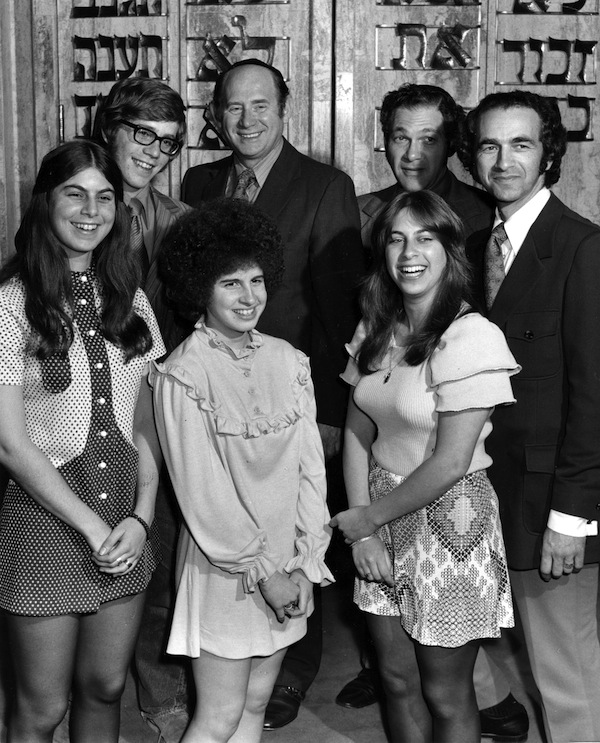
Mystery photo … April 20/18

B’nai B’rith, 1977. (photo from JWB fonds, JMABC L.09486)

If you know someone in this photo, please help the JI fill the gaps of its predecessor’s (the Jewish Western Bulletin’s) collection at the Jewish Museum and Archives of B.C. by contacting archives@jewishmuseum.ca or 604-257-5199. To find out who has been identified in the photos, visit jewishmuseum.ca/blog.

Mystery photo … March 30/18

B’nai B’rith, circa 1970. (photo from JWB fonds, JMABC L.09551)

If you know someone in this photo, please help the JI fill the gaps of its predecessor’s (the Jewish Western Bulletin’s) collection at the Jewish Museum and Archives of B.C. by contacting archives@jewishmuseum.ca or 604-257-5199. To find out who has been identified in the photos, visit jewishmuseum.ca/blog.

Helping more families

On Feb. 20, students at Vancouver Hebrew Academy packaged more than 200 mishloach manot bags full of non-perishable food items donated by the Marine Drive and Grandview Superstore locations. (photo from VHA)

The atmosphere at the Jewish Food Bank on Feb. 22 at the Peretz Centre for Secular Jewish Culture was almost festive. Adults chatted, kids played, as people made their way through the various lines. Vancouver Hebrew Academy students had already come and gone – having delivered more than 200 mishloach manot packages in anticipation of Purim – and Minister of Justice and Attorney General of Canada Jody Wilson-Raybould had stopped in to visit.

“We were thrilled to be able to distribute the Purim packages through the food bank,” Rabbi Don Pacht, VHA head of school, told the Independent. “It was the idea of Hodie Kahn and Rachael Lewinski, two die-hard VHA enthusiasts … Hodie is a past VHA parent and board member, Rachael is a current VHA parent (and a VHA alum) and board member. They have been largely responsible for building the program to where it is today. They saw this as a great way to bring the lesson of Purim into living colour. So much of the Purim theme revolves around helping others and bringing community together to celebrate – think mitzvot of sending food to neighbours and charitable gifts to those in need. What better way to celebrate as a community than to bring the joy of Purim to more and more families?”

photo - Several VHA students and teachers delivered the mishloach manot bags to the Jewish Food Bank on Feb. 22
Several VHA students and teachers delivered the mishloach manot bags to the Jewish Food Bank on Feb. 22. (photo from VHA)

“It’s a powerful symbol of love and friendship among our community,” said Richard Fruchter, Jewish Family Services chief executive officer, about the mishloach manot project in the agency’s February e-newsletter. He also noted that, during Wilson-Raybould’s visit, the minister spoke “with JFS about food security, housing and mental health services. She connected with the dozens of volunteers and hundreds of clients who benefit from this twice-a-month service.”

All of the items provided in the 200-plus mishloach manot gift bags were donated by two Real Canadian Superstore locations: Marine Drive and Grandview. “And they have [donated] for several years now,” said Pacht, stressing his gratitude.

In years past, the initiative has included other Jewish schools – Vancouver Talmud Torah, Richmond Jewish Day School, King David High School, Pacific Torah Institute and Shalhevet Girls High School – and “was an avenue to raise funds for all of the Jewish day schools,” said Pacht, as people donated to have Purim packages sent to friends, family and colleagues. Run under the umbrella of VHA, it was the “Vancouver Jewish Day Schools Purim Project,” he added.

“In past years, we have hosted the event at KDHS and had students from all the schools participate in various capacities,” explained the rabbi. “VTT, VHA and RJDS students packing, KDHS students setting up and cleaning up, PTI and Shalhevet students picking up items from Superstore, etc. We also have had parents from all of the schools volunteer their time to assist the packing process and deliver the packages on Purim day.

“This year, we took a step back and did not run the program as a fundraiser. With only 200 packages being prepared, that were then distributed through the Jewish Food Bank, we managed the entire process in-house.”

VHA also sent out “a mailing containing a Purim kit, with some information about the holiday and a few practical goodies as well,” said Pacht.

“What started in Ruth Huberman’s living room – at the time she was a VHA parent and board member (she now has several grandchildren attending VHA) – preparing about 100 packages, mushroomed into a program that reached the farthest corners of our community. We have over 1,200 families we connect with each year!” he said. “After 10 years of doing the same thing, we found it difficult to maintain the same momentum and enthusiasm. We are looking at various alternative models for next year. Something to refresh the program and keep the community engaged.”

Tranquility and restoration

The Upper Galilee’s Mizpe Hayamim is a beautiful place. (photo by Karen Ginsberg)

Unless you are one of the lucky Canadians who lives in the Okanagan Valley or the Niagara Peninsula, chances are that most of the “fresh food” that you buy – particularly fruits and vegetables – travels some distance before it reaches your table. On a recent trip to Israel, my husband and I experienced how very splendid it would be to live adjacent to a 35-acre organic farm that produces everything from its own olive oil and soaps to bountiful dairy products, as well as every fruit, vegetable, grain and herb one could imagine. We enjoyed all of this at Mizpe Hayamim Spa Hotel, located on Mount Canaan, near the town of Rosh Pina, in Israel’s Upper Galilee.

photo - Mizpe Hayamim Spa Hotel, located on Mount Canaan, near the town of Rosh Pina, is adjacent to a 35-acre organic farm
Mizpe Hayamim Spa Hotel, located on Mount Canaan, near the town of Rosh Pina, is adjacent to a 35-acre organic farm. (photo from Isrotel)

The history of the 96-room hotel dates back to 1921, when a German internist, Dr. Erich Yaroslovsky (later shortened to Yaros), bought the acreage now known as Mizpe Hayamim. Yaros’ vision was to build a convalescent home based on a vegetarian diet and natural treatment methods, which he felt would best serve the rehabilitation needs of his patients. The doctor was particularly drawn to the quality of the air and the tranquility of the setting. The land was originally owned by Baron de Rothschild, who had also been captivated by the beauty and tranquility of the area.

Before realizing his dream, Yaros encountered a series of setbacks, including receiving only a modest water allotment from the town of Rosh Pina, which was developing rapidly; the need to return to Germany for several years to support aging parents; the failure of promised positions as a physician in nearby communities to materialize; and a stint in Tel Aviv serving as its only homeopathic doctor. There was also a construction prohibition order from the British army, which was then planning fortifications in the area to protect against possible Nazi invasion through Lebanon.

Notwithstanding the long series of delays, by 1968, Yaros had the building authorities, financing and his personal determination to develop Mizpe Hayamim, albeit on a more limited scale. He built his first home at the location where the current Mizpe Hayamim now stands. It included a dining room, kitchen, bedrooms for his family and 12 guest rooms for the first of his patients. In later years, he was able to expand.

photo - view from a room at Mizpe Hayamim
(photo from Isrotel)

In English, mizpe hayamim means a view between two bodies of water, in this case, the Sea of Galilee and the lakes of the Hula Valley. The view from the highest and most expansive terrace at the hotel includes the town of Rosh Pina just below and to the left, an Israeli military base in the middle and the tip of the Sea of Galilee to the right. Small Jordanian villages dot the horizon and were barely visible in the mist of an October morning. At the time of our visit, the “mizpe” was only partially green. We were told that, with each teef, toof (bit of winter rain), the surrounding lands would become greener and that, before long, the whole of the Upper Galilee would be lush and vibrant.

A year before he died, in 1984, Yaros sold Mizpe Hayamim to Sammy Chazzan, an Israeli who shared Yaros’s commitment to the healing powers of organic food and tranquil surroundings. For more than 35 years, Chazzan led every dimension of the development of Mizpe Hayamim – hotel and farm – until 2016, when he sold the hotel portion to the Israeli chain Isrotel. He retained stewardship of the farm.

The organic farm was the first-of-its-kind in Israel and employs nine workers. From the time he was 14, Chazzan has had an interest in organic farming – a rather unusual passion for a young man but a passion he has sustained. Until the recent sale to Isrotel, Chazzan’s daily schedule started at 4 a.m., when he would draft the day’s orders for the hotel staff and then walk over to the adjacent farm to work at whatever needed to be done there. At 8 a.m., he would return to manage the hotel and then finish the day with a few more hours spent on the farm.

The achievements of his 35 years of agricultural experimentation are truly remarkable. The farm now includes nine large vegetable, herb and flower gardens, a herd of dairy cows and goats whose milk helps create about 40 individual dairy products – milk, yogurts, ice cream and cheeses. The animals are cared for in the most pristine of settings, feeding on grasses and able to roam about freely. Should they fall ill, they are cared for by a holistic veterinarian practitioner.

photo - Mizpe Hayamim goats
(photo by Karen Ginsberg)

Manure is recycled to fertilize the gardens, and the fruit and nut trees and flowers grow in abundance. Years of trial and error have helped establish which flowers or herbs planted alongside which vegetables reduce insect infestations, eliminating the need for pesticides of any kind. Several times a day, ripened produce is brought to the Mizpe Hayamim kitchen and finds its way to the dinner or breakfast buffets with the sort of haste that most Canadians can hardly fathom. Natural soaps are made on the farm for sale and for use in the hotel. In addition, there is a bakery and small retail outlet that sells some of the produce to guests and members of the public.

At the hotel, there is a full range of spa services for guests. Our casual conversations with other guests suggest that many Israelis come here, seeking a reprieve – nourishment and rest – from the tensions and high activity levels of city life. Guests can enjoy a coffee and tea bar all day long, with many of the farm’s fresh herbs – lemongrass, hyssop, chamomile, spearmint – available to enrich their beverages. Daily exercise classes, an art studio and evening entertainment are optional for guests and help sustain the goal of total relaxation and rejuvenation.

Isrotel plans to refurbish and update some of the hotel rooms but the essential philosophy underpinning this unique endeavour will remain the same. And Chazzan intends to continue his life’s work of building a knowledge base about organic farming and its impacts, through small-scale experimentation.

Long after their visit, guests fortunate enough to enjoy some time at Mizpe Hayamim will continue to benefit from the tranquility and beauty of the area, the organic vegetarian diet, as well as the various spa treatments on offer. For more information, contact Liad Nudelman, reception manager at Mizpe Hayamim, at liadn@isrotel.co.il, or visit isrotel.com.

Karen Ginsberg is an Ottawa based travel writer.

Unexpected Barbadian find

Nidhe Israel Synagogue is a UNESCO World Heritage Site. (photo by Tasha Nathanson)

One of the oldest synagogues in the Western Hemisphere is in Barbados. I was living in Barbados, working on a Canadian agricultural development project, when I tripped over this unexpected fact. I knew that the real estate agent who helped me find housing – and who, not coincidentally, became my neighbour – was Jewish, but I had assumed he was an anomaly here, in the most eastern island of the Caribbean. This was not the place I had anticipated a Jewish story to unfold.

The neighbour, Steven Altman, is reasonably well known in this small place where everyone seems to know most everyone. But many of the islanders I met inserted the comment, “he’s Jewish” into any mention of him, which reinforced my impression that being Jewish was unusual here. The Barbados I encountered in the seven months I lived there is a place that runs according to racial categories and everyone seems to be categorized according to skin colour and place of origin. Even though I’m half-Jewish, I was the white Canadian woman at work.

Curiosity prompted me to board a crazy ZR van headed into Bridgetown one day to find out more about Nidhe Israel Synagogue. ZR vans are semi-unregulated transport vehicles built to seat about 10 passengers, though I’ve been in them packed with more than 20 fellow travelers. People squish in, pressing up against each other with infinite stony-faced endurance. The soca music is generally blaring and often the driver has the flag of some neighbouring island pinned to the front, indicating where he lived before ending up in Barbados driving the public bus route in a private vehicle. The cost is always exactly two Barbadian dollars to ride and the experience is totally worth it.

The Synagogue Historic District is a UNESCO World Heritage Site in the Barbados capital city of Bridgetown. Originally built around 1654, it was destroyed by an 1831 hurricane, rebuilt in 1833 and restored from 1987 through 2017. Constructed by Sephardi Jews fleeing Recife, Brazil, after that colony passed from Dutch to Portuguese hands, these arrivals sought the relative safety of British-controled territory. The Jewish community was able to practise their faith openly here even before they regained that right in England.

photo - The synagogue grounds include a cemetery
The synagogue grounds include a cemetery. (photo by Tasha Nathanson)

The refugees settled into housing on Jew Street (now Swan Street) and brought with them knowledge and experience of the sugar cane industry. For this, I raise a glass of fine Barbadian rum, as this accident of history resulted in a terrific local finished product. By the mid-1700s, the Jewish community was 800 strong, which was the peak of Jewish settlement.

The hurricane in 1831 was a disaster that destroyed more than just the synagogue, resulting in an exodus to the United Kingdom and the United States. By the 1920s, only one Jewish resident, Edmund Baeza, remained, holding the keys to the building. When he, too, left, the synagogue was sold and deconsecrated.

photo - The mikvah wasn’t open to the public, but the inside could be seen from the window
The mikvah wasn’t open to the public, but the inside could be seen from the window. (photo by Tasha Nathanson)

By the 1980s, the building was dilapidated, in use as a warehouse and destined for demolition, when a renewed Jewish community stepped in to begin the process of restoration. The synagogue officially reopened in April 2017, and it is a gorgeous, tranquil and instructive space.

When my neighbour Steven boasted that it was his family that was responsible for the resurgent Jewish community in Barbados, I filed away his comment with a few of his other questionable statements, such as when he had appealed for my company on the basis of needing someone to wash his laundry. Steven wasn’t even aware that I might take offence. Standards of male expression and behaviour are one of the more dubious cultural differences for a Canadian woman living temporarily in Barbados.

photo - The inside of  the mikvah
The inside of the mikvah. (photo by Tasha Nathanson)

Despite my skepticism, however, the Altmans were indeed a primary element of the reconstruction effort and are longstanding pillars of the community, according to the plaques at the synagogue. Steven, when asked, wistfully described the tight-knit community of his childhood, drawn together to play games, fundraise for charity and visit each other’s homes, in addition to worshipping together. I grew to enjoy hearing Steven’s voice trailing out the windows of his home and through the tropical evening heat when he practised the prayers for services; it became a pleasant part of my experience of Barbados.

The second wave of Jewish Barbadians was Ashkenazi, mainly fleeing Europe, starting to arrive shortly after Baeza’s departure. My tour guide at the synagogue museum, curator Celso H. Brewster, described desperately seasick travelers bound for South America with skeins of cloth and other mercantile goods to start anew, stumbling out onto the solid ground of Barbados and refusing to go any farther. They set up shop in Bridgetown instead of continuing their journey.

As for Celso himself, he informed me that he was Baha’i but that he did have some Jewish roots as well. Those roots travel through his family line via a version of what was once a Jewish name, bestowed on a born-out-of-wedlock ancestor via a certain plantation holder with, shall we say, quite liberal application of his affections. I’ve heard various versions of this story from other Barbadians. Jews were not only merchants, but there were some Jewish pirates and, sadly, Jewish slave owners.

Nidhe Israel Synagogue and its grounds – which include the original mikvah, which was uncovered in 2008 to reveal a still-flowing spring; an extensive cemetery, as well as a museum – is a beautiful oasis for thoughtful reflection and learning.

The Synagogue Historic District is located on Synagogue Lane, Bridgetown, Saint Michael’s, Barbados. The museum is open weekdays, 9 a.m. to 4 p.m. It is free to enter the courtyard to look around; the entrance fee to the museum is $25 BDS (about $16 Cdn). To find out more, visit synagoguehistoricdistrict.com. Better yet, visit the synagogue.

Tasha Nathanson recently returned from a stint in the eastern Caribbean as gender equality and youth empowerment advisor on a World University Service of Canada project.

What is freedom?

“Israel in Egypt” by Edward Poynter, 1867. (photo from Wikimedia Commons)

There is a certain inherent ambivalence when we think of the meaning of freedom and its association with the holiday of Pesach. One of the essential features of the liberation story is our freedom from human subjugation: “Yesterday we were slaves to Pharaoh, today we are free men and women.”

This freedom, however, did not come about as a result of a revolution instigated by the Jewish people but, rather, as the biblical story relates, through the redemptive hand of God. As a result, this physical redemption is often connected with a religious duty: “I am the Lord your God, who brought you out of Egypt, out of the land of slavery; you shall have no other gods besides me.” (Exodus 20: 2-3)

What is the nature of this connection? Is it an obligation or an opportunity? Is our commitment to God and the Torah a price we pay for the Exodus, or is it a gift – a gift made possible by our physical freedom, but one that we may choose whether or not to receive? The question we as Jews ought to reflect on this Pesach is whether the freedom from Egypt is limited to liberation from physical servitude, or does it include freedom of conscience and faith.

Historically, Jews did not engage extensively in questions of personal autonomy; at most, they spoke about what Isaiah Berlin referred to as “positive liberty” (Berlin, Two Concepts of Liberty). As opposed to the simple, more intuitive concept of negative liberty – “the freedom from” constraints or compulsion, positive liberty is “the freedom to” – the freedom to be all one ought to be, to do that which is the fullest expression of one’s potential. The notion of positive liberty is clearly present in the rabbinic tradition, in such statements as, “There is no free person but he or she who studies Torah.” (Avot 6:2) Freedom, for Jews, has traditionally meant “the freedom to” – the ability to achieve complete self-realization, through a firm, unwavering commitment to God and His word.

Standing alone, however, positive liberty is an extremely precarious concept. We need look no further than the 20th century, when different fascist leaders established their rule on a promise of positive liberty (the freedom to live in a stable society, the freedom to attain financial prosperity, the freedom to fulfil one’s destiny as a member of the master race), to appreciate the danger it harbours: the creation of oppressive, totalitarian regimes, violently trampling the rights of their citizens in the name of freedom. Without the underlying basis of negative liberty, positive liberty means nothing more than the freedom to do that which others determine you ought, to fulfil what others have decided to be your potential.

This question becomes all the more pointed in the context of the state of Israel. So long as Jews lived in Western liberal democracies, they vicariously inherited the value of negative liberty and functioned within its confines. But an essential question facing the modern state of Israel, the only Jewish democracy, is what concept of liberty does it officially espouse? Is Israel a “free state” that dictates the forms of Judaism that are most appropriate? Or does it guarantee its citizens the right and conditions to determine their own individual Jewish path?

If Pesach is going to be not simply a liberation story of our past but a modern, continuous liberation story “in every generation,” we must recognize that positive liberty is an incomplete liberty, that the freedom from Egypt – indeed, our very existence as a free people in our own country – must be accompanied by a commitment to religious freedom and the diversity it will engender.

The spirit of Pesach requires a national pledge to free Israeli society of all and any vestiges of religious coercion, including the manipulation of public funds in order to constrain spiritual choices. In the spirit of Pesach, we must commit ourselves to speaking only in the language of education, and never in the language of indoctrination and coercion.

One of the great paradoxes of Israeli society is that those who function in the name of positive liberty actively limit the actualization of the spiritual potential of Jews. Consequently, the state of Israel is one of the only places in which non-Orthodox Jews can barely receive a Jewish education. Religious coercion and legislation hasn’t furthered our marriage with God; rather, it has created an ever-increasing rift and divorce.

The freedom of Pesach has multiple dimensions. It is our responsibility to ensure it is understood and employed as a catalyst for progress, as a basis for assimilating the broadest notions of negative liberty within our religious language and values. Just as we reject being enslaved by Pharaoh, so, too, must we reject the subjugation of our minds and souls to any authority. In the end, if God is to be the God of the Jewish people, if Judaism and its values are to shape our lives, it will not be because we owe God for our redemption from Egypt, but because we choose a life with God as free men and women.

Rabbi Dr. Donniel Hartman is president of the Shalom Hartman Institute and author of the 2016 book Putting God Second: How to Save Religion from Itself. Articles by Hartman and other institute scholars can be found at shalomhartman.org.

Pesach’s lessons for today

Israel’s Escape from Egypt, illustration from a Bible card published in 1907 by the Providence Lithograph Company. (photo from Wikimedia Commons)

We begin Passover – which starts this year on the night of March 30 – with two seders, and invite family, friends and guests to celebrate the holiday with us. At both seders, we eat matzah, to recall the swiftness of our ancestors’ departure from Egypt, maror (horseradish) to commemorate the bitterness of the slavery in Egypt and charoset, which resembles the mortar our ancestors were forced to use to build pyramids for Pharaoh. The 15 steps of the seder (order) are our way of retelling the tale.

G-d Himself rescued His beloved children from their bitter situation. As written in the Haggadah, “Vayotzeeaynu Hashem Mimitzraim, lo al yiday malach, v’lo al yiday saraf, v’lo al yiday shaliach, ela haKadosh Baruch Hu bichvodo uviatzmo” – “G-d brought us out of Egypt, not through an angel, not through a fiery angel and not through a messenger, but it was the Holy One blessed be He, He Himself in His glory.”

The Israelites had spent 210 years in Egypt, which was an agricultural country, where the soil was fertile, irrigated by the Nile. Our commentaries teach that Pharaoh didn’t want anyone to see him taking care of his bodily functions, so he would go to the Nile early in the morning then return to the palace. He guarded his power with brutality. We recall the birth of Moses and his early life in a basket on the Nile, saved by Pharaoh’s daughter, Batya (the daughter of G-d) and his rise to life in the palace of Pharaoh.

One of the most striking features of the Exodus was the Israelites’ faith in the promises of G-d. They were an entire nation, men, women and children, numbering several million, who willingly left a prosperous and well-settled country, whose pagan values had already left their impression on them, to venture on a long and dangerous journey without provisions, but with absolute reliance on the word of G-d, as spoken to Moses.

Even more, they didn’t follow the familiar and shorter route through the land of the Philistines, which, although it involved the risk of war, was far more attractive than the prospect of crossing a vast and desolate desert. In war, there is a chance of victory and, even in defeat, there is the chance of escape, but, in a desert, with no food or water, nature allows no chance of survival. Yet they followed this route, disregarding rationality and trusting in the word of G-d.

Why did they do this?

This question is echoed in every generation. In the contemporary, materialistic and competitive world, where we all struggle for economic survival, how can we exempt ourselves from its values? How can we adhere to a code of precepts that restricts our actions? The answer lies in the Exodus from Egypt.

In that time, when Jews responded to the call of G-d, disregarding what seemed reasonable, breaking with the values of their Egyptian environment, it transpired that the path they took was the path of true happiness, spiritually in receiving the Torah and becoming G-d’s Chosen People, and materially, in reaching the Promised Land, flowing with milk and honey.

So it is today and always. Through the Torah – the Torat Chayim, the Law of Life – and the mitzvot (good deeds or commandments), a Jew attaches themselves to the creator of the world, and frees themselves from all “natural” limitations. This is still the way of happiness.

Wishing you a happy, kosher and enjoyable Passover, wherever you find yourself in the world. If you find yourself traveling, or even here in Metro Vancouver without a place to celebrate, there are Chabad Houses where you can commemorate our ancestors’ freedom from Egypt at a joyous and meaningful seder. Chag kosher v’sameach.

Esther Tauby is a local educator, writer and counselor. She wrote this article using excerpts from the letters of the Lubavitcher Rebbe.

A few Pesach songs’ origins

An illustration by Russian artist El Lissitzky in the book Had Gadya, 1919. (photo from getty.edu)

We sing them every year, but from where did Passover songs such as “Chad Gadya” originate?

Chad Gadya” or “One Little Goat” is a playful cumulative song in Aramaic and Hebrew, sung at the end of the seder. According to Wikipedia, the melody may have its roots in medieval German folk music. It first appeared in a Haggadah printed in Prague in 1590, which makes it the most recent inclusion to the traditional Passover seder liturgy.

The Haggadah was a project that was initiated by the anshei Knesset Hagedola, the members of the Great Assembly, the supreme council of sages that ruled during Temple times in Jerusalem. They were the first to compile and canonize many of the texts that we have today. The Haggadah, however, was only started during that era – it was not completed until much later.

“Chad Gadya” also only found its way into the Haggadah at a much later date. This is because the song was written in Aramaic, which was the vernacular of the Jews of Babylon, and not in Hebrew – at least not in Hebrew for the most part. The slaughterer, angel of death and Holy One Blessed Be He in the song are referred to in Hebrew.

Some suggest that “Chad Gadya” was written by Rabbi Eliezer Rokeach in the 12th century.

According to some modern Jewish commentators, the song may be symbolic. One interpretation is that “Chad Gadya” is about the different nations that have conquered the Land of Israel: the kid (goat) symbolizes the Jewish people; the cat, Assyria; the dog, Babylon; the stick, Persia; the fire, Macedonia; the water, the Roman Empire; the ox, the Saracens; the slaughterer, the Crusaders; the angel of death, the Turks. At the end, God returns to send the Jews back to Israel. The recurring refrain of two zuzim is a reference to the two stone tablets given to Moses on Mount Sinai, or refer to Moses and Aaron.

Versions of the song exist in Ladino, Judeo-Italian and Judeo-Arabic.

***

We know that the “Avadim Hayinu” (“We Were Slaves”) section was written by Rabbi Eliezer Hagadol in the second century). It is an introduction to the formal narration of the Exodus from Egypt, based on the views of Samuel. Passages of unknown origin supplement the narration, stressing its importance.

***

Echad Mi Yodea” (“Who Knows One”) is another cumulative riddle with versions in Hebrew and Yiddish. The song relates the 13 basics of Judaism. After relating God’s wonders and kindness and the events of the Exodus, it demonstrates how everything can and should relate to God.

According to Encyclopedia Judaica, this song is first found in Ashkenazi Haggadot of the 16th century. It is believed to have originated in Germany in the 15th century, possibly based on the German folk song “Guter freund ich frage dich,” which means “Good friend, I ask you.”

***

Dayenu” is a Hebrew song, traditionally sung during Passover. The word itself essentially means, “It would have been enough for us.” Day is the Hebrew word for “enough” and the suffix enu means “our.”

This traditional up-beat Passover song is more than 1,000 years old. The earliest full text of the song occurs in the first medieval Haggadah, which is part of the ninth-century Seder Rav Amram.

The song goes through a series of gifts believed granted by God to the Israelites, such as Torah and Shabbat, proclaiming that any of them alone would have been sufficient. It is 15 verses long, sequentially recounting each divine intervention in the story of the Exodus. After each divine act, the chorus “[If God had done only this,] it would have been enough for us” is sung.

Canadian journalist, author and social activist Michele Landsberg wrote “The Women’s Dayenu”:

“If Eve had been created in the image of God and not as a helper to Adam, dayenu.

“If she had been created as Adam’s equal and not been considered a temptress, dayenu.

“If Lot’s wife had been honoured for compassion for looking back at the fate of her family in Sodom, and had not been punished for it, dayenu.

“If our mothers had been honoured for their daughters as well as for their sons, dayenu.

“If our fathers had not pitted our mothers against each other, like Abraham with Sarah and Hagar, or Jacob with Leah and Rachel, dayenu.

“If the just women in Egypt who caused our redemption had been given sufficient recognition, dayenu.

“If Miriam were given her seat with Moses and Aaron in our legacy, dayenu.

“If women had written the Haggadah and placed our mothers where they belong in history, dayenu.

“If every generation of women together with every generation of men would continue to go out of Egypt, dayenu.”

***

Adir Hu” (“Mighty is He”) is a hymn naming the virtues of God in the order of the Hebrew alphabet, expressing hope that God will rebuild the Holy Temple speedily.

The tune of “Adir Hu” has undergone several variations over the years, but the origin is from the German minnesinger period. The earliest extant music for the song is from the 1644 Rittangel Haggadah, the second form was in the 1677 Haggadah Zevach Pesach, and the third version can be found in the 1769 Selig Haggadah. In the Selig Haggadah, “Adir Hu” is also referred to, in German, as “Baugesang” (the song of the rebuilding of the Temple).

There are 24 short, simple lines, each beginning with an attribute of God. Most of the virtues of God are adjectives – for instance, holy (kadosh) – however, a few are nouns, “Lord is He.”

There is also a feminist variant of the song by Rabbi Jill Hammer of the Academy for Jewish Religion in Yonkers, New York. In it, God is feminine (She) and, quoting Hammer, the song “emphasizes God’s sharing in human joys and griefs, and God’s ability to renew life through the strength of the earth.”

Sybil Kaplan is a journalist, lecturer, book reviewer and food writer in Jerusalem. She created and leads the weekly English-language Shuk Walks in Machane Yehuda, she has compiled and edited nine kosher cookbooks, and is the author of Witness to History: Ten Years as a Woman Journalist in Israel.

Contending with contradictions

“The Four Sons,” Arthur Szyk, 1934. According to Wikimedia, Szyk “originally intended his Passover story of persecution and deliverance (told through the traditional text of the Haggadah) to be a strong statement against the Nazis, but no publisher in his native Poland dared take on a project with strong anti-Nazi iconography. He ultimately found a publisher in England. This image of the Four Sons … depicts the Wicked Son as an assimilated German complete with porkpie hat and Hitler mustache.” (image from From Arthur Szyk Society, Burlingame, Calif.)

The significance of the seder’s Four Questions should not be confined to being a concrete educational tool for the purpose of teaching historical information to children having a limited sense of abstraction and who bore easily. The questions are a characteristic of the adult intellectual culture during the time of the rabbis.

In the Mishnah, the child is the one who asks and the parent teaches, but, in the Talmud, another source is quoted that requires the adult to ask questions of him or herself: “Our rabbis taught: if his child is intelligent he asks him, while if he is not intelligent his wife asks him; but if not, he asks himself. And even two scholars who know the laws of Passover ask one another.” (Babylonian Talmud, Pesachim 116a)

Here the point is not to recount the story of the Exodus to children, but rather to create a dialogue of questions and answers among adults. The questions of the wise child may be thought-provoking to his or her parents; similarly, the questions of one colleague would be of interest to another. Someone who knows all the laws of Pesach is still required to ask questions, and scholars on their own at the seder are required to ask themselves questions. Why?

At a certain level, the questions serve as an external pretext to refresh the memory in order to raise the level of consciousness concerning the Exodus, even for those who have passive knowledge of the information. At another level, someone who asks himself or herself questions and then answers them, can delve deeper and discover new aspects of knowledge.

This is the educational method practised in the Lithuanian yeshivot – two students on the same level study the text by asking each other questions, raising hypotheses and debating the issues, without hearing lectures from a teacher “who knows the answers.”

This is common practice in universities, where a researcher finding himself or herself at an impasse takes a walk alone while conducting an internal dialogue, which may culminate with new insights into a subject with which s/he is very familiar. The question is a powerful tool for the advancement of the thinking of both the one who asks and answers it.

The rabbis identified a particular type of question, known as a kushiya. A kushiya queries a practice that contains an internal contradiction or which runs contrary to other authorized sources. Unlike the kushiya, an ordinary question generally begins with the word “what,” for example, “What time is it?” It is as if the object of the question has something, information, that the one asking the question needs, and that the one asked “lends” out (literally, sh’ayla, in Hebrew).

The formulation of the kushiya is more sophisticated: “One would expect that such a thing would happen or be written, but why has something else, something unexpected happened or been written?” The poser of the kushiya comes equipped with information and expectations for a certain world order, and this makes him or her aware of deviations, contradictions and the disappointment of expectations. “How is this night different from all other nights – on all other nights we eat leavened bread and matzah, but on this night we eat only matzah?”

The one posing the kushiya sees the whole picture and has expectations of a rational world order. That is why any contradiction requires a rational explanation. We might expect that the more one learns, the fewer questions s/he might ask, after all, s/he already has so much information. But the true intellectual will pose ever more kushiyot, because s/he is all the more aware of the complexity of the world, which is arranged according to so many principles. Curiosity is increasingly aroused and that is why the wise child is the one who asks the kushiyot of his or her own volition, while the younger children need the help of the parent to ask even the simplest question.

Paradoxically, the search for rationality is sustained by the unusual and not by the regular orderly routine. People do not query that which can be taken for granted, even if the explanation is unknown. For example, based on the experience of many Pesachs and seder nights, to the adult Jew, the youngest child asking the Four Questions is taken as a matter of course. But as soon as s/he discovers a different version of the questions, such as the one we saw in the Mishnah, s/he asks “Why do we ask these questions and not others? What is the reason?” or “Why does the Mishnah say the parent says Ma Nishtanah rather than the child?”

The search for rationality in our familiar world is sustained by the ability to imagine alternatives to the existing order. There is a set introduction to the midrashei halakha, homiletic interpretations and inferences of the rabbis (in the Mekhilta). It involves the raising of a hypothetical question, as in this example from the Haggadah. The rabbis wondered:

“You shall tell your child on that day: ‘It is because of this, that the Lord did for me when I went free from Egypt.’” Could this verse mean that you should begin to tell the story at the beginning of the month (in which the Exodus occurred)? No, for the verse explicitly states “on that day” (of the Exodus). Could that mean that we start when it is still daytime? No, for the verse explicitly states: “because of this.” “This” refers to matzah and maror laid before you (only on seder night) (Mekhilta).

“This” implies that the parents must point at the matzah and maror, and use them as visual aids to tell the story (Rabbi Simcha of Vitri).

“Could this verse mean” introduces an imaginative, alternative hypothesis based on the biblical text. “No, for the verse explicitly states that” is a strict construction of the meaning of the existent version of the text that neutralizes the feasibility of an alternative suggestion.

Indeed, the midrashei halakha ask even when no additional version has been found, and only an imaginative person could envisage other reasonable possibilities. There is no attempt here to undermine the accepted text or religious practice, but rather to understand what lies behind it.

If so, then the study method of the rabbis is seemingly founded on a paradox. In order to understand the reasons for the existing order of the customs or the words of the biblical text, we must be able to conceive of another order based on alternative logic. Only that which is not self-explanatory and is not accepted blindly as tradition can lead to a process of thought and discovery of the rationality it contains. The ideal scholar in the culture of the rabbis is not an authoritative figure acting on the basis of a simplistic faith who accepts basic premises without question.

Noam Zion has been a senior research fellow at the Shalom Hartman Institute since 1978, and he teaches in Hartman Institute rabbinic programs. He also works with the Muslim Leadership Institute, the Hevruta gap-year program for Israeli and American Jews, and the Angelica Ecumenical Studies program in collaboration with the Vatican University Angelicum in Rome. He has developed study guides on Bible, holidays and rabbinic ethics, has numerous publications to his credit and lectures worldwide. Articles by Zion and other Hartman Institute scholars can be found at shalomhartman.org.