Helsinki’s many places to see

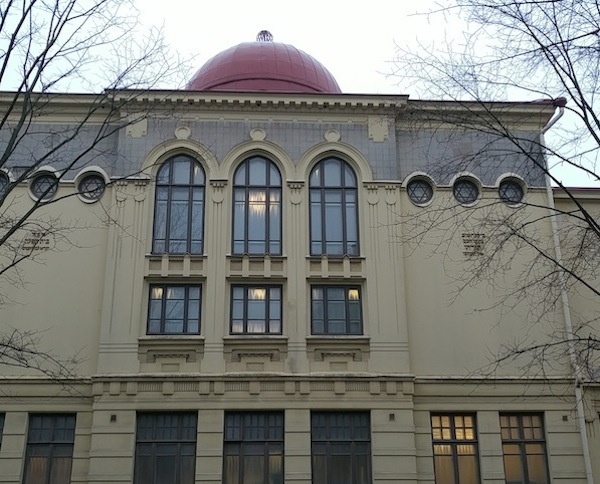
Helsinki Synagogue, in the heart of the city, was built in 1906. (photo by Dave Gordon)

Helsinki’s a city where you can experience high adventure, or simply chill, by taking in the sites on an easygoing walking tour. Elements of bustling metropolis meld with the laxity of a rural town, depending on which turn you take.

Home to some 1,400 Jews of Finland’s approximately 1,800-strong Jewish community, it is not a particularly large city, enabling a tourist to take in much of the core in a very short period of time. And it’s a treat for the eyes – modernity meets medieval, where whole city blocks are infused with colonial Swedish or Russian architecture, rich with history and stunning detail.

photo - Preserves and juices in the market in Helsinki
Preserves and juices in the market in Helsinki. (photo by Dave Gordon)

So, take it slowly. Walk along Norra Esplanade from the waterfront for a couple of kilometres and enjoy a wide array of boutique shops, dining options, cafés and the general feel of the city.

Stroll along Market Square, next to city hall, to get snapshot of local crafts and fare. It’s brimming with booths and kiosks – merchants peddling their wares. Drink fresh squeezed cloudberry or sea buckthorn juice (high in protein, vitamins C and E, and organic acids). Bring home an array of tchotchkes, like handmade knitted slippers, hats and sweaters. Nosh on reindeer jerky. Check out the bookmarks made with reindeer hide, and keychains made with reindeer antlers.

For investors and business, Helsinki is the latest start-up hub.

The city leapt from 43rd place in 2017 to 28th in 2018 in high-tech start-up successes among European and Scandinavian nations. The mega-conference for tech start-ups, Slush, takes place here, gathering 20,000 people. And, one of Europe’s biggest start-up campuses is about to be built, at 70,000 square metres.

Among the disruptors attracting global attention are Leadfeeder (analytics), ContractZen (one-click-cloud contracts), Smarp (shareable content hub), Utopia Analytics (artificial-intelligence monitoring of online discussion) and Hoxhunt (corporate security).

***

Finland is home to three Jewish institutions. Helsinki Synagogue, in the heart of the city, was built in 1906, and now serves about 1,200 congregants. Turku Synagogue was built in Turku in 1912, and has a few hundred members between the city and its surrounding areas. Both shuls are Ashkenazi Orthodox.

Helsinki Synagogue, with its bronze-coloured Byzantine-style dome, also houses a mikvah, a Talmud Torah and a playground. The congregation uses, not surprisingly, bilingual prayer books, in Hebrew and Finnish.

Meanwhile, Chabad Lubavitch of Finland is building a centre next to the city’s Presidential Palace, where they will offer classes, a daycare, a summer day camp and other services. Kosher meals are available through a handful of stores and organizations. Fazer, a local company that makes chocolate and cheeses, doesn’t have a hechsher (kosher certification), but is accepted by the community’s rabbinical authorities as kosher to consume.

The first Jew to officially plant roots in the country is recorded as Jacob Weikman, in 1782, despite the government ban on Jewish residence at that time. By the 1830s, there were enough Jewish soldiers to fill a makeshift chapel at the military base Suomenlinna Fortress, reports Hadassah magazine.

Many of today’s Finnish Jews are believed to be descendents of Russian infantrymen stationed there about 150 years ago.

During the Second World War, it was a complicated relationship for the Jews, many of whom fought with the Finnish army against the Soviets and, later, against the Nazis.

Finland openly defied the Nazi order to deport its 2,300 Jews, according to Yad Vashem. There was, however, a small exception: officials in 1942 allowed the Nazis to apprehend eight Jewish refugees. In 2000, a stone monument to memorialize the seven who died was erected by the government, at the park on Tähtitorninmäki (Observatory Hill).

But new evidence suggests that at least six soldiers of Finland’s army partook in the Final Solution. In January 2018, it was reported by JTA that an investigation had been launched by the Finnish government after the Finnish Society of Church History apparently found written testimony from one of the soldiers of his complicity. More than a year later, it seems that no results from the probe have been announced.

***

photo - Helsinki’s train station
Helsinki’s train station. (photo by Dave Gordon)

More history and culture can be found at the National Museum of Finland. Until Sept. 1, the temporary exhibition Inherit the Dust – Photographs by Nick Brandt is on display, offering an idea of the damage human beings are doing to the environment. Permanent exhibitions at the museum include Prehistory, a multisensory experience that allows visitors to “[t]ouch a genuine reindeer axe, bring a cave painting to life and see a mammoth move. The digital exhibits bring history to the present day.”

The museum of contemporary art, Kiasma, at just 20 years old, has some 8,000 works in its collection, and about 100 are added annually. Here, you can get a great feel for Finnish architecture from the building itself and, with renovations starting this year, the fence blocking off the area under repair has been covered with poster art.

***

There are many other places to visit, of course.

Allas Sea Pool, next to Market Square, is where locals go after work to exercise or relax. The Olympic-size outdoor pool is heated, having a calming effect on the body, while visually, the mist hovers at eye level as it collides with the cool air. Meanwhile, the “sea water pool” – filtered and treated with UV rays – is water straight from the ocean, chilly and punchy. Think of it like the famed “polar dive.”

Want to tap the inner child in you? The grown-up playground (the name of which is too difficult to spell, let alone pronounce) is a “sports acrobatics” centre with trampolines, bouncy airtrack, foam pits, sprung floor and more.

Arkadia International bookshop is a cultural icon in the city, featuring nightly concerts of every kind of music, as well as a venue simply to enjoy a cuppa joe, play a board game or shmooze with friends.

Takeoff Simulation is where you can “fly” a commercial airliner in a flight simulator the size of a real Airbus A320. It includes high-definition visual screens, real sounds and a highly detailed cockpit.

Dave Gordon is a Toronto-based freelance writer whose work has appeared in more than 100 publications around the world.

Retirement offers new path – the Accidental Balabusta

It was an uber-yummy pot roast that spawned the Accidental Balabusta. (photo by Shelley Civkin)

The definition of balabusta goes like this: 1) an impressively competent homemaker; 2) female head of household.

I recently saw balabusta used in a sentence: “She’s such a balabusta, she can make Shabbos for 20 in one afternoon.” Seriously? In which galaxy could anybody (never mind a balabusta) make any meal for 20 in one afternoon? I’m pretty sure that’s called hyperbole, or straight up bovine caca. Maybe I’m just not aware of the superpowers of real-life balabustas; the ones who sport red aprons and rule the domestic world. Personally, I couldn’t even make mac and cheese for 20 in one afternoon.

According to the Jewish Chronicle, “Balaboosters [sic] are rather out of fashion these days, victims of feminism and women’s magazines. Still, at least according to family myth, all of our grandmothers were balaboosters – heroic homemakers who raised large numbers of children in straitened circumstances and made real gefilte fish from a carp that swam about in the bathtub.” Not my Jewish grandmothers! Mine were neither spectacular cooks, nor did they have a bathtub filled with fish.

I don’t buy the idea that balabustas are out of fashion these days. I believe they’re just contemporary versions of the old-time balabustas. We hold down jobs, raise kids – well, not me, personally, but millions of other modern balabustas – and we’re active in our communities. And we just happen to bake, cook, do the laundry, clean the house and more. I, for one, am flattered to be called a balabusta. Even an accidental one. I feel like it puts me squarely in the category with other competent Jewish women, who juggle multiple tasks and are the glue that holds their families together.

So, how did I come to be crowned “the Accidental Balabusta”? It was the day I made a textbook perfect, uber-yummy pot roast. My husband Harvey took one bite and proclaimed me the Accidental Balabusta. Just like that! To substantiate his declaration, a week later I baked a batch of kalamata olive and rosemary challah buns (recipe from Rising: The Book of Challah by Rochie Pinson). They were exquisite. Or so I’m told. For the record, there was no bread machine or KitchenAid dough hook within 100 metres of my tiny galley kitchen. Just me, a 13-litre stainless steel bowl and enough flour to coat a bison.

For an encore, I made a handmade, painted challah cover. Next thing you know, I’ll be herding sheep. Anyway, that’s how the new moniker stuck.

Regarding the definition of balabusta, I might qualify as the “female head of household,” depending on whom you ask. As for being a remarkably skilled homemaker … well, the jury’s still out on that one. Way out. Truth to tell, most people I know would unequivocally classify me as the anti-balabusta. “That Shelley Civkin is a real balabusta!” Said nobody. Ever.

It’s not for lack of trying. OK, for about 50 years, it was. I simply wasn’t interested in cooking and cleaning. I was single and worked full-time. Since I only got married at age 53, the childbearing train had left the station. Empty. I was zero for three.

Then heaven happened: I retired three years ago. I took the advice of a wise rabbi, who told me that retirement doesn’t mean just sleeping in and doing nothing. It means helping others, doing mitzvot and finding your purpose in life. Did I mention I regularly volunteer to bake challah for seniors? I took the rabbi’s words to heart, and here I am today, the Accidental Balabusta. I’m sure my family and friends are laughing their tucheses off right now. “Shelley, a balabusta? You gotta be kidding?” For most of my life I was a water-burner.

If you ask Harvey, he’ll tell you I’m a great cook. To wit, he’ll eat anything. Exhibit A: the fish fiasco. A year or two into our relationship, I decided to make breaded snapper. So, I used my father’s recipe and coated the fish in flour, eggs and breadcrumbs. While it was frying, a tiny piece of breading came off, so I popped it my mouth. Something didn’t taste right. I checked the expiry date on the egg container – it was fine. Then I put my finger in the bread crumbs to taste them – they were good. Finally, I put my finger in the jar of flour. Only to realize that I’d just coated all my fish in icing sugar. Harvey, G-d bless him, ate the icing-sugar-coated fish. I went out for sushi.

Then there was the infamous lamb debacle. It was New Year’s Eve and I decided to go for broke, so I made a rack of lamb. I covered the lamb in my usual Dijon mustard, lemon and garlic mixture and put it in the oven. Our first bite in, both of us noted the unusually strong lemon flavour. But it was tasty.

An hour later, it wasn’t. Harvey ended up in the bathroom driving the big, white porcelain bus. Several hours later, I landed in the hospital emergency department having three bags of IV fluids pumped into me. Let’s just say I got very dehydrated, and leave it at that.

As for being a great homemaker, that’s not my strong suit. What I mean to say is this: I am not on a first-name basis with my vacuum cleaner. In fact, I couldn’t tell you the brand if my life depended on it. I am to housecleaning what porcupines are to Winnebagos. If tchotchkes aren’t screaming out to be dusted, leave well enough alone. Let me clarify: I’m not dirty. I’m just a little messy. I figure there are more important things to do than clean house. Like read. Or eat chips. When guests come over, though, I pull out all the stops. OK, I pull out the fancy hand towels. Actually, Harvey pulls them out. I watch.

The last time I did anything domestic was in Grade 3 Hebrew school, when our teacher had all the girls embroider kippot for the boys. The boys’ assignment – wait for it – was to wear the kippot. No sexism there. Of course, it was the early 1960s. So, you’re welcome, boys.

But back to the balabusta thing. It turns out that I actually enjoy cooking and baking. Who knew? With nothing but free time on my hands now (except for my volunteer activities), I can kick back, put my hair up and tie one on. An apron, that is.

Stay tuned for more Accidental Balabusta.

Shelley Civkin, aka the Accidental Balabusta, is a happily retired librarian and communications officer. For 17 years, she wrote a weekly book review column for the Richmond Review, and currently writes a bi-weekly column about retirement for the Richmond News.

Mystery photo … Feb. 22/19

Dave and Rose Nemetz with an unidentified group, undated. (photo from JWB fonds, JMABC L.16225)

If you know someone in this photo, please help the JI fill the gaps of its predecessor’s (the Jewish Western Bulletin’s) collection at the Jewish Museum and Archives of B.C. by contacting archives@jewishmuseum.ca or 604-257-5199. To find out who has been identified in the photos, visit jewishmuseum.ca/blog.

Preserving the environment

According to talmudic sages, “It is forbidden to live in a town which has no garden or greenery.” (Kiddushin 4:12; 66d) (photo by A. Christen)

Many contemporary Jews look upon Tu b’Shevat as a Jewish Earth Day, a day for contemplating our ecological heritage – and the multitude of threats our planet currently faces.

An ancient midrash has become all too relevant. “In the hour when the Holy One, blessed be He, created the first person, He showed him the trees in the Garden of Eden, and said to him: ‘See My works, how fine they are. Now all that I have created, I created for your benefit. Think upon this and do not corrupt and destroy My world, for if you destroy it, there is no one to restore it after you.’” (Ecclesiastes Rabbah 7:28)

Today’s environmental threats can be compared in many ways to the biblical 10 plagues, which appear in the Torah portions read on the Shabbats immediately preceding Tu b’Shevat. When we consider the threats to our land, water and air – pesticides and other chemical pollutants, resource scarcities, threats to our climate, etc. – we can easily enumerate 10 modern “plagues.” Unfortunately, like the ancient Pharaoh, our hearts have been hardened by the greed, materialism and wastefulness that are at the root of these threats. And, in contrast to the biblical plagues, modern plagues are all occurring simultaneously, and there is no modern Goshen as a refuge, where most of these plagues do not occur.

The talmudic sages express a sense of sanctity toward the environment: “The atmosphere [air] of the land of Israel makes one wise.” (Baba Batra 158b) They assert that people’s role is to enhance the world as “partners of God in the work of creation.” (Shabbat 10a)

The rabbis indicate great concern for preserving the environment and preventing pollution: “It is forbidden to live in a town which has no garden or greenery.” (Kiddushin 4:12; 66d) Threshing floors are to be placed far enough from a town so that the town is not dirtied by chaff carried by winds. (Baba Batra 2:8) Tanneries are to be kept at least 50 cubits from a town and placed only on its eastern side, so that odours are not carried by the prevailing winds from the west. (Baba Batra 2:8,9)

“The earth is the Lord’s.” (Psalms 24:1) And we are the stewards of God’s earth, responsible to see that its produce is available for all God’s children. Property is a sacred trust given by God; it must be used to fulfil God’s purposes.

The story is told of two men who were fighting over a piece of land. Each claimed ownership and bolstered his claim with apparent proof. To resolve their differences, they agreed to put the case before the rabbi. The rabbi listened but could come to no decision because both seemed to be right. Finally, he said, “Since I cannot decide to whom this land belongs, let us ask the land.” He put his ear to the ground and, after a moment, straightened up. “Gentlemen, the land says it belongs to neither of you but that you belong to it.”

The prohibition not to waste or destroy unnecessarily anything of value (bal tashchit, “thou shalt not destroy”) is based on concern for fruit-bearing trees, as indicated in the following Torah statement:

“When in your war against a city you have to besiege it a long time in order to capture it, you must not destroy its trees, wielding the ax against them. You may eat of them, but you must not cut them down. Are trees of the field human to withdraw before you under siege? Only trees that you know to not yield food may be destroyed; you may cut them down for constructing siege works against the city that is waging war on you, until it has been destroyed.” (Deuteronomy 20:19-20)

This prohibition against destroying fruit-bearing trees in time of warfare was extended by the Jewish sages. It is forbidden to cut down even a barren tree or to waste anything if no useful purpose is accomplished. (Sefer HaChinuch 530)

The sages of the Talmud made a general prohibition against waste: “Whoever breaks vessels or tears garments, or destroys a building, or clogs up a fountain, or destroys food violates the prohibition of bal tashchit.”  (Kiddushin 32a)

Rabbi Samson Raphael Hirsch, a 19th-century philosopher and author, states that bal tashchit is the first and most general call of God. We are to “regard things as God’s property and use them with a sense of responsibility for wise human purposes. Destroy nothing! Waste nothing!” He indicates further that destruction includes using more things (or things of greater value) than are necessary to obtain one’s aim. (Horeb, Chapter 56)

It has become customary to recite psalms on Tu b’Shevat, among them Psalm 104. This psalm speaks of God’s concern and care extended to all creatures, and illustrates that God created the entire earth as a unity, in ecological balance:

“You make springs gush forth in torrents; they make their way between the hills, giving drink to all the wild beasts; the wild asses slake their thirst. The birds of the sky dwell beside them and sing among the foliage. You water the mountains from Your lofts; the earth is sated from the fruit of Your work. You make the grass grow for the cattle and herbage for man’s labour, that he may get food out of the earth, wine that cheers the hearts of men, oil that makes the face shine and bread that sustains man’s life.” (Psalm 104:10-15)

Tu b’Shevat is indeed an appropriate time to apply Judaism’s powerful ethic of reverence for God’s creation, conservation and sustainability, to help move our precious, but imperiled, planet onto a sustainable path.

Richard H. Schwartz, PhD, is professor emeritus, College of Staten Island, president emeritus of Jewish Veg and president of Society of Ethical and Religious Vegetarians. He is the author of several books, including Judaism and Vegetarianism and Who Stole My Religion? Revitalizing Judaism and Applying Jewish Values to Help Heal Our Imperiled Planet, and more than 250 articles at jewishveg.org/schwartz. He was associate producer of the documentary A Sacred Duty: Applying Jewish Values to Help Heal the World.

The beauty of creation

In Israel, Tu b’Shevat is a day for planting saplings. (photo from JNF via israel21c.org)

“Keep a green tree in your heart and perhaps the singing bird will come.” This lovely quotation is not from our sages, but is an old Chinese proverb. Nevertheless, it seems appropriate for Tu b’Shevat, the New Year of the Trees, which falls this year on Jan. 21.

Of course, we have our own Jewish sources. For example, “When you see handsome people or fine trees, pronounce the benediction, ‘Praised be He who created beautiful things.’” (Tosefta: Berakot 7:4) Trees have a great significance in Judaism and, long before “ecology” became a popular word, Jews were commanded, even in times of war, when besieging a city, to not destroy its trees. (Deuteronomy 20:19)

Trees were sacred to many people. Pagans believed that gods inhabited them and took their forms. They were druidic, rising out of the earth and tossing their hair. They cooled, sheltered and calmed. It is easy to understand reverence for the splendor and dignity of trees, but only Judaism has a new year for them, which falls on 15th day of the Hebrew month of Shevat (Tu b’Shevat).

In Israel, this date once marked the time from which to count the age of the tree for reasons of tithe or taxes, and also to indicate the maturation of the fruit of the tree. Even today, fruit cannot be eaten until the fourth year, so Tu b’Shevat standardizes the birthday of trees.

The holiday doesn’t commemorate any great historical event, and there are no special prayers in the synagogue. It is a lovely time, ushered in by blossoming white almond trees with their promise of warm summer weather.

Tu b’Shevat is traditionally a time for planting every variety of tree. The Talmud mentions “the joyous planting” on happy occasions. There was a delightful custom of planting a cedar when a boy was born and a cypress sapling at the birth of a girl. When a couple married, the wood of the trees would be used as poles to support the wedding canopy.

In Israel, it is a day for children and teens to go with their teachers into the hills and valleys and plant tens of thousands of saplings. There is also a custom to eat all the fruits of Israel – olives, dates, grapes, figs, citrus, apples, bananas, nuts and pears, which grow in great abundance.

Many scholars stay up late on the eve of Tu b’Shevat, reciting biblical passages dealing with the earth’s fertility. They read from Genesis how trees were created along with all the plants; from Leviticus how the Divine promised abundance as a reward for keeping the commandments; and from Ezekiel 17, the parable of the spreading vine, symbolizing the people of Israel.

Many people hold a special seder to celebrate the holiday, the New Year of the Tree of Life. They drink four cups of wine, beginning with white wine and ending with red, with the second cup a mixture more of white and the third more of red wine. It is rather like the landscape, as it changes from white (pale narcissus and crocus) to red (anemones and tulips) as Tu b’Shevat approaches.

As well as being a birthday, Tu b’Shevat is also a day of judgment for the trees, which ones will thrive and be healthy, which ones will wither and die. Chassidim pray for the etrogim, that they may grow in beauty and perfection for Sukkot.

Planting trees is very significant for Jews, the indestructible people for whom faith in the future is almost an emblem. We plant trees whose fruit we will not eat and in whose shade we will not sit. The one who fears that the world will end tomorrow or next year does not plant trees.

As well, Tu b’Shevat affirms that the soil of Israel is holy. The people and the land have a mystic affinity in Judaism, and the New Year of the Trees reminds us every year of the wonder of God’s creation.

Dvora Waysman is a Jerusalem-based author. She has written 14 books, including The Pomegranate Pendant, which was made into a movie, and her latest novella, Searching for Sarah. She can be contacted at dwaysman@gmail.com or through her blog dvorawaysman.com.

Sharing holiday spirit

Left to right: Archbishop JohnMichael Miller, Dr. Gregg Gardner, Fr. Nick Meisl, Dr. Jay Eidelman and RabbiJonathan Infeld. (photo by Rabbi Adam Stein)

“This is a unique opportunity to learn and growtogether. What better way to open ourselves to that holiday spirit, to welcomethe mysterious and send away the fear of the unknown,” said Congregation BethIsrael president Helen Pinsky in introducing the Dec. 5 program at thesynagogue on Chanukah and Christmas, which was co-hosted by Beth Israel and theRoman Catholic Archdiocese of Vancouver.

After the lighting of a giant electronic chanukiyah by Rabbi Jonathan Infeld, the reciting of the motzi by Archbishop of Vancouver John Michael Miller and a latke-laden dinner, the crowd moved into the sanctuary to hear three scholars: Dr. Gregg Gardner, Diamond Chair in Jewish Law and Ethics at the University of British Columbia; Fr. Nick Meisl, a professor at St. Mark’s College; and Dr. Jay Eidelman, who lectures on the Holocaust and Jewish history at UBC.

Infeld started things off with a short talk.

“The neighbourhood we grew up in, in Pittsburgh, was 50% Jewish or Catholic,” he said. “The kids did not refer to themselves as Jewish or Christian but as ‘Chanukah’ or ‘Christmas.’ We don’t love this, but it shows that the holidays have a particular power.”

Noting that, for many Jews and Christians of the past, neither Chanukah or Christmas were important as religious holidays, the rabbi quoted a documentary he had watched that argued that Charles Dickens had created Christmas, quipping that maybe Dickens “created Chanukah as well, in its modern version.”

Gardner spoke on the origins of Chanukah, noting it was a festival created by the Maccabees to mark their military successes against the Greeks in an effort to preserve traditional Jewish culture. “Ironically,” he said, “creating a holiday to honour yourself is, in fact, a very Greek thing to do.”

The “subversive” rabbis of later generations altered the holiday to downplay its militaristic elements and its focus on the Maccabees, Gardner explained, replacing that with a focus on God’s miraculous intervention in the miracle of the oil that burned for eight days in the rededicated Temple.

In his remarks, Meisl said the balloon of his “naive beliefs” about Christmas popped when, in the course of his studies, he learned that Dec. 25 was not Jesus’s birthday, but rather a date chosen for other reasons. He explored the theories linking the day to the ancient Roman Saturnalia festival of late December, or the Dec. 25 holiday of Sol Invictus (Unconquerable Sun). With humour, he quoted the ancient Christian theologian Origen, who questioned whether Jesus’s birthday should be celebrated at all, noting that, in the Hebrew Bible, only “bad people celebrate their birthdays.” In seriousness, he said it seems that it was around 336 CE that Christians began celebrating Jesus’s birthday on Dec. 25.

Eidelman took to the podium to the sound of the 1970s classic “Eight Days of Chanukah” by Sharon Jones and the Dap-Kings, while changing from his suit jacket to a tacky Chanukah sweater, in the style of the dreaded Christmas sweater. His speech covered various historical and pop-culture themes related to the two holidays, with a focus on how Jews have imagined and reimagined Chanukah “as a way to define ourselves spiritually and a way to claim space in a culture largely based on Christian customs.”

After a short question-and-answer period in which people asked about the development of certain Chanukah customs and the role the story of the Maccabees has played in the Christian tradition, among other things, the archbishop wrapped up the event.

“This has been a wonderful evening of sharing the joy we each feel in the holidays with each other,” said Miller, who made a point of thanking everyone involved in the event by name, right down to the members of the catering and kitchen staff.

“The event was a splendid manifestation of the ties that bind Christians and Jews together in an age-old spiritual heritage,” Miller told the Jewish Independent by email. “Such occasions foster friendships and mutual understanding, and my hope is that they continue. I am very grateful to Rabbi Jonathan Infeld for his leadership role in interfaith relations.”

Matthew Gindin is a freelance journalist, writer and lecturer. He is Pacific correspondent for the CJN, writes regularly for the Forward, Tricycle and the Wisdom Daily, and has been published in Sojourners, Religion Dispatches and elsewhere. He can be found on Medium and Twitter.

Mystery photo … Dec. 14/18

Women at the Beth Tikvah Sisterhood spring conference, which took place at Beth Israel, 2000. Shelley Ail is the first on the right, but the others are unknown. (photo from JWB fonds, JMABC L.11302)

If you know someone in this photo, please helpthe JI fill the gaps of its predecessor’s (the Jewish Western Bulletin’s)collection at the Jewish Museum and Archives of B.C. by contacting archives@jewishmuseum.ca or 604-257-5199. To find out who has been identified in the photos,visit jewishmuseum.ca/blog.

Empowering Negev women

In Lakia, Israel, there are 160 women throughout the village who are responsible for designing and developing embroidery materials. (photo from Michelle Sitbon)

Our trip took us to the southern part of Israel, where we traveled to Beersheva. There is a small sign along the way, that you can miss quite easily, and it says Lakia. Lakia is one of the many Bedouin villages in this part of the country.

The Bedouins are a group of nomadic tribes who have lived in the Negev Desert for hundreds of years. Their heritage can be traced back to the traders along the ancient Spice Route, which happened to cross this region. Most traditional Bedouin hospitality experiences include camel riding, Bedouin food and staying inside a Bedouin tent overnight. However, in the village of Lakia, you are probably not going to find any of those things.

When you stop there, you are in for quite a different and unexpected experience. We arrived in Lakia in the middle of a hot summer day at the end of July and our main goal was to visit the Desert Embroidery. As we drove along the unpaved roads of the village, we quickly realized that Lakia might be small, but the Embroidery was extremely difficult to find. There was no sign telling us which direction to go, even though it is a tourist attraction.

When we finally found our destination, we got out of our vehicle and were warmly welcomed by Naama Al-Sana. She is the Bedouin woman who today runs the Desert Embroidery, and also founded the place together with other women from the community in 1996.

As we entered the visitor centre, we saw a display of beautiful art that was recently made by the local women. These women create the art in their homes in between their chores, and they use the money they earn from it to help support their families.

We were invited to sit inside a beautiful and colourful hand-woven tent, while Al-Sana offered us traditional Bedouin coffee that was scented with local spices. She was excited to hear that we had come all the way from Vancouver, as she has a sister who is currently in Canada, studying at the University of Toronto. Her sister often gives lectures about women in the Bedouin society, as a way to keep the history of this region alive.

The Desert Embroidery doesn’t offer the typical Bedouin tent experience, which includes being served a traditional meal. Instead, you will have the chance to contribute to the empowerment of Bedouin women in your own way. When you participate in one of the workshops or purchase any of their artwork, you will be actively improving the life, health and education of Bedouin women.

The Desert Embroidery was known as the Association for the Improvement of the Status of Women when it first began. The business has grown tremendously over the years and there are now 160 women throughout the village who are responsible for designing and developing embroidery materials. They also provide worker training and product marketing, and there is another group of women who work part-time to provide quality control checks on the products.

The system is very well organized. The women visit the Desert Embroidery twice a week to collect embroidery materials, drop off their finished items, learn about new patterns and designs, and participate in educational workshops and lectures. All of the women are allowed to choose how many hours they work, and they are paid by what they are able to produce within that time. A few of the women have chosen to preserve the traditional jewelry-making that was done by previous generations. They spent time learning how their mothers and grandmothers made jewelry and are now creating their own jewelry to include in the Desert Embroidery collection.

photo - With the help of the Desert Embroidery, Bedouin women in the Negev create the art in their homes, and use the money they earn to support their families
With the help of the Desert Embroidery, Bedouin women in the Negev create the art in their homes, and use the money they earn to support their families. (photo from Michelle Sitbon)

The Desert Embroidery is continuing to achieve its goal of providing employment and income for Bedouin women while empowering them and improving their self-confidence. More than 40 different artistic products can be found on display in the visitor centre, as well as other collaborations that help generate revenues for their work. An example of one of those collaborations is with Kibbutz Gan Masarik, which assists with strengthening the coexistence of Bedouin and Israelis.

The Desert Embroidery is also currently involved in improving the education and health of Bedouin children. And they want to expand to other Bedouin communities within the Negev, so that all Bedouin women can achieve economic independence. There are still so many challenges that women face in Bedouin society and this group is trying to help every woman overcome them.

The main reason I chose to visit Lakia was that I wanted to learn about this destination and the work that the Desert Embroidery is doing. My goal is to share what I have learned and to take other travelers to Lakia, so that they can see it firsthand. Of course, such activities aren’t only being done in the Negev region. In the northern part of the country, in the Galilee region, Israeli and Arab women also create traditional artwork to create a change in the lives of women.

I have made a visit to Lakia part of my itinerary in an upcoming small group tour to Israel, because I believe that travel can support and strengthen local communities. Since I am a travel agent who creates itineraries that are art-oriented, this is a perfect way to show everyone that they can appreciate art while making a difference in both children’s and women’s lives.

In the Mishnah Torah, Rambam organized the different levels of tzedakah, or charity, into a list from the least to the most honourable. Sometimes it is known as the “Ladder of Tzedakah.” The highest form of charity is to help sustain a person before they become impoverished, by offering a substantial gift in a dignified manner, by extending a suitable loan or by helping them find employment or establish themselves in business. These forms of giving allow the individual to not have to rely on others.

Projects such as those led by the Desert Embroidery can be found around the globe in places like Jordan, Mexico and Canada. When we travel, we know the many ways in which we benefit. However, I believe we should also try to find ways to benefit others as we travel, even in small ways. We should become more involved with local communities and support them in respectful ways that will, among other things, help them preserve their tradition and art.

Michelle Sitbon is an art travel adviser who organizes small group tours to Israel among other art-related destinations around world. For more information, visit yourartvoyage.com.

Action plan for your health

(photo from libreshot.com)

Most people are super-excited about starting some sort of a nutrition and wellness plan, especially leading up to a celebration such as a new year, and after all of the holiday indulgences many of us enjoy over Chanukah. But, no matter the strength of our intentions, soon after we start and a few months into the new year, our commitment tapers off.

The Talmud teaches, “the blind eat but are not satisfied.” What does it mean to be blind when it comes to eating?

We should start with asking ourselves, why do we place such importance on food and why should we be planning for healthier nutrition, and better wellness habits?

Are we conscious that nourishment is for spiritual, mental and moral clarity, purity and holiness, as well as to physically strengthen the body?

Choosing nutrient-rich foods is the first step to providing our body – and mind – with the nutrients it needs. And the way our foods are prepared and eaten can influence how well those nutrients are absorbed and used by our body.

The average human brain contains 10 billion nerve cells. And there are many studies showing how our choices of food affect our moods and brain function.

People often say they need to lose weight but then quickly forget what they said if they have travel plans or holiday celebrations. The reality is that eating healthier is a habit that has to be taken seriously and one that has to be a habit all year round regardless of season, travel plans or celebrations. Eating consciously is vital to our health and longevity.

We also shouldn’t remain blind to the supernatural dimension of eating. There are many blessings the practice of Judaism provides, and this kind of daily gratitude can help us derive greater satisfaction from life, including from our food.

There are two dimensions to a person’s eating – sustenance for our body and sustenance for our soul. Our body seeks nutrients, as does our soul. Most people live out their lives without ever really grasping the idea of eating or balancing their nutrition, suffering physically from overindulging and missing the most important lessons from and a spiritual relationship with G-d.

When it comes to food, people bounce between extremes. We go all in for stuffings, creamy dressing salads and huge cuts of meat, but then cut out entire food groups to compensate. People all of a sudden start talking about gluten-free, dairy-free, sugar-free diets and, of course, the ever-so-popular detox. Our bodies are made up to be a perfect system so, unless some of these foods are causing you real health issues, there’s no evidence that eliminating foods completely is better for you.

What makes sense is an action plan.

With so many fad diets, it’s not always easy to differentiate between truths. There are many diets we hear about from friends or friends of friends, that such-and-such has worked for them. But adherence to most of these diets is short-lived because they aren’t based in knowledge and aren’t sustainable or convenient for the individual. In many cases, diets eliminate highly nutritious, essential foods from your meals. As well, if you follow a very restrictive diet and then change your eating habits when you reach your ideal weight, you might find yourself starting to overeat, as you crave the foods you had eliminated, and now satisfy even some of those cravings.

Although no two people are alike and everyone’s nutrition needs vary, when it comes down to it, weight loss is fairly straightforward. Making better food choices, cutting out bad high-fat foods, empty-calorie refined foods, cutting back on calories in general, and getting more exercise pretty much sums it up.

If your goal is to maintain your weight, lose weight or, in some instances, gain weight, calorie quantities need to be adjusted. These varied options will mean different amounts of proteins and overall calorie intake, which, when coupled with an appropriate exercise program, will help you attain your healthy weight – and, in the process, learn how to eat healthily as a lifestyle instead of as a fad or resolution that lasts only a few months.

In general, it’s important to eat protein for every meal, and to keep a pattern of three meals and at least two snacks per day together with eight to 10 cups of water. It’s not recommended to skip meals and then double up at the next one. More evenly spaced meals will help keep your energy level up, and protein at each meal, as well as afternoon snacks, will help keep you from getting hungry.

Remember that the right food is medicine for body and soul, and a balanced diet is one of the simplest ways to better health, and exercise is the least expensive antidepressant.

Marat Dreyshner has more than 25 years of culinary experience and a passion for health, wellness and nutrition. He joined Herbalife Nutrition in 2016, and he and his wife Ella work together as nutrition and wellness coaches.

Mystery photo … Nov. 30/18

Selling bagel sandwiches at a Jewish Community Centre of Greater Vancouver Chanukah event, circa 1990. (photo from JWB fonds, JMABC L.18422)

If you know someone in this photo, please help the JI fill the gaps of its predecessor’s (the Jewish Western Bulletin’s) collection at the Jewish Museum and Archives of B.C. by contacting archives@jewishmuseum.ca or 604-257-5199. To find out who has been identified in the photos, visit jewishmuseum.ca/blog.