Earn Frequent Fryer points

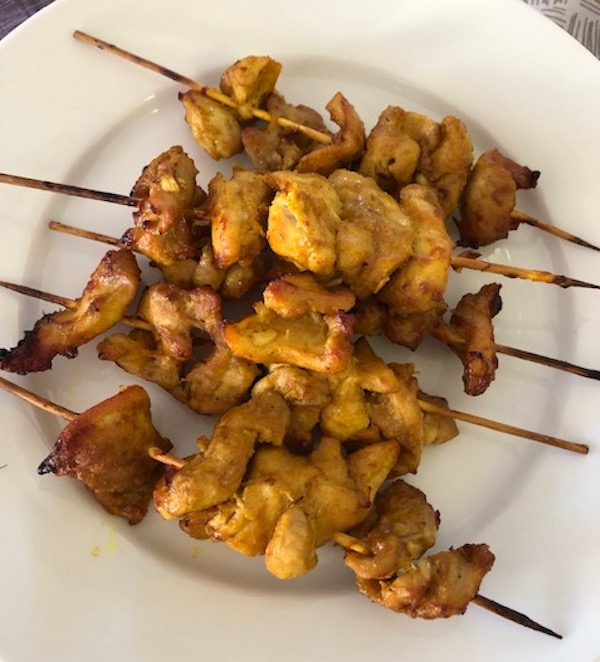
Mouthwatering air fryer chicken satay with peanut sauce. (photo by Shelley Civkin)

My father, alav hashalom, used to use the Yiddish phrase “Don’t hock me a tscheynik,” meaning, literally, don’t bang my teakettle. But, idiomatically, it means don’t bother me with nonsense. My husband Harvey has been hocking me a tscheynik for months now, in the hope that he’ll wear me down and I’ll finally give him the OK to buy an air fryer. Vos air fryer? Whenever people said air fryer, it conjured up a deep fryer filled with greasy doughnuts floating on the top. Or fatty chicken served with waffles, south of the border. It was about as appealing as an oozing wound.

I didn’t know from air fryers. But then my nephew and his wife got one, and regularly post pictures of the mouthwateringly delectable dinners they produce in their newfangled appliance. Still, I was not sold on the idea. While our apartment is a good size, our kitchen was designed for someone who’s culinarily challenged, petite in stature and not in favour of wasting space. Or, for someone like the character of Carrie Bradshaw, from Sex and the City, who only uses her oven to store sweaters. In short, it’s a galley kitchen that only fits two people, if you turn sideways and suck in your stomach. Our counter space is almost non-existent, yet we’ve managed to find a home for a Nespresso machine, waffle maker, Breville toaster oven, Breville blender and two Henckels knife blocks. I can barely fit a Vitamin C tablet on the remaining space. Still, Harvey thinks we can’t live (or at least not live well) without an air fryer.

After months of fighting him on this, I finally relented. Harvey did his due diligence, researched all air fryers known to man (and woman), then snuck out in the dead of night (notice how I made that all dramatic) and bought one. We got the Instant Vortex six-quart air fryer, which is big enough to hold a smart car. Or a baby buffalo.

As you can imagine, we had to make room for it on our aforementioned miniscule counter. The waffle maker now lives in the closet. The Nespresso machine has taken up residence in the liquor cabinet. And the Breville blender now cohabits with the Henckels Dutch oven under the butcher block. Our little family of appliances resembles a group home for wanton, headstrong youth. But still, we love them all the same.

A week has passed since we installed the air fryer into our humble abode and, well, it’s sheer bliss. I never knew it could be like this. So far, Harvey has made baked chicken thighs, carrots and broccoli, hardboiled eggs, potato wedges and hamburgers. All of which passed with flying (frying) colours, except, I’m sorry to say, the broccoli. It was a stringy, hard mess. The air fryer was literally begging us (OK, so I’m anthropomorphizing) for overtime – or at least a day off.

So, does this make us Frequent Fryers?

Meanwhile I’ve been Googling recipes for air fryer eggplant, tofu (Harvey would rather eat nails) and teriyaki salmon. Then, inspiration struck like yummy lightning – I found a bunch of mouthwatering recipes for air fryer chicken satay with peanut sauce. The deal was sealed. Note that, up to this point in time, I had not so much as touched our new appliance. I’d read the owner’s manual a dozen times though. Not wanting to challenge myself too much – you know, performance anxiety, fear of failure – I glommed onto the easiest, most appealing recipe I could find (credit goes to “Damn Delicious”). You’re welcome.

CHICKEN SATAY WITH PEANUT SAUCE

1/4 cup coconut milk
2 tbsp reduced sodium soy sauce
2 1/2 tsp yellow curry powder (I omitted this)
1 1/2 tsp turmeric
3/4 tsp cumin
3 cloves garlic, minced (I used 2 cloves)
1 tbsp freshly grated ginger
1 tbsp brown sugar
1 tbsp fish sauce (I omitted this)
2 lbs boneless, skinless chicken thighs or breasts cut into 1-inch cubes
1 tbsp canola oil (I used olive oil instead)
kosher salt and ground black pepper, to taste
rice vermicelli noodles

for the peanut sauce:
3 tbsp creamy peanut butter
1 tbsp reduced sodium soy sauce
1 tbsp freshly squeezed lime juice
2 tsp brown sugar
2 tsp chili garlic sauce (I used 1 clove garlic, minced instead)
1 tsp freshly grated ginger

  1. To make the peanut sauce, whisk together peanut butter, soy sauce, lime juice, brown sugar, chili garlic sauce (or minced garlic) and ginger in a small bowl. Whisk in two to three tablespoons water (I used coconut milk) until desired consistency is reached. Set aside in the fridge.
  2. In a medium bowl, combine coconut milk, soy sauce, curry powder (optional), oil, salt, pepper, turmeric, garlic, ginger, brown sugar and fish sauce (optional).
  3. In a large Ziploc bag or large bowl, combine chicken and coconut milk mixture, and marinate for at least two hours to overnight, stirring the mixture occasionally.
  4. Make some rice vermicelli noodles, rinse, drain and let them cool in the fridge.
  5. Soak bamboo skewers in water for 30 minutes before using.
  6. Drain the chicken from the marinade, discarding the marinade.
  7. Preheat the air fryer to 385°F for 12 to 14 minutes, or maybe a couple of minutes longer, depending on the wattage of your air fryer.
  8. Thread the chicken somewhat loosely onto the soaked skewers – don’t jam them together or they won’t cook evenly.
  9. Place the skewers into the air fryer basket, leaving room between each skewer. You may have to do a couple of batches to accommodate them all.
  10. Bake for six to seven minutes, then turn the skewers over and bake for another six to seven minutes, until they reach an internal temperature of 165°F.
  11. Serve immediately with peanut sauce over a bed of rice vermicelli noodles. Garnish with thinly sliced green onion or cilantro, and crushed peanuts.

To say that this meal was a success would be a gross understatement. In fact, I think Harvey proposed to me all over again. Then he offered to buy me a new computer. And a car. Perhaps the exhilaration of this delicious meal has gone to my head. Maybe he just said, “Thanks, it was delicious!” I can’t be sure. But my bet is on a new car.

Shelley Civkin, aka the Accidental Balabusta, is a happily retired librarian and communications officer. For 17 years, she wrote a weekly book review column for the Richmond Review. She’s currently a freelance writer and volunteer.

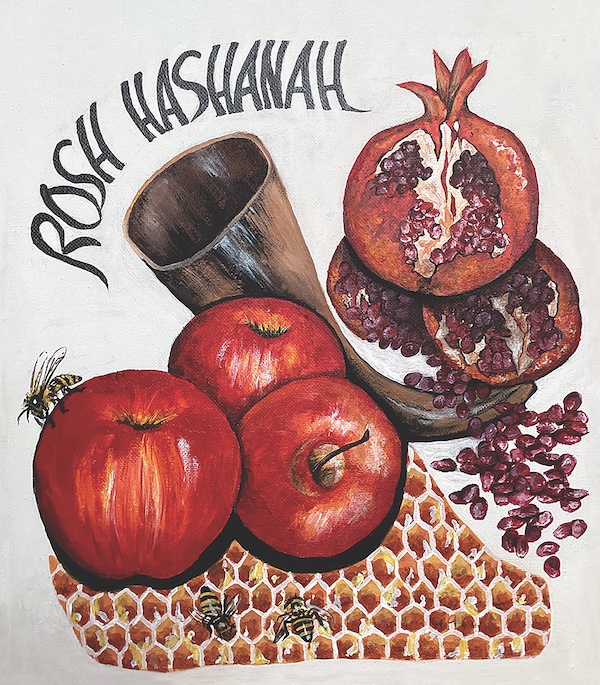
About the art on the cover of the JI’s Rosh Hashanah issue

Merle Linde, working out of Malka’s Studio in Steveston Village, chose four symbols of Rosh Hashanah for her painting.

The shofar: the mournful cry, sounded 100 times during the traditional Rosh Hashanah service, evokes the freedom we gained when we returned to the Holy Land.

image - The cover of the JI's Rosh Hashanah issue by Merle LindeThe pomegranate: a symbol of righteousness, knowledge and wisdom because it is said to have 613 seeds (arils), each representing one of the 613 mitzvot (commandments) of the Torah.

The apples: slices dipped into honey are eaten to symbolize the desire for a sweet new year.

The honey: given to us by the bees, who can inflict pain with their sting and yet produce delicious honey. Linde would suggest that we eat only “sustainable” honey (the food of the bees) so that the bees can survive and continue to pollinate the pomegranate and apple trees.

L’shanah tovah u’metukah! Wishes for a good and sweet new year.

Importance of food in celebration

A round challah symbolizes a long life, or the unbroken circle of the full new year to come. (photo by Przemyslaw Wierzbowski)

On Rosh Hashanah, we are supposed to feast. Why? This is said to come from the passage in the book of Nehemiah (8:10): “Go your way, eat the fat and drink the sweet, and send portions unto him for whom nothing is prepared; for this day is holy unto our lord.”

Round, sweet challah

The most common Rosh Hashanah custom for Ashkenazi Jews is the making of sweet challah, primarily round in shape, to symbolize a long life or the unbroken circle of the full new year to come. Some people place a ladder made of dough on top of the loaf, so our prayers may ascend to heaven, or because it is decided on Rosh Hashanah “who shall be exalted and who shall be brought low.” Some place a bird made of dough on top, derived from the phrase in Isaiah: “as birds hovering so will the Lord of Hosts protect Jerusalem.”

According to John Cooper, in Eat and Be Satisfied: A Social History of Jewish Food, the tradition in disparate Jewish communities of baking fresh loaves of bread on a Friday morning has its roots in the talmudic era. The custom was ignored by medieval rabbinic commentators, he writes, but was revived by the Leket Yosher, a report compiled by Joseph ben Moses in the 1400s on the teachings and practices of his teacher, Austrian Rabbi Israel Isserlin; and by Rabbi Moses Isserles, the 16th-century Polish scholar of halachah, at the end of the Middle Ages.

According to Jewish tradition, the three Sabbath meals (Friday night, Saturday lunch and Saturday late afternoon) and two holiday meals (one at night and lunch the following day) each begin with two complete loaves of bread. This “double loaf” (lechem mishneh) commemorates the manna that fell from the heavens when the Israelites wandered in the desert after the Exodus. The manna did not fall on Sabbath or holidays; instead, a double portion would fall the day before the holiday or Sabbath.

Pomegranate blessings

photo - The pomegranate is eaten to remind us that G-d should multiply our credit of good deeds, like the seeds of the fruit
The pomegranate is eaten to remind us that G-d should multiply our credit of good deeds, like the seeds of the fruit. (photo from pxhere.com)

On the second evening of Rosh Hashanah, it is customary to eat a new fruit not yet eaten in the season and recite the Shehechiyanu, a prayer of thanksgiving for the first time something happens. It is said that, in Europe, this fruit was often grapes; in Israel today and around the diaspora, it is often the pomegranate.

The pomegranate is eaten to remind us that G-d should multiply our credit of good deeds, like the seeds of the fruit. For many Jews, pomegranates are traditional for Rosh Hashanah. Some believe the dull and leathery skinned crimson fruit may have really been the tapuach, apple, of the Garden of Eden. The word pomegranate means “grained apple.” In Hebrew, it is called rimon – also the word for a hand grenade!

Some say each pomegranate has 613 seeds for the 613 mitzvot, or good deeds, we should observe.

Symbolism of fish

The first course of the Rosh Hashanah holiday meal is often fish. Fish is symbolic of fruitfulness: “may we be fruitful and multiply like fish.” Fish is also a symbol of immortality, a good theme for the New Year, as are the ideas that we should aim to be a leader (the head) and that we hope for the best (to be at the top). Another reason for serving fish might be that the numerical value of the letters of the Hebrew word for fish, dag, is seven and Rosh Hashanah begins on the seventh month of the year.

Importance of tzimmes

Tzimmes is a stew made with or without meat and usually with prunes and carrots. It is common among Ashkenazi Jews, particularly those from Eastern Europe and Poland, and its origins date back to Medieval times. It became associated with Rosh Hashanah because the Yiddish word for carrot is mehren, which is similar to mehrn, which means to increase. The idea was to increase one’s merits at this time of year. Another explanation for eating tzimmes with carrots for Rosh Hashanah is that the German word for carrot was a pun on the Hebrew word, which meant to increase.

Tzimmes also has come into the vernacular as meaning to make a fuss or big deal. As in, they’re making such a tzimmes out of everything.

Lekach & other sweets

Among Ashkenazim, sweet desserts for Rosh Hashanah are customary, particularly lekach, or honey cake, and teiglach, the hard, doughy, honey and nut cookie. Some say the origin of the sweets comes from the passage in the book of Hosea (3:1): “love cakes of raisins.” There is also a passage in Samuel II (6:10) that talks about the multitudes of Israel, men and women, “to every one a cake of bread and a cake made in a pan and a sweet cake.”

Ezra was the fifth-century BCE religious leader who was commissioned by the Persian king to direct Jewish affairs in Judea and Nehemiah was a political leader and cup bearer of the king in the fifth century BCE. They are credited with telling the returned exiles to eat and drink sweet things.

According to Cooper’s Eat and Be Satisfied, references to honey cake were made in the 12th century by a French sage, Simcha of Vitry, author of the Machzor Vitry, and by the 12th-century German rabbi, Eleazar Judah ben Kalonymos. By the 16th century, lekach was known as a Rosh Hashanah sweet.

Among the Lubavitch Chassidim, it was customary for the rebbe to distribute lekach to his followers; others would request a piece of honey cake from one another on Erev Yom Kippur. This transaction symbolized a substitute for any charity the person might choose to receive, like the traditional kapparot ceremony, where, before Yom Kippur, one transfers their sins to a chicken.

Some Sephardi customs

Food customs differ among Jews whose ancestors came from Spain and Portugal, the Mediterranean area and primarily Muslim Arab countries. For example, whereas Ashkenazim dip apple in honey, some Sephardim traditionally serve mansanada, an apple compote, as an appetizer and dessert, according to Gil Marks (z”l) in The World of Jewish Desserts.

Just as gefilte fish became a classic dish for the Ashkenazi Jews, baked sheep’s head became a symbol – dating back to the Middle Ages – for many Sephardi Jews for Rosh Hashanah. Some groups merely serve sheep brains or tongue, or a whole fish (with head), probably for the same reason – fruitfulness and prosperity and new wishes for the New Year for knowledge or leadership.

The Talmud mentions the foods to be eaten on Rosh Hashanah as fenugreek, leeks, beets, dates and gourds, although Jewish communities interpret these differently. According to Rabbi Robert Sternberg in The Sephardic Kitchen, Sephardi Jews have a special ceremony around these and sometimes other foods, wherein each one is blessed with a prayer beginning “Yehi ratzon” (Hebrew for “May it be thy will”). The Yehi Ratzones custom involves preparing in advance and then blessing the Talmud-mentioned foods, or dishes made with the foods, as well as over the apples and honey, the fish or sheep head (some substitute a head of lettuce or of garlic) and pomegranate. In doing this, people recognize G-d’s sovereignty and hope He will hear their pleas for a good and prosperous year.

Sybil Kaplan is a Jerusalem-based journalist and author. She has edited/compiled nine kosher cookbooks and is a food writer for North American Jewish publications.

Bafflement part of life

Just as in life outside shul we don’t understand everything we encounter, we don’t all necessarily understand the Torah reading and other parts of the High Holiday service. The High Holidays serve as a metaphor for life itself. (photo from flickr / Lawrie Cate)

Throughout the High Holidays, we repeat in the liturgy pronouncement after pronouncement about our lack of control: we are born against our will, we die against our will, we are but clay in the hands of God, we turn our eyes heavenward as children before a parent, and as slaves before a master. It would be dissonant in such an environment to try to assert our autonomy, to try to shape the experience around our own emotional needs.

And, while we want the High Holidays to be relatable for people, the season by necessity must not be customized to the individual. This is because their meaning lies precisely in the challenge of giving up our individual sense of entitlement in favour of something more important: meaning.

The High Holidays serve as a metaphor for life itself. During this season, we enter into an experience that has been curated for us, that existed before we ever did and which has elements that we are comfortable with and elements that challenge us. I may find myself standing in a synagogue next to people I don’t know, reciting words that I don’t know or would never have written, on a date that means very little to me personally except as a construct of the Jewish calendar.

This is true to life in general: I participate in a world that I don’t completely shape, with others who think differently than I do, within a system that I did not create. We do not choose to be born, nor to which families, nor under what circumstances or accompanied by what baggage. We likewise do not choose what natural successes or tragedies befall us. And, while we do our best to shape our lives, so much of the table is set for us and is beyond our control.

The High Holidays then bid us instead to think about meaning, about the control we do have. If life is not about what we choose, it is about how we choose to engage with what we encounter. We choose how we are going to interpret and how we are going to make meaning of it. How will we choose to see life, and how will our attitudes guide our actions? We may choose to read what we experience charitably or stingily, optimistically, realistically or nihilistically, or more often a messy combination of all of the above. But make no mistake: it is our own choices that will give rise to what we make of those lives that are given to us, to those circumstances that challenge us.

Eschewing a sense of entitlement and control in favour of a sense of meaning and potential is the work of the High Holiday season. It allows us to reflect on how and why we get in our own way, how our sense of entitlement, whether consciously or subconsciously, overrides our good judgment. This helps us to understand the idea of repentance, which is at the core of the High Holidays.

The talmudic sage Rava declared: those who are willing to forgive others easily will likewise be forgiven by God. The language attributed to him is literally, “One who overlooks his/her measurements, [God will overlook all of their sins].” Forgiveness, too, is about letting go of what we may still feel we are owed in favour of building relationships with others. Rather than standing on ceremony over what could have been, I am willing to loosen the reins, to be open to what might emerge. Oftentimes what needlessly keeps us from forgiveness is a focus on what we deserve, what we are entitled to. And, when this happens, we find ourselves once again getting in our own way and holding on to a vision of complete control over what happens or does not happen to us.

Letting go of trying to control the experience is hard. But it can also be liberating. For the High Holiday season, it relieves us of the expectation that we need to relate to everything. More importantly though, for life itself, it relieves us of the expectation of perfection – from ourselves, from others, from life itself.

At the same time, it reminds us of the depth of the human heart and the power of our own will in deciding how we will chart our path forward: that we can come to synagogue not only to be forgiven, but also to forgive; not only to be moved, but to choose to move ourselves.

Wishing all a meaningful New Year.

Dr. Elana Stein Hain is the director of faculty and a senior fellow at the Shalom Hartman Institute of North America, where she serves as lead faculty, directs the activities of the Kogod Research Centre for Contemporary Jewish Thought and consults on the content of lay and professional leadership programs. Articles by Stein Hain and other institute scholars can be found at hartman.org.il. This article was first posted on Times of Israel.

Albania’s many legends

A bunker in Tirana, Albania, that is now the Bunk’Art art and history museum. (photo by Deborah Rubin Fields)

Albania is a country of great contrasts. It has stunning, clean beaches, so gorgeous that locals refer to them as the Albanian Riviera, and it also has hills and mountains that spring up in all directions. The contrasts seem to extend to Albanians themselves – Enver Hoxha, Albania’s longtime communist dictator, who died in 1985, started off as a partisan fighting the Italians and Germans in the Second World War.

Until not too long ago, Albania existed in isolation. Long before COVID-19 raised its head, Hoxha had kept the country shut off from the world. This is remarkable, given that Hoxha had at various periods aligned his Marxist-Leninist politics with the Soviet Union and China.

As in other communist regimes, many Albanian citizens became suspect during Hoxha’s 40-year reign. They were imprisoned, tortured and murdered. Further, over a 20-year period, Hoxha went on a bunker-building spree. He worried that Albania might be invaded by its neighbouring countries and by the Soviet Union. Between 1971 and 1983, at extreme cost to the general economy, Hoxha had more than 173,000 bunkers constructed. Hundreds of soldiers and civilians died in work accidents. Once the bunkers were built, local citizens as young as 12 years of age were expected to defend them from invaders. The bunkers were only abandoned in 1992, seven years after Hoxha died.

Today, some of the bunkers have other uses. In the capital of Tirana, for example, one series of bunkers has been converted into the Bunk’Art, an art and history museum. In Gjirokastra, there is the Cold War Tunnel Museum.

photo - Part of the Cold War Tunnel Museum in Gjirokastra, Albania
Part of the Cold War Tunnel Museum in Gjirokastra, Albania. (photo by Deborah Rubin Fields)

Hiking is also a fantastic way to see this beautiful country, although, in more remote parts of the country, older Albanians do not speak English and the younger, English-speaking generation is leaving Albania to seek their fortunes in other parts of Europe. Also be aware that even visiting castles requires a bit of hiking over either loose or highly polished stone, so it may be advisable to use walking sticks.

Generally, when people talk about blue eyes, they mean the eye colour of other humans or of their pets. But, in Albania, the Blue Eye is a lovely nature site. Reaching unknown depths (divers have gone down as far as 50 metres without reaching the bottom), the Blue Eye is more accurately a blue hole fed by an underground spring.

Albanian mythology recalls mountain spirits who live near springs and torrents in the northern Albanian Alps. These spirits or zanas are courageous and often protect Albanian warriors, but they can also go the other way, doing evil.

Even some of Albania’s mountains have stories. Take Mt. Tomor, for instance. Baba Tomor, or Father Tomor, is the personification of the mountain, a range whose highest peak is in central Albania. Baba Tomor appears as an older man with a long white beard that reaches his belt. Four eagles serve as his assistants. His bride is the young Earthly Beauty. When his territory is threatened, Tomor battles his enemy, Mt. Shpirag. The furrows running down Shpirag’s mountainside are said to be the knocks Tomor gave to Shpirag. Ultimately, the two fought to their deaths. The young bride is said to have drowned in her tears, which then became the Osum River.

Indeed, this is a country with many local legends. Take the story related to Shkoder’s Rozafa Castle. Apparently, the walls of this ninth-century BCE castle kept collapsing. Only when Rozafa (the wife of one of the three brothers building the castle) was enclosed in the castle walls did it stabilize and remain standing. Booker Prize-winning Albanian writer Ismail Kadare based his book The Three-Arched Bridge on this legend.

One of the spots to visit in Gjirokastra is called Sokaku i te Marreve, or Mad People Street. On this street, there is the reconstructed home of the above-mentioned – but sane – writer Kadare.

More interesting things about Gjirokastra include the Gjirokastra Castle, which houses the remnants of a U.S. Air Force Lockheed T-33. Some claim Albanian forces downed the jet during the Cold War (1957). Others say the plane was an American spy jet forced to land at Tirana’s Rinas Airport in December 1957 after developing mechanical problems and flying off course. Both scenarios are unlikely, but they make for good stories.

In a country that has almost no Jews, it is intriguing to know that (protectively covered by sand) Sarande has mosaics containing images of a shofar, a menorah and an etrog. Apparently, back in the fourth- or fifth-century CE, the Jewish community had its own synagogue in Sarande. According to the late Ehud Netzer and the late Gideon Foerster – the Israeli archeologists who dug there (along with an Albanian team) – this synagogue even had a ritual bath.

In contrast to radical Islam, there is Albania’s Bektashi Order, a Sufi Islamic creed with a long mystic tradition in Albania. The Sufi faith does not force devotees to observe the basics of traditional Islam. For example, the Bektashi creed allows for the drinking of alcohol and does not demand men and women be segregated, nor that women wear a veil. Curiously, this order appreciates Sabbatai Zvi, who was a false messiah, according to most Jews. Baba Mondi, the spiritual leader of the Bektashi sect, calls Sabbatai Zevi a dervish – a Farsi word for a spiritual Muslim who ascetically devotes his life to serving Allah; the term has also been used to describe, in rare instances, a Jew.

Ironically, Berat, the city of 1,001 windows, has a Jewish history museum established by the late Prof. Simon Vrusho, who wasn’t Jewish. Since his passing, the small Solomon Museum has been run by his widow. This museum exemplifies the good relations Albanian Jews had with both the Muslim and Christian community. Amazingly, local non-Jews saved almost 2,000 Jews during the Holocaust.

In Tirana’s Grand Park, there is a newly installed Holocaust memorial. It consists of three large plaques in Albanian, English and Hebrew, highlighting the stories of Albanians who saved Jews during the war.

photo - The English plaque of the Holocaust memorial in Tirana
The English plaque of the Holocaust memorial in Tirana. (photo by Deborah Rubin Fields)

Relatively unknown is an Albanian tragedy that exemplifies the worldwide refugee problem. In 1997, the ship Katër i Radës departed from the Albanian port city of Vlora, carrying 120 refugees fleeing the violence that had engulfed the country following that year’s massive collapse of pyramid schemes. On March 28, 1997, the Italian navy warship Sibilla – acting in accordance with an Italian blockade of Albania (designed to prevent refugees from entering the country) – intercepted, rammed and sunk the Katër i Radës in the strait of Otranto, killing 81 of the refugees aboard. Among the victims were many women and children.

Since ancient times, Jews have lived in Albania. However, there are a few theories about how and when Jews arrived there. According to historian Apostol Kotani, Jews may have first arrived in Albania as early as 70 CE, as captives on Roman ships that washed up on the country’s southern shores. Others report that, in Roman times, Jews already lived in the port of Durres. The Jewish population has fluctuated over the centuries, but most of the Jewish population made aliyah in the 1990s and, today, only a few Jews remain.

Deborah Rubin Fields is an Israel-based features writer. She is also the author of Take a Peek Inside: A Child’s Guide to Radiology Exams, published in English, Hebrew and Arabic.

Sweet apples for New Year

(photo from flickr / s2art)

My favourite fall/winter fruit is apples, and not just because they are a main symbol of Rosh Hashanah, helping us start off the new year with a sweet dip of honey. I believe the adage that an apple a day keeps the doctor away. Although the phrase was uttered by Benjamin Franklin, it originated in 1866 in Wales – “eat an apple on going to bed and you’ll keep the doctor from earning his bread.”

Why are apples healthy? They may lower high cholesterol and blood pressure; they have fibre, which can aid digestion; they support a healthy immune system; are a diabetes-friendly fruit; and the antioxidants in apples may play a role in cancer prevention.

All that aside, they just taste great. Here are some recipes to try out, one of which features another New Year’s symbol – the pomegranate.

MOTHER’S ROSH HASHANAH APPLE CAKE

2/3 cup vegetable oil
2 cups brown sugar
2 eggs
2 tsp cinnamon
1 tsp ground cloves
2 cups applesauce (or 2 finely chopped apples)
2 tsp baking soda dissolved in 1 tsp wine
4 cups flour
2 tsp vanilla
2 cups raisins
1/2 to 1 cup finely chopped nuts

  1. Grease two cake pans. Preheat oven to 350°F.
  2. With an electric or hand mixer, cream oil and sugar.
  3. Add eggs, cinnamon and cloves.
  4. Add applesauce, dissolved baking soda and blend. Add flour, vanilla, raisins and nuts.
  5. Pour into the well-greased cake pans and bake for 45 minutes or until a toothpick inserted in the centre comes out clean.

APPLE ENCHANTMENT
(This recipe was in my files from the 1970s, from Carmel wine company.)

1/4 cup sugar
1/4 cup caramel amaretto
grated rind and juice of 1 orange
4 large, firm apples

  1. In a saucepan, combine sugar, amaretto, orange rind and juice. Bring to a boil.
  2. Peel, core and thickly slice apples. Place in the pan as they are sliced. Reduce heat and simmer until apples are tender and liquid has evaporated.
  3. Remove to a dish. Chill.
  4. Garnish with shredded coconut or whipped cream.

BAKED STUFFED APPLES
(This recipe by Ann Chantal Altman is from a 2001 Food & Wine cookbook.)

3 tbsp lightly toasted slivered blanched almonds
1.3 ounces of finely crumbled kosher amaretti (almond-flavoured Italian macaroons)
1/3 cup dry currants
2 tbsp brown sugar
1/2 tsp cinnamon
finely grated zest of 1 lemon
2 tbsp softened unsalted butter or margarine
4 apples
1 cup apple juice
2 tbsp dark rum

  1. Preheat oven to 375°F. Grease a square baking dish.
  2. In a bowl, mix almonds with amaretti crumbs, currants, brown sugar, cinnamon and lemon zest.
  3. Remove interior core and seeds of apples within half-inch of bottom. Score apple skin lengthwise at 1.5-inch intervals and arrange in the baking dish. Spoon filling into apples. Pour apple juice and rum around the apples.
  4. Bake for 20 minutes. Cover loosely with foil and bake 45-50 minutes longer or until apples are very soft. Transfer to plates. Spoon juices on top.

QUICK AND EASY MICROWAVE APPLE COMPOTE

4 large apples
3 to 5 tbsp water or apple juice
1/4 to 1/2 tsp cinnamon
2 to 3 tsp sugar

  1. Cut apples in small pieces, discarding cores. Place in a microwave-safe dish with water or apple juice.
  2. Cover and microwave on high for three minutes. Stir and microwave for two more minutes.
  3. Add cinnamon and sugar. Cover and microwave for one to two minutes or until tender. Sprinkle some sugar on top.

APPLES BAKED IN POMEGRANATE SYRUP

4 apples, cored and cut into 16 wedges each
juice from half a pomegranate
apple juice
1/3 cup apricot preserves
1/2 tsp cinnamon
seeds from half a pomegranate

  1. Use non-stick vegetable spray on a microwavable baking dish.
  2. Place apple wedges in the dish.
  3. Squeeze juice from half a pomegranate and add apple juice to make 1/2 cup.
  4. Add preserves and cinnamon and mix well. Pour over apples and coat. Cover.
  5. Microwave on high for two minutes and stir. Continue until apples are barely tender, at least two minutes more.
  6. Remove seeds from remaining pomegranate half, discard white pith. Sprinkle over apples and serve.

Sybil Kaplan is a Jerusalem-based journalist and author. She has edited/compiled nine kosher cookbooks and is a food writer for North American Jewish publications.

Fish dishes for dinner, lunch

A fish head is one of the symbols of the Rosh Hashanah meal, so why not add a fish dish to the menu? (photo from rawpixel.com)

Soon we will celebrate Rosh Hashanah, for which a fish head is a symbol of leadership (be the head and not the tail) and fertility. This is reason enough, perhaps, to include fish on the holiday dinner or lunch menus. If so, here are a few recipes you could try.

TUNA AIOLI
(8 servings)

2 cups mayonnaise
4 large minced garlic cloves
2 tbsp lemon juice
1/2 tsp dry mustard
2 10-ounce packages frozen Italian green beans
4 7-ounce cans drained tuna
2 20-ounce cans drained sliced beets
8 sliced carrots
2 thinly sliced red or white onions

  1. In a bowl, blend mayonnaise with garlic, lemon juice and mustard. Cover and refrigerate.
  2. Cook green beans following package directions.
  3. Arrange tuna, beets, carrots and onions on a serving platter. Serve with mayonnaise-garlic sauce.

FISH AND ARTICHOKE SALAD
(6 servings)

1 pound fish of your choice
1 cup pareve chicken soup (or vegetable stock)
1/2 cup dry white wine
1 14-ounce can drained and quartered artichoke hearts
2 tomatoes, cut into eighths
1/2 cup halved black olives
1/4 cup olive oil
2 tbsp fresh lemon juice
1/4 cup chopped fresh parsley
salt and pepper to taste
a few lettuce leaves
4 chopped green onions

  1. Place fish, soup and wine in a saucepan. Bring to a boil. Turn off heat and let cool.
  2. Place fish in a bowl with artichoke hearts, tomatoes and olives.
  3. In a small bowl, whisk oil, lemon juice, parsley, salt and pepper. Pour over fish and toss to mix.
  4. Cover and refrigerate overnight or at least three hours.
  5. Line a bowl with lettuce leaves. Spoon in fish mixture. Garnish with green onions.

GRILLED SALMON SALAD
(8 servings)

8 centre-cut salmon fillets
1/4 cup olive oil
1/4 cup fresh lime juice
salt and pepper to taste
8 cups rinsed, dried and coarsely chopped arugula leaves
4 cups halved cherry tomatoes
1/2 cup diced red onion
salt and pepper to taste
2 tbsp olive oil
2 tbsp red wine vinegar

  1. Place salmon in a shallow dish. Combine oil, lime juice, salt and pepper and pour over salmon. Marinate in refrigerator 30 minutes, turn and continue marinating 30 minutes more.
  2. Oil a grill. Grill salmon, skin side down, 8-13 minutes, until medium rare.
  3. Meanwhile, combine arugula, tomatoes, red onion, salt, pepper, olive oil and wine vinegar.
  4. Place a salmon fillet in the centre of each dinner plate. Divide the salad equally and place each portion atop a piece of fish.

Sybil Kaplan is a Jerusalem-based journalist and author. She has edited/compiled nine kosher cookbooks and is a food writer for North American Jewish publications.

Chicken with a French twist

Chicken always makes for a nice holiday meal. For a special treat, however, try out these French kosher chicken entrees.

CHICKEN DIJON
(8 servings)

1/4 cup water or vegetable oil
1 tsp garlic powder
1/2 cup Dijon mustard
1 tsp dry Italian seasoning
8 boneless skinless chicken breast halves
lemon slices or fresh herbs

  1. Preheat oven to 375°F.
  2. In a plastic bag, combine mustard, water or oil, garlic powder and Italian seasoning. Add chicken and shake to coat.
  3. Place chicken in a baking pan. Bake for 20 minutes or until done.
  4. Garnish with lemon slices and fresh herbs.

CHICKEN LEGS COQ AU VIN
(I’ve adapted slightly Chef Eric Ripert’s recipe that was in Food & Wine. It makes 8 servings.)

16 chicken drumsticks
salt and pepper
6 tbsp flour
1/4 cup canola oil
1 cup finely chopped carrots
1 cup finely chopped onions
1 cup finely chopped celery
3 cups chopped mushrooms
4 thinly sliced garlic cloves
1 cup brandy
2 tbsp tomato paste
1 bottle dry red wine
2 cups chicken stock
4 thyme sprigs

  1. Heat oil in a large pot.
  2. Season chicken with salt and pepper and dust with 1/4 cup flour. Add chicken to pot and cook over high heat five minutes. Remove to a plate.
  3. Add carrots, onions, celery, mushrooms and garlic and cook five minutes.
  4. Add brandy and cook one minute. Stir in tomato paste and two tablespoons flour. Add wine, chicken stock and thyme and bring to a boil.
  5. Return chicken to pot, cover and simmer 1.5 hours. Remove chicken.
  6. Simmer sauce until reduced by half, about 10 minutes. Discard thyme. Return chicken to sauce and heat.

CHARDONNAY-BRAISED CHICKEN THIGHS
(I’ve made a few changes to cookbook author Grace Parisi’s recipe that was in Food & Wine. It makes 8 servings.)

4 tbsp unsalted margarine
4 tbsp olive oil
16 chicken thighs
salt and pepper to taste
1/2 cup flour
8 peeled, quartered shallots
2 pounds parsley root or parsnips, cut into 3-by-0.5-inch pieces
2 rosemary sprigs
2 cups Chardonnay or dry white wine
3 cups chicken soup

  1. Preheat oven to 425°F. Melt margarine in a large frying pan with oil.
  2. Season chicken with salt and pepper and dust with flour. Add to frying pan, skin side down and cook until brown, about six minutes. Place on a plate.
  3. Add shallots, parsley root or parsnips and rosemary and cook one minute.
  4. Add wine and cook three minutes or until reduced by half.
  5. Add chicken soup and bring to a boil.
  6. Place chicken skin side up in frying pan and place in oven. Braise 25 minutes or until cooked through.
  7. Broil chicken for three minutes. Return to stove and boil until sauce is thickened, about three minutes. Discard rosemary. Transfer to bowls and serve.

Sybil Kaplan is a Jerusalem-based journalist and author. She has edited/compiled nine kosher cookbooks and is a food writer for North American Jewish publications.

Hitting the high seas & citrus

Who among us enjoys using a 400°F oven during the summer? That would be: Nobody. Ever. For me, summer is synonymous with barbecuing, which is first cousin to steak, hamburgers, chicken and grilled veggies.

Recently introduced to tuna steaks, I’ve now gone over to the light side. On a recent trip to Victoria, good friends had us over for dinner and served one of the best meals we’ve eaten in years. While most of the component parts were healthy, some were deliciously questionable, in terms of caloric heft (see lemon mousse below). The star of the meal, by a long shot, however, was the marinated tuna steak, grilled on the barbecue. Even though it was more well done than I prefer, it was still juicy, incredibly flavourful and tender. I like my tuna steak with grill marks on the outside and pink rareness on the inside. Most good fish restaurants serve it like that. Despite the variance in preferences, our friend cooked it to perfection. As with all good things, I like to share my enjoyment with others. So, you’re welcome.

You can buy frozen tuna steaks at lots of stores. Fresh is even better, but not always available. For your culinary edification, did you know that Pacific bluefin tuna are approximately five feet long and weigh about 130 pounds? (Think: that’s bigger than me!) Apparently, the world record for the largest bluefin tuna caught was set in Nova Scotia in 1979. It weighed in at a whopping 1,496 pounds. How do you even land something like that? It’s like the Tuna That Ate New York. The tuna we had was cut into petite steaks of about five inches by three inches, and was one-inch-thick perfection.

MARINATED TUNA STEAKS
(serves 4)

4 4-ounce tuna steaks
1/4 cup orange juice
1/4 cup soy sauce
2 tbsp olive oil
1 tbsp lemon juice
2 tbsp chopped fresh parsley
1 clove garlic, minced
1/2 tsp chopped fresh oregano
1/2 tsp ground black pepper
salt to taste

In a large non-reactive dish (does this mean it’s even-tempered?), mix together the orange juice, soy sauce, olive oil, lemon juice, parsley, garlic, oregano and pepper. Place the tuna steaks in the marinade and turn it over to coat. Cover and refrigerate for at least 30 minutes. Bring to room temperature before grilling/frying. Preheat grill at high heat, or pan sear on high in a frying pan.

Lightly oil grill grate or frying pan. Cook the tuna steaks for approximately five minutes, then turn and baste with the marinade. Cook for an additional five minutes, or to desired doneness. I’ve read recipes that call for as little as a 45-second-per-side cooking time, so, use your own discretion. Discard any remaining marinade.

Serve it up with a side of guacamango salad (see below), and you’re sure to get a thank you note. Add some tri-coloured baby new potatoes and, voila, just like that, your guests/partner/pets will think you’re Julia Child!

Despite all evidence to the contrary, I can cook and not give people E. coli. I have been known to give my husband and I food poisoning from bad lamb. In my defence, it was a full moon and I was unsupervised. I’ve also been known to accidentally coat snapper in icing sugar instead of flour. Because Harvey and I were in our “courting” phase, he ate it nonetheless. I went out for takeout sushi. This is one of Harvey’s favourite stories. Mostly, I just cook stuff that it’s humanly impossible to screw up. Or, I let Harvey cook and, since he thinks that cooking is like doing a chemistry experiment, I say, knock yourself out Science Guy.

Never heard of my newly created gaucamango salad? Feast your tastebuds.

SHELLEY’S GUACAMANGO SALAD

2 large, ripe Ataulfo mangoes, diced
2 large, ripe avocados, diced
lime juice, to taste
olive oil
fresh mint, chopped roughly
blueberries (optional)

Mix all the ingredients together and tell me this isn’t the freshest-tasting summer salad you’ve ever eaten. Just try me.

As I’ve told you before, this accidental balabusta puts a premium on fast, easy meals, especially during the summer months. And, preferably, recipes that call for fewer than six ingredients, including spices. However, I made an exception for the lemon mousse, which breaches my boundaries for both patience and level of patchkerey. But, man, is it worth it! I usually never try recipes that involve separating eggs, because, well … it’s just dicey. Add in the double boiler element and we’re moving precariously into Ina Garten territory. But my friend’s rendition of this was just so darn good, I couldn’t not try it. If you’re a lemon lover, you won’t be disappointed. If you’re a sourpuss, you also won’t be disappointed.

LEMON MOUSSE DESSERT

2 lemons
1 pouch gelatin powder
4 eggs (separated)
60 grams (or 4 3/4 tbsp) sugar
1 pinch of salt
250 grams (or 1 cup) whipping cream

Wash the lemons. Zest the peel of one lemon and set it aside. Squeeze the juice of both lemons and set it aside.

Separate the eggs. Whisk sugar into the egg yolks.

In a double boiler, heat the egg yolk/sugar mixture and whisk continuously until very hot (but not boiling). If you’re like me and don’t own a double boiler, just set a bowl on top of a pot of hot water instead.

Slowly whisk in the gelatin powder, then add the lemon juice and zest. Put mixture into the fridge to cool, whisking occasionally.

Beat the egg whites with a pinch of salt until firm. Beat the whipping cream.

Once egg yolk/lemon mixture is cooled, gently mix in the egg whites and whipping cream until just combined. Pour into a glass serving bowl for a pretty presentation. Chill in the fridge for a few hours and then garnish with raspberries on top.

This dessert is both fluffy and light, despite all the whipping cream. And the lemon zest gives the richness a welcome bit of texture and zhuzh. This lemon mousse is a spectacular, tart addition to any meal, plus it looks über impressive. Go ahead, boldly go where no accidental balabusta has gone before. Until now. B’tayavon!

Shelley Civkin, aka the Accidental Balabusta, is a happily retired librarian and communications officer. For 17 years, she wrote a weekly book review column for the Richmond Review. She’s currently a freelance writer and volunteer.