JQT’s 2021 Hanukkah Hotties

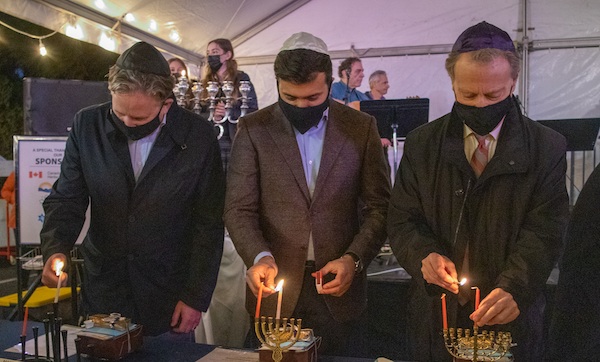
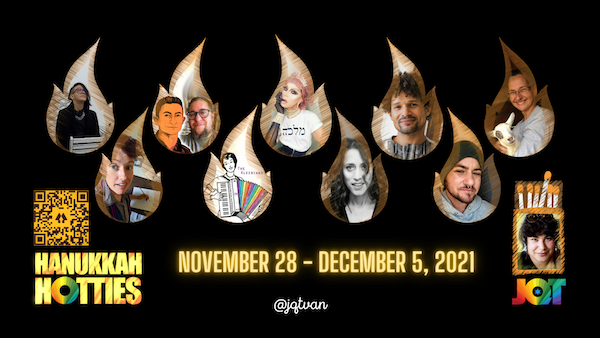
(image from JQT)

JQT Vancouver has a sizzling lineup of Hanukkah Hotties this year. Tune in to daily livestreams on Facebook with each Hanukkah Hottie, as they light their chanukiyah or share another tradition, and chitchat with JQT about their life, craft, activism and intersecting Jewish queer trans identities for the duration of the candles’ burning.

Hosted by Carmel Tanaka, founder and executive director of JQT Vancouver, who identifies as a queer, neurodivergent, Jewpanese woman of colour, the scheduled guests are:

Candle 1 (Nov. 28, 7 p.m.): Karen Newmoon, an Indigenous Jew-ish land dyke and subsistence farmer in Johnsons Landing, B.C.

Candle 2 (Nov. 29, 7 p.m.): Jersey Noah, a Jewish (Sephardi/Ashkenazi) transgender, autistic stoner in Oakland, Calif.

Candle 3 (Nov. 30, 7 p.m.): Adam W. McKinney / LaShawnah Tovah, a gay, Black, Native Jewish artist, and co-director of DNAWORKS in Fort Worth, Tex.

Candle 4 (Dec. 1, 1 p.m.****): Aviva Chernick, a queer, Jewish artist, and voice and meditation teacher in Toronto, Ont.

Candle 5 (Dec. 2, 7 p.m.): The Empress Mizrahi, a nonbinary/queer Persian Jewish Instagram content creator and activist in Los Angeles, Calif.

Candle 6 (Dec. 3, 7 p.m.): The Klezbians, a band of unruly, chutzpah-licious musicians from the Isle of Klezbos in Victoria.

Candle 7 (Dec. 4, 7 p.m.): Saul Freedman-Lawson and S. Bear Bergman. Freedman-Lawson is a student and illustrator in Toronto and Bergman is trans writer and educator from Toronto.

Shamash candle (Dec. 5, 9 a.m.): Tikva Wolf, a cartoonist in Asheville, N.C. (Cherokee territory).

Candle 8 (Dec. 5, 7 p.m.): Ari Fremder, a nonbinary, autistic, Latinx artist/animator and JQT Dream Team member in Vancouver.

During the livestream, closed captioning will be provided by Facebook’s AI bots, and JQT volunteers aim to post edited closed captioning videos on both Facebook and YouTube two to three days after each interview.

This series is supported by Creating Accessible Neighbourhoods (canbc.org), an organization that advocates for and educates about people with disabilities and/or chronic health conditions who have multiple intersecting identities.

For more on the participating artists and JQT, visit facebook.com/jqtvan.

**** NEW TIME!

– Courtesy  JQTVancouver

Savoury, sweet and simple

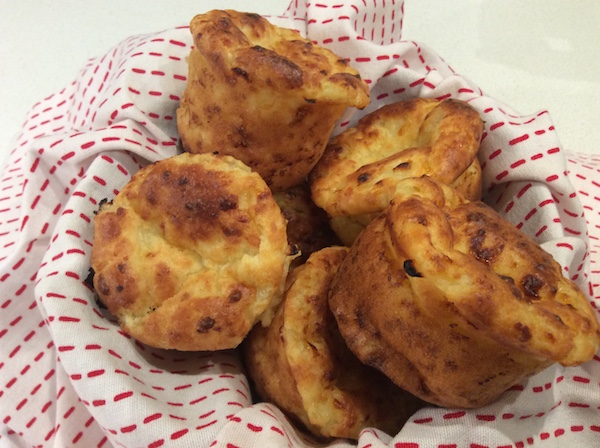
Cottage cheese muffins à la Accidental Balabusta, but double the size. (photo by Cynthia Ramsay)

Looking for a couple of easy recipes to add to your repertoire? But you’re not quite sure what to try? Because sometimes you want savoury. Sometimes you want sweet. But what if you want both? I’ve got just the answer – but it doesn’t come in the form of one recipe. It comes in two. One’s a side dish and one’s a snack or breakfast food. Both punch above their weight, that’s for sure.

With very few exceptions I have neither the focus nor the patience to embark on complicated recipes that call for exotic ingredients and specialty cookware. If I can’t pronounce it and it’s not available at my local Safeway or Superstore, it ain’t happening. (Except for those lamb shanks that I made for Rosh Hashanah, which did call for loads of ingredients and which were, to use my hubby’s words: “The best lamb I’ve ever eaten!” Sorry … I just had a modesty bypass.)

Maybe I’m not the most adventurous eater/cook in the world but I never go hungry. My father, alav hashalom, used to say that I’d eat out of a puddle if push came to shove. I prefer to describe it as having simple tastes.

Good thing my husband didn’t marry me for my cooking. Although it has improved significantly since we got married 12 years ago. When we first met, my idea of dinner was a California roll and Agedashi tofu takeout. We used to eat out at restaurants maybe three or four times a week during the honeymoon phase, i.e. the first four years of our marriage. I kept telling him I knew how to cook; I just chose not to activate that skill. And what do you know. He believed me.

But I digress. Back to the savoury recipe I was going to tell you about. It’s an eggplant side dish or chunky dip and is a perfect accompaniment to just about any meal, be it meat, chicken, vegetarian or fish. It’s a bit time-consuming, but what eggplant recipe isn’t, with all that peeling, slicing and dicing? I’m not a big fan of spicy food so you can up the garlic content as you see fit. I find it’s got just that right combination of salty, spicy, sweet and tart, without being heavy or overpowering. I call it Merle’s Eggplant, after my sister’s friend who gave us the recipe decades ago. Thank you, Merle.

MERLE’S EGGPLANT

1 diced onion
1 large or 2 medium-size eggplants, peeled and cubed
2-3 cloves garlic, minced
14 oz (398 ml) can tomato sauce
a squeeze or two of lemon juice
1-2 tbsp brown sugar

  1. Peel and cube eggplant and set aside.
  2. Fry diced onion in olive oil until lightly browned.
  3. Add eggplant to onions and fry, alternating covered and uncovered, until eggplant is opaque.
  4. Add minced garlic, tomato sauce, lemon juice and brown sugar. Cook on low heat for about one hour, covered.
  5. Refrigerate then serve. Some people like to serve it hot, but I prefer it cold, because I find that the flavours meld even more when it’s been refrigerated. But that’s your call. Try it both ways.

* * *

As for the sweet recipe – cottage cheese muffins – well, it’s a favourite in our home. It’s one of those comfort foods that soothe just about any ailment, from fatigue to sore feet. Aside from being healthy (think protein), they’re filling and super-fast to make, plus it’s one of those recipes that you can make blindfolded with both hands tied behind your back. Eat them hot, eat them cold, eat them with jam, eat them plain.

The only people that won’t like these muffins are the lactose-intolerant. And that can be remedied. I recently found lactose-free cottage cheese at the local supermarket. It’s slightly more expensive, but worth it if you like dairy but not the side effects that can go with it. Knock yourself out with these fluffy, light, healthy muffins. I’ve seen all sorts of variations on this recipe, using cheddar cheese, whole wheat flour, sour cream, etc., but none of them quite matches the simplicity and yumminess of this one.

I would strongly suggest doubling the recipe, since this recipe only makes 12 small muffins. Or just eat several at one go, and explain to shocked onlookers that they’re mini-muffins. Which they’re not, but, never mind. Just look at it as muffin-envy.

COTTAGE CHEESE MUFFINS

1 1/2 cups cottage cheese
2 tbsp sugar
1/2 cup melted butter or margarine
2 tsp baking powder
2 eggs
a pinch of salt
1 cup flour

  1. Preheat oven to 400°F.
  2. Mix all ingredients by hand. Don’t be surprised if the batter is quite thick.
  3. Grease muffin tins or use paper muffin liners. Distribute batter evenly between the 12 muffin cups.
  4. Bake for about 20 minutes or until golden brown on top. They’re ready when a toothpick inserted in the centre comes out clean.
  5. Eat plain or topped with yogurt, sour cream, berries, jam or whatever. They reheat well in the microwave. But, if there are more than two people living in your home, the muffins probably won’t make it till the next day. They may sound too good and too easy to be true, but I’m here to tell you, they’re the real deal. Sometimes, the most basic recipes are the star of the show. Or at least the crowd-pleasers.

* * *

It’s not the number of ingredients or the sophistication of technique that make a recipe sing. It’s the flavour, plain and simple. So, do yourself a favour and try out these two recipes. Tell them the Accidental Balabusta sent you.

Shelley Civkin aka the Accidental Balabusta is a happily retired librarian and communications officer. For 17 years, she wrote a weekly book review column for the Richmond Review. She’s currently a freelance writer and volunteer.

Brisket – a Jewish  tradition!

Brisket is the boneless meat on the lower chest of beef or veal. In traditional Jewish cooking, it is most often braised as a pot roast, especially as a holiday main course. For reasons of economics and kashrut, it was historically one of the more popular cuts of beef among Ashkenazi Jews.

Brisket is also the most popular cut for corned beef, which can be further spiced and smoked to make pastrami. In the 1900s, it appeared on Jewish deli menus, particularly in Texas, where the butchers, who emigrated from Germany and Czechoslovakia, had trouble selling the slow-cooking cut and created a way to dry smoke it and preserve it.

Brisket is one of the primal cuts of beef, though the precise definition of the cut differs internationally. The brisket muscles include the superficial and deep pectorals. As cattle do not have collarbones, these muscles support about 60% of the body weight of standing or moving cattle. This requires a significant amount of connective tissue, so the resulting meat must be cooked correctly to tenderize it.

The term brisket is derived from the Middle English brusket, which comes from the earlier Old Norse brjósk, meaning cartilage. The cut overlies the sternum, ribs and connecting cartilages.

Author and food writer Stephanie Pierson wrote an homage to this cut of beef: The Brisket Book:  Love Story with Recipes was published in 2011.

CRANBERRY-ONION CHANUKAH BRISKET
(This is Justin Chapple’s recipe from Food & Wine. It makes 8-10 servings.)

photo - Justin Chapple’s Cranberry-Onion Chanukah Brisket
Justin Chapple’s Cranberry-Onion Chanukah Brisket. (photo by Justin Walker)

8 cups fresh or thawed frozen cranberries
1 1/2 cups sugar
1 1/2-inch lemon peel strip
3 tbsp fresh lemon juice
salt and pepper to taste
2 1-ounce envelopes kosher pareve onion soup mix
1 7-pound trimmed beef brisket

The day before serving:

  1. Preheat oven to 325°F. Layer two sheets foil in a large roasting pan, letting foil hang over eight inches past each end. Repeat with two additional sheets of foil to form an X. Top with a sheet of parchment paper.
  2. In a saucepan, combine cranberries, sugar, lemon peel strip and lemon juice. Cook, crushing cranberries with a wooden spoon until mixture thickens, 10-14 minutes.
  3. Remove from heat and stir in onion soup mix. Let cool for 15 minutes.
  4. Spread a quarter of cranberry sauce on parchment. Place brisket fat side up. Spread remaining cranberry sauce over it, top with parchment and wrap foil around brisket. Place in oven for three to three-and-a-half hours. Uncover. Let cool one-and-a-half hours, then cover and refrigerate for at least eight hours.

The day of serving:

  1. Preheat oven to 325°F. Uncover brisket. Discard any fat. Scrape off cranberry sauce and place in a bowl.
  2. Slice brisket on carving board. Arrange in ovenproof dish. Spoon cranberry sauce over top, cover and bake 45 minutes to one hour.

BEER-BRAISED BRISKET WITH ROOT VEGETABLES
(This recipe comes from Ian Knauer, former Gourmet Magazine editor, chef, food writer and owner of the Farm Cooking School. It makes 4-6 servings.)

photo - Ian Knauer’s Beer-Braised Brisket with Root Vegetables
Ian Knauer’s Beer-Braised Brisket with Root Vegetables. (photo by Ian Knauer)

1 2.5-to-3-pound brisket
2 tbsp olive oil
1 chopped medium onion
5 ounces sliced shiitake mushroom tops
3 finely chopped garlic cloves
3 large sliced carrots
3 sliced parsnips
1 rutabaga, peeled and cut into wedges
12 ounces beer of your choice
2 tbsp Worcestershire sauce
2 cups chicken stock
2 tbsp flour
1 tbsp dill

  1. Heat oil in a pot. Sear the brisket three to four minutes, turn, and continue searing another three to four minutes. Transfer to a plate.
  2. Stir onion, mushrooms and garlic into pot. Cook, stirring occasionally, for six minutes. Place brisket and juices back in pot.
  3. Stir in carrots, parsnips, rutabaga, beer, Worcestershire sauce and stock. Cover and simmer six hours, until meat is tender.
  4. In the meantime, stir flour and two tablespoons cold water in a bowl then whisk into the pot. Simmer until sauce thickens, about 10 minutes. Place on plate, sprinkle with dill and slice.

Sybil Kaplan is a journalist, editor of nine kosher cookbooks (working on a 10th) and a food writer living in Jerusalem. She leads English-language Shuk Walks in Machane Yehuda.

Minestrone warms the soul

(photo from flickr.com/photos/veganfeast)

Minestrone came about as early as the second century BCE, when Rome conquered Italy and new vegetables flooded the market. It was known as an Italian peasant’s dish or poor man’s soup. Originally, it contained onion, garlic, celery, tomatoes and carrots – pasta seems to have been a later addition.

MY MINESTRONE
(6-8 servings)

2 tbsp margarine
3/4 cup chopped onions
2 minced garlic cloves
1 chopped leek
1/4 cup chopped celery
1/2 cup chopped carrots
2 chopped turnips
1 1/2 cups chopped zucchini
1 1/2 cups chopped cabbage
1 cup chopped potatoes
2 tbsp beef soup bouillon
1 cup chickpeas
1 cup chopped tomatoes
8 cups water
2 tbsp tomato paste
salt and pepper to taste
2 tbsp chopped parsley
1/2 tsp basil
1/2 tsp oregano
1 chopped bay leaf
1/4 tsp marjoram
1/2 cup small pasta
Parmesan cheese (optional)

  1. In a large soup pot, heat margarine. Sauté onions, garlic and leek.
  2. Add vegetables, water and spices but not pasta. Bring to a boil, reduce heat and simmer one hour.
  3. Add pasta and cook 15 minutes. Ladle into soup bowls and add the cheese.

ROOT VEGETABLE MINESTRONE
(Adapted from a Food & Wine recipe, it makes 6 servings.)

1/4 cup olive oil
1 finely chopped onion
1 minced garlic clove
1 sprig rosemary
2 sliced carrots
2 sliced parsnips
3 broccoli stems or chopped kohlrabi
3 cups cubed peeled, cut butternut squash
6 cups pareve chicken bouillon
salt and pepper to taste
1/2 cup angel hair pasta broken into 1-inch pieces
1/2 cup grated cheese

  1. In a soup pot, heat two tablespoons olive oil. Add onion, garlic and rosemary and cook until onion is soft.
  2. Add carrots, parsnips, broccoli or kohlrabi and squash and cook for one minute. Add bouillon, salt and pepper and cook about 15 minutes.
  3. In a frying pan, heat the remaining two tablespoons olive oil. Add pasta and cook, stirring frequently, about four minutes.
  4. Add pasta to soup. Cook until tender, five to six minutes. Discard rosemary. Stir cheese into soup and serve.

Sybil Kaplan is a journalist, editor of nine kosher cookbooks (working on a 10th) and a food writer living in Jerusalem. She leads English-language Shuk Walks in Machane Yehuda.

Pumpkin, but not pies

Pumpkin spice snickerdoodles (photo by Greg Dupree, food styling Torie Cox, prop styling Christine Keel / Food & Wine)

November arrives and I think pumpkin. Here in Israel, the d’la’at is amazing. Whole, they are huge in size and weight, cream in colour, with stripes all around.

Pumpkins are a variety of winter squash that belongs to the Cucurbitaceae (or cucurbits) family. Melon, watermelon and cucumber also fall into this category. Technically, pumpkins are fruit but, since they are often eaten in savoury dishes, many people refer to them as vegetables. Just about every part of the pumpkin is edible, including the seeds, their shell, leaves and flowers. Pumpkins are a superfood and are high in iron, packed with vitamins and minerals, and considered natural antioxidants.

But, enough about that and on to some recipes. Forget pie, though, and try these treats for your holiday guests.

The first dessert is pumpkin spice snickerdoodles. I was unfamiliar with snickerdoodles until coming across this recipe by Kelly Fields. Probably German in origin, the name of these sugar cookies could be a corruption of the German word schneckennudel, but notice the word schnecken, popular in Jewish cooking. American cookbook author Joan Nathan tells us: “Schnecken – the word means snail in German – are made of a rich and sweet yeast dough enriched with egg, sour cream and butter. The dough is pressed out in a large rectangle shape, sprinkled with sugar, cinnamon, raisins and ground nuts, and rolled up like a jelly roll. Cut on the cross section, the roll is sliced, baked and served open-side up in small coiled rounds.” Here is my version made pareve with slight changes.

PUMPKIN SPICE SNICKERDOODLES
(Adapted from Food & Wine. Makes 20 cookies.)

1 3/4 cups sugar
2 tbsp cinnamon
1 1/2 tsp cardamom
1/2 tsp nutmeg
1/2 tsp cloves
2 3/4 cups flour
2 tsp cream of tartar
1 tsp baking soda
1 cup unsalted butter or pareve margarine
2 large eggs
1 1/2 tsp orange blossom water or 3/4 tsp orange extract
1 tsp vanilla

  1. Preheat oven to 350°F and line three baking sheets with parchment paper.
  2. In a bowl, stir together 1/4 cup sugar, cinnamon, cardamom, nutmeg and cloves.
  3. In another bowl, stir together flour, cream of tartar and baking soda.
  4. Beat margarine and 1 1/2 cups sugar until light and fluffy (four minutes). Add eggs one at a time, then orange extract and vanilla. Add flour in two additions.
  5. Shape dough into 20 balls. Roll balls in spice mixture until coated. Arrange on baking sheets. Bake for six to seven minutes, then switch pans onto different racks, and continue baking 10 minutes. Let cool.

BAKED PUMPKIN WEDGES

image - Pumpkin Happy book cover
Published in 1976, Pumpkin Happy recipes are still happy-making.

(While I found this recipe in a newspaper some 40 years ago, it comes from the 1976 cookbook Pumpkin Happy, written by Erik Knud-Hansen and illustrated by Andrea Grumbine. It makes 6 servings.)

1 4-pound pumpkin, cut into wedges, strings and seeds scraped out
1/2 to 3/4 cup pareve margarine
1/4 cup brown sugar or honey
1 tsp cinnamon

  1. Preheat oven to 350°F. Oil a glass baking dish.
  2. Make shallow cuts in each wedge.
  3. Melt margarine in a saucepan. Add sugar and cinnamon. Brush over wedges.
  4. Bake for 35 to 45 minutes, until tender.

PUMPKIN BUTTER

(This butter is great on toast with cream cheese, according to Kelsey Youngman, writing on Food & Wine’s website. This recipe makes 2 1/2 cups.)

1 3-pound pumpkin, stemmed, halved lengthwise and seeded
1 tbsp vegetable oil
1/4 cup apple cider
1/2 cup brown sugar
3 tbsp honey
1 tsp apple cider vinegar
3/4 tsp cinnamon
1/2 tsp ginger
1/4 tsp nutmeg
a pinch of cloves

  1. Preheat oven to 350°F and line a baking sheet with parchment paper.
  2. Brush cut sides of pumpkin halves with oil. Arrange cut side down and bake 50 minutes, or until tender.
  3. Scoop flesh into food processor. Discard shell. Add apple cider, process one minute. Add brown sugar, honey, apple cider vinegar, cinnamon, ginger, nutmeg and cloves. Process 20 seconds. Transfer to a saucepan.
  4. Bring to a simmer, stirring occasionally. Reduce heat and cook until mixture is reduced by one-third and turns slightly darker in colour, about 25 minutes.
  5. Remove from heat, cool and spoon into jars with lids. Store in refrigerator.

Sybil Kaplan is a journalist, editor of nine kosher cookbooks (working on a 10th) and a food writer living in Jerusalem. She leads English-language Shuk Walks in Machane Yehuda.

Making holiday doughnuts

Syrian doughnuts can be made with a hole, or not. And they are topped with lemon or another type of glaze or syrup, rather than having a jelly filling. (photo from vegankinda.wordpress.com)

One of the things I have enjoyed the most as a food writer is learning the different customs of Jews from around the world. When it comes to doughnuts, all the communities make a dough dessert fried in oil, but there are differences.

Dov Noy, who was an Israeli folklorist and ethnologist, related a Bukhharian fable, which says that the first sufganiya was a sweet given to Adam and Eve as compensation after their expulsion from the Garden of Eden. He says the word sufganiya comes from the Hebrew word sof (meaning end), gan (meaning garden) and Ya (meaning G-d). Thus, the word means, the end of G-d’s garden. According to Noy, this fable was created at the beginning of the 20th century, since sufganiya was a new Hebrew word coined by pioneers.

Some consider sufganiyot, which means sponge-like, to be reminiscent of the sweet, spongy cookies that have been popular along the Mediterranean since the time of the Maccabees. Hebrew dictionaries say the word actually comes from the Greek word sufgan, meaning puffed and fried.

A few months ago, I happened to stop at a vendor in Machane Yehuda, the Jewish market where I shop and lead weekly walks, to ask about a pastry he was selling. He told me it was shvinze. Many years ago, a neighbour had given me her mother’s receipt for shvinze and I share it with you here.

I’ve also included a recipe from another neighbour, who made a similar type of dessert that she learned from her mother, who came from Syria. And the third recipe is for traditional Israeli doughnuts that can be filled or left plain. Talia was 5-and-a-half years old when she gave me this recipe – today, she is the mother of four, a tour guide married to a photographer, and living in the scene of the Chanukah story, Modi’in.

MOROCCAN SHVINZE

1 2/3 tbsp yeast
1/4 cup lukewarm water
a pinch salt
4 cups flour
oil
honey or confectioners’ sugar

  1. Place yeast in a small bowl with water. Place flour in another bowl. After the yeast swells, add to the flour. Add salt, then knead into an elastic dough.
  2. Place oil in a deep pot. Wet hands, take a piece of dough and shape it into a circle. Punch a hole in the centre, then drop the dough into oil. Brown it on both sides. Drain on paper towels.
  3. Serve with honey or confectioners’ sugar.

SYRIAN ZINGOLE

 2 tsp yeast
a few spoons warm water
2 cups flour
1 1/2 cups water
oil

icing:
1 cup sugar
1 cup water
1 1/2 tbsp lemon juice

  1. Place yeast in a small bowl. Add a few spoons of warm water to dissolve.
  2. Place flour in another bowl. Add yeast and then more water to make a liquidy batter.
  3. Heat oil in a deep pot. Spoon batter into pan like pancakes. Fry until brown on both sides. Drain on paper towels.
  4. Combine sugar, water and lemon juice in a saucepan. Cook until sugar dissolves.
  5. Dip each pancake in sauce, then place on a serving platter.

TALIA’S SUFGANIYOT FOR JUNIOR COOKS

3 1/2 cups flour
1 1/2 cups plain yogurt
2 eggs
2 tbsp sugar
a pinch salt
1/2 tsp vanilla
oil

  1. In a mixing bowl, supervised by an adult, combine flour, yogurt, sugar and salt. Add eggs and vanilla and blend.
  2. Heat oil in a deep pot (with an adult’s help). Drop dough by tablespoon into oil. Fry until brown on both sides. Drain on paper towels.
  3. When cool to the touch, fill, using a tube or a large syringe, with your favourite jelly. Roll in confectioners’ sugar.

Sybil Kaplan is a journalist, editor of nine kosher cookbooks (working on a 10th) and a food writer living in Jerusalem. She leads English-language Shuk Walks in Machane Yehuda.

The lights of allyship

This Chanukah, kindle the light of liberation, not just for you and your loved ones, but for all people whose freedom of expression is threatened. (photo by Robert Couse-Baker / flickr.com)

In a time of identity searching, introspection and anticipation, Chanukah can be an inviting space to reflect and refract the light before us. From the Chanukah that was to the Chanukah we arrive at, the world has shifted and we are not the same. This holiday of chocolate, oil and games of dreidel beckons us into a moment of contemplation.

Chanukah expresses a language of novelty, innovation and a miraculous expansion from what we thought was possible. The ease and accessibility, the simplicity of candles, the sense that Chanukah is predictable and performative belies the very creative, radical nature of the Festival of Lights.

The annual Chanukah experience, at its core, is an opportunity to receive new insight, empowerment and opportunity to overcome the forces that oppress, debase and deny our most essential identities. Had the few Maccabees not searched to provide that light for the many, none of us would have a miracle to celebrate today. Even though we are privileged to be able to publicly observe our traditions, Chanukah reminds us that our work is not complete until everyone can safely and freely express their identities.

Visibility and proximity

One of the unique aspects of Chanukah is that it is the only festival that occurs in two different months. It is literally positioned between Kislev and Tevet to help us be aware and adapt to changing times. In the light of the candles, it is possible to see our roles anew, clarifying our commitment to ensuring that the privilege and expression of being is available to everyone.

When the Talmud explores modalities of the mitzvah of lighting the chanukiyah, it says that each and every person should have a candle. It continues to explain that an even greater beautification of the mitzvah is when everyone is able to increase the light with each additional day. When everyone has their own chanukiyah, when everyone is able to light all the candles on each night, then everyone is bringing the fullest light possible. This is the hope: with so much light, the world is relieved of darkness.

Our rabbis teach that this attribute of adding is connected to Joseph, whose story we read on Shabbat Chanukah. Joseph’s name means to increase, and his story reveals the relationship between proximity and visibility. The Talmud, Shabbat 22a, juxtaposes the narrative of Joseph being thrown into a pit with the laws detailing the proper placement of the menorah and the limits on how far off the ground it can be.

In Genesis 37:18, Joseph’s brothers “saw [Joseph] from afar … and they conspired against him.” They throw him into a pit, which Genesis 37:24 says “was empty and didn’t have water.” But the rabbis disagree, arguing that, while “empty” implies that the pit didn’t have water in it, it was not without venomous pit-dwellers. There were snakes and scorpions that the brothers didn’t know about, because they were not close enough to the pit to see.

Moreover, the distance at which the brothers first saw Joseph approaching made it easy for them to plot against him. In not one, but two cases, the brothers’ lack of proximity leads to actions that degrade and humiliate. If only they waited to see their little brother up close before acting, they might have changed their plan. If only they approached the pit to look inside, they might have seen the snakes and scorpions. The Torah is clear: proximity and visibility lead to responsibility.

It is for that reason the Talmud instructs us that we cannot place a menorah too far off of the ground – we must be close enough to see and be affected by the candles. If the menorah can’t be seen, we miss the message of the miracle, and the opportunity to take responsibility is lost.

The Hasmoneans were descendants of Aaron, who, the Mishnah tells us, was a lover of peace, pursuer of peace and lover of peoples.

Judaism is a religion of action, and we must be practitioners of our tradition’s wisdom by taking responsibility.

Today, even with technologies that keep us connected across oceans and continents, we understand the challenge and, more so, the threat of being too distant. Jews have a response to prevent the dehumanization that often comes when we are distanced from the lived experience of others – draw in close.

A great miracle happens with allyship

The Hebrew words behind the story of Chanukah and Joseph also reaffirm the holiday’s charge to increase visibility, to be an ally. The rabbis saw our world as created through speech and language and, thus, all Hebrew letters represent hidden truths. Just like the story of Joseph in the pit, the closer you look, the more that is revealed.

The mystics teach that the Hebrew letters for Greece (Yavan is spelled yud, vav, nun) are three lines that descend as the word progresses. The great and mighty culture that claimed elite thought and refinement was in fact a culture that debased and denigrated. Greek leadership prioritized the body over the spirit; what was seen on the outside was of greater value than that which was within. Thus, it could be said that Greece, by elevating the external, actually debases it, a message hidden within the descending letters: yud, vav, nun.

The Hebrew word for Joseph, Yosef, begins with the same first two letters. But the third letter is where the comparison is stark. Instead of a nun sofit (a nun at the end of a word), which is a straight line going down, we have the round letter samech, a symbol for equality. Unlike the hierarchy of the nun, the circle of the samech allows every point on its circumference to be equidistant to the centre. Joseph chooses to chaver (friend) up and stops the descent by treating others as equals.

The nun and samech form the word miracle, nes. The first letter, nun, is the only letter in Hebrew that doesn’t appear in the alphabetical acrostic of the prayer Ashrei. Our rabbis explain that this letter stands for nefela, falling, and, therefore, is omitted. The next letter in the alphabet is the samech and it starts the Ashrei verse, “samech l’chol hanoflim,” “supporting all those who have fallen.” Jews in those days, as in ours, had a choice between the “nun” and the “samech” – to align with the oppressors and feel secure or to ally with those who needed support. In choosing the latter, a great miracle (nes) happened there.

Kindling the light

As the story and words of Chanukah convey, the Jewish response to oppression is not just to be free but to dismantle the system of oppression and provide equality for others. Today, we place a menorah in the window in order to publicize our engagement in the ancient and ongoing story of this struggle. We stand up in broken places of despair and hopelessness to rededicate ourselves and our institutions to this cause. Now, when we see an injustice, when we are proximate to the dehumanization of a child of G-d, we not only see the unholy act itself but also we recognize the imperative to respond.

This Chanukah, kindle the light of liberation, not just for you and your loved ones, but for all people whose freedom of expression is threatened. Kindle a light to banish the darkness of hatred, racism, transphobia and misogyny. Kindle a light that signals to outsiders that you are a home (or an organization) committed to rededication and the recreation of holy space, particularly in the most broken of places.

Chanukah was not immediately established as a holiday. The Talmud teaches that the rabbis waited until the following year to institute a permanent commemoration. When they realized that the miracle could be replicated – that, in every generation, Jews could learn to take the little they had and turn it into something miraculous – they created the holiday. That is the holy ask of Chanukah: to be the light that can extend and expand, to be the miracle that someone else needs.

Michael Walzer writes that “wherever we go, it is eternally Egypt,” but that there is a Promised Land, and the only way to make it across the wilderness is by “joining hands, marching together.” The story of oppression and liberation is also a story of allyship. We will not survive without hands to support and guide us, to hold and elevate us. This year, on Chanukah, be the light and bring the light out of the closet and into the world.

Rabbi Mike Moskowitz is scholar-in-residence of trans and queer Jewish studies at Congregation Beit Simchat Torah in New York and Rabbi Dara Frimmer is senior rabbi at Temple Isaiah in Los Angeles. This article was originally published in the Jewish Journal and articles by other Shalom Hartman Institute scholars can be found at shalomhartman.org.

Heroes throughout the ages

Judah Maccabee purifies the Temple, etching by Julius von Carolsfeld, 1860.

Every year, we look forward to Chanukah, even though it is not even mentioned in the Torah. Its name means “Dedication” and it starts on erev the 25th of Kislev, which, this year, falls on the night of Nov. 28.

The festival celebrates the triumph of the Maccabees, led by Mattityahu and, later, by his son Judah, over the Greek Syrians, led by Antiochus. As a result, Jewish sovereignty was reestablished in Judea for a time.

But we should not forget that this ancient conflict was also a civil war between the Jewish people themselves. The Hellenists admired Greek culture, which they began to emulate; whereas the Maccabees remained steadfast in their adherence to Judaism’s ideals and beliefs. The factions disagreed on various issues, including the rite of circumcision, a fundamental and crucial Jewish ritual that the Hellenists claimed violated the perfection of the body.

In 175 BCE, Antiochus tried to wipe out the Jewish religion entirely by substituting the Greek language, gods and customs. The final blow came when the Temple was defiled and a giant statue of the Greek god Zeus was erected there, with the Jews ordered to worship it.

Some, like Hannah and her seven sons, resisted passively, choosing death rather than idol worship. Hundreds hid in caves and some suffocated to death. But there was no active resistance until the Hasmonean family of Mattityahu and his sons at Modi’in raised a banner: “Whoever is for the Lord, follow me!”

A small army was formed, with Judah Maccabee as its leader. Antiochus sent three armies to suppress the revolt, but the Maccabees triumphed. Their first priority after victory was to purify the Temple.

As the story goes, all the cruses of oil had been defiled except one. Instead of burning for just one day, it miraculously lasted for eight days, until more holy oil could be acquired. Hence, the celebration of Chanukah for eight nights and days.

Today, Chanukah still has relevance. We remember not only the heroism of the Maccabeans, but other heroic acts. Many times in Israel we have seen the victory of a tiny nation against a larger and stronger one, the few against the many.

In 1948, the young Israel Defence Forces defeated much larger Arab armies to usher in the independent state of Israel. Earlier, in the Second World War, there was widespread Jewish resistance to Hitler’s brutal policies and Jews fought in the ghettos and joined partisan units in forests outside Polish and Russian cities conquered by the Nazis.

Israel’s operation into Entebbe to rescue hostages in Uganda is another instance of modern heroism and our history abounds with examples. The revolt of the Hasmoneans is the symbol of the spirit of Zionism. Today, in Western society, no tyrant is forcing us to abandon our faith, but many Jews are in great danger of losing their Jewish identity nonetheless. Hellenism, in a different form, is alive and well.

Chanukah has broad human significance as a festival of liberty and religious freedom, not just for us, but for all people. It is a humanistic festival. The symbol of Chanukah is light and the real miracle is that, despite millennia of persecution and dispersion, the light of our people has never been extinguished.

Dvora Waysman has written 14 books, and the film The Golden Pomegranate was based on her book The Pomegranate Pendant. Her latest novel is Searching for Sarah. She can be contacted at dwaysman@gmail.com.

Dream warms frozen flames

It was just before sunset on the last night of Chanukah, the coldest it had ever been in Chelm. (photo from pxhere.com)

It was a cold day in the village. It was so cold that when Reb Cantor, the merchant, sneezed without covering his mouth, his mucus solidified and blew a hole through the window of his shop, which his wife fixed by throwing a cup of tea at his head. He ducked, and the tea hit the windowpane and froze into place. It was that cold.

It was so cold that the flame of the eternal light in the synagogue froze solid. Instead of flickering brightly, it stood still, like red and yellow glass.

The villagers were frightened. It was just before sunset on the last night of Chanukah. Soup froze on its way from the pot to the table. Vodka oozed as it was poured into a glass. Chanukah candles snapped at the slightest touch. Reb Cantor’s matches broke into splinters. Stoves were almost useless. Warm challahs froze into rocks in seconds. Axes had to be warmed or else, when they struck the firewood, the blades shattered as if they were made of crystal. The Uherka River had frozen solid, trapping in its icy clutches a flock of geese late to leave the area.

It seemed as if the end was near. Everyone was hungry. They were afraid to go outside because the wind sucked the heat from their skin. The air itself left their lips numb. Kissing could be dangerous.

The day had been dark and cold, and the night would be darker and colder. Meals were uncooked and uneaten. Chanukah candles, set in their menorahs, were unblessed and unlit. Families stayed in their homes, huddled together in bed.

Even in the house of the wisest man in the village of fools, the menorah was dark.

Rabbi Kibbitz shivered in his bed with his wife, Channah Chaipul (she kept her maiden name, which, as you know, is another story). The two of them lay fully dressed beneath four sheets, three blankets, two quilts and seven coats – everything warm that they owned. Still, his teeth were chattering. For the first time in his life, he regretted not owning a dog or a cat.

“Channah,” the rabbi said. “We have to light the candles.”

“You do it,” she said. “I’ll watch from here.”

“My hand is too unsteady. The shammos will blow out. You are better at that sort of thing.”

“I’m almost warm,” she said. “You do it.”

“I’m nearly frozen,” he answered.

“So? You want me to get out of bed, light the candles, and come back in with icy cold feet?”

He shuddered. The last time she had put a cold foot on his ankle, his heart nearly stopped.

He sighed and closed his eyes. Maybe in a few minutes he would….

“Are you awake?” she said, elbowing him in the ribs.

“Channah!” he said, suddenly sitting up. “I had a dream!”

“Are you crazy? Lie down, you’re letting in a draft.”

“No, Channah, I’ve had a dream. Quickly! Get up! We need to gather everyone together in the synagogue.”

Mrs. Chaipul squinted at her husband. She hadn’t seen him this excited since he’d beaten Rabbi Abrahms, the schoolteacher, at canasta. “What did you dream?”

“I can’t tell you,” he answered. He slid out of bed and gasped as the frigid air slapped his neck like an icy wet towel. “Tell everyone to bring their menorahs and come to the synagogue. Quickly!”

Grumbling and shivering, Mrs. Chaipul stood, and nearly stopped right there. She wondered if it was possible for blood to freeze. Then, the rabbi went one way and his wife went the other, banging on doors and windows. They ran as fast as they could (which was remarkably briskly, considering their ages), waking villagers and telling them to gather in the synagogue.

“What? Why? Are you crazy?”

“Yes, I am,” said Mrs. Chaipul. “But the rabbi has had a dream. So you can freeze in your house or freeze in the shul. It’s up to you.”

Parents groaned. Children were wrapped in blankets. Doors were pried open. Menorahs were carried carefully, lest they crack into pieces on the short trip to the synagogue.

The small shul filled quickly.

Rabbi Kibbitz stood at the front, on the bimah, with five tallisim wrapped around his shivering old shoulders. He stood beneath the eternal light, staring at the still-frozen flame.

“Is everyone here?” he asked. Everyone looked around and nodded. No one was missing. “Then, please, somebody shut the door!”

“It’s shut,” came a shout from the back.

“Oy,” muttered the chilled rabbi.

“So, Rabbi, what is it?” said Reb Cantor. “What is so important that you asked us to risk life and limb to come to the synagogue on a night so cold my eyeballs almost froze?”

“I had a dream,” the rabbi said.

“So, I heard,” answered Reb Cantor. “You maybe want to tell us what the dream was?”

“I dreamed,” Rabbi Kibbitz sighed, “that all the villagers of Chelm gathered together in the synagogue.”

“Yes? Yes?”

“Well, in my dream, it was a cold, cold night, and the Chanukah candles weren’t yet lit.”

“Yes? Yes?” the villagers repeated.

“And everyone, all of you, came here to the synagogue.”

“Yes? Yes?”

“That’s it.” The wise rabbi shrugged. “We were all here. Then Channah nudged me, and I woke up.”

“That’s not much of a dream,” muttered Mrs. Chaipul.

The citizens of Chelm stared in disbelief at their beloved rabbi.

“You’re crazy!” shouted Reb Cantor. “You yanked us out of our moderately warm beds and dragged us here to tell us that you had a dream that we were all here? That’s it? Rabbi Kibbitz has finally lost his mind! Rabbi Abrahms, it is time for you to become the chief rabbi of Chelm.”

The villagers began to grumble and argue and stamp their feet. A wave of exasperated hot air lifted to the ceiling as their voices rose into shouts.

“Wait, wait!” Rabbi Kibbitz said. “Please, listen.”

Just then a child’s voice shouted, “Look! Look!”

It was young Doodle, the orphan, and one of the most foolish boys in the village of Chelm.

Doodle was pointing up at the eternal lamp. The pale light was thawing – flickering faintly, but growing brighter as it filled the synagogue with its glow of red, orange, yellow and gold.

Reb Cantor himself lifted Doodle up. “Careful, careful now,” he whispered, as the young boy touched his shammos to the light of the eternal flame.

That candle was passed back and forth throughout the shul, as every family lit their own shammos. Everyone held their breath, wondering whether the wind and the cold would extinguish the thin flames.

Then, at long last, the villagers of Chelm said the blessings all together. The shammosim touched the other candlewicks. Soon, for each family, one flame became eight (plus the shammosim).

Now the synagogue was full of light, and the villagers began to sing.

Reb Cantor swept the old rabbi up in a bear hug. “That was some dream!”

Everyone laughed and danced.

They stayed there all night, and the candles burned so slowly that it was well past dawn before the last one burned out.

That morning, when the doors to the synagogue were opened at last, a warm breeze left the shul and spread out over the village.

The ice on the Uherka River cracked, and the flock of trapped geese took flight. All the villagers watched and cheered as the birds sped south.

And, from the east, the sun rose higher, and its rays felt warm with promise.

Izzy Abrahmson is a pen name for author and storyteller Mark Binder, who  lives in Providence, R.I., and tours the world – virtually and in-person. Abrahmson’s Winter Blessings: Warm Stories from the Village was a National Jewish Book Awards finalist.

A happy family holiday

Mini poems that rhyme and colourful  illustrations combine for a family-filled, fun-filled and food-filled holiday book for younger revelers. Hanukkah, Here I Come! (Grosset & Dunlap) by writer D.J. Steinberg and illustrator Sara Palacios is an energetic account that touches upon all the many things a kid might look forward to on Chanukah.

Starting with the setting up of the candles and the stacking of the presents, the meal prep also begins. The children help out their parents.

We briefly learn about the brave Judah Maccabee, “Macca-BAM! Macca-BOOM!” and how he and his brothers made history and the Jews took back their Temple. We light the candles, sharing in the joy with the neighbours across the street, who can be seen from their apartment windows. First gifts are unwrapped and selfies are taken – these illustrations are particularly delightful, as we see and read: “Click! That one cut off my sister.

“Click! Where’s my mother’s head?

“Click! That one’s dark and blurry.

“Click! That’s Mom’s finger instead.”

image - A page from Hanukkah, Here I Come! (Grosset & Dunlap) by writer D.J. Steinberg and illustrator Sara Palacios
A page from Hanukkah, Here I Come! (Grosset & Dunlap) by writer D.J. Steinberg and illustrator Sara Palacios.

There is chocolate gelt, a lesson on how to play dreidel and a visit to Bubbe and Grandpa’s (implying a mixed family perhaps, that the grandfather is not Zayde). Latkes and apple sauce – or are you on Team Sour Cream, instead? – follow. The happy noise of the family celebrating together mounts and dinner is served, with a warning that your jelly doughnut dessert might just explode all over your face.

The last night of Chanukah arrives all too soon.

Editor’s Note: Unfortunately, because of supply chain issues, the publication of Hanukkah, Here I Come! has been postponed to fall 2022.