Touring with Cirque’s ECHO

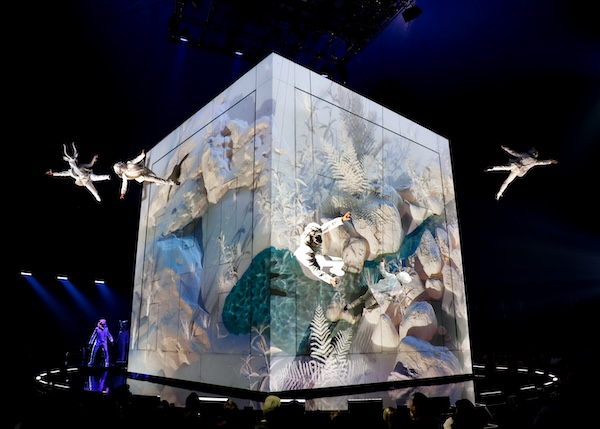
Cirque du Soleil’s ECHO, at Concord Pacific Place until  Jan. 5, is just beautiful. (photo by Jean-François Savaria)

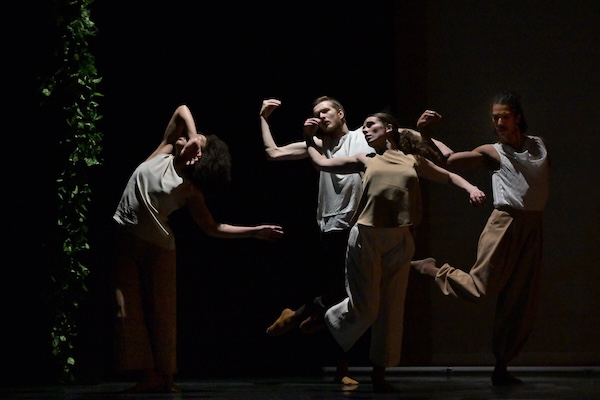
Beautiful. Cirque du Soleil’s ECHO, at Concord Pacific Place until Jan. 5, is just beautiful – the costumes, the movements, the music, the projected images. As with most Cirque productions, there is a minimal storyline. This one follows heroine Future and her dog Ewai as they try to restore balance to the world, between humans, animals and the environment. It is an optimistic, fantastical show, an uplifting break from a reality that sometimes seems hopeless.

photo - "Double Trouble," Cirque du Soleil's ECHO
“Double Trouble,” Cirque du Soleil’s ECHO. (photo by Jean-François Savaria)

The performance the audience sees under the Big Top is, of course, as much the result of many behind-the-scenes and front-of-house workers as it is the performers’ hours of practise and great skill. Every Cirque show is a highly orchestrated experience, international in scope. According to its website, since Cirque du Soleil’s creation in 1984, “more than 400 million people have been inspired on six continents and 86 countries. The Canadian company now employs more than 4,000 employees, including 1,200 artists from more than 80 different nationalities.”

One of those employees is Jewish community member Sarah Sananes, who was born in Florida but grew up in Montreal. She and her siblings attended Hebrew Foundation School for elementary.

“We learned to read, write and speak Hebrew, attended synagogue every Friday morning at Congregation Beth Tikvah, and learned both French and English at the same time,” Sananes told the Independent. “I was young, but I remember loving everything I did and learned during my time there, especially getting to eat TCBY [kosher yogurt]. 

“To this day, my father still uses the menorah I made, which consists of bolts to hold the Hanukkah candles. We celebrated Shabbat every Friday and attended synagogue for the High Holidays. It truly is a beautiful religion to celebrate. As I grew up, I still celebrate the High Holidays and attend Shabbat dinners whenever I can. I continue to educate myself on my religion even as I get older and don’t always have the chance to celebrate like I used to when we were younger.”

photo - Sarah Sananes is a guest experience supervisor with Cirque du Soleil’s ECHO, which is in Vancouver until Jan. 5
Sarah Sananes is a guest experience supervisor with Cirque du Soleil’s ECHO, which is in Vancouver until Jan. 5. (photo from Cirque du Soleil)

Sananes entered the workforce right out of high school.

“I was always more of an active kid than a quiet one who liked to sit in class. This led me straight into the hospitality industry, where I quickly fell in love with the fast pace,” she said. “I worked hard to climb the ladder into assistant manager roles, which led me to managerial positions. I take great pride in my work ethic and leadership skills, even to this day. This is one of the main things that led me to Cirque, and has kept me here. Whether you are presented with a happy guest or an angry guest, the outcome can always be positive, depending on the way you see and handle the situation. One of my favourite quotes is: ‘We can’t control the winds, but we can adjust the sails.’”

Sananes is now a guest experience supervisor with ECHO.

“I first began my journey with Cirque du Soleil in the summer of 2022. I was hired when I started working as the on-site manager on another show, named KOOZA, with the local staffing agency. Once the summer ended, I returned to my job as an entrepreneur,” said Sananes, who owns an employment agency.

“The following summer, I heard Cirque du Soleil was launching a brand new show and, sure enough, I returned once again to manage the local staff. As the Montreal run neared its end, the guest experience position on ECHO became available and, after my interview, I was asked to join the team!”

Sananes had so loved working on KOOZA that, she said, “When ECHO came out, I knew, if it was anything like KOOZA, I would love what I did, everywhere I did it.”

As to what her job entails, it’s a lot.

“The guest experience team is the team that manages everything that has to do with guests in the front of house. Our team is made up of nine supervisors across six departments, which are box office, concierge, merchandise, food and beverage, VIP, and usher,” she explained. “We also have an inventory supervisor and then myself. Each supervisor manages their respective department every day, whereas my role is more like the chameleon of supervisors. Each day, I morph into a different role. Within my time here, I have learned the ins and outs of every single department, being able to cover or assist any of my co-workers whenever and wherever needed. 

“Another part of my role is being the direct link between our partnerships and our visibility departments at Cirque du Soleil’s international headquarters located in Montreal and the tour,” said Sananes. “I make sure all our signage and branding are properly managed and set up. This includes physical signs and all digital assets. Lastly, due to my previous experience as an on-site manager, now being on the other side, I work closely with the local staffing agency and their on-site team to ensure they are able to deliver what we need to successfully operate our show call operations, day in and day out. Some markets are tougher than others when hiring and managing local staff, but it wouldn’t be fun and rewarding if it was always easy!”

Sananes has worked in many markets since ECHO launched in Montreal in April 2023. She has been with the show since the beginning, traveling with it from Montreal to Washington, DC, Atlanta, Ga., and Miami, Fla., before returning to Canada, with performances in Toronto and in Gatineau, Que., among other places.

photo - "Human Cradle," Cirque du Soleil's ECHO
“Human Cradle,” Cirque du Soleil’s ECHO. (photo by Jean-François Savaria)

“After five different cities, we landed here in beautiful British Columbia’s Vancouver,” said Sananes. “My plan is to remain on tour and continue to travel with the show for the foreseeable future. I’ve already got my cowboy boots ready for Houston, so I don’t plan to go anywhere just yet! One of the beautiful perks about being on tour is being able to travel to all these places I’ve never been before, some of which I probably wouldn’t have gotten to see at all.”

When asked if there was anything else she’d like to tell JI readers, Sananes expressed gratitude for her parents.

“My father was born in Jerusalem and my mother was born in Canada. They have both taught me very valuable lessons in life, from when I was little until this very day, and, I pray, for all the days to come,” she said. “Because of my mother, I am tough, courageous and kind. Because of my father, I am resilient, fearless and wise. To my mother and my father, thank you for teaching me the importance of being independent, while still being able to spread love to all those around me.”

For tickets to ECHO, visit cirquedusoleil.com. 

PuSh Festival turns 20

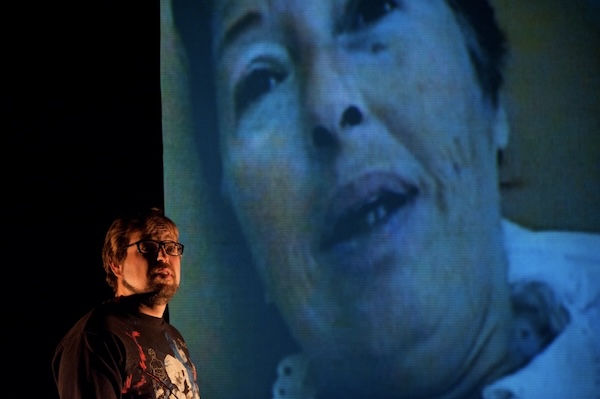
Clayton Lee explores his childhood obsession with Jewish professional wrestler Bill Goldberg in his The Goldberg Variations, which is at Waterfront Theatre Jan. 30 (photo by Kenneth Koo)

PuSh International Performing Arts Festival runs Jan. 23-Feb. 9. This year’s run marks the festival’s 20th year.

PuSh 2025 features more than 25 presentations, including 20 original performance-based productions; five animated parties and cabaret-style events; two film events; and two artist residencies, one of which will culminate in an open studio showing by international guest artists. In addition to a strong Canadian presence, with 13 presentations, the PuSh Festival includes works by artists of Belgium, South Korea, Brazil, United Kingdom, Uruguay, France, Denmark, Italy, Taiwan, the United States, Sweden and Democratic Republic of Congo. 

Among the many presentations this year are at least two with a Jewish angle.

On Jan. 30, 9 pm., at Waterfront Theatre, The Goldberg Variations by Clayton Lee (Canada/United Kingdom) will have its Western Canadian premiere, with a talkback following the show.

Through an unapologetic investigation of desire, power dynamics and identity, Lee explores his childhood obsession with Jewish professional wrestler Bill Goldberg and the impact it has had on his sexual and romantic history. The perplexing crossroads between dominance, submission, heartbreak and vulnerability are laid bare in this candid and unconventional performance where fantasies are both indulged and deconstructed.

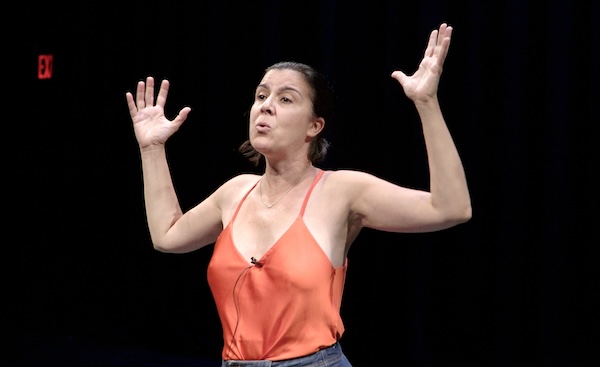
photo - Rebecca Margolick is part of Dances for a Small Stage, Feb. 4 and 5, which showcases 10 experimental, short dance pieces by femme and non-binary artists from different generations and dance practices
Rebecca Margolick is part of Dances for a Small Stage, Feb. 4 and 5, which showcases 10 experimental, short dance pieces by femme and non-binary artists from different generations and dance practices. (photo from PuSh)

On Feb. 4 and 5, 6:30 p.m., at Please Beverage Co., Jewish community member Rebecca Margolick is part of Dances for a Small Stage. Presented by PuSh Festival and Small Stage, the event showcases 10 experimental, short dance pieces by femme and non-binary artists from different generations and dance practices. The other artists participating are Claudia Moore, Cori Caulfield, Jessica Dawn Keeling, Nasiv Kaur Sall, AJ Simmons, Nicole Rose Bond, Burgundy, Ray Young, Adreane Leclerc and Bettina Szabo. There is a post-show talkback Feb. 5.

Other highlights for the 2025 PuSh include BOGOTÁ (Jan. 31 and Feb. 1) by Montreal’s Andrea Peña & Artists, which constructs a brutalist landscape from choreography inspired by Colombia’s political and spiritual heritage, and Dimanche (Feb. 6-8) by Belgium’s Focus and Chaliwaté companies, which paints a sharp yet tender portrait of humanity caught off guard by devastating natural disasters.

PuSh 2025’s animated parties and cabaret-style events include Van Vogue Jam’s Dune Wars Kiki Ball (Feb. 2), opening and closing parties with surprise performances, and the return of the frank theatre’s QT Cabaret at Club PuSh (Jan. 29).

Rounding out the lineup will be two film events: a free marathon screening featuring Brazilian actress Renata Carvalho, the artist behind PuSh’s Transpofagic Manifesto (Feb. 9), and a Born in Flames (Lizzie Borden) film screening (Feb. 6).

The festival’s Industry Series for arts leaders (producers, presenters, curators, directors, and more) returns for 2025, from Jan. 28 to Feb. 2. PuSh, in partnership with Playwrights Theatre Centre and Festival TransAmériques, will also offer free artistic consultations for local artists with invited national and international dramaturgs. 

Ticket prices for most PuSh shows range from $15 to $39. Visit pushfestival.ca or call the PuSh Festival info line at 604-449-6000. 

– Courtesy PuSh Festival

Join Pacific Theatre in Shire

Peter Carlone, left, and Tim Carlson in Pacific Theatre’s production of The Hobbit (photo by Chelsey Stuyt)

Need a break from reality? On now at Pacific Theatre is The Hobbit, based on JRR Tolkien’s book, with all its adventure, wizardry, fantastical creatures, and more. The tale is brought to life by two actors “and a dragon’s hoard of theatre magic.”

A world premiere, Pacific Theatre’s The Hobbit was adapted by Kim Selody, with additional dialogue by Tim Carlson and Peter Carlone, the two actors who play multiple characters in the production. The Jewish Independent spoke with stage manager Julia Lank before the show opened on Nov. 15.

“We’re less than a week into rehearsal and already our performers, Tim and Peter, have made me tear up laughing with their creative solutions,” said Lank when asked what her most fun problem-solving moment had been so far. “Telling a story designed for dozens of characters with just two actors poses obvious challenges, and the entire team – including our designers – have jumped in with both feet,” she said. “The room is incredibly playful (this morning we were testing out rolling beer can ‘barrels’ down the aisles of the theatre) and our director, Laura [McLean] is also keeping the magic and wonder of Middle Earth at the forefront. The show is going to be full of surprises, and it feels great to be a part of creating something new together.”

photo - Julia Lank, stage manager of The Hobbit
Julia Lank, stage manager of The Hobbit. (photo from Pacific Theatre)

Lank is a self-taught stage manager, though she does have a degree in film production and worked as a first assistant director for several years, which, she said, is the film world’s equivalent of a stage manager.

“Stage management is one of those niche jobs that won’t be on a high school career counselor’s radar, but it’s perfect for me – a mix of technical theatre magic, caretaking, and lots of spreadsheets,” she said. “If you’re interested in how the theatrical sausage gets made and you’re unflappable, stage management might be for you.”

Lank’s recent credits include other Pacific Theatre (PT) productions (Gramma and The Cake), as well as Tuck Everlasting (Arts Umbrella), On Behalf (Fringe), L’Elisir d’Amore (Burnaby Lyric Opera), Jasper in Deadland (Awkward Stage) and City of Angels (the PIT Collective), among others.

“I worked as PT’s marketing assistant and later marketing director from 2017 to 2023,” she said. “I left last June to pursue stage management full-time, but I consider Pacific a theatre home and love the work and people there dearly. I’m also a self-taught marketer, but it’s easy to advocate for an artistic space when you genuinely believe in the work they’re doing. Many of my favourite theatre experiences, both behind the scenes and as an audience member, have been at PT.”

How she prepares for a new project differs, but, in general, she said, “I like to familiarize myself with the script and score well before a show begins so I can anticipate areas that may need extra support or take more time to come together. The director will be doing this work, too, and you want to be in the best possible position to help them execute their vision. And you definitely don’t want to be in a position where you didn’t realize there was going to be a live goat onstage until the first read.”

A good follow-up question would have been whether Lank was referring to The Hobbit when talking about an acting goat, but the JI missed that opportunity. Instead, we asked about how The Hobbit fits into Pacific Theatre’s aspiration “to delight, provoke and stimulate dialogue by producing theatre that rigorously explores the spiritual aspects of human existence.”

“Tolkien was famously opposed to religious allegorical readings of his work, but the Pacific Theatre community has a fondness for his work that stems from his personal religious background,” explained Lank. “Regardless, if you’re a person of faith or not, I think the values of compassion, the rejection of greed and needless violence in favour of communal care and quiet contentment and imagination in this interpretation of the story make Hobbit a perfect PT show.”

As for Lank, she was raised in the local Jewish community and attends Or Shalom.

“Judaism honours my curiosity and taught me that questioning a system can only improve it,” she said. “My Jewish identity calls me to care for the vulnerable, stand up for communities whose voices have been suppressed, and honour the natural world. It’s very important to me.”

Turning back to less serious matters, Lank said of The Hobbit: “It’s going to be a marvelous, silly, scary adventure – you’ll be very welcome to join us in the Shire.”

The Hobbit runs to Dec. 21 at Pacific Theatre. Performance times are Wednesday-Thursday, 7:30 p.m.; Friday-Saturday, 8 p.m.; and Saturday-Sunday, 2 p.m. For tickets, which start at $20, visit pacifictheatre.org or call 604-731-5518. 

Learning from her ancestors

Tasha Faye Evans shares a work in progress at Dance in Vancouver. (photo courtesy Scotiabank Dance Centre)

“With everything I do, I always ask myself, what is the medicine of this work? How is this dance, this play, this project, contributing to the greater health and well-being of my community? Who is this character speaking for? Who am I dedicating this work to? Then, when it comes time to perform,” said Tasha Faye Evans, “I am rarely nervous, because it’s not about me and my skills, its more about the work I am doing and who I am doing it for.”

Evans was speaking to the Independent in advance of Dance in Vancouver, which runs Nov. 20-24 at the Scotiabank Dance Centre. The dance and theatre artist, who has Coast Salish, Welsh and European-Jewish grandparents, is presenting t’emək’ʷqən-seed, a work in progress, in a free-to-attend double bill with Starr Muranko/Raven Spirit Dance on Nov. 22, 2 p.m. A moderated conversation with the artists will follow the performances.

“There is not a word in Coast Salish culture for art,” writes Evans on her website. “Our art is functional. Our dances, prayers. Our songs, blessings. I am an artist because I love fiercely and creating work is my way of having hope, preserving the sacred and imagining a better future for all our relations.”

“My own body of work has always been because I am not a blockader, I don’t write the letters to the people in charge, I am weary of shaking my fist in the air,” she told the Independent. “My dance, theatre and community work are my way of addressing a helplessness I feel in the face of the misused powers in the world. My community work is mostly about redress and recalibrating values to align with the original caregivers of these Coast Salish lands and waters. We all share in a sacred responsibility to ensure a future of health and well-being for all our relations, and my work is in service of this sacred responsibility.”

Evans’s choreography has been presented by various companies and she has participated in performances and festivals around the world. She has many projects on the go, in dance and more broadly. One initiative is In the Presence of Ancestors, an exhibition of five Coast Salish House posts being carved and raised in Port Moody along its Shoreline Trail. She was recognized for the 

exhibit with a 2023 Edge Prize, which is given to leaders, or “Edgewalkers,” in the Salmon Nation, described on the prize’s website as “a bioregion defined by the historic range of wild Pacific salmon, from the Salinas River in California, north to the Yukon River in Alaska.”

seed was inspired by a sculpture created by Coast Salish artist James Harry.

“The sculpture was part of KWÍKWI – The Seventh, an exhibit James Harry and his partner Lauren Brevner dedicated to their daughter, the seventh generation born in James’s family since colonization,” said Evans. “seed draws upon what master carver Xwalacktun [James Harry] refers to as the Ancestor’s Eye or the Salish Eye, and the fundamental shapes and teachings of Coast Salish art and design, the sphere, crescent and trigon. The Salish Eye can be found carved into the oldest Coast Salish tools and, for that matter, I refer to these shapes as sxwōxwiyám, part of our original stories, written into the land and shared generation to generation, teaching us how to be human.”

Having collaborated with master carvers for more than a decade now, Evans said her “choreography experiments with how Coast Salish art and design can be expressed in movement, gesture and architecture of the space. I am developing a methodology that is based in the shapes and cultural teachings of the Ancestor’s Eye, the sphere, trigon, crescents, and the space in between. I am passionate about showcasing Coast Salish art form and culture and I am driven to share sxwōxwiyám and invoke a sacred responsibility in my audiences for all our relations.”

photo - Tasha Faye Evans
Tasha Faye Evans (photo by Yasuhiro Okada)

What people will see at Dance in Vancouver is “the tap root of t’emək’ʷqən-seed,” said Evans, “the first part of the work to grow, unfolding itself first towards the earth. I’ll be sharing that vulnerable moment of the creative process where the story is newly manifesting, taking root in the body and just beginning to grow.”

seed was commissioned by Odd Meridian Arts, whose artistic director is Ziyian Kwan. While in residence there, Evans created another work, Song.

“My connection with Odd Meridian Arts began decades ago when I was a shaved-head theatre kid and Ziyian was one of those dancers I’d see on posters and just stare at in awe,” shared Evans. “She’s always represented ambition for me and what a successful career as an artist looks like. (I don’t think I’ve told her this.) Ziyian has always been one of those artists whom I could only aspire to be.”

It was during COVID that Evans said she “got over” herself and responded to a message Kwan had posted on Facebook.

Song was also a seed,” said Evans. “It was a section of a larger piece I am still creating called Cedar Woman. It was a landing piece in my creative process, when I was exploring how to re-member myself to a legacy of Coast Salish women. I follow the song I hear calling me in my heart. The dance is a journey through the song, all the way back in time to my first grandmother, singing the song as prayer for her grandchildren during the great flood. I don’t dance Song the same in Cedar Woman any longer, but the core of Song, is finding itself in seed.”

For Evans, being part of such diverse ancestry, holding space for her Coast Salish, Welsh and Jewish heritage, is challenging. 

“For much of my adult life, it has been learning how to sit in the circle within my Indigenous community,” she said.

“I didn’t grow up in Jewish culture more than our comfort foods like chicken soup, matzah, and lox and cream cheese. We did not practise being Jewish and I learned very little about this part of me other than the trauma we all carry. For years, I wore a Star of David, mostly because it was a gift from my Nana. Sometimes, I feel my Jewish great-grandmother Faye nudging me disgruntledly until I mention her name, too, when I introduce myself. I’m not sure how to hold being Jewish in this body while living here in these Coast Salish lands and waters.

“There is a piece I’d like to create for my GG Faye, actually. I have a long mink coat that reminds me of one of the photos I have of her, taken just before World War II. I know she’d really appreciate that and I welcome the parts of me I would discover dancing for her.”

Her Welsh heritage has also been less explored, but, said Evans, “I have always longed to go to Wales. To dance on those lands and waters and listen to the language calls me for sure.

“While it’s these Coast Salish lands and stories that dance in me the loudest, I do honour that I am the dream of all my ancestors.”

Dance in Vancouver also features a work by Action at a Distance/Vanessa Goodman on Nov. 23 and DIV Unstructured on Nov. 24 includes Idan Cohen/Ne.Sans Opera & Dance. For more information and tickets, visit thedancecentre.ca.

A Shylock written for Rubinek 

Saul Rubinek in Mark Leiren-Young’s Playing Shylock, which is playing in Toronto. Leiren-Young wrote the work with Rubinek in mind. (photo by Dahlia Katz)

Victoria playwright Mark Leiren-Young spent October in Toronto, where his Playing Shylock is appearing at Berkeley Street Theatre through Nov. 24. The one-man show, which stars Saul Rubinek, is based on the Jewish character in Shakespeare’s The Merchant of Venice.

“I’ve been attending rehearsals, run-throughs and previews as a playwright,” Leiren-Young told the Independent from Toronto before the play’s world premiere. “That means I’m around to work on the script with the actor and director. Since it’s a new script, that means I’m adjusting it to reflect ideas that come up in rehearsals, working with the costumes, the designs and the space. Really, anything that needs doing to get the script as tight and right for the actor and the production as it can be – making sure ideas are clear, jokes land and that Saul is having as much fun as possible.”

photo - Mark Leiren-Young
Mark Leiren-Young (photo by Jeffrey Bosdet)

Leiren-Young’s play Shylock first appeared on stage at Bard on the Beach in 1996. Playing Shylock, he said, is an all-new play with the same core premise: a production of The Merchant of Venice has been canceled in mid-run due to a controversy over the production.

“This is a bespoke piece that started during the COVID lockdown and I built it around Saul’s life experiences after studying his voice, his personal history, his greatest roles, his mannerisms,” Leiren-Young said. “This was written to sound like Saul and feel like Saul and not like a character or story created by me.”

In fact, when actor John Huston, who starred in multiple productions of Shylock, touring five provinces, asked Leiren-Young what was recognizable from that first play, the playwright responded, “The lines that Shakespeare wrote.”

“Beyond keeping some of Shylock’s best lines from Merchant of Venice, this is an all-new play because we’re in an all-new world,” said Leiren-Young. “And it’s a new world in so many ways. Think about how controversies played out before social media. Think about how the issues in theatre and society have changed, and the issues the Jewish community is facing.”

According to Leiren-Young, the original draft of Playing Shylock was completed a couple of years ago. Yet, he tries to update his plays to reflect current circumstances.

“This script always included a cancelation letter inspired by an actual cancelation announcement,” said Leiren-Young. “The original draft for Playing Shylock was inspired by a letter announcing the cancelation of a screening of the controversial opera The Death of Klinghoffer about a decade ago.”

The letter now, he said, is largely inspired by the decision of the Belfry Theatre in Victoria to cancel its January production of The Runner after protesters demonstrated and vandalized its property because they objected to a play about an Israeli volunteer with the Orthodox group ZAKA.

“Not just because it’s more current, it’s Canadian and more relevant to the times,” he said, “but because that letter appeared to be used as the template for canceling another play at a theatre across the street from the Belfry.”

Rubinek, a distinguished stage veteran, is widely known to film and television audiences. To name but a few of his credits: Wall Street, Barney’s Version, Frasier. This past June, the Globe and Mail placed Rubinek in the 25th spot on its list of the greatest Canadian actors of all time.

“I believe that if the people who made that list see this show, they’ll want to bump up his ranking by a fair bit. Watching Saul deliver Shakespeare’s lines is amazing. Watching Saul deliver my lines is a dream,” Leiren-Young said. “He’s 76 and he’s better on lines than any other actor I have ever worked with.”

Of the play, Rubinek said Leiren-Young “leaps into the historic controversy about the character of Shylock with gleeful relish and biting humour and then has the chutzpah to create a poignant study of why theatre should matter.”

The actor added, “To collaborate with on a new play – and I’ve done a lot of them – Mark is an actor’s dream: tirelessly inventive, generous, creatively stubborn in all the right places and, best of all, funny.”

This weekend, on Nov. 10, 2 p.m., at Victoria’s Congregation Emanu-El, Leiren-Young will give a talk about Playing Shylock, his original play Shylock, the character of Shylock, the impact and history of The Merchant of Venice and “anything else the audience that day wants to talk about.”

The author of numerous books, Leiren-Young is the only writer to win the Leacock Medal for Humour (Never Shoot a Stampede Queen) and the Science Writers and Communicators Award for Canada’s best science book (The Killer Whale Who Changed the World).

Leiren-Young’s Sharks Forever is a non-fiction book for middle-school readers and features an introduction by environmental activist Paul Watson. His next book, Octopus Oceans, is being released in early 2025. He is currently working on a new book for young readers focusing on how to protect the oceans and the animals who live there.

To follow Leiren-Young online, visit his website, leiren-young.com, and his Substack page, substack.com/@skaanapod?. 

Sam Margolis has written for the Globe and Mail, the National Post, UPI and MSNBC.

Comedy can unite and heal

Comedian Erik Angel performs his one-man standup show, Speaking Falafel, at the Jewish Community Centre of Greater Vancouver on Nov. 14. (photo from Erik Angel)

“This year, I discovered even more how comedy is an important tool to bring people together, for release and relief, and I won’t be exaggerating if I say that comedy saved me this year,” Erik Angel told the Independent in an interview in advance of his solo performance Nov. 14, 8 p.m., at the Jewish Community Centre of Greater Vancouver. He’ll also be taking part in a show for students at the University of British Columbia while he’s here.

“This is perhaps the saddest time in my life, with a lot of pain, sorrow and worry, and going on stage night after night and making people laugh, helps me clear my mind and move on,” said Angel of the year since Oct. 7, 2023. “On stage, I deal with my reality today, with antisemitism, but I do it in an entertaining way. They say that comedy is tragedy plus time and I call my performance a humanitarian respite for the soul.”

Angel, who lives in New York, has opened for headliners like Maz Jobrani and Zarna Garg. He’s been part of several comedy festivals and has performed in more than a dozen countries to date. This will be his first time in Vancouver.

Born and raised in Israel, Angel moved to the United States for love, he said, after meeting his bashert at, of all places, the Jewish community centre in Krakow, Poland, in 2015. 

“I went to Krakow for a long weekend and all my life changed completely,” he said. 

Angel has worked in several creative fields. As a singer-songwriter, he released three albums in Israel. He studied drama and worked as an actor for five years. He did some standup comedy in Hebrew at open mics in Israel almost a decade ago, but said he quickly switched to doing routines in English, even while still in Israel.

“Since summer 2016,” he said, “I’ve been doing comedy in English, almost on a daily basis.”

The show that Angel is bringing to the Vancouver JCC next week is the product of a lot of work. 

Speaking Falafel is an hour of comedy that I worked on for seven long years of comedy spots, day after day, and I am very proud of it. It’s a very funny show about my journey since I went on this long weekend in Krakow and met the love of my life. I share the difficulties of becoming a new immigrant, newly married in my 40s, the differences between Israeli culture and other cultures in the world, how to be now ‘the Jew’ everywhere, to live 24/7 with a second language. I tell stories, I speak with the audience, and I even sing a little bit.”

The Nov. 14 show is a bonus for Vancouverites, as Angel’s main purpose for coming to the city is the UBC show, which is the start of a winter tour for Comedy for Peace. 

Angel established Comedy for Peace five years ago.

“I grew up in Israel with two million Muslims. I never met one – not in school, not in my basketball team,” he said. “I started to meet Muslims when I started to travel the world. The meetings were always friendly, and I wanted to do something artistic together. When I moved to New York, I became part of the New York comedy scene. I produced the first show, that was a huge success, and since then we have had shows in more than 50 cities in the US and Canada.

“Comedy for Peace is not a political event,” he stressed. “It’s about different communities who sit together under one roof and have fun. Simple as it sounds, we want to show people how easy it is to collaborate, laugh, learn about each other and discover how much we are more alike than different. Today, we also have a version with Christian comedians that will travel with the West Coast tour. Nov. 9, Comedy for Peace will be part of the New York Comedy Festival for the second time.

“After Oct. 7, a few shows were canceled (and a few not) and very fast we decided that, for us now, it’s more important than ever and this is why we keep going,” added Angel. “There are comedians, mostly Muslim or Christian Arabs, that cut me off and don’t want to be a part of it – it’s painful because I didn’t change – but most of the comedians are still on board. And our goal now is to bring our message everywhere possible, and [I] will never give up and will always believe most of us, the people, just want to live together peacefully.”

Performing alongside Angel at UBC will be Liz Glazer, Gibran Saleem and Paul Schissler.

“From my experience, people that come to support the show support the idea and are not coming to protest or say something against it and I hope it will be the same this time,” said Angel when asked if he was concerned about the protests and vandalism that have taken place at UBC and other universities. “We are a non-political peace show, so it’s crazy for me to think that things will go differently. Until today, the only problem we have had to deal with was people calling/writing or trying to shame online our Muslim/Christian Arab comedians or asking them not to do it anymore. Most of them just want to do it more since then. But still, we have the reality, there are many haters out there and everything can happen. We have a Q&A session at the end and we are open to speaking with reasonable people that will come with an open heart and ask questions they want to speak about or to understand more. This is part of our mission, to be there together on stage.”

To watch some clips of Angel’s performances from around the world, visit his YouTube channel, youtube.com/@erikangelcomedy9702, or his Instagram page, instagram.com/erikangelcomedy/?hl=en. For tickets to Speaking Falafel, go to eventbrite.com. 

The joys of connection

Actor Kerry Sandomirsky – who has more than 130 stage and screen credits – is making her producing debut with the Vancouver première of The Sound Inside, written by Adam Rapp, which was nominated for six Tony Awards in 2020, including best play. The Nov. 14-24 performances at Vancity Culture Lab represent two other milestones – the first production of Sandomirksy’s newly established company, all day breakfast theatre, and the launch of the Search Party’s New Cartography initiative.

photo - Actor Kerry Sandomirsky produces her first play – the Vancouver première of The Sound Inside, by Adam Rapp – and launches her new company, all day breakfast theatre
Actor Kerry Sandomirsky produces her first play – the Vancouver première of The Sound Inside, by Adam Rapp – and launches her new company, all day breakfast theatre. (photo from the Cultch)

“I was looking for something to produce, so I was reading a lot of scripts,” Sandomirsky, who is Jewish, told the Independent. “There was something about The Sound Inside that kept pulling me back. Adam Rapp describes it as haunting, and I think I was haunted by it. My aunt and uncle who live in LA are avid theatre-goers. On two previous occasions they have suggested work I should consider. Coincidently, those pieces became important touchstones in my career. When I was in the middle of negotiating rights for The Sound Inside, they contacted me once again about this compelling show they had just seen. I hung up and bought the rights.”

Being a producer comprises multiple responsibilities.

“Producing involves raising money, putting a team together, creating a budget, getting insurance, finding a theatre, organizing and initiating publicity and marketing campaigns, and ensuring the production is created in a supportive environment,” said Sandomirsky. “So often in life we are in a state of reactive business, and producing was a way for me to take agency.”

Sandomirsky not only produces The Sound Inside, but co-stars in it with Jacob Leonard; Mindy Parfitt, founding artistic director of the Search Party, directs.

Sandomirsky portrays the character of Bella Baird, “an under-appreciated novelist and tenured creative writing professor who forms an unlikely bond with a mysterious yet talented student, Christopher Dunn,” played by Leonard, who happens to have been a student of Sandomirsky’s when she taught at Studio 58. “Brimming with suspense, Rapp’s riveting play explores the limits of what one person can ask of another,” reads one description of the 90-minute play.

The Sound Inside is about two people who have isolated themselves from the world, but, to their great surprise, find in each other a reprieve from loneliness,” said Sandomirsky of the play’s appeal. “It is about the delight of connection, the joy of a shared sense of humour, and the power of being seen.”

“The Search Party created New Cartography as a response to Kerry’s desire to produce The Sound Inside,” Parfitt told the Independent. “It has been a way for us to expand how we create theatre and to identify ways we can support and encourage artists to develop themselves.”

photo - Mindy Parfitt, founding artistic director of the Search Party, whose New Cartography initiative offered Kerry Sandomirsky support in her first producing role
Mindy Parfitt, founding artistic director of the Search Party, whose New Cartography initiative offered Kerry Sandomirsky support in her first producing role. (photo from the Cultch)

The Search Party’s website notes that the initiative’s purpose is “to provide mid-career and established artists an opportunity to develop new aspects of their practice. Initiated by the artist, it provides hands-on practical experience in a previously unexplored area of their own creative landscape. Through the New Cartography program, artists receive mentorship, resources, tools and systems in theatre production.”

An application process for the initiative isn’t in place yet, said Parfitt. But, if artists are interested, they can contact her through the company’s website, searchpartyproductions.com.

“There are many aspects to this process which are new for me,” Parfitt said. “Kerry brought me the script. She and Jacob had done considerable work on it before I got involved and so there was some catching up for me to do. This is unusual as a director. Usually that process is completely reversed.

“We have been rehearsing part-time over several weeks, which also is different from the complete immersion that all of us are used to,” she continued. “The Search Party is dedicated to marrying a strong design with a compelling script. Kerry’s company – all day breakfast theatre – prioritizes actor-driven theatre.  is an exploration in uniting our two visions.”

“Mindy has been instrumental in demystifying the many logistics of producing,” said Sandomirsky. “She has provided practical advice and infrastructural support. The experience has given both of us an opportunity to make theatre in a new way.”

For tickets to The Sound Inside, visit thecultch.com/ticket/the-sound-inside. 

Feel-good comedy at Metro

The cast of Bound! The Musical (In Concert), a quirky, character-based show, the story of which is a vehicle for the characters’ journeys and personal growth. (photo by Joelle Wyminga)

For two nights only, Nov. 19-20, Metro Theatre and Bound Musical Theatre Society are presenting the world première of the feel-good comedy Bound! The Musical (In Concert). 

Written by longtime friends Wayne Morris and Glen Freedman, their collaboration on Bound! – music and lyrics by Morris, book by Freedman and Morris – began in 2015. Morris had been working on the concept for several months.

The show is a reimagining of Shakespeare’s Love’s Labour’s Lost. Four Olympic-bound male athletes “are tricked into abstaining from vices and ‘romance’ during their high-intensive training, only to find themselves suddenly at the centre of a research study run by a group of attractive, brilliant and highly driven women,” reads the synopsis. “What follows is a hilarious battle of wills as their desires and the binds of their stringent guidelines battle for the win.”

“Glen and I were hanging out at Kits Beach, and I started telling him about the show,” Morris recalled. “Glen peppered me with all kinds of questions about the characters and the story. It turned into a two-hour conversation, after which I said, ‘Glen, you have to write this with me.’”

“To which, without any hesitation, I said, ‘yes,’” Freedman told the Independent. “The idea of working with Wayne on a creative project again (yes, we’ve been down this road before, though many years ago) carried a sentimental nostalgia for me.”

“When we first met, we started writing and performing songs together,” said Morris. “Together, we joined an ’80s band led by one of Glen’s friends. It was the ’80s after all!”

“It was a blast, even though they wouldn’t let me sing,” quipped Freedman.

The pair has lived in Metro Vancouver for more than 25 years, Morris in Maple Ridge, Freedman in Yaletown.

“We met at Marianopolis College in Montreal in our late teens, and became great friends. After university, we backpacked through Europe together,” said Morris.

Morris was an actor before becoming a singer-songwriter and then music producer as well. Freedman, while a keyboardist, took a less musical route and became a psychiatrist. Along the way, he also completed a creative writing program at Simon Fraser University and attended Bishop’s University in Quebec, where he performed in Chekhov’s The Cherry Orchard.

Morris and Freedman formed the Bound Musical Theatre Society earlier this year “as the vehicle for this and future productions,” said Morris. “Our lawyer recommended a not-for-profit society as the type of entity the local theatre industry is used to working with.”

The Metro Theatre production of Bound! is directed by Hailey Fowler, with musical direction by Kylie Fonacier. It features a diverse ensemble cast in what Morris describes as “a character-based show, and the story is a vehicle for the characters’ journeys and personal growth.

“For me,” he said, “this focus on character was challenging at first as a lyricist, in that the lyrics needed to reflect 10 distinct voices. As the show and characters continued to develop, and the songs were continually rewritten and refined, this process became easier, as both the characters and the lyric-writing process became more familiar.”

“As our show is about resilience and the possibility of change at times of challenge,” said Freedman, “it was my view that we had to create characters, each with their own unique personality quirk that was getting in their way – ‘bounding’ them up, you might say. Each character would then get their own story arc, in which they would overcome these constraints, to a realistic degree. The goal was to induce the audience to see themselves in these characters, such that they would walk away from the show with a feeling of hope and a bounce in their step.”

No doubt the musical’s 16 original songs will contribute to that bounce. Morris said his biggest musical influence is the Beatles, “and so that is a big musical influence for the show, including having a wide variety of musical styles across the show, in the same way the Beatles do.”

In a similar vein, Morris based the story on Shakespeare’s Love’s Labour’s Lost because, he said, “I wanted to have the best possible source material, and what better source than Shakespeare? Using Shakespeare ensured a solid story structure. Love’s Labour’s Lost is a very fun story, with silliness and great wordplay. That’s the type of show I wanted to write. Also, in Love’s Labour’s Lost, I loved the fact that the women in the story consistently have the upper hand over the men; very progressive then, and seems to fit our world today!”

“I couldn’t agree more,” said Freedman, whose day job has helped him in the creation process.

“Due to the nature of my work as a psychiatrist, I have, over time, developed an understanding of the nature of suffering – a human experience that ties us all together – and how personality informs how we suffer,” he said. “I have also had the privilege of having seen firsthand how change in how we think can manifest. This, I feel, has helped in our creating characters that are true to life, and who undergo change for the better, in a manner that we hope will be experienced by the audience as believable and relatable.”

And which will leave audiences feeling positive, though Morris and Freedman differ slightly in their outlook.

The press material describes Morris as a “glass half-full person.”

“It’s part of my nature to look for the good in everyone, and I’ve discovered that almost everyone means well deep down,” he said, acknowledging, “I’ve also been very fortunate that hard work and some good life decisions have led to things working out for the most part in my life.”

As for Freedman, optimism comes a little harder.

“Through my adult life (and with lots of therapy), I’ve gradually moved to a place of being able to recognize what’s in and out of my control, of what I have agency over and what I have to accept, of understanding that, just because I accept something does not mean I have to like it, and of letting go of expectations of how I wish things should go,” he said. “This mindset has fostered within me a capacity to face the events of life, sometimes tumultuous, with curiosity, a sense of humour and presence.”

While neither Morris nor Freedman are religious, Judaism does impact their lives.

“Judaism has shown me the value of a strong sense of community and connection,” said Morris. “The importance of these is a huge theme of the show.”

“I would add,” said Freedman, “that feeling oneself to be part of a community helps to add meaning to our lives.”

For more information and tickets to Bound!, go to boundthemusical.com/in-concert. 

Judaism’s funny sides

Los Angeles-based comedian and podcaster Antonia Lassar brings The Best Jew to Vancouver Performing Stars’ theatre on Nov. 30. (photo by Xander DePascale)

Ever wonder how Sarah might have welcomed back Abraham and Isaac from their “camping trip”? Who’s the biggest diva in the Hebrew Bible? What elements an interior designer for synagogues considers? These are just a few of the questions comedian Antonia Lassar answers in recent social media posts.

On Nov. 30, Vancouverites can see the Canadian debut of Lassar’s The Best Jew, in which she shares anecdotes about her Reform Judaism upbringing, contemplates questions like whether the late Debbie Friedman is the Messiah, and much more. Music and singing play a big part in the show, which will be opened by the Klezbians, a band from Victoria.

Lassar draws her inspiration from the Jewish communities she’s lived in, in Boston, New York and Los Angeles. “It’s sometimes brutal to be sitting in shul and not be able to pull out my phone to take notes, because I just noticed something hilarious that I need to write about,” she said. “I’m constantly having great ideas in places where I’m not allowed to write anything down!”

Lassar grew up in Newton, Mass., and attended theatre school before moving to New York City. Two years ago, she relocated to Los Angeles to focus on film and television. “I’ve known since I was a kid that I wanted to perform, but I didn’t pinpoint comedy as my strong suit until I got out of college,” she said. 

Today, she describes herself as being deeply immersed in the Jewish community, but, for many years, Lassar found her Jewish life uninspiring. “I didn’t like Judaism growing up,” she admitted. “It felt like an afterschool activity I was forced to do, in the same way I was forced to take piano lessons. I thought both were useless and probably just child abuse.”

It took a foray into other religions before Lassar returned to Judaism with genuine interest and curiosity. For that, she thanks Chabad in Brooklyn. “They sucked me in and gave me a great love for Judaism,” she said. “But I wouldn’t call myself Reform or Chabad. Like many Jews of my generation, I feel like I’m between denominations.”

When it came to writing comedy, Lassar turned to what she knew best, and that was Judaism. “Most Jewish comedy stays at the level of cultural Ashkenazi stereotypes of bagels and overbearing mothers,” she said. “This never felt representative of my experience. I wanted to write comedy for Jews that went beyond stereotypes and that shows a different side to Judaism, one that’s not commonly portrayed in comedy.”

She wrote The Best Jew for a pluralistic Jewish audience and has performed it for a wide range of Jews, from Reform to Hassidic. “My material is very clean, and any passing reference to controversial subjects like the Holocaust is extremely respectful,” she said. “This is an 18+ show, but it won’t offend anyone.”

In the show, Lassar jokes about the Reform movement’s obsession with the word “meaningful,” and Chabad’s distribution of menorahs, among many other subjects. “It’s so much more fun performing for Jewish communities than at comedy clubs, where you’re just another comedian,” she reflected. “When I perform at a synagogue, they treat you like you’re Moshiach! It’s a dream job to travel around the country and meet amazing Jewish communities who are so diverse and so welcoming.”

Lassar comes to Vancouver as a guest of JQT Vancouver, a volunteer-run Jewish, queer and trans nonprofit, and Jewish Family Services Vancouver, as part of the organizations’ Mental Health Support Series. While Lassar’s queer identity does come up, “it’s not a huge part of the show,” she said. “I’ve spent a lot of time in very Orthodox spaces, where the question of queerness is unavoidable. And I’m proud to be a queer Jew who is deeply engaged in Judaism.”

To get an idea of Lassar’s comedy, check out her sketches on Instagram and TikTok. She also co-hosts, with comedian Raye Schiller, Yenta Pod, a weekly podcast with the tagline “Sometimes funny, sometimes Jewish, always gossip.”

For tickets ($18) to The Best Jew on Nov. 30, 7 p.m., at Vancouver Performing Stars’ theatre, visit comedynightwithantonia.eventbrite.ca. 

Lauren Kramer, an award-winning writer and editor, lives in Richmond.

More than an edgy cabaret

Left to right: Shane Baker, Sasha Lurje and Michael Wex in The Last Night at the Cabaret Yitesh (Di Letste Nakht Baym Yitesh), which closes this year’s Chutzpah! Festival Nov. 9-10. (photo by Shendl Copitman)

“The final sketch in the show, ‘The Last Jew in Poland,’ is based on a real 1930s cabaret sketch of the same name that got Ararat, the famous Yiddish cabaret, closed down,” said creator Michael Wex of The Last Night at the Cabaret Yitesh (Di Letste Nakht Baym Yitesh), which plays at the Rothstein Theatre Nov. 9-10 as part of the Chutzpah! Festival.

“The sketch, however, hasn’t survived,” he continued. “Shimon Dzigan (of Dzigan and Shumacher), who was a member of the troupe, describes the general set-up of the piece in his autobiography, but doesn’t give many details, except to say that everybody involved expected to be arrested the next day (and was surprised not to be). I’ve tried to reconstruct something that would have bothered the censors of the 1930s as much as the original.

“‘Di Endekuvne,’ one of the genuine old songs in the show, was actually banned following its first performance,” he said.

The Last Night at the Cabaret Yitesh is set in Poland in the spring of 1938. With only one performance left before the censor’s office closes the cabaret, and with their visas secured to leave the country, the performers decide to put on a show of forbidden material and greatest hits.

The idea for The Last Night at the Cabaret Yitesh came from Andreas Schmitges of Germany’s Yiddish Summer Weimar, who called Wex with a request.

“Since 2019 was the 100th anniversary of the Weimar Republic, Yiddish Summer was planning a commemorative program and Andreas wanted to know if I could put together a Yiddish-language cabaret revue that would reflect the way Yiddish culture absorbed and was influenced by the zeitgeist of the Weimar era,” said Wex.

photo - Michael Wex
Michael Wex (photo by Zoe Gemelli)

Wex, who is Canadian, is an internationally recognized expert on Yiddish. He has many nonfiction books to his name, including Born to Kvetch: Yiddish Language and Culture in All of Its Moods, on the history of Yiddish, and Rhapsody in Schmaltz: Yiddish Food and Why We Can’t Stop Eating It. He’s also a translator, novelist, playwright, columnist, public speaker and performer. His creative process involves much research. For Schmitges’ proposed project, Wex first sought out surviving Yiddish cabaret material.

“I dove into scores of books, listened to even more recordings, in search of authentic material that would still resonate with a 21st-century audience,” he said. “Much of the older material just didn’t ‘read’ anymore: there were a lot of jokes about local politics and references to long-forgotten celebrities. There was fairly strong political censorship in interwar Poland, especially in the years following the Nazi takeover of Germany, which means that much of the surviving satirical material is pretty bland. I deliberately sought out lesser-known Yiddish cabaret songs, including at least one that was never recorded.

“My next resort was to see what was going on in non-Yiddish Polish culture at the time. I went through newspapers from the period to try to figure out how much international pop culture was available in 1920s and ’30s Poland and was delighted to find that Hollywood movies that would have played in Vancouver in, say, 1934, were playing in Warsaw at pretty much the same time, and that Louis Armstrong records were on sale in Warsaw record stores. I looked at the pop music charts: the most popular song in Poland in 1928 was ‘Ain’t She Sweet’ translated into Polish. This information widened the range of material that could plausibly be presented as being performed at the time and gave me the licence I needed to adapt and translate some well-known pop songs of the era into Yiddish.”

photo - Patrick Farrell in The Last Night at the Cabaret Yitesh (Di Letste Nakht Baym Yitesh), which is at the Rothstein Theatre Nov. 9-10
Patrick Farrell in The Last Night at the Cabaret Yitesh (Di Letste Nakht Baym Yitesh), which is at the Rothstein Theatre Nov. 9-10. (photo by Shendl Copitman)

Wex wrote some songs and sketches to round out the show, then came up with the storyline that adds context: the performers whose cabaret is about to be closed, but who have ship tickets and visas to leave the country.

“Suddenly, they’re free to perform what they want to, not only what they’re allowed to,” said Wex, who also directs and acts in The Last Night at the Cabaret Yitesh.

The other people involved – Shane Baker (United States; co-director, performer), Patrick Farrell (US/Germany; original music, arrangements, piano, accordion, percussion), Regina Hopfgartner (Austria; vocals), Daniel Kahn (US/Germany; vocals) and Sasha Lurje (Latvia/Germany; vocals) – “are the people for whom the show was written,” Wex said. “It’s like an A-list of contemporary Yiddish performers and I recall telling Andreas that I wouldn’t do the show without them. It was my one diva moment – but I think it worked.”

The current incarnation of the show premièred at the Ashkenaz Festival in Toronto in 2022. It had changed so much from the 2019 Yiddish Summer Weimar production that, Wex said, “Weimar could almost be seen as a workshop.”

For Wex, giving audiences an idea of what 1938 Poland was like is important “because the whole world is looking more like 1938 Poland with every passing day.”

“Arts and culture,” he said, “including but not limited to comedy and music, is really the best way we have of trying to find a common ground from which to understand conflict, stand up to tragedy and, ultimately, seek out ways to mitigate or ameliorate the feelings and attitudes from which such conflicts and their accompanying tragedies have grown. As we see every day, shouting slogans might make us feel good and brave and involved but it does nothing to establish the common ground necessary to arrive at any kind of understanding with our opponents. Arts and culture, comedy and music – they’re all bulwarks against dehumanization.”

The Last Night at the Cabaret Yitesh is in Yiddish with English supertitles. For tickets, go to chutzpahfestival.com – where you’ll find the whole Chutzpah! lineup – or call 604-257-5145. The festival runs Nov. 1-10.