The gift of innocence?

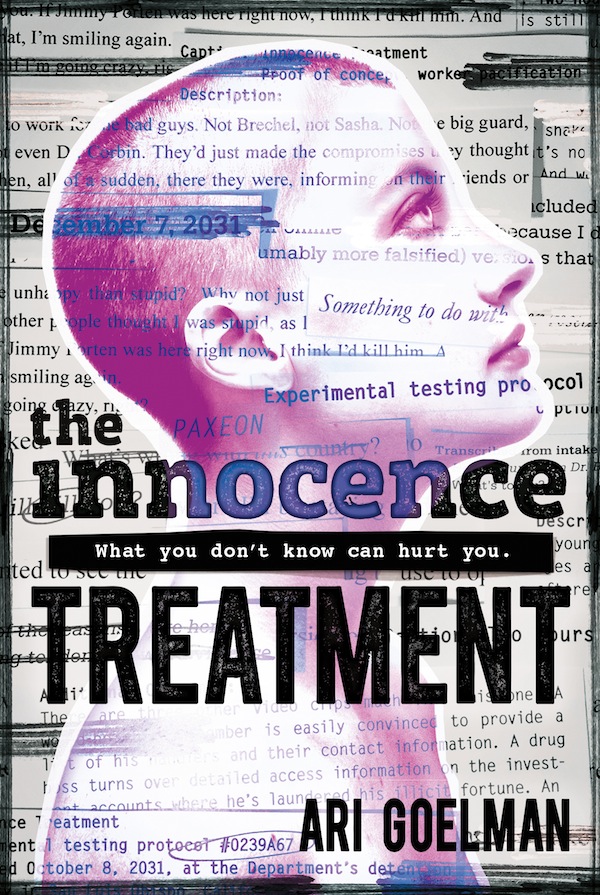
The Innocence Treatment by Ari Goelman is a psychological thriller set in 2031 America. 

Looking for a smart, tense, psychological thriller for your teenage reader? Ari Goelman’s The Innocence Treatment (Roaring Brook Press, 2017) would fit the bill. Though, if you’re unsure, you can ask the author himself. Goelman will be doing a reading and book-signing on Nov. 21, 7 p.m., at Book Warehouse on Main Street. He will also be at the Cherie Smith JCC Jewish Book Festival on Nov. 27, 6:30 p.m.

Goelman is originally from Philadelphia. “I moved around the U.S. a bunch before ending up in Vancouver, living mostly in New York City and Boston before I came here,” he told the Independent. “I came to Vancouver gradually, a few months here (1995), a few years here (1997-1999), until finally settling here in 2006. I wanted to make sure I waited until I definitely couldn’t afford to buy a house in the city. As for why, I had family in Vancouver, so, when I was looking into grad schools, I knew it was a fun (and back then) affordable place to live.”

The Innocence Treatment is Goelman’s second book. His first, The Path of Names, for middle-grade readers, received many literary awards and nominations. He also writes short stories and is on the faculty of Kwantlen Polytechnic University. His undergraduate degree in economics is from New College of Florida, he has an MSc in planning from University of British Columbia and a PhD in urban studies from Massachusetts Institute of Technology.

photo - Ari Goelman
Ari Goelman (photo by John Goldsmith Photography)

“One of the first bits of paid writing I ever did was for this very newspaper, when I first came to Vancouver in 1995,” he shared. “True story. A once-off article about Kidsbooks.” True, indeed. The story, “No kidding around,” was published on Sept. 29, 1995, in the Jewish Western Bulletin, the Independent’s predecessor. But back to the present … well, the future.

Goelman sets The Innocence Treatment in his home country in 2031, when “the United States was still enjoying the lull between the first and second uprisings. A drought was drying out the last of the great western forests, but it would be another two years before the massive wildfires that left millions homeless and sparked the second uprising.”

His main character, 16-year-old Lauren was once so innocent that she had to be watched at all times so that no harm would come to her. At first, she is “super-excited” to be undergoing a medical procedure to “fix” her, because then she “won’t be stupid anymore.” But, afterward, she discovers that understanding people and their motivations doesn’t necessarily lead to happier or better outcomes and, more than once, the “new” Lauren must use her ample self-defence skills and literally kick some butts.

“Lauren’s kick-ass qualities naturally emerged from her character,” said Goelman about his strong female lead. “I started with the idea of a character who had spent her whole life very naive and very protected, and I imagined she’d be furious once the veil was lifted and she started to experience the world as it really was. I figured, as well, that after spending her whole life being unavoidably passive, she would be thrilled by her new ability to act and would make the most of those abilities.”

The problem becomes one of self-restraint, which Goelman explicitly explores in a chapter involving an experiment while Lauren is in custody, which I personally found somewhat out of place, or forced.

“What I was trying to do in that chapter was to show Lauren’s inability to control herself, even when she genuinely wants to, both for her own self-interest and to spite Dr. Corbin,” explained Goelman. “That’s what Corbin is really measuring – not Lauren’s fighting ability, but her paranoia and anger. It was a fun chapter to write, because it’s from Lauren’s perspective and she’s aware of the challenge that she’s failing, even as she fails it.”

Overall, The Innocence Treatment is a fun book to read. To use an apt cliché, it is a page-turner. It is also a little scary in its seeming prescience, having been written before the election of Donald Trump and the apparent descent of America.

“Yes, The Innocence Treatment does feel a bit unfortunately prescient at this point,” agreed Goelman. “I’m glad it was published this year, or it would have started seeming less like a near future world and more like the past.”

As for what he thinks the future might hold in reality, Goelman said, “I think the most we can hope for is to slow climate change and deal with its consequences in a fair way that limits human suffering. I’m not real optimistic about our near-term prospects, as I think that nothing good will happen as long as so much of the world’s resources are controlled by so few individuals and families.

“The world of The Innocence Treatment is very much formed by the combination of climate change disaster and the unequal distribution of wealth. And,” said Goelman, “while the election of Donald Trump in the U.S. is the latest and maybe the best example of how these two trends come together, we don’t have to look so far from home. The B.C. Liberals ran this province for 16 years, defunding public education and subsidizing the fossil fuel industry, at the behest of their very wealthy (and largely unregulated) donors.

“On the upside,” he said, “it’s not like the solutions are so complicated – if we get money out of politics, I believe humans can be really brilliant at solving problems collaboratively. So, while I’m pretty pessimistic about any major improvement in the near term, I think it’s very possible to change things for the better – it just requires the political will. There’s a part of The Innocence Treatment where Lauren’s older sister describes the family’s life right after the ‘Emergency’ era permanently reshaped the U.S., and one of the things she remembers is it wasn’t so bad being without power, as people came together to help each other. I think there’s a lot of truth to that. Given the chance, humans are really good at working together. They’re also really good at struggling for dominance and to monopolize scarce resources. It’s anyone’s guess which direction we’re going.”

For the full schedule of the Jewish Book Festival, which runs Nov. 25-30, visit jewishbookfestival.ca.

Step aside fried latkes

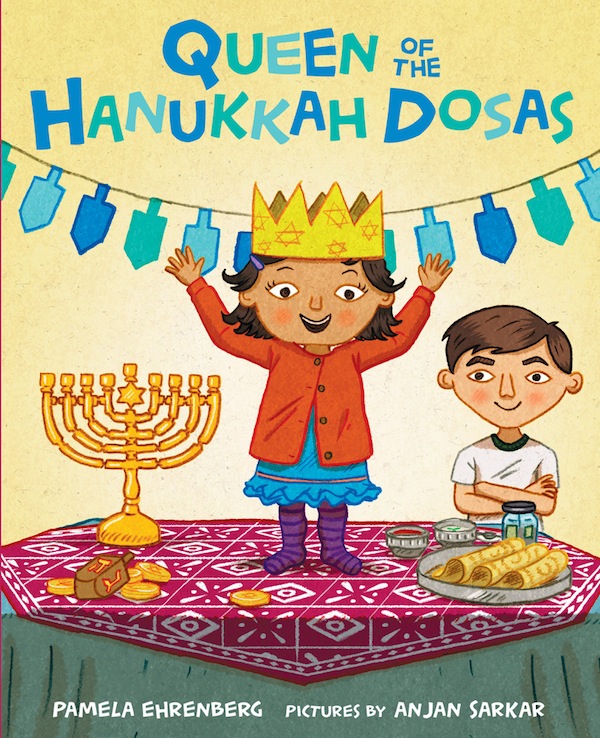
My younger brother has one main rule for my nieces, who are 6 and 4 years old – “No head injuries.” Sounds simple enough, until you see one of them launch themselves off the back of the couch. I could see a bit of them in the character of Sadie in Queen of the Hanukkah Dosas, written by Pamela Ehrenberg and illustrated (beautifully and creatively) by Anjan Sarkar.

“It wasn’t that I didn’t want my little sister, Sadie, to help us make dosas for Hanukkah,” explains her big brother. “The problem was, she climbed too much.” Onto tables, out of cribs, up stacks of cans at the supermarket, Sadie does like to climb. And luckily so, it turns out. But you’ll have to read the book to know why.

book cover - Queen of the Hanukkah Dosas
Queen of the Hanukkah Dosas cover

If the title didn’t give it away, Sadie and her family are a Jewish family with Indian heritage. Instead of latkes, they are celebrating the Holiday of Lights with dosas, and there is a recipe for the Indian pancake in the book, as well as a recipe for sambar, a vegetarian lentil stew made with tamarind paste and many other delicious ingredients.

Queen of the Hanukkah Dosas, published by Farrar, Straus and Giroux (2017), is part of PJ Library, which sends free Jewish children’s books to families with kids from 6 months to 8 years old. B.C. community members can sign up through Jewish Federation of Greater Vancouver or Jewish Federation of Victoria and Vancouver Island.

PJ Library’s selection committee chose Queen of the Hanukkah Dosas because it “loves how this book celebrates the varied cultural and ethnic backgrounds that make up today’s Jewish community, and encourages each of us to be proud of our individuality.”

The book also offers the opportunity to talk about various holiday customs that cut across Jewish cultures. Sadie wears a dreidel costume for some of the book, the family lights the chanukiyah, there is gelt on the table and, of course, dosas are fried, so there’s that miracle of oil to discuss.

Resettling Eretz Yisrael

Alison Pick discusses her new novel, Strangers with the Same Dream, at the Cherie Smith JCC Jewish Book Festival Nov. 25. (photo by Emma Lee)

“Here they were, she thought, in this remote land of Palestine, far from their homes and families. They had left their lives as they knew them to turn the Balfour Declaration, and the idea of a homeland for the Jews, into truth. They were strangers with the same dream…. But this was the thing: Zionism was not just an idea. It was something that was happening, now and now and now. It was something she could make happen.”

So thinks Ida, one of the three main characters in Alison Pick’s latest novel, Strangers with the Same Dream (Knopf Canada, 2017). Pick will be in Vancouver to open the Cherie Smith JCC Jewish Book Festival on Nov. 25, 7:30 p.m., at the Rothstein Theatre. Appropriately enough, the title of her conversation with Jerry Wasserman is Idealism vs. Reality.

Ida has come to Palestine, to Eretz Yisrael, the Land of Israel, on her own from Russia, having seen her father killed and knowing that the brutal attackers also raped her mother; her sister, “Eva, thank God, had been at school.”

It is 1921. Ida is part of the Third Aliyah, one of many other young idealists, most of whom had no idea at the harsh conditions that awaited them – the heat of the dessert, the abundance of malaria-spreading mosquitoes, the backbreaking work, the relinquishment of individuality and, of course, their new Arab neighbours, who were displaced by their arrival.

The leader of Ida’s particular group is David, who immigrated during the Second Aliyah, in 1910. He “had helped establish the moshava [settlement] at Kinneret, planting eucalyptus trees along the muddy banks, negotiating with the fellaheen [farmers]. Ida heard he had traveled the entire length of Eretz Yisrael on horseback, meeting the Arabs in every tent and marketplace, learning their various customs so as to help in the purchase of land.”

And there is David’s wife, Hannah, who, “like David, had arrived in the Second Aliyah, which meant the halutzim [pioneers] instantly respect her.” While the “historic speeches fell to David; Hannah was left with the logistics.” For example, Hannah was the one to request that the new olim (immigrants) voluntarily surrender all of their valuables “to the enterprise they were building together. She did not want strangers circulating like policemen to take each other’s belongings. Especially not after what so many of them had been through in Czarist Russia.”

photo - Strangers with the Same DreamStrangers with the Same Dream is divided into three sections, each of which is written from the perspective of one of the three protagonists – Ida, David and Hannah – about the same series of events.

“Following the writing of my memoir Between Gods, I was very interested in the relationship between truth and memory, and the ways in which different people (family members, as one example, or characters) experience the same events very differently,” Pick told the Independent. “I love to challenge myself with each new book and so I decided to try and tell the same story through three different sets of eyes. I wanted the reader to have the pleasure of seeing things the characters did not; that is, miscommunications, misunderstandings, falsely attributed motivations.”

The protagonists could be considered archetypes of a sort. “Although I didn’t set out to write it that way,” said Pick, “Hannah certainly has some of the Mother in her, and Ida has the Maiden. David, I suppose, could be seen as a Trickster, although that might be a generous way to characterize him.”

The novel is introduced by a short prologue, written in the voice of a ghost – a former halutza – who sets up the narrative and then enters it occasionally.

“The ghost is a link between the past and the present,” explained Pick. “Because the three narrative voices were necessarily so limited, I wanted an additional over-arching outside view – outside of time, even – who could reflect both backward and forward. I was also thinking about the idea of haunting – that Israel today (as with Canada, as with many other places) is haunted by history, by the very real lives of those who came before us and influence how we live and how we understand our own stories.”

Pick chose to set the novel in 1921 for a number of reasons.

“I’m not an historian, although I do love writing historical fiction – and, while there is a lot of leeway in fiction as a genre, it is important to me to get the historical facts right. So, I set relatively narrow parameters for myself – all the action takes place roughly over the course of one year. The kibbutz in Strangers with the Same Dream is fictional, but it is loosely based on Kibbutz Ein Harod, established in 1921. While there had been other, smaller attempts at kibbutzim, Ein Harod was the first attempt on a bigger scale, and it is a kibbutz that has, still today, a mythical presence in the collective psyche of Israel.”

The novel took Pick about three years to write, and she did research in Israel.

“At Kibbutz Ein Harod, there is an incredible archive about the early years of kibbutz life,” said Pick. “I was able to access first-person diaries, many written by the female pioneers, which I had translated from Hebrew. Both the translator and the archivist herself were wonderful sources of information about the early years, and they introduced me to an elderly man (who has sadly since passed away), who was there at the establishment of the kibbutz in 1921. So, I read, I researched, I listened, I imagined. And then I tried to breathe life into a world of the past, to bring it to life for readers today.”

While some readers might find the ghost an intrusive presence, I found the novel completely engaging, in part because it shows some of the grim realities the halutzim faced, not only from the land and their Arab neighbours, but from one another. Readers will be able to picture what it was like in those early days. If I wasn’t sure before, I am now that I would have made a poor halutza – the hard work and strange surroundings wouldn’t have been nearly as daunting as the high risk of malaria and the challenges of living in a collective with few resources. I came away from the novel with more admiration for (most of) those who worked to make the idea of Zionism a reality. At least one reviewer, though, has imputed an anti-Zionist message to the novel.

“I confess I have been surprised by the (few) reviews that take the novel as anti-Zionist,” said Pick. “Perhaps I’m naïve – and I am certainly a newcomer to Judaism, which is no secret – but I adore Israel. I traveled there three times during the writing of the book and, each time, I fell more madly in love with the place.

“It did not occur to me that exploring the psyche of those early Zionists – who at the very least did realize that the place they were ‘settling’ was already populated – would be construed as anything other than telling the simple truth. I did not start out with a political message and, indeed, I think to do so is anathema to good fiction. The role of art, as I see it at least, is to open, to unravel, to make space for more questions rather than to judge, decide or condemn. Although one of the characters [David] is decidedly a villain, albeit I hope one in whom the reader sees humanity, the other two main players (Hannah and Ida) are, to my mind, hugely sympathetic. Everyone in the novel – Jews and Arabs alike – are simply trying to make do in a both remarkable and remarkably difficult situation.”

For tickets to hear Pick, and for the full book festival lineup, visit jewishbookfestival.ca.

Retribution and restoration

Hidden in the spine of a 1947 edition of Anne Frank’s The Diary of a Young Girl, in its original Dutch, is a piece of paper with the German words, “Die Vergeltung,” or retribution. (photo by Shula Klinger)

I ran into Richard Smart in North Vancouver in early September. It was at Urban Repurpose, a nonprofit store that sells used building materials and an eclectic mix of donated household items. Many of these items are vintage and, if you’re interested in local history or looking for artistic inspiration, it’s also a treasure trove.

Employing skills handed down over three generations of his family in England, Smart restores and sells antique books using tools that have “barely changed for centuries.” And, since a homeschooling mom never misses an opportunity to educate the children, I asked him if we could come by the Old English Bindery to see him at work. In mid-October, he invited us to see how a broken book could be repaired.

Smart showed us book presses, tools for applying gold leaf to the bindings of books, piles of ancient, beautifully decorated papers and, of course, the books themselves – travel writing, fiction, nonfiction, massive tomes of human anatomy, bigger than any book you’d see in print nowadays. He also applied gold leaf to the kids’ index fingers, which delighted us all.

photo - Het Achterhuis. Anne Frank’s The Diary of a Young Girl
Het Achterhuis. Anne Frank’s The Diary of a Young Girl. (photo by Shula Klinger)

Just before we left, Smart showed me a small, bubble-wrapped book. I looked down as he held it out. Its title: Het Achterhuis. Anne Frank’s The Diary of a Young Girl.

“It’s a first edition,” he said. There was a pause, to let this information seep in. He pointed to the front left edge. “I only did minor repairs on it, here.”

I stared at my hands, holding this 1947 edition of The Diary of a Young Girl, in its original Dutch. Looking down, just breathing. Thinking about how, a mere two years before this book was published, Anne and her sister Margot were still alive. In captivity, but alive. Anne was still writing, contemplating the nature of the human soul.

A moment later, Smart pointed to the inside of the spine, where it had separated from the contents. “Look at that,” he said, and pointed to some words in German: “Die Vergeltung.”

“I looked it up,” he said, and here he became animated. “It means retribution. Or payback.”

I was already choking back the emotion of holding this 70-year-old edition of The Diary, but now this?

I asked how the text had gotten there, when the book had come apart, if it had been placed there during the original binding.

“Bookbinders often used scraps of paper to pad the inside of a spine,” he explained. “But to choose this particular piece of paper? Just think about that.”

By then, my head was full of questions, all competing for my attention. Unfortunately, my two children were also competing for my attention. The little one was extremely curious about the book presses, but the big one was edging toward the door. Also, as interested as they are in world history, this wasn’t the time to tell them about the Holocaust, so we left.

Over the next few days, I learned more about the book’s earlier life and Smart’s plans for its future. “This book needs to go back to its community,” he said. When asked if it there had been any fanfare at the Dutch auction, he said, “It was just an ordinary estate sale.”

Since the original dust jacket was missing, Smart has made a case for it. Working to match it to the cover’s original colour, he chose a pale blue leather inlay for the lid and patterned, or “paste,” paper for the sides.

photo - In the spine of this 1947 edition of The Diary of a Young Girl is a piece of paper with the German words, “Die Vergeltung,” or retribution
In the spine of this 1947 edition of The Diary of a Young Girl is a piece of paper with the German words, “Die Vergeltung,” or retribution. (photo by Shula Klinger)

I also wrote to Anne Frank House in Amsterdam. Gertjan Broek replied, saying, “There are still a few mysteries around the first edition of Anne Frank’s Het Achterhuis.” He agreed that “randomly available” pages from other books were often used to pad spines – “paper was a scarce resource in those years,” he noted.

This was probably the case with the page used in Smart’s edition of Het Achterhuis. Die Vergeltung was published in Bayreuth, Germany, in 1941 and reprinted in 1944. In Broek’s view, the typefaces were a match. Broek didn’t know if this was true for all of the 3,000 books in this first run, but he said he’d ask his colleagues.

A few days – and a good deal of anxious email-checking – later, Broek wrote again. “Three experts in book restoration have told me they have never seen a first edition copy of Het Achterhuis with this kind of print.”

And that is where the story rests, for now. I would love to paint a more detailed picture of the bookbinder at a workbench in 1947. I picture hands cutting out a page of that German book, laying it into the backbone of Anne’s book. Was the bookbinder just doing a job, or taking a degree of satisfaction in leaving a deliberate, but hidden, commentary inside this now-iconic piece of work?

There’s another layer to the tale.

In an age where people are rushing around permanently plugged into an online world, bookbinders like Smart have an unusual job. Every day, instead of racing ever forwards, he steps into worlds that have passed, touches books first purchased by people who haven’t lived for centuries. As he preserves their books, it’s as if he offers a passage between their time and ours.

Amid all of these remarkable works, Anne’s stands out as a beacon. “Books like Anne’s make this work worthwhile,” said Smart, who is keen to sell his copy of Het Achterhuis, but to an organization, not a private individual. “I had an offer on it but I refused it,” he said. “I have my heart set on it going into an institution that will display the story.”

So, in preserving precious books, Smart is doing far more than simply offering a service, repairing material goods. He is acting as a guardian of history.

Smart also wonders about the binder of this copy of copy of Het Achterhuis, “the moment of looking for a spine liner and putting that particular one in. What was going through his mind, in 1947?” On reading this in Smart’s email, I replied that, really, the book was priceless.

Later that day, he emailed again. “This one copy is priceless, as you say. Not financially but historically. Just imagine the story told by everyone that sees this book in a museum. It would bring people in, just to see this, and talk about it. That is worth so much for everyone in this world.”

Responding to my expression of gratitude for his professional conscience, he said, “Faith is everything.”

Shula Klinger is an author, illustrator and journalist living in North Vancouver. Find out more at niftyscissors.com.

Imagining a different future

ChiZine Publications is preparing to publish a new book: Other Covenants: Alternate Histories of the Jewish People, the first-ever anthology of Jewish alternate history stories, to be edited by Mark Shainblum and Andrea D. Lobel. Contributors already confirmed include science fiction masters Harry Turtledove and Jack Dann.

Shainblum and John Dupuis forged a new trail in Canadian literature in 1998 with Arrowdreams, Canada’s first alternate history anthology. Now Shainblum and Lobel propose to do the same for Jewish literature, and explore the rich possibilities of Jewish roads not taken.

Shainblum was born and raised in Montreal, where he and illustrator Gabriel Morrissette co-created the comics series Northguard and Angloman. Shainblum has published science fiction in various magazine and anthology markets, and he also co-edited Superhero Universe: Tesseracts Nineteen, in 2016, with Claude Lalumière.

Lobel has worked as a writer and editor for more than a decade, winning two industry awards. An ordained rabbi, she also holds a master’s in religious studies (McGill University) and a PhD in religion (Concordia University). She has taught at both McGill and Concordia. Her book Under a Censored Sky: Astronomy and Rabbinic Authority in the Talmud Bavli and Related Literature is forthcoming from Brill Publishers in 2018.

Other Covenants is open to submissions of short fiction, through Sunday, Feb. 4, 2018, at 11:59 p.m., Eastern Time. Submissions must be between 1,000 and 10,000 words in length, and may be in English or French (the book will be published in English and authors will be responsible for translations). Original stories are preferred, but the editors will consider reprints of significant works on a case-by-case basis. Payment will be eight cents (Canadian funds) per word. Authors may be from anywhere in the world and do not need to be Jewish.

Many individual stories of Jewish alternate history have been published over the years, but Other Covenants will be the first themed anthology collecting such stories under one cover.

Some possible themes to explore are: What if the Holocaust had never happened? What if Joseph’s brothers had not sold him into slavery in Egypt? What if the state of Israel had been established in Uganda? What if Jesus’s followers had not broken with Judaism? What if Jews had proselytized their faith door-to-door for a thousand years? What if the Romans had not destroyed Jerusalem and the Second Temple? What if Judaism became the dominant Western religion, but was riven by conflicts between the Temple priesthood and reformist rabbis? What if the Spanish Inquisition had never occurred? What if Napoleon had not smashed down Europe’s ghetto walls?

Full submission guidelines and the online submission system are at chizinepub.com/other-covenants-alternate-histories-of-the-jewish-people. Stories must not be submitted by email – they must go through the submission system.

History is constantly new

Laurence Rees, former head of BBC TV History and author of the award-winning book Auschwitz, has written a very compelling and authoritative “new” history of the Holocaust, based on 25 years of research, and on many personal meetings with survivors and perpetrators – The Holocaust: A New History (Public Affairs, 2016).

The “new-ness” of Rees’ book is evidenced in the 100 pages of footnotes, which contain more than 100 references to “previously unpublished testimony,” plus new evidence from heretofore unrecorded diaries, speeches, stenographic reports, Wehrmacht soldiers’ letters, journals, private conversations and interviews. Add to this the results of “hundreds” of visits Rees made to exact killing locations, all of which have their first exposure here.

As with other great one-volume histories of the Holocaust, such as Martin Gilbert’s The Holocaust (1986) and Raul Hilberg’s The Destruction of the European Jews (1961), Rees’ history is difficult to read – not because of the writing (Rees’ prose is more engaging than either Gilbert’s or Hilberg’s) but because of what the reader has to face in reading about the Holocaust. The cold, impersonal, machine-efficient systematization of genocide; the brutality, the humiliation, the sadism and the ear-piercing silence of the church: all are offered here in unremitting detail. The silence of the world-at-large is also indicted here – as one survivor told Rees about her “liberation”: “What liberation? No one wanted us. There was no Israel, no England, no America and no Canada, with its wide open spaces.”

book cover - The HolocaustRees lays his cards on the table in his prologue: “make no mistake about it – the Holocaust is the most infamous crime in the history of the world.” Rees’s words echo almost exactly the words of Winston Churchill in July of 1944.

To his credit, Rees sees through the usual “excuses” for the Judeocide – that is, need for “Lebensraum,” for “ridding of the world of a bacillus” or for the preventing of a Jewish plot for world domination. Rather, says Rees, the perversions which truly fueled the killing machinery were mad racism thoroughly laced with sadism and opportunity for profit.

On the usual controversial points: first, Rees agrees with Ian Kershaw that “No Hitler, No Holocaust”: no one who studies Holocaust history, he says, “can help but conclude that Hitler was primarily responsible for the Holocaust.” Second, Rees sides persuasively with the “functionalists” rather than the “intentionalists,” an old dilemma among historians of the period wrestling with the idea of whether the Judeocide was planned out in advance (“intentionalism”), or just came about piecemeal (“functionalism”). Third, as mentioned, Rees is adamant that the Holocaust was unique: “a crime of singular horror in the history of the human race.”

Rees is particularly, and rightly, harsh on the slavish complicity of the Dutch civil service (75% of the Dutch Jewish population perished) and the atrocious treatment of Jews in Vichy France, and bitterly condemns the hideously self-serving complicity of the Romanians in joining up with the German Nazis. But he saves his bitterest attack for the end of the book, vehemently accusing the Hungarians of a major crime for allowing what he rightly refers to as the “Hungarian Catastrophe.” (Nor does Canada escape indictment: Rees reminds us of Mackenzie King’s loud admiration of Hitler in the late ’30s, and of the antisemitic pronouncements of Canada’s Immigration Branch in 1938, preventing any Jewish immigration to Canada.)

Rees has some interesting insights on the “Danish Rescue” – the spiriting away to Sweden of almost all of Denmark’s Jewish citizens. Jews were thoroughly integrated into Danish society, and there had been a great number of intermarriages between Jews and non-Jews in Denmark. In never-before-published interviews, Rees offers heart-warming evidence of the bravery of Danish non-Jews in warning, hiding and planning passage for their Jewish neighbours. As a result, says Rees, when the Germans called, “most of the Danish Jews were not at home.” Rees offers “no simple explanation of why this happened in Denmark and nowhere else,” but he guesses that the Nazi functionary (Werner Best), known to have warned the Danish police about the upcoming “Action” in October of 1943, may have been motivated by the need to “avoid bad feeling” in a country that was supplying considerable food supplies to the Reich. No less of a motivating factor, Rees further conjectures, was the fact that Best, who had been appointed in his 20s to a judgeship, was intelligent enough to foresee the Nazis’ future defeat and subsequently “needed to start improving his CV as far as the Allies were concerned.”

Rees’ book reminds us, then, that history, ironically, is always “new” – and we are, therefore, reminded to constantly view it, and to re-view it, through ever-changing historical lenses.

Graham Forst, PhD, taught literature and philosophy at Capilano University until his retirement and now teaches in the continuing education department at Simon Fraser University. From 1975 to 2010, he co-chaired the symposium committee of the Vancouver Holocaust Education Centre.

Keeping children safe

Bracha Goetz reads from one of her recent books to her two grandchildren. (photo from Bracha Goetz)

Many of us were raised to not talk to and be wary of strangers, but the sad fact is that kids are much more likely to be taken advantage of or abused by someone they know and think they can trust. This reality was the driving force behind Bracha Goetz’s book Let’s Stay Safe, which was published in English in 2011, and just came out in Yiddish this summer, as Zai Gezunt.

Born in Queens, N.Y., Goetz graduated from Harvard and started on the road to becoming a psychiatrist before heading to Israel for what was to be one summer. However, while in Israel, she become observant, and ended up staying. There, she did a further 11 years of study, got married and had a family.

Goetz and her family have since moved to Baltimore, where she coordinates a Jewish Big Brother Big Sister (JBBBS) program. As well, she writes children’s books and, to date, has published 36 of them. “They are all spiritual children’s books,” she said. “Originally, I was just writing Jewish children’s books, but now I’m also writing spiritual children’s books for anybody.

“I always wanted to write spiritual books for everyone, but I just recently found a publisher that was interested. It’s not easy. It took a long time, but I’m very happy to do that, because, although these are Jewish concepts, they are also actually universal concepts that I’d love to share with any child.

“I try to write books that I wished I could have read as a child, to answer the spiritual questions I had as a child that weren’t answered,” she continued. “They were answered for me when I was 22, but I try to write about the deepest spiritual concepts on a simple level so any child can understand them. I also try to do it in a joyful, delightful way, so that it can go right into their soul.”

In her role at JBBBS, Goetz witnesses firsthand how sexual abuse affected children. This made her think about how she was teaching her own children about such dangers.

“I realized that I didn’t raise my children with an awareness about it,” she said. “I taught my children about ‘stranger danger,’ but, when they were little, we weren’t as aware as we are today that, with most sexual abuse, the perpetrators are known to the children; that’s how they get access. It’s rare that it’s a stranger. It’s most commonly someone the child already knows. There was no book like this in the Orthodox community and some of the books (in the general community) are not culturally relevant for Orthodox people.”

photo - Let’s Stay Safe, which was published in English in 2011, and just came out in Yiddish this summer, as Zai Gezunt
Let’s Stay Safe, which was published in English in 2011, and just came out in Yiddish this summer, as Zai Gezunt.

Goetz wanted to write a book that would be accepted by the Orthodox Jewish community specifically, as the subject tends to be less discussed in these communities. So, she wrote Let’s Stay Safe, but could not find a publisher. That is, not until Rabbi Yakov Horowitz, dean and founder of Yeshiva Darchei Noam in Monsey, N.Y., agreed to help and got the book accepted by ArtScroll.

“He really worked at it, and it was a really groundbreaking book,” said Goetz. “There was nothing like it out there. We wanted readers to understand that these were additional normative safety rules that needed to be adhered to by children to be safe. Of course, the book is also for parents, because, when parents read it to their children, they also gain an awareness.

“It’s not a good idea to leave the safety responsibility of children up to the children. It’s the parents’ responsibility. But, the parents also need to teach the awareness to their children and remind them about it every so often. As they come upon new circumstances, they need to review the guidelines.”

To take the book a step further, especially in Chassidic communities, Horowitz spearheaded a Yiddish version. “In certain Chassidic communities,” explained Goetz, “their mother tongue is Yiddish. We wanted to reach as many people as possible, so that they would bring this book into their homes and share it with their children. Even the pictures were altered to be more Chassidic-looking. We don’t want anything to stop the Yiddish-speaking population from getting this information.”

One of the concepts Goetz wanted to stress in the book was that children speak with a parent even if somebody touched them inappropriately a long time ago. It is important for these experiences to be told, she said, so that survivors can heal, and also so that the perpetrators cannot continue abusing children.

Another concept she wanted to convey clearly is not to trust someone just because she or he is dressed in Orthodox clothing, as that does not automatically mean they are safe people.

“There’s one picture of an older teenaged boy at a camp,” Goetz said, by way of example. “Many times, it’s a familial problem, where it’s an older brother, an uncle, a step-brother who is the perpetrator. Just this week, I was in a community different than I was usually in, but the people knew I was the author of the book … and, this happens a lot, people come to me with questions. I was outside watching my grandchildren and a mother came by and said, ‘Does this seem right? There’s a teenaged boy and he’s playing with all these little children. He’s playing ball with them. He doesn’t live in this community. And why is he here? He’s Orthodox, as well, just as the children, but he didn’t know any of them. Why was he playing with them?’ I said that’s definitely a red flag.

“This kind of awareness was not typical before the Let’s Stay Safe book was published. The incident illustrates the impact that the book has had. Now, there is a general awareness in our community, because there has been consciousness-raising on the issue of child sexual abuse.”

Books written by Goetz are appropriate for kids ages 2 and up, but are better starting at the ages of 3 or 4.

“This book is often read to 4- to 8-year-olds but, the truth is, older children love reading this book, too,” said Goetz. “And what I find so interesting is that a lot of children tell me it’s their favourite book of mine, which I never expected because it’s all about rules and guidelines. But, they love it. It gives them a sense of safety and security, and children ask for it as their bedtime story.”

Other books written by Goetz touch upon topics like eating healthily (and enjoying it), teaching children sensitivity, and teaching people how to interact more naturally with children with special needs.

Rebeca Kuropatwa is a Winnipeg freelance writer.

Granirer paints with words

I am the proud owner of a Pnina Granirer work. More importantly, I am privileged to know the wonderful human being who is Pnina Granirer. After reading Light Within the Shadows: A Painter’s Memoir, I now know more about her art, its influences and styles, and her life, its joys and challenges. I also discovered that she writes as beautifully as she paints, and has a warm sense of humour.

Each chapter features a relevant quote from people throughout history, something they said or, most often, wrote; people as diverse as Roald Dahl, Anne Frank and Shakespeare. In these and her own words, Granirer imparts not only her life story but her philosophies on creativity, education, identity, family, business.

“There are people who plan their lives meticulously, step by step – I have never been one of them,” she writes. “Of course, I had goals, but these were like signposts to be reached one by one, short-term endeavours without a specific plan for the faraway future. I rather liked the idea of floating along, steering my boat from time to time and hoping that I would reach my destination, whatever it was meant to be.”

And the 82-year-old has experienced many destinations on her continuing journey. In a May interview with the Vancouver Sun, she talked about having written a book twice the size of what was published.

“There were a lot more historical references, many stories about family members and some more memories – it was too long and had to be cut,” Granirer told the Independent.

About the possibility of another book, she said, “I’m thinking about this and how I could use some of the chapters that have been cut, but, at the moment, I’m far too busy with getting through with the exhibition. I need a quiet space in order to begin thinking about writing and hope that I’ll begin doing just that early in 2018.”

book cover - Light Within the Shadows Granirer will do an artist’s talk at the Sidney and Gertrude Zack Gallery on Nov. 16 to open an exhibit of her work mounted in conjunction with the Cherie Smith JCC Jewish Book Festival because the occasion also represents the launch of her memoir. The event is sponsored by National Council of Jewish Women. This is especially appropriate because one of the topics that Granirer explores in her memoir is the difficulty of being a mother, a wife and an artist. About the 1970s, when her two sons, David and Dan, were young, she remarks, “I had little contact with the visual arts community in general and its avant-garde segment in particular. I didn’t have much time for forging professional ties, as my world consisted of my husband and my sons, who were a great source of joy and a well of inspiration for my art.” In this period, she not only produced much work, but also took on teaching.

Her memoir – which includes pages of colour photographs of her work – is divided into three acts. It takes readers from Romania, her birthplace and where she grew up, surviving the Holocaust; to the safety of Israel in 1950, to where first her father, then the family, fled from the dangers of communist Romania; to the United States in 1962, where her husband Eddy, a math professor, could find work, as the recently initiated American-Russian space race saw Americans “pouring money and resources into research, hoping to be the first to put a man on the moon…. Mathematics, the cornerstone and essential building block of scientific research, was suddenly in high demand all over North America.” Three years later, the Granirers would make their way to Vancouver.

Granirer talks about luck throughout the memoir and, specifically, about a couple of “old hackneyed sayings” being true, that of being “in the right place at the right time” and of being “born under a lucky star.” “Events beyond our control do change the course of our lives,” she writes. And, while they don’t always do so for the better, Granirer chooses, at least in looking back, to appreciate her good fortune.

“Of course, I never even thought of being lucky at the time,” she admitted to the Independent. “One just lives one’s life as it comes along and only later, in retrospect, one sees the whole picture. Getting older allowed me to have a better perspective of the past and writing the memoir brought it all together. We kept saying for years how lucky our family was to live in Vancouver, but day by day there were ups and downs and the occasional complaints when unfortunate events happened – and they did. The memoir was a watershed for me and helped me see the serendipitous moments in my life when fate could have gone easily the other way.”

The light and shadows of the book’s title not only apply to the vividness of remembered moments and the darkness in which forgotten moments lie, but also the grey areas through which we must travel in life – the uncertainties, the aforementioned circumstances beyond our control.

When asked if she was a naturally optimistic person or developed into one, she said, “I probably am more of the former, although that does not mean that there are not times when I feel as if the world is collapsing on me. There have been hard times for me in the past, but somehow I seem to manage to get through. I just try to deal with the black thoughts, when they come. Nothing is really black-and-white, it’s through the shadows that we have to find our way.”

In addition to geopolitics, health and other uncontrollable issues, Granirer also had to negotiate the politics of the art world, in which she had to deal with many curators who “did not seem to be interested in art and artists, except as tools for enhancing their own careers.”

“… meeting someone who loves a painting and wishes to live with it, who wants to learn the details of its creation and is convinced that owning it will enrich his or her life, is the most rewarding experience for an artist.”

Nonetheless, she persevered – “Early in my career,” she writes, “I decided to follow my own course, regardless of the cost.” She did so, even as she realized that, in her profession, “being different was not considered an asset, but a liability.” Though admitting that all artists, including herself, crave recognition, she writes that “meeting someone who loves a painting and wishes to live with it, who wants to learn the details of its creation and is convinced that owning it will enrich his or her life, is the most rewarding experience for an artist.”

To mark her 80th birthday, in 2015, and her 50th year in Canada, Granirer gave many others a gift. “Established galleries usually charge the artist 50% commission for each work sold, in exchange for space and promotion,” she explains. “Why not invite the public … for 10 days and offer the commission to my collectors instead.” It was because of this generosity that I was able to buy my first Granirer.

After this exhibition and sale, Granirer and her husband headed back to Romania, 65 years after they had left the country. It was a meaningful visit with at least three serendipitous occurrences. But, back in Vancouver, she ended up in hospital. Sixteen days later, after two surgeries for diverticulitis, she made it home. “I counted my blessings and told myself how much worse it could have been,” she writes. “What if it had happened while I was in Romania?”

She returns to the memoir’s opening paragraph about getting older, in which she remarks, “Simple words like ‘later,’ ‘next year,’ ‘tomorrow,’ ‘not now,’ become risky, unsure and speculative.” But there is also much to look forward to, she says. At the time of writing, it was an international exhibit in Costa Rica and one in Spain. Currently, she’s preparing for the Zack Gallery exhibit and the launch of the memoir. The event takes place Nov. 16, 6 p.m., and admission is free. It will be a great opportunity to meet the artist – and pick up a copy of Light Within the Shadows.

Conversation continues

Author Nathan Englander with the Globe and Mail’s Marsha Lederman at an Oct. 22 event held by the Cherie Smith Jewish Book Festival, which runs Nov. 25-30. Englander was in Vancouver as part of a North American tour of his latest novel, Dinner at the Center of the Earth. For an interview with Englander, visit jewishindependent.ca/a-novel-born-of-heartbreak. (photo by Cynthia Ramsay)

Goldman memoir is a must-read

Breakfast at Andrésy circa 1945. René Goldman is holding his bowl out for more food. The children peering through the windows are from another dining room, who had likely finished their meal but had not yet been given permission to leave. (photo from memoirs.azrielifoundation.org)

René Goldman’s account of his childhood – A Childhood Adrift (Azrieli Foundation) – is set in Belgium and France during the Second World War, when Hitler’s plan was to annihilate all European Jews. Each European Jewish child was automatically sentenced to death. Only between six and 11% of European children survived the Holocaust. Ironically, this memoir describes both a heartbreaking and an uplifting story of one Jewish boy’s struggle to stay alive and sane despite all odds against him.

A Childhood Adrift is both personal and, at the same time, an important historical document. The story, written with a spatter of tongue-in-cheek humour, is a fascinating labyrinth of multiple narratives; stories within stories. It is not only about René the child, but also René the man, who revisits the past and examines the wounds left by war.

Goldman weaves his experiences throughout the periods of war and postwar, when he is a young man who travels back to the places that sheltered him and other children lost in the horror of war. The entire narrative is skilfully infused not only with historical and political facts but with the geography of various places so poignantly described one can feel and see them.

Goldman writes about the time when children lost parents, siblings and homes. These children had to depend on the kindness of strangers or were left alone to fend for themselves.

Goldman was 6 years old when the Nazis invaded his native Luxembourg, where he was born, and Belgium, where his family had taken refuge. In 1942, the family fled Belgium for France. From the last station before the French border, they walked on foot to the Demarcation Line between the German Occupied Zone and the Free Zone. No sooner did they cross the line than they were arrested by the French police, who were rounding up Jews escaping from the Occupied Zone, and the family was interned in Lons-le-Saunier. On Aug. 26, Goldman and his mother were taken to the city’s train station for deportation. His aunt appeared from nowhere and tried to take him away, but to no avail. Eventually, she found someone in authority to send two officers to rescue the young boy and save him from boarding the train. His mother was already in one of the cars waving goodbye as the train was pulling out of the station. This was the last time Goldman saw his mother. He was 8 years old.

His father disappeared that morning and it was only in 1944 that Goldman was reunited with him for a brief time, until his father was arrested and taken away. Only after the war did Goldman find out that his father died at the end of the death march from Auschwitz, in January 1945.

In 1942, Goldman was placed in the care of the OSE (Oeuvre de Secours aux Enfants) and brought to Château du Masgelier. After two weeks, he was taken to the village of Vendoeuvres, where a young couple offered to take care of him. Soon afterward, the Free Zone was invaded by the Germans.

What followed for Goldman were moves to several homes due to the changing circumstances, which necessitated a constant search for safe places for children.

Left an orphan in 1945, Goldman was placed in the care of the CCE (Commission Centrale de l’Enfance), an organization inspired by communist ideology, which was instrumental in shaping his political beliefs. His faith in this system remained unshaken until he lived in Poland for three years, when he became disillusioned, even shocked, by it.

He writes, “I can now in all candidness recognize that I caught myself wondering whether communism was not the greatest lie of the century, if not of all time.”

Goldman’s narrative strength, among his many others, leans towards the lyrical.

One of the immediate postwar places to which Goldman was moved in France was the town of Andrésy and its Manoir de Denouval, which inspired poetic instincts in him. Here, he found the beauty of gardens and serenity, a “sanctuary” that shielded him for a time from his loneliness and the postwar chaotic reality. Interestingly, Marc Chagall, who donated funds for the children’s care, would occasionally visit the manor.

“I was enthralled with the Enchanted Manor,” writes Goldman. “It nourished in me a fascination with mystery as I explored it for hidden nooks and ventured up the narrow winding steps that led to the turret, sometimes even in the dark of night.” And, indeed, these were dark times in the young boy’s life for it was then that he realized he was an orphan.

Friendships played a huge part during the war and in the postwar period. In the boys and girls Goldman befriended along the way, and some of the kind teachers, he found a certain relief from the loneliness he felt, and from the lack of affection and support. One person who played an important role in his life was Sophie Micnic, who became his caregiver and friend. This woman, a founding leader of the MOI, the Jewish communist resistance movement in Paris and Lyon during the war, later became the director of CCE. It was she who took Goldman under her wing, and recommended that he live in the “Enchanted Manor.”

A Childhood Adrift – a must-read – is a powerful testimony of a child’s response to the calamities of war and their everlasting imprint on his life. It is also a statement of courage and survival in the face of adversity. Eventually, Goldman developed a tremendous hunger for knowledge, education and a desire for communication in as many as 10 languages.

In the last section of the book, the author reveals himself as a poet and a grown man still deeply immersed in his past.

Lillian Boraks-Nemetz is a Vancouver Holocaust Education Centre outreach speaker, an award-winning author, an instructor at the University of British Columbia’s Writing Centre and the editor of the No Longer Alone section of VHEC’s Zachor, in which a longer version of this book review was originally published. René Goldman will be the keynote speaker at the community’s Kristallnacht commemoration on Nov. 5, 7 p.m., at Congregation Beth Israel. Copies of his memoir will be distributed to those in attendance. Holocaust survivors are invited to light a memorial candle. The ceremony is presented by VHEC, Beth Israel and the Azrieli Foundation. For Pat Johnson’s review of Goldman’s book, which was initially called A Childhood on the Move, visit jewishindependent.ca/fragmented-childhood.