Skip to content
  • Home
  • Subscribe / donate
  • Events calendar
  • News
    • Local
    • National
    • Israel
    • World
    • עניין בחדשות
      A roundup of news in Canada and further afield, in Hebrew.
  • Opinion
    • From the JI
    • Op-Ed
  • Arts & Culture
    • Performing Arts
    • Music
    • Books
    • Visual Arts
    • TV & Film
  • Life
    • Celebrating the Holidays
    • Travel
    • The Daily Snooze
      Cartoons by Jacob Samuel
    • Mystery Photo
      Help the JI and JMABC fill in the gaps in our archives.
  • Community Links
    • Organizations, Etc.
    • Other News Sources & Blogs
    • Business Directory
  • FAQ
  • JI Chai Celebration
  • JI@88! video

Recent Posts

  • Zionism wins big in Vegas
  • Different but connected
  • Survival not passive
  • Musical celebration of Israel
  • Shoppe celebrates 25 years
  • Human “book” event
  • Reclaiming Jewish stories
  • Bema presents Perseverance
  • CSS honours Bellas z”l
  • Sheba Promise here May 7
  • Reflections from Be’eri
  • New law a desecration
  • Resilient joy in tough times
  • Rescue dog brings joy
  • Art chosen for new museum
  • Reminder of hope, resilience
  • The national food of Israel?
  • Story of Israel’s north
  • Sheltering in train stations
  • Teach critical thinking
  • Learning to bridge divides
  • Supporting Iranian community
  • Art dismantles systems
  • Beth Tikvah celebrates 50th
  • What is Jewish music?
  • Celebrate joy of music
  • Women share experiences 
  • Raising funds for Survivors
  • Call for digital literacy
  • The hidden hand of hate
  • Tarot as spiritual ritual
  • Students create fancy meal
  • Encouraging young voices
  • Rose’s Angels delivers
  • Living life to its fullest
  • Drawing on his roots

Archives

Follow @JewishIndie
image - The CJN - Visit Us Banner - 300x600 - 101625

Author: The Editorial Board

Canada’s support of Israel feels good

Canada’s Prime Minister Stephen Harper stood in Israel’s Knesset Monday and delivered a speech that was, predictably, a summation of his government’s unconditional defence of Israel’s right to exist in peace.

While Harper received thunderous applause, his speech was significantly disrupted by a couple of members of the Knesset. At home, while Harper’s position is deeply pleasing to Zionists, it has been condemned as a betrayal of Canada’s traditional “honest broker” role, our middle-of-the-road approach to this issue and many others.

There is no doubt that Harper’s government has moved the country’s foreign policy in a pro-Israel direction, but seeing this as an abandonment of a balanced approach requires selective hindsight. Was Canada’s position “balanced” when we maintained our “go along to get along” approach that saw us vote in support of endless rounds of anti-Israel resolutions, year after year, at the UN? No.

Since the formation of Israel, the Liberal party has governed Canada for some 20 more years than have the Conservatives, including Harper’s seven-plus years as prime minister. Looking at the three main parties, from left to right, it’s the NDP, Liberals and Conservatives. The Liberals are in the middle. It should not be surprising that the party’s position on any topic should, on average, be closer to the middle, or more “balanced” than a position taken on the same topic by the NDP or Conservatives.

In other words, our vaunted Canadian neutrality is a figment of the ideological imagination. It is a chicken-and-egg scenario to determine whether Canadians’ overall middle-of-the-roadness caused so many Liberal federal governments or whether our middle-of-the-roadness is the product of many years of Liberal governments. The question of identity is a complex one, but Canadians are perceived as polite, apologetic, and meek rather than aggressive. This is a perception that, most likely, has allowed us to act as peacemakers in the international arena where others have failed. (It also helps, no doubt, that Canada has never been strong enough militarily on its own to pose a threat to any government with which it may be working to resolve a conflict.)

On many fronts, Harper and his Conservative government have thrown into question what it has meant to be Canadian thus far, from social policy to arts funding to foreign affairs. But, as Canadian voters have given him a majority government, he and his party are obviously not the only ones interested in reshaping the Canadian identity and changing its role in the world.

Harper’s political opponents – and those activists who tend to side against Israel – insist that Canada is losing face internationally, that our long-husbanded reputation for not making waves is hurting us on the global stage. Keeping in mind that Canada remains a small power whose influence, such as it is, has always come through the world’s respect for our principled stands, not because we have the biggest army or the largest population, this may be true as regards our role as a peacemaker. However, the jury is still out on how it will affect our international standing to be a country that speaks out strongly and unequivocally in support of our friends.

The argument that “true” friends are unafraid to criticize and, therefore, Canada is not being a true friend of Israel in its supposedly unquestioning support (we are not privy to what happens behind closed doors) holds some sway, but, at this point, there is no shortage of people letting Israel know what it is ostensibly doing wrong. The international discourse is so lopsided and biased against Israel that, despite any disagreements with Harper we as Canadian Jews might have on any number of his domestic or foreign policies, it is hard not to be proud – both as Canadians and as Jews – that he is so publicly and steadfastly supportive of Israel, rather being a bit player in the European and American chorus of ambiguity.

Harper’s seemingly uncharacteristic Canadian lack of balance on this matter of international affairs appeals to us. Whether or not his lonely voice is having any impact – positive or negative – in re-balancing a wildly unbalanced discourse doesn’t even matter. It just feels good to hear it.

Posted on January 24, 2014May 8, 2014Author The Editorial BoardCategories From the JITags Stephen Harper
Profeti della Quinta brings Salomone Rossi to life

Profeti della Quinta brings Salomone Rossi to life

Profeti della Quinta is at Vancouver Playhouse on Feb. 2. (photo by Susanna Drescher)

The documentary Hebreo: The Search for Salomone Rossi (Joseph Rochlitz, 2012) introduced last year’s Vancouver International Film Festival audiences to Profeti della Quinta, a Switzerland-based Renaissance and early Baroque vocal ensemble, primarily composed of Israelis. It followed the quintet to the Italian town of Mantua, the birthplace of Salomone Rossi, the first-known – and elusive – early-17th-century composer of Jewish music, who also was “one of the most renowned composers and performers at the court of the Gonzaga dukes.” The film’s audiences were treated to the ensemble’s musical preparations ahead of their concert of Rossi’s works at the Palazzo Te, where his music might have originally been performed, as well as by illuminating commentary from historians and musicologists on Rossi’s music and its impact.

On a North American tour to support their latest recording, Il Mantovano Hebreo, featuring Italian madrigals and Hebrew prayers by Rossi, Profeti della Quinta is in Vancouver Feb. 2, presented by Early Music Vancouver at Vancouver Playhouse. The first half of the program includes a screening of the 45-minute 2012 documentary; the program continues with the live performance of Rossi’s music. Members of the ensemble appearing in the Vancouver recital include Doron Schleifer and David Feldman, cantus; Lior Leibovici and Dan Dunkelblum, tenor; Elam Roten, bass and musical direction; and Orí Harmelin, chitarrone (a large bass lute).

Rotem, the ensemble’s music director, who also composes and plays the harpsichord in addition to the bass, spoke with the Independent about the quintet’s newest release, the experience of making the film, and their upcoming recording Rappresentatione Di Giuseppe E I Suoi Fratelli (Joseph and His Brethren), a “musical drama in three acts sung in biblical Hebrew,” Rotem’s composition for the ensemble set to be released in March.

Jewish Independent: When and how was Profeti della Quinta established?

Elam Rotem: Profeti della Quinta started while I was still in high school. Around the age of 17, I fell in love with vocal music, and especially the music of the 16th and 17th centuries. It was shortly after that I collected some of my friends and started singing Latin motets in the corridors of the school. The early sacred music that we were singing was a very odd element in an Israeli kibbutz school, but I think that our fellow students liked it.

Later, we were lucky to add Doron Schleifer, who can sing perfectly the soprano lines of 16th-century music and has a most beautiful and unique voice color, different from any other countertenor I know. After a pause, when I was in the army, I studied music in Jerusalem and then joined Doron in Basel in the schola cantorum – one of the best schools specializing in early music. There, we found new colleagues. Not so surprisingly, most of them are from Israel, too. (In this particular tour, we are all Israelis, but in others, it’s not always the case.)

JI: Can you talk about the experience of making that film about Salomone Rossi and what it was like, ultimately, to play his music at the palazzo?

image - Salomone Rossi image
Profeti della Quinta performs the music of Salomone Rossi.

ER: It should be noted that we are definitely not the first to sing and play Rossi’s music – not at all. His Hebrew sacred music is quite common in Israeli choirs’ repertoire, and was also performed and recorded in America. Rossi’s instrumental music is played in many concerts of 17th-century music. However, with our historically informed performance approach, we try to get closer as much as possible (and this is not simple) to the way Rossi’s music may have been performed in his time. Our special combination of knowledge in early music and in Hebrew allows us to read Rossi’s Hebrew music in its original notation (this is something worth seeing and we welcome people after the concert to have a look in the scores).

Moreover, in our new album, Il Mantovano Hebreo, we shed light on Rossi’s most neglected repertoire – his beautiful Italian madrigals. Singing in the palaces of Mantova [Mantua] where Rossi worked 400 years ago was an amazing experience for us. We look forward to further experiences like that in Italy!

JI: Can you speak to what role, if any, music plays in “illustrating” Jewish history?

ER: As far as I understand, the Hebrew music of Rossi is a very local phenomenon that probably stopped not much after its creation, probably around Rossi’s death (circa 1630). Other compositions in Hebrew came up only much later in music history, and not in Italy. However, this was a very interesting point in history – a Jewish musician succeeds in breaking the barriers of society, becomes successful and accepted, and then goes back to his own community and tries to revolutionize the music of the synagogue. In Rossi’s own words, to share with God the talents that were given to him.

JI: There seems to be a movement to work to “uncover history” through performing the work of composers who were (or nearly were) “erased” by history. Can you comment on the experience and responsibility of performing “neglected” music? How does Profeti della Quinta approach this enterprise? How do you make this music accessible to contemporary audiences?

ER: Profeti della Quinta are privileged to be (at least) the third generation of the “early music movement.” However, we believe that if music is “only” forgotten, that alone is not a good enough reason to bring it to life. We believe in good music, and when we find such good music, we want to share it with others. This was exactly the case with Rossi’s Italian madrigals. The purpose of music in the early 17th century was to move the listeners, and this is exactly our aim, as well.

JI: Profeti della Quinta achieves “vivid and expressive” performances by “addressing the performance practices of the time.” Can you explain a little bit more about that approach? Do you try to recreate an experience or to create something entirely new?

ER: This is an important point – it is not possible to recreate early music exactly the way it was done. This is simply because we cannot know fully how it was done. However, there are many things we can do. We strive to understand the compositions better (historical counterpoint and composition techniques), to understand the way music was performed (historical notation, ornamentation practices) and, as much as we can, also the social context and the meaning the music had in the time of its use. Nevertheless, we are aware that what we are doing is a new creation, mainly inspired by the past.

JI: What are some of the challenges of your dual role as music director of the quintet, as well as being one of the musicians?

ER: This is, in fact, quite simple: Before the concert I’m the musical director, but during the concerts I’m one of the performers. The concerts are the easy and fun part!

JI: I’m curious about your composition about Joseph and his brothers. Can you describe what it’s like to compose in Hebrew, while “using the musical language and context” of Italian Renaissance composers? Mazal tov on the recording’s upcoming release!

ER: Thanks, we are all very excited about the coming release of Rappresentatione Di Giuseppe E I Suoi Fratelli (Joseph and His Brethren). Concerning the language, I merely followed Rossi’s footsteps. He was the first to use the Hebrew language within the Christian musical language of his day. For Joseph and His Brethren, I also used the musical language of the early 17th century but with a focus on the newly invented dramatic genre – the opera. It’s a Hebrew Orfeo, if you like! (I intentionally don’t say “Jewish”; the Old Testament’s stories belong to whole of the Western culture. Luckily for me, it’s my mother tongue in which it was originally written, and I’m excited to share it.)

JI: Many leading Israeli classical musicians leave Israel for Europe. How difficult is it to achieve an international reputation while based in Israel? Do any of you participate in the Israeli expat community in Europe?

ER: This is a difficult question. Being in the middle of Europe makes … traveling around relatively easy, and this economical aspect is crucial today. For example, we performed in the U.K. only once, after … winning in the York competitions. We got several calls, but none of the organizers were able to pay the travel [costs]. The situation would have been much more difficult if we were coming every time from Israel.

JI: Your February concert with Early Music Vancouver will be paired with a screening of the documentary film. What’s it like to perform alongside yourselves, as it were?

ER: We love performing next to the screening of the film. The audience actually knows what [they are listening to] and, therefore, enjoys and is moved much more from our performance. It is related to what “early music” is – the more you understand the context, the stronger your experience is. We are looking forward very much to this tour!

Profeti della Quinta is in Vancouver, Feb. 2, 3 p.m., at the Playhouse; there is a pre-show chat at 2:15 p.m. Early Music Vancouver has recently introduced half-price tickets for concert-goers 35 years of age or younger, and rush seats for students with valid ID are $10 at the door. For information and tickets, visit earlymusic.bc.ca.

Format ImagePosted on January 24, 2014April 16, 2014Author Basya LayeCategories MusicTags Early Music Vancouver, Il Mantovano Hebreo, Joseph and His Brethren, Playhouse, Profeti della Quinta, Rappresentatione Di Guisepp E I Suoi Fratelli, Salomone Rossi
Metro Theatre’s Deathtrap macabre, fun

Metro Theatre’s Deathtrap macabre, fun

Left to right: Melanie Preston, Drew Taylor, James Behenna, Don Briard and Deborah Tom, in Deathtrap at Metro Theatre. (photo by Tracy Lynn-Chernaske)

If you like rollercoaster rides, then Metro Theatre’s staging of Ira Levin’s Deathtrap as part of its 51st season is for you. This satirical thriller winds its way through more twists and turns than any ride at the PNE. Levin, who has penned such classics as Rosemary’s Baby, The Stepford Wives and The Boys from Brazil, steps it up a notch with this macabre mix of Monty Python meets Sleuth, with a twist of Macbeth thrown in for good measure. Stephen King called Levin, “the Swiss watchmaker of suspense novels.”

Deathtrap ran on Broadway for 1,800 performances over four years and garnered a Tony nomination for best play. In 1982, it was made into a film starring Michael Caine and Christopher Reeve.

The play-within-a-play format is based on the premise of an aging Broadway playwright, Sidney Bruhl, whose repertoire consists of one set, five-character thrillers, such as The Murder Game and Blind Justice. However, writer’s block has landed him in a dry spell and he has not had a hit for 18 years. He is reduced to teaching college seminars to aspiring writers – or “twerps,” as he calls them, while living off his wife’s fortune. A young student, Clifford Anderson, shows him a script that looks like it could be a smash hit.  It’s called Deathtrap, and guess what? It is a one-set, five-character thriller. Only Bruhl has seen the manuscript. When Anderson wants to discuss his work with his teacher, Bruhl sees a light at the end of his tunnel and tells his wife, Myra, of a killer idea to get his hands on the manuscript. He invites the young man to his remote New England retreat and tells him to bring all the copies of his play with him. Anderson has no family and has not told anyone where he is going. Need I say more? As in an Agatha Christie play, A Murder is Announced – but is it really?

Houdini handcuffs, a garroting, a body dragged out to be buried, a resurrection, a heart attack, a double murder and a clairvoyant who has a premonition about it all, are all part of the thickening plot. The audience cannot be sure that this is going to end well for anyone as it grapples with hidden meanings, plot reversals and deceit until the final coup de theatre.

The set is very simple – a quaint old colonial farmhouse with the attached stable converted into a beamed study for Bruhl’s writing, replete with a crackling fireplace. A desk with a manual typewriter sits front and centre.  The walls are covered with posters from Bruhl’s Broadway hits and an assortment of antique weaponry from those plays, including maces, swords, daggers and a cross-bow, visual spoilers, perhaps?

Community members Melanie Preston (who was profiled in the Jewish Independent, Sept. 10, 2010), playing Myra, Bruhl’s nervous wife, and Deborah Tom, as the Bruhls’ nosey Dutch psychic neighbor, carry the female roles. In an e-mail interview, Preston noted that, “The character of Myra is a wonderful challenge. When I first read the script, she surprised me, so I am trying to do the same for the audience, but it is always challenging to make someone real while honoring the script. I have worked hard to study my internal motivations with the other characters and to bring what Myra struggles with to life.”   Added to that motivation is the fact that Preston’s true-life significant other, James Behenna, plays naïve Anderson. “I have always wanted to work on stage with James again,” she said. “He is a very good actor, and it’s nice to have both a hubby and a boyfriend in the play.”

Tom said she has fond memories of her early acting days at Vancouver’s Peretz School under the tutelage of Lerner Bossman and Claire Klein Osipov, where she developed her passion for theatre. By e-mail she said she “fondly remembers the elaborate productions with beautiful sets and costumes performed in the auditorium of the old, one-storey building, with the aromas of all the goodies the babas were making in the adjacent kitchen. Everyone contributed and it is this sense of community that [I have] found here in our local nonprofit theatre organizations such as Metro.”

In this production, Tom plays Helga Van Torp, a renowned psychic. With her ersatz accent, she provides much of the comic relief. Drew Taylor is convincing as the suave but cunning Bruhl. His one-line witticisms are barbed with delicious bitterness as he complains that “nothing recedes like success.” Behenna’s Anderson is the perfect counterpoint to Bruhl’s sophistication.  Director Don Briard does quadruple duty, not only showing his thespian talents in a smaller role as Bruhl’s lawyer, Milgrim, but also as set, lighting and sound designer for the play.

On preview night, some of the actors had trouble with their timing and Tom’s accent needs some work, but all of this should improve over the course of the run. Some critics have labeled the play dated and a genre past its sell-by date. This reviewer does not agree – there is nothing like a good bout of murder and mayhem for one’s entertainment pleasure. Deathtrap runs until Feb. 8. Tickets are available at 604-266-7191 or metrotheatre.org.

Tova Kornfeld is a Vancouver freelance writer and lawyer.

Format ImagePosted on January 24, 2014August 27, 2014Author Tova KornfeldCategories Performing ArtsTags Deathtrap, Deborah Tom, Don Briard, Drew Taylor, Ira Levin, James Behenna, Melanie Preston, Metro Theatre
Michael Abelman art bright, optimistic

Michael Abelman art bright, optimistic

Michael Abelman’s show runs at the Zack until Feb. 16. (photo by Olga Livshin)

A day before Michael Abelman’s art show opened, someone wandered into the Sidney and Gertrude Zack Gallery, looked around, and exclaimed: “How nice. Spring has arrived!” This random comment could serve as a description of the entire show. Bright optimistic flowers bloom on the gallery walls, defying the winter rain outside, encompassing all seasons. It’s hard to believe that the artist only started painting 10 years ago.

“I always loved art,” Abelman told the Independent about his start, “loved visiting museums and galleries. There are wonderful paintings in galleries along Granville Street, but I could never afford them, so I thought I would paint what I like myself.”

His vague wish to create beauty resulted in the birth of an artist, although from his background, one might never guess the exuberance of his floral canvases. By education, Abelman is an accountant; by profession, a salesperson. He grew up in South Africa and immigrated to Canada 20 years ago, together with his partner. He never painted in his native country, but Canada inspired him to start.

“In the beginning, I was really bad for a long time,” he admitted with a smile. “But I never gave up. I learned: studied with Lori Goldberg, took classes at Emily Carr, read textbooks and went to galleries.” And, of course, he painted.

“Studying art was a long, slow progression for me,” he recalled. “Each year, I would get better – maybe one percent. Then, three years ago, I had a big jump in quality. I joined Artists in Our Midst that spring and opened my house to the public.”

He sold several paintings that first year, which seemed like an acknowledgement of his skill, although sales don’t really matter to him. “I enjoy painting. That’s why I do it. If my paintings sell, all the better, but I would do it anyway. I don’t think I’ll ever stop.”

Abelman finds inspiration in the gardens around Vancouver. “I like painting what I see close to home. It’s beautiful here,” he said. “I’ve traveled to Europe, South America and Australia, but I don’t want to paint what I see there. I don’t want to paint Mexico. I want to paint local gardens. My partner, Leon, is a gardener. His garden is wonderful. I painted it one whole year. It motivated me. Leon grows some interesting tropical trees, plants from South Africa. He has a banana tree.”

Several paintings in the exhibition reflect the artist’s vision of his partner’s garden. One of them he even named after the gardener: “Leon’s Garden.”

Verdant greenery and the profusion of flowers of all varieties dominate Abelman’s pictures. Pink roses and red poppies, gorgeous dahlias and coquettish impatiens, slender blush-tinged mallows and exotic orange pokers beckon the viewers to enter the paintings, smell the fragrance, hear the leaves whisper.

All this multicolored magnificence has been painted indoors, in the artist’s basement turned studio, from photographs and picture books. “It’s often cold and rainy outside,” he lamented. “And I try to paint every day, at least one hour a day.”

He uses his own photographs and those of others as a motif, a starting point for his unique compositions, which are imbued with polychromatic light. He never copies a photo. To breathe life into his paintings, he changes the layout, applies his own impressions to the image or introduces a little mystery.

One of the paintings in the show, “Reflections Through My Window,” resonates with enigmatic undertones. Furniture and living stems, glass panes and a bouquet in a glass vase intertwine in the image, creating something new, discordant and harmonious simultaneously. It’s hard to discern what is reflection and what is reality, what is inside the glass and what is outside. “Mystery is good,” Abelman said with satisfaction when he talked about this painting.

“When I look at photos to find a new idea for a painting, color is more important to me than content,” he explained about his creative process. He constantly searches for that elusive quality that only reveals itself to true artists. “I’m always pushing the limits of beauty, but my esthetics change with years, evolve…. It’s all about that final lost layer of paint that makes all the difference.”

Sometimes, that final touch is a shadow or a few stray wavelets in a pond, or a lone petal falling into a stream. Water – be it a tiny rivulet in a garden, a pond in Giverny or the somnolent Burrard Inlet – features prominently in many of his paintings. “I love painting water,” he said.

Always on the lookout for new imagery, Abelman visited the library of Van Dusen Botanical Garden a few months ago for some flower books. When the librarian saw his paintings, she offered him a show at the library, and that show was mounted in the fall of 2013. His impressionistic flowers did very well alongside the real thing. “I was invited to speak to the Richmond Art Guild later this spring, because they saw my paintings at the Van Dusen. They have 60 members.”

He sounded amazed at his own luck, despite his rapidly improving skills and the attending commercial success, as if he can’t take himself too seriously. Even when he disclosed his secret ambition, he laughed, as if sharing a joke: “I want my paintings to be so good that it would hurt you to walk out of the galley without them.”

In Full Bloom is at the Zack Gallery until Feb. 16.

Olga Livshin is a Vancouver freelance writer. She can be reached at [email protected].

Format ImagePosted on January 24, 2014May 5, 2014Author Olga LivshinCategories Visual ArtsTags In Full Bloom, Michael Abelman, Zack Gallery
This week’s cartoon … Jan. 24/14

This week’s cartoon … Jan. 24/14

For more cartoons, visit thedailysnooze.com.

Format ImagePosted on January 24, 2014May 2, 2014Author Jacob SamuelCategories The Daily SnoozeTags Jacob Samuel, Lego, thedailysnooze.com
This week’s cartoon … Jan. 17, 2014

This week’s cartoon … Jan. 17, 2014

For more cartoons, visit thedailysnooze.com.

Posted on January 17, 2014April 16, 2014Author Jacob SamuelCategories The Daily SnoozeTags Jacob Samuel, magician, thedailysnooze.com
Kahane and Andres at PuSh

Kahane and Andres at PuSh

Brooklyn-based Gabriel Kahane will be in Vancouver for the PuSh International Performing Arts Festival, with pianist and composer Timo Andres, for Mixtape, a “live playlist” of eclectic and dynamic music appreciation. (photo by Josh Goleman)

Gabriel Kahane describes himself as a “songwriter, singer, pianist, composer, devoted amateur cook, guitarist and occasional banjo player.” With the release of his sophomore album Where are the Arms in 2011, the New York Times called him a “highbrow polymath,” an apt description considering he dips his toes into multiple genres, plays several instruments and seems equally comfortable composing a pop song, a musical theatre work or a piece for chamber ensemble.

The Brooklyn-based Kahane will be in Vancouver for the PuSh International Performing Arts Festival, with pianist and composer Timo Andres, for Mixtape, a “live playlist” of eclectic and dynamic music appreciation: “Bach cantatas played alongside folk songs, pieces by their friends and colleagues, music by classical giants Schubert and Schumann, and songs and solo piano works by Kahane and Andres themselves.”

Kahane spoke with the Independent ahead of the Jan. 27 and 28 concerts, part of the festival’s Music on Main program.

Growing up with pianist and conductor Jeffrey Kahane as a father meant early music immersion, but, even then, his interests were diverse.

“I began formal musical training at around the age of 4 on the violin, but switched to piano at age 7, in no small part because I wanted to be like my father, who was and is a concert pianist,” Kahane said. “I also sang from a young age in choruses, and found myself, through curious circumstances, singing in a handful of operas as a boy. My childhood was culturally peripatetic – I went from dusting off my parents’ attic-consigned guitars one week to acting in plays the next, learning jazz standards on the piano for a time, all while doing the national junior chess circuit. I realize this makes me sound like a kid out of some Wes Anderson film, but it wasn’t actually that bizarre…. In college, after transferring from conservatory where I’d been studying jazz piano, I found myself writing a musical with a classmate of mine, which exposed me to the pleasure of permanence, as opposed to the more ephemeral arts I’d been engaged in previously: improvisation, acting. When I finished college and moved to New York, I began both to study piano seriously for the first time (I had been a miserable student as a child) as well as to write songs – pop songs – if you will.

“When I was 25,” he continued, “I had an idea to make a found-text song cycle with ads from Craigslist as lyrics, which caught the attention of some folks in the classical music world, which opened some unexpected doors toward my writing concert works. A few years later, I released my self-titled album of chamber-pop songs, which again had the inadvertent effect of getting me noticed by classical institutions like the L.A. Phil[harmonic], Kronos Quartet, etc. All of this is to say that my path to being a ‘composer’ really began with my efforts as a songwriter, which is where I am most at home.”

Kahane plays guitar and banjo in addition to piano, but is “most at home singing while playing the piano and, in a sense, I think of that compound as my instrument.”

That versatility has led to a prolific output. Aside from two albums, Kahane saw the release of the cast recording from the 2012 musical February House. His music and lyrics for this Public Theatre-commissioned musical “move from mournful to antic,” wrote the New York Times in their review, which also referred to Kahane and his former classmate Seth Bockley, who wrote the book, as an “imposing team.” His biography recounts a partial list of his recent accomplishments without fanfare: “Kahane has been commissioned by, among others, Carnegie Hall, the Los Angeles Philharmonic, American Composers Orchestra, Kronos Quartet, the Caramoor Festival, and Orpheus Chamber Orchestra…. Other appearances … include performances of his orchestral song cycle Crane Palimpsest with the Alabama and Waterloo-Cedar Falls Symphonies, a recital with Timo Andres at the Library of Congress, and a two-night stand at Ann Arbor’s UMS with the new music ensemble yMusic.”

Effectively managing priorities is key for such a kinetic career. “I’ve been very lucky to have a lot of different opportunities at a relatively young age,” he explained, “and it can be overwhelming. The period of 2011-2013 was tricky for me, and I got pretty overworked in those years, during which time my second album, Where are the Arms, was released; my musical February House premièred at the Public Theatre; and I wrote and premièred three fairly large works for orchestra and voice, along with a smattering of chamber music and various tours. It was just too much. So this last year, when Sony approached me about making some records for them, I made a decision to turn down a lot of work and just focus on that project, which I’m just wrapping up now. I feel much more sane doing one thing at a time, though I’m again starting to feel the itch of wanting more projects at once. I do have two other large projects in the pipeline, but I am, for the moment, committed to doing them one at a time.”

Each project encompasses its own terrain, and is intellectually and psychologically distinct, he noted.

“Writing for oneself as a musician is maybe not dissimilar from how auteurs in the film world operate – they’re writing the thing that they will then (sometimes) shoot and direct. There’s a kind of internal, unspoken conversation going on about how the thing is going to be interpreted, and that often means that one uses a kind of shorthand. (A great example of this in music is Mozart’s Coronation Concerto, where the left-hand part doesn’t exist, because Mozart was just going to make it up. Incidentally, a radical completion of this piece is on Timo’s latest album, and I think it’s stunningly brilliant.)

“When you write for someone else, you invariably have to put more on the page in order to communicate the totality of what you want expressed, and you’re most likely less familiar with their instrument, whether it’s a voice or a violin, and you have to invest in familiarizing yourself to the point where you close that gap.”

Kahane is forging his place in the American songwriting tradition and his libretto Gabriel’s Guide to the 48 States, for example, makes clear the reason. It’s his ability to seamlessly shift between the American tradition and the Western classical tradition that affirms his seat at the vanguard of American new music.

“I certainly think of myself as coming out of the American songwriting tradition, but there are also Germanic roots in what I do, both genetically – my grandmother fled Germany in 1939 – and also musically. I think a lot of my concert music traffics in an attempt to reconcile the populism of the American Songbook with the modernist tradition of 20th-century Europe. And there’s also a connection between the American Songbook and the 19th-century German lied tradition, a connection that Timo and I are, I think, attempting to tease out in our program for PuSh.”

Mixtape is an eclectic and energetic collaboration and is a manifestation of the exploration of the intersections and (receding) boundaries between the American folk and the Western classical tradition. 

In fact, Mixtape is an eclectic and energetic collaboration and is a manifestation of the exploration of the intersections and (receding) boundaries between the American folk and the Western classical tradition. Andres and Kahane have a similar sensibility and sense of creative adventure.

“Timo and I were really friends before we were collaborators. I think it’s a pretty effortless collaboration in that 1) Timo is a brilliant pianist, 2) brings no ego to the table [and] 3) we have similar priorities as musicians, which is basically to play the stuff that we love and to organize it somewhat obsessively. I think the audience will find the evening surprisingly approachable, kind of like that first time you had sea urchin on pasta and were like, ‘OMG, this is delicious,’ even though you thought you hated uni.”

Defying categorization in a world of hyper-classification has its benefits, but it also proves complicated when it comes to marketing.

“Yes, there absolutely are challenges,” he said about his body of work. “First and foremost, it’s much easier to cultivate an audience that already exists, as opposed to one you have to cull from many corners. Creatively, I can’t imagine my life any other way, but there is certainly a struggle in finding the audience that is interested in all these little dribs and drabs from various esthetic spaces.”

“As I mentioned earlier, my grandmother, and all of her immediate family, fled the Nazis in 1939 and settled in Los Angeles. The story of her flight by boat was the impulse for my piece Orinoco Sketches, which I wrote for the L.A. Philharmonic, using my grandmother’s diaries as a basis for my own text. Inasmuch as Judaism is about a rejection of intellectual dogma, I definitely feel that my creative life is informed by being Jewish – constant renewal of ideas and spirit in pursuit of something newer and truer.”

Kahane’s Jewish identity informs this esthetic, as well. “I definitely identify as Jewish, maybe more culturally and philosophically than religiously,” he said. “As I mentioned earlier, my grandmother, and all of her immediate family, fled the Nazis in 1939 and settled in Los Angeles. The story of her flight by boat was the impulse for my piece Orinoco Sketches, which I wrote for the L.A. Philharmonic, using my grandmother’s diaries as a basis for my own text. Inasmuch as Judaism is about a rejection of intellectual dogma, I definitely feel that my creative life is informed by being Jewish – constant renewal of ideas and spirit in pursuit of something newer and truer.”

Kahane spends his downtime in the kitchen. “I absolutely love to cook, as does Timo, though I’ve gotten too serious about it for it to be strictly enjoyable, i.e., I’m nearly as critical of myself as a cook as I am as a musician. I tend toward the Italianate in that realm. I’m also a pretty voracious reader, though more and more, I’m doing these research-based projects that demand a lot of reading, which cuts down on pleasure reading.”

Mixtape, with Gabriel Kahane and Timo Andres, is on Jan. 27 -28, 8 p.m., at Heritage Hall. Visit pushfestival.ca.


Format ImagePosted on January 17, 2014April 27, 2014Author Basya LayeCategories MusicTags February House, Gabriel Kahane, Gabriel's Guide to the 48 States, Mixtape, Timo Andres, Where are the Arms

Diaspora and Israel 2.0

Next month, we may get an idea of the shape of a dramatic paradigm shift in Israeli-Diaspora relations. The government of Israel is expected to spend as much as $1.5 billion in the next 20 years on a new initiative to strengthen Jewish identity outside Israel.

The Jerusalem Post reports that working groups are considering programs in seven different areas, primarily targeting Diaspora Jews aged 12 to 35. Ideas being floated include a world Jewish peace corps, Hebrew language courses in public schools, and the expansion of Birthright-style programs to younger Jews and more financial support for Jewish summer camps.

The program, which first made news last summer, seems to be a significant shift away from the traditional Israeli position that the reconstitution of Jewish sovereignty in the state of Israel should logically and inevitably lead to the “negation of the Diaspora.” As Israel’s Diaspora Affairs Minister Naftali Bennett said last year, “In Israel, we typically view the world as a source of aliyah and a big fat wallet, and that’s got to change.”

The Israeli government is apparently prepared to put up $30 million this year, rising to $300 million annually within five years. The initiative has a 20-year timeline.

The potential is enormous. But there are issues to address as the idea comes to fruition. In initial discussions, the issues of intermarriage and assimilation in the Diaspora appear to be significant motivators for the Israeli proponents. Certainly, the creation of more social and programmatic opportunities for young Diaspora Jews to meet one another will increase the possibility that they will find their bashert. However, there has been, at least in certain parts of the Diaspora, an effort to recognize intermarriage and accommodate it, in order to ensure that our communities are inclusive and accepting of diverse families. It would not be a welcome measure if the Israeli government were to initiate public relations campaigns that appear to condemn or stigmatize intermarried families.

There is also the not-insignificant reality that, it could be argued, the Diaspora has more effectively managed relations between Judaism’s religious streams than has Israel. The quasi-governmental role in religious affairs we see in Israel represents a degree of discrimination against the very streams of Judaism that represent a majority of Jews in the Diaspora. There are a great number of things that Israel would do well to export to the Diaspora; relations between religious streams and secular Jews is not among them.

Especially among secular Israelis, Israeli-ness is often considered effectively a successor to Jewishness. The Diaspora experience has nothing to parallel this reality. Israel is founded on Jewish traditions, values and rituals. It follows a Jewish calendar. It observes Jewish holidays. Its citizens – religious, secular, even non-Jewish – are confronted and absorbed every day with a culture that is intrinsically Jewish. In the Diaspora, Jewish people must make a personal effort to engage with their Jewishness. In many instances, the synagogue is the point of connection between Jewish families and their identity. In Israel, belonging to a synagogue can have a very different connotation.

The proponents of this program – in the government of Israel and in the Jewish Agency for Israel – appear to be making tremendous effort to incorporate the interests and needs of Diaspora communities into the planning of the program. There is great reason for optimism that this could be the beginning of a profoundly improved and dramatically more integrated relationship between and among the world’s Jews. If, as early indicators suggest, this program progresses as a mutually supportive undertaking, and not as Israelis telling Diaspora Jews how to run their affairs, it could be a turning point in Jewish life for the 21st century and beyond. Israel has much to teach the Diaspora. And the Diaspora has much to teach Israelis.

Any increase in dialogue and understanding between Jews inside and outside of Israel is a step in the right direction. But neither group should attempt to define for the other the right way to be.

Posted on January 17, 2014May 8, 2014Author The Editorial BoardCategories From the JITags Diaspora Jews, Jewish Agency for Israel, Naftali Bennett
Long-forgotten chapter: 1942’s Operation Torch

Long-forgotten chapter: 1942’s Operation Torch

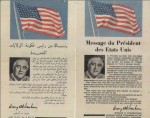
A message from U.S. Gen. Dwight Eisenhower to the people of Casablanca, found on the street of that city in 1942. (image from commons.wikimedia.org)

In the wake of invasion and military defeat in the summer of 1940, Adolf Hitler and the French government in Vichy, now headed by Marshal Pétain, concluded an armistice by virtue of which France was divided into an occupied zone and a non-occupied zone. The conditions imposed by Germany were at first relatively lenient: the French government retained partial autonomy in the occupied north and full autonomy in the non-occupied south. Vichy also retained varying degrees of control over the French colonial empire: while Algeria remained under direct French rule, Morocco and Tunisia had the status of protectorates under their native rulers supervised by France. In Morocco, King Mohammed V defied France by refusing to apply Vichy’s antisemitic laws. In Tunisia, Gestapo and SS followed Erwin Rommel’s army and, in 1942, rounded up the Jewish population for deportation to the Nazi death camps.

In the spring of 1942, strong disagreements among the Allies came to light in regard of the strategy to adopt against Germany. While President Franklin Roosevelt initially leaned in favor of Josef Stalin’s insistent demand for a landing in Western Europe in 1942, in the end, he reluctantly rallied to Prime Minister Winston Churchill’s view that such a landing at that time could not possibly succeed. He believed that the Allies would not be ready for this risky operation until late in 1943, or even 1944. Churchill proposed that, instead, an Allied landing be staged in North Africa, in order to deny Germany and Italy full control over the Mediterranean and compel Rommel’s army, which was retreating from Libya, to fight on two fronts.

In preparation for this operation, the Americans entered into secret contacts with the anti-Vichy underground in Algiers to enlist its assistance in the landing, albeit with some reluctance since the United States still recognized the legality of the Vichy government with which it maintained diplomatic relations.

Such is the background of Operation Torch placed under the command of Gen. Dwight Eisenhower. On the morning of Nov. 8, 1942, a mostly American fleet of more than 100,000 men landed under air cover on the coasts of Morocco and Algeria. Three days later, the Germans violated the armistice of 1940 and invaded the southern zone of France in collaboration with the Italians.

In the port of Algiers, the landing was greatly facilitated by the local resistance, composed in the main of young students, who effectively sabotaged the communications of the local French military, seized public buildings and even arrested two of the top commanders: Admiral François Darlan, Pétain’s former prime minister, and Gen. Alphonse Juin. It is important to note that two-thirds of these 400 young resistance fighters were Jews. The French authorities in Algeria were fanatically devoted to Vichy and so zealous in the implementation of that regime’s antisemitic legislation, that they established internment camps in the Sahara in preparation for the round-up and deportation of the Jewish population to the death camps of Europe. Vichy also deprived the 116,000 Jews of Algeria of the French citizenship that had been awarded them in the 19th century.

What happened after the Allied landing is simply shocking. The young Jews, whose support facilitated the capture of the Algerian capital, were abandoned to whatever fate had in store for them. Instead of handing North Africa to the control of the Free French Forces organized by Gen. Charles de Gaulle from London, the Americans allowed Vichy’s stooges to remain at the helm.

What happened after the Allied landing is simply shocking. The young Jews, whose support facilitated the capture of the Algerian capital, were abandoned to whatever fate had in store for them. Instead of handing North Africa to the control of the Free French Forces organized by Gen. Charles de Gaulle from London, the Americans allowed Vichy’s stooges to remain at the helm.

Roosevelt despised de Gaulle and his Free French Forces, and chose to place in command of the French army of North Africa, whose commanders, including Darlan, resented Germany’s violation of the armistice of 1940, the semi-Vichyste Gen. Henri Giraud. The young anti-Vichy fighters were for the most arrested and interned in the Sahara. Some of them narrowly avoided being executed. The Vichy laws remained in force. De Gaulle eventually rallied a number of generals in charge of colonial troops in French Equatorial Africa and arrived in May 1943 in Algiers, where he established the authority of Free France, invalidated the Vichy laws, and restored to the Jews their French citizenship.

Unfortunately for those of us who grew up revering him, Roosevelt’s connivance with Giraud and Vichy’s military commanders, and politicians in Algeria who had conveniently changed sides, was not the only instance of his betrayal of the hope that our people had pinned on him during the dreadful years of the Shoah. As for de Gaulle, the sympathy that he expressed for the suffering of our people at the time of the liberation of France and his sadness-filled admonition to his Jewish soldiers in the Free French Forces that antisemitism was not dead, were expressions of a friendship, which unfortunately did not survive the temptations of realpolitik and opportunism. On the morrow of Israel’s victory in the Six Day War of 1967, de Gaulle labeled the Jews a “proud and domineering people” and turned France from an ally into an enemy of Israel.

It took nearly half a century for the Jewish resistance in France to win official recognition; for the members of the Jewish communist urban underground, even longer. The Jewish contribution to the liberation of French Algeria is only now beginning to be written about.

René Goldman is professor emeritus at the University of British Columbia.

Format ImagePosted on January 17, 2014March 31, 2014Author René GoldmanCategories Op-EdTags Alphonse Juin, Charles de Gaulle, Dwight Eisenhower, François Darlan, Franklin Roosevelt, Free French Forces, French Algeria, Henri Giraud, Marshal Pétain, Operation Torch, resistance fighters, Vichy, Winston Churchill

Stamp collector Ed Kroft wins awards

Collect postal history and you learn not just how mail has traveled in years past, but also how people lived and functioned. Just ask Ed Kroft, a collector and historian of postal history from Israel who was recently awarded the 2013 Leslie Reggel Memorial Award by the Society of Israel Philatelists (SIP) for his outstanding contributions to Israel philately.

photo - Ed Kroft
Lawyer Ed Kroft, an avid stamp collector, was granted the 2013 Leslie Reggel Memorial Award by the Society of Israel Philatelists.

Kroft is a Vancouver tax lawyer and ardent collector of postal history who started collecting stamps at the tender age of 10. “My teacher at Associated Hebrew Day Schools in Toronto, Ed Deutsch, would bring his stamp collection to school to show us, and he focused on the stamps of Israel,” he recalled. “We formed a stamp club at school and later, I worked at a stamp store to put myself through university.”

Stamp collecting has changed significantly over the years, as many people have moved from soaking stamps off the paper they were used on, to collecting postal history and learning to understand the postmarks and information on the envelopes that contain those stamps.

“Postal history tells a story about how mail has traveled, which requires you to learn about the area, the population, how to read postmarks and envelopes,” he said. “The beauty of collecting postal history as opposed to collecting stamps is that you’re collecting different pieces of mail and trying to describe the history of the postal services.”

In a room filled with bookshelves containing the vast collection he’s amassed, Kroft has binders containing mail that originated in Israel but was destined for many different corners of the world, from New Zealand and Australia to South Africa, Argentina, the Caribbean islands, Brazil and Chile.

“As a Jew, I care about this because it’s interesting to see where Jews were at that time,” he said. “This collection gives me connections to Jewish culture and identity, Jewish history, geography, events, places, buildings and customs. This is part of our heritage, and we can’t let this history disappear.”

Kroft’s collection of mail from the Holy Land dates from the 1870s to the present day. From one binder, he pulled out an envelope inscribed by Ze’ev Jabotinsky to one of his relatives in 1918, and another written to Jabotinsky by his mother. There’s an envelope written by Captain Joseph Trumpeldor and another by Sir Moses Montefiore. While the letters are often no longer in those envelopes, the envelopes offer evidence about the passage of mail, Kroft explained.

The Society of Israel Philatelists is a nonprofit dedicated to studying and promoting Israel philately, with members all over the world. Kroft joined SIP in the mid-1970s and has been an active member ever since, currently serving as its president.

“My collection of Holy Land philately has helped me make many friends around the world who have common interests,” he said. “It’s taught me a lot about Judaism and brought to life things I learned when I was much younger.”

His collections include the history of Rishon LeZion from settlement through statehood, 1882-1948, a history of prisoners of war in 1948-1949, and the history of the Carmel Wine Co., among others. Each one tells a story through postal history, a story about which Kroft is passionate, eager to learn more about and committed to teaching others. “I’m honored to win the award,” he said. “The people who preceded me were extremely knowledgeable and great collectors.”

For now, he is intent on keeping the future of SIP bright by spreading information about its members and their work, and he is hoping to attract new collectors to its ranks.

Kroft will be speaking on The Relevance and Enjoyment of Philately, the Hobby of Stamp Collecting, to Jews in the 21st Century, on Jan. 30, 7:30 p.m., at Temple Sholom Synagogue.

Lauren Kramer, an award-winning writer and editor, lives in Richmond, B.C. To read her work online, visit laurenkramer.net.

Posted on January 17, 2014May 1, 2014Author Lauren KramerCategories LocalTags Leslie Reggel Memorial Award, Society of Israel Philatelists, Temple Sholom Synagogue

Posts pagination

Previous page Page 1 … Page 661 Page 662 Page 663 Next page
Proudly powered by WordPress