Research in genetics

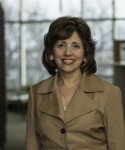
Dr. Cheryl Rockman-Greenberg (photo from Dr. Cheryl Rockman-Greenberg)

“There are approximately 7,000 rare diseases, each individually very rare. But, when you look at them as an aggregate, rare genetic metabolic disorders, they affect approximately one in 15, or two million, Canadians.”

Although there are various ways to define what constitutes a “rare genetic disorder,” Winnipeg-based Dr. Cheryl Rockman-Greenberg told the Independent, “One definition is that a rare disease is one that only affects one in 12 or fewer individuals in the general population, or some have defined it as disorders affecting a maximum of 1,000 to 2,000 individuals.”

Rockman-Greenberg specializes in medical genetics and genetic metabolic disorders. She said rare diseases represent a disproportionally large percentage of Canada’s medical, health-care and pycho-social burden.

Children who have a genetic rare disease experience high morbidity and mortality in the first two years of life. Phenylketonuria (PKU) is one of the more well known and, before a newborn baby leaves a hospital, he/she undergoes a heel poke. According to the Mayo Clinic website, PKU is an “inherited disorder [that] causes an amino acid called phenylalanine to build up in your body. PKU is caused by a defect in the gene that helps create the enzyme needed to break down phenylalanine. Without the enzyme necessary to process phenylalanine, a dangerous buildup can develop when a person with PKU eats foods that are high in protein.”

“Every baby born in Manitoba is screened for a whole series of rare metabolic diseases,” said Rockman-Greenberg.

Newborn screening programs have been in place across Canada since the 1960s and have expanded over time as treatment options, and the ability to diagnose disorders right after a baby is born, have increased.

“PKU only affects one in 15,000 children, but it’s an important metabolic disorder,” said the doctor. “Untreated children with PKU have severe developmental problems.”

Through research, it was discovered that PKU can be controlled by providing a special diet and, if treatment is started early, any damage can be completely prevented.

“These are all hereditary disorders. These metabolic disorders I treat or that are screened for at birth are all caused by one single gene pair, where there is a mutation in both copies of the gene,” said Rockman-Greenberg.

“Remember, genes come in pairs as two copies of the gene. And, if there is a misprint in each copy, if the child has misprints in both copies of the gene, then that condition is manifested. The genetic abnormality is the most significant factor for what causes the signs and symptoms. The environment plays little role overall.”

In the last few decades, more resources have been put into research. A big step in this direction was in the United States, with the Orphan Drug Act of 1983, which gave incentive to companies to develop treatments for rare metabolic diseases. Canada does not yet have such a policy.

“If you can imagine developing a treatment when there may be 50 patients in the whole country,” said Rockman-Greenberg. “It’s, first of all, a very expensive venture. For the industry, it’s much more profitable to do a drug trial for a common disease that may affect thousands and thousands of people.”

Regardless, the number of drugs that have been developed by companies prepared to invest in the research of rare diseases has increased.

“For many of these rare diseases, there are or have been excellent clinical trials over the past decade,” said Rockman-Greenberg. “And when the clinical trials have shown that a treatment is effective and safe, then more and more of these drugs get licensed and become available to treat patients.

“And then industry has stepped in and shown a commitment for drug development. This has greatly increased the number of diseases, rare metabolic diseases, that were not amenable to treatment but now have the potential for an effective treatment. So, a lot of the barriers have been removed … [because of] good research by industry and basic research by university scientists.”

Another factor that has helped change the landscape is the development of national patient groups.

“Parents and patient groups are extremely effective,” said Rockman-Greenberg. “They have really brought together the rare disease community that, in the past, has been very fragmented. Now, there’s a national voice through the Canadian Organization for Rare Diseases (CORD), Canada’s national network for organizations representing all those with rare diseases.”

“There are many disorders – rare, ultra-rare diseases – where we had seen babies die early of the disease. Now, the potential of treatment, viable and good quality survival, good quality of life … that’s what being a doctor is all about.”

Of these changes that have enabled her to provide better care for patients, Rockman-Greenberg said, “It’s wonderful. There are many disorders – rare, ultra-rare diseases – where we had seen babies die early of the disease. Now, the potential of treatment, viable and good quality survival, good quality of life … that’s what being a doctor is all about.”

Looking ahead, Rockman-Greenberg is optimistic. “In general, there are more and more incentives for drug development for rare metabolic diseases, so I see the metabolic community continuing to participate in clinical trials,” she said. “The development of therapies and, then, another major role that we as doctors have is to help ensure that patients have access to these promising therapies.

“We have to make sure that there are programs in places in all the provinces and territories that are going to allow patients to have access to these treatments. So, there’s lots of work that needs to be done and physicians have to be part of this dialogue with industry, governments and stakeholders to ensure we can make real change for patients with rare diseases.

“It’s one thing to find the cause for a rare disease. It’s another thing to prove a treatment is effective through clinical trials. But, at the end of the day, we have to make sure patients who aren’t candidates for treatment trials have access to care.

“We need to make sure as many people as possible are aware of the existence of rare metabolic diseases and how complicated they are, what a burden these diseases have on the patients and their families, but also about the many programs being developed to help research and develop new treatments, and help them connect to patient support groups that assist rare-disease patients.”

Rockman-Greenberg is the director of the metabolic service and a clinical geneticist in the program in genetics and metabolism of the Winnipeg Regional Health Authority. She is also a professor in the department of pediatrics and child health, and the department of biochemistry and medical genetics at the University of Manitoba. She grew up in Montreal and moved to Winnipeg in 1978. In January 1979, she began working at Winnipeg Children’s Hospital. As both a pediatrician and medical geneticist, she sees patients throughout their lifespan.

Rebeca Kuropatwa is a Winnipeg freelance writer.
Technology for clean water

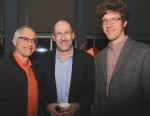
Weizmann Canada event speaker Dr. Brian Berkowitz, centre, with attendees David Berson, left, and Raffi Reitzik. (photo by Sydney Switzer)

Everyone who attended the Oct. 15 lecture The Quest for Clean Water left the intimate theatre at Science World with a thoughtful look, still digesting the sheer mass of information Weizmann Institute of Science Prof. Brian Berkowitz shared.

The event was introduced by local Weizmann Canada chapter member Dr. Hillary Vallance, a medical biochemist at B.C. Children’s Hospital and a professor at the University of British Columbia. UBC Prof. Jonathan Berkowitz took the stage next to give a more in-depth and personal introduction of the speaker, who happens to be his brother.

Brian Berkowitz heads the department of earth and planetary sciences at the Weizmann Institute in Rehovot, Israel. His talk took many twists and turns, the topics ranging from recent developments in his lab around technologies in water purification, to nanoparticles in sunscreen. He took the audience into the world of hydrology (the study of water), sharing facts, advice and stories.

He began with the message of how interconnected everything is on the planet. But one example is the regular occurrence of a dust cloud from the Sahara blowing minerals to the Amazon to enrich the soil in the rainforests there. He believes that “greening” the Sahara would kill the Brazilian rainforests. In addition, he predicts that, within as little as a decade, parts of Europe and North America will become much cooler because of interference of the melting glaciers in Greenland with an oceanic current.

The Weizmann Institute has some 2,700 staff and students who explore basic science, he explained. And it is this freedom to delve into basic science that has produced so many breakthroughs, including those in the area of water purification.

“Working at the Weizmann Institute is a dream job,” he said. “I know my research will be supported, that I can get expensive equipment if I need it, with no pressure. The only thing I need to do is be the very best in the world at what I’m doing.”

Diving into the topic of the evening, Berkowitz said that, in northern Alberta, there are vast pools of water made highly toxic by its use in oil production. The water came from the Athabasca River and sits in pools, contaminating the environment, untreated.

Berkowitz has discovered a technology that would not only decontaminate this water, but could make it so clean that it would be drinkable. Why is it not being used? “The technology is expensive,” he said. “More importantly, it is difficult to change people’s perception about where the water came from, so they don’t want it back into their water systems even though it’s been purified.”

He gave the example of an experiment where people were asked first to swallow regularly a number of times. Then they were asked to spit into a glass of water and drink their own saliva mixed with the water. The subjects found it difficult to stomach their own saliva. This simple study illustrated the difficulty in convincing governments to give the go ahead on releasing water that was once toxic waste.

Another challenge with the technologies that his and other labs produce is the expense of getting them to market. Berkowitz said investors are looking for a big, quick return and, at this stage, making clean water does not generate the kind of money necessary for the capital required. Even governments are not yet prepared to invest. Eventually, there will be little choice but, for now, much of Berkowitz’s technology stays with the Weizmann Institute, ready for the future.

Although it is frustrating that existing technology sits idle instead of cleaning up environmental disasters, Berkowitz had some good news. He discussed ways in which perceived water shortages can be mitigated. “Most cities waste 30% of their clean, treated water through leaky pipes,” he said. “It’s not so much an issue of shortage, as a distribution problem.” He also encouraged people to eat less beef. “It takes 15,000 litres of clean water to produce one kilogram of beef. If people ate less meat, we’d save a lot of water.”

Berkowitz explained how he has made a number of groundbreaking discoveries by being in the right place at the right time. He spoke of an experiment that caused an explosion in his lab when he was out for lunch – and led to the discovery of a technique using nano-disruptive technology to purify very polluted water completely in eight hours.

Berkowitz then took questions from the audience, which led to a discussion on the organic food movement and the dangers associated with the “natural” elemental chemicals used in organic farming that he believes are, in many cases, more harmful than manufactured pesticides. He also opened other cans of worms with examples of how pharmaceuticals are polluting the world’s water supply; which foods absorb toxins through groundwater; why sunscreen is scary; and his new project that uses MRIs of rocks to predict how long an oil spill will take to reach groundwater. All topics, hopefully, of future Weizmann lectures.

For more information on how you can become involved with the Vancouver chapter of Weizmann Canada, contact development associate Camille Wenner at 604-260-8506 or 604-315-4430 (cellphone), camille@weizmann.ca or via weizmann.ca.

Michelle Dodek is a freelance writer living in Vancouver.

From mundane to medical

The Vancouver Israeli Technology Club team on Oct. 7 with event speakers, left to right: Ronen Tanne (VIT), Prof. Ran Goldman, Ido Sarig, Eran Elizur (VIT), Consul General D.J. Schneeweiss, Yaron Bazaz (VIT) and Rod Zehavi. (photo by Rinat Lanciano)

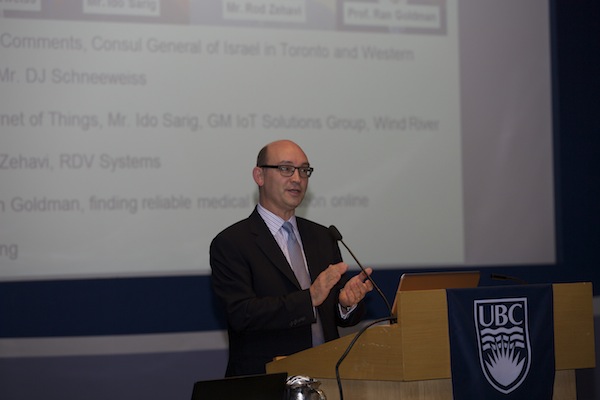
At the University of British Columbia Robson Square Theatre on Oct. 7, the Vancouver Israeli Technology Club (VIT) held their sixth event.

VIT was started in December 2013 by local entrepreneurs Ronen Tanne, Yaron Bazaz and Eran Elizur, who all have moved from Israel to Vancouver. Tanne is now mostly interested in cybersecurity and is co-founder of a startup company in Israel that is developing a security platform focused on the Internet of Things (IoT). Bazaz has started several companies related to social media, his most recent startup being Downtown, a mobile app that has been named the “Waze for Pedestrian Traffic.” Elizur has gained a wealth of experience in commercializing technology for large organizations, such as Creo, as well as starting his own company, KaleidoFlex, which was sold to an Asian display manufacturer a few years ago.

VIT’s mission is to create an ecosystem for Israeli and Jewish technology entrepreneurs, professionals and investors in British Columbia to meet, exchange ideas and collaborate with the general tech and investment communities in the region. Now numbering more than 450 registered members, the nonprofit society is completely funded by sponsorships, which cover the cost of running events.

The recent event attracted more than 200 people. It was sponsored by the Centre for Israel and Jewish Affairs, the Jewish Federation of Greater Vancouver, McKesson Corp., Second City Real Estate, Navigate Surgical and Kodak.

After networking and refreshments, VIT welcomed D.J. Schneeweiss, consul general of Israel in Toronto and Western Canada, as the opening speaker. Schneeweiss spoke about the importance for Israel to maintain its relationship with the “Israeli diaspora” and commended VIT on its work and growth.

photo - Consul General D.J. Schneeweiss gives the opening address at the Oct. 7 VIT event
Consul General D.J. Schneeweiss gives the opening address at the Oct. 7 VIT event. (photo by Rinat Lanciano)

The keynote speaker was Ido Sarig, general manager of the IoT division in Wind River, an Intel subsidiary. Sarig, who was invited from Silicon Valley to present at the event, spoke about the IoT revolution and how it will transform people’s lives – when everyday appliances such as cars, home appliances and other objects (“things”) will be connected to the worldwide web. It is predicted that, over the next few years, the IoT revolution will connect more than 50 billion devices to the internet, compared to around 10 billion today (mostly mobile devices and smartphones).

Sarig spoke about the possibility of connected cars. By communicating with other cars and with their surroundings, cars will be able to drive, navigate and find parking autonomously without a driver. This could reduce congestion on roads and save gas. Furthermore, since connected cars comply with traffic rules better than human drivers and never drive under the influence of alcohol or drugs, this would also make them safer. Several big players, such as Intel, Google, Microsoft and IBM, are already establishing dominance in this field, but Sarig said there are also opportunities for startups and new players to make an impact in this emerging market. He pointed out that, as more “things” become connected, more security concerns will arise, as well as more opportunity for developing predictive analytics and remote diagnostics.

Following Sarig’s talk, two local entrepreneurs provided overviews of their companies.

Rod Zehavi, chief executive officer of RDV Systems, spoke about his company’s virtualization software, which caters to professionals in the architecture, engineering and construction sectors. It enables them to bring their projects to life by creating video clips of what their final project would look like using professional design files. Zehavi called this a “video game for professionals” since one can navigate in the virtual project and get multiple views of the end result. This could significantly reduce development times and facilitate decision-making. The RDV software has a mobile version, which allowed Zehavi to take event attendees on a virtual tour of a new construction project in Modiin, Israel, using their smartphones.

Finally, Prof. Ran Goldman of UBC and B.C. Children’s Hospital spoke about finding and using medical information online. Goldman pointed out that our habit of searching the internet for medical information to self-diagnose has led to a new disease: cyberchondriasis. This is the unfounded escalation of concerns about common symptoms based on reviews of online health searches. Goldman gave examples from his experience in the hospital’s emergency room. One story he shared was about a mother whose child had a skin rash, which she thought was an abscess. A friend directed her to a website that recommended a home treatment using heat, and she ended up burning her child by applying a glass full of boiling water to his rash before taking him to the ER. Goldman and his team have developed Med School for Parents, which is an online tool that helps parents of young children find reliable medical information.

After the speakers, program attendees had more opportunity for refreshments and networking. Tanne, Bazaz and Elizur have already begun working on the next event, as well as other plans for VIT’s future.

Canadian machalnikim

The Machal memorial, in Jewish National Fund’s Yitzhak Rabin Park. (photo from machal.org.il)

You would think that, after serving in the Second World War, you would just want to pick up where you had left your civilian life. Indeed, the vast majority of Jewish and non-Jewish Canadian soldiers did so. But some 300 Canadian fighters joined more than 4,100 volunteers from almost 60 countries to fight for and maintain Israel’s independence. They were referred to as machalnikim, machal being an acronym in Hebrew for mitnadvei chutz l’Aretz, or “overseas volunteers.”

According to Smoky Simon, World Machal chair, four interrelated factors impelled the volunteers to keep fighting: the Holocaust, the British deportation of Holocaust survivors, the Arab threat to wipe out Palestine’s Jewish population and the feeling of Jewish unity, particularly in times of major crises.

These veteran fighters provided inexperienced Israeli forces with much-needed military knowledge and leadership. For example, Torontonian Ben Dunkelman claimed that “Canadian pilots accounted for one-third of all Arab planes shot down in that war.” In fact, John McElroy, a Canadian Second World War ace, succeeded in doing just that.

Following Israel’s independence, Machal volunteers built the radar system for the then-infant Israeli army. According to Rabbi Dr. Joe Heckelman, in his 1974 book American Volunteers and Israel’s War of Independence, this “early warning” system identified intruder planes “at relatively great distances.” Until mid-1949, a significant number of Machal personnel worked on the radar unit, then called Squadron 505.

Other Canadians volunteered for other kinds of service. Thus, Toronto-born Leonard Fine, who had served for five years as a physical training instructor in the Royal Canadian Air Force, joined the Israeli 72nd Infantry Battalion of the 7th Brigade. Dunkelman commanded this brigade. The only two platoons of the completely English-speaking B Company successfully removed problematic Arab Liberation Army observers and snipers situated on the Kabul mountains, overlooking the small Arab village of Tamra. Canadian volunteer Sidney Leisure died in the shooting. A month later, Fine became the sergeant major of the support company.

Another former member of the Canadian Air Force also switched military careers in Israel. Montreal-born Willie Rostoker volunteered to staff immigrant ships, undaunted by the fact that he had no sailing experience. Rostoker was quick to learn, and started studying navigation and other seaman’s skills. He proved to be a very good helmsman. Between 1946 and 1948, he worked on several Aliya Bet ships, including Ulua (aka Chaim Arlosorof), which docked in Palestine on Feb. 27, 1947; Pan York (aka Kibbutz Galuyot), which arrived in Palestine on Jan. 1, 1948; Fabio (aka the Battle of the Ayalon Valley), which made it to shore on May 29, 1948; and the Kefalos (aka the Southerner), which steered into Israel on Nov. 23, 1948. In addition, before the ma’apilim (Jews who tried to enter Palestine during the British blockade) set sail on the Battle of the Ayalon Valley, Rostoker trained them. When the fighting ended, he made Israel his home.

Speaking of ships, David Azrieli reports in Rekindling the Torch: The Story of Canadian Zionism (2008) that, during this period, two Canadian corvettes were purchased as “freighters” – the Beauharnois, renamed the Josiah Wedgwood, and the Norsyd, dubbed Aliya Bet Haganah. Canadian Moishe Sokolov volunteered to sail with the Haganah. It was supposed to transport 1,200 refugees and return for more people. But, once in Yugoslavia, the crew learned it would be the last Aliya Bet ship allowed into Palestine. Hence, orders were to take as many refugees as possible: 2,600 boarded, with about half below deck and half on deck. According to information obtained from the World Machal website: “It was so crowded that the ones above could not get below, and the ones below could not get topside. It was a very difficult and dangerous trip for all, passengers and crew alike, but all the refugees got to Palestine.”

After Israeli independence, the vessels were reactivated and renamed the Hashomer (Guard) and the Haganah (Defence). The vessels engaged Egyptian warships, bombarded enemy positions and patroled the shoreline. Their biggest coup came on Aug. 24, 1948, when the former Canadian corvettes seized a huge cargo of arms intended for the Arab armies. In what was called Operation Pirate’s Booty, the Hashomer and the Haganah intercepted the Argiro, a ship sailing under the Italian flag. The Israeli crew members found 8,000 rifles and 10 million rounds of ammunition.

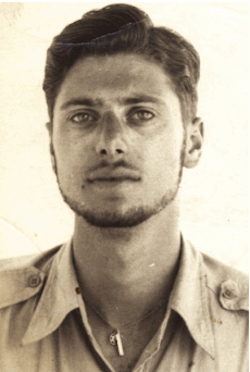
photo - Canadian Machal volunteer Joe Warner, who is now 90 years old
Canadian Machal volunteer Joe Warner, who is now 90 years old. (photo from machal.org.il)

Although not from a Zionist background, Canadian Joe Warner, now 90 (and going strong), joined the fighting because he felt “it won’t be worth being a Jew elsewhere if Israel did not survive.” He fought in southern Israel, in the Faluja area. The battles in which he participated helped free the Negev from Egyptian control of main roads. The combat – especially around the strong concrete police fortress of Iraq-Suidan – was intense. Years later, when Warner visited the Givati Museum established at that very spot, he found the captured Egyptian cannon his anti-tank unit had used.

Warner had been training as a pharmacist after his Second World War discharge. So, in Israel, he was called upon to be a pharmacist/ medic. He responded by setting up a first-aid station at Hazor, making use of medical equipment and supplies seized from the Egyptians. This early hands-on experience apparently served him well, as for 15 years he helped establish and manage Pfizer drugs in Israel.

In contrast to Warner, now 91-year-old Batya Wolfson Lam had a strong Zionist background. As a member of Toronto’s Shomer HaTzair, she had made aliya in 1947 or 1948. After three months of boring work on Kibbutz Sasa, she jumped at the call for volunteers to help in the fighting. She joined Machal, as the pay was slightly higher than the pay received by regular Israeli soldiers. She was assigned to the English-speaking air force codes and ciphers department. There, she received messages that she forwarded in secret code. She first worked at a station on Yarkon Street in Tel Aviv but, after a year, she opened stations in Jerusalem, Dorot, Yavniel and Haifa. She trained the staff for these locations. She served in the army for two years, returning briefly to Sasa. Then, she moved to Kibbutz Eindor, where she met her husband. Although her four children chose not to remain on the kibbutz, she has lived there for more than 70 years. She regrets that Machal volunteers haven’t received more recognition for their contribution to Israel.

Mention must be made of the Canadian volunteers who lost their lives in Israel’s fight for independence. They include both Jews and non-Jews. According to Heckelman and World Machal, they were George (Buzz) Beurling, Wilfred (Zev) Cantor, William (Willy) Fisher, Leonard (Len) Fitchett, Sidney Leizerowitz, Edward Lugech, Ralph Moster, Sidney Rubinoff, Reuben (Red) Schiff and Fred Stevenson. Two cousins, Harvey Cohen and Ed Lucatch, are not recorded to have joined any army unit; they disappeared without a trace.

Deborah Rubin Fields is an Israel-based features writer. She is also the author of Take a Peek Inside: A Child’s Guide to Radiology Exams, published in English, Hebrew and Arabic.

דואר קהילתיות

קנדה פוסט מקפיאה את החלטתה להפסיק לחלק דואר דואר לבתים פרטיים. (צילום: Bernard Gagnon via commons.wikimedia.org)

תוצאות ראשונות של ניצחון הליברלים בבחירות לטובת האזרחים: קנדה פוסט מקפיאה את החלטתה להפסיק לחלק דואר דואר לבתים פרטיים

הניצחון המוחץ של המפלגה הליברלית בבחירות בתשעה עשר באוקטובר ותבוסת מפלגת השמרנים, מביאה כבר לשינוי משמעותי ראשון לרווחת התושבים. רשות הדואר הקנדית קנדה פוסט החליטה בימים האחרונים להקפיא את החלטתה השנויה במחלוקת, להפסיק ולחלק דואר לבתים פרטיים (בעיקר לאילו שנמצאים באזורים מרוחקים). מדיניות זו של קנדה פוסט נוגעת לכחצי מיליון קנדים, והיא נקבעה בשנה שעברה כביכול לאור הפסדים כספיים כבדים של רשות הדואר. השנה הרשות דיווחה דווקא על רווחים נאים במאזנה. כתוצאה מכך חלק גדול מבעלי הבתים הפרטיים נאלצים כבר בשנה האחרונה לאסוף את הדואר בעצמם, ממתקנים של תיבות דואר קהילתיות, שרבים מהם כבר הוקמו בכל רחבי המדינה. רבים מתנגדים למדיניות קנדה פוסט בהם כאמור המפלגה הלברלית שזכתה ברוב הקולות בבחירות, איגוד עובדי רשות הדואר כיוון שדוורים רבים יאבדו את מקום עבודתם, וכמובן אזרחים רבים.

בקנדה פוסט מציינים כי המדיניות לעבור לתיבות דואר קהילתיות תיבדק מחדש בעצה אחת עם הממשלה הליברלית החדשה, ברשות ג’סטין טרודו, שהושבעה השבוע. מכל מקום אילו שכבר אוספים את דברי הדואר שלהם מתיבות קהילתיות, ימשיכו לעשות זאת עד להודעה חדשה. ולעומתם אילו שתיבות הדואר הקהילתיות שלהן עדיין לא הוקמו, ימשיכו להינות מחלוקת דואר עד לביתם.

תושבת בירת קנדה אוטווה מצאה דרך מקורית להיאבק בקנדה פוסט שעמדה לבנות מתקן לתיבות דואר בסמוך לביתה. מרי-מאי דאוניג כועסת מאוד על רשות הדואר שהחליטה להקים מתקן של תיבות דואר קהילתיות, דווקא ליד הגינה המטופחת שלה, מול ביתה בו היא גרה לא פחות עשרים שנים. דאוניג ידעה כבר לפני כחצי שנה (בחודש אפריל) כי המתקן יבנה ליד ביתה, ומאז היא נערכת להיאבק כל הכוח ברוע הגזרה. כל בקשותיה מרשות הדואר שתעתיק את את המתקן למקום אחר עלו בתוהו. לפני מספר ימים אף הופיעו מספר עובדים של קנדה פוסט למקום ליד ביתה בכוונה להכשירו, להקמת המתקן. דאוניג הבינה שאין לה שום דרך להפסיק את הפרוייקט מלבד נקיטה בצעד פיזי יוצא דופן, ובתקופה האחרונה היא נשכבה במלוא קומתה כל יום על השטח שמיועד למתקן. היא פגשה במקום מפקח בנייה של רשות הדואר ואמרה לו מפורשות כי ההחלטה להקים את תיבות הדואר הקהילתיות, מנוגדת למדיניות הממשלה החדשה של המפלגה הליברלית. לדבריה הרשות שהיא קורפורשיין ממשלתי, אינה יכולה להתעלם מהחלטת הממשלה ומרצון הציבור הרחב שבחר בה. המפקח לא התכוון לעצור את בניית המתקן ודאוניג נערכה להמשיך ולשכב במקום כל יום. ולשמחתה שכנייה ואיגוד עובדי רשות הדואר תמכו במאבקה והבטיחו לעזור. אך כאמור קנדה פוסט החליטה בשלב זה להפסיק את המשך פרוייקט הקמת תיבות הדואר הקהילתיות, ודאוניג יכולה לחזור ולחייך והיא אינה צריכה עוד לשכב על האדמה הרטובה ליד ביתה.

מכרה יהלומים חדש בקנדה שבהקמתו הושקעו כמיליארד דולר

חברת ‘יהלומי מאונטיין פרובינס’ הקנדית (שמניותיה נסחרות בבורסת ניו יורק) תפעיל מכרה יהלומים חדש בשם ‘גאציו קיו’, שיכנס לפעולה במחצית השנייה של השנה הבאה. המכרה שמשתרע על פני שטח של למעלה מעשרת אלפים דונמים, נמצא בטריטוריות הצפון-מערביות, במרחק של כשלוש מאות ק”מ מעיר הבירה ילונייף. בבניית הפרוייקט מושקע סכום גבוה מאוד שנאמד ב-1.1 מיליארד דולר. בהקמת המכרה מועסקים כיום כשש מאות עובדים. ובעת יכנס לפעולה בשנה הבאה יועסקו בו כארבע מאות עובדים.