In search of perfect shofar

On the right track to finding a place to purchase shofarot. (photo from Steven Finkleman)

Heading down the B2 from Swakopmund to Windhoek, I could see by the road signage that this would be a prime location to search for the perfect shofar. As you can see from the signage, with each kudu, one would have two shofars to blow on Rosh Hashanah.

So, I went on the prowl for the perfect shofar in Namibia. When I was in Windhoek last spring and was at the airport awaiting my return flight to the big city of Johannesburg, I happened to notice a Chassidic man on my flight carrying several long, Yemenite-style shofarot. Although I didn’t speak to him at the time, it was clear that with an abundance of African antelope, Namibia could be a good source of shofarot for Jews all over the world.

Apparently, there are two types of shofarot that are kosher to use. The original was a ram’s horn, which is linked to the biblical account of the near sacrifice of Isaac. At the last moment, a ram tangled by its horns in the bush appeared to Isaac’s father, Abraham, and he sacrificed the animal instead of his son. The other style comes from Yemen, where there was an abundance of antelope, or more specifically kudu, from which the Jews in that country were able to make shofarot.
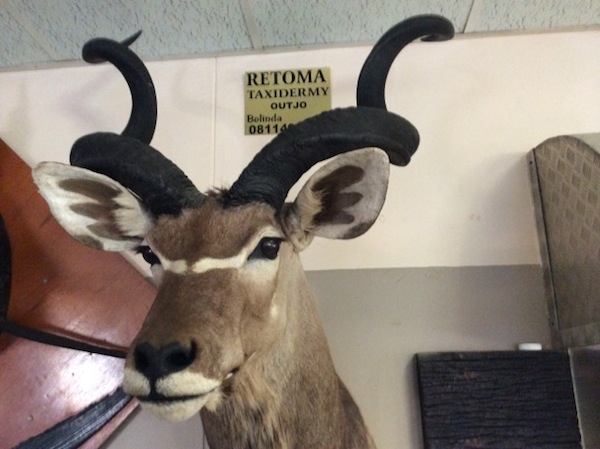
photo - A fantastic set of kudu horns
A fantastic set of kudu horns. (photo from Steven Finkleman)

Both styles are used today, and indeed in my own synagogue sanctuary is a painting by Gertrude Zack of a rabbi blowing a Yemenite-style shofar. Whether there are still kudu in Yemen is unclear to me. Perhaps, it is too dangerous for Jews to fly into Sanaa looking for kudu horns. Therefore, why not come to the safe locale of Namibia, known among tourists as “Africa lite” for a safe supply of kudu-horn shofars.

I was fortunate to have a work project this April in Windhoek and, clearly, one of my main goals, besides work, of course, was to track down that supply of kudu horns. It sounded like a great article: “In search of the perfect shofar, direct from its source.”

I made contact with Zvi Gorelick of the Windhoek Jewish community, and visited the synagogue, now about 80 years old, took some great pictures and attended the Friday night service. Theirs is a small community, very diverse and welcoming. Indeed, the second Shabbat, I had arranged to lead the service in my Reform style, with lots of traditional and vibrant Shabbat songs, probably quite distinct from the South African Orthodox service that the congregation was used to. Indeed, after services, I was fortunate to be invited to Barbara and Alexandra’s home for Shabbat dinner. All were welcome to join.

Once there, I was able to ask Zvi the all-important question in order for me to continue my quest for the perfect shofar. I was directed to the Nakara Tannery in the North Industrial area.

The two-dollar cab ride took me directly to the factory and the factory shop. Trying to keep things low-key and not to come across as a camera-happy tourist snapping four million pictures, I kept calm as I checked out the warehouse and then the factory store. The warehouse was filled with hides of all kinds, the most distinctive being the piles and piles of Zebra hides. Quite a sight. And, we think in Canada, it’s cool to have a bearskin on the wall!

As I entered the factory store, I noticed some kudu horns on the ground, polished, and some of very gaudy colorations – blue, orange, red, etc. Obviously not suitable for a shofar.
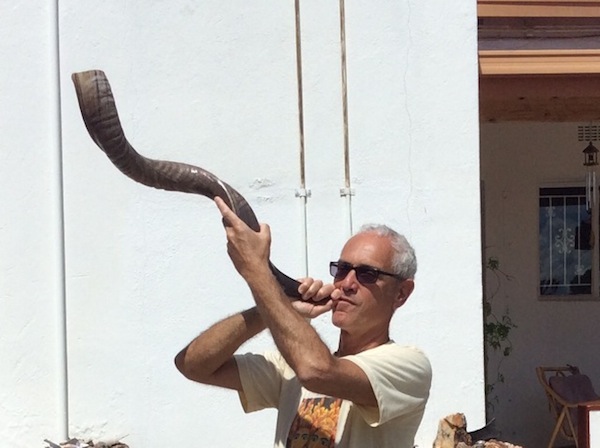
photo - Testing a shofar out in advance of Rosh Hashanah
Testing a shofar out in advance of Rosh Hashanah. (photo from Steven Finkleman)

Trying to play it cool, I asked the sales lady at the desk, Marie-Louise, if they sell vuvuzelas made of kudu horns. Do you remember all those horns at the World Cup soccer tournament in South Africa a few years ago? She replied in the affirmative, and as I stammered away asking for a kudu-horn sort of trumpet, she responded in her Afrikaans accent, and asked if I was interested in buying a shofar for Rosh Hashanah! I knew immediately that I was at the correct spot. I coolly ordered four, but subsequently placed an order for another three. Darn good price … perhaps I ought to import them. I wonder who is making the 10 times mark-up in North America!

I then asked to see the factory where the shofarot are made. Starting with raw skulls, the horns are removed, soaked in water to remove the central core, then polished, and finally the tip is cut off in order to turn it into a shofar. I took my usual million pictures of the workshop and the production line, and, of course, tested a few shofarot out.

As I packed up my multiple shofarot, I began to wonder what sort of grief the customs officials might give me with my suitcase of kudu horns. After all, I would be crossing multiple borders, into Botswana, Zambia, Zimbabwe, the United States and, finally, home to Canada. I’d tell them the truth, of course, that these are religious article; I was unlikely to run into any trouble. Right?

Steven Finkleman, originally from Winnipeg, is a retired pediatrician living in Kelowna. He travels extensively and often researches and visits remote Diaspora communities on his adventures.
Waldman Library’s holiday books for kids

Rosh Hashanah and Yom Kippur are nearly here! A memorable way to include some special inspiration for you and your children is to drop into the Isaac Waldman Jewish Public Library, where you’ll find a great variety of books perfect for both celebrating both of the High Holidays. Here are just a few of the new children’s books that you can find on loan.

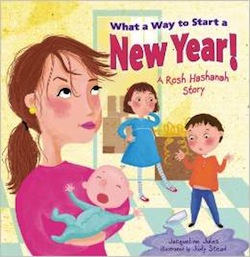
image - What a Way to Start a New Year coverWhat a Way to Start a New Year! A Rosh Hashanah Story. The complexities of both family and relating to a new community are thoughtfully explored in story of Dina and her family moving to a new city via the great value and resilience of tradition renewed in the High Holidays. Dina’s family life is expressively and colorfully illustrated by Judy Stead.

I’m Sorry Grover: A Rosh Hashanah Tale. Part of the enduring Shalom Sesame series, this is a delightful introduction to all the important aspects of Rosh Hashanah. Dear old Grover tells the funny adventure of Brosh, who has misplaced his favorite blue, woolly hat. In his search, his doubts are resolved and confidence and New Year happiness restored.

Apple Days: A Rosh Hashanah Story. Every year, in preparation for the holiday, Katy and her mom pick enough apples to make their special sauce. But this year brings the birth of a new baby cousin for Katy, so, apple picking is off. Not to worry, the family’s friends and neighbors come to the rescue. Dynamic illustrations complete a story as fresh and crisp as a first, sweet autumn apple.

The library has dozens of other books on the High Holidays, including the Sammy Spider’s First Series that are very popular with preschoolers, as well as lots of board books for babies and toddlers.

Take the books home or read in the library. Babas and Zaydas can drop in with their grandchildren, who can choose their favorite holiday story.

To see a complete list of library books, check out the library catalogue at jcclibrary.ca.

Keep the celebration going: HaTov v’HaMeitiv

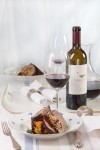
During a festival when people try and increase their “blessings,” adding many different wines provides the opportunity to keep proclaiming HaTov v’HaMeitiv. (photo courtesy of Yarden Inc.) 

The Rosh Hashanah meal is a festive affair. Traditions abound as to how the evening meal can bring good tidings for the year ahead. While some stick to apple and honey for a sweet new year, others recite a full array of blessings over various symbolic foods; from increasing in numbers like the seeds of a pomegranate to hopes of being the head not the tail, akin to the lamb’s or fish head that adorns some tables.

When reflecting on wishes for the upcoming season, one Rosh Hashanah tradition that continues throughout the year is that of the HaTov v’HaMeitiv blessing, recited when switching from one style of wine to another. In addition to its centrality for sacramental purposes, in ancient Israel, wine was cleaner and tastier than drinking water and it continues to be a focal element of Jewish culture. The custom is to celebrate the abundance of this joyful beverage, which symbolizes wealth, happiness and success. Given wine’s special power to “gladden the heart” and the uniqueness of each varietal, the sages instituted the special blessing. As opposed to regular blessings which, once recited, “cover” all similar food types, adding the HaTov v’HaMeitiv blessing maintained an awareness of the risks of mindless intoxication and proclaimed gratitude for the abundance of this most-sought-after beverage.

The sages were very clear that drinking alone could lead to sin or impropriety and that only when one is in the company of others could true joy be experienced, thus the blessing is said when two or more are present.

This blessing praising “He who is good and bestows good” is most commonly recited when switching between a white and a red wine, but it can be said when partaking in a wine of a different varietal, quality or style. It is said only when the second (or third, fourth or fifth) wine is of equal or better quality and when the wine is being drunk in company. The sages were very clear that drinking alone could lead to sin or impropriety and that only when one is in the company of others could true joy be experienced, thus the blessing is said when two or more are present.

Celebrating the good and enjoying superior-quality wines are wonderful ways to enhance the Rosh Hashanah table and raise the spirits of all the celebrants. During a festival, when people try and increase their “blessings,” adding many different wines provides the opportunity to keep proclaiming HaTov v’HaMeitiv. In time for the festive season, there are a number of high-quality Israeli wines that are hitting the shelves, yielding the chance to keep blessing good (and better) offerings.

From white to red

The Galil Viognier is a pleasant change from the more traditional white grape varieties. The Viognier is a challenging wine to perfect, but the Galil Mountain Winery, on the border of northern Israel, produces a flawlessly dry, yet extremely fruity and floral offering. Move from this more unusual white to an ever-loved red, the Gilgal Cabernet Sauvignon. Produced by the Golan Heights Winery, this classic red wine is a treat for any cabernet fan. Full-bodied and with an exquisite finish, the Gilgal Cabernet Sauvignon exhibits blackcurrant and cherry notes rounded out by earthy, spicy and oaky characters. While it is eminently drinkable upon purchase, recently wine experts in Israel have been opening decade-old bottles and have been surprised by its aging potential.

Novel blends, from fruity to complex

The Mount Hermon Indigo, named for its signature indigo color provided by a blend of syrah and cabernet sauvignon grapes, set new standards for affordable kosher wine when it was released last year. Now in its second vintage, it is a medium-bodied, fruity wine combining a deep plum flavor with hints of herb and a subtle smokiness. Move from the Mount Hermon Indigo to the Yarden 2T for a richer and fuller-bodied blended red wine. The Yarden 2T, like the Mount Hermon Indigo, shows off plum and cherry characters but this blend of two Portuguese grapes has been aged for 18 months in French oak barrels. The lengthy aging period enables the wine’s deep flavors to flourish and produces a richer, blackberry flavor coupled with Mediterranean spice and deep chocolate notes. The Yarden 2T stole the show this year at the Citadelles du Vin, France’s biggest wine awards, and raises the bar when looking for wine to top that which has been previously tasted.

Whites, from young to aged

Moving from a fresh wine to a richer and aged wine normally implies moving from a white to a red wine but it is possible to do the switch with two white wines. The Gilgal Riesling resembles the traditional rieslings emanating from Alsace and German regions. The Gilgal Riesling showcases the riesling’s familiar high acidity balanced with tropical and fruity aromas. It is a young and easy to drink wine, which underwent a short, cold fermentation and makes a great accompaniment to the first course of the Rosh Hashanah meal. Move from this easy-to-drink white to a richer, barrel-aged chardonnay such as the Yarden Odem Chardonnay. Produced entirely from grapes grown in the Odem organic vineyard on the slopes of the Golan Heights, this delicious, aged chardonnay combines a melt-in-your-mouth buttery flavor with aromatic pear, quince, apple and tropical notes. The Yarden Odem Chardonnay is aged sur lies for seven months in French oak barrels, giving it a rich and full body and one that will improve for a number of years to come.

When saying HaTov v’HaMeitiv, it is preferable to have the previous wine still open and remaining. This Rosh Hashanah, keep the wine flowing all evening and toast a l’chaim to a “good and better” year ahead.

Anna Harwood is a writer and clinical psychology student at Bar-Ilan University in Israel. She made aliyah from England at the end of 2010 and has been living in Jerusalem ever since.

Divine plan in the works

The key to understanding the confusing global landscape of the 21st century is to recognize that there is nothing normal or logical about it. If you’re confused by current events and concerned with the recent surge of antisemitism and the war with terrorists in Gaza, you may think that you have lost touch with reality – or maybe it’s the rest of the world that’s gone mad. Scanning the news, it sometimes seems as if the world now supports the bad guys over the good. However, if you look closely, you can see the Divine hand at work, the work of Divine providence and intervention. Why would G-d intervene in this way? Would G-d ever cause there to be irrational support for evil in the world?

The answer to this critical question is that the Almighty seeks to maintain a balance of power in the world at all times. It is often difficult to appreciate the significance of events as they unfold. When we look at a majestic tapestry, we can admire the work of the weaver, but we cannot see the back of the tapestry, with all its loose threads and knots, nor can we see the hard work that the weaver put into it or the amount of time it took them to weave such a masterpiece. In this way, the hand of G-d majestically weaves a wondrous and deliberate pattern on the tapestry of Jewish history. In order for humanity to have free choice, however, there must be a balance of good and evil in the world. In fact, in the most mindboggling illogical world events lies the deepest Divine providence and order; the chaos provides the perfect backdrop and balance for free choice and its maximum impact.

G-d’s plan is nothing short of incredible. In recent history, He has returned millions of Jews to their homeland, even though we are surrounded by tens of millions of hostile neighbors. Just this summer, terrorists in Gaza fired about 4,000 missiles at Israel. There were just a few fatalities.

My parents (may they live to 120) who live in Netanya heard a few rockets over the summer, and were so grateful when they found out that those missiles drowned in the Mediterranean Sea in the middle of the night. My sister who lives in Kfar Chabad, 10 kilometres from Ben-Gurion Airport, told me that she woke up one day to find a commercial Swiss Air jet and a huge Air Canada plane rerouted to a field just two kilometres away from her home. The airport had been closed to international flights. Watching with her grandchildren, she described how the aircraft were taking off and landing half a block from her house. My nephew was a tank commander in Gaza and, thank G-d, he came home safely.

photo - Israel support rally at VAG on July 27/14
The afternoon rally at Vancouver Art Gallery felt like a miracle in itself. (photo by Shahar Ben Halevi)

Given everything, it was miraculous that there were few Israeli fatalities. Nonetheless, most of us here in Canada felt helpless. However, Israel saw supporters gather in cities around the world. Here in Vancouver we had two rallies in just one day in late July to show our love for Israel and our gratitude to the soldiers of the IDF. In fact, the afternoon rally at Vancouver Art Gallery felt like a miracle in itself. Seeing my own sons with the Israeli flags draped round them and seeing them singing, dancing and being with community members from the Lower Mainland filled my and my husband’s heart with nachat. Holding up our posters and flags to cars driving by on Georgia, our hearts swelled with joy and pride. The sign I made and carried, the straw hat I wore with an Israeli flag through it, gathering with Jews and non-Jews in support of our homeland, I felt a true sense of unity.

What is our role in G-d’s plan for the world? How can we believe in G-d when there are so many things going on that we abhor? What can we do about it all?

Our role in this world is actually a mission that G-d gave all Jewish people. It is to join together in unity to create a peaceful and harmonious world. Some call this tikkun olam. If we’re worried about what’s happening in Israel, we can review some of the many thousands of miracles that G-d has made for us. In fact, we don’t need to worry, because G-d is in control, as we have seen so many times over these recent months. G-d has given each of us what we need to be able to fulfil our jobs in this world. We are called, “a light among the nations.” This means that we need to try to model ourselves as bright lights. How do we do that?

One way to do this is to teach by example. By making ourselves the best we can be and by helping our friends and families, as well. True, we can only have influence over those close to us, but we can engage them in doing mitzvot, for example, praying to G-d and saying psalms every day, including chapters 20, 130, 142, which are particularly relevant for our soldiers in Israel. Any mitzvah that we can do, big or small, can turn over any difficult times we may have. Doing mitzvot is the way we teach those around us to not feel helpless. On the contrary, we do mitzvot to feel special and important in G-d’s eyes.

Whether it be visiting someone who isn’t well, putting some coins in a tzedakah box, calling someone who may live alone and would appreciate a call, shopping with people who may be new to town and aren’t familiar with our city yet, the list is endless. That way, we are doing something instead of feeling helpless to change the situation. 

Whether it be visiting someone who isn’t well, putting some coins in a tzedakah box, calling someone who may live alone and would appreciate a call, shopping with people who may be new to town and aren’t familiar with our city yet, the list is endless. That way, we are doing something instead of feeling helpless to change the situation. That is how we find our belief in G-d increasing and we can sleep at night knowing that G-d is the one watching over us and His whole universe that He created. Doing mitzvot also guarantees that we will retain our own goodness and not, G-d forbid, fall into wanting to take revenge on Israel’s enemies.

When we celebrate Rosh Hashanah this year, we can also ask G-d to give us the faith that we may feel we have misplaced. It is a wonderful time of year as we go to synagogue to pray to G-d for ourselves, family, community, and to feel connected to G-d who loves us so much, as a parent loves an only child. When we wish each other “Shana tova u’metukah,” we are offering everyone we speak to a wonderful, sweet New Year with all their wishes coming true for them. Our blessings to each other are precious and we get many mitzvot for offering them. Then our faith will shine through us as we make the world a better place. Our hearts will be filled with joy when we hear the 100 blasts of the shofar each day of Rosh Hashanah, as we know we are asking G-d to grant us a year filled with health, happiness and only good for us and all our sisters and brothers around the world. What a wonderful feeling that is.

Shana tova u’metuka, have a wonderful, sweet year beginning with an apple dipped in honey, and then enjoy everything sweet in your life this special year of 5775. Celebrate in your special way with family and friends. May G-d give you the strength you may need this year to accept your gifts from G-d in an open way.

Esther Tauby is a local educator, counselor and writer.

For Jews, sorry is not enough

Christianity and Judaism have many customs and symbolism in common. Naturally, as the aphorism states, the child does not stray far from the mother. We both take vows to repair our character. But, in one area, we grossly diverge: the proclamation of the new year.

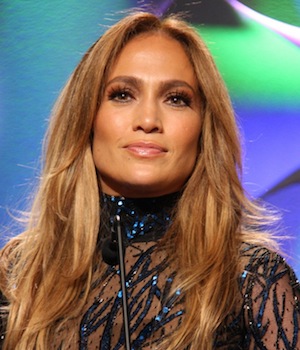
photo - It’s OK to lust after your neighbor’s Jennifer Lopez-looking wife – as long as you don’t act on that desire
It’s OK to lust after your neighbor’s Jennifer Lopez-looking wife – as long as you don’t act on that desire. (photo from Stemoc via en.wikipedia.org)

To put it plainly, New Year’s Eve to your Christian friends may be an office party with wine, stolen kisses and shrill music that drowns the clarion call of the shofar. Rosh Hashanah is both private and public sober meditation, as serious as death. You can tell it’s Rosh Hashanah even without a calendar when Jewish faces go serious – when Jewish eyes are not smiling.

In both religions, we reexamine our behavior, note our lapses and vow to improve our moral balance. But, in Judaism, ceremony and symbolism take the throne. The environment is much more regal. After all, we are asking of this shofar-announced first day of the year to come – the king of days, so to speak – mercy and goodness. And, above all, life. May that lump on your leg be benign. May Bennie turn a dark corner and find through honest labor the means to feed his family. We attempt to woo good fortune with a shofar blast, the bugle call of the Jewish warrior. We give tzedakah. We fling away our sins, contemptuous of our selfish errors of the past. This is the first bright, shining day of the year to come. Repent, so that the year to come will reflect the life to come. Sweet as the honey in which we dip our challah.

If we were a bit morally careless during the previous year, we bear down hard on the 10-day interval leading to Yom Kippur. We must be as angelic as a human can be so that we are properly inscribed in the Book of Life – and please, Sir, spell my name right. It’s one “b,” not two.

Forgiveness depends not only on repentance, but also on restitution. If I burned down my neighbor’s house, I must rebuild it. “Sorry” is not enough. I must repay my debts of insult, deceit, thievery and violence. And, to be heretical for a moment (rabbis, read no further) it is vulgar, but not a sin to lust after your neighbor’s wife who looks like Jennifer Lopez. So long as you suppress your evil inclination and take no action on your devilish desire.

Deeds, deeds, Judaism is all about deeds.

Ted Roberts is a freelance writer and humorist living in Huntsville, Ala.

Importance of prayer

The holy month of Elul has begun, the sixth month in the Hebrew calendar. There is a rabbinic allusion that the month was named from the initial letters of “Ani le dodi v’dodi li” (“I am my beloved’s and my beloved is mine”), describing the relationship between G-d and His people. In the Aggadah, we read that Elul has special significance because of Moses’ 40-day stay on Mount Sinai (Exodus 34:28), which was calculated to have begun on the first of Elul and ended on the 10th of Tishrei (Yom Kippur).

Every weekday morning, the shofar is sounded and Psalm 27 recited. Sephardim have already begun saying Selichot, but Ashkenazim recite this only in the last days of the month. The word selichah means forgiveness – it is a plea for forgiveness for sins and, as we approach the time when we know that we will be judged, we practise a kind of spiritual stocktaking. We look inward, trying to assess what happened to last year’s dreams/goals, asking pardon for wrongs committed and hoping, with repentance, charity and prayers, to be written into the Book of Life for another year.

Rav Nachman of Bratslav expressed it beautifully: “Every word of your prayer is like a rose which you pick from its bush. You continue until you have formed a bouquet of blessings, until you have pleated a wreath of glory for the Lord.”

Prayer takes on special meaning in Elul, as we move toward Rosh Hashanah, which celebrates the birth of the world. Then, we will recite the special prayer called Unetenah Tokef (“Let us proclaim the sacred power of this day…”) when we are reminded of our mortality. The translation for part of it reads: “Humanity’s origin is dust, and dust is our end. Each of us is a shattered pot, grass that must wither, a flower that will fade, a shadow moving on, a cloud passing by, a particle of dust on the wind, a dream soon forgotten…. But You are the Ruler, the everlasting G-d.” Legend has it that this prayer was written some 10 centuries ago by Rabbi Amnon of Mainz. Ordered to convert to Christianity by the local bishop, Rabbi Amnon refused. His limbs were amputated and, as his mutilated body lay before the ark as he was dying, he said these words, which are also part of the Yom Kippur liturgy.

When mystics pray, they believe there is an ascent of the soul to upper worlds. Prayers of thanksgiving and praise are deemed worthier than petitionary prayers (when we are asking for things), because they are selfless. Some people believe that the highest form of worship is silence. The Bible tells us that Abraham was the first to utter a true prayer – for his fellow man.

In these times, when we are at war, agonizing over our losses and the many families who have lost loved ones, we in Israel need to have faith more than ever. We pray for all Jews to have a good, safe year. We share a common destiny – Jews in Israel and abroad – and it is this shared destiny that binds us together, no matter how different our ethnic and cultural boundaries may be.

I memorized the following poem when I was a schoolgirl. I never knew the author, and doubt that he was Jewish, but I think it is appropriate now and all the year: “I shall pass through this world but once / Any good therefore that I can do / Or any kindness I can show / To any human being / Let me do it now / Let me not defer it or neglect it / For I shall not pass this way again.”

Dvora Waysman is the author of 13 books, which are available through Amazon, or from the author at ways@netvision.net.il. Her website is dvorawaysman.com.