
A grandfather’s sins

Prof. Roger Frie’s  Not in My Family rises above the merely personal (image from cenes.ubc.ca)

Forty-three years ago, at Vancouver’s first Holocaust Symposium, for which I was the chair, the keynote speaker was the Lithuanian partisan fighter Leon Kahn. His presentation to a large group of high school students described, among other things, how he watched, in hiding, while his mother and sisters were raped and murdered by members of the Einsatzgruppen – the murderous “task forces” mandated to kill Jews by gunshot (the so-called “Holocaust by bullets”) in German-occupied countries. Approximately two million Jews were murdered by the Einsatzgruppen.

After Leon was finished speaking, a tall, blond, blue-eyed boy walked slowly up to the podium. He was, he said, of German origin, and wanted to apologize to Leon. His face revealed how devastated he was. Leon shook his hand and told him, “Look, it wasn’t your fault. Now go on and live your life.”

That was my first experience with deutsche Schuld, German guilt.

There are literally hundreds of books and websites approaching deutsche Schuld from every angle. The author of Not in My Family: German Memory and Responsibility After the Holocaust (Oxford University Press, 2017) is Roger Frie, a Simon Fraser University professor and locally practising psychotherapist who is a third-generation German-Canadian. Based on his profession, he addresses the issue of German guilt in the present book from a personal psychological perspective, using his fear of being exposed as a “bad German,” along with his experience with inherited guilt, as his templates.

Frie’s Not in My Family was triggered, he says, by his mid-life discovery, long hidden by his family, of his beloved grandfather’s Nazi past. The book invites us to follow him as he slowly builds up the courage to go to the archives in Berlin to find the documentation revealing his grandfather’s Nazi membership and wartime activities.

“Opa” was hardly a high-ranking Nazi functionary, it turns out: he was “an ordinary German,” who operated, for all intents and purposes, as a minor motorcycle repairman. (Frie writes more about this apparently apolitical “motorcycle club” later in the book, but one is still left to wonder how the author, already heavily burdened with inherited guilt, would have felt if his Opa were discovered to have been say, a camp guard, or a member of the Totenkopfverbaende, the infamous Death’s Head Units.)

Ironically, Frie has professionally analyzed children of Jewish survivors, and some of his most intimate reflections arise from his wrestling, during these sessions, as to whether or not to reveal that he is himself of German heritage.
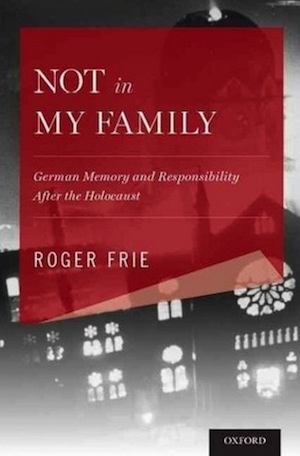
image - Not in My Family book coverConstantly throughout Not in My Family, Frie reiterates that he “has an obligation to remember the past” and, while remembering, he has many sincere reflections on post-Holocaust German guilt and responsibility, complicity, prejudice, cowardly denial and “shameful silence” of past issues, as well as, of course, the “need for redemption” and “the problematics of trauma,” especially of his own, rooted in a questionable notion of vicarious perpetration, three generations down the line.

On this last point, clearly, there was a therapeutic dimension for the writing of Not in My Family: it reflects on every page. But the book rises above the merely personal. For example, Frie is brutally honest in rejecting the moral camouflage of the “Germans suffered too” ilk, and on the need to be suspicious of Germans who feel “deluged” with the Holocaust.

Near the end of Not in My Family, Frie reflects that “writing can be a form of discovery, of examining life and making sense of the past.” This book, for him, he admits, was “personally meaningful” and “emotionally draining.” But if, as he puts it, the book “creates a space for dialogue and reflection on the nature of German memory and the Holocaust,” it is a valuable contribution to an ever-growing body of knowledge about how the greatest crime in human history came to be perpetrated by, among others, affectionate, family-loving, probably not dogmatically antisemitic, minor motorcycle repairmen.

Graham Forst, PhD, taught literature and philosophy at Capilano University until his retirement and now teaches in the continuing education department at Simon Fraser University. From 1975 to 2010, he co-chaired the symposium committee of the Vancouver Holocaust Education Centre.
Finding the future in the past

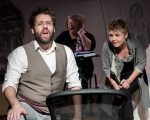
Left to right: Michael Rubenfeld, Mary Berchard and Katka Reszke in We Keep Coming Back, which plays March 13 and 14 as part of the Chutzpah! Festival. (photo by Jeremy Mimnaugh)

At first, we expected the piece to focus mainly on the past and how sad the absence of Jewish life in Poland is. After going and also spending more time in Poland, we now propose that it is through focusing on the present and future, with an aim at building positive perspectives, that will ultimately lead to transformation and genuine healing,” said Michael Rubenfeld about We Keep Coming Back, which plays at the Chutzpah! Festival March 13 and 14.

Rubenfeld created the multimedia work with Sarah Garton Stanley, as well as his mother, Mary Berchard, and filmmaker and translator Katka Reszke. Rubenfeld and Garton Stanley are co-directors of Selfconscious Theatre. We Keep Coming Back is based on a trip that Rubenfeld and his mother took to Poland in 2013.

“It was always our intention to make a piece of theatre and the trip was connected to a desire to explore intergeneration trauma and, also, more specifically, the problems in my relationship with my mother that stem from unresolved trauma and disconnect from our family’s roots in Poland,” said Rubenfeld. “So, the trip was an experiment of sorts; to see if going to Poland with my mother, visiting her mother and father’s hometowns and going to Auschwitz, would give us the opportunity to mourn together, which might also bring us closer together.”

According to a blog on Selfconscious Theatre’s website, after surviving the Holocaust, “Berchard’s family moved from Poland to Sweden, where she was born. They then immigrated to Canada in 1951, where she grew up and eventually had a son, Michael.”

Rubenfeld and Berchard were in Poland for about two weeks. “My mother has since been back three or four more times, and I now have a home in Poland with my wife,” said Rubenfeld – the couple lives in both Krakow and Toronto. “We’ve toured We Keep Coming Back to Poland three times,” he added.

The project has worked to bring mother and son closer.

“It’s been really nice for us to have a piece that we do together,” said Rubenfeld. “It gives us an excuse to spend time together to do something we know we’re going to enjoy. It’s also given us commonality, which has been really essential for our relationship.

“My mother has always been very supportive, though we don’t always have a lot in common. This project has changed that. We also now have Poland in common, and our mutual interest. My mother really loves it in Poland. She’s also become quite interested in uncovering more about our history and has started researching and archiving our family tree. It’s brought her a lot of happiness and has been a really healing thing – which, in general, has been good for our relationship as well.”

We Keep Coming Back “speaks so openly and honestly about what it means to love a parent, or to be loved by a child, and how so many of the resources for a good and enduring love were torn apart by the Holocaust and all of the horrors, throughout the generations that linger,” said Garton Stanley, who is also associate artistic director of English theatre and interim facilitator for indigenous theatre at the National Arts Centre in Ottawa.

“Honestly, as someone on the ground since the get-go, I was most curious about Michael’s developing love for Poland and how, over the course of the play’s creation, he not only fell in love with a Jewish woman from Poland but that he now lives there,” she said. “Michael and I are very interested in the line between fiction and reality and the space for realizing possible worlds through dramatic form. Michael now speaks some Polish. He’s making deep-rooted reconnections and helping contribute to a vibrant Jewish life in Poland.”

Garton Stanley and Rubenfeld met just over 10 years ago, after she saw him in a show. “He was performing in it with my partner at the time,” she said. “He was amazing. We became fast friends shortly thereafter.”

At Selfconscious Theatre – which they started together – the two have also co-created The Book of Judith; Mother, Mother, Mother; and The Failure Show.

For We Keep Coming Back, Garton Stanley is not only co-creator but the director. “My co-creation,” she explained, “was part facilitator, part conceiver, part devisor, part writer, part mediator, part friend and always enthusiast.”

How Reszke became involved in the production is a little more circuitous and fortuitous.

“Once we decided to take the trip to Poland, we connected with a producer named Evelyn Tauben, who was doing research around contemporary Jewish Poland,” explained Rubenfeld. “Through Evelyn initially, we started learning about the renaissance of Jewish culture in Poland, which, at the time, I knew nothing about. Once learning about it, we determined that it was important to us that we engage with it on our trip, and that’s when Katka came into the picture.

“We knew we needed a translator to join us, and we also knew we wanted to document the process. We joked that it would be incredible if we could find someone who could both translate, film and be a Polish Jew who might want to collaborate with us artistically. On a lark, we Googled ‘Polish, Jewish, filmmaker,’ and that’s how we discovered Katka. We sent her an email, and one thing led to another.”

“Mary Berchard and Katka Reszke,” added Garton Stanley, “are fascinating performers and neither of them has any training in this area. Their stories and their curiosity combine with Michael’s to create a new family. And this feels like one of the piece’s hidden successes.”

As for what has most surprised her about the project, she said, “That we are still doing it and learning from it. And learning from the audiences whose histories intersect with Michael’s, Mary’s and Katka’s own generational challenges and traumas. And that the piece resonates as deeply as it does. It has a beautiful heart and this is always surprising, in the best way.”

“I believe that, in our desire to never forget what happened during the Holocaust, we have also forgotten that Poland was one of the most important contemporary homelands for the Ashkenazi Jewish people for over 500 years,” said Rubenfeld. “So much of our contemporary culture was bred in this land, and we forget that the Jewish people were happy living in Poland before the war. We are raised to think of Poland as only the place of tragedy. While I understand why, I think that it’s essential to remember and celebrate a time when there was such vibrant Jewish culture. Most was destroyed because of the war, and it’s impossible to not feel sad. But, as we move into the future and the pain continues to recede, it is just as important to remember the incredible prewar Polish Jewish world of Poland. It was very profound.”

For tickets to We Keep Coming Back at the Rothstein Theatre, and for the full Chutzpah! schedule, visit chutzpahfestival.com.