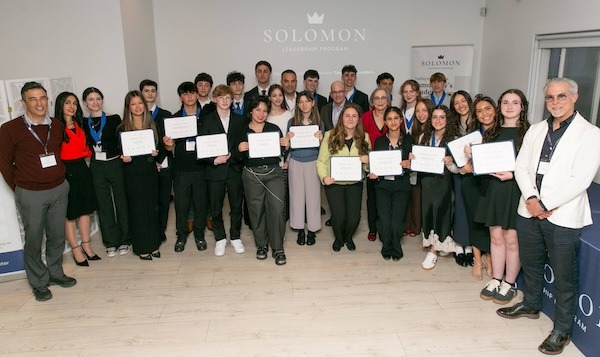
Solomon Leadership Program fellows and mentors celebrate the completion of the 2025-2026 program. Applications for the next session are open till the end of August. (photo by Alan Katowitz Photography)
When Riki Oirechman first read about the Solomon Leadership Program two years ago, she knew she needed to do everything she could to bring it to Vancouver. Geared to high-achieving, community-oriented Jewish students in grades 11 and 12, the year-long program aims to foster participants’ growth as leaders, thinkers and engaged members of their communities. The Ohel Ya’akov Community Kollel undertook the initiative, under the direction of Rabbi Shmulik Yeshayahu, with Oirechman as coordinator of the local chapter.
The Solomon Leadership Program pairs student participants with local volunteer mentors, members of the Jewish community who have excelled in a variety of industries. Among them are doctors, a tech innovator, a judge, business executives and entrepreneurs. The mentors are assigned a small group of student participants, and there are meetings twice a month to listen to hosted speakers and discuss various issues.
“I love this curriculum, which explores topics such as leadership, character, communication, tolerance, vision, empowerment, persistence, strategy and judgment,” Oirechman said. “It encourages students to develop confidence, resilience and a strong sense of purpose, but it also creates meaningful connections between generations. Students have an opportunity to build relationships with successful professionals and community leaders, expanding their personal and professional networks.”
Daniel Friedmann, a director at Solutum Technologies, which develops sustainable materials, is one of the mentors. “When I saw the amazing course material and the incredible speakers on the roster, I knew I wanted to participate,” he said. “Any time you mentor a completely different age group, you learn a lot. As a mentor, I get to see the world through the eyes of the students and learn about their issues, concerns and what they’re struggling with. But I also get the benefit of listening to the speakers, who are not paid public speakers, but individuals working at the top of their respective industries.”
He gave an example. “One of our speakers was Howard Chow, senior deputy chief of the Vancouver Police,” said Friedmann. “And though his speech was months ago, it was mind-boggling and I’m still thinking about what he said. We had many diverse speakers for each of the core topics, and they all brought something unique to that topic.”
The program’s website lists the other 2025-2026 mentors: Itamar David, co-founder of Update Capital, Inc.; Dr. Gabriel Hirsch, who works in physical medicine and rehabilitation; Mark James, president of MJG Brewery Restaurants, Red Truck Brewing Co., and Triple F Investments Corp.; Dr. Neil Pollock, surgeon and director of Pollock Clinics; Barry Rivelis, a board director and executive in diverse organizations; and Sunni Stromberg-Stein, a retired judge, who presided at all three levels of the BC courts.
Pollock has been a mentor in the Solomon Program since 2024 and also supports it philanthropically. “I was drawn to this program because it invests in the future of our youth and helps prepare the next generation of leaders. It’s been a privilege to be part of it,” he said.
“The program brings together a remarkable group of young people who are curious, thoughtful and eager to learn, grow and make a positive impact on the world and in their communities. And it offers something that is increasingly rare: meaningful conversations where students are exposed to leaders from diverse professional backgrounds and are encouraged to think critically about character, resilience, communication, responsibility and the importance of personal growth and leadership.”
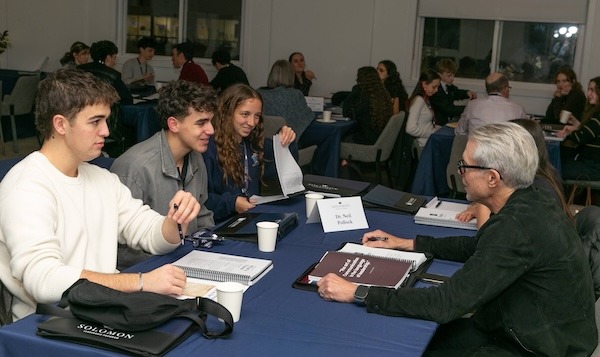
While he shares some of the lessons he’s learned over the years, Pollock said he’s learning a lot from the students, too. “I am continually inspired by the students’ perspectives and creativity. They ask thoughtful questions and challenge us to think about the future in new ways. Working with them gives me confidence that the next generation is well equipped to lead.
“One of our greatest responsibilities is to help develop the next generation of leaders,” he continued. “Strong communities don’t happen by accident, they are built by people who are willing to invest their time, experience and resources in young people. I support the Solomon Program because I have seen firsthand the difference it makes and how the relationships formed, the confidence gained and the opportunities created can have a lasting impact on a young person’s life.”
Friedmann said he wishes he could have been a student in the program when he was a teen. “It would have changed my life,” he said. “Students in the Solomon Program have access to really good, fundamental information on leadership that you just can’t get otherwise, knowledge that they use to figure out where they’re headed and why. They become better public speakers and develop good bonds with other students in the program.”
Rotem Eilon Kfir was one of the students who participated in the 2025-2026 program and her mother, Rachel Eilon Kfir, witnessed her daughter’s growth as a result. “She began the program as someone who was afraid to stand in front of people and talk and, over the year, she developed more confidence and grew considerably. She connected and related to her mentor, loved the guest speakers and found the program genuinely interesting,” Eilon Kfir said of her daughter’s experience. “I strongly recommend it to anyone who has a chance to attend, because it builds confidence and adds a strong sense of community.”
Pollock agrees. “I’d encourage parents to see the Solomon Leadership Program as an investment in their teenager’s future,” he said. “It gives students the opportunity to learn from accomplished mentors, build meaningful relationships and develop skills that can’t easily be taught in a classroom. It also helps strengthen their connection to the Jewish community and encourages them to think about the role they can play in shaping its future. If your teenager is willing to learn, grow and challenge themselves, this program is an exceptional opportunity that can influence not only what they do, but the kind of person they become.”
Applications for the 2026-2027 program are open now through the end of August. Prospective participants are interviewed, and must demonstrate academic excellence and volunteerism, and provide references. The program accommodates a maximum of 30 students, and costs $500. Upon successful completion, participants earn three university credits. For more information, visit solomonprogram.org.
Lauren Kramer, an award-winning writer and editor, lives in Richmond.