Skip to content
  • Home
  • Subscribe / donate
  • Events calendar
  • News
    • Local
    • National
    • Israel
    • World
    • עניין בחדשות
      A roundup of news in Canada and further afield, in Hebrew.
  • Opinion
    • From the JI
    • Op-Ed
  • Arts & Culture
    • Performing Arts
    • Music
    • Books
    • Visual Arts
    • TV & Film
  • Life
    • Celebrating the Holidays
    • Travel
    • The Daily Snooze
      Cartoons by Jacob Samuel
    • Mystery Photo
      Help the JI and JMABC fill in the gaps in our archives.
  • Community Links
    • Organizations, Etc.
    • Other News Sources & Blogs
    • Business Directory
  • FAQ
  • JI Chai Celebration
  • JI@88! video

Recent Posts

  • Eby touts government record
  • Keep lighting candles
  • Facing a complex situation
  • Unique interview show a hit
  • See Annie at Gateway
  • Explorations of light
  • Help with the legal aspects
  • Stories create impact
  • Different faiths gather
  • Advocating for girls’ rights
  • An oral song tradition
  • Genealogy tools and tips
  • Jew-hatred is centuries old
  • Aiding medical research
  • Connecting Jews to Judaism
  • Beacon of light in heart of city
  • Drag & Dreidel: A Queer Jewish Hanukkah Celebration
  • An emotional reunion
  • Post-tumble, lights still shine
  • Visit to cradle of Ashkenaz
  • Unique, memorable travels
  • Family memoir a work of art
  • A little holiday romance
  • The Maccabees, old and new
  • My Hanukkah miracle
  • After the rededication … a Hanukkah cartoon
  • Improving the holiday table
  • Vive la différence!
  • Fresh, healthy comfort foods
  • From the archives … Hanukkah
  • תגובתי לכתבה על ישראלים שרצו להגר לקנדה ולא קיבלו אותם עם שטיח אדום
  • Lessons in Mamdani’s win
  • West Van Story at the York
  • Words hold much power
  • Plenty of hopefulness
  • Lessons from past for today

Archives

Follow @JewishIndie
image - The CJN - Visit Us Banner - 300x600 - 101625

Tag: Chutzpah! Festival

Filler doing it her way

Filler doing it her way

Deb Filler performs at the Chutzpah! Festival on March 4. (photo from Chutzpah!)

“I’ve performed all over the world, baked challah bread onstage, done shows everywhere, and this is the first time in all these years I am performing in Vancouver live. Delighted to be coming back to do a show! I hope there’ll be more,” Deb Filler told the Independent.

Filler, who will perform at the Chutzpah! Festival on March 4, lived in Vancouver for six months, starting in late 1979.

“I was tempted to stay but never did,” said the comedian, actor, musician, teacher and writer originally from New Zealand. “My career in North America started there. I had an agent and things were going well but New York called, Stella Adler and Uta Hagen, the great acting teachers I studied with. So, I drove across country and the rest as they say….”

While Filler left Vancouver for New York, she has lived in Toronto since 1995.

“I came for a film that was being made of my work, Punch Me in the Stomach, and I stayed and I fell in love,” she said. “Toronto is a terrific city for fun, culture. And it’s close to Europe and New York. I was in New York before that for 15 years, so I guess I’m a bit of a rightie not a leftie – coastie. Not politically, that’s for sure!”

Filler will be bringing her show I Did It My Way in Yiddish (in English) to the Rothstein Theatre for one performance only – March 4, 1 p.m. Described as a journey around the world, “jam-packed” with music (Filler on her guitar) “and a raft of loveable characters she creates,” the initial work was commissioned by the Jewish Community Centre London, called the JW3, as it is located on Finchley Road, NW3. The centre’s tagline is “The postal code for Jewish life.”

“It’s a fantastic modern facility in North London with cafés, art studios, a theatre, meeting places, gallery, classrooms, a school, a film space, a real cultural hub,” said Filler, who had worked with them before the commission. “I’d gotten a great response several times in the past and they were keen for me to come back for their U.K. Jewish Comedy Festival so asked me to perform a new show. I knew – because the stories I tell about meeting and befriending Leonard Bernstein, Leonard Cohen and another Jewish musician called Lenny – that London audiences would respond like audiences have all over the world. So, when they asked, I was delighted to agree, and now the show has been in New York, L.A., Sydney, Toronto, and is coming to Vancouver and D.C.”

Since the commission, the show has changed a bit.

“We made a short dramatic film of one of the stories, which is sometimes screened during the show as a multimedia segment, which Chutzpah! requested. Also, the name has changed to describe the show better than The Three Lennys.”

A March 2017 article on broadwayworld.com describes a bit of the show: “As Deb drives for a car service in New York City, she takes us on a truly incredible ride with Leonard Cohen, reducing the venerable Canadian folksinger to tears of laughter. Her story of meeting Leonard Bernstein as a teen, bringing him fresh challah bread from her father, a survivor of the Holocaust who heard Bernstein play Gershwin’s Rhapsody in Blue in a displaced persons camp after the war, is extraordinary. What happens next is truly unbelievable.”

One of the things that will happen next for Filler is a trip to Europe. “I’m being invited to Landsberg in Germany as guest of the reunion there of my father’s displaced persons camp, where Leonard Bernstein played and my dad saw him in 1948…. I’m also working on My German Roots Are Showing, which I read in London with actor Miriam Margolyes as my mother. She is fantastic!”

In a conversation a few years ago on Auckland’s Newsbeat (newsbeat.kiwi) with journalist Keren Cook, Filler spoke about Jewish humour and how her family provided a rich environment and offered many resources for her creative expression.

When the Independent asked her about how she takes into account her relatives’ feelings, Filler said, “There are red lines, nothing too personal, but my family are wonderful and amongst my biggest fans, so it’s been a pleasure to perform for them. One relative loved my show Punch Me in the Stomach, but somebody put a worm in her ear and she got defensive so I’ve taken her out of future shows to safeguard any feelings she may have about being exposed. It’s all done with love and admiration, and a bit of comedy of course. So, sometimes one must exaggerate for the laugh. But it’s all good.”

Filler taught at Brown University for 14 years in Providence, R.I., and she teaches at Humber College in Toronto and at Toi Whakaari (New Zealand Drama School), in addition to having private students. “I’ve recently started directing,” she said, “and just had a wonderful show open in Auckland for Pride Festival, called Random Shagger. It’s doing really well.”

She advises aspiring comics about to pick up the mic for the first time, “Be strong! Be brave! Have confidence in your persona. And do it for yourself, not for drunken college students who tend to populate comedy club audiences.”

For tickets to I Did It My Way in Yiddish (in English) and the full Chutzpah! Festival lineup, visit chutzpahfestival.com.

Format ImagePosted on February 23, 2018February 21, 2018Author Cynthia RamsayCategories Performing ArtsTags Chutzpah! Festival, comedy, Deb Filler
Salomé’s rightful place

Salomé’s rightful place

Salomé: Woman of Valor will have its world première at the Chutzpah! Festival March 8-10. (image by Anya Ross, graphics by John Greenaway)

There have been many interpretations of Salomé – thought to be the woman whose alluring dance persuaded King Herod to honour her request that he have John the Baptist beheaded – but none quite like that of Salomé: Woman of Valor, which has its world première at Chutzpah! March 8-10.

The creation of this complex, multilayered work that combines poetry, music, dance and film was led by composer and trumpeter Frank London and poet and performer Adeena Karasick. It features live music by London, percussionist Deep Singh and keyboard player Shai Bachar. The poetry is written and performed by Karasick, the dance choreographed and performed by Rebecca Margolick and Jessie Zaritt, and the video analyzing Charles Bryant’s 1923 silent film Salomé was made by Elizabeth Mak. The whole production is directed by Alex Aron.

“Frank was intrigued by the Salomé story due to the visual cornucopia of the Bryant film, and because it is a story where dance was at the centre, motivating the complex chain of events, and thus ripe for reinvention as a contemporary dance-theatre piece incorporating Bryant’s imagery,” Karasick told the Independent about why the work focuses on Salomé and not another Jewish historical or literary woman. “However, he was only aware of the [Oscar] Wilde retelling of the Salomé story and thus not really interested in her narrative. He came to me to see if I could reenvision her story in a more compelling way.”

It has always bothered her, said Karasick, how, within Christian mythology and entrenched in history by writers like Wilde, Gustave Flaubert and Stéphane Mallarmé and artists such as Gustav Klimt, Gustave Moreau and Aubrey Beardsley, “Salomé was seen as yet another Jewish temptress/Christian killer – but, in fact, there isn’t any evidence to substantiate this claim. According to apocrypha and Josephus’s Antiquities, she came from Jewish royalty and there is no evidence she murdered John the Baptist or even danced for Herod,” said Karasick.

“The only historical reference that [Herod’s wife] Herodias’s daughter’s name was Salomé is from Flavius Josephus, who makes no other claims about her – not that she danced for Herod, not that she demanded John’s head, but only that she went on to marry twice and live peacefully. The other apocryphal reference is that a daughter danced for Herod, which caused him to lose his mind and kill John the Baptist. Thus, the conflagrated Salomé that appears in the Wilde play, [Richard] Strauss opera and all subsequent productions, is an amalgamated construct, so we felt it was our duty to set the record straight.”

In fact, added Karasick, there are three women named Salomé in Jewish history: Salomé, daughter of Herodias and Herod II (circa 14-71 CE); Queen Salomé, her great-aunt (65 BCE-10 CE); and Salomé Alexandra (139-67 BCE).

“Her great-aunt, Salomé I, was the powerful sister and force behind Herod the Great, king of Judea and Second Temple rebuilder,” said Karasick, while Salomé Alexandra (also known as Shelomtzion) was one of only two women who reigned over Judea.

“I wanted my Salomé, Salomé of Valor, to carry the weight of both her genetic lineage and the cultural heredity of her name, embodying the legacy and power of the women that came before her,” said Karasick.

Karasick, who was born in Winnipeg, grew up in Vancouver, earning her bachelor’s from the University of British Columbia. She did her master’s at York University and her PhD at Concordia University. Among other things, she teaches literature and critical theory at Pratt Institute in New York, is co-founding artistic director of KlezKanada and performs her work around the world. The author of nine books – with a 10th, Checking In, published by Talonbooks, on the way – she has been awarded for her contributions to feminist thinking and, last year, the Adeena Karasick Archive was established at Special Collections, Simon Fraser University.

London – a member of the Klezmatics and the group Hasidic New Wave, who has performed with countless musicians and made numerous recordings of his own – saw Karasick perform in New York in 2011. He then hired her, she said, “along with Jake Marmer to design and lead the poetry retreat at KlezKanada…. We hadn’t yet collaborated before this, but I was always compelled by his music and the breadth of all he created as a masterful revolutionary himself, not only as a spectacularly fierce trumpet player but virtuosic composer, reinvigorating klezmer music, transcendentally intermixing it with aspects of world music, jazz, Chassidic new wave, punk – and always felt it would be a thrilling and highly symbiotic artistic match.”

When Frank approached her about the Salomé project, said Karasick, they both “fell in love with the Bryant film but were so perplexed” about Salomé’s “reputation in cultural history.”

So, Karasick started researching, “poring through the multiple and conflict[ing] narratives – through Josephus and the apocrypha, locating the many discrepancies between Christian and Jewish mythologies, speaking with specialists in the field, and became fascinated with how there are so many ‘truths,’ stories, misreadings, and how imperative it is to question these grand narratives, problematize traditional cultural, moral and religious perspectives.

“For millennia,” she said, “Jews have been portrayed as the murderers of gods and prophets in other people’s mythologies, so Salomé: Woman of Valor deconstructs this mythology, exposing how she was not a demonic murderess, and opens up the possibilities for infinite retelling and how truth itself is always a construct of veiling and unveiling.”

About the magnitude of the project, Karasick said, “As the author of nine books invested in issues of ethnicity, gender and ways to construct meaning, as professor of poetry and critical theory, gender images in the media, and poetics and performance, Salomé: Woman of Valor is a logical progression in my 30-year career, and has allowed me to integrate my experiences in one work – something that I have never done before.

“Due to the scope of this show,” she said, “I’m able to weave together the multiple styles of writing that I’ve experimented with over the years – sound poetry, homophonic translations, post-language conceptualism, kabbalistic and feminist revisionist practices, all syntactically playful, polyphonic, ironic and rhythmically complex – a fusion of my esthetic passions and expertise; opening a space of female empowerment.”

While London has been involved in many projects, Karasick said Salomé might be the first for him with performance poetry at the centre.

“We created Salomé: Woman of Valor as an integration of performance poetry, dance, music and video exploring the dialectic between narrative and abstraction – it is a quantum leap forward in collaborative artistic development, challenging my conceptual processes of making an artwork,” she said. “I couldn’t be more excited.”

Salomé: Woman of Valor is already being presented in an array of venues and contexts, said Karasick. “Its form and content make it appropriate to be presented at jazz, dance, poetry, new theatre, literary and electronic literature festivals; in performing arts centres, universities, avant garde text-based multimedia events, as well as events focusing on new media and cross arts,” she said.

“With its feminist and mystical kabbalistic take on Jewish historical subject matter and a live score which draws from East European Jewish music (klezmer) with jazz, Arabic and Indian musics, our Salomé is especially attractive to Jewish culture festivals and to presenters of Jewish music, language, dance and art.”

The libretto has been published in Italian and in English, and selections of it have been published in Bengali, Arabic, Yiddish and German. It is “being taught in universities worldwide in departments of global literature, Jewish studies and humanities and media studies,” she said.

The artists bringing Salomé: Woman of Valor to Vancouver are all “at the forefront of their respective fields,” said Karasick, “and so I feel so fortunate to be working with such powerful creators, all revolutionaries in their own ways. Frank works with Shai Bachar and Deep Singh on a number of musical projects – Deep and Frank started the internationally acclaimed bhangra-klezmer fusion band Sharabi; and [Frank] co-developed Night in the Old Marketplace with Alex Aron, so bringing her on board as a director seemed a natural fit.

“Over the five years of envisioning the piece, we tried on a number of dance styles, ranging from tribal belly dance to sword dance/swallowers, and, with the advice of (Merce Cunningham protégé) Gus Solomons, Jr., settled on the avant garde modern dance of Israeli superstar Jesse Zarrit and the stunningly poetic Rebecca Margolick, with a shout-out to the Dadaist Loïe Fuller stylings by Jodi Sperling.”

Mak’s video on Bryant’s silent film, notes the project’s promotional material, is “punctuated with Jim Andrews’ stunning vispo [visual poetry], with special video appearances by … Tony Torn as Herod, lit by Nicole Lang.”

“Together,” said Karasick, “we’re expanding our work in ways only dreamed possible; have created an intellectually provocative, audio-visual sensorium, informed by our (Frank’s and my) ongoing obsession with excess, desire and pushing boundaries.”

And it’s an interest, if not obsession, with many others, as well. The Kickstarter campaign for Salomé surpassed its goal of $20,000, about half of the project’s budget.

“The show has been garnering a lot of love and support from colleagues and patrons,” said Karasick, “perhaps due to ways that it addresses the social and political necessity to speak the unspoken, resist stereotypes, misrepresentation and outdated myths, and fosters a thinking that leads to a hybridized syncretic culture, one that honours the intermixing of blood, belief, rhythm, texture and being. Content-wise, it addresses outdated notions of identity and ethnicity, and carves out a space where difference and otherness can be celebrated. We feel incredibly grateful, and hope that we can keep growing it. Broadway, here we come!”

But, first, the Chutzpah! Festival. They have also been invited to Toronto’s Ashkenaz Festival and the Boston Jewish Music Festival, said Karasick, who will continue to tour with the Salomé books. “Frank,” she said, “will record and release the music as a CD. We hope to see it at major festivals and venues worldwide.”

The presentations of Salomé at Chutzpah! are presented in association with the Dance Centre, where the performances will take place. For tickets and the full festival lineup, visit chutzpahfestival.com.


Format ImagePosted on February 16, 2018February 14, 2018Author Cynthia RamsayCategories Performing ArtsTags Adeena Karasick, Charles Bryant, Chutzpah! Festival, dance, film, Frank London, music, Oscar Wilde, poetry, Salomé, spoken word, vispo, women
Musical tribute to dear friend

Musical tribute to dear friend

Perla Batalla brings the music of Leonard Cohen to the Rothstein Theatre March 11. (photo from Chutzpah!)

I didn’t choose singing. It chose me,” Perla Batalla told the Independent in an email interview. Batalla brings her personal and moving tribute to her good friend, Leonard Cohen, to the Chutzpah! Festival March 11.

“He was not only a mentor and a friend, but also a very great inspiration. Being as I was young when I worked with Leonard – I was in my 20s – I watched him like I was watching a master and learning as much as I possibly could,” she said. “His need to always seek the comfort of his audience was truly generous – and all too rare. We began working together in the 1980s and we never lost touch, even after I was touring on my own.

“In Leonard’s earlier tours,” she said, “he would tell stories before every song – very funny, honest stories about his life. Each night he’d tell similar stories, but they always seemed fresh – like I’d never heard them before – I think that was because of his honesty, and his ability to show up and always be authentic, be authentically Leonard Cohen.

“He had a huge impact on what I do and how I perform. If I approach a song with unconditional honesty, the meaning is not static – it can ebb and flow as I relate the words to my own life and experiences.”

In Vancouver, Batalla – who lives in Ojai, Calif. – will be joined by pianist Michael Sobie.

“He recently returned after touring as assistant conductor and pianist with the Game of Thrones Concert Stadium Tour,” Batalla said. “Michael also performs as the principal pops pianist with the Grand Rapids Symphony and has toured internationally as pianist/conductor with Broadway musicals like Les Misérables, Wicked, Aïda and tons more. He is a dream to work with.”

Perla Batalla in the House of Cohen features songs and personal stories that “reveal Cohen’s lighter side,” notes Batalla’s website. It also shows “her sincere respect and deep love for the music, the poetry and, most of all, for her dear friend, Leonard Cohen.” Cohen passed away Nov. 7, 2016.

Batalla released her first recording in 1994, an eponymous CD on the Warner/Discovery label, and has since produced six CDs on her own label, Mechuda Music, one of which, Bird on the Wire, was a tribute to Cohen. Internationally known, Batalla composes and performs in both English and Spanish. The names of two of her CDs, Discoteca Batalla and Mestiza, more than hint at how important her heritage is to her.

“I grew up in Venice, Calif.,” she said. “Our family owned a Mexican record shop called Discoteca Batalla, which served as an important hub for Latino culture in West L.A. I constantly feel the push and pull of the Afro-Mexican influence from my father and the Euro-Argentine-Jewish elements from my mom. This is my own mestiza, mix – I wouldn’t trade it for the world. From all sides, theatricality is in my bones, my roots. I don’t only use my voice to sing a song. To completely engage, I have to use my entire body. And it has to be sincere. It has to come from within.”

She said she comes from a long line of musicians on her father’s side in Mexico and theatre people on her mother’s side in Argentina. “My father was a singer and my uncle, Cipriano Silva, was a trumpet player with the world-famous Mariachi Vargas de Tecalitlán,” she added. “My desire to sing came early – when my family took a camping trip, I can remember sitting by myself among the redwoods singing to them. I made up a song and it felt strange, but good. Trees are a very attentive audience.

“When I was a little older,” she continued, “I remember watching my uncles and my father (who were usually pretty scary) singing traditional songs after dinner and openly weeping as they sang – and it occurred to me at the time that music seemed to have a unique power. By the time I was in my teens, I was studying opera privately and singing in clubs at night; I have never wanted to do anything else.”

When asked about her creative process, how a song comes to her, she said, “Research and serendipity. My current Frida Kahlo project, Blue House, is an example. I wanted this song cycle to be a love letter to the creative spirit. My songwriting partner, David Batteau, and I began by reading everything we could get our hands on; we spent a lot of time in museums; I even started to paint and do art pieces. Through research and discussion, ideas begin to appear like ghosts. It starts as a thread, and then we follow the thread to wherever it leads; destinations we had no idea were even there when we embarked.

“I am also inspired by stories. When I keep my ears open, I can hear stories everywhere. Sometimes there can be a great story hidden within a painting, a black-and-white photograph, or a symphony.”

Not only has Batalla been recognized for her work in music, but she also has been awarded for trying to heal the world in other ways, as well.

“I am most grateful for having the opportunity to do educational outreach with at-risk youth in underserved communities around the U.S.,” she said. “I take a lot of time to talk with the students about how being creative can give you power. Sometimes young people just need to be given permission to explore the artistic horizon.

“Passing on love and appreciation for music, poetry and the beauty of the Spanish language to the next generation of artists is paramount. I want young people to discover the magic of song. When words and music collide with honesty and humanity, the result is the foundation on which everything of life is built. At a time when art and music are marginalized in the education of youth, I am now more than ever committed to educational outreach as I travel throughout the world. Exposing young audiences to the beauty of art, music and poetry through music and live theatre may be our best defence against the current onslaught of cynicism.”

As for her love of Cohen’s music?

“For me, it is his imagery, use of metaphor and painful honesty, which gives Leonard’s lyrics such depth of meaning,” she said. “His poems and songs are also intrinsically personal. When I sing his songs, Leonard’s lyrics help sustain me – I reinterpret them with each performance. Plus, his lifetime dedication to his craft at the expense of all else is the epitome of devotion to beauty.”

She added, “For an artist, reading reviews or caring what everyone thinks is the kiss of death. Since I’m human, I do care what some people think, but, in the end, I do what will satisfy my creative goals and desires. I am grateful every day that I have the freedom to take chances and continue my own journey.”

Perla Batalla in the House of Cohen is at the Rothstein Theatre for one performance only, on March 11, 7:30 p.m.

For all of the Chutzpah! music offerings and the full festival schedule, visit chutzpahfestival.com.
Format ImagePosted on February 9, 2018February 7, 2018Author Cynthia RamsayCategories Performing ArtsTags Chutzpah! Festival, Leonard Cohen, music, Perla Batalla, storytelling
Chutzpah! opens with Open

Chutzpah! opens with Open

Ezralow Dance’s Open comprises many themes. (photo by Angelo Redaelli)

Los Angeles-based Ezralow Dance kicks off this year’s Chutzpah! Festival at the Rothstein Theatre Feb. 15 with, appropriately enough, a work called Open, for its embodiment of myriad ideas and ways in which to express them.

Chutzpah! also features a range of creative expression every year, with performers from around the world in dance, comedy and theatre. As has become tradition, the Jewish Independent will highlight several of the performances prior to the month-long festival. This week, we focus on dance, speaking with Daniel Ezralow, as well as Israel’s Roy Assaf.

* * *

“Open is a testament to what I believe,” Daniel Ezralow told the Independent in an email interview. “When my wife (who collaborated with me) and I were thinking of a title for the show, we played around with a lot of options, but when we came up with the one word Open, it expressed everything that I wanted to say. Be open, open yourself, open to others, open your eyes, open your mind, open your heart and stay open to the world in many senses.

“It was a way of saying, leave your judgments at the door and try, just try, to be open-minded. I find that we are so full of judgment, many times we fail to see the beauty of what is so simple and directly in front of us. I am constantly attempting to open my mind and receive what comes to me. There is a wonderful concept, ‘to want what you get, not get what you want.’ I think Open has something to do with this.”

In his work, Ezralow is certainly open to new ideas and a wide variety of media. In his 40-some years in dance, he has performed with several companies, co-founded others and choreographed for numerous groups around the world, including Batsheva Dance Company, Paris Opera Ballet, Maggio Musicale Fiorentino and the Atlanta Ballet. He choreographed the opening ceremony of the 2014 Winter Olympics and Cirque du Soleil’s Love. He has created for dance festivals, Broadway shows, gymnastics competitions, television, film, commercials and other corporate projects, awards programs, pop star performances and music videos. The award-winning choreographer, director and multimedia artist has a vast and eclectic resumé, to say the least.

“I remember as a child always asking my father ‘why?’ I asked him why about just about everything. There is no question I am naturally curious,” said Ezralow. “I was once working with Chaim Topol on a project in New York City and we were in a taxi together. I asked him why – why does he work, why does he do the things he does? I’ll never forget the response he gave me. He said, ‘Curiosity.’ At that point, I understood that was the same thing that made me do the things I do. My mother always encouraged me to ask questions and to do what I believed in. I do lose myself in creations, but usually it is not an escape. In my best moments, I also try to live life like a creation and lose myself in it.”

In looking at his body of work, it’s hard to believe that Ezralow didn’t take a formal dance lesson until he was in his late teens, when he was a biology student at University of California, Berkeley.

“Dancing chose me so strong, I had little choice to shy away from it,” he said of his change in career direction.

“At the time, I was deeply disappointed with the American medical system. I felt it had nothing to do with helping people and was mostly about a hierarchy to achieve a status of life. The system was very closed to acupuncture, Eastern ideas and anything alternative. At the time, this made me feel that it was really askew and not for healing and helping people but rather for diagnosing, medicating with pills and cutting in surgery.

“Hopefully, this has changed and we are now entering a period of truer possibilities,” he said. “I just saw a wonderful documentary titled Heal, which delves into the human possibilities to heal ourselves. This is the kind of medicine I would like to get involved with. I also feel that the work I do is healing – dance is healing!”

About his goal as an artist, he said, “As I have grown, I have shed some of my desire to be a performer/exhibitionist and have been humbled with age, which has allowed me to dig deeper to understand that all I ever really wanted was to make people happy. Happy can mean crying, happy can mean laughing, happy can mean many things to me. I really just want to help people to be inspired to live another day of their lives on this planet.”

Ezralow’s father’s family came to Los Angeles via Winnipeg, of all places.

“My grandfather ran from the Russian revolution to Canada and settled in Winnipeg, where my father was born, who was one of a family of five. My grandfather was a carpenter,” he explained. The family moved to Los Angeles, he said, “probably because my grandfather saw there was opportunity. They settled in Boyle Heights, the poor Jewish area of L.A., and he began building houses. One by one, he would build a house, sell the one they lived in and move to the new house. I took a tour of Boyle Heights with my father before he passed away and he pointed out all of the homes my grandfather built and the family had lived in.”

According to the Jewish Journal, Ezralow’s parents met in Los Angeles; his mother was born in Poland, but the family emigrated when she was quite young.

“My mother grew up a Sabra in Palestine, before the declaration of the state of Israel,” he said. “All of my family on her side are still in Israel and I would travel every other summer with my family to Israel, so I am connected by heritage to a people I know intimately from my entire childhood. This has given me a sense of Jewishness as natural and surrounding me.

“In Los Angeles, as well,” he continued, “there is a very strong and permeated Jewish community, which I grew up in and was a bar mitzvah. But, after that, I felt that there was too much dogma in religion. I have worked many times with Batsheva in Israel and still have a deep connection to everyone. I am sometimes sad to see what is happening with the conflict there. But I feel a strong sense of Jewish humanity in my soul. It is something that is universal and not selective to one religion.”

* * *

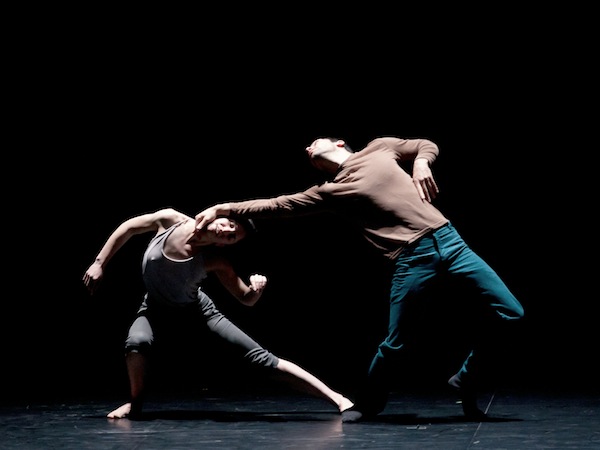
photo - Roy Assaf Dance’s Six Years Later
Roy Assaf Dance’s Six Years Later. (photo by Costin Radu)

Roy Assaf is both creator of and a performer in the two award-winning pieces he is bringing to the Chutzpah! Festival, starting Feb. 22.

“I dance in both works, the duet Six Years Later and the trio The Hill,” he said in an email. “Back in 2011 and 2012, when these works were created, it felt perfectly natural for me to choreograph and to dance the work at the same time. Nowadays when I create, it is not at all the obvious choice.”

Assaf was born in Israel, and dance has been a part of his life for as long as he can remember. About 15 years ago, he started working with Emanuel Gat, initially as a dancer, then as an assistant choreographer. Assaf’s first choreographed work, in 2005, won two awards at the Shades in Dance competition in Tel Aviv. In 2010, he worked with the Noord Nederlandse Dans company in Groningen, Holland, creating for them a work called Rock.

“I was invited by their artistic director, Stephen Shropshire,” said Assaf about that commission. “The amount of trust that Stephen gave me while working with his company strengthened my belief in myself that I could and should keep making pieces.”

Since then, Assaf has created or co-created works for many other companies, including two full-length pieces supported by the Intima Dance Festival, a work for L.A. Dance Project for the Biennale de Lyon, a collaborative piece for the Royal Swedish Ballet, and a piece for the Gothenburg Ballet. This past fall, he began creating 25 People, working with third-year Juilliard students in New York City, where he was on faculty for a semester, which he is resetting with dancers in Israel.

For Assaf, dance is not simply art for art’s sake.

“I would like to give people room to imagine,” he said. “It’s certainly not about distracting people – I really hope we are in the business of encouraging or facilitating engagement in one’s own life. What a pity it would be if dance principally served to distract or disconnect someone from his or her experience. Please do come to a performance and be fully yourself there – see what you see, recognize what you recognize, run with your fantasies, meet your uncomfortable places.”

The duet Six Years Later explores the relationship between two people who have come together after having been separated for a long time, while The Hill is a commentary on war, based on the Hebrew song “Givat Hatachmoshet,” about a particularly devastating battle that took place during the Six Day War in 1967, a battle that Israel won but with great losses.

Despite the different subject matter, Assaf has described both pieces as having a lot in common.

“They share a spine, in terms of physical material,” he explained. “If you look closely, you may discover that they are both dealing with much of the same movement – but that the same movement has undergone a very different treatment in each work. You might say they share a point of origin, but parted ways in their process. Each work followed a path to its logical conclusion. Both, however, deal with the story of human touch: its effect, its consequence.”

For all of the Chutzpah! dance offerings and the full festival schedule, visit chutzpahfestival.com.

Format ImagePosted on February 2, 2018February 1, 2018Author Cynthia RamsayCategories Performing ArtsTags Chutzpah! Festival, dance, Daniel Ezralow, Israel, Rothstein Theatre, Roy Assaf
Our sense of reality and self

Our sense of reality and self

Chuck Wilt and Rebecca Margolick in birds sing a pretty song. (photo by Maxx Berkowitz)

Social media has changed the way in which we work, play and shop. It has changed how we communicate, access information, and even how we define ourselves.

A new work by Rebecca Margolick and Maxx Berkowitz, called birds sing a pretty song, “explores how surveillance and confinement through our digital and physical surroundings affect one’s sense of reality and self.” The full-length piece will have its world premiére in New York City next week. It will then arrive in Vancouver for its Canadian première at Chutzpah!Plus May 13-14.

Birds sing a pretty song was created during a year-long fellowship at New York’s 14th Street Y Theatre’s LABA: A Laboratory for Jewish Culture and two Chutzpah! Festival creation residencies.

LABA describes itself as a program “that uses classic Jewish texts to inspire the creation of art, dialogue and study.”

“After learning about LABA in 2015, we decided to take our shared vision and esthetic to create a piece together that would leverage our differing backgrounds and skill sets of dance and music, design and tech,” said Margolick and Berkowitz in an email interview. “Through the year of study and support from the LABA fellowship, our original concept, revolving around the loss of physical self in a hyper-social world, evolved through the varied conversations about beauty and imagery seeded by the provocative ideas in the ancient texts we studied.

“We had two work-in-progress showings at the 14th Street Y in April 2016 and, this past year, we were fortunate to be able to continue to develop the full-length piece through the support of two creation residencies from the Chutzpah! Festival, in Vancouver and Sointula, B.C., where we refined the choreography and brought in live music. The roots of last year’s showing are still present; however, the movement, sound and film have all changed.”

“Some of the most memorable moments in the development of the piece were when Maxx and I would have moments of clarity between us,” said Margolick. “After coming up with complex ideas, we would realize that staying true to our core goal for this piece, being that simple and raw, can be the most impactful, and that technology should be used as a means to enhance the narrative of the work, rather than a means of distraction or excess.”

As for Berkowitz, he said, “One of the most memorable conversations Rebecca and I had during the development of this piece was walking home after a LABA study session where we had read the story of a rabbi who was known as one of the most beautiful people of the time. His beauty led a princess who loved him without reciprocation … to the point of losing touch with what his beauty meant to her, coveting his beauty to the point of taking the skin off of his face to make a mask for herself. This horrifying story led us to discuss the parallels with how one can lose themselves in their online personas, seeking fame, beauty and recognition to the point of losing their sense of self.”

Birds sing a pretty song involves two dancers, whose wanderings the audience follows “through a world manipulated and influenced by the ‘curators’ … and projected light structures that move and direct the world onstage. Throughout the piece, they encounter an attempt at a relationship, fleeting glimpses of memory, and a fight for connection.”

Dancers Margolick and Chuck Wilt are joined by guitarist/media/composer Berkowitz, guitarist/composer Jake Klar and percussionist Bruno Esrubilsky (the curators) and Israeli author and scholar Ruby Namdar.

“The idea of ‘curators’ came from our exploration of how, in our social media platforms, it is easy to forget that everything you see is carefully selected for you based on the computer-crafted picture of you, that you can get trapped in a sounding room where the news, information and even advertising is targeted at your historical tastes and how that can be harnessed to manipulate your choices and decisions and fixes you into a stereotype of yourself,” explained Berkowitz. “This has become even more [relevant] in the current political climate and the ‘post-truth’ world, in which social media has played such a heavy role, and surveillance is an ever-increasing fact of life.”

“We wanted to play with the idea of the dancers being trapped in a curated space (the stage), where the musicians subtly manipulate the dancers’ movement and reactions,” added Margolick. “The dancers are also aware of the audience’s gaze, subconsciously at first but, as the piece goes on, they become aware of the audience and curators and are left exposed.

“As a performer, I was always intrigued by the fact that you’re in an enclosed space together with the audience, where you are aware that the audience is watching you as you are also watching them. This feeling of being observed while also observing is something I wanted to explore in this piece.”

Margolick has family connections in Vancouver, and has given of her time to the Jewish Community Centre of Greater Vancouver’s Festival Ha’Rikud, which she will do again when she is here in May. She also has connections to the Metro Vancouver dance community.

“I trained at Arts Umbrella from 6 to 18 years old and, through that program, I was introduced to both local and international dance artists and choreographers,” she said. “Over the past couple years, I’ve traveled between New York City and Vancouver and have been involved in dance projects with Donald Sales’ Project20 and Shay Kuebler’s Radical System Art. As for the Jewish community, through growing up attending Temple Sholom, working at the JCC summer day camp and dancing with Or Chadash, I was immersed into the local Jewish community.”

Berkowitz, too, has local ties.

“I was fortunate,” he said, “to be involved with the Chutzpah! Festival in the past, joining Shay Kuebler’s Radical System Art’s residency in Sointula to document their process and teach photography to local residents. And, in 2015, my up-and-coming band Twin Wave had two performances in Vancouver, at the Imperial Theatre and the Red Room.”

Among the major supporters of birds sing a pretty song are the Jewish Foundation of Greater Vancouver, Phyliss and Irving Snider Foundation, Diamond Foundation, Betty Averbach Foundation, Canada Council for the Arts, B.C. Arts Council and the City of Vancouver.

Birds sing a pretty song is at the Rothstein Theatre May 13, 8 p.m., and May 14, 7:30 p.m. Tickets are $29.50, $25.50 (senior) and $23.50 (student) and can be purchased at chutzpahfestival.com, 604-257-5145 or in-person at the JCCGV, as well as from Tickets Tonight, 604-684-2787.

Format ImagePosted on April 28, 2017April 26, 2017Author Cynthia RamsayCategories Performing ArtsTags Chutzpah! Festival, dance, LABA, Maxx Berkowitz, Rebecca Margolick
Dance that speaks out

Dance that speaks out

Kyle Abraham/Abraham.In.Motion’s The Gettin’ is among the repertoire the company will be bringing to Vancouver March 11-13 for the Chutzpah! Festival. (photo by Jerry and Lois Photography)

Kyle Abraham/Abraham.In.Motion is bringing to Western Canada for the first time a sample of its acclaimed repertoire, including The Gettin’, Quiet Dance and excerpts from the company’s newest work, Dearest Home. They will perform at the Chutzpah! Festival March 11-13.

“Dearest Home is a new evening-length work that is broken up into solos and duets dealing with love, longing and loss,” explained Kyle Abraham in an interview with the Independent. “Some of the themes, and movement itself, were derived from the workshops and conversations that took place during residencies. The excerpts that are shown in this program were made during a residency at the Hopkins Centre for the Arts, Dartmouth College.”

Politics, identity, justice and freedom are some of the other themes Abraham explores in his work.

“I try to create work that reflects society as I see it,” he said. “Sometimes people see hope in that and sometimes people see the disparity that is in closer correlation to my experience growing up in this country. But, there is also purposefully the possibility of seeing both hope and disparity in my work; I think that speaks to the conflict and tensions that have been in this country for a long period of time. There are stories that are from an earlier time, but the work winds up correlating with current events basically because of the cyclical nature of history repeating itself over and over again. With that work so often comes a direct smack in the face that there is still so much more progress to be made. I like to make work that speaks to all those things.”

Religion also plays a part in some of Abraham’s creations.

“Since my parents passed, and since my mother’s more recent passing, I have had a really conflicting connection with religion and spirituality in a larger sense,” he said. “I was very curious as a child when it came to religion. I think there’s so much history in religion, in so many different ways. My parents were of different Christian faiths: my father was raised in an Episcopalian church, my mother was raised in a Baptist church, and I purposely chose to go to Hebrew school. I think that shows that I was really interested in learning about different faiths and trying to figure out where I fit in.

“It’s a tricky thing. Just because your parents believe something doesn’t mean that’s what you will believe. Just because your friends believe something doesn’t mean that’s ultimately what you’ll wind up believing yourself. But, I’ve always been curious about religion and faith in some way, shape or form, and have spent time in different religious spaces through points in my life. The last religious space I was in was a (Jewish) temple; that was in October for a friend of mine’s mother’s passing. And then, before that, it was my mother’s passing, in a Baptist church.”

While his parents weren’t artists per se, Abraham said the arts were encouraged at home, and that his parents “were really creative people because they worked in education and they had to come up with inventive ways to really push education forward in the public school system.”

Born and raised in Pittsburgh, Abraham’s education in dance started relatively late in life.

“I started studying dance the summer I turned 17, when I took a boys jazz class,” he said. “The catalyst for this was seeing the Joffrey Ballet performing in Pittsburgh to Prince’s music, which was the first dance performance I ever saw. I also had some good friends that were in musical theatre that I went to raves with, and they suggested that I audition for our high school musical.”

Though he has made a career of dance, before Abraham started on that route, he studied music. And, when he took a break from dancing for a few years, it was to music he returned.

“For so much of my life, music has been my first passion,” he said. “When I was a senior in college, I thought about moving to England to study studio composition, to make electronic music, but, during that same year, I started taking company classes with Bill T. Jones. I was later offered an apprenticeship, which led to joining the company very briefly after college.

“That experience was very telling for me, because it helped me realize that even though I really loved that company and wanted to be around them, I preferred being a part of the creative space around the dancers rather than being a dancer myself within the company. I had a very hard time with making mistakes with an artist’s work that I respected so much. I felt like I was ruining the possibilities for people to be inspired by messing up, which is such a heavy burden to bear that I needed to find a healthier way into dance.

“When I quit dancing,” he said, “I started working in record stores; I would meet up with friends and I would maybe sing over some records for friends while playing around in the studio making songs. I also worked at the Andy Warhol Museum as an artist educator. During that time, I thought about different facets of my artistic interests growing up; for example, bringing in music at times, bringing in movement and finding ways we could connect those art forms to Warhol’s work. That’s primarily what I was doing with that time off.

“My way back into dance started when I was dating a visual artist. At the time, we both wanted to move to England so we thought that the best way for us to do that would be for both of us to get into school in England. I also applied to NYU [New York University], just as a backup plan in case I didn’t go to Europe – maybe I would go to NYU and see what New York was like again. We both ended up going to school in London, where I attended the [Trinity] Laban School. I went to Laban for maybe a couple months, but I was frustrated by the lack of opportunities I had to really dance: to make dance, take classes, etc. So, I left school and spent the rest of my time there focusing on trying new things (i.e. singing). I eventually moved to New York to go to NYU to figure out what my relationship to dance could be.”

Abraham received his bachelor in fine arts from the State University of New York at Purchase (2000) and his master’s from NYU (2006). He is a multiple award-winner, for both his choreography and performance. He has performed with many notable companies, and his works have been performed not only by his company, Abraham.In.Motion, which he founded in 2006, but others, as well, throughout the United States and abroad.

About one of the pieces set to have its West Coast première next weekend, Rachael Carnes of eugeneweekly.com wrote, “… The Quiet Dance, a quintet set to Leonard Bernstein’s ‘Some Other Time,’ this work built organically around simple gestures, from the swivel of knees and elbows side to side, to the slow descent of a head, alone, or against another. Abraham played with connection here, relating dancers to self and other, finding moments of counterpoint, without being heavy-handed or glossy. His organic style delved into lovely canonical structures without feeling artificial or contrived, as he boldly carved the stage space into two separate fields of vision.”

About The Gettin’, she wrote, “set to Robert Glasper’s interpretation of Max Roach’s Freedom Now Suite, Abraham plows even more deeply into the roots of racism, exploring the similarities between apartheid South Africa and the U.S.

“Jazzy and lyrical, yet pointed and gripping, this piece sings from a deep, guttural place.”

Abraham.In.Motion performs March 11 and 13, 8 p.m., and March 12, 7 p.m., at Rothstein Theatre. For tickets ($29.47-$36.46) and the full Chutzpah! schedule, call 604-257-5145 or visit chutzpahfestival.com.

Format ImagePosted on March 3, 2017February 28, 2017Author Cynthia RamsayCategories Performing ArtsTags Chutzpah! Festival, dance, Kyle Abraham
Gonna be a fun night

Gonna be a fun night

Jessica Kirson and Jon Steinberg (below) launch this year’s Chutzpah! Festival on Feb. 18. (photo from Chutzpah!)

Everyone who likes to laugh should attend the opening night of this year’s Chutzpah! Festival on Thursday, Feb. 18, at Rothstein Theatre. Watch a few of Jessica Kirson’s or Jon Steinberg’s routines and you’ll see the wisdom in Steinberg’s comment to the Independent: “Jessica and I, we have very different styles of comedy but we’re both very funny, so there’s something for everyone. If you come to the show and you don’t enjoy yourself, you may be the problem.”

Both seasoned and acclaimed performers, Kirson and Steinberg have long been funny.

“I was always the class clown,” Kirson told the Independent. “I had no idea that I wanted to do stand-up comedy. I had no idea I was capable. I never thought I could get on stage in front of people. I ended up taking a class and that’s what gave me the strength to actually perform. I was petrified. Once I did it, I fell in love with it.”

Whereas Kirson initially considered becoming a therapist, following her mother’s example, and went as far as graduate studies in social work, Steinberg’s path to stand-up was more direct.

photo - Jon Steinberg
Jon Steinberg (photo from Chutzpah!)

“As a kid, I always enjoyed making people laugh,” he said. “In high school, all my friends were into skateboarding but I was really bad at it. So, when my friend Toby made a skateboard video, I did some comedy sketches to go in between the clips of kids skateboarding. It was my way of being included.

“One night, I was out with a friend, walking in the rain with a paper bag full of doughnuts when the bag tore open and all the doughnuts rolled out into the street. I started telling people about it and they found it funny, and then I figured out how to tell it in a way that was funnier and eventually this would come to be known as ‘The Doughnut Story.’ The humor came from the disproportionate level of build-up to pay-off, and also how sad I was about losing all my doughnuts.”

The success of that story led to other stories that Steinberg and a buddy would write for Steinberg’s repertoire. Later, this buddy convinced him to run for high school president, “as a joke.”

“I had to deliver a speech in front of roughly 800 students,” said Steinberg. “That made my first open mic night in front of 35 people seem way less intimidating.”

His first time seeing live comedy was in Toronto at Yuk-Yuk’s.

“It was one of those nights with 10 comics on the bill, Russell Peters, Shaun Majumder, and many other great comics. Awhile after that, I did my first open mic at the Yuk-Yuk’s in Ottawa.”

Steinberg’s comic style is nerdy and calm, his hair being the most out-of-control aspect of his act. Kirson, on the other hand, exudes energy and her facial expressions are a sight to behold.

“I am very intense like my comic persona,” Kirson said. “I am definitely not as loud. I am not ‘on’ all of the time. A lot of people assume that of comedians and it is so not true. I am very silly and love to laugh at myself and ridiculous situations around me.”

She is edgy and pushes boundaries in her performances but is, ultimately, kind-hearted. “I never want to be mean-spirited to anyone,” she said. “If I feel like I am hurting someone’s feelings, I back off. I do, like most comics, love to get people thinking.”

Steinberg, too, steers clear of nastiness. “If I write something and I believe that it’s funny, and not mean-spirited, I’ll try it,” he said. “But if it consistently gets a poor reaction from audiences, I’ll drop it from my act. Some audiences are more sensitive than others, but my goal is to make people laugh, not to make them sad, so I won’t try to cram something down people’s throats and blame them for not liking it. So, if you’re at my show and I do a joke that you don’t like, just know that I may be in the process of figuring out I shouldn’t do that joke. You might only need to hear it once to realize that I shouldn’t have said it, but I may need to say it three or four times before I come to the same conclusion, so don’t spoil it for me by coming up to me after the show and telling me which jokes I shouldn’t do.”

Despite his extensive touring, the comedy festivals and television specials, Steinberg admits to still being a little nervous when doing stand-up. However, he said, “I find that helps keep me alert and in the moment. It’s like crossing the street – you need to be a little afraid of being hit by a car, just enough that you remember to look both ways, but not so afraid that you can’t cross the street.”

Kirson, too. “I get nervous at times,” she said. “I have done so many kinds of shows for so many years that I know what to expect from certain audiences. If I get fearful, I try to remember that I am seasoned, and most likely it will be fine. I get the most nervous doing television.”

And she has done a lot of television – on Comedy Central, Nickelodeon, VH1, Oxygen, Bravo, the Women’s Television Network, NBC, Fox, ABC, Showtime … the list goes on. The Jessy K Show YouTube channel has more than 100 videos with more than 2.5 million views in total.

“I started making silly videos with a friend of mine and posting them online. People loved them and it just grew from there,” said Kirson of the show’s genesis.

Many Canadians will recognize Steinberg from CBC Radio’s The Debaters.

“My first debate was in 2010,” he said. “That was when they were doing the TV version, which was taping in Vancouver. I came back to do another one of those shortly after. They stopped doing the TV version shortly after that, but the director of that was a guy named Brian Roberts, and after that he cast me in a kids’ TV show he was doing, which allowed me to quit my day job at an electronics recycling facility. So, The Debaters has been good for me in a lot of ways. I do around three to five of the tapings a year, it helps fill out my schedule, and it exposes me to a whole different audience. I have one coming up in March in Victoria.”

While their comedy isn’t Jewish per se, Judaism or Jewish culture are a part of who they are.

“I’m very proud to be Jewish,” said Kirson. “I love the traditions, the culture. It means, family, home, it is my rooting in life.”

For Steinberg, “the things that are most Jewish are those that secular and Orthodox Jews have in common, like bagels or potato kugel. I know a lot of people think that stuff is trivial, but it’s what we have in common.”

As to what else he’d like to do career-wise, Steinberg – who has appeared on the sitcom Spun Out and the drama Remedy – said, “I’d love to do more acting. I’ve done a bit, and it’s a lot of fun, but I’m happy just doing stand-up too. My goal isn’t to be famous, it’s just to make a living doing things I enjoy, so that can include stand-up, acting, writing, or things like The Debaters, which combines all three of those things.” In 2014, he released the album Between Me and the Wall.

Kirson also enjoys a breadth of activities. In addition to performing around the world, her TV appearances and her YouTube channel, the award-winning comedian has appeared in film and she recently launched her own podcast. While she would love to have her own television show so she can draw an even bigger audience, she said, “I make a good living at doing something I love. I’m very grateful.”

For more on Steinberg, visit jon-steinberg.com; for more on Kirson, jessicakirson.com. The comedians’ Feb. 18 Chutzpah! opener starts at 8 p.m. For tickets ($36, $21 for students), call 604-257-5145 or visit chutzpahfestival.com.

Format ImagePosted on February 5, 2016February 4, 2016Author Cynthia RamsayCategories Performing ArtsTags Chutzpah! Festival, comedy, Jessica Kirson, Jon Steinberg
Idan Sharabi has been dancing all his life

Idan Sharabi has been dancing all his life

Idan Sharabi will be joined by three other dancers when he comes to Vancouver for Chutzpah! (photo by Tami Weiss)

From running around barefoot as a child to dancing for audiences around the world, Idan Sharabi has never stopped moving. “Dancing is the only action I have been doing all my life,” he told the Independent – and we in Vancouver can see him in action at Chutzpah! early next month.

The festival runs Feb. 22 to March 9, and Idan Sharabi & Dancers opens for eight-member Italian contemporary dance company ImPerfect Dancers in performances on March 6, 8 and 9. While based in Tel Aviv-Yaffo, Idan Sharabi & Dancers are an international group: accompanying Sharabi to Vancouver are Ema Yuasa (Japanese), Rachel Patrice Fallon (American) and Dor Mamalia (Israeli). Sharabi himself has studied in Tel Aviv (Thelma Yellin High School of the Arts) and New York (Juilliard School), performed with Nederlands Dans Theatre (NDT) in The Hague and Batsheva Dance Company in Israel, and had his work shown in – among other places – Israel, Switzerland, the United States, Japan, Italy and Canada (Montreal and Toronto).

“I have loved every person I have met from Canada. I have had a great connection with them immediately. There is something I like about Canadians!”

The Chutzpah! show will bring Sharabi to Vancouver for the first time. “I have been many times to Montreal but never anywhere else in Canada,” he said. However, “I have loved every person I have met from Canada. I have had a great connection with them immediately. There is something I like about Canadians!”

Idan Sharabi & Dancers will be coming to Vancouver from a residency in Holland. “Right after, we go to Rome to perform in the Food for Thoughts event [hosted] by the European Dance Alliance of Valentina Marini and, after, to teach repertoire workshops and master classes at the Contemporary Dance School Hamburg, in Germany,” said Sharabi, who has known and collaborated with each Mamalia, Yuasa and Patrice Fallon for some years now.

“Dor and I have worked together for the past 2.5 years,” Sharabi told the Independent. “We met back when I created for him and others in The Project of the Israeli Opera House, in 2011. Since then, we’ve been good friends and inspiring each other to create.

“Ema had danced with me in NDT and we created a lot together there: both Adar and K’zat (two pieces of our repertoire were made back then with her). She joined the group in 2010, when we had just started in Israel with our first show, when we weren’t yet settled at all. It was the show Home, which I had created for five dancers and, only two years later, I was able to start Idan Sharabi & Dancers as a traveling and performing group. It took those years, but Ema stuck with me through it, even though she lived in Holland – it was done by e-mails, phone, Skype. We made it happen, and she joined us again, since August 2013, in the Copenhagen Summer Dance Festival of the Danish Dance Theatre, who invited us to perform Adar there.”

Last but not least, Patrice Fallon and Sharabi met each other in 2011 at the Springboard Danse Montreal program. He has worked with her since then. “I was invited by Yuri Zhukov recently to create for his company ZDT [Zhukov Dance Theatre] in San Francisco, Calif., and I insisted on him auditioning her for the company,” explained Sharabi. “She got it and came to do my project there – we created together Spider on a Mirror. Everyone was happy with the decision to bring her, as she is definitely a great and very physical, groovy dancer with an open mind and heart, and then I realized she should definitely join us every time, whenever it’s possible.” The Chutzpah! show will be the first time that Patrice Fallon joins the full group of Idan Sharabi & Dancers in performance – she will also be with them during their residency in Holland prior to their coming here.

Born in Rishon Le Zion, Sharabi moved with his family to Mazkeret Batya when he was four years old. “It was like a tiny town,” he said of where he grew up. “Back then, everybody used to know each other and you got really close to your neighbors. The whole town was like a big neighborhood. Now, there is a road to it but when I was a child, there was no road yet for cars to drive on, and we used to run there barefoot, there was just sand. Actually, I don’t remember many cars … inside the village. We could basically use the ‘road’ (the sand) to lie down on, we would play there.”

Sharabi said he grew up in a traditional Jewish home. The youngest of three children, he went to synagogue with his father and brother every Friday night, and there was always Shabbat dinner, at least until he was in his mid-teens. “No one from my family works formally in the arts,” he said, “but they are all very creative, and especially my mother, who writes stories and poetry – but never to be published.”

Asked when he first discovered dance, Sharabi shared, “I always remember dancing and moving around as a kid. In general, as a kid, I was weird, according to the stories and my overall feeling. My mom says I was telling her things like there is movement inside plants, that the flower I was holding in my hand is not only what we see. She also says my father tells her that he can never understand me and he thinks my mom and I understand each other because we are both ‘crazy.’

“So, movement, and even exploration, was always there. I first started dancing in a class when I was about 12 years old.”

Sharabi also shared the recollection of a vacation at a hotel where his family stayed every summer. He participated every night in a dance activity for kids. “I think it was called Disco-Kid or something,” he said. “Apparently, according to the stories, I stayed there every day after the other kids left and kept moving around with one of the entertainment team of the hotel, and made myself – and her – memorize movements. By the end of the week, I had a little dance I had choreographed for us! Then, she brought my parents to watch me when I was dancing.”

“I don’t know how to describe how dancing makes me feel, but I can say for sure that dancing is the only action I have been doing all my life.”

A year later, he said, he was studying dance. “I don’t know how to describe how dancing makes me feel, but I can say for sure that dancing is the only action I have been doing all my life.”

One of Sharabi’s recent creations – with two other members of the group – is Nishbar, which means both broken and breaking, and the work has “a lot to do with feeling broken … breaking down or breaking up,” explained Sharabi. He said, “Everything we create in the group is personal on a certain level and people are touched in the creation process. I feel the moment when there is no inspiration for myself or the dancer, it stops there.”

“I realized how we always have our first stage in the process, which is playing a lot of games in the studio, getting to know the dancers, their personalities, their insecurities, the natural movement approach, their ideas of things, their creativity or the lack of it. Mainly, you see the reasons for one to dance almost right there on the spot.”

Sharabi and Mamalia recently were inspired to choreograph a work for Israel Ballet, at the ballet company’s invitation to Sharabi. “It was a very interesting process,” he said. “I realized how we always have our first stage in the process, which is playing a lot of games in the studio, getting to know the dancers, their personalities, their insecurities, the natural movement approach, their ideas of things, their creativity or the lack of it. Mainly, you see the reasons for one to dance almost right there on the spot…. This is something I always start with these days. In my group, I can sometimes just start with a lot of improvising with the dancers, or just watching them improvise and [encouraging] them towards different directions, giving them more and more tools to develop, things that I think of at the moment, leaving the freedom for them to develop other things…. I love this kind of process because I always learn so much from it.”

At the Chutzpah! Festival, Idan Sharabi & Dancers will be presenting a première formed from a couple of different parts of their repertoire. Called Makom, Sharabi explained, “Dor is a dear friend and so I talk to him a lot. I realized at a certain point that I simply love talking to him, I love how witty, funny, easygoing and open and sensitive he can be. I decided to start recording our talks. It became small interviews I would make with him before rehearsing. I asked him stuff in English instead of Hebrew because I started thinking [I would like] to use the material. He didn’t think we would do such a thing and it definitely surprised him to hear himself on the soundtrack. Then we went through a whole process of discovering his voice and the sound it creates in space and time. The textures of his voice and the meanings of what he had said were almost always connected.”

About the future, Sharabi said, “We might travel to Malta this summer. I go a lot to Europe to teach and create for companies as a freelance choreographer and this has created interest recently from a lot of companies to join my company with theirs, and so we do a lot of collaborations.

“We are booked to perform Nishbar and more works from our repertoire in Jerusalem, in Beit Mazye Theatre, in May. After, [we’ll be] in Herzliya with another show with the orchestra there. Poliphony invited my group for this collaboration. Artistic director and conductor Gil Shohat had met me recently and expressed his interest in my work to live music. I loved the idea and we are going to work on that as soon as we step in Israel again.”

ImPerfect Dancers and Idan Sharabi & Dancers are at the Rothstein Theatre on March 6, 8 p.m.; March 8, 2 p.m. and 8 p.m. (evening includes a talkback); and March 9, 4 p.m. Note: There is partial nudity. Tickets ($20-$28, plus taxes and service charge) are available at chutzpahfestival.com, as is the full festival schedule.

Format ImagePosted on February 21, 2014April 16, 2014Author Cynthia RamsayCategories Performing ArtsTags Chutzpah! Festival, Dor Mamalia, Ema Yuasa, Gil Shohat, Idan Sharabi, Idan Sharabi & Dancers, ImPerfect Dancers, Makom, Nishbar, Poliphony, Rachel Patrice Fallon, Rothstein Theatre

Posts pagination

Previous page Page 1 Page 2 Page 3
Proudly powered by WordPress