The knowledge that we die

Shabbat, Oct. 26
B’reishit, Genesis 1:1-6:8
Haftarah, Isaiah 42:5-43:10

One Yom Kippur, a rabbi was warning his congregation about the fragility of life.

“One day, everyone in this congregation is going to die,” he thundered from the bimah.

Seated in the front row was an elderly woman who laughed out loud when she heard this.

Irritated, the rabbi said, “What’s so funny?”

“Well!” she said, “I’m not a member of this congregation.”

Membership and affiliation aside, the most important lesson we learn in life is that one day it will end: one day we are going to die.

This is the great lesson and gift of the parashah B’reishit, with its iconic tale of Adam and Eve in the Garden of Eden.

Amid all the lush greenery, flowing rivers and natural beauty of the garden, at its centre stood two trees. All of the trees and their fruits were permitted to human beings as food, except for the Tree of All Knowledge and the Tree of Life. We read: “God Eternal then commanded the man, saying, ‘You may eat all you like of every tree in the garden – but of the Tree of All Knowledge you may not eat, for the moment you eat of it you shall be doomed to die.’” (Genesis 2:16-17)

When they eat from the Tree of All Knowledge, the knowledge they get is that, one day, they are going to die. Before the forbidden fruit, they didn’t even know death was part of the equation. Now they know and it scares them – to death. They like the garden: life there is beautiful, they don’t want it to end and, standing right next to the Tree of All Knowledge, is the answer to their anxiety – the Tree of Life. One bite from that fruit and they will live forever. This terrifies God. We read: “God Eternal then said, ‘Look, the humans are like us, knowing all things. Now they may even reach out to take fruit from the Tree of Life and eat, and live forever!’ So the Eternal God drove them out of the Garden of Eden to work the soil from which they had been taken.” (Genesis 3:22-23)

God kicks them out of the garden – not as punishment, but as a blessing. If they think they will never die, then how will they truly live? If you have eternity, then there is no urgency for anything; with unlimited tomorrows, everything can wait.

The German existentialist Martin Heidegger, in his masterwork Being and Time, taught this: he said that, in order to truly live authentically, we have to confront death head-on. In other words, knowing that I am going to die is what allows me to truly live. Heidegger wrote: “If I take death into my life, acknowledge it and face it squarely, I will free myself from the anxiety of death and the pettiness of life – and only then will I be free to become myself.”

But, as Ernest Becker wrote in his Pulitzer Prize-winning masterwork The Denial of Death, even though we objectively know that we are all going to die, we don’t actually believe what we know to be true.

Becker’s work is important because of his astute observation that our obsession with not dying actually gets in the way of our fully living.

We are so focused on outwitting, outlasting and outplaying death, staying in our own Garden of Eden, that we make amazingly selfish choices in life. We set up what Becker calls “immortality systems” – non-rational belief structures that give way to the belief that we are immortal.

For example, we try to buy immortality by accumulating possessions and wealth, as if our things will somehow protect us when death comes knocking. We take on heroic roles in our business or our household: we think that, if we make ourselves indispensable, death can’t touch us. “I can’t die this week; I have a sales meeting on Thursday.”

Judaism suggests a different approach to death and to life. Rather than deny death, Jewish tradition instructs us to embrace it. Judaism teaches that we should live each day as if it is our last because we don’t know, it very well may be (Babylonian Talmud, Shabbat 153a).

Imagine, as God does in this parashah, if human beings directed all the energy they focus on not dying toward the more sacred goal of truly living. How would you fill each moment of every day if you truly knew and understood that you will never get that moment back once it has passed; that it is gone forever?

The psalmist declares: “The span of our life is 70 years or, given the strength, 80 years … and they pass by speedily and we are in darkness; teach us to count our days rightly, that we may attain a wise heart.” (Psalm 90:10, 12)

The wise person, our rabbis teach, counts each day and makes each day count. Knowing that our days are numbered helps us clarify our priorities and our purpose. Our most precious possession is not money or things: you can always get more of those. No, our most precious and finite possession is time.

Henry David Thoreau wrote: “I went to the woods because I wished to live deliberately…. I wanted to live deep and suck out all the marrow of life, to put to rout all that was not life, and not, when I had come to die, discover that I had not lived.” (Walden, reissue edition, Princeton University Press, 2016)

When Adam and Eve are kicked out of the garden, the Torah records the very first thing they do. “And Adam knew his wife Eve and she bore him a son.” (Genesis 4:1) They have a child: the very realization of “I’m not going to live forever” is answered with our best attempt at immortality – progeny.

And so, a final question remains. Where is the true paradise? Is it in the Garden of Eden where no one ever dies and time is limitless? Or is it East of Eden, outside the garden, where every moment is precious, every decision is life-changing and the fruit, sometimes bitter, compels us to appreciate the sweet?

Rabbi Dan Moskovitz is senior rabbi at Temple Sholom and author of The Men’s Seder (MRJ Publishing). He is also chair of the Reform Rabbis of Canada. His writing and perspective on Judaism appear in major print and digital media internationally. This article originally appeared on reformjudaism.org.

Vibrant democracies

On Monday, Canada and Israel each embarked on a new adventure in governance. Here at home, Justin Trudeau’s Liberal party had a surprisingly robust showing in the federal election, winning the irrefutable right to form a minority government, or to form a coalition of some description.

The Liberals’ relatively strong showing – 157 seats to Andrew Scheer’s 121; just 13 short of a majority – opens the door for a government with Jagmeet Singh’s New Democrats holding a balance of power. Just a few days before the election, polls suggested a race so tight, and with the Bloc Quebecois and NDP taking so many seats, that any configuration to reach the magic 170 number would have required not two parties, but three. That complicated scenario was averted, leaving the Liberals free to face the House with either a formal agreement with the NDP or a tacit knowledge that the now-fourth party is in no financial position to return hastily to the election battlefield.

In Israel Monday, President Reuven Rivlin called on Blue and White leader Benny Gantz to attempt to form a government after incumbent Binyamin Netanyahu failed to do so after the second inconclusive election this year. Gantz has said he hopes to form a “liberal unity government,” but that is as challenging as Netanyahu’s failed effort to coalesce a majority. He may be hoping that, if Netanyahu is indicted in the coming days, Likud under a new leader might be a viable partner – or perhaps some MKs unfettered from Netanyahu’s long years of leadership will break away and form a faction to join Gantz. Another plan has Gantz propping up Netanyahu unless and until Netanyahu is charged, at which point Gantz would stand up as prime minister, which seems a strange compromise with a tarnished leader. As usual in Israeli politics, there are a vast number of moving parts.

Multiple moving parts is less typical of Canadian politics, where our tendency toward majority governments typically sequesters any moving parts in the all-powerful Prime Minister’s Office. Not so during a minority Parliament, when individual MPs on all sides are able to wield power in ways they can only dream of in a majority scenario.

In what must be a jagged pill for the once and future prime minister, Jody Wilson-Raybould, whose testimony about Trudeau’s treatment of her was the single most detrimental arrow in Trudeau’s reelection armour, was herself reelected as an independent in Vancouver Granville. A large number of Jewish British Columbians, now, are represented in Parliament by an individual who belongs to no party. This will be fascinating to watch in many respects, not least how she pursues politics from the opposition benches as the SNC-Lavalin affair continues to percolate.

Other sidebars in the result include the scuttled effort by a leading anti-Israel figure to re-enter Parliament. Svend Robinson, who, during 25 years in Parliament, was one of Canada’s most vociferous voices against Israel, threw his hat back in the ring but came up short in Burnaby North-Seymour – being narrowly defeated by the incumbent Liberal despite this being ground zero in the battle over the Liberals’ Trans Mountain pipeline expansion.

More notably, Maxime Bernier, leader of the nascent People’s Party, lost his own seat in Quebec. His party made effectively no impact anywhere, sending the hopeful sign that messages of populist xenophobia that seem to be resonating elsewhere in the world still fall largely on deaf ears, at least electorally, here.

Canada will almost certainly have an easier time forming a government than Israel will but, in both cases, the drama plays out against the backdrop of healthy, vibrant, disputatious democratic systems. No matter what the outcomes, we should be thankful for that.


Canada is not immune

Maxime Bernier’s performance at the federal leaders debate Monday night may have been unimpressive, and at times badgering, but no doubt some ears pricked up at his assertion that he is the only party leader whose position on immigration stands apart. True enough. He calls for about 150,000 immigrants annually, half the number now admitted.

The People’s Party leader was challenged at the get-go by a debate moderator who raised Bernier’s past comments about “extreme multiculturalism” and his use of the words “ghettos” and “tribes” to describe new Canadians.

Bernier will be lucky to win his own seat in Quebec and his actions in the debate probably didn’t win him a groundswell of supporters anywhere else. But the emphasis on immigration was notable. Slashing immigration in half, which could have detrimental impacts on the economy and growth of the country, would represent a huge number of people refused entry to Canada. But it’s not really about the numbers. It was the underlying message. Bernier was signaling to potential supporters that immigration is generally undesirable, with all the attendant impulses that message is intended to convey.

Hours before the debate, an Angus Reid Institute poll indicated that Canadians are split on the issue – and leaning in the direction of less immigration and tougher treatment for asylum-seekers. Forty percent of respondents said Canada takes in too many refugees, while 13% said we accept too few.

Bernier may not be the best messenger for the anti-immigration idea, but it is clear that there is a constituency in Canada for a politics that is exclusionary and plays on discriminatory tropes. All the main political parties are admirably standing firm against this impulse, for now. But it is worth keeping a close eye on this trend and reminding ourselves regularly that Canada is not immune from xenophobia.

Trump betrays Kurds

U.S. President Donald Trump stunned and confounded even his closest allies in Congress and his military advisors when he announced Monday that he would withdraw American troops that were helping safeguard Kurds who have valiantly held off ISIS and battled the blood-soaked regime of Bashar al-Assad in Syria.

Turkey’s President Recep Erdogan is threatening an incursion into Kurdish-held Syrian territory and analysts say the offensive could include massacres of Kurds, a longtime enemy. The move is a brutal betrayal of the stateless Kurdish people who have been steadfast allies of the West against the worst forces in the world today. Trump’s irrational, inhuman act could lead to mass murder of the very people who are – or were – our greatest allies in that horrific battle. His motives are opaque and suspect. He appears to be doing the bidding of Turkey, Russia and Iran and, at the same time, emboldening ISIS. Trying to understand the inner workings of his mind, in this case, as in most, is probably fruitless.

Stateless people are endangered everywhere, nowhere more than in the contentious and violent region the Kurds are condemned to live. Jews understand the perils of statelessness in a dangerous world. That was one of the lessons of the 20th century. Another lesson was to depend on no one else for survival. Repeatedly, Israel has had to defend itself alone from existential threats. The Kurdish people are in a deeply precarious position now and, in an ideal world, alternative forces would come to their aid.

Meanwhile, for those supporters of Israel who insist that moving an embassy and having a Jewish daughter make Trump a reliable friend of Jews, let this be a lesson about the capriciousness of the man’s loyalty and humanity.

Do more than vote this fall

If you could give just a few hours to build relationships and build goodwill for the Jewish community, would you do it? Now – during an election – is the best possible time to get active and engaged so that you can make a real difference. Voting is a start, but it’s not enough.

Our community makes up less than 1.1% of the population and we’re continuing to shrink. We also tend to live in urban centres. That means we have an impact at the ballot box in just 10 (three percent) of Canada’s 338 ridings. But it doesn’t have to be that way. We need to get engaged so we can work beyond just our local ridings where we vote.

CJPAC, the Canadian Jewish Political Affairs Committee, is a multi-partisan, nonprofit organization. CJPAC’s mandate is to engage our community in the political process and foster active political participation. We work hard to build relationships, especially with candidates in the other 97% of ridings. If we had a repeat of last election, where there was a turnover of at least one-third new members of Parliament, that would be a lot of new relationships to build. We can start the process early by community members volunteering and getting to know the candidates and vice versa.

In the last federal election, 70 races – that’s 20% of all races in Canada – were won or lost by less than a five percent margin. Some races were lost by only 50 votes! A few more volunteers could have made the difference from being just a candidate to becoming an MP.

Hands down, the most effective way to make a difference this election is by volunteering for the candidate or campaign of your choice. Every campaign is hungry for volunteers, and just a small amount of time can be a big help.

You can expect to go door-knocking (possibly with your candidate!), make phone calls to constituents, hand out literature in the community, put up lawn signs or even work in a polling station.

“It’s a few hours of time committed, and it really does make a difference,” said Sharon Fitch, who volunteered on an NDP campaign in Victoria.

Volunteering can be done with the whole family and high school students can even get volunteer credit in some provinces, building their resumés along the way. Jonah Presser was just 15 when he first volunteered on a Conservative campaign in Montreal.

“It’s an excellent networking opportunity, builds confidence and you never know where volunteering could lead you,” he said.

CJPAC’s team makes volunteering easy by training you on the ins and outs of campaign volunteering, connecting you with the campaign of your choice and being there for you throughout the volunteering process. You can volunteer in your local riding or in one of the other 328 ridings where there is no strong Jewish presence. Maybe that means volunteering 20 minutes away from your home or, if you have a cottage, volunteering there. We need to cover a lot of ground to build goodwill and have the biggest impact.

“CJPAC supported connecting me to whatever party I wanted and helped me navigate who to contact,” said Maddy Cooper, who volunteered on a Liberal campaign in Toronto.

Even though Election Day is Shemini Atzeret (Oct. 21), campaigns need help every day of the week and every day of the election period.

You have the power to make a difference for the candidate you support and the opportunity to ensure that they have a connection to the Jewish community. So, take the first step by signing up to volunteer at cjpac.ca/volunteer, and CJPAC will connect you with the campaign or candidate of your choice.

Regardless of how one votes, it is incumbent upon all of us to build relationships with all parties. Our community is not monolithic and that is a great strength, especially when it comes to elections. Let’s put that strength into action.

Don’t wait to get engaged in this election. The outcome is in your hands.

Joseph Paperman is the chair and Mark Waldman is the executive director of the Canadian Jewish Political Affairs Committee. This article originally appeared in the CJN.

A dose of humility, gratitude

Between Rosh Hashanah and Yom Kippur, there were lots of opportunities for reflection and self-examination. I had a helpful reminder when I recently taught a workshop on recycling and reuse in fibre arts.

I worked as an English, writing and adult education teacher when I was in my 20s, and I’ve taught off and on ever since. Lately, I’ve mostly taught fibre arts, but I enjoy teaching in general. Often, as we moved for my husband’s academic life, I’d give up my teaching job, uproot myself and try again in the next place we lived. It was a challenging situation. A couple of moves ago, I switched over to writing, editing and design, and only occasional teaching. Now it all has to fit in around my kids’ needs as well, so I’ve taught a lot less in recent years.

My wake-up call came when I checked in at a teaching venue. About six years ago, I helped create the festival that hosted my workshop. First, the volunteer asked who I was and what I needed. I pointed to the class list and said I was teaching. The volunteers started chatting with me, “Oh,” they asked, “Do you knit?”

“Well yes,” I replied. “I write knitting patterns.”

It went from there. They had no idea who I was at all. I explained that I had been a teacher at the festival more than once. It came up that I’d written books on the subject and, if they couldn’t take my class, as they were volunteering, they could download my designs online and learn that way.

It continued when they rushed into my classroom five minutes into the workshop to hand out name tags. (They’d forgotten them.) I smiled and said we already had them. “Oh,” they responded, “someone else gave them to her!” I had to smile back and say, “I brought them myself – something I’d learned from helping to start this festival.”

We live in an age of constant social media bombardment and self-marketing. If we aren’t always in our profession’s limelight somehow, it’s possible that no one will know us; that anything we’ve accomplished is irrelevant if we’re not at the top of somebody’s Instagram or social media feed.

This encounter reminded me that, even if I’m teaching, being paid and my bio is up on the website, well, I’m a nobody like everybody else. We all put on our pants one leg at a time. We may think a lot of ourselves, and that’s well and good, but is there any reason to think that? (In my case, not really!)

From Selichot up to Yom Kippur is when we’re supposed to focus on self-examination and make apologies. We make space and time to think about when we missed the mark and how we can do more. We have to reflect on whether we have run away from our responsibilities or failed in our lives. How can we do better at keeping our promises, and go beyond?

On Yom Kippur, we read the Haftorah portion of the story of Jonah (Jonah 1:1-4:11). This is a hard story to hear and I always find myself with conflicting emotions. I mean, who thinks they can get a direct order from the Almighty and then take a boat ride in the opposite direction? Is it normal to get thrown overboard and swallowed by a whale? Not so much. (It’s a whale of a tale!)

Once Jonah gets to Nineveh, he does what he is asked to do – and the people respond. They atone. This doesn’t please Jonah either. Jonah wishes that they were punished rather than forgiven for their previous bad behaviour. He wants retribution rather than compassion.

Jonah is human, like all of us. He learns what it means, eventually, to lose everything. He is abased and despondent. It’s miserable, but he learns a lot.

After my class, which went very well, by the way, and was a lot of fun, I realized that I was pitying myself, like Jonah. I spent time thinking, I’ve lost everything, nobody’s heard of me anymore.

Avoiding the great big pity party, I resolved that I should be grateful. I’d had fun and earned money in my classroom. When others recognized me later that day, I felt grateful and tried to celebrate the connections I had made in previous years.

For me, having twins and some health challenges has meant that I’ve had to adjust my worldview. Like Jonah, I’ve had to learn that I’m just not in control. Instead of running away from Nineveh, I gave up some volunteer activities, work commitments and other things when I discovered that I couldn’t manage it. Like Jonah, I can’t blame others who flourished in the meanwhile. Jonah had to sweat it out in the heat, alone, to learn this, but here it is: we’re not in control.

Instead of feeling angry that we’re not recognized or that Nineveh wasn’t punished appropriately for its mistakes, let’s turn the story around. It’s great that there’s a divine power at work who saves Nineveh and Jonah, and teaches him (and me) important lessons about compassion. I hope I didn’t embarrass those volunteers.

A little navel-gazing helped me realize what I needed for 5780: an increased dose of humility and gratitude.

Joanne Seiff has written regularly for CBC Manitoba and various Jewish publications. She is the author of three books, including From the Outside In: Jewish Post Columns 2015-2016, a collection of essays available for digital download or as a paperback from Amazon. See more about her at joanneseiff.blogspot.com.

Status quo OK?

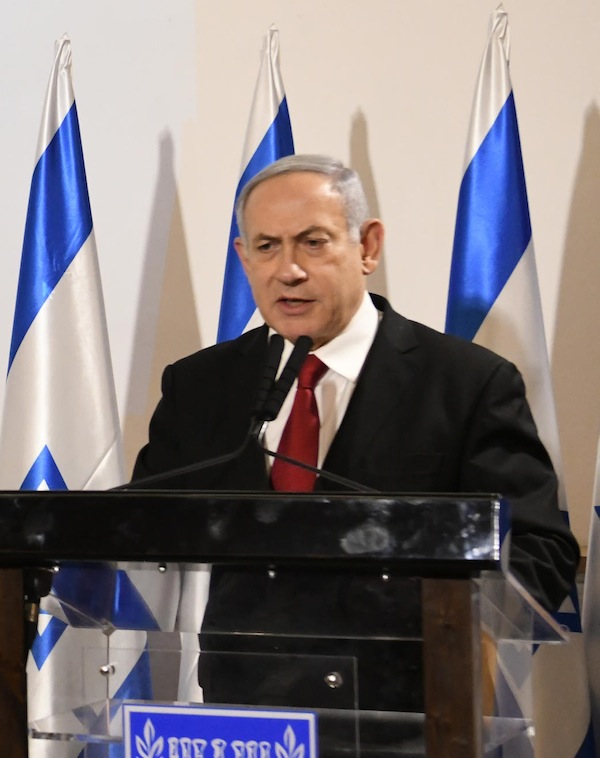
Israeli Prime Minister Binyamin Netanyahu places his vote on election day. (photo by Haim Zach/IGPO from Ashernet)

Unless something dramatic happens between when we write this and when you read this, the future of Israel’s government remains uncertain. To avert a third election in a year, the most viable option for a stable government would appear to be a “national unity” or “centrist coalition” involving both major parties, Likud and Blue and White.

This was the subject of face-to-face discussions between leaders and President Reuven Rivlin, but no agreement was reached. So Binyamin Netanyahu, the incumbent prime minister, has a few weeks to try to cobble something together. If he fails, Rivlin will probably call on Blue and White leader Benny Gantz to give it a go. Some bets are that, if it comes to that, there will be enough Knesset members desperate enough to avoid a return to the polls that some accommodation will be made. Perhaps the likeliest possibility is a Likud-Blue and White unity government without Netanyahu. (This scenario would become likelier if Netanyahu officially faces criminal charges in the next few days.)

Any broad coalition of this sort would lead to a degree of progress on some fronts – if far-right and religious parties are excluded, some policies and legislation that appeal to the secular majority are likely to advance – while progress on some other fronts would likely stall.

One example is the peace process – although there is, basically, no progress to stall at this point. There is great divergence in Israel over what the next steps should be vis-à-vis the Palestinians. In a broad-based coalition government, that uncertainty would define government policy, probably leading to inaction.

During the recent election, Netanyahu went further than previous leaders, promising to annex chunks of the West Bank to Israel. Gantz and the centre-left in Israel have been confounded by the reality that, while they seek a two-state solution and recognize a one-state situation as demographically unsustainable, until Israel sees a benefit to ending the occupation and can be certain that an independent Palestine in the West Bank will not be a launch pad for terror, independence will not come and the occupation will not end. Without that, no peace, no Palestine.

As a result, we will likely see more of the status quo, until some force acts to alter it. While Netanyahu’s provocative promise to annex areas would have altered the status quo for the worse, a precipitous end to the occupation that left a vacuum to be filled by those wishing to do Israel harm would likewise be a change for the worse. The tense status quo Israelis and Palestinians have now is definitely not great, especially for Palestinians, but it is better than outright war.

An old tale has the rabbi of a medieval Jewish community visiting the duke who has threatened to throw the Jews from his realm. The rabbi returns to his community and tells his people, “I convinced the duke to let us stay – if I can teach his dog to talk within five years.” The Jewish community is dumbfounded. “What a promise? It’s impossible!” The rabbi says, “Relax. I’ve got five years. The dog could die. The duke could die. I could die. Meanwhile, I bought us five years.”

The occupation, the statelessness of the Palestinian people, the recurring missile attacks from Gaza and the violence against civilians are not things we should understate or dismiss. But neither should we believe that any change is necessarily an improvement. The status quo is better than war and it is better than the dissolution of the Jewish state. The status quo is not ideal, but it may be better than currently available alternatives.

Self-image to be tested

It was all decorum and politeness at an election forum Sunday sponsored by the Centre for Israel and Jewish Affairs and SUCCESS, the United Chinese Community Enrichment Services Society.

The comparative decorousness of the event – although interrupted at one point by an impassioned outburst related to the mistreatment of indigenous peoples – will likely be an anomaly as the neck-and-neck campaign proceeds. Desperate measures will likely be employed as Liberals and Conservatives battle for a majority – and as New Democrats and Greens spar in what seems destined to be a down-ticket race of its own.

And all of this is playing out against the potentially upending news that the People’s Party of Canada’s Maxime Bernier has been admitted to the national debates on Oct. 7 and 10 organized by the official Leaders’ Debate Commission.

The new party – started by the breakaway former Conservative from Quebec – has attracted a range of malcontents, including extremists of various sorts being involved in or peripheral to his party. While the four “mainstream” parties have all tread relatively lightly around super-charged racial issues, Bernier – and perhaps less predictably, his fellow 337 candidates across the country – seems prone to exploit and exacerbate racial divisions.

On this and many other issues that will form the meat and potatoes of the rest of the campaign, Canadians will now hear the perspective of Canada’s answer to the populism that has taken root in the United States, Europe and elsewhere. The degree to which these ideas and Bernier’s rhetoric catches on will tell us much about our country and ourselves. Canadians have liked to imagine that we are immune to the phenomenon of xenophobia that seems to be gaining ground globally. But, then, we haven’t had, in recent history, a chance to vote for a party that represents such ideas.

One of the things that has been notable during the aftermath of Prime Minister Justin Trudeau’s recently revealed repeated donning of deeply problematic costumes, including blackface/brownface, is what seems like a divergence between the official voices and the unofficial voices.

Elected officials utter pieties about respect for diversity. Representatives of multicultural and anti-racism organizations speak of challenges and opportunities. Yet, in radio call-in programs and online comments – those voices of “ordinary” people – the responses seem quite different. Many complain that the blackface controversy is all a sideshow that diminishes focus on issues like the economy and the environment. Others suggest a tempest in a teapot or political correctness run amok.

In a few days, Canadians will get our first look at all the party leaders side by side, including Andrew Scheer and Jagmeet Singh, who remain somewhat unknown quantities, and Bernier, who will bring some genuinely outside-the-establishment perspectives to the debate. How far Bernier pushes the envelope – and how Canadians respond to his ideas – will tell us just how accurate our self-perception as an open, tolerant society really is.

Religion and politicians

In an interview with the CBC last week, federal Green party leader Elizabeth May was asked who her personal hero is. She responded, “Jesus Christ.” Almost immediately, she apologized, saying that she had responded while failing to “self-edit.”

Canadians, by and large, are not so open to publicly discussing matters like religion, politics or other things that could be perceived as controversial. But political leaders should be prepared to discuss things in their lives that have shaped them. In fact, religion seems likely to be more central in this election than it has been in decades.

New Democratic Party leader Jagmeet Singh felt compelled to address his religion in an ad (notably aimed at Quebec voters) about how his identity as a Sikh influences his worldview.

While Quebec’s Bill 21, which bans the display of religious symbolism in the public service, means Singh would not be permitted to teach in the province or hold certain roles in the civil service, he managed to finesse the issue quite neatly. He found a sort of common ground by acknowledging that Bill 21 is an effort by Quebecers to protect and preserve their identity, the importance of which he acknowledged paralleled his own pride in his identity and the importance it holds in his life.

Over the weekend, he also managed to continue discussing the topic while having a few laughs, which rarely hurts. Singh, who has struggled to connect with voters in the pre-election period, may come out of this round a winner by making Quebec voters and other Canadians take a good look at him for the first time.

Meanwhile, Liberals are trying to portray Conservative party leader Andrew Scheer as having a hidden agenda, based on his Catholic religious beliefs, on issues like reproductive freedom and equal marriage.

Scheer and Prime Minister Justin Trudeau, both Catholics, have taken similar approaches, asserting that their religious views will not dictate party or government policies. However, there is probably a different calculation being made on each side. Trudeau’s policies are probably more liberal than the teachings of his church, so segmenting the two prevents an undesirable schism with his church. Scheer is probably calculating that his beliefs in the teachings of his church are not shared by the majority of voters; therefore, segregating his political and religious positions may have a hint of political expediency. In both cases, Trudeau and Scheer have been vague and both have attempted to move past the topic. (This is tougher for Scheer, whose grassroots supporters, in many cases, are more religiously conservative than the average voter. Working on not alienating them while courting middle-of-the-road voters places him in a bit of a bind.)

The reticence by Trudeau and Scheer to enthusiastically discuss their religious views, and May’s odd flip-flop on Jesus, may be a consequence of a root misunderstanding around the separation of church and state: the concept is that religious institutions should not unduly influence, or be influenced by, governments. It does not mean that individual elected officials should neuter their religious views as they cross the threshold into the legislature. If one’s deeply held religious beliefs and values are what make up a person’s identity, worldview and morality, these are things that should very much be on the table for people seeking the public’s trust. By example, there is plenty in biblical literature that May could have cited as motivators for her environmental priorities. That kind of openness would be refreshing. Singh tried it. We’ll see what happens.

If religious adherence is an important part of who a candidate is, it would be nice to think that they would not be embarrassed or shy to share these perspectives with us. Canadians would perhaps understand our leaders better – including when they say that they personally believe one thing but would not legislate it on the country, which is an entirely legitimate position.

What likely makes voters suspicious or skeptical is when a politician seems to be hiding something, is ambiguous about how their beliefs might guide policy positions, or is ashamed of who they are.

Need earth-friendly policies

We are now well into the Hebrew month of Elul, which provides an incentive for heightened introspection, a chance to practise teshuvah, changes in our lives, before the Days of Awe, the Days of Judgment, the High Holidays of Rosh Hashanah and Yom Kippur. The shofar is blown every morning (except on Shabbat) in synagogues during the month of Elul to awaken us from slumber, to remind us to consider where we are in our lives and to urge us to consider positive changes.

How should we respond to Elul today? How should we respond when we hear reports almost daily of severe, often record-breaking, heat waves, droughts, wildfires, floods and storms; when July 2019 was the hottest year since temperature records were kept in 1880; when 18 years in this century are among the 19 hottest years and 2014, 2015 and 2016 successively broke temperature records; when polar ice caps and glaciers are melting far faster than projections of climate experts; when climate scientists are warning that we could be close to an irreversible tipping point when climate change could spiral out of control with disastrous consequences, unless major changes are soon made; when we appear to also be on the brink of major food, water and energy scarcities; and when, despite all of the above, so many people are in denial, and almost all of us seem to be, in effect, rearranging the deck chairs on the Titanic as we approach a giant iceberg?

Israel is especially threatened by climate change since, among other dangers, a rising Mediterranean Sea could inundate the coastal plain, which contains much of Israel’s population and infrastructure; and the hotter, drier Middle East projected by climate experts makes terrorism and war more likely, according to military experts.

It is well known that one is not to shout fire in a crowded theatre – except if there actually is a fire. The many examples of severe climate change indicate that the world is on fire today. Therefore, we should make it a priority to do all that we can to awaken the world to the dangers and the urgency of doing everything possible to shift our imperiled planet onto a sustainable path.

We should urge that tikkun olam (the repair of the world) be a central focus in all aspects of Jewish life today. We should contact rabbis, Jewish educators and other Jewish leaders and ask that they increase awareness of the threats and how Jewish teachings can be applied to avert impending disasters. We should write letters to editors, call talk shows, question politicians and, in every other way possible, stress that we can’t continue the policies that have been so disastrous.

As president emeritus of Jewish Veg, formerly Jewish Vegetarians of North America, I want to stress that shifting toward a vegan diet is something that everyone can do right away. It would significantly reduce greenhouse gas emissions and it would be consistent with Jewish teachings on preserving human health, treating animals with compassion, protecting the environment, conserving natural resources, and helping hungry people.

The afternoon service for Yom Kippur includes the book of Jonah, who was sent by God to Nineveh to urge the people to repent and change their evil ways to avoid their destruction. Today, the whole world is Nineveh, in danger of annihilation and in need of repentance and redemption, and each one of us must be a Jonah, with a mission to warn the world that it must turn from greed, injustice and idolatry, so that we can avoid a global catastrophe.

Richard H. Schwartz, PhD, is professor emeritus, College of Staten Island, president emeritus of Jewish Veg and president of Society of Ethical and Religious Vegetarians. He is the author of several books, including Judaism and Vegetarianism and Who Stole My Religion? Revitalizing Judaism and Applying Jewish Values to Help Heal Our Imperiled Planet, and more than 250 articles at jewishveg.org/schwartz. He was associate producer of the documentary A Sacred Duty: Applying Jewish Values to Help Heal the World.