Extremes and elections

Drawing parallels between political events in disparate countries may be folly, but it’s the season for frivolity, so why not. As British Conservative Prime Minister Boris Johnson was piling up an historically massive majority government, Canada’s Conservative leader Andrew Scheer was giving in to an apparently inevitable whimpering end to his leadership.

For most British Jews and many other observers, Johnson’s victory elicited something between relief and elation. While the Labour party has been the traditional home for many or most of that kingdom’s Jewish voters for generations, it is estimated that just six percent of British Jews voted to elect Labour leader Jeremy Corbyn prime minister this year. Corbyn has alienated Jewish voters and aligned with the most extreme elements in British society; his party is demonstrably rife with antisemitic people and ideas, as evidenced in a years-long probe first by the party and now by the country’s human rights watchdog. Under Corbyn, it seemed, there were two things the party would not tolerate: racism and Jews.

Of course, the election was not a litmus test on Corbyn’s antisemitism. Few non-Jewish voters probably made their decision based on that concern. Rather, his position on the ballot question – Brexit – was confused and inarticulate. Still, it was with a sense of justice, if not schadenfreude, that many Jewish observers watched Corbyn’s career collapse last week. Even so, the horse they bet on isn’t without serious flaws: Johnson is well known for his racism, xenophobia and Islamophobia, and his hard-right agenda is antithetical in other ways to many Jewish voters who may have found themselves between a rock and a hard place.

Hours earlier, Canada’s Scheer dropped the bomb that he would resign as party leader. The wagons had been circling since his defeat in the federal election in October. His Achilles heel, it is widely accepted, was his ambiguity around socially conservative policy issues.

During the campaign, opponents suggested that Scheer had concealed plans to threaten marriage equality and reproductive rights. However, the law permitting gay marriage and the absence of a law around abortion are both consequences of Supreme Court decisions, not of Parliament acting of its own volition. Barring a revolutionary shift at the Supreme Court, the status quo constitutionally could not be undone. More practically, there is very little political will to alter the status quo on these and a host of other litmus test issues. Not only are Canadians at large mostly in agreement with the way things stand, the critical mass of voters who swing elections are overwhelmingly centrist.

On the face of it, Scheer’s argument – that he has specific personal views that he would not manifest into legislation or policy; indeed, Justin Trudeau effectively and successfully made the same case four years earlier – is a morally valid one. Scheer’s problems on this front were twofold. He expressed his position poorly, failing to articulate either his deeply held values or his endorsement of the people’s consensus in a way that resonated with voters, and he misread the depth of investment many or most Canadians now have on these topics. He bet that Canadians might be satisfied with and respect the idea that he believes particular things but would not legislate on the basis of these faith-based positions. While this left many of his core supporters unenthused, it also misread the enthusiasm of the very voters he was trying to capture. Scheer’s refusal to participate in Pride parades became symbolic. A proportion of Canadians – the proportion that could swing elections – no longer wants a leader who will merely not interfere with an individual’s right to marry or to control their reproductive system, they want leaders who will unambiguously champion these rights.

There was plenty else wrong with the Conservative party’s campaign but, as Scheer tried to remind rogue members of his own party in the weeks following the results, they kept the Trudeau Liberals to a minority and, indeed, created a genuine threat of defeating them at points in the campaign, something few Conservatives thought was a reasonable possibility when Scheer was first elected party leader two years ago. Alas for him, the party smells blood and seems to want someone who can go in for the kill when this minority Parliament dissolves.

Even with the Conservative party in transition, Canadians might have to head to the ballot box before Trudeau’s four years are up. For the British, this month’s election was their third in less than five years. Meanwhile, Israel is gearing up for its third election in a year and the United States, too, is tumbling towards a fraught election.

We are in the midst, it seems, of a continuing test as to how well democracy can negotiate political extremism. At least for now, in Canada, the socially conservative “private” views of Scheer are political losers, but election results in other democracies prove that complacency can’t be an option.

Time to face ourselves

Actor and comedian Sacha Baron Cohen delivered the keynote address last month at an Anti-Defamation League conference. His words quickly went viral because he pinpointed fears and challenges shared by millions about the power of social media. He hit many nails on the head.

“Democracy, which depends on shared truths, is in retreat, and autocracy, which depends on shared lies, is on the march,” he said. “Hate crimes are surging, as are murderous attacks on religious and ethnic minorities. All this hate and violence is being facilitated by a handful of internet companies that amount to the greatest propaganda machine in history.”

He was referring to social media like Facebook and Twitter and platforms like YouTube and Google, whose algorithms, he said, “deliberately amplify the type of content that keeps users engaged – stories that appeal to our baser instincts and that trigger outrage and fear.”

Had Facebook existed in the 1930s, he went on, it would have run 30-second ads for Hitler’s “solution” to the “Jewish problem.”

Baron Cohen acknowledged that social media companies have taken some steps to reduce hate and conspiracies on their platforms, “but these steps have been mostly superficial.”

“These are the richest companies in the world, and they have the best engineers in the world,” he said. “They could fix these problems if they wanted to.” The companies could do more to police the messages being circulated on their sites, he suggested.

He’s correct about the problems. But the first problem with his solution is that he is asking a couple of corporations to judge billions of interactions, making them not only powerful media conglomerates, which they already are, but also the world’s most prolific censors and arbiters of expression. Of course, by abdication, they are already erring on the side of hate speech, but is the alternative preferable? If we think Facebook chief executive officer Mark Zuckerberg has too much power now, do we really want to make him the planet’s censor-in-chief?

Yes, the platforms benefit from and, therefore, promote, the most extreme viewpoints. But, even if we could, would forcing those voices off the platforms make the world a safer place? There are already countless alternative spaces for people whose extremism has been pushed off the mainstream sites. Just because we can’t hear them doesn’t mean they’ve gone away.

Marshall McLuhan, the Canadian philosopher who declared “the medium is the message” died four years before Zuckerberg was born. He could have predicted that social media would change the way we interact and communicate. But has it fundamentally changed who we are? Or has it merely allowed our true selves fuller voice? Perhaps a little of both. Facebook, Twitter and the others are not agnostic forces; they influence us as we engage with them. But, in the end, they are mere computer platforms, human-created applications that have taken on outsized force in our lives. And all the input is human-created. Since the dawn of the industrial age, we have imagined our own inventions taking over and controling us, from Mary Shelley’s Frankenstein to 2001: A Space Odyssey’s Hal to Zuckerberg’s Facebook.

In all these cases, fictional or not, the truth is that the power remains in human hands. This is no less true today. We could, if the political will existed, shut down these platforms or apply restraints along the lines Baron Cohen suggests. But this would be to miss the larger point.

We live in a world filled with too much bigotry, chauvinism, hatred and violence. This is the problem. Dr. Martin Luther King said: “Darkness cannot drive out darkness; only light can do that. Hate cannot drive out hate; only love can do that.” And there are plenty of sites on social media that advance mutual understanding and love over hate. Are their messages as likely to go viral? Probably not. But that, ultimately, is determined by billions of individual human choices. A small but illuminating counterrevolution seems to be happening right now with a renaissance of the ideas of Mister (Fred) Rogers and his message of simple kindness. While much of the world seems alight in hatred and intolerance, a countermovement has always existed to advance love and inclusiveness. This needs to be nurtured in any and every way possible.

If Facebook were a country, its “population” would be larger than China’s. Bad example when we are discussing issues of free speech and the accountability of the powerful, perhaps, but illuminating – because an entity of that size and impact should be accountable. As a corporate body, it has few fetters other than governmental controls, which are problematic themselves. Concerned citizens (and platform users) should demand of these companies the safeguards we expect. We are the consumers, after all, and we should not ignore that power.

But neither should we abstain from taking responsibility ourselves. Social media influences us, yes. But, to an exponentially greater degree, it is merely a reflection of who we are. It is less distorted than the funhouse mirror we like to imagine it being. If what we see when we look at social media is a depiction of the world we find repugnant, it is not so much social media that needs to change, it is us.

Troubles in leadership

A world leader decries investigations into his possible criminal corruption as an “attempted coup” based on “fabrications and a tainted and biased investigative process.”

No, not that world leader. This time it is Binyamin Netanyahu, Israel’s prime-minister-by-a-thread. Finally indicted on graft charges after months of anticipation, he became the first Israeli prime minister ever to face charges while in office. He insists the indictment will not impact his leadership, just as the country seems on an irreversible path to a third election in a year.

In a region with a scarcity of free and fair elections, Israel can’t seem to stop having them. From that perspective, things could be worse. Whether Netanyahu’s Likud party stands with him in his time of trouble remains to be seen. The possibility of his departure from the political scene, which he has dominated for nearly a generation, would provide the most significant shakeup of the field and possibly prevent a third inconclusive outcome.

On this side of the ocean, the U.S. House of Representatives continues investigating President Donald Trump. Few people, including Republicans, are making much of an effort to refute the basic facts. Evidence piles upon itself that the U.S. president indeed asked the president of Ukraine for a dirty political favour – a bribe – in exchange for military financial aid that had already been approved by the U.S. Congress. GOP responses to this evidence range from “So?” to the only slightly more nuanced argument that the president of the United States didn’t get what he wanted and the president of Ukraine did, so no harm done.

With Trump seemingly in thrall or somehow beholden to Vladimir Putin, and his party steadfast behind him, we are treated to the spectacle of a party that 60 years ago was trampling over individual liberties based on a largely false suspicion that “the Russians” were infiltrating the country’s government and threatening its entire way of life now responding to a disturbingly similar situation, this one far more provably real, with a shrug.

While Canada, thankfully, has no such level of political intrigue or corruption at the moment, a shocking diplomatic move last week has set the official voices of the Jewish community on edge.

The day before swearing in a new cabinet, the government of just-reelected Prime Minister Justin Trudeau opted to vote at the United Nations General Assembly to condemn all Israeli settlements in the West Bank, jumping on a dogpile led by North Korea, Egypt, Nicaragua and Zimbabwe, none of whom should be arbiters of justice or human rights. To be clear, the vote means almost nothing in practical terms. But symbolism does count. And the vote was a slap in the face by Canada to Israel and those in this country who recognize it as our closest ally in the region for historical, moral and pragmatic reasons.

Some speculate that the shift in tone reflects the new minority government currying favour with the New Democratic Party, which has included some notorious Israel-bashers. That is probably a less likely reason than the campaign by Trudeau to win Canada one of the rotating seats on the United Nations Security Council. Where former prime minister Stephen Harper’s refusal to “go along to get along” in the anti-Israel hatefest that occurs annually at the UN was seen as a key reason we lost out on a seat, Trudeau seems determined to hedge his bets.

A prestigious seat on the Security Council would presumably elevate Trudeau in the eyes of the world after he frittered away the “Canada is back” optimism of four years ago by failing to meet climate targets while bhangra dancing across the world stage.

Regardless of the motive, it is a reprehensible act that could have serious implications for the political orientation of Jewish Canadians in the next few years. Coming as it does while the ink is barely dry on the results of an election in which Liberals mostly made the right noises to Jewish and pro-Israel Canadians, it seems a particularly brutish little dagger to unsheathe now.

Trojan horse for Israel?

United States Secretary of State Mike Pompeo said Monday that the United States does not view Israeli settlements in the West Bank as a violation of international law, reversing long-standing U.S. policy.

Most countries, and the United Nations General Assembly, hold that the settlements contravene the Fourth Geneva Convention, which declares that an occupying power “shall not deport or transfer parts of its own civilian population into the territories it occupies.” There are counterarguments: Jewish residency in the area goes back thousands of years and, since Jordanian occupation of the area, which was superseded by Israeli occupation in 1967, was never internationally recognized, there was effectively no legal sovereign power and, as a result, the prohibition outlined by the Geneva Conventions is moot.

These are arcana for legal minds, but the more practical implications of the announcement demand the questions: Why? And why now?

The announcement came 48 hours before the deadline Benny Gantz was granted to form a government in Israel. Was this some last-ditch lifesaver thrown to Prime Minister Binyamin Netanyahu by his friend Donald Trump? Trump seemed to throw Netanyahu more of an anvil than a buoy after Netanyahu’s poor showing in the most recent election, contending that the relationship was between two countries, not between two men. Typically, Trump’s concept of loyalty to ostensible allies is solid as the wind.

And what does the U.S. administration hope to gain from this? Is there some domestic political calculation at play? It may be an ideologically consistent position for Republicans to side with the Israeli right. But ideological consistency, or any consistency at all, is not a hallmark of the administration.

Some would say that there is an overemphasis on settlements as a component of the conflict, that there is a vast range of issues at the root of the continuing Israeli-Palestinian struggle and that settlements are among the most likely to be satisfactorily resolved through compromise. Other accelerants, like incitement in Palestinian society, are less easily dismantled or accommodated through trade-offs.

Whether we are vehemently opposed to settlements in the West Bank, whether we are passionately in favour of the right of Jewish people to live in that area, or whether we fall somewhere in between, realpolitik should convince us that settlements undermine attempts by the Israeli side to project a good-faith commitment to an eventual resolution of the conflict.

But, more to the immediate consequences, almost instantaneously after Pompeo’s comments, the Overseas Security Advisory Council, a branch of his own department, issued a new security alert for Jerusalem, Gaza and the West Bank, warning of potential retaliation by Palestinians in response to Pompeo’s remarks: “U.S. citizens should carefully consider risks to their personal safety and security at sites and events that are potential targets” and “should avoid nonessential movements and events that attract attention.”

Violence should always be blamed on the perpetrator, and defences should not be made that seem to excuse it based on “provocations.” Nevertheless, the Secretary of State made a comment that led to an immediate warning from his own department that American and Israeli people and interests may be put at risk. And for what?

Is this a “gift” to Jewish and Zionist Americans? Sure, if we believe that it is beneficial to have the Diaspora pro-Israel movement associated with the extreme right in both countries, and that our long-standing commitment to peace and two states with contiguous defensible borders is a concept increasingly isolated to the left. Clearer heads would see it as a very divisive gift indeed, a Trojan horse more than a gift basket from Zabar’s.

For whatever else it may have been, Pompeo’s statement is, at root, the manifestation of something we have repeatedly warned against in the space: the politicization of the important bilateral relationship with Israel for short-term political reasons. That isn’t good for Israel in the long run.

Rockets raining down

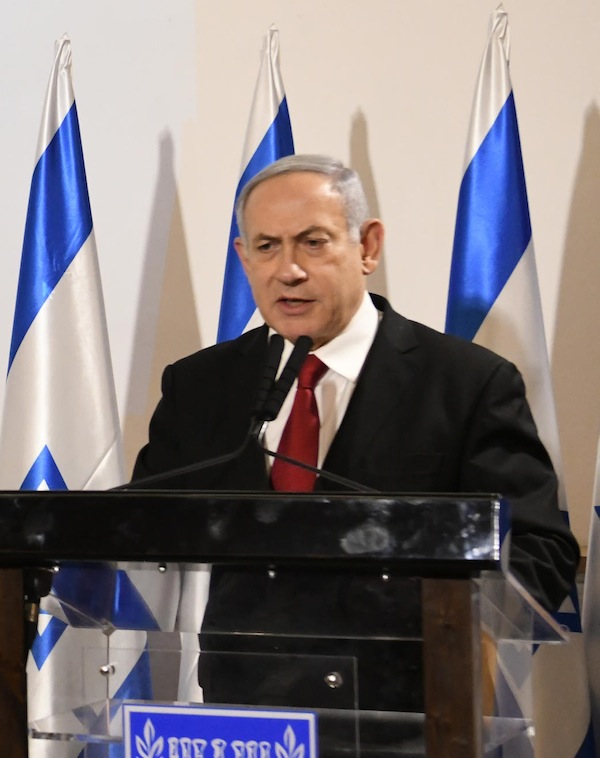
Israeli Prime Minister Binyamin Netanyahu talks about the rockets being fired from Gaza. (photo by IGPO via Ashernet)

Rockets were falling on southern and central Israel as the paper went to press this week. After the Israeli military killed Islamic Jihad commander Baha Abu al-Ata, Gaza once again erupted into full war footing.

The Iran-backed Palestinian Islamic Jihad called the assassination “a declaration of war against the Palestinian people” and declared, “Our response to this crime will have no limits.” Because they’re usually so restrained.

Schools were closed and Israelis, especially in the “envelope” area near the Gaza Strip but also in Tel Aviv, hunkered down in bomb shelters as Iron Dome deflected some but far from all of the rockets launched from the enclave.

The new, or renewed, conflict does not occur in a vacuum. Political leaders in Israel are in the midst of difficult negotiations to form a government after the second inconclusive election this year. Some critics claim the fighting is a scorched earth attempt by incumbent Prime Minister Binyamin Netanyahu to shake up the status quo and tip domestic politics in his favour. But, among those who reject this assessment is Netanyahu’s chief rival, Benny Gantz, who is now leading the efforts to cobble together a working alliance in the Knesset.

It all has a feel of déjà vu, of course, because this scenario, in different permutations, has played out repeatedly. As we posited in this space recently, some people say the status quo cannot hold. It can. It has for decades. But intermittent, terrible flare-ups like this are a part of and a price for that status quo, a high price paid by both Israelis and Palestinians. Until someone finds a path for both peoples to coexist more peacefully, this is life.

Xenophobia intolerable

Don Cherry and Ron Maclean on screen, in 2018. (photo by Ross Dunn/flickr.com)

For many Canadians, Don Cherry and his bombastic pronouncements about hockey, but, more importantly, about society and whatever pops into his head, have been like a tolerated, occasionally amusing uncle at the family table. An opinionated crank who seems like a throwback to an earlier, less refined time, Cherry has been coming into our living rooms for decades, part and parcel with our national pastime.

But there’s a limit.

Cherry was finally told to leave the family table Monday after a rant about “you people” – new Canadians, immigrants or, as people of his inclination might characterize them, “foreigners.”

“You people … you love our way of life, you love our milk and honey, at least you can pay a couple bucks for a poppy or something like that,” Cherry said on Hockey Night in Canada last Saturday, two days before Remembrance Day. His implication was that new Canadians do not wear poppies or perhaps do so in lesser numbers than Canada-born Canadians. The Canadian Broadcast Standards Council was inundated and paralyzed on the weekend by complaints from viewers. On Remembrance Day, Sportsnet, which broadcasts the program, pulled the plug.

Cherry was unrepentant: “I know what I said and I meant it. Everybody in Canada should wear a poppy to honour our fallen soldiers.”

But that wasn’t the context of what he said. His implication was clear: immigrants take the benefits of life in Canada but do not respect the sacrifices that built the country or those who made them. That’s a far different – and more xenophobic – thing than saying everyone should wear a poppy.

Already, of course, social media grumps and trolls are declaring this the latest case of “political correctness” run amok, akin to taking “all thy sons command” out of the national anthem and all the other modernizations that threaten the hegemony of the geezer class.

Times change. People adapt or they don’t. But there are consequences in either case.

“To keep my job, I cannot be turned into a tamed robot,” said Cherry.

So be it.

The next generations

An important event took place in Vancouver last weekend, as hundreds of child survivors of the Holocaust convened at a downtown hotel for the conference of the World Federation of Jewish Child Survivors of the Holocaust and Descendants. A Shabbat dinner, moving speeches, presentations and other events were attended by survivors, their children and grandchildren, with specific programs organized with the interests and needs of each group in mind.

Attendees felt the heavy presence of time, as some reflected that these conferences are seeing fewer survivors and that the firsthand knowledge of these events will soon be carried only by the second and third generations. (See next week’s paper for coverage of the event.) Attendees, who fortunately witnessed Vancouver over a few days of autumn sunshine, raved about the welcome they received from locals and the quality of the program and the achievements of the organizers. But it is Vancouverites who should be most honoured to have been able to meet and experience the spirit and resilience of these remarkable individuals. Each survivor has a very different survival story and life history, yet they come together in part because of a need to connect with others who are most likely to understand not only the facts of their Holocaust experiences, but the unique hurdles – and, notably, the many, many achievements – of having survived and thrived after an early life of often-unimaginable challenge.

We are now amid a week of solemn remembrance – the 81st anniversary of Kristallnacht, on the night of Nov. 9-10, followed by Remembrance Day, Nov. 11. These weighty commemorations are an opportunity to reflect on the past and to rededicate ourselves to a world free of hatred, war and genocide.

The past cannot be undone, but restitution and reconciliation can help to take that past and, in some small ways, find meaning that restores honour and dignity to the victims and those who carry their legacies. That is one of the themes of the new exhibit just opened at the Vancouver Holocaust Education Centre (VHEC).

Treasured Belongings: The Hahn Family and the Search for a Stolen Legacy opened Thursday, launched at the annual Kristallnacht Commemoration with a presentation by Dr. Michael Hayden, a renowned Vancouver medical researcher. Hayden’s grandparents, Max and Gertrud Hahn, who were murdered in the Holocaust, had one of Germany’s most significant collections of Judaica. The story of the survival of parts of that collection – and the ongoing efforts to locate and restitute other items – is not so much, he says, about the artifacts themselves, but about reclaiming the individuality and dignity of his grandparents and the lives that were stolen from them. (Again, next week’s paper will feature coverage of this event.)

For Hayden, the process has been emotional, sometimes rewarding, sometimes disheartening. But it is an act of dedication to restore the individuality of two of Nazism’s victims. Sheer numbers of genocide victims are almost incomprehensible, especially to young minds, which are the most critical target of contemporary Holocaust education. Intergenerational narratives like those of the Hahn-Hayden family, illuminated with tangible artifacts, are a vital means to bring this history in a meaningful way to the generations who will not have the opportunity to meet and hear testimony from those who witnessed and experienced that cataclysmic history themselves.

Those of us who have had the privilege of being entrusted with the stories of survivors, or the experiences of veterans of the wars against tyranny, must appreciate the importance of being witnesses to the witnesses. We should take a moment over this weekend to consider how we can act in our daily lives to advance a world that does justice to their memories and experiences.

Choosing love not hate

On Sunday, vigils were held in many cities to commemorate the 11 worshippers killed at Tree of Life Synagogue in Pittsburgh on Oct. 27, 2018. The shooting was the deadliest attack on Jews in American history.

As we have mourned and taken greater measures toward protecting ourselves, we have, mainly, not let fear paralyze us or isolate us from our neighbours and the larger world. We have continued to live Jewishly, whatever that means to each one of us; whether it’s helping those less fortunate, lobbying for sound government policies, going to synagogue or simply being kind to the people we encounter in our day.

In Vancouver, community members and others could join two collective moments of remembrance on Sunday: the Jewish Federations of North America’s Pause with Pittsburgh, which included the livestreaming of a public memorial service, and a service at Congregation Beth Israel, organized by the Rabbinical Association of Vancouver with the Centre for Israel and Jewish Affairs, the Jewish Community Centre of Greater Vancouver, Hillel BC and the Jewish Federation of Greater Vancouver.

Over the weekend, Jews were also encouraged – as they were in the wake of the tragedy last year – to #ShowUpForShabbat, an initiative of the American Jewish Committee, calling for us “to honour the victims and raise our collective voice for a world free of antisemitism, hate and bigotry.”

Beth Israel’s Rabbi Jonathan Infeld, who grew up in Pittsburgh, told News 1130, “There are still many people who are frightened and worried about what took place a year ago…. There are people who are concerned about coming to synagogue and people who are concerned about antisemitism. Especially on holidays, one of the messages I deliver is that, unfortunately, antisemitism is on the rise in the world. But we have to remain strong, to have the courage to come to synagogue, and to not allow attacks like this to prevent us from being who we are and to deprive us of the benefits that come from being in a sacred space.”

Infeld also noted, “One of the aftermaths of the attack is that people in Pittsburgh didn’t feel this was an attack just on a synagogue, they felt it was an attack on Pittsburgh…. We have to understand an attack on any sacred space is an attack on an entire community, so we need to stand together as one community with the message that love is stronger than hate.”

While the situation is not as bad as elsewhere in the world, the number of hate crimes and the incidences of antisemitism in Canada, including in British Columbia, have increased worrisomely. Love has a long row to hoe. Not only to give us the courage to speak up in the face of prejudice, but also to confront and temper our own. Not only to make us self-assured enough to make space for those with whom we agree and for whom we care, but also for those with whom we disagree and whom we dislike. Not only to inspire us to dream of a better world, but to give us the imagination and resourcefulness to bring those aspirations into being.

Love can only be stronger than hate if we choose to make it so.


Vibrant democracies

On Monday, Canada and Israel each embarked on a new adventure in governance. Here at home, Justin Trudeau’s Liberal party had a surprisingly robust showing in the federal election, winning the irrefutable right to form a minority government, or to form a coalition of some description.

The Liberals’ relatively strong showing – 157 seats to Andrew Scheer’s 121; just 13 short of a majority – opens the door for a government with Jagmeet Singh’s New Democrats holding a balance of power. Just a few days before the election, polls suggested a race so tight, and with the Bloc Quebecois and NDP taking so many seats, that any configuration to reach the magic 170 number would have required not two parties, but three. That complicated scenario was averted, leaving the Liberals free to face the House with either a formal agreement with the NDP or a tacit knowledge that the now-fourth party is in no financial position to return hastily to the election battlefield.

In Israel Monday, President Reuven Rivlin called on Blue and White leader Benny Gantz to attempt to form a government after incumbent Binyamin Netanyahu failed to do so after the second inconclusive election this year. Gantz has said he hopes to form a “liberal unity government,” but that is as challenging as Netanyahu’s failed effort to coalesce a majority. He may be hoping that, if Netanyahu is indicted in the coming days, Likud under a new leader might be a viable partner – or perhaps some MKs unfettered from Netanyahu’s long years of leadership will break away and form a faction to join Gantz. Another plan has Gantz propping up Netanyahu unless and until Netanyahu is charged, at which point Gantz would stand up as prime minister, which seems a strange compromise with a tarnished leader. As usual in Israeli politics, there are a vast number of moving parts.

Multiple moving parts is less typical of Canadian politics, where our tendency toward majority governments typically sequesters any moving parts in the all-powerful Prime Minister’s Office. Not so during a minority Parliament, when individual MPs on all sides are able to wield power in ways they can only dream of in a majority scenario.

In what must be a jagged pill for the once and future prime minister, Jody Wilson-Raybould, whose testimony about Trudeau’s treatment of her was the single most detrimental arrow in Trudeau’s reelection armour, was herself reelected as an independent in Vancouver Granville. A large number of Jewish British Columbians, now, are represented in Parliament by an individual who belongs to no party. This will be fascinating to watch in many respects, not least how she pursues politics from the opposition benches as the SNC-Lavalin affair continues to percolate.

Other sidebars in the result include the scuttled effort by a leading anti-Israel figure to re-enter Parliament. Svend Robinson, who, during 25 years in Parliament, was one of Canada’s most vociferous voices against Israel, threw his hat back in the ring but came up short in Burnaby North-Seymour – being narrowly defeated by the incumbent Liberal despite this being ground zero in the battle over the Liberals’ Trans Mountain pipeline expansion.

More notably, Maxime Bernier, leader of the nascent People’s Party, lost his own seat in Quebec. His party made effectively no impact anywhere, sending the hopeful sign that messages of populist xenophobia that seem to be resonating elsewhere in the world still fall largely on deaf ears, at least electorally, here.

Canada will almost certainly have an easier time forming a government than Israel will but, in both cases, the drama plays out against the backdrop of healthy, vibrant, disputatious democratic systems. No matter what the outcomes, we should be thankful for that.


Canada is not immune

Maxime Bernier’s performance at the federal leaders debate Monday night may have been unimpressive, and at times badgering, but no doubt some ears pricked up at his assertion that he is the only party leader whose position on immigration stands apart. True enough. He calls for about 150,000 immigrants annually, half the number now admitted.

The People’s Party leader was challenged at the get-go by a debate moderator who raised Bernier’s past comments about “extreme multiculturalism” and his use of the words “ghettos” and “tribes” to describe new Canadians.

Bernier will be lucky to win his own seat in Quebec and his actions in the debate probably didn’t win him a groundswell of supporters anywhere else. But the emphasis on immigration was notable. Slashing immigration in half, which could have detrimental impacts on the economy and growth of the country, would represent a huge number of people refused entry to Canada. But it’s not really about the numbers. It was the underlying message. Bernier was signaling to potential supporters that immigration is generally undesirable, with all the attendant impulses that message is intended to convey.

Hours before the debate, an Angus Reid Institute poll indicated that Canadians are split on the issue – and leaning in the direction of less immigration and tougher treatment for asylum-seekers. Forty percent of respondents said Canada takes in too many refugees, while 13% said we accept too few.

Bernier may not be the best messenger for the anti-immigration idea, but it is clear that there is a constituency in Canada for a politics that is exclusionary and plays on discriminatory tropes. All the main political parties are admirably standing firm against this impulse, for now. But it is worth keeping a close eye on this trend and reminding ourselves regularly that Canada is not immune from xenophobia.