Rallies help keep hope alive

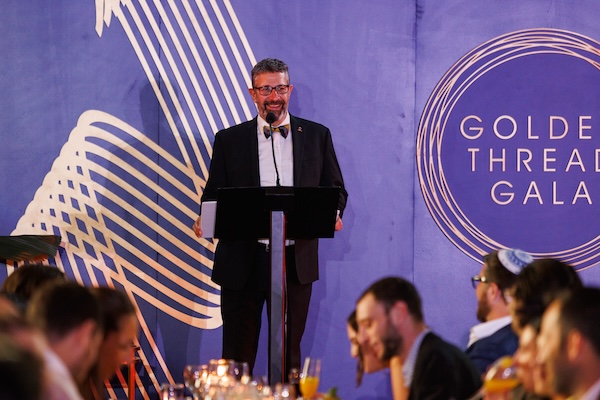
Jewish Federation of Greater Vancouver chief executive officer Ezra Shanken addresses those who gathered at the Vancouver Art Gallery Jan. 14. (photo by Pat Johnson)

Vancouverites gathered Jan. 14 to mark the 100th day since the Oct. 7 terror attacks and to demand the release of hostages. The weekly vigils – which have taken place since the day after the attacks with the exception only of two weeks during the December holidays – continue to gather hundreds, with police escorts accompanying marchers through downtown streets after speeches outside the Vancouver Art Gallery.

“This is the moment for leaders of the world to take a stand against terrorism, to call on Hamas to release the hostages,” said event organizer Daphna Kedem. “Where are you, world leaders? You stay silent while girls are held in tunnels and Hamas are abusing women of all ages. Where are you? [There are] 136 hostages: 17 women, two children, 15 men and women over the age of 65, 94 men and youngsters, eight foreigners. We will not rest until they are all back.”

Kathryn Zemliya spoke of the commitment she made to Israel when she became a Jew by choice 17 years ago.

“Israel is the Jewish homeland,” she said. “Israel is also the birthplace and source of our Jewish faith. Our religious holidays reflect all the seasonal changes in the state of Israel and we celebrate those throughout the year.”

Her commitment to Israel, she said, is also a very personal one. 

“Israel is one of a very few handful of Middle Eastern countries where people are not punished as criminals simply because of their sexual orientation or gender identity,” said Zemliya. “For me, this is tremendously important. There are lots of places in the world where I could not travel with my family, where I could not travel with my wife, but I know that I would always be welcomed in Israel.”

She called for justice and defined what that justice would look like.

“Justice requires that we listen to and believe those who have given testimony of rape, brutality and torture that they have experienced or witnessed at the hands of terrorists,” she said. “Justice requires that we recognize and care for those who have been displaced from their homes due to conflict on all fronts in Israel because the war is not happening just in Gaza. Justice requires that we recognize and care for those who have lost family members, who have been traumatized and who, because of their life circumstances, are retraumatized daily by this terror. My hope is that we will see this justice soon and in our time, that is what we pray for.”

Rabbi Hannah Dresner, senior rabbi at Or Shalom Synagogue, and Rabbi Arik Labowitz, assistant rabbi, addressed the crowd.

“We are here to console one another through the power of gathering in such a difficult time,” said Dresner. She noted that the week’s Torah portion featured the demand by the Israelites to the tyrant of their time to let their people go. “We, likewise, are commanded by everything we know to be decent, to demand of the tyrant of our time, let our people go.”

Labowitz spoke of “waves of grief, fear and deep concern for the existential realities of our precious home in the land of Israel.”

“We are all heartbroken by the loss of life, the ever-deepening chasm and the generations of repair that will be required to heal from this moment in our shared history,” he said. “We know that the Jewish people have a heart that is bigger than any malicious attempts against us. The love and support that has come together to repair the fabric of Israeli society, of our local communities and of each of our hearts, is made up of the strength whose origin is in the plight of our ancestors to be free people in a land of our own, a land where our people were sovereign for centuries and a land that we returned to after 2,000 years of exile.”

photo - Rabbi Arik Labowitz, assistant rabbi of Or Shalom, standing next to his colleague, Rabbi Hannah Dresner, the congregation’s senior rabbi. The two spoke at the Jan. 14 rally marking 100 days since Oct. 7
Rabbi Arik Labowitz, assistant rabbi of Or Shalom, standing next to his colleague, Rabbi Hannah Dresner, the congregation’s senior rabbi. The two spoke at the Jan. 14 rally marking 100 days since Oct. 7. (photo by Pat Johnson)

Adi Keidar, who moved to Vancouver from Israel in 2000, shared the lesson she has learned since Oct. 7.

“Life, I used to think, matters to all,” she said. “But these past 100 days, I am sad to say, I’m wrong.”

Evil exists, she said, but must not be allowed to be the dominant voice. 

Ezra Shanken, chief executive officer of the Jewish Federation of Greater Vancouver, acknowledging the day’s below-freezing temperatures, said of the hostages: “The least we can do is stand here in the cold if they live in the cold depths of the tunnels.

“Let them know that, even in the coldest days of the year, we will stand out here and we will stand with them because we know that they need it,” he said, urging attendees to “keep showing up.”

Kedem, who has organized the events week after week, read aloud the names of the 136 hostages.

107 days

A week later, the King David High School community was front and centre at the Jan. 21 rally. Students of the Jewish school sang and spoke at the gathering, which ended in a downpour of rain as the group marched through city streets.

“You’re a link in a chain that has been growing stronger for thousands of years,” event organizer Daphna Kedem told the students.

Erica Forman, a 2022 alumna of King David, and brother Max Forman, a Grade 12 student, spoke of the strength they gathered during this time of unprecedented antisemitism from their respective communities at the University of British Columbia Hillel and at King David.

Rutie Mizrahi, parent of a Grade 12 student, spoke of her uncle and aunt, Oded and Yocheved Lifshitz, who were abducted from their home in Kibbutz Nir Oz Oct. 7. Yocheved, 85, was among the first hostages released, after 17 days in captivity, because her captors believed she was near death.

The captors underestimated her aunt, Mizrahi said, and she has survived, despite arriving back in Israel appearing to be about half the weight she was when kidnapped. Yocheved had been rolled in a carpet and driven away on a motorcycle, but not before she saw her 83-year-old husband being savagely beaten outside their home. She did not believe he could have survived, but another hostage, freed later, confirmed that Oded was alive in Gaza but, without his blood pressure medication, had repeatedly fainted and was then taken to a hospital. 

“The odds that we will see him back alive are close to zero,” Mizrahi said.

King David’s head of school Russ Klein said he is grateful his father, Emerich Klein, a Holocaust survivor who passed away earlier in 2023, is not witnessing the hatred in the world since Oct. 7.

“He instilled in us the need for Israel,” the principal said. “Only Jews, he said, would take care of Jews. I spent much of my time growing up not believing him. As I found with so many things as I got older, I learned my father was right.”

Klein called the school assembly on Oct. 10, when students and faculty gathered to mourn the Hamas murder of alumnus Ben Mizrachi, 22, and the other victims of the pogrom, the hardest moment of his career.

He urged people of all ages to inform themselves of facts to better engage in the discussion around events in Israel and Gaza, specifically directing attendees to resources released recently by the Jewish Federation of Greater Vancouver, an online toolkit called “The Power of One” and a messaging guide called “Real Peace Now.” Both are available at jewishvancouver.com. 

Protests, picketing alarm Jews

Screenshot of Nelson City Council’s Oct. 22, 2023, meeting. Left to right, Topaz Zafrir, Yael Finer and Judy Banfield of the Kootenay Jewish Community Association present their concerns about the rise in anti-Israel and antisemitic events to the council.

Last October, as tensions in Canada were mounting over the Israel-Hamas war, three members of the Kootenay Jewish Community Association in Nelson paid a visit to the city council meeting to convey a request: that the council refrain from taking sides when it came to the emotionally charged protest rally that had taken place the day before. Nelson residents Judy Banfield, Yael Finer and Topaz Zafrir said they were also there to ask the police to continue its protection of Jewish community events, as it had in previous years. “We are very grateful for that,” Banfield said. “Right now, our community is frightened.” 

The week before the meeting, Hamas had called to its supporters for a “day of rage.” The response was swift in Nelson, a college town that has seen an escalation of pro-Palestinian sentiment and anti-Israel demonstrations in recent years. About a hundred people turned out to hear speakers who gave accounts of what they believed was happening in Gaza. According to Kootenay Jewish community leader Yael Finer, the presentations included assertions about Israel’s role in Gaza that had already been debunked. The purpose of the rally, she felt, was to incite antisemitism and anti-Israel sentiment in the city. Finer, an Israeli-Canadian who moved to Nelson in 2016, told the council that one of the speakers also made a pitch on behalf of Hamas.

“A final speaker said, ‘Don’t hate Hamas. They’re our brothers, our sons, our fathers,’” Finer recounted.

“The event was supposed to be about peace and education,” she said. “I actually reached out to the organizer, asking to speak at the event as one of the Israeli or Jewish [residents].”

Finer told the council that she empathizes with the Palestinian people and shares concern over the current situation in Gaza. She had gone to the rally to learn. She said her request to speak at the event was denied. 

Finer added that one of the speakers was a city council member, “creating a perception of legitimacy” for the demonstration. The mayor later released a statement clarifying that only the mayor’s office represented the views of the city government, including at public events.

Not a new phenomenon

Banfield, who is a former Selkirk College instructor and has lived in Nelson since 1990, said antisemitism isn’t a new phenomenon in the city. She said the planned speech in 2013 of Greta Berlin, an accused antisemite, put the community on edge. Eventually, the Nelson library rescinded the offer for her to speak, but she was later offered a venue at the United Church. Although the gathering remained peaceful, Banfield said anti-Israel and antisemitic behaviour have only grown more evident.

“I have been in Nelson a long time and we’ve always been very open that we’re here and inviting,” she told the Jewish Independent about the local Jewish community. She said that, until recently, religious celebrations used to be open to the Nelson public. However, a couple of years ago, demonstrators picketed a Jewish holiday celebration.

“People were picketing us, basically as being Jews, being responsible for what is going on in the Middle East,” said Banfield. Since then, she said, the community has had to ask for police protection at religious and other community events and to conceal their locations from the public. “We do not feel safe gathering together in an announced venue,” she told the Nelson council.

Last November, demonstrators held another rally, this time calling on the city to formally advocate for a ceasefire. According to several attendees, there were also calls for boycotting local businesses that were assumed or known to do business in or with Israel.

Jeff Shecter, another long-time resident and one of the Jewish community’s first leaders, said even more people turned out for that rally. He said the protests and “river to the sea” chants have unnerved the Israeli members of the community.  “[They] were more shocked than the rest of us who were maybe used to it,” Shecter observed. While he said he is not afraid, “to have a demonstration supposedly in support of Palestine without anyone, not a single soul, denouncing what happened on Oct. 7 was a travesty.”

Zafrir, one Nelson’s most recent arrivals from Israel, told the council that the community isn’t trying to stifle anyone’s voice. “We’re not asking you to take sides,” she said. “The Palestinians and whoever supports them have the right to protest, as we have to do so, and still feel safe in our community. Any person in Nelson should feel safe, despite disagreement or place of origin.” 

On Dec. 5, acknowledging that it had received numerous calls for action, the city issued a formal letter “calling for peace in Gaza” and appealing for a “cessation of hostilities from all involved parties.” While the information shared among council members briefly mentioned the Oct. 7 attack by Hamas, the letter that was disseminated to the public did not. Nor did it mention the death toll from the terror attack or that more than 240 people had been abducted by Hamas and most were still missing.

Banfield said she is sympathetic of the pressure that the city council is under. “I mean, they did end up passing a resolution promoting a ceasefire. And I know there was a lot of discussion about it on council and they made it as lukewarm as possible,” she said. “And I guess at this point, the biggest thing for us is that they have given us protection.”

Asked whether she felt the city council understands the Jewish community’s concerns about safety at this time, Finer shook her head. “No,” she said, adding that she had hoped others would understand that anti-Israel protests and picketing of Jewish sites is alarming. “[Even] though there was no direct threat to the Jewish people in the town, it was implied. And that makes me feel terrified,” Finer told the council.

Still, Finer hasn’t given up hope that things could change in Nelson. As the new leader of the Kootenay Jewish Community Association, she’s already thinking about ways to bridge differences and enhance dialogue with those who don’t know, or don’t understand, Nelson’s small Jewish community. 

Jan Lee is an award-winning editorial writer whose articles and op-eds have been published in B’nai B’rith Magazine, Voices of Conservative and Masorti Judaism and Baltimore Jewish Times, as well as a number of business, environmental and travel publications. Her blog can be found at multiculturaljew.polestarpassages.com.

Help vs antisemitism

The Antisemitism and Israel Crisis Response Team’s hands-on guide can be found at jewishvancouver.com/toolkit.

Since Jewish Federation of Greater Vancouver launched the Antisemitism and Israel Crisis Response Team (AICRT) in November 2023, the team has been dedicated to helping Jewish community members navigate the challenges of a post-Oct. 7 world.

Last week, AICRT – co-chaired by Rabbi Dan Moskovitz and Nico Slobinsky – launched a hands-on guide for community members. It covers everything from tips on engaging in social media, to reporting an antisemitic incident, to hosting neighbours at events so non-Jewish friends can connect with the Jews in their lives in positive ways.

On the day before Federation launched this guide, the Vancouver Police Department released a report that the Vancouver Jewish community experienced a 62% increase in police-reported antisemitic hate incidents in 2023 compared to 2022 – and 33 of 47 incidents occurred after the Oct. 7 terrorist attacks perpetrated by Hamas. (See vpd.ca/news/2024/01/16/israel-hamas-war-fuels-increase-in-hate-crimes-protests-in-2023.)

Antisemitism is a real and present threat, and it’s a growing problem. That’s why Federation, the response team and the Jewish community are coming together to push back against it.

The toolkit is a guide to help people take meaningful actions – as well as advice on where to turn if you need help. All of it is based on two key factors – what the response team has heard from community members about what they need to navigate these dark times, and professional polling of the broader community.

The guide at jewishvancouver.com/toolkit is a living document and will be updated as the situation changes, and new resources are needed. Right now, the contents include:

• Information on well-being and mental health
• Key messages
• Engaging on social media
• How to be a grassroots organizer
• Dealing with antisemitism in K-12 schools
• University resources
• How to write a letter to the editor
• How to engage BC MLAs and MPs
• How to report an antisemitic incident
• How to have difficult conversations with family and friends

The toolkit is designed to help people stand up when needed, and to draw in those who are already inclined to support the community. Write to the Antisemitism and Israel Crisis Response Team at AICRT@jewishvancouver.com with any ideas or comments.

Antisemitism Legal Helpline

The Antisemitism Legal Helpline aims to connect those facing antisemitism with legal information and resources. It is being hosted through Access Pro Bono, a nonprofit providing referrals and legal assistance. Their newly hired coordinator, Dan Rothwell, is a Vancouver lawyer with experience in the public, private and nonprofit sectors. He is keen to connect with community partners to help make this project a valuable tool in the fight against antisemitism, and he can be reached by email: drothwell@accessprobono.ca.

The helpline can be reached at 778-800-8917. 

– Courtesy Jewish Federation of Greater Vancouver

Mission endorses Canada’s Antiracism Strategy

Left to right: Michael Sachs, director of JNF Pacific Region, with Mission Mayor Paul Horn and city councilor Mark Davies, councilor Danny Plecas, Mission resident Eitan Israelov, councilor Angel Elias, councilor Carol Hamilton (back) and councilor Jag Gill. (photo from Michael Sachs)

At its Jan. 22 meeting, Mission city councilors voted on a motion moved by Mayor Paul Horn: “That the City of Mission Council endorses Canada’s Antiracism Strategy and refers the strategy to the newly formed Accessibility, Inclusion and Diversity Committee as a tool in their work.” The motion passed unanimously. Canada’s Antiracism Strategy uses the International Holocaust Remembrance Alliance “Working Definition of Antisemitism,” which defines antisemitism as “a certain perception of Jews, which may be expressed as hatred toward Jews. Rhetorical and physical manifestations of antisemitism are directed toward Jewish or non-Jewish individuals and/or their property, toward Jewish community institutions and religious facilities.” 

What happens after the war?

Area of Gaza controlled by the Israeli Defence Forces on Jan. 11, 2024.

While the war in the Gaza Strip continues between Hamas guerillas and the Israel Defence Forces (IDF) in the labyrinth of tunnels burrowed beneath Khan Yunis and in the alleys of the devastated city (population 205,000), another battle is being fought across Israel over the postwar fate of the coastal enclave.

Ultra-nationalist members of Knesset Bezalel Smotrich, leader of the National Religious Party, and Itamar Ben Gvir, head of Otzma Yehudit (Jewish Power), recently called for Gaza’s 2.2 million residents to be voluntarily resettled elsewhere. Congo was cited as a destination for the exodus. U.S. State Department spokesman Matthew Miller called the statements by Smotrich and Ben Gvir “inflammatory and irresponsible.”

Egypt is adamantly opposed to allowing the two million displaced Gazans to shelter in the Sinai Peninsula, lest Israel prevent the refugees from returning. Similarly, the Jewish state is no more likely to allow them to pass through its territory to fly out of Ben-Gurion Airport than it is to resettle those refugees who fled their nearby villages in the Arab-Israeli War of 1948.

photo - One controversial postwar scenario is for Israel to rebuild some of the post-1967 Gaza Strip settlements from which it unilaterally  withdrew in August 2005
One controversial postwar scenario is for Israel to rebuild some of the post-1967 Gaza Strip settlements from which it unilaterally  withdrew in August 2005. (photo by Gil Zohar)

Further limiting the options, Israel’s high-tech Erez Crossing at the north end of the Gaza Strip – similar in scale to a massive airport terminal – was destroyed during Hamas’s Oct. 7 rampage in which some 1,200 Israelis and other nationals living in cities and kibbutzim near the Gaza frontier were massacred and 240 kidnapped.

Concurrently, the black market is burgeoning for fixers with links to Egyptian intelligence; they are making a fortune in “fees” extorted from Gazans desperate to exit through the Rafah Crossing at Gaza’s south end. The bribe for being placed at the head of the legal exit list for passage across the Rafah border into Egypt and on to Cairo International Airport has now soared to $10,000.

In the face of the vast human suffering, staggering damage to infrastructure and environmental catastrophe caused by the conflict, which marked its 100th day on Jan. 14, another controversial postwar scenario is for Israel to rebuild some of the post-1967 Gaza Strip settlements from which it unilaterally withdrew in August 2005. The forcible evacuation of 8,600 Jewish residents from Gush Katif (the Harvest Bloc) – a cluster of 17 villages in the southern Gaza Strip – set the stage for Hamas’s 2007 coup d’état when it seized power from Mahmoud Abbas’s Palestinian Authority, based in Ramallah in the West Bank.

On Dec. 22, 2023, a group of settlers held an organizational meeting at the agricultural village of Kfar Maimon near the Gaza Strip demarcation fence to launch their plan to create a beachfront community on the barren dunes at Gaza’s southern edge. The day was symbolic since Asarah b’Tevet (the 10th of the Hebrew month of Tevet) is a fast day in the Hebrew calendar, marking the date 26 centuries ago when Nebuchadnezzar II of Babylon began his six-month siege of Jerusalem, which resulted in the destruction of Solomon’s Temple and the downfall of the Kingdom of Judah.

Though Gaza was allocated to the Tribe of Judah in the Hebrew Bible, the ancient Israelites never vanquished their Philistine nemesis who dwelt there and in the cities of Ashkelon, Ashdod, Gat and Ekron. Jewish and Samaritan communities intermittently flourished in the territory of Gaza over many centuries. Shaken by the riots of 1929, however, the Gazan Jewish community ended in 1948. In Gaza City’s historic Zaytoun quarter, the Ottoman-style Hammam al-Sammara (the Samaritan bathhouse) bears witness to the ancient Samaritan community that was exiled in 1917 by the Turkish army during the battles of the First World War.

The group of would-be settlers – who staged a car rally just outside Gaza on Jan. 11 – are encouraged by the report that Israel’s Knesset will be hosting a conference Jan. 28 on rebuilding settlements in Gaza after the war, and will offer precise maps and plans. The news site mako.co.il says that Knesset members and other public figures are expected to speak, and thousands of Israelis have already applied to join the settlement nuclei in Gaza.

The organizers of the event stated, “We are working both on the political level and on the practical side towards the moment when they can get on the ground. There is a great demand in the public that the victory of the war includes within it Jewish settlement in the Gaza Strip.”

Meanwhile, senior ministers among Prime Minister Binyamin Netanyahu’s right-wing allies have criticized the IDF over its plans to probe Oct. 7 intelligence failures. And Israel’s future may be hurtling backward to the widespread protests over judicial reform that divided the country in the months that preceded Hamas’s devastating surprise attack. Such is public anger that calls for a spring election are becoming vociferous.

Were Netanyahu and Abbas to both step down, and Saudi Arabia and Israel to establish ties, a postwar scenario of regional integration – including high-speed trains whisking cargo from Haifa to Riyadh and Abu Dhabi – could emerge. The trauma of the Gaza War could give birth to Mideast peace.

More than 50,000 Israelis responded to the Ashkenazi and Sephardi chief rabbis’ call for a day of prayer at the Western Wall in Jerusalem to mark the new moon of Shevat.

In Judaism, the full moon of Shevat is celebrated as the New Year of the Trees. Besides the pink-white almond blossoms, which mark the beginning of spring, the blood-red anemones also carpet the fields of the western Negev by the Gaza Strip. Like the poppies in Flanders Fields, this year those wildflowers will symbolize the tragedy of war. 

Gil Zohar is a writer and tour guide in Jerusalem. A longer version of this article can be found at religionunplugged.com/gil-zohar.

Past trauma can help us

Rabbi Dr. Tirzah Firestone spoke in a Zoom webinar hosted by Victoria’s Kolot Mayim Reform Temple on Jan. 14. (PR photo)

Rabbi Dr. Tirzah Firestone unraveled intergenerational trauma, and offered solutions to help remedy it, in a Zoom webinar hosted by Victoria’s Kolot Mayim Reform Temple on Jan. 14. Firestone, the author of the award-winning 2019 book Wounds into Wisdom: Healing Intergenerational Jewish Trauma, is a Jungian psychotherapist and a leader in the Jewish Renewal movement.

“When I was first approached by Kolot Mayim last year to present this talk, nobody had any idea of the life-changing events that we would be experiencing,” Firestone began, acknowledging the geopolitical developments on and after Oct. 7. “Nor did I ever fathom when I wrote Wounds into Wisdom that it would be so very painfully relevant today in the midst of historical traumas in the making.”

An objective of the January talk was to address traumas experienced by one’s ancestors that get transmitted onto future generations in the form of fears, anxieties and hopelessness. Firestone’s goal is to help current generations “metabolize life better” so that the damaging psychological effects of trauma are not extended to future generations. In other words, those who come after should experience life from a position of resilience and hopefulness.

Firestone, who currently lives in Boulder, Colo., spoke about her own parents, who were deeply impacted by the Shoah – her mother as a German survivor and her father as an American soldier stationed in Germany.

“The past does not disappear. The painful histories our ancestors endured, along with their warmth, resilience and all their good resources, are intertwined within us, both psycho-spiritually as well as physically and physiologically,” said Firestone. “And they create the patterns of who we are and who we are becoming.”

Along these lines, the pain from trauma can be unspoken over the course of generations, yet becomes part of the individual nonetheless. Or, as in a quote from Israeli psychologist Dan Bar-On, cited by Firestone: “Untold stories often pass on more powerfully from generation to generation than stories that can be recounted.”

Ongoing patterns, whether ones of heroism and activism or depression and anxiety,  are transmitted across generations.  A young woman Firestone worked with, for example, became an activist, not knowing it ran in the family – her grandmother and great-aunt, neither of whom she had ever met, were rebels in their shtetl decades earlier.  

Another example involved a woman whose very first memories as a young child were nightmares. One night, she explained to her concerned mother why she would wake up crying so often. The image in the young child’s mind was of an old wooden town where a man at the train station would jump from the platform to the train tracks. The man would run along the tracks yelling, “Stop! Stop!”  The train would go on with the young man unable to catch it. 

When the mother heard her child’s story, she cried and asked in disbelief, “How could you possibly have known this?” It was the story of the child’s grandfather who, in the Second World War, found out belatedly that Jews in his town, including his young family, had been rounded up and deported by train. He ran after the train, but never caught up and never saw his family again. The man survived the Holocaust and started a new life and family in the United States.

Traumas can happen collectively.  Firestone noted that Israeli journalist Chemi Shalev wrote, “I am a Jew, and there are scenes of the Holocaust that are indelibly etched in my mind, even though I was not alive at the time.”

Firestone also outlined research conducted by Rachel Yehuda of New York’s Mount Sinai Hospital, which showed that the children of Holocaust survivors were three times more likely to develop post-traumatic stress disorder symptoms when exposed to traumatic events than the children of other Jews.

In the latter part of her talk, Firestone focused on what can be done towards healing trauma. Every family has its own ruptures and resources, no matter who or where it is, she said. Whether through intelligence, resilience or good fortune, every family today is a survivor. Thus, she asked, “What family resources can you tap to assist you in this current moment in history?”

Among some of the keys she highlighted for healing trauma, and which are discussed in greater depth in her book, is being aware of family legacies. This awareness, she asserts, will hinder the transmission of trauma to succeeding generations.

Another is to face one’s losses. “When we face our grief, we can start to feel our grief. When we don’t feel our grief, it becomes pathogenic. It makes disease on the inside of us,” she said.

A third technique for healing, according to Firestone, is “to harness the power of one’s pain.” That is, one can use the tremendous power contained in pain to bring on more destruction and further pain or to bring light, warmth and hope.

Firestone advised taking action. Here she employed a saying from Midrash: “Had I not fallen, I would not have arisen. Had I not been subject to darkness, I would not have seen the light.”

In concluding her remarks, Firestone said, “We have a mandate to draw on our ancestors’ greatest traits – their survival skills, their courage, their ingenuity – to apply to circumstances now. There are so many people who are suffering. What can we do from our own pain by harnessing its power and going places that we could not have gone before we endured [it]?”

For more on Firestone and her writings and ideas, visit tirzahfirestone.com. 

To register for future Kolot Mayim speaker series Zooms, the next of which takes place Feb. 4, click here.

Sam Margolis has written for the Globe and Mail, the National Post, UPI and MSNBC.

Celebrating in Victoria

Left to right at Chabad of Vancouver Island’s 20th anniversary gala last November: Rabbi Meir Kaplan; Iddo Moed, Israel’s ambassador to Canada; Dr. Elior Kinarthy and Leah Kinarthy, founders of Kineret Tamim Academy of Victoria; and Rebbetzin Chani Kaplan. (photo from Chabad of Vancouver Island)

Chabad of Vancouver Island, led by Rabbi Meir and Rebbetzin Chani Kaplan, ended last year by marking a few milestones. The centre celebrated its 20th anniversary in November with a gala that included many dignitaries from across North America, including the Israeli ambassador to Canada. The centre – which is officially called the Verrier Family Chabad Centre for Jewish Life and Learning – marked eight years since the opening of its own building, which was the first new synagogue built on Vancouver Island in more than 150 years. And, Dec. 22-23, the centre hosted Cantor Yaacov Orzech and the Kol Simcha Singers for a community Shabbaton in solidarity with Israel, marking the first time a choir has ever sung at the Chabad synagogue.

My own connection with the Kaplans and Chabad of Victoria began several years ago, when the Kaplans hosted me at their home for Rosh Hashanah. At the time, services were being conducted in the annex of a nearby school. I was impressed at the dedication of the members of the synagogue in their little makeshift shul and even more impressed when I learned that a new Chabad Centre would be built. 

At the 20th anniversary event, which I unfortunately couldn’t attend, a future milestone was announced – the establishment of a new Jewish elementary school in Victoria. Kineret Tamim Academy will be the first new Jewish day school on the island in 160 years. It will be part of the Tamim Academies network, which operates 15 schools across North America, including locations in Toronto, Portland, New York and Miami. Opening in September, it will complement the existing CTots Childhood Education Centre at the Chabad Centre, which has a preschool and kindergarten.

photo - The Verrier Family Chabad Centre for Jewish Life and Learning first opened its doors eight years ago
The Verrier Family Chabad Centre for Jewish Life and Learning first opened its doors eight years ago. (photo from Chabad of Vancouver Island)

A spontaneous day trip to Victoria several months ago led to the December milestone at Chabad of Vancouver Island. I called Rabbi Kaplan from the ferry, and he told me to drop by the synagogue and say hello. When I arrived, the rabbi gave me a tour of the two-storey building which houses the kindergarten, a mikvah, offices, a meeting/study room, a Judaica store and a social hall. The building was light and spacious, and the acoustics were impeccable. I mentioned to Rabbi Kaplan that the Kol Simcha Singers, with whom I sing, would appreciate the great sound in the shul. He was intrigued and suggested that perhaps the shul could host an evening for the choir. On a subsequent visit, I brought Cantor Orzech and, after that meeting with Rabbi Kaplan, the stage was set for the community Shabbaton.

The choir – which includes Matanya Orzech, Sydney Goldberg, Maurice Moses, Hirschel Wasserman, Geoffrey Goldman, Edward Lewin, Terry Barnett and me – made our way from Vancouver to Victoria to lead the Friday night and Shabbat morning services. We were joined for this special occasion by a Kol Simcha singer who grew up in Victoria, as well as a chorister who is originally from Manchester but is now a resident of Qualicum Beach. As we crowded around Cantor Orzech on the bima to chant, in harmony, ancient Shabbat melodies, the shul’s acoustics enhanced our voices and made for a heavenly sound. After services, we enjoyed a Shabbat dinner made by Chef Menajem. We ate downstairs in the bright and cheery social hall, which features paintings from local artists. It was a joyous evening, with Rabbi Kaplan leading some spirited singing interspersed with inspiring words of Torah.

photo - Rabbi Meir Kaplan, far right, with Cantor Yaacov Orzech (back) and the Kol Simcha Singers at Chabad of Victoria prior to the Dec. 22-23 Shabbaton
Rabbi Meir Kaplan, far right, with Cantor Yaacov Orzech (back) and the Kol Simcha Singers at Chabad of Victoria prior to the Dec. 22-23 Shabbaton. (photo from Chabad of Vancouver Island)

Shabbat morning was more of the same, with the choir singing, under the cantor’s direction, songs to honour Shabbat and Israel. During the service, Rabbi Kaplan acknowledged several members of the congregation who have family members serving in the Israel Defence Forces. At lunch afterwards, the choir sang Shehecheyanu, a prayer that commemorates a milestone, because singing at the centre was a new experience for both the choir and Chabad of Vancouver Island. 

At the lunch, Rabbi Kaplan shared that one of our choir members, Terry Barnett, was born in Victoria and had lived there until the 1980s. After the meal, I took a walk with Terry along Cook Road to Dallas Road for a view of the ocean and the Olympic Mountains. For Terry, it was nostalgic being back in Victoria. For me, it was a pleasure to be in the city, too – I had almost moved there several years ago. Terry and I got back to synagogue just in time for ma’ariv, the evening service, and then most of the choir returned to Vancouver.

I stayed over a few extra days and, on Sunday morning, attended services and watched a video of the Lubavitcher Rebbe, Rabbi Menachem Mendel Schneerson (1902-1994), who stressed the need for education in a Jewish community. There were several new programs announced for 2024, including a six-week series entitled Advice for Life, which offers the Rebbe’s guidance for leading a more purposeful life. Registration for the series, which is also held at other Chabad centres, can be made via chabadvi.org or myjli.com. The new program complements the Shabbat and Sunday morning services, weekly classes and adult education and holiday celebrations that the centre offers throughout the year. 

Later that Sunday, I took a walk to some familiar places in Victoria and checked out the Fernwood General Store, which is in the neighbourhood I would have moved to. It’s a small grocery store that used to be owned by South African Jews and that still features a kosher section, with kosher chicken, blintzes, bourekas, gefilte fish, tuna, matzah and grape juice, among other things.

My visit to the island for the December Shabbaton reminded me of how much Jewish Victoria has to offer and brought back memories of another milestone I had the privilege of witnessing, the 150th anniversary commemoration of the Conservative Congregation Temple Emanu-El, the oldest synagogue in continuous use in Canada. Hopefully, I will be able to return to Victoria again to celebrate and perhaps write about another Jewish milestone in British Columbia’s beautiful capital city. 

David J. Litvak is a prairie refugee from the North End of Winnipeg who is a freelance writer, former Voice of Peace and Co-op Radio broadcaster, “accidental publicist,” and “accidental mashgiach” at Louis Brier Home and Hospital. His articles have been published in the Forward, Globe and Mail and Seattle Post-Intelligencer. His website is cascadiapublicity.com.

Mental health series begins

The first session in the new JQT-JFS mental health series will be facilitated by Alycia Fridkin, left, and supported by Anat Kelerstein. Listen & Be Heard takes place Feb. 11, 1 p.m., at Or Shalom.

“JQT and JFS are working together to answer the Jewish LGBTQ2SIA+ community’s explicit request for more mental health support in our newly launched JQT Mental Health Support Series,” said Aviva Rathbone, JQT chair. “This series will offer a steady flow of targeted workshops and events throughout the calendar year to get the JQT community talking, moving, crafting, laughing, vibing and healing together.”

The new JQT (Jewish Queer Trans) Vancouver and Jewish Family Services Vancouver program begins Feb. 11, 1pm, at Or Shalom Synagogue with Listen & Be Heard, a gathering for Jewish queers, transfolk and enbys in an intentional space for sharing and listening to each other’s perspectives on the Palestine/Israel conflict, including recent events in Gaza.

Facilitated by Alycia Fridkin and supported by Anat Kelerstein, the three-hour session will address “the elephant in the room – the Israel/Palestine conflict,” said JQT executive director Carmel Tanaka. “This was already identified in our 2022 community needs assessment as an extremely taxing topic that continues to negatively impact our community’s mental health, regardless of one’s stance. It is important that we create spaces that are not binary and welcome all perspectives.”

Fridkin is an equity and anti-racism consultant in health care. Kelerstein is a registered social worker and clinical counselor.

The JQT Mental Health Support Series, made possible with the support of the Jewish Community Foundation of Greater Vancouver and private donations, was developed in partnership with JFS Vancouver, following a 2022 community needs assessment that identified mental health support as a critical service gap for the Jewish LGBTQ2SIA+ population. The new mental health series as a whole answers nine of the needs assessment’s 13 calls to action. (See jewishindependent.ca/thirteen-calls-for-action.)

Future programs in the mental health series currently include (subject to change) a mindfulness kiddush cup clay workshop with Reuben King; a spoken word/music jam evening with fanny kearse; a screening of Sarah White’s documentary film Not Quite That; a cross-cultural history talk and demo of mahjong with Tanaka; a theatrical performance of Florida! You Kill Me! with Berlin’s Nana Schewitz (sponsored by the Goethe-Institut); a belly dancing workshop with Rathbone; a townhall conversation on the needs of parents of JQT youth; a JQT Pride Party; drop-in group therapy sessions; and the launch of the JQT Mental Health Toolkit.

The next session in the series is JQT Death Café at Mountain View Cemetery on Feb. 25, at 1 p.m. A townhall-style conversation on the status of Jewish queer trans dying and death services in British Columbia, people are invited to come learn, bring questions and voice their ideas at this hybrid event hosted by the JQT Seniors Initiative.

Registration for the mental health series events is free and required in advance. Details can be found at jqtvancouver.ca/events. To donate to the series, visit jfsvancouver.ca/donate and type in “JQT Mental Health” as the designated program. To learn more about the series, go to jqtvancouver.ca/jqt-mental-health. 

– Courtesy JQT Vancouver

Rabbis’ emotional journey

Left to right: Rabbis Susan Tendler, Hannah Dresner, Philip Bregman, Carey Brown, Andrew Rosenblatt, Jonathan Infeld, Philip Gibbs and Dan Moskovitz in Israel last month. (photo from facebook.com/jewishvancouver)

Eight Vancouver-area rabbis recently visited Israel where, among many other things, they handed out cards and letters prepared by Jewish day school students and members of Vancouver’s Jewish community to soldiers and other Israelis. The response, according to one of the rabbis, was overwhelming.

“I saw soldiers taking these cards and then dropping down to the sidewalk and crying,” said Rabbi Philip Bregman. “Holding them to their chest as if this was a sacred piece of text and just saying, ‘Thank you. To know that we are not forgotten….’”

photo - The rabbis’ mission included the delivery of thank you cards to Israeli soldiers
The rabbis’ mission included the delivery of thank you cards to Israeli soldiers. (photo from facebook.com/jewishvancouver)

Bregman, rabbi emeritus at the Reform Temple Sholom, was almost overcome with emotion while recounting the experience, which he shared in a community-wide online presentation Dec. 17. The event included seven of the eight rabbis who participated in the whirlwind mission, which saw them on the ground for a mere 60 hours. Rabbi Andrew Rosenblatt of the Orthodox Congregation Schara Tzedeck was part of the mission but did not participate in the panel because he extended his time in Israel.

According to Ezra Shanken, chief executive officer of the Jewish Federation of Greater Vancouver, who emceed the event, the Vancouver mission was unique in Canada and possibly in North America for bringing together rabbis from across the religious spectrum. The close connection of most local rabbis, facilitated by the longstanding Rabbinical Association of Vancouver (RAV), set a foundation for the mission, which took place in the second week of December.

The eight rabbis transported 21 enormous duffel bags, filled with gear like socks, gloves, toques and underwear, mostly for military reservists.

photos - The rabbis delivered warm clothing, including socks, to Israeli soldiers
The rabbis delivered warm clothing, including socks, to Israeli soldiers. (photo from facebook.com/jewishvancouver)

Shanken, who visited Israel days earlier with Federation representatives and five Canadian members of Parliament, said nothing prepared him for what he encountered there. Bregman echoed Shanken’s perspective.

“It’s one thing to have that as an intellectual understanding,” said Bregman, “It’s another thing when you are actually there to witness the absolute pain and trauma. People have asked me how was the trip. I say it was brutal.”

The reception they received from Israelis was profound, several of the rabbis noted. 

“I’ve been to Israel dozens of times,” Bregman said. “People are [always] happy to see us. Nothing like this.”

Rabbi Dan Moskovitz, senior rabbi at Temple Sholom, said the mission was to bear witness and also was a response to what rabbis were hearing from congregants about the centrality of Israel in their lives. He told the Independent that he was able to connect with two philanthropists in Los Angeles who funded the mission. Rabbi Carey Brown, associate rabbi at Temple Sholom, and Rabbi Susan Tendler, rabbi at the Conservative Beth Tikvah Congregation, in Richmond, handled logistics, with input from the group.

The unity of Israelis was among the most striking impressions, said Brown.

“It’s so all-encompassing of the society right now … the sense that everyone’s in this together,” she said. The unity amid diversity was especially striking, she noted, when the rabbis visited the central location in Tel Aviv known as “Hostage Square.”

Brown said Israelis asked about antisemitism in Canada and seemed confounded by the fact that there is not more empathy worldwide for the trauma their country has experienced.

Tendler reflected on how Israelis were stunned and touched by the fact that a group of Canadians had come to show solidarity.

The rabbis were able to experience a microcosm of Israeli society without leaving their hotel. At the Dan Panorama Tel Aviv, where they stayed, they were among only a few paying guests. The hotel was filled with refugees from the south and north of the country who are being indefinitely put up in the city. 

Several rabbis spoke of incidental connections in which they discovered not six degrees of separation between themselves and people they ran into, but one or two.

Rabbi Jonathan Infeld of the Conservative Congregation Beth Israel, who is chair of RAV, told of being approached by members of a family staying at their hotel who heard they were from Vancouver. They asked if the rabbi knew a particular family and he replied that he not only knew them but that a member of that family had just married into his own.

Likewise, Tendler ran into people who went to the same summer camp she did and the rabbis found many other close connections.

“The idea [is] that we are spread out but, at the heart of it all, we honestly really are one very small, connected people,” said Tendler. “We are one family, one community and that was the most important, amazing thing of all.”

Close connections or not, the rabbis were welcomed with open arms. Rabbi Philip Gibbs of West Vancouver’s Conservative Congregation Har El told of how he was walking past a home and glanced up to see a family lighting Hanukkah candles. They insisted he come in and mark the occasion with them.

Gibbs also noted that the political divisions that had riven the society before Oct. 7 have not disappeared, but that the entire population appears to have dedicated themselves to what is most important now.

The rabbis met with scholars, including Israeli foreign ministry experts and many ordinary Israelis, including Arab Israelis, as well as the writer Yossi Klein Halevi, who told them that many Israelis feel let down by their government, intelligence officials and military leadership.

The rabbis traveled to the site of the music festival where 364 people were murdered, more than 40 hostages kidnapped and many more injured on Oct. 7. They saw scores of bullet-riddled and exploded vehicles. All of them will be drained of fuel and other fluids before being buried because they contain fragments of human remains that ZAKA, Israel’s volunteer rescue, extraction and identification agency, could not completely remove from the vehicles.

Rabbi Hannah Dresner of the Jewish Renewal-affiliated Or Shalom Synagogue was not the only rabbi to compare the mission with a shiva visit.

“I was just so amazed at the care that was being given, that each of these vehicles was now being siphoned of any remaining flammable materials so that each one of them could be buried according to our halachah,” Dresner said, “so that none of the human remains would be just discarded as junk. I found that overwhelmingly powerful.”

Relatedly, the group visited an exhibit at Expo Tel Aviv, which recreates the music festival site and features unclaimed property from the site, including the historically resonant sight of hundreds of pairs of shoes.

photo - The visiting rabbis went to an exhibit at Expo Tel Aviv, which featured unclaimed property from the music festival site where hundreds were murdered
The visiting rabbis went to an exhibit at Expo Tel Aviv, which featured unclaimed property from the music festival site where hundreds were murdered. (photo from facebook.com/jewishvancouver)

The rabbis visited Kibbutz Be’eri, where more than 100 people were murdered, and saw the devastation and destruction, some of it not from Oct. 7 but from days after, when explosives planted on that day detonated. It was also at this kibbutz that the Israel Defence Forces found a copy of the Hamas playbook for the atrocities. 

“It sounded as if it could have been written by Eichmann or Hitler,” said Bregman. “[The intent] was not only to destroy the body but to destroy the mind, the soul, the psychology, the emotional and spiritual aspect of every Jew.”

The plan included strategies for setting fire to homes in order to force residents out of safe rooms, then specified the order in which family members were to be murdered – parents in front of their children. 

photo - As part of their mission to Israel, Vancouver rabbis visited kibbutzim that were attacked by Hamas on Oct. 7
As part of their mission to Israel, Vancouver rabbis visited kibbutzim that were attacked by Hamas on Oct. 7. (photo from facebook.com/jewishvancouver)

While the trip may have had the spirit of a shiva visit, the mood of the Israelis, Dresner said, was “can-do resourcefulness.”

“It’s felt to me over the past couple of years that Israelis have been kind of depressed,” she said, referring to divisive political conflicts. “But they are full force embracing their ingenuity and turning the energy of the resistance movement into this amazing volunteer corps to supply really whatever is needed to whatever sector.”

Groups that had coalesced to protest proposed judicial reforms pivoted to emergency response, she said, ensuring that soldiers and displaced civilians have basic needs met and then creating customized pallets of everything from tricycles to board games, bedding and washing machines, for families who will be away from their homes for extended periods.

The rabbis also went to Kibbutz Yavneh and paid their respects at the grave of Ben Mizrachi, the 22-year-old Vancouver man and former army medic who died at the music festival while trying to save the lives of others. They had a private meeting with Yaron and Jackie Kaploun, parents of Canadian-Israeli Adi Vital-Kaploun, who was murdered in front of her sons, an infant and a 4-year-old.

On the final evening of their visit, the rabbis hosted a Hanukkah party for displaced residents of Kiryat Shmona, the northern Israeli town that is in the Vancouver Jewish community’s partnership region.

At the party, Temple Sholom’s Rabbi Brown spoke with a woman whose two sons are in Gaza fighting for the IDF.

“I told her that we do the prayer for tzahal, for the IDF, in our services in our shul,” Brown said, “and she was so surprised and touched, and she said, ‘Keep praying, keep praying.’” 

Prof: “no choice but to resign”

Dr. Ted Rosenberg (photo from BC College of Family Physicians)

Ted Rosenberg has stepped down from his post as a clinical assistant professor at the University of British Columbia’s faculty of medicine, citing an unsafe environment, following his repeated attempts to have the school do more to address antisemitism.

In a Jan. 1 letter to UBC, the award-winning geriatrician, who has taught at the medical school for more than 20 years – prior to that, he had a position at the University of Manitoba – wrote that because the faculty has failed to address concerns, he had “no choice but to resign.”

A tense atmosphere developed following the Oct. 7 Hamas attacks when a petition titled “A Call for Action on Gaza” first appeared at the faculty of medicine and was signed by more than 225 of its students. The petition went beyond calling for a ceasefire in Gaza. Rather, it condemned Israel as “a settler colonial state,” accused it of “collective punishment through indiscriminate bombing of civilians” and claimed that “Palestinian people have been continually abused, traumatized and killed by the settler state of Israel and its Western allies for over 75 years.”

In a Nov. 29 letter to UBC president Benoit-0Antoine Bacon, medicine faculty dean Dermot Kelleher and other top officials at the university, Rosenberg wrote, “This petition and other similar statements on campus, as well as the inaction by UBC, makes me wonder if antisemitism has become systemic in this institution.”

While praising UBC’s efforts to redress discrimination and promote diversity and inclusion, he asked, “Why do these efforts for diversity and inclusion come to an abrupt halt when it involves ‘including and protecting’ Jewish/Zionist students and faculty?” According to Rosenberg, the petition not only made him feel unsafe but also traumatized a medical student “who was left distressed, anxious and sleepless after reading it, and enduring the hostile reactions of colleagues and faculty.”

A Dec. 21 letter, co-signed with 283 other physicians – both Jewish and non-Jewish – stressed the growing polarization at the medical school due to events in the Middle East.

“This is resulting in hate speech, student intimidation and the feelings of many students and teachers that they are working in a toxic environment. Several of us have expressed concerns to you in writing and are waiting for specific responses,” the letter read.

The letter also called into question the validity of the anti-Israel petition, emphasizing that it contained several inaccuracies, caused deep divisions within the medical student community, and was one-sided and unrelated to medical care.

In requesting a response from university leadership to take action to protect the integrity of the medical school and the safety of medical students and staff, the letter urged that those who signed the petition “be made aware of the significance of their choice of contentious language.”

Additionally, the letter called on the offices of equity, diversity and inclusion (at both the university and the medical school) to receive sensitivity training regarding Jewish issues and antisemitism, encouraged the university to adopt the International Holocaust Remembrance Alliance definition of antisemitism, and asked the university to form a clear policy on the boundaries of free speech, “having zero tolerance for any speech that crosses the boundary to antisemitic or hate speech or language used to incite violence, either openly or covertly.”

Both letters received responses from Dean Kelleher of the medical school. Rosenberg, however deemed them inadequate. In the resignation letter, he said they “did not address any of our specific concerns re: the medical student’s petition, antisemitism within the faculty, or concerns that politicization and polarization of the Middle East conflict are creating a toxic work environment.

“I checked the recommended links to your and the president’s statements on respect and compassion…. Two words are conspicuously absent from all these documents: 1. Jew(ish) and 2. Antisemitism.”

Rosenberg added that he searched the websites for the offices of equity, diversity and inclusion at the university and the medical school for “antisemitism” and did not find the word included among the several anti’s that were mentioned.

In his most recent letter, Rosenberg said he lamented the deaths of innocent civilians on both sides, but denounced the “oversimplistic ahistorical demonizing narratives and rhetoric” taking place.

Rosenberg also expressed the hope “that the faculty of medicine and UBC will recognize this serious threat of antisemitism/Jew-hatred and the dangers of politicization and polarization of the faculty and student body.”

In his concluding remarks, he advised the school to consult with the physicians who collectively wrote the school leadership in December. “They can work with you to constructively, collaboratively and proactively rectify this situation and ultimately help restore respect, compassion, empathy and trust among colleagues and students,” he said.

Rosenberg told the CJN that he is aware of other faculty members who have considered resigning because of the present atmosphere at the medical school. Since his letter, he also has heard from people at the faculty who are prepared to do more to recognize antisemitism – and to do something about it when it appears at the school.

In response to a request for comment about Rosenberg’s resignation, a spokesperson for UBC wrote, “The faculty of medicine and the University of British Columbia have been very clear that antisemitism, or discrimination of any kind, is completely unacceptable. We are committed to creating a safe and respectful environment for all of our community members and will continue to take steps to do so.

“In response to concerns raised by faculty and learners, the faculty of medicine is also working expediently to develop educational opportunities for inclusive learning and respectful dialogue within the faculty in areas that directly reflect our stated values, including how we address issues such as discrimination, harassment and hate speech,” they added.

Rosenberg, a Victoria-based physician who makes house calls, is an advocate for keeping the elderly in their homes for as long as possible. His company, Home Team Medical Services, aims to improve quality of life and increase independence for older people and their families. The company provides home-based health care for people 75 to 105 with physiotherapists, rehabilitation aides and care coordinators, in addition to a team of nurses and physicians.

In 2016, Rosenberg received the BC College of Family Physicians Award of Exceptional Contribution in Family Medicine. 

Sam Margolis has written for the Globe and Mail, the National Post, UPI and MSNBC. This article was originally published at thecjn.ca.