L’Chaim program grows

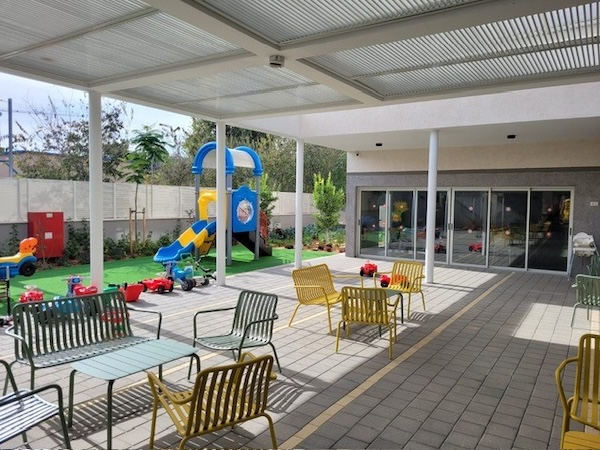
L’Chaim Adult Day Centre is now open five days a week. (photo from L’Chaim)

L’Chaim Adult Day Centre has received funding from Vancouver Coastal Health to expand its program. It can now offer its services to frail senior citizens in the community on a five-day-a-week, 16-clients-per-day basis.

L’Chaim first opened its doors on Sept. 14, 1985, in the Maccabee Room of Beth Israel Synagogue. At first, L’Chaim operated only one day a week and was run completely by volunteers. A project of the National Council of Jewish Women and the Jewish Family Services Agency, it was able to secure funding from the Jewish Community Fund and Council, as well as NCJW.

Soon afterward, a committee was formed to secure funding from the BC Ministry of Health, which allowed the program to operate two days a week. Ten years later, L’Chaim moved to the Jewish Community Centre of Greater Vancouver, thanks to a $400,000 grant from the BC government, which enabled the JCC to renovate the premises to meet L’Chaim’s needs. On April 1, 1996, L’Chaim opened at the JCC and, since then, it has been operating three days a week, serving 13 clients a day.

As the Jewish population has grown and aged, the number of clients seeking L’Chaim’s services has increased. Unlike other adult day centres in Vancouver, L’Chaim has a cultural mandate to accommodate Jewish seniors who live outside Vancouver’s geographical boundaries, but prefer to frequent L’Chaim precisely because of the Jewish component of its activities. This has not precluded the intake of seniors in the area who, though not themselves Jewish, want to attend L’Chaim because of its cultural programming and level of care, but demand has been greater than L’Chaim can service and the wait list and wait times are long.

With the recent expansion, under the supervision of L’Chaim’s trained activity specialists, more participants will be able to benefit from the variety of programs offered, including exercise sessions, discussion groups, live entertainment, expressive art and garden therapy, games, and day trips into the community. Participants receive a culturally and nutritionally appropriate meal prepared fresh daily, consisting of a three-course kosher lunch tailored to their dietary needs. As well, L’Chaim has a nurse on the premises who supervises medications, monitors participants’ health status and other aspects. Of course, Shabbat and Jewish holidays are occasions for special celebrations, often in conjunction with other stakeholders and programs at the JCC.

 “Old age,” as Tennyson wrote, “hath yet his honour and his toil,” and the longer people can stay at home surrounded by loved ones and visit those places that have become familiar, the better off we all are. L’Chaim is honoured that it can provide care and comfort to the frail elderly and thereby offer support to their relatives and caregivers. Anyone who goes by the JCC will see that it is a hub of activity and being located within its walls makes L’Chaim all the more vibrant. Relatives can drop off their loved ones and take advantage of JCC activities; L’Chaim clients can see people they know who drop by the office.

Now that L’Chaim has obtained funding to expand its services, it looks forward to growing from strength to strength, and this will require time and money. Fortunately, L’Chaim has an active board of committed individuals, as well as day-to-day onsite volunteers, who aid its director, Leah Deslauriers.

Deslauriers was hired by the JCC as the seniors program coordinator shortly after she graduated from the gerontology program at Simon Fraser University. In 2008, she started overseeing L’Chaim, when their administrator went on vacation, and she left her position at the JCC and became the director of L’Chaim in 2017. The position includes intake, fundraising and strategic planning, and it is in large part due to her accomplishments that L’Chaim now embarks on the next stage in its development.

L’Chaim benefits from the financial support of the Jewish Federation of Greater Vancouver, several Jewish foundations, and the donations, large and small, of many friends and supporters. To all of them, L’Chaim is grateful. 

To see if you or your loved one is eligible for L’Chaim’s services, contact the home and community care office in your local health authority or get in touch with Deslauriers by calling 604-638-7275. 

– Courtesy L’Chaim Adult Day Centre

Exploring past, present

During Hillel BC’s Holocaust Education Week, Drs. Gene Homel (pictured above) and Rachel Mines offered Unheard Echoes, a program on Jews in Lithuania. (photo by A. Jaugelis)

Unheard Echoes, a program on Jews in Lithuania, was held Jan. 29 during Hillel BC’s Holocaust Education Week on the University of British Columbia campus. Dr. Gene Homel, an historian, and Dr. Rachel Mines, a Yiddishist and English instructor, spoke about the past and present experiences of Litvaks, Jews with roots in the region of Lithuania.

Homel began by introducing Lithuania, a liberal democracy in the North Atlantic Treaty Organization (NATO) and the European Union, currently in the news because of possible threats from Russia’s attack on Ukraine. He explained that Jews have been a key, productive part of Lithuania since at least the early 1300s, when they were invited by nobility to settle in these territories and were granted a charter to run their own affairs in their own communities. By the 1700s, the largest Jewish population in Europe was in what was then the Polish-Lithuanian Commonwealth, occupying much of Eastern Europe. The partition of Poland in the late 1700s absorbed the region into imperial Russia.

Vilnius, now Lithuania’s capital but then in the Russian empire, was known as “the Jerusalem of the North” for its role as a world-renowned centre of Jewish learning, culture and publishing. However, poverty and Russian conscription motivated many Jews to emigrate in the early 20th century to North America,  South Africa and elsewhere.

In 1918, with the First World War winding down, Jews joined the successful push for an independent Lithuanian state. While the restored Polish state, which now included Vilnius, slid into enhanced antisemitism in the 1930s, the much smaller Lithuanian state avoided pogroms and other extreme manifestations of antisemitism. Lithuanian Jews and Christians lived side by side in relative peace.

The 1939 pact between Nazi Germany and the communist Soviet Union divided Eastern Europe between the two tyrannies, and the Soviets forcibly annexed and Sovietized Lithuania and the other two formerly independent Baltic states, Latvia and Estonia. Mass deportations of Baltic peoples to Soviet Siberia included many Jews, who comprised an estimated 7% of Lithuania’s population but 10% of the deportees.

Nazi Germany’s invasion of the Baltics and the Soviet Union in mid-1941 initiated the Holocaust in Lithuania. Of the 220,000 to 250,000 Jews there, 95% were murdered, most in the early stages of Nazi occupation and control.

Lithuanian historians and researchers agree that, while most Lithuanians were passive bystanders, some thousands (the exact number is unknown) were (by degrees) active collaborators with the Nazis. Homel pointed out that collaborators were active in almost all other European countries, and there were some Lithuanians, such as Catholic clerics, who served as rescuers of their Jewish neighbours. More than 900 Lithuanians have been recognized by Yad Vashem as Righteous Among the Nations, and there were doubtless many more.

In 1944, the Soviets returned to the Baltics, robbing Lithuania, Latvia and Estonia of their independence, and costing many people their freedoms and their lives. Decades later, the fall of Soviet Communism – Lithuania was the first Soviet republic to declare its independence in 1990 – led to a revival of Jewish culture and institutions, as the Soviet Union had not only suppressed religious and cultural expression but denied or downplayed the Jewish Holocaust in the areas it controlled.

Homel discussed a particularly sensitive issue in Lithuania’s history of wartime Nazi occupation, since there was some overlap between those who were both anti-Soviet partisans from 1944 to the early 1950s (thus nationalist heroes) and Nazi collaborators. Recent published research on Lithuanian collaboration in the Holocaust has caused a stir of controversy, raising the problems of a competing sense of victimhood and of definitions of genocide. This can be seen as a sort of zero-sum game.  Collaboration has been a contested issue in other countries’ histories, of course, for example France and, notably, Poland.

That said, the Lithuanian government has accomplished much by way of justice since the restoration of independence. Shortly after that time, in May 1990, the government issued a declaration condemning “without reservation the genocide perpetrated in Lithuania against the Jewish nation … and notes with sorrow that among the executioners who served the occupiers there were also citizens of Lithuania.” The declaration also stated that there would be no toleration for any expressions of antisemitism, and that all bodies of government and citizens should “create the most favourable conditions for the Jews of Lithuania….”

Four years later, the government created the annual Sept. 23 National Memorial Day for the Genocide of Lithuanian Jews. Commemorations are held in schools and other public and governmental institutions. The prime minister recently joined a march to Paneriai, a site of mass murder of Jews and non-Jews during the Nazi occupation. The Vilna Gaon State Jewish Museum includes five sites, one being the “Green House” Holocaust museum. In 2011, Lithuania committed to pay 37 million Euros over a decade in compensation for Jewish communal property seized during the mid-20th century, and recently the government passed a bill to transfer another 37 million euros. Rescuers have been honoured in the country, as well as by Israel’s Yad Vashem. International teams of archeologists are working on a project to recover Vilnius’s historic Great Synagogue, which was utterly destroyed by the Soviets in the 1950s.

Mines followed Homel’s presentation with a more personal view of Lithuania, based on her reconnection with her Litvak roots, and her experiences with the non-Jewish Lithuanian community both in Lithuania and in British Columbia. She detailed her father’s family life in Skuodas, a lively and thriving town near the Latvian border, which, prewar, had many Jewish-owned enterprises. His relatives once owned a productive boot and shoe factory in town. In 1936, her father, Sender, moved to Kaunas, then capital of Lithuania, and married. In 1941, Sender and his family were imprisoned in the Kaunas ghetto. That winter, Sender was deported to Latvia and forced into slave labour in several Nazi ghettos and concentration camps. As a survivor, he emigrated to Canada in the early 1950s, where he remarried and started a second family.

photo - Dr. Rachel Mines presented a more personal view of Lithuania, based on her reconnection with her Litvak roots, and her experiences with the non-Jewish Lithuanian community both in Lithuania and in British Columbia
Dr. Rachel Mines presented a more personal view of Lithuania, based on her reconnection with her Litvak roots, and her experiences with the non-Jewish Lithuanian community both in Lithuania and in British Columbia. (photo by A. Jaugelis)

Mines and Homel have visited Lithuania a number of times in the last 16 years or so, including a Yiddish summer program at Vilnius University. They found a warm, welcoming reception in Skuodas, where the local museum featured a display on the town’s Jewish population, including Mines’s father. Locals took them to sites of interest, including the Jewish cemetery and Holocaust memorials, which date back many decades, to when the country was still under Soviet occupation. In 2015, Mines was invited to Skuodas to address high school students and adults during that year’s commemoration of the Holocaust in Lithuania. As she learned more about her father’s origins, Mines created a bilingual website on the town, shtetlshkud.com, as a genealogical and historical resource.

Both Mines and Homel are members of the board of directors of the Lithuanian Community of British Columbia (LCBC), which welcomes Litvaks and acknowledges the Jewish contribution to Lithuanian history and culture. The last two years, the LCBC has commemorated Lithuania’s National Memorial Day for the Genocide of Lithuanian Jews, first at the Peretz Centre for Secular Jewish Culture and then at the Italian Cultural Centre. LCBC’s website is lithuaniansofbc.com. 

– Courtesy Gene Homel

A need to shift thinking

New approaches for getting younger generations to engage in communal Jewish life were put forward by Rabbi Mike Uram, the first-ever chief Jewish learning officer for Jewish Federations of North America, in a Zoom talk organized by Kolot Mayim Reform Temple in Victoria on Feb. 4.

Uram admitted he does not have a magic answer to the problem that has been confounding leaders of Jewish institutions for several years. Instead, he regards himself as a “provocateur” who stimulates novel thinking and a sense of possibility.

photo - Rabbi Mike Uram urges organizations to create new entry points and ways for Jews to connect with Jewish life
Rabbi Mike Uram urges organizations to create new entry points and ways for Jews to connect with Jewish life. (photo from Kolot Mayim)

He started by addressing Jewish communities and Jewish institutions, saying they no longer exist as they have in the past. He suggested that there is no longer the same power of gatekeeping and that the concept of who is a Jew has become more fluid. What may be seen as a community – through a synagogue, federation, university campus or geographic area – is, according to Uram, more accurately described as a network. 

“There’s something imprecise about the language, and that imprecision leads to imprecise strategies,” he said, adding that this view is more aligned with an operating system that was in place several decades ago. “And the operating system, which was perfectly aligned with the North American Jewish population in the 1950s and 1960s, is now almost perpendicular with the ways that North American people and Jews access almost everything else in their lives.”

Using television viewing patterns as an example, Uram demonstrated a shift from “macro-communities to micro-communities.” That is, in the 1950s, close to three-quarters of the American public watched an episode of the hit show I Love Lucy at the same time. Today, a successful show might obtain a viewership in single-digit percentages. 

A similar pattern can be identified in Jewish circles, if one were to observe the steep decline in the numbers of Jews affiliated with a synagogue today as opposed to the 1960s, he said. The drop is not singular to Jewish groups; a corresponding fall in institutional engagement has occurred across a range of civic and political organizations.

More broadly, people are spending less time out of the house and have fewer friends than in previous generations. As well, with social media and streaming services’ algorithms, people are now living more in “customized little bubbles.” To solve this dilemma, Uram proposed a change in the language and thinking used by institutions to bring the unaffiliated into their realm. 

“When we say us and them, we’re thinking we’re the core, they’re the periphery. We’re involved, they’re uninvolved. We’re affiliated, they’re unaffiliated. The problem with that thinking is [that] it is measuring Jewish identity on a very linear and highly judgmental spectrum,” Uram said.

The challenge, too, with this institutional mindset, he argued, is that people do not wake up each day thinking they are an uninvolved or unaffiliated Jew and wondering how they can become more involved or affiliated. In fact, he said, many have a negative stereotype of organizational Judaism, as a place they feel judged and like an outsider.

Nonetheless, Jews not participating in institutional Jewish life are no less proud of being Jewish.

“They don’t feel broken,” Uram said. “They don’t feel like they need a synagogue or a federation to fix them. What has changed in American life is that, as affiliation rates have gone down, positive Jewish feelings have actually gone up.” Many Jews are interested in Judaism but not affiliation, he said. Hence, rather than focusing on programming and marketing, institutions should concentrate on building relationships, he said.

While emphasizing that he is not disparaging affiliation, Uram urges organizations to create new entry points and ways for Jews to connect with Jewish life.

“It’s a one-on-one conversation, and it’s more like community organizing than it is like traditional programming,” he said, noting that the organized Jewish community can often function like a taxicab in the age of ride-hailing companies or network television when there are streaming services.

“We’re not in the business of preserving network television,” he said. “We’re in the business of changing people’s lives with amazing shows. So, we should be doing anything we can do to get people to interact with the magic and the power and the wisdom of Jewish values.”

Another issue within a community is infrastructure, such as buildings, staff and program calendars, said Uram. Here, he advocates a change in philosophical approach, focusing on impact over affiliation.

“Spending a little bit more time talking about how we’re going to make a difference in people’s lives, rather than how they can help us keep the organization strong, will trickle down and change the way emails are written, the way the website looks, the way people are greeted,” he said.

Towards the end of his talk, Uram threw some questions out to institutions, asking if they were in the synagogue preservation business, the program planning business, the membership business or the transforming people’s lives business.

“My guess is they do not say that our mission is to make sure that the next generation of Jews joins. It probably says that they’re going to engage in Judaism in a way that transforms them and the world, that makes them feel closer to community and that helps them live more enriched lives, and all those things,” Uram said.

If organizations are to meet the challenges and take advantage of the opportunities offered in the future, they must understand the perspectives of the next generation, he said. Millennials, he added, bring with them their own insights and values that can “guide the future of Judaism in exciting ways.”

Uram is a former executive director of Hillel at the University of Pennsylvania and the author of the 2016 book Next Generation Judaism: How College Students and Hillel Can Help Reinvent Jewish Organizations, which received a National Jewish Book Award. He was speaking as part of Kolot Mayim’s 2023/24 Building Bridges Speaker Series. On March 3, Rabbi Dr. Nachshon Siritsky, spiritual leader of the Reform Jewish Community of Atlantic Canada, will talk on the topic Our Evolving Jewish Understanding of G!d and Gender. To register, visit kolotmayimreformtemple.com. 

Sam Margolis has written for the Globe and Mail, the National Post, UPI and MSNBC.

Supporting one another

On Jan. 22, Jewish Seniors Alliance, as part of its Empowerment Series, presented a lecture by Dr. Honoré France. An educator, artist, writer, therapist and consultant in the field of mental health, France explored the early history of seniors peer support, which is based on the concept of seniors helping seniors. 

Grace Hann, trainer and supervisor of Senior Peer Support Services at JSA, co-hosted the Zoom event with Andrea Krombein of South Vancouver Seniors Network, which co-sponsored it. About 60 seniors participated. Gyda Chud, past president of JSA, welcomed everyone.

In her introduction of France, Hann said she uses his writings in the JSA’s peer-support training program. She noted that France has presented his ideas on training in many countries and has been involved with peer support since the late 1970s, when he moved to Victoria. He was influenced by the works of Viktor Frankl, as well as work done in a hospital in Paris, where a doctor and a former patient began a program to help patients by using recovered patients as volunteers. Much research has been done in this area, she said, and it has been shown that paraprofessionals can be as effective as therapists.

France has written a book on peer counseling and peer support. As well, he said, Frankl’s book Man’s Search for Meaning and Erik Erikson’s eight stages of life (of psychosocial development) are still being used by therapists. Communication and listening skills are of prime importance in peer counseling, he said, and Hann pointed out that silence, as well as mirroring back what the client has said, are useful in opening communication and forming a bond between the volunteer counselor and the senior. Two volunteers, Marie and David Kirkpatrick, said they had learned from the training provided by Hann and Charles Leibovitch, senior peer support services coordinator with JSA, and through contact with clients.

France also discussed some of the myths about aging. For example, we are just as mentally fit at age 80 as at age 20, he said, but our reaction times are slower. To keep healthy, we need to exercise both the body and the mind, he said.

Chud thanked France for his comments and his work, noting how effective it has been in JSA’s peer support training program. Comments and questions included Margot Beauchamp on the connection between isolation, loneliness and general health, and Larry Shapiro said volunteering should be first on any list of things seniors should be doing.

A new training session for peer support will begin on March 1 and those interested should contact the JSA office. The next Empowerment program will take place in March, with the Jewish Museum and Archives of British Columbia. More details will soon be available at jsalliance.org. 

Shanie Levin is a Jewish Seniors Alliance Life Governor. She is also on the editorial committee of Senior Line magazine.

Community milestones … Jewish Medical Association, Freilich & Karasick

Left to right: Drs. Larry Barzelai, Ran Goldman, Mor Cohen-Eilig, Marla Gordon and Maya Rosenkrantz. (photo from Dr. Marla Gordon)

The Jewish Medical Association of British Columbia held its inaugural event Monday evening, Feb. 12, at Schara Tzedeck Synagogue, with 100 attendees in person and 20 via Zoom. Three speakers presented and all were inspiring, relaying hopeful words, with the broad message being to unite and stand together.

Dr. Dynai Eilig, an Israeli-born and -trained orthopedic surgeon who works and lives in Vancouver, traveled to Israel on Oct. 9 to work in Soroka Medical Centre’s trauma centre. He shared heartbreaking stories, but also stories of resiliency. He spoke about the 150,000 reservist army volunteers from outside Israel who came in the early days after Oct. 7.

photo - Dr. Dynai Eilig presenting at the inaugural event Feb. 12. (photo from Dr. Marla
Dr. Dynai Eilig presenting at the inaugural event Feb. 12. (photo from Dr. Marla Gordon)

Dr. Robert Krell, a retired child psychiatrist and Holocaust survivor, explained the correlation between the rise of antisemitism now and that in Europe in the 1930s. He said Holocaust education is needed in all universities and all faculties and that medical and other educators must not resign from their teaching posts.

Dr. Yael Glassberg, an Israel-based pediatric gastroenterologist, joined via Zoom. She spoke on the child hostages who were released and her assessment and involvement with these children.

Planning for the JMA community-building event took place over a two-month period, led by pediatric emergency room physician Dr. Ran Goldman and elder-care physician Dr. Marla Gordon.

The Jewish Medical Association of British Columbia was started by Gordon and family physician Dr. Larry Barzelai in November 2023 as an attempt to get Jewish physicians together to support one another, especially in the current situation of increased antisemitism. The group has almost 300 members.

– Courtesy Dr. Marla Gordon

***

photo - Eric Freilich
Eric Freilich

Eric Freilich was recently promoted to director of legal, private equity and M&A (mergers and acquisitions) at BMS Group and heads the Canadian legal team for the multinational insurance broker.

Eric grew up in Vancouver and is a graduate of the University of British Columbia, where he was a proud and active member of Hillel and of the Jewish fraternity, Alpha Epsilon Pi. Following graduation from UBC, Eric moved to Toronto to work in the film industry. He then went back to school and received his doctor of law and a master of business administration from York University. He worked at two prominent Toronto law firms prior to going in-house, focusing on corporate/commercial work and mergers and acquisitions.

Eric has recently found his way back into academia, contributing to teaching courses on mergers and acquisitions and risk management techniques in transactions at the Schulich School of Business.

Outside of work, Eric’s strongest sense of identity comes from being the best father and husband he can be.

***

Adeena Karasick and Ian Keteku are the inaugural winners of the League of Canadian Poets Spoken Word Award, which consists of two $1,000 awards, presented annually to two poets for a single poem or suite of poems up to 10 minutes in length.

Karasick won for the poem “Eicha,” featured in Aerotomania: The Book of Lumenations (bit.ly/aerotomania).

“Attuned to sound poetry’s domain, Adeena Karasick’s homophonic translation ‘Eicha: The Book of Lumenations’ unfolds as a dynamic interplay of acoustic and material expressions,” wrote LCP Spoken Word Award juror Eric Schmaltz. “Immersed in the intricacies of language’s auditory, textural and tonal dimensions, Karasick engages the original text, the Book of Lamentations, and brings it into dialogue with the multifaceted layers of our present. A simultaneous act of lamentation and ecstatic intertextual exploration, Karasick’s performance traverses sonic texture and electroacoustic manipulation to resound with a symphony of hope and sorrow.” 

Keteku was honoured for the triptych: “Mr. Tally Man,” “the space between” and “The Light.” LCP Spoken Word Award juror Andrea Thompson called him “a master of spoken word,” noting: “With impeccable comedic timing and understated affect, Keteku’s performances are a triumph of wordplay and musicality, driven by wisdom and humanity – alive as a heartbeat.”

For more about the League of Canadian Poets, visit poets.ca.

רילוקיישן לקנדה: מידע מעודכן לישראלים בימים קשים אלה

מרכז הקהילה היהודית והישראלית נמצא בטורונטו שהיא העיר הגדולה ביותר בקנדה
צילום Fabian Roudra Baroi

קנדה היא אחת מהמדינות האטרקטיביות ביותר להגירה: מדינה מבוססת כלכלית, יפה, רגועה ועם תנאים סוציאליים נדיבים לתשוביה. עם זאת, רילוקיישן לקנדה כרוך בקשיים ואתגרים

 בשנים האחרונות הפכה קנדה לאחד מהיעדים הנחשקים ביותר להגירה עבור ישראלים. בניגוד למדינות רבות אחרות, המדינה הקנדית דווקא מעודדת הגירה לתחומה. בהתאם לכך, מדי שנה מהגרים אליה בין שלוש מאות אלף לחצי מיליון איש. לקנדה מערכת בריאות אוניברסלית מהטובות בעולם (בניגוד לשכנתה מהדרום ארצות הברית), חקיקה סוציאלית נרחבת, יציבות פוליטית וכלכלית, נופי טבע מדהימים ועוד. היא מדורגת במקום השלישי במדד המדינות שהכי טוב לחיות בהן (ולעומת זאת: ישראל מדורגת במקום הארבעים ושלושה בלבד)

עם זאת, ישנם מספר דברים שכדאי לקחת בחשבון לפני שעושים את הצעד המשמעותי  להגר. כמו: הגשת בקשות ההגירה לקנדה כרוכה בעמלות של אלפי שקלים, החורף קר להפליא ויכול להגיע גם עד למינוס חמש עשרה מעלות צלזיוס. וכן שקנדה קנדה רחוקה משראל מרחק של לכל הפחות עשר שעות טיסה (והטיסות לרוב יקרות), מה שמקשה על ישראלים המהגרים אליה להגיע לביקורים תכופים בארץ

קהילות יהודיות וישראליות בקנדה: מרכז הקהילה היהודית והישראלית נמצא בטורונטו שהיא העיר הגדולה ביותר בקנדה. זו עיר רב-תרבותית ותכולו למצוא בה קהילות מהגרים מכל העולם כולל ישראל כמובן

ממשלת קנדה הקימה פורטל המפרט את סוגי הויזות השונים וכן את ההליכים הנדרשים על מנת לקבל כל אחת מהן. הוויזות השכיחות ביותר הן: איחוד בני משפחות עם אחד מבני המשפחה יש כבר אזחרות קנדית. ויזת סטארט אפ – ניוד של חברת סטארט אפ לקנדה או הקמתה כאן (אשרת עבודה וכן שהייה קבועה). יש גם ויזת עבודה לבעלי מקצועות מבוקשים. קנדה מעודדת הגירה לאנשי מקצוע העובדים במקצועות מבוקשים עליהם נמנים בין היתר: סיעוד, הנדסה, תכנות, פיננסים ופיזיותרפיה

ויזת עבודה לעצמאים: חלק מהפרובינציות בקנדה מציעות תוכניות קליטת הגירה משלהן, כחלק מתהליך בחינת הויזה על המועדמים לעבור מבחנים בידיעת השפה האנגלית (או הצרפתית למי שמעוניין להגר לקוובק). יש לשים לב שתהליך הגשת בקשת הויזה כרוך בעמלות שיכולות להגיע גם לאלפי דולרים קנדיים. ממולץ להתייעץ עם סוכני הגירה כדי לוודא את העמידה בתנאים, תקינות מסמכים ועוד

איך מוצאים עבודה בקנדה: אחד מהיתרונות הגדולים הטמונים בהגירה לקנדה הוא העובדה שהיא מדינה דוברת אנגלית (אלא אם עוברים לקוויבק ששם השפה המדוברת היא צרפתית). לפני ששולחים קורות חיים באנגלית מומלץ לוודא עם דובר אנגלית שפת אם, שאין בתרגום שגיאות ושהמונחים המקצועיים המצוינים כתובים נכון. עוד מומלץ לפתוח/לעדכן פרופיל ברשת החברתית-עסקית לינקדין, הנחשפת למרכזית בהליכי חיפוש עבודה בקנדה. מומלץ גם להעלות לפרופיל שלכם בה פוסט המבשר על המעבר המתוכנן ועל חיפוש עבודה מתאימה. מומלץ עוד לחפש ישראלים בלינקדין מתחום העיסוק הרלוונטי שגרים בעיר אליה מתכננים לעבור ולנסות להיעזר בהם

מערכת הבריאות הקנדית נחשבת לאחת מהטובות בעולם ומדורגת באופן קבוע בעשירון העליון בדירוגים שונים, כולל של ארגון הבריאות הנילאומי. בניגוד לשכנתה ארצות הברית ובדומה לרוב מדינות אירופה, בקנדה קיימת מערכת בריאות אוניברסלית הנגישה לכולם, ובנוייה על תשלום מס בריאות. כמו בישראל, ניתן להוסיף לכף ביטוח רפואי פרטי, שבכוחו להגדיל את הכיסוי, לקצר זמני המתנה לרופאים מומחים ועוד. ישנם מקומות עבודה המספקים ביטוח רפואי פרטי כהטבה לעובדיהם. כל הפרטים הללו רלוונטיים לאזרחים קנדיים. אם עדיין לא קיבלתם אזרחות של המדינה – מומלץ להצטייד בביטוח רפואי פרטי

Robinson out of cabinet

Screenshot of the Jan. 30 B’nai Brith Canada panel discussion during which Selina Robinson spoke her controversial words.

Selina Robinson, who has called herself “the Jew in the crew” that is British Columbia’s cabinet, is out. The minister of advanced education and future skills resigned Monday after a torrent of protest following comments she made last week during a B’nai Brith Canada online panel discussion, in which she referred to the area that would become Israel as “a crappy piece of land.” 

Premier David Eby announced Robinson’s departure from cabinet, saying her comments were “belittling and demeaning.”

“The depth of work she needs to do is substantial,” said Eby. “What has become apparent is the scope of work, the depth of the hurt. As a result, we came to the conclusion together – she needed to step back.”

The announcement came after protesters threatened to disrupt New Democratic Party events, forcing the cancelation of a major fundraising gala Sunday night and a government news conference Monday. A network of Muslim societies issued a statement over the weekend that no NDP MLAs or candidates would be permitted in their sacred spaces until Robinson was removed from cabinet.

Robinson will not run for reelection as member of the Legislative Assembly for Coquitlam-Maillardville, a decision she says she made earlier.

Response from Jewish community leaders was fast and critical.

“The removal of MLA Robinson, who apologized for her comments and promised to do better, sends a chilling message that Jewish leaders are held to a different standard than non-Jewish ones,” said Nico Slobinsky, Centre for Israel and Jewish Affairs’ vice-president for the Pacific region, in a statement. “In the past, when BC NDP politicians and staff have made antisemitic comments, the Jewish community has been asked to accept their apologies and – on every occasion – we have. As a show of goodwill, we never publicly demanded their resignations and, instead, placed our trust and faith in the premier and the BC government when he said that his team would learn from the incidents and not repeat their egregious errors.

“When, on International Holocaust Remembrance Day – a day to commemorate the six million Jews slaughtered in the Second World War – one of Premier Eby’s staff tweeted that ‘we stand with the Muslim community,’ we were asked to accept that stunning gaffe as a mistake. And we did.

“We were also asked to work with a Parliamentary Secretary for Anti-Racism Initiatives who made remarks that were deeply hurtful to our community,” Slobinsky said. “And, despite her repeated offensive actions, she continues to remain in her role.”

This reference to Vancouver-Kensington MLA Mable Elmore alludes to a history of problematic remarks, from claiming before her election that her union was dominated by “Zionist bus drivers” to more recently using a speech in the legislature ostensibly about transgender rights to call for Israel to end the war with Hamas. 

Slobinsky added: “Today, as the Jewish community in BC is confronted by an alarming increase in antisemitism and by frequent pro-Hamas protests calling for the Jews of Israel to be eradicated, the loss of MLA Robinson is especially distressing, as we no longer have our strongest advocate – who understands the challenges and sensitivities of the Jewish community – at the table.

“The community is both offended and hurt by what has happened to a great ally and British Columbian, and it has seriously undermined the confidence of the Jewish community in the Government of British Columbia. Given this obvious double standard and loss of Jewish representation in cabinet, Premier David Eby must share what steps he is going to take to repair the relationship and restore the community’s trust in him and his government.”

“Facing an unprecedented increase in hate, the Jewish community in BC is hurting,” Ezra Shanken, chief executive officer of the Jewish Federation of Greater Vancouver, said in a statement. “The level of online vitriol aimed at Selina Robinson leading up to her resignation – which mirrors the reality faced by much of the Jewish community since the Oct. 7 terrorist attacks committed by Hamas – shows worrying trends in our public discourse. We are saddened to have lost one of the strongest advocates fighting against antisemitism from within cabinet – especially at a time when it is needed most.

“It is shameful that Premier David Eby has bowed to pressure from a loud minority whose campaign to discredit MLA Robinson was centred in anti-Jewish bias and lacked the offer of grace they demand when others falter.

“We need stronger leadership from this government to bring our communities together – not divide us,” said Shanken.

The Rabbinical Association of Vancouver sent a letter to the premier, signed by nine rabbis, expressing disappointment.

“We believe you have capitulated to a small but loud group of people,” the letter read. “Now it feels like you have given in to bullies for political expediency. We will remember this day the next time you ask for our trust and support.”

At least one voice in the Jewish community was pleased with Eby’s decision. “The decision to remove former MP [sic] Selina Robinson from office is a crucial win for organizers including IJV-Vancouver and our allies, who stood firm and united against anti-Palestinian racism,” tweeted Independent Jewish Voices. “The rhetoric we all heard was shameful. Thank you to all who helped hold BC accountable.”

B’nai Brith Canada told the Independent they are grateful for the work that Robinson undertook to combat antisemitism on BC’s post-secondary campuses as minister. 

“It is unfortunate that comments she made last week have resulted in her feeling compelled to step down from her ministerial position,” Richard Robertson, director of research and advocacy for B’nai Brith Canada, said in an email. “We believe her apology was sincere and that MLA Robinson will work to regain the confidence of the constituents who were offended by her remarks.” 

“B’nai Brith Canada believes that this incident underscores the need for the province to take further steps to combat racism and hatred,” said Robertson. “One such step, amid rising levels of antisemitism, is for the BC government to adopt the IHRA definition of antisemitism.” 

United in grief and resilience

Bassem Eid, right,  addresses those who gathered Feb. 4 for the event United, as fellow speakers Virág Gulyás, left, and Yuval David listen. (photo by Pat Johnson)

Yuval David knew 32 people who were murdered on Oct. 7. Among them were 10 friends who gathered to celebrate a birthday and headed to the Nova music festival. 

“All 10 …” he said, struggling to maintain his composure. “Not one made it out of that celebration.”

David was speaking Sunday night at United, one of the largest community gatherings since the events of Oct. 7 and probably since before the pandemic. About 800 people gathered at Temple Sholom, where three diverse speakers brought their perspectives to an audience of Jews and non-Jewish allies.

The Feb. 4 afternoon event was the brainchild of Megan Laskin, a community leader who organized a similar event last November geared to women, who were asked to bring their non-Jewish friends; hundreds attended. Sunday’s gathering was presented by Jewish Federation of Greater Vancouver, Jewish National Fund of Canada, StandWithUs and Temple Sholom. David, an American actor, filmmaker and activist, who is gay, was joined by Palestinian advocate and media commentator Bassem Eid, and Virág Gulyás, a Hungarian-born former diplomat who grew up with what she described as typical antisemitic stereotypes and has become a leading voice for the Jewish people and Israel. The audience alternated from rapt silence to thunderous ovations. 

Since Oct. 7, David has been thinking about his grandparents, Holocaust survivors who saved others in the camps. His grandfather was known as the “Magic Man” for somehow obtaining desperately necessary medications and helping others out of life-threatening scenarios. 

“When I was a little child in Israel, I couldn’t walk more than a few steps with them in public without somebody rushing up not only to them but to me, to say, ‘Do you know who your grandfather is? Do you know who your grandmother is?’ And they would lean down to me and they would say, ‘If it wasn’t for what your grandparents did, I would not be here today,’” he said. “As a little child, holding their hand, walking in the street, I knew that I was walking with heroes. I knew that I was walking in the footsteps that I must walk someday.”

His grandparents instilled chutzpah in him, he said, for precisely this moment in history.

“I was raised to understand what it means to have chutzpah because I was raised to understand what it means to not have chutzpah,” he said. “I was raised to understand what ‘never again’ actually means.”

His worldview and his Zionism were reframed by Oct. 7, he said.

“But it was also reframed by Oct. 8,” he said, referring to global reaction to the events of the day before. Not only did he lose friends on Oct. 7 and others who have died in battle during the war, but another friend, who survived the Nova festival, recently committed suicide because she could not live with the memories. Closer to home, in a different way, he says he has lost most of his friends in the United States.

“I also lost two-thirds of my friends in my life in America who revealed themselves,” he said. “Revealed that they were not my true friends, revealed that even though they came to my Shabbat dinners and they came to my film screenings and they were plus-ones at fabulous events, especially if they were gift bags … crickets. Where are they?”

Some even sent him photographs of themselves protesting against Israel.

“These aren’t pro-Palestinian marches,” he said. “Whoever calls them pro-Palestinian marches is a liar. These are pro-Hamas, pro-terrorism, anti-Palestinian, anti-Jewish and anti-democratic events, he said.

“I used to be woke,” he said of his years as a progressive activist. “Now I’m awake.” He calls his former allies who condemn Israel and side with Hamas “fauxgressives.” 

“If you are going to be ‘pro,’” he said, “then do something good for the people. If you are pro-Palestinian, help create businesses, help create schools, help refugees – do something that helps somebody’s life. But, if all of your fake ‘pro’ activity is to be ‘anti,’ is attacking, is subjugating, is belittling, then you are a racist bigot. Shame. We must name and shame.”

Gulyás is an academic and former European Union diplomat who devotes much of her time contesting anti-Israel and antisemitic narratives. She spoke of how she confronted the anti-Jewish biases she was raised with in Hungary. She noted that anti-Israel street eruptions began on Oct. 8, before Israel’s military had responded to the pogrom – worldwide, she said, activists were prepared.

“They had all the slogans, all the flyers, all the social media posts, all the hashtags ready,” she said. On the other hand, most Canadians and others in the West do not subscribe to the hatred and anti-Israel vehemence seen on the streets, yet remain silent.

Would large numbers of people have reacted as street activists and social media keyboard warriors have if any other sovereign country were invaded by terrorists with the intention to mass murder, she asked.

“Unless you’re a psychopath, you wouldn’t,” she said. “But, somehow, when it comes to Jews and Israel, we remain silent, we look at the other side and with this we normalize Jew-hatred.”

Eid is a rare Palestinian voice in international media against the defamation of Israel and the corruption and ideology of the Palestinian regimes. He shared a story of a friend who lives in the northern Gaza Strip, who told Eid that Hamas representatives knocked on his door at night. They told him they wanted to pay him $50 a month – a windfall – to build tunnels under his home. Eid asked him how he replied to the request.

“He said, ‘My answer was, “Please try to build four tunnels and give me $200 a month,’” Eid recounted. This is how Hamas exploits the poverty of its people to meet its objectives, he said.

The high Palestinian death toll, Eid told the audience, is due partly to Hamas officers forcing civilians back into the homes and neighbourhoods the Israel Defence Forces has warned them to evacuate.

At the expense of millions of dollars in foreign aid, Hamas has built hundreds of kilometres of terror tunnels, he said. “But, in the meantime, Hamas didn’t build one shelter for their own people.”

When you ask Hamas why they don’t protect their people, Eid said, they reply that keeping Palestinians safe is the responsibility of the United Nations and the Israelis.

Eid blamed the United Nations Relief and Works Agency for Palestine Refugees in the Near East (UNRWA), which has recently been under fire for its employees’ involvement in terrorism, for holding Palestinians hostage for more than 75 years.

“Peace is possible between the Israelis and the Palestinians,” said Eid. “But it is impossible while Hamas is still ruling the Gaza Strip. This is the first thing that we should have to get rid of. The day after the war, the first thing is how to trash UNRWA from Gaza.”

Temple Sholom’s Rabbi Dan Moskovitz opened the event. Laskin, who conceived the event, spoke of the grief of this time.

“As the war goes on and more innocent lives are lost on both sides, it is hard,” she said. “But let me be clear. We can strongly support Israel and the Jewish people and also express sympathy for the innocent Palestinians who are suffering. They are not mutually exclusive. We are mourning for all innocent lives lost. You can take a side though, and that side is against Hamas.” 

A plea for the hostages

A screenshot of former Israel Air Force pilot Uri Arad speaking at the Jan. 20 Bring Them Home rally in Jerusalem.

***

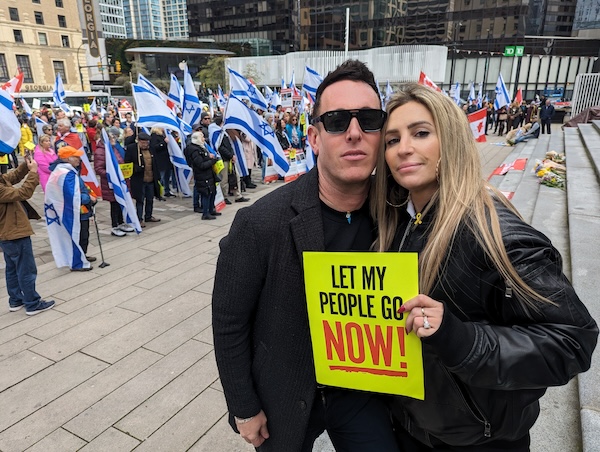
Weekly rallies have been held in “Hostages Square,” the plaza in front of the Tel Aviv Museum of Art, since the Oct. 7 terror attacks by Hamas, who killed 1,200 people and kidnapped 240 that day. Every week, thousands gather in the square and in other locations, calling for the release of the 136 hostages still being held in Gaza, at least 32 of whom are now believed to be dead. At the Jan. 20 Bring Them Home rally in Jerusalem, one of the speakers was Uri Arad, a former pilot who was held in captivity in Egypt for six weeks during the 1973 Yom Kippur War. Arad is not related to Ron Arad, an Israeli Air Force officer missing in action since 1986, who Arad mentions in his speech. The remarks below were translated into English by Rahel Halabe, a Vancouver translator and educator, who is a family friend.

***

I was asked to speak here today because I have been a prisoner of war. Until recently, I had avoided talking publicly about my captivity or even identifying as a past captive. The reason I stand here today and talk to you stems from my deep empathy with the hostages and their families, my fear for the hostages’ fate and the need to join the call for their immediate release.

Indeed, I can testify from my experience that captivity is a very difficult experience, physically and mentally. Still, it is important for me to emphasize that, as difficult as my experience was, it is not the same as what our hostages in Gaza are going through. As a pilot of the air force, I was totally aware of the possibility of falling into captivity and I was prepared physically and mentally to cope with the experience. This is not the same for innocent civilians who are kidnapped out of the blue, without any previous preparation. As time goes on, it shows that the hostages are indeed going through hell.

Moreover, being held captive by a state is not the same as being held captive by a murderous terrorist organization. Being held by a state, I did not feel the constant existential threat on my life – I knew that, eventually, I would return home. This is unlike the hostages in Gaza, who are in constant existential fear of being murdered by their captors, or even killed by our own forces. It is, therefore, a much more difficult experience than what I went through.

I shut my eyes and imagine Noa Argamani, the Bibas family, Amit Buskila, Elyakim Libman, Yusef and Hamza Alziadneh, Liri Elbag, and all the other hostages, and my heart is shattered. Here in Israel, there are so many tormented families who are suffering from uncertainty and worry for their loved ones, some of them after experiencing losses without the ability to properly mourn. It’s just horror. We have to say clearly and loudly: we have reached a stage in which every day that passes is like Russian roulette in the life of the hostages. Therefore, it is necessary to do everything, everything, to bring them home now!

When people ask what reassured me most and helped me get through my time in captivity, I answer without any hesitation: I knew that the state would do all that it could to bring me back home. The ability to cope with torture, difficult interrogations and the uncertainty of my fate mostly came from my belief in the contract between me and the state, from knowing that I would not be abandoned. This confidence is what accompanies all soldiers who are ready to give their life for the state. This is the Israeli ethos of solidarity, the most sublime expression of which is that those injured on the battlefield are never abandoned, even if their rescue may involve losses, and that the state goes above and beyond to bring its captives and hostages home.

This is why I came here today, to say in a clear voice: the return of the hostages is the most important mission, maybe the only one, that should guide decision-makers at this moment. This is the necessary condition for our ability as a nation to recuperate from the horrendous disaster that hit us on Black Saturday. All of us are tormented knowing that Ron Arad never came back. It is, therefore, important to say it is unthinkable that there will be tens more of “Ron Arads.” If we don’t regain our composure and immediately bring the hostages home, this will happen. Some of the hostages will return in coffins, others will be forever lost.

But, I am asked, how do we bring them back? Don’t they keep telling us that the objective of destroying Hamas is not less important, that there have been great attempts to bring them back, that both objectives are interconnected and that we must keep putting military pressure on Hamas to bring the hostages back? It must be said, at this point in time, as Gadi Eisenkot expressed so well two days ago, this is senseless. The truth is that, today, these two objectives contradict each other. And the evidence is that – except for one hostage – all the hostages who have come back were returned in the framework of a deal. The military operation not only did not help in the return of the hostages, but it even cost the life of a few of them, and every day that passes just increases the danger to their lives. The conclusion is clear and sharp: the only way to bring the hostages back alive is through a deal. Now!

There are those who object to stopping the war, claiming that it would be a repetition of the same mistake that brought Oct. 7 upon us, and that it will eventually bring upon us many more Black Shabbats and an existential danger to the state in the long run. They mistakenly think that the destruction of Hamas is just around the corner. This is a delusion! Today, it is clear to all who are reasonable that the destruction of Hamas is an extremely difficult goal, which will require years to achieve. It is important to understand that what really hides behind this claim is the willingness to give up on the hostages. In the clash between short-term and long-term interests, those who claim the above prefer the long-term. I say, first, we must bring back the hostages! In the long-run, we will be able to continue weakening the terrorists through both military pressure and political initiatives, while striving for comprehensive agreements that will bring an end to the conflict.

I know that the thought of being forced to stop the fighting and, on top of that, pay the heavy price of a mass release of terrorists, is difficult for many people. I, too, have found it hard to swallow and say this grudgingly, but there is no escape. It is necessary to internalize that the hostages are the major asset Hamas has in its hands, and that [Hamas leader Yahya] Sinwar will not give up this asset except in exchange for the end of fighting. The strategic failure of Black Shabbat puts us, after more than 100 days of fighting, in a position in which we are forced to clearly make a decision and pay the price. The Israeli government, therefore, should initiate a deal of “all for all,” including a stop to the fighting. Now!

Binyamin Netanyahu refused to take responsibility for what happened on Oct. 7, but has been “gracious” enough to declare that he is responsible for all that will happen. If so, it must be clearly said: Netanyahu is responsible for the fate of the hostages. From here, I would like to address the prime minister and say: Netanyahu, you have brought upon us the worst catastrophe in the history of the state. This will be your legacy; you will be inscribed in history with shameful disgrace. Still, you have a chance to somehow soften history’s judgment, if you bring the hostages back alive. This is the time to rise above the political considerations that have led you and initiate a deal for the return of the hostages. Now!

Finally, I would like to say: continuing the current policy will cause a rupture, impossible to repair, in Israeli society. Israel will lose its soul, one of its most significant elements. We will never again be able to say that we hold human life sacred. This is an unbearable price. Therefore, bring the hostages back in exchange for stopping the fighting. Now!

Thank you all. 

Commemorating the Shoah

Richmond RCMP Chief Superintendent Dave Chauhan, left, lights memorial candles with survivors David Schaffer, Sidi Schaffer, Amalia Boe-Fishman and Ilona Mermelstein, and Richmond Mayor Malcolm Brodie at a commemoration of International Holocaust Remembrance Day, at the Bayit, in Richmond, on Jan. 25. (photo by Pat Johnson)

Amalia Boe-Fishman was born in Leeuwarden, in the Netherlands, days before the start of the Second World War. Her mother’s parents and siblings had made aliyah to Israel in the early 1930s, but her mother, Johanna, stayed behind to pursue a career in nursing. Working in the Jewish hospital, she met Arnold van Kreveld, a patient who had been in a motorcycle accident, and they fell in love.

The couple married in 1935 and their first child, David, nicknamed Dik, was born in 1937. Amalia arrived Aug. 23, 1939. 

“We had a good life, family, friends and neighbours,” Boe-Fishman said. But then, in May 1940, the German army invaded the Netherlands. 

Boe-Fishman shared the story of her family’s survival at a commemoration of International Holocaust Remembrance Day, at the Bayit, in Richmond, on Jan. 25.

After the Nazis overran the Netherlands, her father’s parents and siblings were deported to Westerbork, a Nazi transit camp in the Netherlands, on Sept. 3, and on to Auschwitz, where they were immediately murdered, on Sept. 7. 

Her father was a scientist and his young research assistant, Jan Spiekhout, a member of the Dutch resistance to the Nazis, would save the lives of the entire van Kreveld family.

“Jan Spiekhout found immediately an address for my father to go into hiding,” Boe-Fishman recalled. “He then found different hiding addresses for my mother, another address for my brother and then one for myself.”

Amalia was not yet a year old and her parents knew they might never see their children again.

“My mother gave me a special doll to keep me company and a letter I brought with me so my new family would understand her little girl a little better,” said Boe-Fishman. “In the letter, [she] told them how fond I was of my older brother Dik. If my parents would not survive the war, the Holocaust, to send us together to Israel to stay with one of my mother’s sisters.”

Amalia was taken to the home of Spiekhout and his parents, Durk and Froukje Spiekhout. The crowded and deeply religious Dutch Reformed household already had six children, of which Jan was the eldest. The younger Spiekhout children were told that Amalia was the daughter of a sick aunt in Rotterdam. 

“They became my family,” said Boe-Fishman. “Father Spiekhout took a great risk bringing me into his household. He was a policeman. After all, policemen were supposed to work for the Nazis and round up Jews.”

She learned later that he instead warned Jewish neighbours of impending Nazi roundups.

“My father, typically Jewish looking, with dark hair, went from hiding place to hiding place – at least 26 different addresses,” Boe-Fishman said. “All at night and all arranged by Jan Spiekhout. My mother, not so typically Jewish looking, did not need to flee so often. 

“As for myself, I don’t know what I remember or what I was told later on,” she said. “I was not allowed to go outside and I had to stay indoors for three years.”

On April 15, 1945, Canadian forces liberated Leeuwarden.

“What did that mean for me?” she asked. “Liberation should have been a really happy time for me. I was told that I could go outdoors. I didn’t know what to expect, what was waiting for me outdoors. Indoors had become my entire life. Indoors was where I felt secure and safe. Indoors was all I knew.”

Greater change was to come.

“I was told I had a real family and I was told I was going home,” she said. “But who were those people, who were those strangers? I did not want to leave the family Spiekhout. They were my real family and I loved them. My own father and mother were patient with me. They would come over to visit and I would run away or hang onto Mother Spiekhout screaming, ‘I don’t want to go home!’”

Dik, who was now 7-and-a-half, was also a stranger to little Amalia. Most incredibly, and at profound danger, a younger sibling had been born in hiding, a baby named Jan, in honour of the family’s saviour.

The name Jan has profound resonance in the family. Amalia’s oldest son, who joined her at the commemoration, was born in 1962 and is also named Jan.

That the entire immediate family had survived the Holocaust – had grown, in fact – was almost inconceivable. Dutch Jews had one of the lowest survival rates during the Holocaust. The van Krevelds owed everything to the Spiekhout family who, in 2008, were recognized as Righteous Among the Nations by Yad Vashem’s Holocaust Martyrs’ and Heroes’ Remembrance Authority. Boe-Fishman and her children attended a ceremony honouring the Spiekhouts in The Hague in 2009. 

In 1961, Boe-Fishman (then van Kreveld) went to Israel trying to find her Jewish identity. The Eichmann trial was taking place at the time, which cracked open consciousness of the Holocaust not only for most of the world, but for survivors, including her family, who had remained almost entirely silent on the subject. In Israel, she met and married a Canadian Jew from Vancouver and settled here becoming, among other things, a devoted speaker to class groups and others about her Holocaust experiences.

photo - Amalia Boe-Fishman and son Jan Fishman. Boe-Fishman shared her survivor experiences at the memorial event
Amalia Boe-Fishman and son Jan Fishman. Boe-Fishman shared her survivor experiences at the memorial event. (photo by Pat Johnson)

Rabbi Levi Varnai of the Bayit contextualized Boe-Fishman’s presentation.

“I think that this year – every year, but this year maybe more than any year – with all the craziness in the world, this event is even more important than ever before,” he said.

Keith Liedtke, president of the Bayit, served as master of ceremonies and credited Michael Sachs, now regional director for Jewish National Fund of Canada, for starting the tradition five years ago of inviting the mayor to recognize Holocaust Remembrance Day annually. 

Cantor Yaakov Orzech chanted El Moleh Rachamim. Richmond’s Mayor Malcolm Brodie read the proclamation and reflected on Boe-Fishman’s experiences. RCMP Chief Superintendent Dave Chauhan joined the mayor and survivors in lighting memorial candles. Liedtke read a message from Steveston-Richmond East Member of Parliament Parm Bains. Kelly Greene, member of the Legislative Assembly for Richmond-Steveston, brought greetings from Premier David Eby. Also in attendance were Richmond South Centre MLA Henry Yao and Richmond city councilors Chak Au, Andy Hobbs and Bill McNulty.

In addition to the Bayit, the event was presented with the Vancouver Holocaust Education Centre, Centre for Israel and Jewish Affairs, Kehila Society of Richmond and Jewish Federation of Greater Vancouver.