Student is CEO of tech firm

Iddo Gino at the 2014 World Hackathon Day in Tel Aviv. (photo from israel21c.org)

There’s something unusual about one of the startups renting co-working space in the newly opened WeWork building in Herzliya: its CEO is still in high school.

Iddo Jonathan Gino, 17, is a senior at the Hebrew Reali School in Haifa and hopes to finish an undergraduate degree in computer science at the Open University next year. When he’s not studying in school and online, he heads RapidPay, a year-old company whose four employees have created a mobile in-store and online payment platform for customers – mainly fellow teenagers – who don’t have a credit card or bank account.

“I try to manage my time as well as possible,” he said.

Having lived with his family in New Zealand for a couple of years before high school, Iddo speaks English fluently and has a working knowledge of Italian, as well as programming languages such as JavaScript, PHP and Python.

“When I was about 11, I went with my dad to his workplace and I sat with one of the programmers and saw all the cool stuff he was doing,” Iddo related. “He showed me a program he made to sort out seating for his son’s bar mitzvah automatically. Then he gave me a book to learn how to program. And, from there, one thing led to another.”

Iddo began with “some cool little projects,” learning how to build online management systems, interactive websites and iOS apps. Last summer, he had an internship at a tech startup in Israel.

“I got to experience how a startup works, and then I opened my own,” he explained.

Last year, Iddo teamed with students from the American Hebrew Academy in Greensboro, N.C., to develop a predictive app, SmartAlarm, which uses traffic data, flight changes and other real-time information to determine the appropriate time for the user’s alarm to ring in order to get to a destination at the right time. They hope to get funding to launch the app.

“Today, many people are referring to the so-called ‘Age of Context,’ where everything will be connected and every product or service will be enhanced using data and technology from elsewhere,” he said. “SmartAlarm is a great concept that utilizes contextual technology and real-time data sources to give users a true benefit.”

This project was part of a long-distance collaboration between the two high schools. Reali, one of Israel’s oldest private schools, boasts many distinguished alumni.

“Reali is a really great school that has allowed me to do college courses and have my own startup, and we have opportunities in school to create stuff, too,” said Iddo, a computer science and physics major.

Last May, he and fellow teen entrepreneur Gil Maman – CEO of HealthBelly and an award-winning veteran of several hackathons – helped organize the Israeli branch of World Hackathon Day, held at the Google Campus in Tel Aviv. This global initiative was the brainchild of Innovation Israel co-founder and wearable technology evangelist Nir Kouris, 32.

With the help of an ROI micro-grant and corporate sponsorships, Kouris and two Netherlands-based co-founders connected Israeli teen techies with peers abroad as they hacked apps for health, finance, music, charity and travel. Hundreds participated in the weekend event last May, leading to some potential partnerships and products.

Behind the scenes, the hackathon also afforded organizational experience to enterprising teens like Iddo and Gil, and their counterparts in Holland, India, Spain, Morocco and Germany.

Iddo said he’s motivated by “all the awesome futuristic stuff out there, like GetTaxi and Waze,” both founded by young Israeli entrepreneurs, though perhaps not quite as young as he is.

“One of my role models is Mark Zuckerberg, the founder of Facebook,” said Iddo. “He went to university but didn’t stay there long. He had one good idea to pursue and went with it.”

Iddo also admires Israeli tech legend Dov Moran, one of the early pioneers of portable data storage. “I like the way he created something nobody believed he could, and now we can’t live without flash memory.”

The Haifa whiz kid muses: “One of the things about the Israeli personality and culture is that it enables you to grow quickly and is very open-minded. I could talk to investors when I was 15, and they took me seriously. I don’t know if that’s something that could happen abroad.”

Israel21C is a nonprofit educational foundation with a mission to focus media and public attention on the 21st-century Israel that exists beyond the conflict. For more, or to donate, visit israel21c.org.

Reading aloud aids learning

An important tip from Israeli experts: children recall information better when they repeat the material aloud. This is the conclusion of a study conducted at Israel’s Ariel University by Prof. Michal Ichet from the department of communication disorders in collaboration with Prof. Yaniv Mama from the department of psychology and behavioral sciences.

They found that when children hear new information and then repeat it loudly and clearly, this significantly improves their ability to remember the words, compared with their memory of words spoken by someone else.

This simple “listen and repeat” method can be used to help even pre-reading students learn and memorize information – including facts, vocabulary and foreign languages – more effectively.

The study was conducted in Hebrew but is applicable to any other language of instruction, say the researchers.

“I personally have always thought that repeating something aloud helps me commit it to memory. Now we’ve found that the research that supports this theory is indisputable,” Ichet said.

The learning is not as effective if the children hear the words spoken by someone else or if they repeat the words to themselves quietly or silently.

Previous studies on the “listen and repeat” technique have focused mostly on adults who have the ability to read and write. The increase in an adult’s capacity to remember information using this method is about 20%. In the 5-year-olds tested by Ichet and Mama, the increase was as high as 35%. They theorize that repeating words aloud creates a pathway in the brain. These words then receive “preferential status” when being set into memory and thus become more familiar.

The researchers suggest that teachers, parents and caregivers take this tip to heart in order to improve young children’s mastery of new information.

Israel21C is a nonprofit educational foundation with a mission to focus media and public attention on the 21st-century Israel that exists beyond the conflict. For more, or to donate, visit israel21c.org.

A solution for cyberbullying

Alon Bar-David, co-founder and co-chief executive officer of Red Button. (photo from Red Button)

While cyberbullying is a relatively new phenomenon, bullying is as old as human history. From the playground to the office to cyberspace, it is remarkably transferable from one platform to another. But three young Israelis have developed a technology to reduce its progress on the latter front – the Red Button.

Winner of a “Stop Cyberbullying” competition held in Israel three years ago, the app’s red button, when pressed, sends a screen shot to one of the many volunteers who work with Red Button. If the content is deemed inappropriate, it is reported to the website – whether that is Facebook, YouTube, Google or JoeSchmoe.com – so that the content can be removed.

In some cases, the Red Button team has permission to remove the content; in other instances, the content is relayed to cyberbullying police, schools, business owners or even hospitals, if need be.

“When we published the Red Button and it went on air in December 2013, we saw for the first time just how cruel cyberbullying can be,” said Alon Bar-David, 27, co-founder and co-chief executive officer of the nonprofit.

In Boston, working with a business accelerator there to bring the app to North America, Bar-David told the Independent, “As soon as we published the Red Button, we received a lot of response, a lot of requests and we finally understood just how big the problem is and how big our solution needs to be.”

screen shot - The app’s red button, when pressed, sends a screen shot to one of the many volunteers who work with Red Button.
The app’s red button, when pressed, sends a screen shot to one of the many volunteers who work with Red Button.

When a user presses the button, an anonymous report is sent to the Red Button team. “They do not need to identify, they do not need to register,” explained Bar-David. “They only need to download it for free, press on the red button, and a screen print is sent to us.”

Currently, the app is available to Android users and it can be accessed via Google Chrome or Firefox. It can also be used as a web extension to the browsers. The company is working on an iPhone version.

Bar-David and the Red Button team receive hundreds of reports every day and there are dozens of volunteers who analyze them. When cyberbullying content is detected, the volunteers escalate the report to the appropriate place.

“Up until now, we’ve removed 95 percent of the [reported material] deemed to be cyberbullying,” said Bar-David. “We review the violence over the network in Israel. Before, no one was doing anything against the phenomena.

“We have access to many websites in Israel. We have a lot of power in our hands. We can really reduce cyberbullying.”

One of the most important ways Red Button is able to help is in suicide prevention. When the reports come in, they are directed to the suicide prevention police unit. “In 2014, we were able to help [prevent] more than 40 cases of attempted suicide and have a representative go to their home and save lives,” said Bar-David. “These are the only cases where an IP address is provided to police, so that they can get a location.”

Another big component is education. “We go to different schools every week and teach the kids what cyberbullying looks like, explaining what cyberbullying actually is,” said Bar-David. “Because most children, students, don’t know what cyberbullying is, they would not recognize it.”

The Red Button educators explain what it is. “More important than that,” he added, “they explain how to deal with the phenomena. They give them tools, the Red Button and a lot of other tools, and, every week, we go through different schools all over Israel.”

To find affordable, qualified staff, Red Button collaborates with Israeli universities. “The one that we have the biggest collaboration with is the Interdisciplinary Centre in Herzliya, Israel,” said Bar-David.

To generate interest from the general student population, the participating universities give school credits to the volunteers. There were more than 200 applicants last year to fill 50 spots.

“But the reason the students do it is because they think it’s important,” said Bar-David. “We only take students that really feel a connection to the issue we’re dealing with.”

As Red Button understands better than most, cyberbullying is a global problem. “We think that the Red Button should be all over the world because the cyberbullying phenomena isn’t just in Israel,” said Bar-David. “It’s a bigger issue all over the world, especially in the U.S. This is the reason we are here [in Boston]. We want to see the market here and see how to implement the Red Button here in the U.S.”

Bar-David is also interested in Red Button’s potential use in Canada. Noting that he just saw an article about cyberbullying on a Canadian news website, he said, “I understand if it gets to the news, that means the problem is very familiar in Canada. I hope we will be in Canada as soon as possible. Some people would like us there yesterday.”

For more information or to donate to Red Button, visit redbutton.org.il. While the site is only in Hebrew at the moment (the team is working on changing that), an English or Hebrew email can be sent to contact@redbutton.org.il.

Rebeca Kuropatwa is a Winnipeg freelance writer.

Is it paradise or pinkwashing?

Organizers estimate 180,000 people marched in the Tel Aviv Pride parade, June 12. (photo by Robin Perelle)

Alberto Lukacs-Böhm dabs a handful of birds onto the sunny sea-to-sky poster he’s painting for Tel Aviv Pride.

To live openly as a gay man in today’s Tel Aviv is to be free, he says. “It’s like to drink a fresh, clean water. That’s freedom.”

The 65-year-old is one of seven seniors gathered around a table at the Tel Aviv gay centre on June 11. The members of Golden Rainbow (Keshet Zahav) are chatting and painting as they finalize their plans to march together in the city’s 17th annual Pride parade the next day.

For Lukacs-Böhm, the path to freedom was somewhat complicated. Though he knew he was gay from a very young age, he married a woman in Hungary to avoid upsetting his mother, a circus illusionist who cried when he told her he’d kissed a boy at age 13.

He returned to Israel in 1988, the same year the country decriminalized homosexual sex. It was time, he says, “to take back my life in my hand.”

“From very young, everybody knows I’m a gay,” he explains, “[but] it was always complicated to be gay.”

“Is it still complicated to be gay?” I ask.

“Nooo,” he says, his face lighting up in an ear-to-ear smile.

“No whatsoever!”

“To speak about homosexuality or lesbian or transgender – it’s absolutely normal in Israel,” he says.

* * *

It’s day two of a five-day press trip to Israel, sponsored and entirely funded by the Israeli tourism ministry to show off Tel Aviv Pride to 43 journalists from around the world.

Day one began with an exuberant tour of gay Tel Aviv, led by Shai Doitsh, chair from 2012 to 2015 of the Aguda, Israel’s national LGBT task force. For the last decade, Doitsh has also been working with the tourism ministry and the municipality of Tel Aviv to market the city as a gay destination, a project he initiated in 2005, according to his LinkedIn profile.

Doitsh paints a rosy picture of Tel Aviv as one of the most accepting cities in the world, a year-round gay haven, where as much as 25 to 35 percent of the population may be gay, he claims.

Tel Aviv is a gay hub, both in Israel and throughout the region, he says, pausing repeatedly on Rothschild Boulevard and its surrounding streets to point out gay-friendly venues and the abundance of rainbow flags flying throughout the city for Pride.

photo - Alberto Lukacs-Böhm, right, stands behind Golden Rainbow members Nitzan Aviv and David Goldstein, centre
Alberto Lukacs-Böhm, right, stands behind Golden Rainbow members Nitzan Aviv and David Goldstein, centre. (photo by Robin Perelle)

He lists the many rights and benefits enjoyed by gay Tel Avivim, such as protection from workplace discrimination (introduced throughout Israel in 1992); the right to serve equally in the military (considered deeply important in a culture that requires military duty and prioritizes serving one’s country); the right to adopt your same-sex partner’s children (though surrogacy and marriage remain off-limits under the purview of ultra-Orthodox rabbis who frown on gay families); and Tel Aviv’s gay centre and Pride parade, both supported and funded by the municipality.

The gay community has a strong presence in Tel Aviv and in the city’s secular politics, Doitsh says.

“Our movement and our fight for equality is definitely the most successful in Israel” among the country’s minority groups, he says.

* * *

Doitsh may have a vested interest in trumpeting Tel Aviv’s gay appeal, but every gay, lesbian and transgender Israeli I’ve interviewed in the last few weeks has echoed his assessment. The city genuinely welcomes and supports its LGBT community, they say, or at least those members who more closely match mainstream norms.

It’s also a bubble that bears little resemblance to the rest of Israel, they all agree.

“Being in Tel Aviv is a bit like being in New York and pretending you see the entire United States,” says Moshe Zvi who, with his partner Eyal Alon, has joined the crowd gathering in Meir Park for the city’s Pride parade June 12.

“It’s a state within a state,” Alon says.

“I call it a bubble of sanity,” Zvi says.

Organizers tell us that 180,000 people are expected to gather in Meir Park to march in this year’s parade, making it the largest Pride in the Middle East and Asia.

As the marchers begin to file out towards Bograshov Street, Alon and Zvi tell me about some of the tensions that simmer beneath Israel’s seemingly gay-friendly surface.

Though Tel Aviv is a more liberal, secular city, Israel’s relatively small ultra-Orthodox Jewish community wields a disproportionate amount of political power in the national legislature due to the nature of Israel’s coalition politics, which rely on small-party support to pass most initiatives.

The ultra-Orthodox hold “almost a monopoly on power concerning marriage, cemeteries, conversion,” David Goldstein says.

Goldstein, 73, moved to Tel Aviv five years ago from San Francisco, fulfilling a lifelong dream. Now a member of the Golden Rainbow group, he says he feels much safer here than in the United States. But Tel Aviv is a bubble, he readily agrees.

It’s a secular city founded by Jewish businessmen who wanted a city of their own, he explains. Jerusalem, in contrast, is a holy city. Tel Aviv is anything but, he says, though it’s holy to the gay community and others who encourage diversity and a cosmopolitan lifestyle – anathema to the ultra-Orthodox community’s strictly religious worldview.

“They’re a very closed community,” Zvi says.

Being gay is “illogical in their way of thinking,” Goldstein says. “They would say, ‘Oh, I’m so sorry to hear that you’re this way.’”

Though he doesn’t consider the ultra-Orthodox mean-spirited in their anti-gay views – it’s “not the hatred that I find among [the] American right-wing,” he says – their steadfast repudiation of gay families makes life outside Tel Aviv less hospitable.

In one of Israel’s few headline-grabbing anti-gay hate crimes, an ultra-Orthodox man notoriously stabbed three people in the Jerusalem Pride parade in 2005, as protesters, mostly religious Jews, lined the route. Jerusalem Pride persists, I’m told, but it’s both more political and more tense than Tel Aviv’s cheerful take on the event.

It is getting easier to come out in other parts of Israel, Alon says. But it’s still easiest in Tel Aviv, where the ultra-Orthodox community is smaller, wields less power and seems more resigned to surrender the secular city to its wicked ways.

* * *

Then there are the more obvious, if less willingly broached, tensions.

Of course, Tel Aviv is a bubble, says Tal Jarus-Hakak who, with her partner Avital, was a lesbian feminist in Israel long before their nine-year legal battle successfully set a precedent allowing gays and lesbians to adopt their partners’ children.

Tel Aviv may be a cheerful, colorful, tolerant city with beautiful beaches, clubs, an increasingly well-established gay community with more and more families and businesses, and “an amazing, vibrant” gay culture, they say, but 60 kilometres away there is war, violence and poverty in many areas of Israel.

I’m sitting with the Jarus-Hakaks on the deck of their Vancouver home a few days after my return from Israel, a country they left in 2006 because, despite all their attempts to change its policies through protest and democratic means, they found the pace of change too slow and life there too traumatic, especially raising three sons.

Staying inside the bubble of Tel Aviv is “a survival mode,” Tal says. But it can get uncomfortable, too.

“Is that why you moved here?” I ask.

It’s hard to live outside the bubble – with consciousness – but it’s hard to stay inside the bubble, too, she says. Many people would call us traitors for saying this, she adds, but we’re not speaking against Israel. We’re speaking for Israel, to try to do things differently, she says.

Hadar Namir says she doesn’t want to go back to Israel either. One of Israel’s pioneering lesbian activists, Namir has been on vacation in Vancouver since April.

“I’m not wishing to go back,” she says. “I’m not comfortable with the human rights situation in Israel. That, for example, Arab-Israeli citizens are remote from being equal – and this is authorized by the government for years.”

Namir, who spent 15 years working with Israel’s Association for Civil Rights, draws me a map of the country. She places Tel Aviv on the Mediterranean coast, adds Haifa further north and Jerusalem about 45 minutes east, inland. Then she adds the occupied territories.

photo - Hadar Namir says she’s uncomfortable with the human rights situation in Israel
Hadar Namir says she’s uncomfortable with the human rights situation in Israel. (photo by Robin Perelle)

The map, unlike anything I saw during our ministry-sponsored tours of Tel Aviv and Jerusalem, fills with fences and checkpoints, until it’s a messy, convoluted ink-blot puzzle. She tells me stories of families divided, cut off from each other and their land or forced to take long detours to tend their olive trees, if they can tend them at all. She says there are different legal systems in the occupied territories: one for Jewish people accused of committing a crime and a different system for Arab people. She talks about inadequate government support for Arab cities, and difficulty accessing health care.

“Some gay men say, ‘let not interfere our fight for LGBT rights with other fights.’ Not me. I don’t believe it,” she says.

“I don’t want to simplify things,” she hastens to add. “It’s much more complicated” than good Israelis and Hamas terrorists. “And I do understand the desire for a Jewish state,” she says.

But different people have different narratives, she says: Independence Day for some is considered a disaster for others.

* * *

One commonly repeated narrative in Israel and around the world is that Arab communities kill gay people, further distinguishing Israel as a gay oasis.

Most of the Israelis I met in Tel Aviv hesitated when I asked them if gay Palestinians would be marching in the Pride parade.

There must be some gay Palestinians here, Zvi and Alon say, after a brief pause.

“I don’t think it’s easy being a gay Arab anywhere,” Zvi offers. “As in everything, I think life in Israel is easier than life in Palestine.”

Alon mentions a gay Palestinian party in Tel Aviv, and some gay-known coffee shops in Ramallah. But they’re discreet, he says.

Karl Walter, one of our tour guides, says there likely are Arabs participating in the parade, but quietly. They wouldn’t be able to go home, he tells me, “because the Arabs would kill them.”

Arabs “crush” gays in Gaza and in Ramallah, he asserts.

The reality, says Samira Saraya, is more complicated.

Saraya lives in Tel Aviv as an openly gay Palestinian woman. She is also an actress, an activist and a nurse who, in 2003, co-founded Aswat, a group for gay Palestinian women. She also attended the first monthly gay Palestinian parties in Tel Aviv.

“It’s complicated to live in Tel Aviv and be an Arab as well,” she tells me by phone, a week after my return from Israel. “Living in a kind of militaristic society…. On the other hand, I really love the people around me. But the moment we get into politics, it’s complicated.”

I ask her if Tel Aviv’s gay-friendly embrace extends to gay Palestinians.

“If you are willing to bargain your identity, if you are willing to be more Israeli, less Palestinian,” she says. “It depends.”

I ask if she has faced discrimination within the gay community.

“Of course,” she replies. She recalls one experience doing outreach to high school students with a mostly Jewish LGBT organization and hearing a fellow presenter say he wouldn’t date an Arab.

In the gay community, she says, “they don’t see that there is a connection between being oppressed for your sexual identity and your ethnic identity.”

As for the common refrain that Arabs kill gays, she says it’s too easy to paint Israel as democratic and gay-friendly against a backdrop of Arab homophobia. She says she enters the occupied territories as an openly gay Palestinian and no one has ever hurt her.

“I go as a lesbian to Ramallah, as well, and to Nazareth, and do not face homophobia or somebody cursing me because I’m a dyke.”

Palestinian society is “chauvinist and homophobic,” she says, but there are Palestinian people in the occupied territories living their lives as openly gay and nobody is killing them. Some of her friends are even out to their families, she adds.

Though Saraya says many Palestinians who live in Israel go to Tel Aviv Pride, it’s almost impossible for gay people from the occupied territories to get permission to attend. “Less and less people are permitted to come to Israel,” she says. “There are checkpoints and restrictions and protocols.”

* * *

I ask Namir what she thinks of the Israeli tourism ministry flying me and 42 other journalists from around the world to Tel Aviv for Pride.

Tel Aviv is a genuinely gay-friendly city, she says, and the municipality really does support the parade, the community centre and even a shelter for LGBT youth. “I do believe the credit is there,” she says. “I’m totally respectful that the minute that we decided to go out of the closet in 1993, they were opening the doors to us.” But it’s still “pinkwashing,” she says.

Tal Jarus-Hakak agrees. The ministry brought you over to show “the nice part of Israel, how tolerant we are,” she tells me.

It’s “part of their propaganda to show Israel as a gem in this area” – the only democratic country in this area, she says.

But Israel is the only democratic country in that area, Avital interjects.

“But even if that’s the case, it does not take off of Israel the responsibility for what it’s doing in the occupied territories,” Tal replies.

“There’s nothing wrong about the parade in Tel Aviv and nothing wrong about people coming to the parade,” Saraya says. “What’s wrong is trying to use the parade to cover the other violations that Israel do every day. This is pinkwashing.”

Zvi isn’t so sure. He doesn’t think showing off Pride necessarily detracts from the Palestinian situation. “I think mindfulness is in order,” he says, “but I’m glad people are coming to Tel Aviv. God knows Israel could use some good publicity. Should Tel Aviv not get this kind of feedback? I want tourists to come here.”

Walter, our guide, vehemently rejects any suggestion of pinkwashing.

“The thing to understand is that the gay parade and all that we’ve accomplished is for us,” he says, “not for tourism. It’s not for show. It’s not a PR stunt. It’s the most visible expression of freedom in the world – the only free gay community in the Middle East. People tend to forget that. We don’t.”

Gay rights in Israel have nothing to do with the Palestinian situation, he says. “If anyone uses the term pinkwashing, you immediately know that he’s a racist and a homophobe. He doesn’t have the decency to say that my foes – they did something good.”

Tourism ministries in other countries also show off their best traits to visitors, Goldstein points out.

He, too, finds the pinkwashing criticism unfair.

“I think the critics of Israel – they’re really against Israel to begin with,” he says. “People who have an axe to grind and [are] trying to besmirch Israel any way they can. So, any good points, they say they’re doing it to fool the people. I think it’s a bit antisemitic to say that.”

* * *

Back in the seniors’ room at the Tel Aviv gay centre, Lukacs-Böhm cheerfully cleans up his paints and prepares for another day in his gay paradise.

“For me, [to] be free is to drink cold, clean water when I want and how I want,” he says, with a smile.

Robin Perelle is the managing editor in Vancouver of Daily Xtra, Canada’s gay and lesbian news source. This story first ran on dailyxtra.com on July 2.

A look into the Ashernet archives

Traveling by car between Tel Aviv and Jerusalem in 1973. (photo by Edgar Asher)

In the 1970s, Edgar Asher worked at BBC Television News as a photojournalist. In 1973, he went to Israel to take photos of the country, mainly for the Ministry of Tourism, but also to update the BBC stills library. It was his first trip – he and his family would make aliya in 1975.

photo - With café culture yet to be established, Dizengoff Street was one of the only places to go and, noting the average age of the clientele in this photo, the “city that never sleeps” did not apply to 1970s Tel Aviv
With café culture yet to be established, Dizengoff Street was one of the only places to go and, noting the average age of the clientele in this photo, the “city that never sleeps” did not apply to 1970s Tel Aviv. (photo by Edgar Asher)
photo - Adiv Hotel on Ben Yehuda Street in Tel Aviv, 1973
Adiv Hotel on Ben Yehuda Street in Tel Aviv, 1973. (photo by Edgar Asher)


The love of chocolate

Goodies from Sarina Chocolate’s kids workshop. (photo by Viva Sarah Press)

Israeli chocolatiers aren’t worried about the reported shortage of the sweet treat despite warnings by the world’s largest cocoa grinder, Barry Callebaut, that a potential chocolate shortage by 2020 is imminent.

“There will always be chocolate,” Limor Drucker of Sarina Chocolate told this reporter. “As long as there’s a demand, people will make it.”

“Originally, only kings were able to get chocolate. As long as people want it, people will grow it. I think reports of a shortage in chocolate are a marketing tool to get people to pay more,” added Jo Zander, co-founder of Holy Cacao.

photo - Chocolate spoons from Galita Chocolate
Chocolate spoons from Galita Chocolate. (photo from israel21c.org)

Visitors centres and chocolate-making workshops like Sarina have popped up around Israel as the domestic gourmet chocolate scene continues to grow. From Sweet N’ Karem in Jerusalem to Sarina Chocolate in the Sharon region, to Galita Chocolate Farm near the Kinneret to De Karina Chocolate Factory in the Golan Heights, to Hagit Lidror’s Vegan Chocolate in the Western Galilee, hands-on workshops on making pralines and other chocolate treats are popular.

Israel has a Chocolate Museum in the Upper Galilee and annual chocolate festivals.

“What’s more important for me than how many chocolatiers there are in Israel, is what kind of chocolate Israelis are eating. There’s more awareness of good quality chocolate,” Drucker said. “The level is going up. Today, people understand what makes good chocolate.”

Israeli cacao trees?

At Sarina Chocolate, the workshop begins at the hothouse. This is the only place in Israel where visitors can see cacao trees.

Drucker had worked as an English teacher before becoming a chocolatier. In 1999, her husband, Gil, who is an agriculturalist and grows oranges, was relocated for a job to Germany and they lived there for six years. During that time, she decided to take a course in chocolate-making at Barry Callebaut Academy.

She was hooked. Fine-tuning her craft came via internships and visits to chocolatiers in Europe and North America. Upon returning to Israel in 2005, she and her husband decided to “build this centre from scratch on our own land” in Ein Vered, a moshav near Netanya. After five years of bureaucracy and licensing procedures, Sarina Chocolate opened at Rosh Hashanah 2010.

The Druckers decided that cacao trees would add an educational element to their venture. On a visit to a nursery not far from their home, they met a salesman who had brought cacao seeds to Israel from Brazil “because he wanted to be able to say that he had every type of tree at his nursery.” He had tried to grow the trees in Israel with little success. The Druckers bought all six of his seedlings.

Though Israel’s weather is not ripe for these tropical trees, the Druckers created a singular hothouse replete with special air-conditioning units, sprinkler systems and drip irrigation. The six cacao trees may need pruning so as not to split open the roof of the hothouse, but their yield is zilch.

“We don’t make our own chocolate. Six trees are not enough to make chocolate,” she said. “So, why do we have this place if we don’t make chocolate? We have them to teach and show people how the process is made. We leave the cocoa fruit on the trees as long as possible for people to be able to see.”

The Druckers received a one-time grant from the Ministry of Agriculture and Rural Development of Israel when they first set up the hothouse, but today all energy and care costs are their responsibility. “It’s worth the investment because we’re the only ones in Israel with the cacao trees,” she said. “It’s special.”

Get your hands dirty

From the hothouse, visitors are taken to a square mosaic at the entrance to the centre. Here, Drucker tells the abbreviated history of chocolate from the Mayans to the Aztecs to Christopher Columbus presenting these brown beans to King Ferdinand and Queen Isabella, to Spanish explorer Hernando Cortez, who is credited with being the first to add sugar to cocoa beans, to modern-day chocolate habits.

A short film highlights the health benefits of chocolate, and shows how the beans are dried, ground and mixed into chocolate sludge before being cooled, molded and packaged.

Visitors, decked out in aprons and chef hats, are now ready to get their hands dirty.

Eating chocolate is one thing, but actually trying to mold it is a whole other experience. Squeezing the chocolate through a cornetto (funnel) is harder than it looks, as the chocolate quickly hardens.

The kids workshop includes fondue dipping, cupcake decorating and making milk-chocolate discs with outlined white-chocolate pictures, as well as three-chocolate molded lollipops. Adult workshop participants get to play with alcohol fillings, premium ingredients and chocolate-making techniques. Like the other chocolate centres throughout Israel, Sarina has workshops for families, businesses, wedding parties, bar- and bat-mitzvah events and birthday parties.

Drucker – who was born in Congo, grew up in South Africa and immigrated to Israel with her family in her late teens – conducts the workshops in both English and Hebrew.

“The centre is designed to be an experience for all the senses,” she said. When the hardened chocolates are brought out of the refrigerator and displayed on the counter, they look almost too good to eat.

Demand for quality

Whereas mass-produced, low-grade chocolate candy bars used to suffice, today Israelis demand better texture and flavors.

Most of the chocolatiers in Israel – and around the world – use ready-made industrial chocolate processed in Europe. The innovation and creativity kicks in when the imported product is formed into pralines, truffles or flavored confections.

One Israeli company, Holy Cacao, actually imports cocoa beans, grinds them and mixes its own chocolate.

“We’re proud to be Israeli chocolate. Do we do it to be the most profitable? No. We grind our own beans for quality,” said Zander.

“The demand for chocolate has always been more than the supply. The demand for our chocolate is greater outside of Israel. We sell to the health market. I’m not sure why our top sellers are 100% cocoa mass with no sugar.”

Sarina Chocolate, named for Drucker’s late mother, adds its own flavors to fine Belgian chocolate. “I love working with chocolate,” she said, confiding that she prefers working with it than eating it. She also loves the reaction her job elicits from others. “I just tell people I’m a chocolatier, and they start smiling.”

Israel21C is a nonprofit educational foundation with a mission to focus media and public attention on the 21st-century Israel that exists beyond the conflict. For more, or to donate, visit israel21c.org.

Triple treatment for cancer

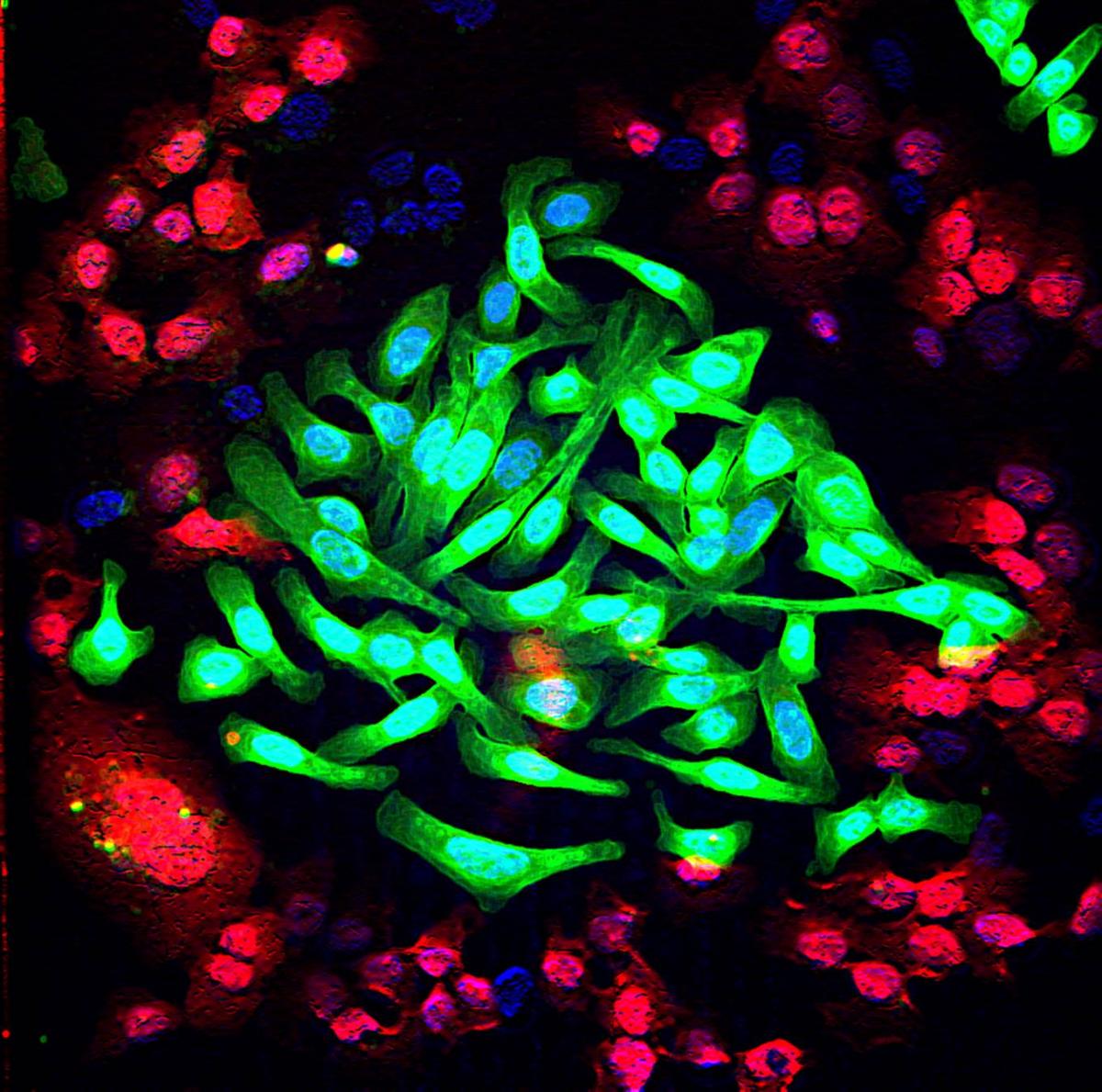
Lung cancer cells (green) cultured together with normal lung cells (red). The triple-antibody combination EGFR, HER2 and HER3 strongly impairs the survival of tumor cells while sparing normal cells. (Modified confocal microscopy image by Maicol Mancini, lab of Prof. Yosef Yarden, via wis-wander.weizmann.ac.il)

Lung cancer is the leading cause of cancer death worldwide, responsible for some 1.59 million deaths a year. That figure is due, in part, to the fact that the cancer often returns after what, at first, seems to be successful treatment. And the recurring cancer is often resistant to the chemotherapy and other drugs that originally drove it into remission. According to new research by the Weizmann Institute’s Prof. Yosef Yarden, a new strategy involving a three-pronged approach might keep an aggressive form of lung cancer from returning.

photo - Prof. Yosef Yarden
Prof. Yosef Yarden (photo from National Cancer Institute via commons.wikimedia.org)

The research arose out of some puzzling results of clinical trials, said Yarden. One class of relatively common lung cancers, which carry a particular mutation in a receptor on the cell membrane, called EGFR, can be treated with a sort of “wonder drug.” This drug keeps a growth signal from getting into the cell, thus preventing the deadly progression and spread of the cancer. But within a year, those with this mutation invariably experience new cancer growth, usually as a result of a second EGFR mutation. To prevent this from happening, researchers had tried to administer another drug, an antibody that is today used to treat colorectal cancer. This drug also obstructs the passing of the growth signal by stopping EGFR. Even though the antibody drug should have been able to effectively block the EGFRs – the growth receptors – including those generated by the second mutation, clinical trials of this drug for lung cancer did not produce results. “This finding ran counter to everything we knew about the way tumors develop resistance,” said Yarden.

How do the cancer cells manage to circumvent the blockade put up by an anti-EGFR antibody? In the new study, which appeared earlier this month in Science Signaling, Yarden and his student, Maicol Mancini, discovered what happens to cancer cells when they are exposed to the receptor-blocking antibody.

“The blocked receptor has ‘siblings,’ other receptors that can step up to do the job,” explained Yarden. Indeed, the team found that when the main receptor (EGFR) continued to be blocked, one of the cell’s communication networks was rerouted, causing the siblings to appear on the cell membrane instead of the original receptor. The finely tuned antibody did not block these, and thus the cancer cells were once again “in business.” The researchers uncovered the chain of protein communication in the new network that ultimately leads to appearance of the sibling growth receptors. This new network may overcompensate for the lack of the original receptor, making it even worse than the original. In addition, the team found that the rewired network sometimes included the participation of another molecule, known as receptor tyrosine kinase MET, which specifically binds to one of the siblings. This signaling molecule is often found in metastatic cancers.

Once the researchers discovered how the blockade was breached, they set out to erect a better line of defence. Yarden and his team created new monoclonal antibodies that could target the two main growth receptor siblings, named HER2 (the target of the breast cancer drug Herceptin) and HER3. The idea was to give all three antibodies together – the two new ones and the original anti-EGFR antibody – to preempt resistance to the treatment. Indeed, in isolated cancer cells, applying the triple treatment prevented them from completing the rewiring necessary for continuing to receive growth signals.

Next, the team tried the three-pronged approach on mouse models of lung cancer that had the secondary, resistance mutation. In these mice, the tumor growth was almost completely arrested. More importantly, further research showed that this treatment reined in the growth of the tumor while leaving healthy cells alone.

Although much more research is required before the triple-treatment approach makes it to the clinic, Yarden is hopeful that it will change not only the treatment protocol for lung cancer, but the understanding of the mechanisms of drug resistance. “Treatment by blocking a single target can cause a feedback loop that ultimately leads to a resurgence of the cancer,” he said. “If we can predict how the cancer cell will react when we block the growth signals it needs to continue proliferating, we can take preemptive steps to prevent this from happening.”

Also participating in this research were Drs. Nadège Gaborit, Moshit Lindzen and Tomer Meir Salame of the biological services department, and Ali Abdul-Hai, also of Kaplan Medical Centre; and research students Massimiliano Dall’Ora and Michal Sevilla-Sharon; together with Prof. Julian Downward of the London Research Institute.

Yarden is the recipient of the 2015 Leopold Griffuel Prize for fundamental research, awarded by the major French association for fighting cancer, called ARC Foundation for Cancer Research. He is the incumbent of the Harold and Zelda Goldenberg Professorial Chair in Molecular Cell Biology.

Weizmann Institute news releases are posted at wis-wander.weizmann.ac.il, and are also available at eurekalert.org.

Driverless cars one step closer

Prof. Zvi Shiller in the RAV Lab. (photo from israel21c.org)

Within a few years, you may be traveling in a car with nobody at the wheel. Whether you call it an autonomous, driverless or self-driving vehicle, this automobile of the near future needs a host of complex components, some now under development at Israeli companies and academic laboratories.

“You will be able to go to, let’s say, Paris or Tokyo, rent a car, swipe a card and tell it where you want it to go. You won’t have to know the area or the traffic rules,” explained Prof. Zvi Shiller, founder of the department of mechanical engineering and mechatronics at Ariel University and director of its Paslin Laboratory for Robotics and Autonomous Vehicles (RAV Lab).

The biggest benefit will be fewer traffic accidents than we have today – which cause more than 30,000 casualties annually in the United States alone – by eliminating human error in driving. But that requires a very, very smart car.

In the RAV Lab, Shiller and his students are developing algorithms that will automatically modulate speed and handling in response to constantly changing, unpredictable road conditions. Driverless cars will need this capability to meet future safety regulations.

“Today’s driverless cars, introduced by leading car companies such as Ford, Volvo and even Google, can drive very well on a road that is smooth and flat. Our research is about driving over a surface with bumps, ruts and hills,” said Shiller. “This is much more difficult because you can easily lose stability on that kind of terrain. If you’re driving too fast over a bump, you may jump into the air. You have to know at which speed you can drive safely without losing contact with the ground. You may need off-road driving capabilities less than 10% of the time, but you can’t trust a car that cannot handle those 10%.”

The current research continues Shiller’s work at the University of California-Los Angeles Laboratory for Robotics and Automation, which he founded and headed for 14 years before joining Ariel University in 2001.

At the RAV Lab, Shiller and his students have developed a small mobile robot that manoeuvres between obstacles at high speed, showing how the driverless car would handle itself.

[vsw id=”pGgmBVxFsB8″ source=”youtube” width=”425″ height=”344″ autoplay=”no”]

“I haven’t seen a similar robot moving as fast,” said Shiller. “This stems from our ability to compute the optimal velocity that exploits the robot’s motion capabilities.”

A couple of years ago, the lab published their results from testing a simple version of this algorithm against one developed at the Massachusetts Institute of Technology, where Shiller earned graduate degrees in mechanical engineering.

“Our algorithm computes a collision-free path among 70 tightly spaced obstacles in half a millisecond, compared to 500 milliseconds (0.5 seconds) it took the algorithm from MIT,” he reported. “That’s 1,000 times faster!”

RAV Lab’s technology could be one of a few systems for driverless cars to come out of Israel. The different systems address everything from motion planning to cyber-security.

Among the companies working on self-driving car technologies is Jerusalem-based Mobileye, whose driver-assistance software is already built into approximately 3.3 million vehicles worldwide. Mobileye reportedly is collaborating with American electric car manufacturer Tesla on developing its driverless vehicle.

Shiller said that one of the most difficult functions to automate is the 3-D mapping system to take the place of human perception in identifying and avoiding moving and stationary hazards in the car’s vicinity.

“Researchers are still working on this,” he said. “Once we map the region around the vehicle, we can use this information to do the next part, which is planning the vehicle’s motion. That’s where my research comes in.”

Making life easier

Over the years, Shiller’s students have produced robots that climb stairs, clean windows, operate wheelchair lifts, dispense pills, push baby strollers uphill, turn pages and accomplish other everyday tasks. They’ve built up a portfolio of almost 90 robotic products over the last 10 years to solve daily life problems in a futuristic way. “Some of these are world firsts,” said Shiller.

[vsw id=”461BsHCuKLk” source=”youtube” width=”425″ height=”344″ autoplay=”no”]

The RAV Lab’s research has been supported by Israel’s ministries of science, transportation and defence, the Israeli Space Agency, General Motors and the Paslin Foundation.

As head of the Israeli Robotics Association (IROB), Shiller is optimistic that Israel can become a world leader in smart robotics.

“Quite a few of the Israeli robotics companies are world leaders in their fields,” he said, citing examples such as Robomow, the Dolphin swimming pool cleaner, the SpineAssist surgical device, Mobileye and the ReWalk exoskeleton.

“The research we do in Israel is state of the art,” said Shiller. “I believe that if we build upon the infrastructure developed over the last 25 years in the remarkable Israeli high-tech industry, we can become world leaders in robotics as well.”

For more information, visit ariel.ac.il/sites/shiller/ravlab.

Israel21C is a nonprofit educational foundation with a mission to focus media and public attention on the 21st-century Israel that exists beyond the conflict. For more, or to donate, visit israel21c.org.

Five-minute charger

StoreDot’s technology would enable drivers to charge their car batteries in less time than the company needs to explain how it works. (screenshot from israel21c.org)

StoreDot made headlines when it unveiled its prototype instant phone battery charger at last year’s Microsoft ThinkNext exhibition in Tel Aviv. The flash-battery/flash-charger unit could be available on smartphones by the end of this year. And, at the 2015 ThinkNext in early May, the Israeli company announced that it intends to demonstrate its five-minute ultra-fast-charge car battery next year.

This groundbreaking technology would enable drivers to charge their car batteries in less time than StoreDot needs to explain how it works.

[vsw id=”RQTQMNojy3Q” source=”youtube” width=”425″ height=”344″ autoplay=”no”]

StoreDot specializes in cost-effective, environmentally friendly nanotechnologies using organic materials that increase electrode capacitance and electrolyte performance. This is the recipe for making batteries that can be fully charged in minutes rather than hours.

While competitors in the electric-vehicle space seek to increase mileage per battery charge, StoreDot is focusing on dramatically reducing charging time.

“This is part of our larger initiative to commercialize a proprietary game-changing technology of fast-charging batteries that would transform the lives of smartphone users as well as drivers,” said StoreDot chief executive officer Doron Myersdorf.

The privately owned StoreDot, incorporated in Israel in 2012, also announced the opening of its new facility in Herzliya, housing an organic chemistry lab, battery material development lab and R&D battery production line.

Israel21C is a nonprofit educational foundation with a mission to focus media and public attention on the 21st-century Israel that exists beyond the conflict. For more, or to donate, visit israel21c.org.

Israeli poet talks to JI

photo - Erez Biton
Erez Biton

After years of writing poems that blend his Algerian/Arabic background and his Ashkenazi-influenced schooling, Israeli poet Erez Biton, 73, this year received the Israel Prize for Hebrew literature and poetry. Born to Moroccan parents in Oran, Algeria, in 1942, he is the first Israeli of Mizrahi descent to win the country’s top literary honor, though he is no stranger to awards for his work.

“Poetry is like a tale of an elusive dream, but one must not give up,” Biton told the Independent. “One must, to a certain extent, pursue this elusiveness and try to catch it and change it into the poetic expression. The coping is with the controlling, the conscious, the immediate, which prevents an encounter with the twilight sensation that enables the poem to dawn.”

Biton envisions poetry as an independent, physical sense. “The poem is a continuation of you, added to you by the poetic ability,” he explained. “Just as it is difficult to catch the tale of a dream, so does the poem impose, sometimes for the good, sometimes for the bad.”

By internalizing the poetry of such writers as Hayyim Nahman Bialik, Nathan Alterman, Yehuda Amichai, Zelda Schneurson Mishkovsky, Amir Gilboa, Dahlia Ravikovitch and Avot Yeshurun, Biton said he developed a poetic stance of his own. “If, at first, I wrote love poems of a boy seeking his path to the world of poems, which were defined as universal existential with no description of time and place, then, in my additional poetry, I had become totally concrete, and thus saw myself as different from others.”

Biton started on his artistic journey with the help of Elisheva Kaplan, a piano teacher at Biton’s school who stopped teaching in order to dedicate her life to translating written books into Braille. This was essential for Biton, as he lost his sight at the age of 10.

Kaplan brought some of Biton’s poems to Shimon Halkin, an Israeli poet, novelist, teacher and translator (who passed away in 1987). Upon reading Biton’s work, “Halkin suggested that I send my poetry to [the now defunct literary magazine] Keshet,” said Biton. “I received an enthusiastic letter from the editor of Keshet, Aharon Amir, in response to reading my poems ‘Jaffa Street,’ ‘Variations on One Subject of Bach,’ and more.”

When Biton lost his sight and left hand to an explosive device he found while playing, he recalled, “This was a type of loss, a death of an intimate entity, which until the age of 10 and a half, was a part of me. And, to lose that, [it’s as though] something dies in you. With this death, I am in negotiation.”

Biton decided to become a social worker instead of a writer. “There was no one I could show my poems to,” he said. However, he added, “as a result of my encounter with human suffering as a social worker, I acquired compassion, sensitivity to others, which were later absorbed into my poems.”

Biton immigrated to Israel in 1948 with his family. The year after he lost his sight, he went to school at Jerusalem’s Institute for the Blind. He received his bachelor’s in social work from the Hebrew University, his master’s in psychology from Bar-Ilan University, then worked as a social worker for many years. He also worked as a journalist and was a columnist for Maariv. His first book, Mincha Marokait (Moroccan Gift), was published in 1976.

Biton’s decision to become a social worker stemmed from his identification with the hardships involved with making aliya. His experiences have also contributed to his poetry.

“The process of my growth ripened in me foundations of lyric sensitivity that came to expression in the poetic writing,” he said. “A writing of truth can grow through a deep encounter with different life situations and I say that all human suffering is not foreign to me. Therefore, I find in myself a space of accommodation and also of the unusual and the different.”

Biton expressed gratitude for the recognition he has attained, saying if he is to be considered part of the chain of poets that includes writers such as Bialik, “a great grace will be done with me. And grace will be done with me also by those who will see me as someone who opened a certain door, because it took time until people started to talk my language.”

Biton does not see himself as a man of religion, but said, “Moroccan associations echo in me, biblical associations echo in me. All the materials I treasured, which I internalized – poems of Bialik – all the materials that I absorbed, especially the Moroccan language, it was an immense joy to me to give an echo to something from an entirely different me.

“One of the unique components in the writing of my poems is the use of expressions in Arabic…. During the healing of the internal tears, I found myself writing poems that embed in the Hebrew syntax expressions in Moroccan Arabic, which was my childhood language.”

His work has paved the way for others. “I used in my poetry groundbreaking Moroccan expressions and, eventually, other poets used the expression ‘Moroccan’ as a title to the names of their creations,” he said.

“I’m in a battle of two phases. One says blindness is a great lacking, an endless depravation of encountering the world…. On the other hand, when I am a bit more reconciled with myself, there are also the possibilities of hearing, touching and listening to the speaking of people, as a type of melody.”

Of course, not only his cultural background has influenced his writing. “On the sensory level,” he said, “I’m in a battle of two phases. One says blindness is a great lacking, an endless depravation of encountering the world … emphasized by the recognition of the memory of seeing until the age of 11.

“On the other hand, when I am a bit more reconciled with myself, there are also the possibilities of hearing, touching and listening to the speaking of people, as a type of melody. The sensation, the touch of a woman, the face of a woman, the lips of a woman – all of these are at the other side of the scale of what there is.”

Integral to his success has been his wife. “In my attempt to understand the proceeds that happened in my work, I cannot ignore the significance of my marriage to Rachel in the year 1982,” he said.

Biton’s wife, Rachel Calahorra, is an architect and graduate of the Technion in Haifa. She was born in Israel to parents who emigrated from Athens. The couple met in early 1980.

“What was special in our relationship was we believed in each other, in the intellectual capability and the emotional side of deep love,” said Biton. “Our connection as a couple led also to a mutual intellectual cultural search toward an integration … between East and West.

“The marriage, the starting of the family, and its expansion in the birth of our children, Asaf and Shlomit, sharpened in me the question of blindness and my place as a blind person in the family, as a father and a husband.”

Biton found himself writing poems like, “The Joy of Your Eyes” and “Arrangement with a Firstborn.”

“Without a doubt,” he said, “my marriage to Rachel was a very significant turnaround, not only in the course of my life, but also in my writing, with the complexity of her life with me as a blind person, in her endless support of my overall actions.”

While Biton has won other awards for his work, with the receipt of the Israel Prize this year, as well as the Bialik Prize for lifetime achievement and the Yehuda Amichai Prize last year, he said he now feels more accepted.

The Israel Prize committee described his poems as, “The epitome of courageous dealings, sensitive and deep with a wide range of personal and collective experiences centred around the pain of migration, planting roots in the country and the reestablishment of the Mizrahi identity as an integral part of the overall Israeli portrait.”

In his speech at the prize ceremony, Biton said, “My parents were like an open book to me. My mother was a collection of poetry in Arabic, carrying an ancient Jewish legacy. And, indeed, so I have become an accumulation of childhood experiences, experiences of lively observation, of freedom of movement in spaces, climbing on trees and on fences, and a lot of running.

“I was an accumulation of sounds, of dialects, or poetry, from my father’s home. Eleven years of freedom of movement and seeing … sensory treasures were collected in me … of which I make use still today.”

Rebeca Kuropatwa is a Winnipeg freelance writer.