Play’s Vancouver links

Zayd Dohrn’s Reborning returns to the New York stage this summer. (photo from Zayd Dohrn)

The play Reborning, written by Zayd Dohrn, is being performed Off-Broadway at the Soho Playhouse in New York City from July 5 through Aug. 3, thanks to Vancouver’s Reality Curve Theatre.

A Canadian nonprofit professional theatre company founded in 2011, Reality Curve reached out to Dohrn to bring this play, which ran in Vancouver last year, to the New York stage. The production is produced by artistic director Paul Piaskowski, Darren Lee Cole and Rebecca McNeil, and is presented by Playbook Hub with support from the Vancouver Film School, the Canada Council for the Arts and Shimon Photo.

Reborning is a dark comedy-drama with elements of horror. In it, people are able to buy life-like infant dolls that look like loved ones who have died. The play centres around Kelly, a woman who lives with her boyfriend in Queens, N.Y., and creates “reborn” baby dolls. She has a client who commissions her to make a replica of her dead baby girl and, as Kelly constructs this doll, it stirs up memories from her own life.

“It’s a relationship between a younger and older woman – a customer and an artist – who are both looking for something and it becomes dangerous,” said Dohrn, who lives in Chicago and is an associate professor at Northwestern University. “There is a whole subculture with these dolls. I wrote the play right after the birth of our first child. My wife was shopping online for baby toys and clothes and she found these life-like dolls. The photos of them are incredible, realistic, detailed and medically accurate. Some even have hospital bracelets. There is something beautiful about them, yet very disturbing.”

Dohrn talked to customers and heard their testimonials. “Many of these people can’t get over the loss of their baby and use the dolls therapeutically.”

The play stars Emily Bett Rickards (CW’s Arrow), Piaskowski (Unspeakable, The Twilight Zone) and Lori Triolo (Riverdale), who is also the director.

The first production of Reborning, which starred Ally Sheedy, was 10 years ago at the Summer Play Festival at the Public Theatre in New York City, when Dohrn was at the Julliard School. It has had more than 20 productions nationally and internationally over the last decade, including in Los Angeles, Brazil, Panama, Florida, San Francisco and, in 2018, Vancouver, where he connected to Reality Curve.

Dohrn’s life and road to literary success could be a fascinating play in itself. His parents, Bill Ayres and Bernadine Dohrn, were leaders in the radical group the Weather Underground (also known as the Weathermen) back in the 1960s and 1970s. There was an accidental explosion in a Greenwich Village townhouse where Weathermen lost their lives, and the couple went underground, using assumed names. Dohrn, who is now 41, spent his early childhood on the run.

“It didn’t seem strange to me to grow up being fugitives, that was just our life,” he said. “We lived in New York City in Harlem, traveled a lot, moved around a lot and lived in communes. Then my parents turned themselves in and we settled in New York. My mom went to jail for almost two years when I was 5, and I have vivid memories of visiting her there. My dad took care of me while she was gone.”

When his mom was released from prison, she became a lawyer. “My dad became a professor and I was raised in a middle-class house, although they still had their notoriety and they were committed to their politics and their cause,” said Dohrn. “Growing up, we would go to a lot of demonstrations and meetings with other activists.”

Dohrn went on to earn an undergraduate degree from Brown University, a master’s in fine arts from New York University, a master of arts from Boston University and a playwriting fellowship from Julliard. He also spent a lot of time in China. Fourteen years ago, he married Rachel DeWoskin, and they have two daughters. DeWoskin, who is from Ann Arbor, Mich., is an author, teaches at the University of Chicago and also spent many years living in China before she and Dohrn met.

Many of Dohrn’s plays draw from his childhood and life experiences. In one of his earlier plays, Haymarket, set in 1886, a bomb explodes in the middle of a peaceful rally of demonstrators in Chicago – at least one of the radicals goes into hiding. His play Sick, about a Manhattan couple who go to extreme measures to protect themselves from pollution, was reminiscent of living in Beijing and witnessing the fear during the SARS epidemic.

When asked about his religion, Dohrn said he considers himself a cultural Jew. “My mom was half-Jewish and my parents were atheists, but, culturally, my mom considers herself Jewish and we were raised as cultural Jews and celebrated Passover and Chanukah,” he explained. “We celebrated in a radical way – we did Passovers in a women’s prison in upstate New York, celebrating the Exodus as a story of freedom and celebrating with female inmates in prison.”

Dohrn noted that he, his wife and kids have traveled a lot, visiting Jewish sites. “My wife considers herself Jewish and we are raising our girls with a lot of Jewish cultural influences,” he said.

Dohrn and DeWoskin spend time each year in China. “Rachel kept her apartment in Beijing for at least 10 years and we would go for a few months every year,” he said. “When our kids started to grow up, we wanted a place where they could be more independent so we got an apartment in Shanghai. We spend three-quarters of the year in Chicago and one-quarter of the year in Shanghai. We both have academic schedules so we are able to spend the summers and winters there. There are still historical monuments and artifacts from the Jewish community in Shanghai and the synagogue is now a museum. Our apartment there is in the building that was the Jewish processing centre for the refugees during World War II.”

Currently, Dohrn is developing a series about radical political movements like the Weather Underground and the Black Panthers for Showtime and a feature film for Netflix. He’s looking forward to Reborning being back on the New York stage. “For me,” he said, “it’s a bookend, to have it back in New York again after all these years.”

Alice Burdick Schweiger is a New York City-based freelance writer who has written for many national magazines, including Good Housekeeping, Family Circle, Woman’s Day and The Grand Magazine. She specializes in writing about Broadway, entertainment, travel and health, and covers Broadway for the Jewish News. She is co-author of the 2004 book Secrets of the Sexually Satisfied Woman, with Jennifer Berman and Laura Berman.

TUTS season is set to begin

Left to right: Sheryl Wheaton as Rosie, Lori Ashton Zondag as Tanya and Caitriona Murphy as Donna in Mamma Mia! with Adam Charles as Jack, Caleb Lagayan as Race and Graeme Kitagawa as Mush in Disney’s Newsies. (photo by Lindsay Elliott)

Iconic Swedish pop music and a story that exemplifies America’s love of the underdog are coming to Stanley Park’s Malkin Bowl this summer. Theatre Under the Stars presents Mamma Mia! and Disney’s Newsies on alternate nights, starting with a preview of Mamma Mia! July 5.

Set in the Greek islands, Mamma Mia! features ABBA songs aplenty, as bride-to-be Sophie invites three of her mother’s former lovers to her wedding in order to figure out which one is her father. The TUTS production features two Jewish community members who are veterans of the stage: Wendy Bross Stuart as music director (and rock band pianist) and Stefan Winfield as Harry Bright, one of the possible fathers, a role that was played by Colin Firth in the film version of the musical.

About his preparation for the TUTS production, Winfield shared: “Main note to self: do not attempt to replicate Colin Firth’s performance! He is a great actor. His quintessentially understated, sensual and impossibly British charm that comes across so well on the screen is not something I’d ever be able to reproduce on the Malkin Bowl stage in a way that connects with anyone past the first row … so, I’m bringing what I can to the role, doing my best to fulfil the vision of the creative team.”

Winfield’s first TUTS show goes back to childhood. In 1976, he played Randolph in Bye Bye Birdie. “My next appearance on the Malkin Bowl stage was not until 1999,’ he said, “when I played an adult role (i.e., not a Jet or a Shark!) in West Side Story.”

Since then, he has been involved in several TUTS shows, including Jesus Christ Superstar, another mounting of Bye Bye Birdie and of West Side Story, and The Drowsy Chaperone. Among other things, he was also in Parfumerie at the Metro Theatre in 2014, directed by Disney’s Newsies musical director, Christopher King, and has been directed a few times by fellow Jewish community member Richard Berg, who is currently TUTS’s production manager.

photo - Stefan Winfield plays one of the prospective dads in Theatre Under the Star’s Mamma Mia!, which previews July 5
Stefan Winfield plays one of the prospective dads in Theatre Under the Star’s Mamma Mia!, which previews July 5. (photo from TUTS)

“It’s a pleasure to be working again with Shel Piercy,” Winfield added. “This is the fourth time I’ve performed under his direction on a theatre production, but the first time dates back to 1977! I played Kurt in a very local production of The Sound of Music for Marpole Community Theatre, directed by Shel, who, I believe, had only recently graduated from Eric Hamber. He’s a guy who’s been telling great stories for several decades, on stage and screen; I am very honoured to work with him.”

Another co-worker partially explains why Winfield likes being involved in TUTS. “The opportunity to work under the direction of and perform with outstanding theatre professionals, including my wife, choreographer Shelley Stewart Hunt – not to mention the crowd of extraordinarily talented and impressively trained up-and-coming young people who give themselves over to TUTS for the summer. And, for me personally, TUTS has really lived up to its mandate of creating a family atmosphere in allowing me to share the experience with my son Wesley, who was ‘en ventre sa mère’ during Bye Bye Birdie as Shelley was choreographing, then performed in featured bits in The Drowsy Chaperone at the age of 5, and is doing the same now in Mamma Mia! – this time actually executing choreography set by his mum! To watch it gives me joy … naches, if you will.”

And it’s a family scene that is among Winfield’s favourites in Mamma Mia!

“There are a lot of great moments,” he said, “but I’d say my favourite occurs during the scene when the dads meet Sophie for the first time. Harry is singing ‘Thank You for the Music,’ playing the guitar while lost in wistful reminiscence, when, to his surprise, in walks Sophie who joins in on the song. It’s a moment made all the more special by the lovely voice and energy of the young lady who’s playing Sophie in our production, Keira Jang.”

Also a TUTS veteran, Bross Stuart has worked with Piercy and Stewart Hunt before.

“Shel, Shelley and I have worked together on many shows; we go back a very long time,” said Stuart. “In fact, Shelley was actually my student when she was in Grade 8. And an excellent student at that! As a team, I have profound respect for Shel and Shelley. There is a wonderfully creative synergy between the two of them and between them and myself. They see possibilities which are almost magical.”

Bross Stuart’s first TUTS production was Fiddler on the Roof in 1997.

“In those days,” she said, “it had not occurred to people in Vancouver that it might be useful to have an actual Jewish person involved with a production of Fiddler on the Roof. TUTS was ahead of its time, realizing how important this would be! In those days, there was very little Jewish influence in this town, especially compared to where I had spent my childhood and young adult life – in New York City and Montreal.”

photo - With Mamma Mia! music director and pianist Wendy Bross Stuart has added ABBA’s music to her repertoire
With Mamma Mia! music director and pianist Wendy Bross Stuart has added ABBA’s music to her repertoire. (photo by Erin Palm)

Describing working at TUTS as “intoxicating,” Bross Stuart highlighted the beauty of Stanley Park and said about the feeling of “conducting/playing outdoors in front of a large, appreciative audience – absolutely second to none. A very special experience!”

As well, she noted that “each show has completely different demands because of the material we are using.” For Bross Stuart, ABBA’s music was a new challenge.

“ABBA was not in my repertoire at all,” she admitted. “During the ABBA period, I was busy living in Japan and studying traditional music for koto and shamisen, composed by Yatsuhashi Kengyo and Tsuruyama Kengyo. No pop music for me! However, I have learned so much about this style from working on Mamma Mia! Doing ABBA music has taken me to a new place in my musical life. Growing and learning is such an exciting venture.”

While music rehearsals officially started on April 24, Bross Stuart said she opened her home for early rehearsals to anyone who wanted a head start.

“The style of the music makes the approach much different from most shows,” she said. “Less on the micro details and more on the big picture. As a detail-oriented person, it is a great learning experience for me – and, I am playing keyboard in a rock ’n’ roll band (and conducting). Each of the four keyboards is hooked up to a computer with many sound patches. I love it!”

For tickets to Mamma Mia! and Disney’s Newsies – which may not have local Jewish community members in its creative team but has music by Alan Menken, lyrics by Jack Feldman and book by Harvey Fierstein – visit tuts.ca or call 604-631-2877.

Exploring music, dance, self

The cast of Tara Cheyenne Performance’s The Body Project. (photo by Wendy D. Photography)

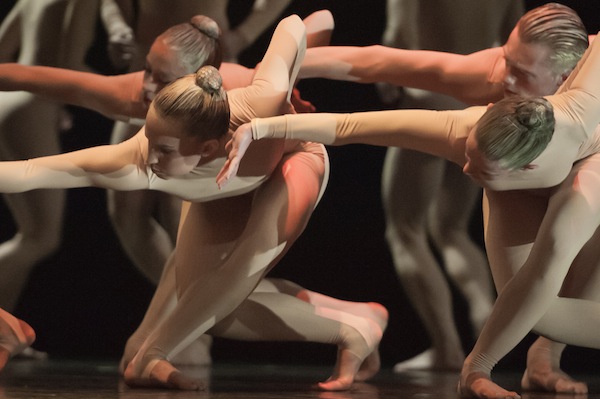
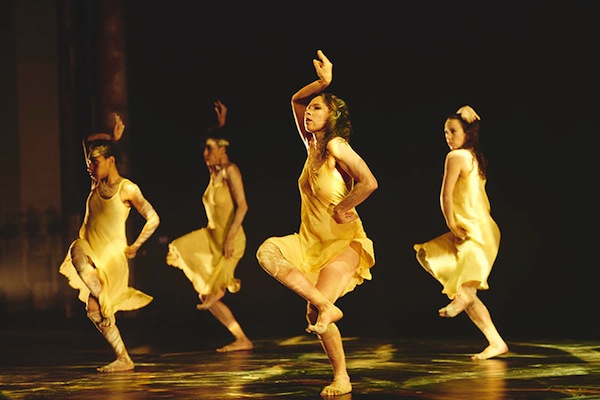
Among the more than 20 choreographers and companies from across Canada, Brazil and Korea that are participating in this year’s Dancing on the Edge Festival are local Jewish community members Alexandra Clancy (Soleful Dance Company) and Tara Cheyenne Friedenberg (Tara Cheyenne Performance).

Soleful Dance Company’s Where the Music Begins will take place July 12, 8:15 p.m., in the Firehall Arts Centre courtyard, and Tara Cheyenne Performance’s The Body Project (working title) is part of Edge 5 July 11, 9 p.m., and July 13, 7 p.m., at the Firehall. DOTE runs July 4-13. Click here to watch the festival trailer on YouTube.

* * *

Where the Music Begins, created by Clancy and composer and musician Mike W.T. Allen, was commissioned by Dances for a Small Stage for its Summer Series.

“Mike and I had played music together but never officially constructed any works for stage,” Clancy told the Independent. “Throughout the rehearsal process, there would be a back and forth of ideas; sometimes I would have a rhythmical phrase of tap dance and Mike would then create a melody over top, and sometimes Mike would compose a phrase of the melody and I would choreograph specifically to that part of the tune. After some give and take between our prospective instruments and ideas, we solidified a melody and then decided upon the structure of the tune. Some of the tune is improvised, some is a conversation, and some is very set and predetermined. We both enjoyed the collaborative process and found a harmonious way to create music and dance together.”

Clancy grew up in Vancouver and has always been involved with the Jewish community. “I was raised Jewish; attending Hebrew school on Sundays, becoming bat mitzvah, and participating in holidays and traditions,” she said. “After going on Birthright a few summers ago, I was re-inspired by the beauty of the culture and have tried to stay more engaged in the community by attending Axis events and other social gatherings, as well as going to synagogue when I can. I am grateful for the support and familial kindness that I have received from the community, consistently reminding and encouraging me that I am capable of whatever I put my all into.”

And she has put her all into a lot, having trained in all genres of dance, studying at Danzmode and the Vancouver Tap Dance Society. She was a member of Tap Co., a pre-professional youth tap dance company, and has trained and performed across North America.

photo - Alexandra Clancy is one of the performers and choreographers whose work will be featured in this year’s Dancing on the Edge, which runs July 4-13
Alexandra Clancy is one of the performers and choreographers whose work will be featured in this year’s Dancing on the Edge, which runs July 4-13. (photo from DOTE)

“After graduating, I lived in Austin, Tex., and was a member of Tapestry Dance Company in its 25th season,” said Clancy. “I then moved back to Vancouver and have been performing and teaching ever since. This past year, I taught at the Arts Connection, Dance Co., and the Pulse, sharing my love and passion for tap dance and educating the next generation of talented dancers.

“As recital season comes to an end, I am currently in a creative residency with Dances for a Small Stage, where we are developing works for our Summer Series and exploring digital literacy in dance. As well as preparing for DOTE, I am also in the studio rehearsing and creating for our upcoming performance at Jacob’s Pillow later this summer. In the fall, I will be moving to Calgary to attend the training program at Decidedly Jazz Dance Company.

“My goal,” she said, “is to broaden my toolbox to assist in expressing myself and telling stories through dance. This upcoming year, I hope to continue to collaborate and create through Small Stage, develop more new works with Soleful Dance Co., film a concept video, and share dance through as much teaching and performing as possible.”

Jacob’s Pillow is located in western Massachusetts in the town of Becket. Clancy auditioned for and then attended the inaugural tap dance program at Jacob’s Pillow in 2010 and returned two years later (again with an audition) for a second summer of learning and dancing. “My time at the Pillow was the most influential training thus far in my life and it has always been a dream of mine to perform my own work at the Pillow,” she said.

That dream will become a reality this summer.

“Jeffrey Dawson and I co-choreographed a piece for an online competition Jacob’s Pillow was running this year, and we were lucky enough to be chosen as Top 6 and then voted Top 3, meaning we will get to perform our work live at the Inside/Out stage on Aug. 17,” said Clancy.

In addition to choreographing and teaching, Clancy established Soleful Dance last spring. She and some other dancers “felt we needed a name and a clear avenue to share the work we had started developing. Based in Vancouver, this company is a platform to express ourselves and tell stories through the music of tap and the movement of dance.

“Although under my direction,” she said, “Soleful Dance Company is rooted in collaboration. Our ultimate goal is to make audiences feel something. All of the members of the company’s primary focus is tap dance; however, everyone brings a versatile background to the creative process, spanning from contemporary dance, to acting, to playing music and more. We hope to continue to grow and create more works to share with audiences in the near future.”

Clancy described tap dance as “a magical art form that allows one to not only express through movement but connect and emote through sound.

“This traditional American art form has a rich and complex history that is intertwined deeply with jazz music and culture,” she explained. “There is a sense of community that I have always appreciated about tap dance, and I feel a great amount of respect and gratitude that I get to perform and participate in its culture. It just feels good to get to move your body and dance and then, on top of that, creating and connecting with music opens endless doors of expression.”

* * *

The Body Project is a new interdisciplinary performance created from interviews, symposiums and roundtables.

“I started research on and around the theme of ‘female body image’ about a year ago,” Friedenberg told the Independent. “Part of our research/creation process has been interviewing female-identifying and non-binary people (many dancers and actors). To date, 35 people have generously participated.

“In the studio, I have been mining my own complicated and unhealthy relationship with my body as a dancer in a female body with the help of my amazing collaborators/performers. The process so far has involved exploring how the forms of stand-up comedy and dance can express this difficult, and often absurd, story of struggling with body image that many of us share.”

The performers – Bevin Poole, Caroline Liffmann, Kate Franklin and Kim Stevenson – came into the process shortly after Friedenberg began her exploration of the topic.

“We are working very closely with intimate and difficult material so, although I am leading the process, it is essential that all the voices/bodies in the room are present in the work. For example, there is a section choreographed by Kim Stevenson – much of the gestural language has been created through our own gestures as we’ve spoken about our personal experiences with body image.”

About the creative process, Friedenberg said, “These are very busy people, so we have had times when we are all in the studio and other times when it’s just me and one collaborator. Making room for people’s lives and demands, including parenting and caring for parents, is an important part of our feminist practice.

“Justine A. Chambers is our dramaturge/outside eye and Michelle Olson will be involved in the project as a consultant and possibly a performer in the next phase of development.”

As professional dancers, the performers/creators have shared some common struggles and coping mechanisms regarding body image.

“The pressure to fit a very narrow ideal of the ‘dancer body’ has been difficult and complex for all of us,” said Friedenberg. “There’s the pressure to be very thin, small, more muscular, or less muscular. Pressure to fit an oppressive ideal of beauty. We each have found ways to navigate these limiting ideas. Sometimes we have had to remove ourselves from certain arenas in order to survive. Sometimes we have found power in defying the stereotypes of what a dancer should look like to the euro-centric patriarchal gaze. But I keep coming back to the effort and energy required to bare these expectations and what we can transform with that energy instead.”

She added, “It must be noted that the many voices, words, time and contributions from the people we have interviewed are alive in the work through our bodies and presence. Their names will be listed on our website. Although the work, at this early stage, is a version of my story, it is also very much a result of being together in conversation about body image, in a circle, speaking, listening, moving, supporting and sharing with many powerful female-identifying/non-binary people – ‘the personal is political.’”

* * *

The full DOTE schedule can be found at dancingontheedge.org. For tickets, call 604-689-0926 or visit tickets.firehallartscentre.ca.

The search for a friend

Finding Fukue follows Jessica Stuart’s journey to Japan to find her childhood friend.

screenshot - Finding Fukue follows Jessica Stuart’s journey to Japan to find her childhood friend
(screenshot)

To what lengths would you go to find a childhood friend whose letters stopped coming decades ago? When online searches proved fruitless, Vancouver-born, Toronto-based musician Jessica Stuart headed back to Japan, and her journey is recorded in the CBC Short Docs film Finding Fukue, which was produced with Real Stories. Since posted to YouTube last November, the charming and moving documentary has been viewed more than 3.6 million times to date.

“When I was 9 years old, my parents got English teaching jobs and moved us all to Japan for a year,” shares Stuart as the film starts. Among the images we see are clips of home movies from that year, 1988. “I was a blond kid, and that made me of interest to all the Japanese people because they had never really seen a blond-hair person before,” she says. “They would point at me or my sister, touch my hair, talk at me; I didn’t understand anything yet. The day after we arrived, I went to school for the first time and then that was crazy. I didn’t feel that anyone was interested in getting to know me, except for one person, and her name was Fukue, and we became best of friends.”

The Stuarts – Wendy, Ron and daughters Fiona and Jessica – settled in Saku, then a small rural village with no foreigners. Now, however, Stuart has to start looking for her friend Fukue in a city of 100,000 people. She visits the elementary school they attended and gets a yearbook, where she gets Fukue’s father’s name and an address from the year 2000, but this leads her to a new development, where she and her translator (for the more complex encounters) meet some women who remember her family but can’t help with finding Fukue.

At Saku City Hall, a press contingent meets Stuart and she gets the word out on television and in print. Finally, a clerk at City Hall manages to find a phone number for Fukue’s sister, who connects the two friends. The reunions – first by phone and then in person – are quite emotional. The two fall into a familiar comfort and get reacquainted. They have kept in touch since.

The approximately 21-minute film can be found at youtu.be/ZVlZMOB-Sq0.

Meet Barry at Havana

Did you know without goats, the coffee bean may have never been discovered? Are you able to recognize if the vinyl you hear coming from your neighbor’s apartment is a 78, 45 or 33? Do you type your university essays out on a typewriter? Barry knows, Barry can, Barry does, Barry will and Barry did. Introducing the next wave in AI customer service. Barry is the perfect fit for all your too-cool-for-school business needs.

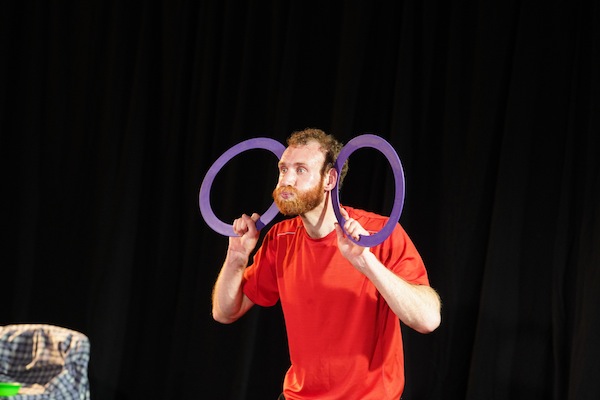
In Jewish community member Ira Cooper’s Artisanal Intelligence, fellow community member Hannah Everett plays Jane, the entrepreneur and creative genius responsible for developing Barry, a fast-learning, curious and fashion-wise artificial intelligence customer service robot, played by Drew Carlson. Cooper describes his play as “not simply a form of absurdist, comedic, low-brow escapism as it may come across. It’s a conversation about identity, as most things are, and its tumultuous relationship with self versus societal box-fitting…. There are other dialogues, too; questions raised about creation versus intent versus audience response and who gets to create meaning. It’s also an affirmation of what love can be.” Artisanal Intelligence is at Havana Theatre July 5 and 7, 9:30 p.m. Tickets ($15) can be purchased at showpass.com.

Mature content (14+)

Masks, stories and dance

George and Tamara Frankel at Masks, Revelations and Selfhood, the spring forum of Jewish Seniors Alliance, in partnership with the Louis Brier Home and Hospital, which was held May 26 at the Peretz Centre. (photo from JSA)

Since August 2018, Louis Brier Home and Hospital residents have explored themes of personhood and creative expression, crafting masks, narratives and original dances with expressive arts therapist Calla Power and choreographer Lee Kwidzinski. The whole process was filmed by Jay Fox for a documentary.

Power, Kwidzinski and Fox, as well as Louis Brier resident Jennifer Young, who participated in the project, shared their experiences with guests at Masks, Revelations and Selfhood, the spring forum of Jewish Seniors Alliance, in partnership with the Louis Brier. The forum was held May 26 at the Peretz Centre for Secular Jewish Culture.

The four presenters brought with them many of the masks that were made by the Louis Brier residents, which they placed on tables near the audience. Everyone could examine them up close and try them on. This allowed people to experience the changes one feels when masked, hidden from others.

JSA president Ken Levitt welcomed everyone and spoke about JSA’s motto, “Seniors Stronger Together,” noting that JSA’s free peer support programs – which require the financial support of the community to continue – exemplify the power of older adults assisting other older adults. He then introduced Power, who has been working with residents at the Louis Brier for about five years.

The Masks Project lasted seven months, culminating in a program that includes masks, stories, poems, drama and dance. In her summary of the history of masks, Power said the oldest masks, dating from the Neolithic period, were found near Jerusalem several years ago. She explained that masks are used in many cultures as part of religious and/or spiritual ceremonies. In a slide presentation, she showcased masks from different cultures, including African, Indian and local indigenous cultures. Frequently, she said, those wearing the masks would represent “the gods” and be a conduit for messages from above.

Ginger Lerner, Louis Brier recreation therapist, had approached Power about making masks for Purim, obtaining a donation from the estate of Frank and Rosie Nelson that facilitated the project. Power did some research on Purim and discovered that many of the characters were masked; for example, Esther, who masked her origins, and Vashti, who refused to be unmasked. As residents engaged with the project, they discussed such topics as what parts of ourselves do we keep hidden behind a mask.

Kwidzinski, who specializes in dance movement, has 30 years of experience working with older adults, mainly those with dementia and those who are in wheelchairs. She has a dance company in Mission, and the dancers worked with the mask makers to create movements related to the masks and the residents’ ideas. The dancers became the bodies of the mask makers, who chose the movements and the music. The mask makers came on stage with the dancers for the performance.

Young, one of the mask makers, expressed how moving the entire experience had been. She said the group became close, even though they hadn’t known each other well before.

Young said she had been reluctant about the dance aspect but felt that the dancers were extremely supportive and, at the end, she said she found the movements liberating, as if she were also dancing. She said she gained energy and willpower from the experience, and thanked Power, Kwidzinski and Fox for giving her the ability and opportunity to “get up and keep going.”

Fox has produced award-winning films, documentaries, music videos and public service announcements. He was involved in the Masks Project from the beginning. He felt that the journey was as important as the film and the art produced. The film was screened at the forum, and can be viewed at youtube.com/watch?v=YspYE6juiy0.

Gyda Chud, JSA first vice-president, led the question-and-answer session. Members of the audience expressed their appreciation for the information and the beauty of the project. It was suggested that advocacy was needed to have this type of project adopted by other care homes and adult day-care centres.

I wrapped up the afternoon event with a thank you to the presenters, which was followed by snacks provided by Gala Catering.

Shanie Levin is an executive board member of Jewish Seniors Alliance and on the editorial board of Senior Line magazine.

Dali artwork on display

Left to right: Oree Gianacopoulos, Chali-Rosso Gallery director; James Sanders from Dali Universe (Switzerland); and Susanna Strem, president of Chali-Rosso Gallery. (photo by Shula Klinger)

May 17 and 18 saw the unveiling of two sculptures by Spanish surrealist Salvador Dali, which will be on display until September. The sculptures were brought to Vancouver by the Chali-Rosso Gallery on Howe Street, the site of the annual Definitely Dali exhibition. More than 100 Dali originals are on display at the gallery, along with 20 smaller versions of Dali’s bronzes.

On May 17, “Dalinian Dancer” was revealed at the corner of Thurlow and Alberni. “Space Venus” was unveiled on the next day at Lot 19, on West Hastings at Hornby. The unveilings were accompanied by flamenco music, which Dali loved.

Oree Gianacopoulous, Chali-Rosso’s director, spoke before the unveiling of “Space Venus.” Describing it as one of Dali’s “iconic” pieces, she expressed her gratitude to Beniamino Levi, director of Dali Universe, the foundation that lends out the artwork. Levi worked with Dali himself to develop the collection of 29 sculptures.

This is the third year that Dali sculptures have traveled to Vancouver, under the leadership of Chali-Rosso president Susanna Strem, a member of the Jewish community. Working in close collaboration with Dali Universe in Europe, which loaned the sculptures to Chali-Rosso, Strem’s initiative has helped establish a new cultural tradition for the downtown core.

This year, the gallery also worked with Virtro Games to develop a smartphone application to enhance viewers’ experience of the sculpture. Definitely Dali is an augmented reality app – when a phone camera is focused on the image of Dali’s face, the dancer begins to move her arms and spin.

Alex Lazimir, who developed the app, talked about the privilege of spending many hours looking at Dali’s dancer. “I really like this piece because it was like going into Salvador Dali’s mind. The first thing I thought was that she has to be spinning.”

photo - Salvador Dali’s “Dalinian Dancer” can be found at the corner of Thurlow and Alberni
Salvador Dali’s “Dalinian Dancer” can be found at the corner of Thurlow and Alberni. (photo by Shula Klinger)

After the unveilings, Chali-Rosso hosted a champagne reception and a talk by James Sanders of Dali Universe (Switzerland). With reference to the sculptures at the gallery, Sanders spoke about Dali’s life and the tremendous influence of his surreal imagination on the world of art. Sanders is responsible for sourcing locations, sponsors and partners for exhibitions all over the world.

Originally from Europe, Strem came to Canada 25 years ago, via a spell in Israel. Formerly an information technology professional, Strem spoke about the challenge of bringing world-class art to public spaces in Vancouver.

“These sculptures are traveling all over the world. They’re exhibited in many major cities. Vancouver has to compete with cities like New York, London and Paris. These are major art hubs, so we are very happy that we managed to get two sculptures.”

Last year, Definitely Dali featured “Woman in Flame” and “Surrealist Piano.” More than three million visitors saw the sculptures.

Bringing monumental works of art here is a labour of love, however. “It takes almost a year to organize something like this,” said Strem. “Last year, when we had two other sculptures here, we were already talking about this year’s exhibition. It all depends on what is available and circumstances in other cities.”

The logistics of moving bronzes like “Space Venus” – which is 3.5 metres high – can be tough. “These sculptures were transported by ocean freight from Italy, then traveled through the Atlantic to the Panama Canal, up the Pacific Ocean past Mexico and California to Vancouver,” she said. “It’s a long journey. We experienced a delay. There was a traffic jam in the Panama Canal.”

photo - “Space Venus” by Salvador Dali has been placed in Lot 19, on West Hastings at Hornby
“Space Venus” by Salvador Dali has been placed in Lot 19, on West Hastings at Hornby. (photo by Shula Klinger)

These exhibits are both the impetus for, and a sign of, urban growth – “for a real city,” said Strem, “public art is a natural part of its evolution.” She spoke of the collaboration with the Downtown Business Improvement Association. “They were full-force behind it from day one, which helped motivate us. They were really enthusiastic,” she said.

Part of Chali-Rosso’s community involvement includes supporting Recovery Through Art, a charitable organization in Vancouver that gives individuals struggling with mental illness and addiction a chance to heal through the creation and appreciation of art.

Strem is already seeing the impact of the Dali pieces on public display. “If somebody is looking at their phone and they walk by 10 times but, this time, they look up and their face changes, even for a fleeting moment, that’s important. Or they might stop for 30 minutes. There are many ways to enjoy art,” she said.

Strem explained that, to truly become part of life, art should not just be locked away in special locations.

“It’s not about having a destination for art, where you allocate time and energy to it,” she said. “When we don’t engage with art like this, in public, people are missing out.”

Shula Klinger is an author and journalist living in North Vancouver. Find out more at shulaklinger.com.


Get lost in the sound

Itamar Erez’s new CD, Mi Alegria, is being launched with a concert at the Annex. (photo by Wolfgang Vogt)

Composer, performer and teacher Itamar Erez releases his new CD in a concert June 20 at the Annex. The title, Mi Alegria, or My Happiness, is a play on words: his daughter’s name is Mia.

Originally from Tel Aviv, Erez teaches guitar at Vancouver Symphony Orchestra School of Music and collaborates with renowned musicians from numerous cultures and musical traditions. His music is infused with the melodies, instruments and rhythms from across the Middle East and beyond.

Erez traces his love of music to his childhood home. His father was a pilot who brought many stories and gifts home from overseas trips – food, clothes, shoes and the music.

“You couldn’t get a lot of records. My father would always bring music with him,” said Erez in an interview with the Independent. “Really interesting music: Bartok, Stravinsky, Coltrane and Bach. I absorbed a lot of it.”

There was also live music in his home, he said. He tells these stories with ease, which is reflected in his style of composition, with its shifting, fluid themes and nuanced moods.

“At 6, I asked to play the piano, so we got one and my older sister and both parents took lessons. We’re all musical,” he said.

Added to all the different traditions in Israel, Erez got a well-rounded education in music, which shows in his eclectic repertoire.

“I remember the first piece I wrote that was performed in a theatre: a piano and upright bass duo. I was 16 or 17,” he said. “It was a magical experience to come out with my own music.”

The relationship between father and son, through music, is mirrored in his relationship with his own son, Yahli. The new album features a song written for his son, “Yahli’s Lullaby.”

“It came about when I was improvising in my room and my son was playing,” said Erez. “He was really listening and asked me what it was.”

Erez derives inspiration from a wealth of other sources: literature, history and myriad musical traditions. “My muse is constantly changing,” he said. “It alternates between world music and jazz, with a lot of classical music.” About Mi Alegria, he said, “this release is definitely going towards jazz.”

“I focused on classical composition at one time, and I felt limited,” he explained. “At some point, I just decided to let go of figuring it out. Something wants to come out, influenced by different traditions, meeting musicians from all over the world, like the Turkish musician I met.”

These influences can be heard on his new album.

“‘Samai’ is based on a Middle Eastern melody that I’m ‘quoting’ – a very traditional piece. The original is a folk tune based on a metre of 10/8; classical Arabic or Turkish tradition,” he said by way of example.

“In my daily practice, I play Bach. It’s really important to me, but not in concert because it’s not my tradition.”

Instead, he prefers to perform his own compositions. “I love the freedom of playing my own music because it doesn’t have to fit a standard of performance,” he said.

Erez writes down his compositions, but only when he needs to share them. When he is composing in the moment, improvising on the piano, “I rarely play a piece the same twice,” he said. “When you’re learning to compose and improvise, it’s important to try things out for hours, transcribing, figuring out what other musicians are doing … just getting lost in the sound.”

Of his new release, Erez said, “I’m super-excited. It’s been awhile since my last release and this is a really fresh new sound.”

For Mi Alegria, Erez worked with percussionist Hamin Honari, with whom he has been collaborating for several years, as well as musicians François Houle, Dani Benedikt, Celsa Machado, James Meger, Kevin Romain and Ilan Salem.

The piece “Tides” evokes the ocean so clearly, with eddies of rapid notes below the slower, tidal shifts in the music, with the cymbal taking the role of the surf, crashing on the shore. “Requinto” is a mischievous piece that moves quickly, with many rapid changes, including the sudden arrival of a sweeping clarinet solo – it calls to mind the swift footsteps of children chasing butterflies. “Shesh” is syncopated, laden with whirling rhythms and pregnant pauses. The intense, mesmerizing repetitions and rising tensions evoke the intelligence of Dave Brubeck or Moe Koffmann, while the wind section takes the listener to the Middle East and China.

The new album is fueled by Flamenco-sized passion but also the playfulness of Bach. The result is a work of both tremendous discipline and unbridled freedom. All in all, the mood of the album suggests so much of human experience and emotion, from joyous to the pensive, from comical to introspective and brooding, and beyond.

In addition to the concert June 20 at the Annex, with opening band the Giving Shapes, Erez also performs on July 11 at Hermann’s in Victoria and July 28 at Frankie’s in Vancouver, with his quartet.

Shula Klinger is an author and journalist living in North Vancouver. Find out more at shulaklinger.com.

Jerusalem’s Henderson

Adam Henderson stars in Jerusalem, at the Jericho Arts Centre June 7-30. (photo from United Players)

The play Jerusalem by Jez Butterworth sees its debut in Vancouver this month at the Jericho Arts Centre and its lead actor, Adam Henderson, is a member of the Vancouver Jewish community.

Henderson grew up in New York City, moved to Winnipeg as a teenager and, after studying and working as an actor in England for 20 years, relocated to Vancouver in 2000. “I wanted to have a more balanced life than was possible in England, with more time to raise a family,” said Henderson, who is married with two children at home ages 5 and 12.

Asked about his Jewish identity, he said he describes himself as “a New York Jew from a mixed upbringing, but Jewish by birth and culturally interested.”

Henderson’s acting career began at the Manitoba Theatre Centre when he was 17 and has taken him all over the world, including to Israel, where he starred in War Shepherds in the 1980s. Today, in addition to doing live theatre, he teaches accents and dialects at the Vancouver Film School, and voice acting at the University of British Columbia. As a dialect coach, he specializes in helping other actors with their accents and dialogues, and he records audiobooks, too. “Vancouver doesn’t easily support actors, so we have to do other things to make our acting happen,” he explained.

As he rehearsed for Jerusalem – a play that references a poem by William Blake and not the holy city of Jerusalem – he was also working on Altered Carbon, a television show for which he’s coaching an actor from Berlin to sound more American. “It’s exciting for me because my family is originally from Berlin and I have a strong connection with the city,” he told the Independent.

Jerusalem, presented by United Players, is about a squatter called Johnny “Rooster” Byron and his retinue, and has a cast of about 16, Henderson said. “It’s quite a remarkable play and was made famous by Mark Rylance, one of my heroes, who played the role of Rooster. It’s a great adventure taking on a role that he’s put his stamp on, and it’s both intimidating and inspiring, because he sets the bar quite high!”

Henderson said anyone who enjoys classical theatre will enjoy Jerusalem, a play rich in language and “quite epic.” As for his lifestyle move to Vancouver almost two decades ago, that’s worked out well, he added.

“I have a successful family and I can organize my schedule to be there to raise my kids. In London, I was constantly busy with my career and, though it’s an exciting place to work, it’s harder in that environment to have a stable life. In Vancouver, I don’t travel much and there’s more contact with nature, which I find calming.”

Jerusalem runs June 7-30 at the Jericho Arts Centre. Tickets, which range from $22-$28, are available at the door or online at unitedplayers.com.

Lauren Kramer, an award-winning writer and editor, lives in Richmond. To read her work online, visit laurenkramer.net.

First edition Frank diary

Dr. Robert Krell and VHEC executive director Nina Krieger at the display case for Het Achterhuis, a first edition of Anne Frank’s Diary of a Young Girl. (photo by Shula Klinger)

In November 2017, the Jewish Independent published the story of a first edition of Anne Frank’s Diary of a Young Girl, that had come to light in North Vancouver (jewishindependent.ca/retribution-and-restoration).

The edition had been purchased by bookbinder Richard Smart from an estate sale in Holland. The book was badly damaged. The front cover had come apart and the spine had broken away from the bound pages. Inside the binding, pieces of another book had been used to pad the spine. It was common practice at a time when paper was scarce, but, in this case, the paper fragments came with a message. Taken from a German volume, the original bookbinder had positioned the title of the book, Die Vergeltung, where it could easily be seen. Its meaning: retribution.

Smart planned to sell the book but not to a private collector. He wanted it to remain in the public eye and be kept within the Jewish community.

A few weeks after the article was published, I received an email from Dr. Robert Krell in Vancouver. A survivor himself, he is a founder of the Vancouver Holocaust Education Centre. He wanted to know if the book was still for sale and could be purchased for the VHEC.

I passed Krell’s message to Smart at the Old English Bindery, and a conversation began about its possible sale. Two weeks later, I drove Smart and Emilie Crewe, the bindery’s administrator, to a meeting at Krell’s home. Krell and his assistant, Joy Fai, welcomed us, and we talked over coffee.

Krell explained his position on the sale, talking about the book’s precious legacy and his own feeling for history. It was deeply moving when he held the book for the first time and opened the cover to see the printed words in the spine.

For any lover of history, a volume like this can take a pretty firm hold on one’s imagination. When the volume is a treasure of this kind, in the hands of a Dutch Holocaust survivor, and – just possibly – with its own, private message of solidarity for those who perished, the power of this moment is immeasurable.

It took a few minutes to finalize the administrative aspects of the sale. Krell gave me a moment alone with the book, then I put it back in the decorative box Smart had crafted, wished Anne goodnight and closed the lid.

Het Achterhuis is now on display at the Vancouver Holocaust Education Centre. The case is situated next to the classroom where all school students begin their tours. It is, said Krell, “a high-traffic area,” so the children cannot fail to pass the book. And, while the centre’s artifact-driven exhibits include many extraordinary items, he said, “the symbolism of Anne reaches far more children than we can.”

photo - Housed at the VHEC, Het Achterhuis will be a teaching tool
Housed at the VHEC, the book will be a teaching tool. (photo by Shula Klinger)

Having said that, Krell added, “It’s symbolic for all the wrong reasons. It’s a lovely story of a bright girl who saw so much more than anyone else could, from that tiny room. The Dutch use this photo of a smiling adolescent girl as an example of Dutch resistance, but they have not yet apologized for what they did, the 100,000 Dutch Nazis.”

Krell spoke of the many ties between Holland and Canada, describing liberation day on May 5, 1945, by Canadian troops. Even now, Holland celebrates this day with a gift of tulip bulbs to Ottawa.

Asked why the first edition should be housed here, at the VHEC, Krell said, “Why not? We have been teaching students since 1976. We have earned the right to have a precious book to show our students and loyal teachers.”

Krell emphasized the educational role of the book – artifacts make history real for children, he said. And, “to continue our teaching, we have to use artifacts that survivors have left us. They are evidence of what happened and we have to show what they represent. A skipping rope, a toy, a tin cup, a utensil – that is the difference between life and death.”

Even more importantly, he said, “we’re in a phase of succession to the next generation, to carry the legacy of survivors. These include memories and warnings because we’re facing incredible racism and antisemitism in the world today.”

Contemplating the importance of remembering and teaching about the Holocaust, Krell offered a sombre analogy. At Auschwitz, he said, when prisoners were robbed of their last possessions, they were stockpiled in a spot they named “Canada,” the land of plenty. “Canada was in Auschwitz,” said Krell. “We must be careful not to bring Auschwitz back to Canada.”

Shula Klinger is an author and journalist living in North Vancouver. Find out more at shulaklinger.com.