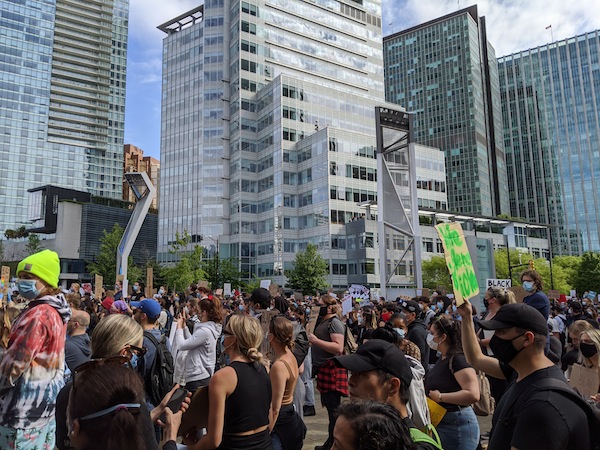
An X post about an antisemitic takeover of the Simon Fraser University library downtown, named after Jewish philanthropists Samuel and Frances Belzberg. Khalida Jarrar is a member of the Popular Front for the Liberation of Palestine, which Canada listed as a terror entity in 2003. (screenshot)
More than 250 members of the Jewish community gathered at Congregation Beth Israel last week to learn more about antisemitism occurring on BC campuses. The discussion was led by a panel of Jewish students representing the University of BritishColumbia, the University of Victoria and Simon Fraser University, as well as educators and a spokesperson from Hillel BC. Panelists spoke about how pro-Palestinian activists have created an environment that has made Jewish students and educators feel unsafe, and that their concerns are, by and large, not being taken seriously by university administrators.
“Hillel has shifted from being a place where students explore their identity to being an emergency room for antisemitic incidents,” said Ohad Gavrieli, executive director of Hillel BC. “What we’re encountering is unprecedented, and our main role has been to protect and defend Jewish identity.”
Hillel is focused on safety, education, programming and advocacy, said Gavrieli. It is assisting students as they try to file complaints about antisemitism, while continuing with events like Shabbat dinners and bagel lunches, critical components that allow for the continuity of Jewish life during this crisis.
Gavrieli said universities’ approaches to antisemitism have been very ineffective.
“While they understand we’re hurting as a community, they’re politicians and they care about their institutional reputation. They want to please both sides,” he argued. “So, when we talk with them about the encampments, they tell us to be patient, that they’re working on it and will come up with a solution.”
Member of the Legislative Assembly Selina Robinson described a similar “deafness and silence” when she spoke about antisemitism with her political colleagues.
“I heard stories from Langara students who were afraid to leave the bathroom because there was marching in the hallways. I got calls from students whose instructors were telling them they needed to participate in a march, and from educators whose administrators were involved in BDS [boycott, sanction and divestment] activity,” she recalled. “I felt I needed to say something, so I said lots – to the attorney general, the solicitor general, the chief of staff. And I got silence, or responses like, ‘we’re looking into it’ – but nothing happened.”
For Aria Levitt, a Jewish student leader entering her second year at UVic, the campus environment is daunting.
“When an encampment was established in the Quad at UVic, the university issued a statement that overnight camping there was not allowed. But the encampment is still there, and they’re not doing anything about it, which is a statement in itself,” said Levitt. “I heard the marches, protests and chants and it was very scary. I don’t feel proud to weara UVic sweater,” she added.
At Simon Fraser University, Rachel Altman, an associate professor, said the Faculty for Palestine group has been relentless about holding anti-Israel events, and that those events even count towards the educators’ professional credit. “I attended one of their events and I was shaking by the end of it, it was so deeply unsettling,” she confessed.
“The hatred in the room was palpable,” said Altman. “They were clearly talking about me and my colleagues, misrepresenting my responses and not giving me a chance to defend myself. I felt hated by colleagues who have never spoken to me face-to-face. One person made a claim that Israel is stealing organs. This group is large and it’s having an impact on the general climate at SFU.”
Altman is trying to get her faculty association to adopt a neutrality policy and to develop institutional neutrality. Dr. Estie Ford, a professor at the Peter A. Allard School of Law at UBC, is working with her colleagues to establish the Jewish Academic Alliance of BC, with the goal of being a face for Jewish faculty who are not anti-Zionist, across the province. “This is a new time when people are coming together and there’s so much amazing work being done,” Ford said.
Gavrieli fields calls from Jewish parents wondering how safe BC campuses are for their children. He tells students to continue to hold their heads high, to not be afraid and to tackle the issues head-on.
“Antisemitism right now is being driven from campus and it’s rooted on campus,” he said. “Any parent with a child entering university should encourage them to engage in Jewish life on campus, to make it more vibrant and to deal with this issue fearlessly, because this is the time to fight.”
Lauren Kramer, an award-winning writer and editor, lives in Richmond.
Co-authors Raja G. Khouri, left, and Jeffrey J. Wilkinson in a conversation at Canadian Memorial United Church and Centre for Peace June 13. (photo by Pat Johnson)
To bridge a divide between peoples, Jews and Palestinians need to listen and understand one another’s stories of trauma, according to two authors who spoke in Vancouver June 13.
“Not only do we not know each other’s narrative, we don’t want to know each other’s narrative,” said Raja G. Khouri. “We are resistant to the other’s narrative. Palestinians need to understand Jewish suffering and Jews need to understand Palestinian suffering.”
Khouri, founding president of the Canadian Arab Institute, is a Palestinian-Canadian. With Jeffrey J. Wilkinson, a Jewish American who lives in Canada, he wrote The Wall Between: What Jews and Palestinians Don’t Want to Know About Each Other.
The two men have been engaged in ongoing dialogue around trauma and other topics related to Israel and Palestine. Their book was released four days before the Oct. 7 terror attacks.
Jewish trauma from the Holocaust and Palestinian trauma from the Nakba, or the “Catastrophe” of the 1948 war, replay in various ways among the peoples today, said Wilkinson, an educator who works on issues of trauma.
“It’s not about amount of loss,” said Wilkinson. “Six million Jews died, 750,000 Palestinians [were] displaced. That impact is not about the numbers. That impact is about that loss, that something being taken from you, that feeling of anger, resistance.”
The conversation, at Canadian Memorial United Church and Centre for Peace, was sponsored by Vancouver Friends of Standing Together, in partnership with several other organizations. Standing Together describes itself as “a progressive grassroots movement mobilizing Jewish and Palestinian citizens of Israel against the occupation and for peace, equality and social justice.”
The authors acknowledge the chasms between the consensus Israeli and Palestinian narratives, while carefully noting that they did not claim to speak on behalf of their respective peoples.
“Zionists are saying 1967, 1967, 1967,” said Wilkinson, referring to the war that marks the beginning of what many consider “the occupation.”
“Palestinians are saying 1948, 1948, 1948. The two-state solution does nothing to address 1948,” Wilkinson said.
A two-state solution is not something either author views as a reasonable proposition, said Wilkinson – unless it is as a waystation to an alternative that neither author spelled out explicitly.
“I’m not saying it’s a bad solution and you can’t support it,” Wilkinson said of the idea of two states. “But I want you to frame it from the perspective of justice, and it does not address the injustice of Palestinians.”
While the evening – and the book – were billed as a conversation across barriers, the divide was not as big as advertised. Both authors view the existence of Israel as a problem to be solved.
“I believe that Zionism and my Judaism are not compatible,” Wilkinson said. “That does not lessen my compassion for the vast majority of my community who are somewhere on that journey but not where I am, and I embrace you as you walk through that.”
Wilkinson explicitly denounced the extremist rhetoric heard in some anti-Israel protests, such as calls to destroy Tel Aviv and telling Jews to “go back to Poland.”
Khouri said Palestinians believe that “the antisemitism label” has been misused to silence them.
“We both know that antisemitism is real and it’s dangerous,” he said. “But, to Palestinians, it is a weapon that has been used to silence criticism, or at least that’s what we believe. And it’s important to get that.”
Both men believe there is a misunderstanding around definitions of terms.
Israelis and their allies might hear the word “apartheid” and reject it.
“Lens the word from the person who is speaking,” Wilkinson advised, outlining how he views separate treatment of Palestinians as equivalent to the racist regime of 20th-century South Africa.
“Likewise with terms like genocide,” said Khouri. “We both avoided using the term for the longest time. But I can tell you there isn’t a Palestinian I know who isn’t convinced that this is absolute genocide because of the mass killing that is happening. Whether it meets the legal definition of genocide or not, it feels very much like genocide.”
The defensiveness that comes around these terms, they said, is a barrier to the peoples’ understanding of each other.
The flexibility of definitions extends to the term “intifada.”
“When you hear someone, say, we’re calling for intifada, ask them what they mean by this,” said Khouri. “Do you mean going and blowing up cafés and buses?”
Neither author offered their interpretation of the term.
The Oct. 7 attacks took place in a particular context, they said.
“If you fixate on Oct. 7 only, then you’re missing a big part of the picture,” said Khouri.
“That doesn’t mean you grieve less for the victims of Oct. 7,” Wilkinson said. “It doesn’t mean that.”
Avril Orloff, representing Vancouver Friends of Standing Together, emceed the event. Rabbi Laura Duhan Kaplan, director of inter-religious studies and professor of Jewish studies at the Vancouver School of Theology provided a land acknowledgment and contextualized the discussion in the context of Shavuot, which was ending as the event began.
Co-directors of Chabad of the Tri-Cities Rabbi Mottel and Nechama Gurevitz with their children. (photo from Tri-Cities Chabad)
Since he arrived just under two years ago, Rabbi Mordechai (Mottel) Gurevitz has had a very active and wide-ranging schedule. He’s been organizing programs and events and, most importantly, building community in the Tri-Cities (Coquitlam, Port Coquitlam and Port Moody).
Gurevitz, co-director of Chabad of the Tri-Cities, gave the Independent a few examples of the growth he has witnessed. This year’s Passover seder brought in nearly 50% more attendees compared to 2023. There was a similar increase in attendance for a Ten Commandments reading and ice cream in the park gathering during Shavuot.
For Lag b’Omer on May 26, the largest Jewish event in Tri-Cities history was held at Rocky Point Park. Hundreds of people came out in the rain for a day filled with music, featuring Vancouver band Tzimmes, dancing, art, a marketplace, a magic show, bouncy castles and, of course, mouthwatering food.
Gurevitz, a Brooklyn native, arrived in the Tri-Cities in November 2022 with his wife, Nechama, who hails from Portland, Ore. In a recent interview, he told the Independent that he adores the region and is very happy and amazed to see the interest in the Jewish community for Jewish activities – and, he added, he regularly has to replenish his supply of mezuzot.
“We feel grateful for where we live,” he said. “It is such a beautiful, growing community. Geographically, it is a beautiful place with beautiful people. I feel privileged to be in this position to lead. It is not something I take lightly. I am really happy that we are here.”
The goal of Chabad of the Tri-Cities programming is to raise the Jewish profile and increase the sense of Jewish community in the area, Gurevitz explained. He gets the most joy, he said, when he hears from community members about connections they have made through his efforts, such as two sets of parents arranging a play date for their children after meeting at a Chabad event.
“One of the challenges of the Tri-Cities is that it is geographically spread out. Organically, there is a challenge for a community to grow because people are all over. What we are finding is that, by creating infrastructure, it is blossoming,” he said.
The region’s population comprises people of all ages, and many young families. As a result, there are programs to meet the needs of various demographics, from teen activities to special groups for men and women, in addition to a Hebrew school, weekly Torah classes and Kabbalat Shabbat meals. The programs have been well received, Gurevitz said, and have created a space for people to come together.
“All of these are cogs in the machinery. Each of them is important on its own, but, in the greater picture, what is emerging is a vibrant Jewish community. Jews are hanging out with other Jewish people. There is a place to celebrate our traditions, connect and meet new friends,” Gurevitz said.
On March 10, Tri-Cities Chabad celebrated the milestone of completing a sefer Torah. Along the way, there was great excitement, as members of the community dedicated letters and chapters for the new scroll.
Rabbi Mottel Gurevitz writes the final letter of the Chabad of Tri-Cities community Torah. (photo from Tri-Cities Chabad)
“There is something very unifying about a community writing a Torah,” Gurevitz said. “The energy in the room that day was something so special, with the joy and the celebration and people of all ages kissing the Torah. That was a real monumental event this year.”
Gurevitz, who also teaches at Vancouver Hebrew Academy, jokes that he has two full-time jobs. A typical day might have him teaching in Vancouver in the morning and returning to the Tri-Cities in the early afternoon to have meetings, run programs, prepare for events and reach out to people.
“As a rabbi, I believe our first priority is our fellow Jews’ physical well-being, then we can care for their spiritual well-being. I am being there for people, helping however we can. The part I like most is meeting people and making those connections,” he said.
On July 2, at 7 p.m., Chabad of the Tri-Cities will put together an event to mark the 30th yahrzeit of the Lubavitcher Rebbe, Menachem Mendel Schneerson. Titled An Evening of Inspiration, the event will feature Rabbi Meir Kaplan, leader of Chabad of Vancouver Island.
“Our very existence in the Tri-Cities, a boy from Brooklyn walking around looking like a rabbi in Coquitlam, is to the Rebbe’s credit. We are gathering to pay tribute to the Rebbe. What was unique about him is that he made leaders and empoweredindividuals,” said Gurevitz, pointing to the 5,000 Chabad centres currently operating in more than 100 countries. “We will reflect on how the Rebbe’s legacy could inspire us to live a more meaningful and purposeful life.”
The accordion “has gradually and sneakily taken over my life,” says musician David Symons, member of the group Obliquestra. (photo by Stephanie Reed)
“Klezmer, choro, Tin Pan Alley, French musette, German songs, Russian waltzes, and so on” … Obliquestra plays the music they “most wanted to play after being isolated at home for so long” during the pandemic, David Symons told the Independent. The accordionist, singer and composer is one of the three members of the band who will be playing at the Vancouver Folk Music Festival, which takes place July 19-21 at Jericho Beach Park.
Symons will be joined at the festival by Dr. Sick on violin, guitar and musical saw, and Susanne Ortner on clarinet. It will be their first time performing together in Vancouver.
Obliquestra started when live music started returning in 2021, explained Symons. “Dr. Sick, who I had worked with for years in my band The Salt Wives (and one of the most unfairly talented musicians in town) called me up and said there was a new bar opening next door to his house and it would be amazingly convenient to play there every Saturday. I called SusanneOrtner, who I hadn’t played with, but who I knew was a master klezmer clarinetist, though she mainly does Brazilian choro and jazz now.”
They started playing together in Symons’ backyard with banjoist Aaron Gunn and bassist Stoo Odom, “without any concept, really,” said Symons, just playing what they wanted to play.
“I’ve sort of always had this eclectic approach,” he said. “Discreet genres of music are mostly a marketing convenience. Musicians have always played and been influenced by whatever they heard, whatever was available, and whatever the public would pay them to play. Klezmer is a good example of this, being an amalgam of various musical styles from central and eastern Europe and, later, America. I doubt those old school musikers (you wouldn’t call someone a klezmer in those days unless you were trying to get punched) were concerned with notions of ‘authenticity’ or genre. They were playing what they heard and liked, and what their public wanted to hear. We are at least doing the first part of that.”
Obliquestra – Dr. Sick, left, David Symons and Susanne Ortner – play at the Vancouver Folk Music Festival on July 21. (photo by Stephanie Reed)
While Symon has “gotten away from klezmer a bit these last few years, really since the pandemic started, mostly for lack of people to play it with,” he said “it’s still the music closest to my heart.”
Why that’s the case, and why he’s also been interested in Yiddish music, despite not being Jewish, is hard to put into words, he said. “In fact, if I could put it into words, maybe we wouldn’t need music. It makes me feel good?”
He said many people assume that a person is Jewish if they play klezmer, and even that it’s a strange thing for a non-Jew to do.
“I’ve always felt this attitude contains an implicit condescension toward the music,” said Symons. “It would never occur to anyone that if someone plays Rachmaninoff they must be Russian, or if they play bluegrass they must be a hillbilly, etc. The music stands on its own merits, whatever one’s ethnic background. Most of the Jewish klezmorim I have known didn’t grow up with the music any more than I did. Still, you have to be careful and respectful. I used to do a lot of Yiddish song and, though I love it, I do less of that now because I realized that, unless I am prepared to devote a few years of my life to learning the language, there’s a lot of nuance that I’m going to miss, no matter how much I work on my pronunciation.”
Symons grew up in rural New Hampshire. “My father plays Latin percussion and guitar, but my folks were divorced and I didn’t see him much, and I had very little interest in music until about 15,” he said. “I was into theatre and acting. Then, I more or less simultaneously discovered Tom Waits and classical music, particularly Beethoven, and suddenly fell in love with music.
“I played guitar for a few years, but the Waits album Frank’s Wild Years convinced me to get an accordion. This was pre-internet in rural New Hampshire, so I put an ad in the local paper asking if anyone had an accordion I could buy. It turned out a lot of people did, and I was very lucky to get something playable. Then, the accordion more or less sat around decoratively for the next couple of years until I happened to see Itzhak Perlman on David Letterman’s show with a bunch of klezmer musicians. He had just released a klezmer album with the top American klezmer bands at the time, and I became obsessed with this music and went down a deep rabbit hole for the next 25 years or so. I taught myself accordion to play klezmer, largely while working in a parking garage in Burlington, Vt., which had nice, cathedral-like acoustics.”
Symons acknowledged, “Of course, no one is truly self-taught – that just means I’ve learned a lot of little things from a lot of different people, without ever having any one teacher or mentor. As for my relationship with the accordion, the damn thing has gradually and sneakily taken over my life. They’ll tell you that you can just pick it up for fun once and awhile and put it down whenever you want, no harm done, but don’t believe them, kids! For many years, I tried to resist accordion clichés and now, in my middle age, I own not one, but two pairs of lederhosen. I started fixing accordions when I moved to New Orleans and there was no one doing it here. Twelve years later, I am sitting in a room in my home with somewhere between 40 and 50 accordions around me, in various states of functionality. The accordions have won.”
About the move to New Orleans, Symons said, “I lived in Vermont for 15 years and was ready for something new. Or, in the case of New Orleans, something old and dirty. I had spent a month in here in 2003 when I was traveling around the country busking in this tiny, ancient Toyota camper. I always thought about going back and trying to live there. Loving New Orleans is like loving a complicated, brilliant, yet self-destructive person. Someone who might be utterly charming one day and destroy a hotel bathroom the next. I still feel like an outsider here most of the time, but I’ve come to terms with that. I’m happy that I’m able to make myself useful to my fellow accordionists by keeping their instruments in working order.”
Symons and his fellow Obliquestra musicians – “Mini-Obliquestra or Obliquestrio,” as Symons quipped – play the folk festival’s South Stage July 21, 11:50 a.m.-12:40 p.m. For the weekend’s full lineup and tickets, visit thefestival.bc.ca.
Brian Gleckman in front of his work, “The Judgment of Solomon (Psak Din: Judgment).” Psak din is a ruling given by a beit din, a Jewish court. (photo by Olga Livshin)
Brian Gleckman’s first show at the Zack Gallery, Abstracted Identity, opened on June 18.
The artist has loved art since childhood. “I grew up in Los Angeles,” he said in an interview with the Jewish Independent. “It is a vibrant city for visual arts. There are an endless number of art galleries and museums, and I was always there. And, of course, I always drew and painted.”
After getting his degree in visual art and history from California State University, Gleckman traveled extensively around Europe, before settling in Vancouver more than 30 years ago. But traveling has remained his passion and, during his travels, he invariably focuses on art and art history, museums and galleries.
“When I first visited Europe, I fell in love with Rococo and Baroque,” he said. Baroque and Rococo are both highly ornamental styles, which infused the art and architecture of post-Renaissance Europe.
Later, he drifted towards more contemporary styles, both as an art connoisseur and in his own work. “I suppose I can call my art abstract expressionism,” he said.
“Colour for me is a vehicle that allows me to play with shapes and space,” Gleckman explained. “Spatial relationships and composition of the images are of the utmost importance to me. I’m also concerned with depth and texture. I aim to create visual tension in my paintings. I think art shouldn’t be too easy or too comfortable. I want my viewers to engage, to ask questions. ‘What did he mean by that?’ ‘How does it make me feel?’ My viewers might not arrive at the same inner realization I conceived, but their explorations are more important than my answers. When people interact with my art, they become part of the creation process.”
With his current show, Gleckman seeks to “portray things that lie beyond the tangible – that is, beyond the figurative, beyond the readily recognized narrative. The paintings in this exhibit are expressions of the inspiration I derive from biblical stories, religious thought, as well as rudimentary ideas within kabbalah. Selected from the portfolios of my professional artwork, these paintings are reflections of how I personalize the intangibles of Judaism.… These paintings are abstractions of my Jewish identity, an identity that is the product not so much of formal religious practice but the summative effect of intellectual and emotional sensibilities of my Jewishness.”
Of course, the Jewish Community Centre of Greater Vancouver, which is home to the Sidney and Gertrude Zack Gallery, felt like the perfect venue for such a show, but there was an additional reason why Gleckman wanted to exhibit at the Zack.
“After Oct. 7, I wanted to do something that had meaning,” he said. “I wanted to share my pride in my Jewish identity. At the same time, I wanted to be part of the effort to help Israel, to make my own contribution. But I am an artist. I create art. I thought maybe my art could inspire someone to do something for Israel, to help in some way.”
He approached the gallery with the idea of a show and offered to donate any proceeds from the sales of his paintings.
“I’m going to donate whatever I get to two organizations: ASI-Canada (Association for the Soldiers of Israel), which supports active-duty IDF soldiers, and Magen David Adom, which is Israel’s emergency response service. To promote the sales, I’m also offering 30% discount off my website prices for all my paintings.”
The exhibit comprises 27 paintings from several of Gleckman’s established series. “For this exhibition, I have included paintings that are accompanied by titles … for fuller comprehension,” he said.
“The titles invite viewers to search for and reflect on the nuances of their own understanding of the selected stories, themes and ideas,” the artist explained. “I’m not trying to dictate my own interpretations to viewers. Instead, with the titles, I try to nudge viewers in the right direction. The titles are sort of guidelines for understanding the images, their conceptual representation.”
“Yerushalayim (Jerusalem)” by Brian Gleckman. The Hebrew words in the painting are from Psalm 137: “If I forget you, O Jerusalem, may my right hand forget … if I do not bring up Jerusalem at the beginning of my joy.”
Most of the titles are in Hebrew, spelled phonetically in the English alphabet. Some are in English, but they represent Jewish customs and stories. For example, the large painting “Tikkun Olam” is a field of life-affirming blue, while “Shiva” is bleak and dark, a painting of grief and despair, but both will generate different feelings for everyone.
A few other paintings are linked to grief and death, but many sport bright colors, like “Aytz Chaim” – blue and gold and triumphant – which proclaims the artist’s vision of the Tree of Life. The painting, tall and narrow, is framed by golden words.
Another tall and narrow painting, “Tefillah” (a prayer), contains this one word in Hebrew, as well as 10 bright gold stars dancing on the blue background below, representing a minyan, the quorum of 10 men (in Orthodox Judaism) or people needed for Jewish communal prayers.
Another painting with words and colours woven together is “Yerushalayim.” Its golden-brown palette is reminiscent of the ancient city of Jerusalem, its modernity and its millennia of history, including conflict.
Then there are calligraphed Hebrew letters, each magnified manifold on its own black and white canvas. “Their shapes are still recognizable,” said Gleckman, “but I wanted to explore the possibilities, the situation where something we know becomes something else, something to investigate and find a new meaning.” Each of these letter-paintings is like a road, curling capriciously according to the letter’s design, leading the viewers towards the unknown.
Abstracted Identity runs until July 18. To learn more, visit the artist’s website, briangleckman.com.
Olga Livshinis a Vancouver freelance writer. She can be reached at olgagodim@gmail.com.
Dr. Allison Sekuler of Toronto’s Baycrest Centre for Aging and Brain Health Innovation. (photo from baycrest.org)
On June 5, National Council of Jewish Women Canada (NCJWC) welcomed Dr. Allison Sekuler of Toronto’s Baycrest Centre for Aging and Brain Health Innovation as the featured speaker in the Zoom webinar titled Defy Dementia: Learn How to Reduce Your Dementia Risk.
Dr. Allison Sekuler of Toronto’s Baycrest Centre for Aging and Brain Health Innovation. (photo from baycrest.org)
Sekuler is the Sandra A. Rotman Chair of Cognitive Neuroscience at Baycrest’s research institute and the president and chief scientist at the Baycrest Academy for Research and Education. She is known for her foundational research in perception, cognition and brain function, as well as her clinical and translational work on age-related sensory and cognitive decline. She is the inaugural Canada Research Chair on Cognitive Neuroscience and has received numerous national and international honours, including being named one of Canada’s Top 100 Most Powerful Women by the Women’s Executive Network in 2019.
The recent webinar began with an introduction from Monica Simon, chair of NCJWC’s ageism committee. Then, with the help of AI-generated images, Sekuler presented attendees with an optimistic view of what she hopes the future holds. “We want to see a world where every single person is living a life of purpose, fulfilment and dignity,” she said.
Baycrest is at the forefront of a new field called predictive neuroscience for precision aging – an individualized approach that examines one’s brain, body and environment to detect the best ways to prevent the onset of dementia or delay it for as long as possible. This approach not only encompasses the pre-diagnosis stage, but helps medical professionals and loved ones navigate caring for someone with dementia.
“If you think about what precision medicine has done for cancer, that’s what we want to do for aging, brain health and dementia,” said Sekuler.
Through innovations in predictive neuroscience, the Baycrest team is working toward a goal of no new cases of preventable dementia being diagnosed by the year 2050 – currently, 750,000 Canadians are living with dementia, and that figure is expected to more than double by 2050.
“What we want to do is nip that in the bud as much as possible,” Sekuler said, acknowledging that, while they cannot entirely eradicate the condition, they can do more to decrease the risk for those who do not already have dementia. Research suggests that, if the onset of dementia can be delayed by even five years, the prevalence of the condition can be decreased by 50% worldwide, she said.
While there are several risk factors – such as age, sex and genetics – that cannot be controlled, Baycrest’s Defy Dementia program raises awareness of the lifestyle changes people can make to reduce their dementia risk and improve their cognitive health.
“At least 40% of the risk factors for dementia are things that we can change by changing our lifestyle,” said Sekuler.
On the podcast Defy Dementia, co-hosts Sekuler and Jay Ingram, one of Canada’s leading science journalists, cover a different risk factor every month. Each episode features a guest with lived experience with dementia and an expert on the risk factor under discussion, such as stress, sleep, diet, exercise and environment.
There are currently 12 episodes available on the website defydementia.org, or any streaming platform. Many episodes have accompanying infographics and minute-long videos summarizing the topic at-hand, also available on defydementia.org.
“Whether you like to listen to things, read things, watch things or look at things, we’ve got you covered,” Sekuler said.
Sekuler gave a high-level overview of the risk factors, sharing how each correlates to one’s dementia risk and what one can do to manage them. She reminded attendees that genetics are not the be-all and end-all, but, rather, a piece of the puzzle that can often be counteracted by managing the risk factors.
Regarding sensory loss, Sekuler explained how strains on one’s hearing and/or vision can negatively impact cognitive abilities. She pointed to tools such as Baycrest’s free online hearing test and the importance of regular check-ups for hearing and vision loss. Further, she explained that loneliness has been proven to increase dementia risk by 50%, and that social engagement in any form is key to maintaining cognitive health. She emphasized that a healthy balance of diet, exercise and sleep helps, as does lowering stress as much as possible and embracing opportunities to try new activities and learn new things.
Sekuler also turned the group’s attention towards the vital role of caregiver. She shared that “one in every two people” will assume this role, if they do not get dementia themselves. However, caregivers often sacrifice a healthy diet, proper sleep and social engagement, she said, making them six times more likely to develop the condition. Sekuler stressed that “a caretaker cannot take care of someone else if they are not taking care of themselves,” and that inviting more professionals, caregivers and loved ones into the equation lessens the burden on one individual and may be a saving grace for that person’s health.
During the question-and-answer period, which was moderated by NCJWC’s Rochelle Garfinkel, Sekuler was asked what organizations like NCJWC can do to fight dementia. She highlighted the importance of sharing information and resources widely, and encouraged involvement in dementia research wherever possible. As well, she said, promoting tools like Baycrest’s online cognitive assessment test to “get your baseline” – as one would do with a regular vision test – is crucial for early detection.
According to Sekuler, when it comes to protecting your cognitive health, “everyone can make these changes. You don’t have to be perfect, but you do have to start somewhere.”
Alisa Bressleris a graduate of Queen’s University in Kingston, Ont. She is an avid reader and writer and will be pursuing a master’s of journalism at Boston University in the fall. Bressler is a member of the Vancouver Jewish community, and was the inaugural Baila Lazarus Jewish Journalism Intern.
Kayemet LeYisrael – Jewish National Fund activities in Winnipeg took place at Brock Corydon school, Gray Academy (above) and Herzliya Synagogue. (photo from KKL-JNF)
A variety of educational and experiential activities conducted by teams from the department of Zionist education in the diaspora, part of the education division at Kayemet LeYisrael – Jewish National Fund, took place in Jewish communities around the world during “National Month,” which includes Memorial Day, Independence Day and Jerusalem Day. Activities took place at schools, kindergartens, Sunday schools, synagogues, Jewish organizations and elsewhere in 16 countries, including Canada.
A Kayemet LeYisrael – Jewish National Fund activity at Brock Corydon school in Winnipeg. (photo from KKL-JNF)
In Canada, teams conducted activities in Toronto, Windsor and London, Ont., and in Winnipeg, Man. Activities included a virtual art and graffiti tour of Tel Aviv-Jaffa, lectures on life in Israel post Oct. 7, a Kites for Hope event, and activities for children about Independence Day.
Kayemet LeYisrael – Jewish National Fund at Herzliya Synagogue. (photo from KKL-JNF)
“Activities organized with the envoys from Israel were incredibly meaningful to our communities here in Canada,” said Yifat Bear Miller, KKL-JNF envoy to Canada. “As we are distant from Israel here in Canada, such activities fostered a deep connection to Israel, Judaism and the current situation in the region.”
Rabbi Dr. Eytan Cowen, his wife Rabbanit Caroline Sarah Bitton-Cowen and their family will take up the mantle of spiritual and rabbinic leadership at Congregation Beth Hamidrash. (photo from Beth Hamidrash)
Rabbi Dr. Eytan Cowen has agreed to become the next rabbi and spiritual leader of Congregation Beth Hamidrash and leader of the Vancouver Sephardi community.
The congregation is excited for Rabbi Cowen, his wife Rabbanit Caroline Sarah Bitton-Cowen and their family to join them and take up the mantle of spiritual and rabbinic leadership. The start date is yet to be determined, to best enable the family to navigate the challenges of moving to Vancouver from Toronto.
Cowen served as rabbi of Tiferet Israel Sephardic Congregation in Toronto from 2014 to 2017. He returned to his hometown, Toronto, from Indianapolis, where he served for two years as full-time rabbi of Etz Chaim Sephardic Congregation, a 100-year-old community.
Cowen pursued and completed his rabbinical studies at Rabbi Isaac Elchanan Theological Seminary of Yeshiva University and the Sephardic Rabbinical College of Rosh Kollel. In addition, he is a graduate of the University of Toronto with a double major in microbiology and Jewish studies, as well as four years of postgraduate study at the Canadian College of Naturopathic Medicine. He is a licensed naturopathic doctor, practising integrative medicine for the past 20 years, and endeavours to combine Torah and health.
Bitton-Cowen was born in Paris, France, with Sephardi heritage from Morocco and Tunisia. She is a graduate of Stern College and Sy Syms School of Business. She enjoys teaching others, sharing wisdom with women of the congregation, and is an accomplished certified professional accountant.
The rabbi and rabbanit are the proud parents of Eliyahu-Yaacov (23), Nissim-Nahum (21), Simcha-Mazal (20), Rivkah-Chaya (16), Efrayim-Menashe (13), Tehila-Adelle (9), Batsheva-Esther (6) and Batya-Emunah (4). They have one granddaughter, Sofia Adina (14 months).
* * *
Alexis Doctor received her master of arts in Jewish professional studies at Spertus Institute. (photo by Maggie Russo)
On May 5, Chicago-based Spertus Institute for Jewish Learning and Leadership awarded master’s degrees to 18 graduates who embody the vital Jewish tradition of learning, which grounds us in our history and equips us to face contemporary challenges.
Vancouver resident Alexis Doctor, director of member and guest services at the Jewish Community Centre of Greater Vancouver, is among this year’s graduates. She received a master of arts in Jewish professional studies, completing a creative leadership-building program designed to advance careers and strengthen the organizations students serve.
“It’s something I will take with me for the rest of my life – the program has given me fresh new ideas to take back to my team,” said Doctor. “This has been one of the most challenging things I’ve ever done, but it’s also one of the most rewarding.”
Spertus Institute, which was founded in 1924, is an institution of higher Jewish learning dedicated to real-world action. At its core are degree and certificate programs in which students engage with Jewish ideas in the service of personal growth, community leadership and professional advancement. These offerings, which merge theory and practice, educate Jewish professionals, community leaders and those who seek quality, reflection-driven scholarship. Those interested in becoming a future Spertus Institute graduate should visit spertus.edu for program and application information or contact assistant director of recruitment Amie Barrish at abarrish@spertus.edu.
* * *
The Jewish Federation of Greater Vancouver’s 2023 annual campaign generated $10.3 million for the community, thanks to the generosity of some 2,500 donors.
As a result of this year’s $10.3 million total, Federation will be able to provide crucial stability to its more than 30 partner organizations by ensuring that they can count on funding that helps fuel their important front-line work. Plus, they will be able to access additional funding through grants for programs and services that deliver on the strategic priorities for the community.
An additional $1.25 million in funding directed to special projects was also raised, as was $20.4 million through Federation’s Israel Emergency Campaign (IEC).
In addition to addressing immediate needs after the Oct. 7 Hamas attack on Israel, the IEC allocation committee, chaired by Stephen Gaerber, is committed to addressing the medium- and long-term needs of Israelis who continue to be affected by the ongoing war and hostage situation.
* * *
The Vancouver Holocaust Education Centre has presented the 2024 Meyer and Gita Kron and Ruth Kron Sigal Award for Excellence in Holocaust Education to Ben Lane (Collingwood School) and Mike Wolthuizen (Rutland Senior Secondary School). Both have demonstrated exceptional commitment to Holocaust education throughout their careers and have significantly impacted their students, colleagues and school communities.
The Kron Sigal Award was established in memory of Meyer and Gita Kron and their daughter Ruth Kron Sigal, Lithuanian Jewish survivors of the Holocaust who re-established their lives in Vancouver. Through their lifelong involvement with education and community, the family touched the lives of thousands of students.
Ben Lane (photo from vhec.org)
During his tenure at Collingwood School in West Vancouver, Lane led the development of a comprehensive Holocaust education program at the school. He created classroom resources and lesson plans and implemented school-wide events, commemorative programming and co-curricular opportunities for students, colleagues and the community to engage with the history of the Holocaust.
An alumnus of Yad Vashem’s International School for Holocaust Studies, Lane’s approach to Holocaust education demonstrates creativity, depth of knowledge in subject matter and pedagogical quality. This is reflected in his bespoke lesson plans and robust teaching materials, which combine engaging history lessons with innovative project-based learning. These allow students to navigate complex issues of antisemitism, genocide and the legacies of the Holocaust with accuracy, sensitivity and a sense of responsibility for the subject matter.
Exposing students to primary sources of Holocaust history has been a priority for Lane, and he regularly incorporates VHEC programs into his curriculum through exhibition tours, workshops and survivor outreach speaker engagements. As well, he has facilitated a co-curricular student group to participate in the Dora Love Prize, a Holocaust education program sponsored by the University of Essex. For the past three years, this student group has engaged with scholars and survivors internationally and produced innovative projects annually to raise awareness of the Holocaust and human rights.
Mike Wolthuizen (photo from vhec.org)
Wolthuizen teaches Genocide Studies 12 and Social Studies 10 at Rutland Senior Secondary School in Kelowna. He has been instrumental in advancing Holocaust education in the Central Okanagan School District, where he recently co-developed Holocaust 12: Beyond the Shoah, a social studies elective course to be introduced into classrooms in September 2024.
Colleagues, administrators and students attest to Wolthuizen’s thoughtful and innovative teaching approach, which creates a supportive environment for students to express their thoughts and critically analyze events in Holocaust history. He fosters meaningful discussions and ethical reflections on human choices. Through exposure to survivor testimony and primary sources, he cultivates in his students an appreciation for the stories of the individual. One student shared:
“Because of his teaching, one of my key takeaways from the course was the importance of the stories of individuals that were impacted by the Holocaust and other genocides, rather than just statistics. When learning from him, it became very evident that he cares so much about each individual and their rights, and that their stories hold an immense amount of power and importance when discussing the Holocaust.”
Also an alumnus of Yad Vashem’s International School, Wolthuizen has attended dozens of workshops and conferences, locally and internationally, to enhance his knowledge of Holocaust study. He has shared this knowledge and expertise beyond his own community, leading professional development programs and teaching in multiple school districts as a guest lecturer on Holocaust history.
* * *
Becky Wosk is the winner of the 2024 Earl Parker Award for Jewish Film, an honour given by the Edmonton Jewish Film Festival. (photo from Becky Wosk)
Becky Wosk is the recipient of the Edmonton Jewish Film Festival’s 2024 Earl Parker Award for Jewish Film. The $1,500 award will go towards Wosk’s production of a documentary on Jewish identity and how we are all connected.
Wosk is a directing student at Langara College in the film arts program. She has been immersed in the arts since a very young age and is a multidisciplinary artist and performer – her band Hollow Twin recently released a new LP on vinyl and digitally.
Wanting to gain more technical skills and hands-on experience in directing, to make music videos for her and other bands, as well as documentaries and shorts, Wosk applied to the Langara film program. It was her instructor who sent her the application to the Earl Parker award for a Jewish-related film project. Wosk’s pitch was One Thread.
One Thread is a documentary-style short that will be filmed in Vancouver. Interviewees will range from age 18 to 99+, including Holocaust survivors.
“I see this potentially becoming a series that can eventually be all tied together spanning globally to see how, regardless of where we live, our backgrounds, we are one people – a tribe of resilient humans who have overcome all odds to be here today. A look at the diversity of the diaspora and how we all have one common thread,” wrote Wosk in her submission. “The participants will not be limited by religious sect, as I want the overarching theme to be our DNA, not necessarily religion – but I would like to touch on customs and traditions within the interviews.”
Wosk is hoping to incorporate klezmer music and archival photos from various sources into the film. She will be putting a call out soon for interviewees of all ages, genders and backgrounds who identify as Jewish. The filming will take place this fall.
Len, Jeffrey, Sharon and Valerie on their family trip to China in 2009. (photo from Valerie [Chan] Hum)
Little did we realize when our son, Jeffrey, married Sharon Szmuilowicz in August 2008 that we would find ourselves visiting China nine months later as a family and visiting all our ancestral homes.
My family comes from the village of Sui Nam, Toi San district, Guangdong province. My grandfather was sponsored by a tailor and moved to Victoria in 1893 as a 16-year-old from a very poor family. He eventually married, started a restaurant business (the Panama Café) and fathered 12 children. Today, more than 140 Chan family members have been born in Canada over five generations and 131 years.
My husband Len’s family was from a small village of 30 houses in Chongkou, Kaiping district, Guangdong province. Len’s father traveled back and forth between China and New Westminster to earn money to support his family. In 1950, Len and his grandmother left China for Vancouver and then met up with Len’s father, who had moved to Ottawa. Two years later, the rest of Len’s family arrived in Canada. The family owned a number of restaurants over the years.
When our son married a Jewish woman from Toronto, we never thought we would learn that her family has ties to China as well.
The idea for the trip to China was initiated by Sharon. She felt it was important to learn about Jeffrey’s culture and family history. However, since the Szmuilowicz clan also had a direct link to China via Shanghai, it was an opportunity to explore both their histories.
On May 13, 2009, 62 years after Sharon’s family left China, our tour guide Hao brought us to the Shanghai Jewish Refugees Museum, the former Ohel Moishe Synagogue, at Sharon’s request, where we were able to access a computer database listing all the refugees who had lived in Shanghai. We were so pleased to see Sharon’s grandfather and great-grandfather listed in the database, including their former address. Jacob and Samuel Szmuilowicz, age 59 and 21, were listed as Polish refugees living at 30-50 Zangyang Rd. What a tremendous discovery! And, to top it off, 30-50 was next door to the synagogue and was still standing.
Valerie and Sharon outside the Shanghai Jewish Refugees Museum, the former Ohel Moishe Synagogue. (photo from Valerie [Chan] Hum)We decided to knock on their door and see if anyone remembered Sharon’s family. The present residents moved into the building in 1950 and had no recollection of the previous Jewish residents who had crammed into these small apartments more than 70 years ago. Although we could not find anyone who knew Sharon’s family, it was still a remarkable discovery to find the records and the home they had lived in.
For the purposes of our trip, Sharon’s story begins with her grandfather, Samuel. To escape conscription into the Russian army, Samuel and his father, Jacob, left their homes, by foot, in 1939, making their way to Japan via Manchuria. At the time, Samuel was at university in Vilna (now Lithuania; then under Polish occupation), studying mathematics, and Jacob was running a general store in Lida, then in Lithuania (now in Belarus).
Their transit visas were issued by Japanese diplomat Chiune Sugihara. He was giving out these visas without the knowledge of his government. It was dangerous for him to do so, but he knew that he needed to do something to save as many Jews as possible. In 1985, Sugihara was the first and only Japanese citizen to be listed by Yad Vashem as a Righteous Among the Nations.
With visas in hand, the journey took nearly two years to complete. They traveled by day and hid at night, finally arriving in 1941. In January 1942, they were transferred to Shanghai, where they joined the approximately 20,000 Jews who had migrated there in three waves beginning in the 1800s.
During their five years in Shanghai, Jacob sold rice while Samuel, who was attending the American School and learning English, ended up driving jeeps for the American army. They made enough money to leave for Mexico City in 1947, where they ran a textile factory that manufactured cotton goods, and started the Spanish-speaking arm of the Szmuilowicz clan. Sharon’s parents met in Mexico and moved to Canada, so her dad could pursue a career in medicine.
We learned that there were many Jews who fled Eastern Europe and ended up in Hong Kong or China.
The next part of our discovery trip found us traveling by ferry from Hong Kong over to the mainland city of Zha Hai, where we were then met by distant Hum clan relatives, who drove us to my paternal grandfather Chan’s hometown of Sui Nam. I suspect I am the only descendant who has made the trek back to the town of Sui Nam, which appears very old and somewhat decayed, but still standing.
In the village of Lohk Hing Leih, 90-year-old Mrs. Tam remembered Len, who used to play with her eldest son. (photo from Valerie [Chan] Hum)Half an hour later, we arrived in the small village of Lohk Hing Leih, a cluster of 27 buildings housing the remaining Hum clan. Len’s family left the village in 1949, spending a year-and-a-half in Hong Kong awaiting their papers for entry into Canada. The village remains very poor, comprised of mostly vacant buildings surrounded by rice paddies and vegetable gardens.
Ninety-year-old Mrs. Tam, looking remarkably spry and pleasant, incredibly, remembered Len, who used to play with her eldest son. The other village residents were too young to remember him, but they swiftly brought out some food offerings, the incense, paper money to burn before the family altar, and lit some Chinese firecrackers. These are age-old traditions, in honour of the Hum ancestors. There were no young people living in the village. They had all left to find jobs in the cities. We wonder if the village will even exist in 20 years’ time.
Call it fate or bashert that, from the 1940s, three different families who started off in China, one a Jewish refugee family in Shanghai and two native Chinese families living in small villages near Canton, would be reunited in Canada through marriage 70 years later. The biggest blessing is that, on May 11, 2024, a Szmuilowicz-Hum great-great-granddaughter celebrated her bat mitzvah in Toronto. We were all be thrilled to be there.
Valerie (Chan) Humlives in Ottawa. She was born in Victoria, where her family have lived since 1893. Her grandparents ran the Panama Café at 1407 Government St. for many decades. This article was originally published by the Ottawa Jewish Bulletin.
The ways in which the characters of Srulik, left, and Handala epitomize the historical and cultural narrative of the Israelis and Palestinians, respectively, imbue these cartoons with an impact stronger than words. (photo by Gil Zohar)
Driving east from Jerusalem on the winding Jordanian-built road that once led down from the Mount of Olives to the Dead Sea, one passes through a series of picturesque Arab suburbs and soon comes to a dead end in front of the grotesque West Bank barrier.
Called Geder ha-Hafrada (separation fence) in Hebrew and jidar al-fasl al-’unsuri (apartheid wall) in Arabic, the insurmountable (if still incomplete) eight-metre-high concrete barrier has no doubt contributed to a reduction in terrorism and car theft. However, my objection to it is more existential: like some of those in West Berlin who spray-painted their protest for freedom on the Bundesrepublik side of die Mauer even as armed GDR guards used deadly force to prevent anyone from approaching the wall’s eastern side, I believe all walls must fall.
It is a metaphor that has repeated itself from Joshua’s encircling of Jericho, to the Berlin Wall and its remaining East Side Gallery, to Garth Hewitt’s ballad “They’ve Canceled Christmas in Bethlehem,” about the stranglehold the wall has placed on both day-to-day life and religious pilgrimage in the place where Jesus, “the Prince of Peace,” was born 2,000-plus years ago.
The world today is caught between two conflicting ideologies: some democratic countries joining in unions with open borders, joint legal systems and a common currency, of which the European Union – notwithstanding its problems – is a great success. Then, there are other countries – many repressive and undemocratic – defending their borders with minefields and walls. Like John Lennon, I prefer the first vision – of a growing global union without barriers. Imagine that.
Thus, armed with the tools of the graffiti artist – an X-ACTO knife, cardboard stencil and spray paint – I recently made my way to Abu Dis with my friend Hajj Ibrahim Abu el-Hawa, my daughter Bareket and fellow artist Eva Feld to make our mark. Reasoning that a picture is worth a thousand words, we chose a symbolic image whose meaning is unequivocal.
The image we created depicts Handala raising hands with Srulik (see picture). The two iconic cartoon characters are respectively well known by Palestinians and Israelis – yet, each is equally unknown by the other. It is a symmetry of ignorance of the other’s narrative that will have to be overcome before true peace can be achieved.
Allow me to explain the mirror meanings of the twin caricatures.
Handala – an omnipresent image on T-shirts and key chains in the aswaq (plural of suq, market) of Jerusalem, the West Bank and Gaza Strip – was created by Naji al-’Ali in 1969. A 10-year-old child driven in 1948 from his Galilee village of ash-Shajara (14 kilometres from Tiberias) to the ‘Ain al-Hilweh refugee camp in Lebanon, al-’Ali went on to become the leading political cartoonist in the Arab world.
Before being assassinated in London in 1987, he produced more than 40,000 bitingly sarcastic cartoons lampooning Arab leaders and lamenting the stateless status of his people. His autobiographical image of Handala – a barefoot, faceless, refugee youth – remains a potent symbol of the struggle of the Palestinian people for justice and self-determination.
Al-’Ali wrote: “Handala is my signature. I gave birth to this child in the [Persian] Gulf. He was born 10 years old, and he will always be 10. At that age, I left my homeland and, when he returns, Handala will still be 10, and then he will start growing up. The laws of nature do not apply to him. He is unique. Things will become normal again when the homeland returns.”
Impish Srulik – a diminutive of Yisrael (Israel) – carries an equally rich symbolism in depicting nascent Israel and, in particular, its native-born Sabras. The illustrated character was first drawn in 1956 by the cartoonist Kariel Gardosh, better known by his nom de plume, Dosh. The Hungarian-born Holocaust survivor drew Srulik for decades in the pages of the daily Maariv, until his death in 2000.
Dosh generally depicted Srulik as a young man wearing a kova tembel hat, “biblical sandals” and khaki shorts. He drew him as a pioneering Zionist and lover of the land of Israel, a dedicated farmer who in time of need dons an Israel Defence Forces uniform and goes out to defend the state of Israel, equipped with an Uzi machine gun. In contrast to the antisemitic stereotype of the weak or cunning Jew, which appeared in the Nazi weekly Der Stürmer and other European and Arab newspapers and journals, Dosh’s Srulik was a proud, strong and sympathetic Jewish character.
Shalom Rosenfeld, editor of Maariv from 1974 to 1980, wrote: “Srulik became not only a mark of recognition of [Dosh’s] amazing daily cartoons, but an entity standing on its own, as a symbol of the land of Israel – beautiful, lively, innocent … and having a little chutzpah and, naturally, also of the new Jew.”
Introducing Srulik to Palestinians and Handala to Israelis is not a bad way to begin to redress each side’s ignorance of the other’s narrative. The ways in which they epitomize the historical and cultural narrative of their own people imbue these cartoons with an impact stronger than words.
When a peace treaty is ultimately implemented between Israel and Palestine (as I’m sure it must), perhaps the image of Handala and Srulik holding hands could be adopted as a neutral symbol of coexistence and nonviolence. Their creators, Naji al-’Ali and Kariel Gardosh, both knew firsthand of persecution and exile, and the iconic figures they bequeathed us share the hope of living in freedom and peace. When peace finally arrives, new and emotionally satisfying images and symbols will need to be created to bridge the chasm between Jews and Arabs in our broken Promised Land.