Almost 700 days of waiting

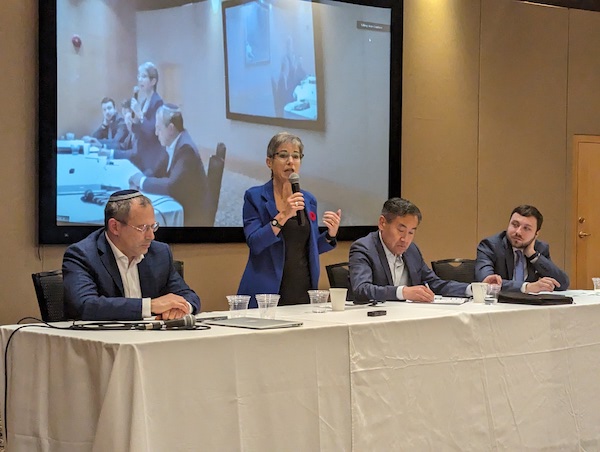
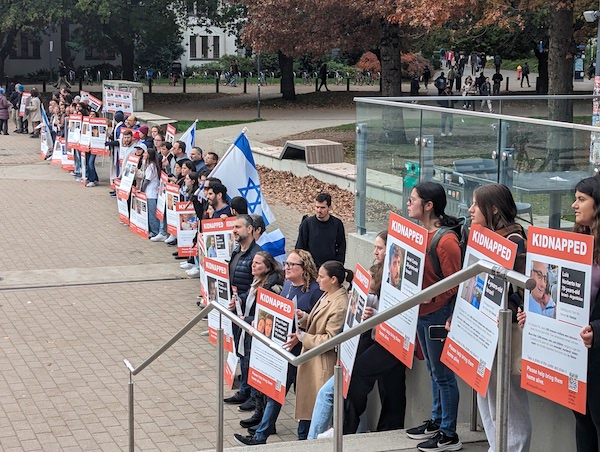
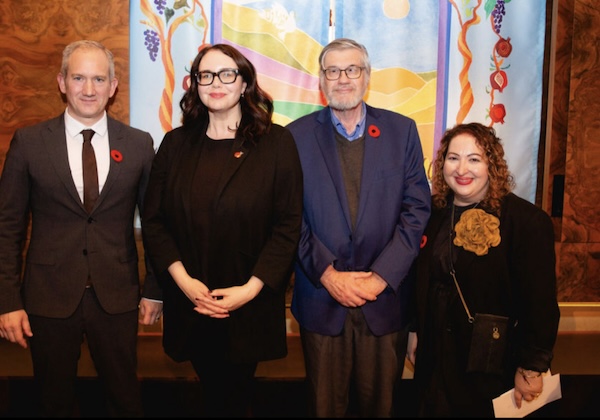
Almost every Sunday since the first days after Oct. 7, Daphna Kedem has led a vigil for the hostages. People have gathered in solidarity and to hear from a diverse array of speakers, first outside the Vancouver Art Gallery and now at Vancouver City Hall. (photo by Pat Johnson)

Almost 700 days have passed since the horrors of Oct. 7, 2023, and the holding of Israeli hostages in the tunnels of Gaza.

In Vancouver, as in cities worldwide, Jews and their allies gather frequently to mourn the lost, stand in solidarity with Israelis and remind the families whose loved ones are still in captivity that there are people across the planet who hold them in their thoughts.

Almost every Sunday since the first days after Oct. 7, Daphna Kedem has led a vigil for the hostages – first outside the Vancouver Art Gallery and now at Vancouver City Hall. Missing only a few weeks due to Jewish or statutory holidays or, like this month, because police security was stretched thin with the Pride Parade, a stalwart group gathers at 12th and Cambie in solidarity and to hear from a diverse array of speakers.

Another regular gathering also takes place, with the group Vancouver Stands With Israel organizing marches across the Burrard Street Bridge and back, waving Canadian and Israeli flags. This past Sunday, scores of participants were greeted with a few hostile catcalls, an exponentially larger number of supportive messages, and a great deal of nonchalance and curiosity. Joining the parade were members of the Persian- and Indian-Canadian communities, carrying their respective flags.

photo - Jews and allies assemble near Burrard Street Bridge in a march last Sunday, Aug. 24
Jews and allies assemble near Burrard Street Bridge in a march last Sunday, Aug. 24. (photo by Pat Johnson)

Over the summer, the group Vancouver Friends of Standing Together began holding weekly vigils, also at Vancouver City Hall. (See jewishindependent.ca/encouraging-another-way.)

The competing events reflect divisions in the community. At a rally earlier this month, Kedem acknowledged that she has received “a lot of backlash” from people who believe she and some of her speakers are “too political.” Kedem calls for an immediate end to the war, which she views as the most likely path to get the remaining live hostages home safely. 

“If this is too political, then I’m probably very political,” she said. 

Over the course of almost two years, the Sunday rallies organized by Kedem have featured diverse voices, both hawkish and dovish, with many speakers expressing personal reflections that cannot be pegged on a political spectrum. Christian pastors have spoken and sung. First Nations representatives have taken part. Rabbis are usually in attendance, including Rabbi Philip Bregman, who, most weeks, leads the group in national anthems.

Kedem begins the events by reading excerpts from the previous evening’s rallies in Tel Aviv, usually voices of family members of those held hostage.

Rabbi Carey Brown, associate rabbi of Temple Sholom and a fellow of the Rabbinic Leadership Institute of Shalom Hartman Institute, spoke this past Sunday of the significance of the month of Elul, which began the night before.

“It’s the time that we as a people and as individuals begin our journey of self-reflection and soul-searching as we prepare for the new year,” she said. “It is a month that whispers to us: return, reflect, renew.”

photo - Rabbi Carey Brown speaks at the Aug. 24 vigil for the hostages, which took place at Vancouver City Hall
Rabbi Carey Brown speaks at the Aug. 24 vigil for the hostages, which took place at Vancouver City Hall. (photo by Pat Johnson)

When she is asked how to live more Jewishly, Brown suggests people let the Jewish calendar guide them.

“It’s a map,” she said. “It’s a heartbeat. It’s the soul’s clock. We measure time in many sacred ways. In Judaism, we count days, months, years … a reminder of the holiness in time, and even our grief and our longing are measured in time. Today is Day 688 … of the captivity of still 50 hostages, living and dead. We count because we care. We count because they matter. We count because time is sacred and their time has been stolen. Think of all the time that has passed: 688 days of missed holidays, 688 days without their families, 688 days of fear, torment and waiting. And now, here we are again, standing on the threshold of Elul, preparing once more for Rosh Hashanah, for Yom Kippur. This time, time feels different. It feels heavy.” 

Toby Rubin, local chapter president of Canadian Hadassah-WIZO, urged attendees to stand firm until all the hostages are returned.

“We ask that all of you continue to support, to advocate, to push and to ask your allies and your political leaders to continue to do what they need to do to get every one of those 50 home,” she said. “And, again, whether they’re dead or alive, we want them back.”

Earlier in August, on Tu b’Av, community activist and leader David Berson blew the shofar and reflected on the date, which is a commemoration of love and unity. 

“The shofar isn’t only a High Holiday symbol, it’s also a biblical emblem of revelation and covenant,” he said. “As I blow the shofar today, let this be a clarion call to rebuilding the wholeness of our people, of listening and understanding, of hearing what is troubling the other and taking that into consideration, of opening our hearts and being curious about what is hurting. We have all been through so much since Oct. 7 and, while we cannot put the genie back in the bottle, we must stand together and embrace that which does bind us in an eternal bond of community, of belonging and embracing our humanity and the humanity of others.”

That same day featured Karen James, a past board chair of the Jewish Federation of Greater Vancouver and current chair of the local partnership council for the Centre for Israel and Jewish Affairs. She is also on the board of governors of the Jewish Agency for Israel.

James reflected on her experiences as a competitive swimmer, including participating in the Maccabiah Games in Jerusalem in 1965, which connected her more deeply not only to her Jewishness and to Israel, but to the branch of her family that had made its way to Palestine in the era when her grandfather settled in Canada.

She shared another personal story that affected her connection to her identity and to Israel.

In 1972, James was on Canada’s Olympic swim team. She and teammates were out celebrating after their competitions were over, watching the Canada-Russia hockey series. As they walked back to the Olympic Village in the wee hours of the morning, they saw four men with a big duffle bag. The four men clambered over the fence to get into the Olympic Village and the Canadians did likewise.

“I went to my dorm, slept for a little bit, but then was woken up to all the commotion in the village,” James recalled. She became a firsthand witness to the terrorist attack on Israeli athletes at the Munich Games.

“I watched the negotiations happen between [the terrorists] and the Germans and, in the evening, I saw when the Israeli team members were led out onto a bus with their hands bound and they were blindfolded,” she said. “Later that night, we’d heard that they were safe and alive, that they’d been freed. But that was wrong. They made a mistake. I don’t know how that got out there because, in fact, the Germans tried to storm the planes and the Palestinians threw grenades and shot the remaining Israeli hostages.”

James went on to describe a more intimate experience with antisemitism. In a consultation with a medical specialist, the doctor repeated the words “It could be worse” twice. On the second occasion, James asked the doctor what she meant by noting that “it could be worse.”

“And she said, ‘Look at what’s happening in Gaza,’” James recalled the doctor telling her. “It was so inappropriate to say that to me.” 

Antisemitism is growing, said James. “The main thing that keeps me going is community,” she said. “All of you. All of my community.” 

BGU rebuilds after much loss

Jeff Kaye, vice-president for public affairs and resource development at Ben-Gurion University of the Negev, was in Vancouver earlier this month. (photo from BGU)

A couple of years ago, many Israelis were beginning to think the country’s legendary solidarity was fraying, that people were less caring, that a split between Israelis and diaspora Jews was growing and that young Israelis had lost some of the fervour of earlier generations. Oct. 7 changed everything. The chasm between Israelis and diaspora Jews evaporated, according to one Israeli who visited Vancouver recently.

“We really are in this together and we are a much stronger Jewish people, both in Israel and outside of Israel,” said Jeff Kaye, a vice-president of Ben-Gurion University of the Negev, who spoke with the Independent Aug. 7.

Older Israelis who thought younger people took the country for granted have had their assumptions upended, he said.

“They were the TikTok generation,” Kaye characterized the stereotypes about young Israelis. “All they wanted to do was earn some money, take care of themselves. And what Oct. 7 taught us is, underneath this, we had raised a generation of young people who have purpose, who care deeply about the country, who care deeply about values and, without being told, they took responsibility.”

Kaye saw this attitude in action at the university. Administrators were struggling to come to terms with the changed reality and students themselves instantly set up a babysitting initiative, food collections and volunteer teams. 

Kaye, BGU’s vice-president for public affairs and resource development, made aliyah from Scotland in 1981, then spent a decade in special needs education before joining the philanthropic sector. He spent four years as emissary to the Jewish Federation of Detroit and then more than a decade in a senior leadership position at the Jewish Agency for Israel, during which time he helped create the Fund for Victims of Terror. Before joining BGU, he served for five years as executive vice-president and director-general of the International Fellowship of Christians and Jews. 

Kaye was in Vancouver at the invitation of BGU Canada, one of about a dozen national and regional affiliates of BGU, that include chapters in Argentina, Belgium, France, South Africa, Switzerland and a global chapter for Russian speakers.

“My role is to find people throughout the world and say, this is what we do. This is who we are. This is why we do what we do,” he explained.

With a team of about 35, Kaye helps connect people with projects that meet their objectives and those of the university, whether recruiting people to serve on the board, run activities, sponsor projects, build a building or provide a scholarship.

Oct. 7 and the months since have affected the university profoundly, as they have every aspect of Israeli life. About 118 BGU students, faculty and staff were killed that day or in the war. Of BGU’s approximately 20,000 students, about one-third of them were called up for military service just as the academic year would have been starting in 2023.

“Obviously, universities couldn’t open and we were still under attack,” Kaye said. The first semester after Oct. 7 was delayed to Dec. 31.

Kaye credits the university’s president, Daniel Chamovitz, with ensuring a flexibility that allowed students to access as much education as possible around their military and other responsibilities. 

In addition to the semester that began Dec. 31, another semester began a month later for soldiers who had returned in the interim. The university had multiple semesters running concurrently and, like many organizations that adopted new technologies, also offered recorded classes so students did not need to be on campus.

Because Israelis routinely start university after military service, many BGU students are not living at their parents’ homes, and may even have kids of their own. That created economic challenges for many who had lost not only class time but part-time or full-time income and saw spouses away on military duty. The university had to provide laptop computers for people whose homes were destroyed and psychological assistance for students who had witnessed or experienced horrific things.

On June 19 this year, during the war with Iran, a ballistic missile hit the university-affiliated Soroka Medical Centre, destroying a major part of the facility.

“Our labs – teaching labs, research labs, pathology labs – were all entirely destroyed,” Kaye said. 

Miraculously, there were no fatalities. In an act of prescience, administrators had moved surgeries into a basement, fearing just such an attack. Kaye said the move – a day before the bombing – may have saved scores or hundreds of lives.

Another blast damaged a university gym. After the formal ceasefire, but when Iran continued sending missiles, an off-campus residence was struck, leaving 50 or more students and faculty homeless.

In Israel, a portion of property taxes are allocated to a fund to restore private property damaged or destroyed by terrorism or war. If your seven-year-old car is hit by a rocket, the fund will reimburse you the value of a seven-year-old car, Kaye said. “But if it’s a microscope that costs $800,000 and it’s 12 years old, you get money for a 12-year-old microscope,” he said. “But there’s no secondhand microscopes out there. So, you have to find the money to buy a new microscope.”

This is one of an incalculable number of examples of expenses incurred as a result of the war in this one university alone.

Kaye is grateful for donors worldwide who have stepped up to assist BGU in its time of challenge, but he noted that almost every organization in Israel faces variations on the same challenge – and diaspora communities have been called upon over the past two years to support umbrella emergency campaigns. 

Amid all this, Kaye finds both optimism and hope. 

What’s the difference?

“Hope is, you sit by and pray, wonder, hope that something’s good is going to happen,” he said. “Optimism is when you make it happen. I’m an optimist who is actively involved in bringing hope – and that’s incredibly easy to do in our university because we get up every day and we say, how can we make it happen?” 

Ruta’s Closet reissued

Lady Esther Gilbert speaking at Vancouver City Hall April 8, when Vancouver Mayor Ken Sim proclaimed Ruth Kron Sigal Day in the city. (photo by Keith Morgan)

Ruta’s Closet, the Holocaust narrative of the late Vancouverite Ruth Kron Sigal, is being reissued for a new generation of audiences – and the book’s author is ensuring the survivor’s inspiring story of survival and resilience reaches the widest possible global audience.

Vancouver journalist Keith Morgan, who completed the book shortly before Kron Sigal’s passing, at age 72 in 2008, has updated the publication – and created an extensive range of multimedia projects to expand the impact of the written volume.

image - Ruta’s Closet book coverFirst issued as a fundraising initiative for the Vancouver Holocaust Education Centre, Ruta’s Closet was later published in the United Kingdom, with distribution there reaching new audiences. 

The book recounts the harrowing survival story of the Kron family, imprisoned in the tiny Shavl (Šiauliai) ghetto in Lithuania, through the eyes of the youngest daughter, Ruta (later Ruth). Their survival against Nazi persecution hinged on the courage and resourcefulness of her parents, Meyer and Gita Kron, as well as the bravery of non-Jewish rescuers. Depicted with novel-like narrative power but rooted in rigorous research and eyewitness testimony, the memoir vividly portrays atrocities such as mass murder, a Nazi ban on Jewish births and the deportation of children to Auschwitz, while also shining a light on courage, compassion and human resilience amid the evil.

Kron Sigal didn’t live to see the book in print but she saw the final draft.

“She said to me shortly before she died, ‘You are going to carry on telling my story, Keith, aren’t you?’ And I said, of course I am,” Morgan told the Independent. “So, I took that on as a mission.”

Surveys indicating widespread ignorance of Holocaust history, combined with skyrocketing antisemitism, motivated Morgan to launch a series of Ruta’s Closet-related projects. 

“We updated the book and decided it was time to go basically worldwide with this,” he said. 

In addition to the re-release of the hard-copy, Morgan and his small team of colleagues recorded an audiobook and released an ebook. They revamped the existing Ruta’s Closet website and made it more interactive.

Working with Bill Barnes, a local radio producer, Morgan developed a 25-segment podcast.

“We are doing Zoom interviews with people around the world who are a part of a driving force behind an imaginative, creative initiative in spreading Holocaust awareness and education,” he explained. “I’ve got Ruth’s kids – Michael, Marilee and Elana – each week doing an introduction for book clubs.”

The VHEC has produced a downloadable guide for book clubs, as well as a teacher’s guide to the book, which makes it additionally relevant as British Columbia’s education curriculum mandates Holocaust education this year for the first time as part of the Social Studies 10 coursework. 

“The beauty of it, for British Columbia, is it’s technically a local story,” Morgan said. “It’s about Ruth. It’s about somebody who came here and did a lot for her adopted society.”

photo - Journalist Keith Morgan, author with Ruth Kron Sigal of Kron Sigal’s memoir, Ruta’s Closet, is ensuring that her story of survival and resilience reaches the widest possible audience
Journalist Keith Morgan, author with Ruth Kron Sigal of Kron Sigal’s memoir, Ruta’s Closet, is ensuring that her story of survival and resilience reaches the widest possible audience. (photo from Keith Morgan)

Morgan, who spent many years as the crime reporter at the Province newspaper, met Kron Sigal when his editor asked him to take on a more uplifting assignment and begin a series about people doing good works at home and abroad.

“Somebody said, ‘Oh, you should talk to Ruth Sigal,’” who was sharing her Holocaust story with students. “I went to meet her. I was very impressed. She told her story and it had an amazing impact on me. I just knew this was an important story to tell.”

He found immediate support from Dr. Robert Krell, the founding president of the Vancouver Holocaust Education Centre. 

“Robert Krell kind of took me under his wing – he was a close friend of Ruth – and he said, ‘I’ve got just the guy to introduce to you, who will be really helpful to you for pulling the story together.’” 

The person was renowned historian Sir Martin Gilbert.

“The British schoolboy in me thought, ‘How do I curtsy?’” Morgan joked.

Morgan met Sir Martin in London and got a one-on-one master course in writing about the subject.

“He looked me right in the eye and said, ‘You have to tell the story as though you were writing it for your newspaper and make it accessible to all people,’” Morgan recalled. “Sadly, Martin died [in 2015], but Lady Esther Gilbert took up his mantle and, since then, she’s been an ally and was very important in this edition in terms of going through it, adding bits here and there.”

She spoke at a ceremony at Vancouver City Hall on April 8 this year, when the mayor proclaimed Ruth Kron Sigal Day in the city.

Kron Sigal’s story resonates profoundly with people, according to Morgan.

“We can all relate to what happened to Ruth and her sister Tamara,” he said. “It also tells us compelling stories about how, through their own devices, they basically survived and helped others along the way. We also see what other members of the family did to help the broader community.… We get this family story, which, in itself, is very dramatic, but we also get this wider picture of how a community in the ghetto work with each other, help each other.”

Morgan sees Kron Sigal’s narrative as an inspiration not only because of her survival against the Nazis but in all she did after becoming a Canadian.

“Ruth came here, an adopted country, and spent 25 years at the Women’s Resource Centre and the VHEC Child Survivors Group,” said Morgan. “That’s an example to everybody: come into a new society, an adopted country, and just roll up the sleeves and get working. Isn’t that an example to anybody that comes in?”

No less a triumph, Morgan said, is the family Ruth and her husband, Dr. Cecil Sigal, created. 

“You look at that family and you think, ‘Victory!” he said. “Because they beat Hitler.” 

Offering solidarity, support

This summer, Jewish Addiction Community Services (JACS) and Jewish Family Services Vancouver (JFS) launched JACS Family Circle, a group that meets biweekly to provide solidarity and support for family members and loved ones of Jews experiencing addiction.

“Most people are surprised that this exists,” said Rabbi Josh Corber, director of addictions and mental health services. “But alcoholism is a family disease that affects everyone in the family differently. And, regardless of their loved one’s recovery journey, they deserve to have a life that’s happy, joyous and free.”

Nine people showed up for the first JACS Family Circle meeting, on July 28, and, depending on the needs of the attendees, the frequency may become weekly. Corber said gratitude was the main theme that emerged from the first meeting. “We received immense appreciation for the fact that this group exists now, and the attendees were happy to have this group and to have one another,” he said.

Since their Third Seder event in April, JFS and JACS have been busy launching this group and the Jewish Addiction Circle (JAC), a support group for people struggling with addiction, which follows Jewish teachings as they relate to self-care and recovery. JAC also meets biweekly. While participants don’t have to be Jewish to attend, they should be connected in some way with Judaism, or at the least, comfortable with the therapy provided having a Jewish basis. 

Corber leads JAC and co-leads JACS Family Circle with Elana Epstein, a certified recovery coach.

In early July, JACS Vancouver participated in the AA International Convention in Vancouver, which was attended by more than 30,000 people. Because AA does not partner with external agencies, JACS rented a booth at “Sober City,” at the Junction Public Market, Granville Square. There, Corber interacted with convention attendees, tourists and cruise ship passengers, educating them about the work of JACS and similar Jewish organizations in other cities in Canada and the United States.  

“I was able to make connections with many Jewish addicts in recovery,” he said. “There were sober Jews from small cities in the US who felt very isolated as Jews, and some of them were moved to tears when they spoke with us. Many of the people who approached us were Jewish, and many were not, but all of them were happy that we were there. Some didn’t know of any Jewish agency involved with addictions prior to meeting us.”

Corber worked hard to spread awareness of JACS’s work at the convention, and says addiction services for Jews are needed now more than ever.

“It can be difficult for people who aren’t Jewish to help us if they don’t understand the Jewish culture, though they sincerely want to,” he said. “But what we can build together will benefit the Vancouver Jewish community as well as alcoholics everywhere. The returns on our participation are hard to quantify right now but, on a world level, JACS Vancouver is now much more known. This can bring all kinds of returns, including philanthropic.” 

Those interested in joining JAC or JACS Family Circle should email Corber at jcorber@jfsvancouver.ca for more information. 

Lauren Kramer, an award-winning writer and editor, lives in Richmond.

Music’s healing power

The annual Music Heals gala raises funds and awareness of the therapeutic use of music. This year’s event takes place Oct. 23 at the Commodore Ballroom. (photo from David Barnett)

Vancouver’s business and entertainment communities are combining their philanthropic forces at the Commodore Ballroom Oct. 23 for a gala to support Music Heals, the charitable foundation that raises awareness and funds for the therapeutic use of music in physical and mental health processes.

photo - David Barnett founded Music Heals in 2012
David Barnett founded Music Heals in 2012. (photo from David Barnett)

David Barnett, who founded Music Heals in 2012 and currently serves as board president, said tickets will be available after Labour Day and are expected to sell out quickly. Still, the event, which is already fully booked from an artist standpoint, always has room for sponsorship opportunities, according to Barnett.

“It is a great group at Music Heals,” he said. “We bring in all types of artists from all over, including Grammy Award winners, and produce a fun variety show. We don’t reveal any of the artists. We keep everything a surprise.

“It is a super-fun event to produce and it brings the downtown business community and the music industry together for one night to celebrate the power of music.”

Since its beginning, Music Heals has distributed more than $5 million to help vulnerable Canadians gain access to music therapy. That translates to more than 65,000 funded music therapy hours in 85 different facilities, from children’s hospitals to senior centres to burn units, to hospices and rehabilitation centres. The funds have gone towards helping at-risk youth, cancer patients, those needing bereavement support and many others.

The 2024 gala raised more than $450,000, with sponsors such as RBC, BMO, ZLC Financial, Colliers International and Westbridge Capital, among numerous other organizations. DJ All Good, bbno$, CeeLo Green, Jack Thomas, Bif Naked and the Delta Police Pipe Band were some of the performers that appeared. 

photo - “We always try to bring in something eclectic. The event itself is a little bit rowdy, and we try to keep the volume up,” says Music Heals founder and board president David Barnett about the organization’s annual gala
“We always try to bring in something eclectic. The event itself is a little bit rowdy, and we try to keep the volume up,” says Music Heals founder and board president David Barnett about the organization’s annual gala. (photo from David Barnett)

As for the upcoming event, Barnett, who calls Music Heals one of his “passion projects,” said, “We always try to bring in something eclectic. The event itself is a little bit rowdy, and we try to keep the volume up.  We feature a story that is happening in the community and have a video of how we spent the money in the previous year.

“It is an opportunity for us to build a community of friends, business associates and music industry people to have some fun and raise some money for a very cool kind of cause to support facilities that use music as medicine in their healing for mental and physical health.”

In 2025, Music Heals gave more than $520,000 to 45 music therapy programs that included Ronald McDonald House BC and Yukon, Canuck Place Children’s Hospice, BC Cancer Foundation and the Pacific Autism Family Centre.

Countless studies have been conducted on the healing power of music. The overwhelming conclusion is that listening to or playing music has a beneficial effect on overall human health and can mitigate various physical and mental ailments. Music, various research has shown, can lower stress, lift moods, bolster energy and lower pain levels.

Music therapy can benefit people in all age groups, from children with developmental disabilities to older adults with Alzheimer’s. For young people, music can help improve their cognitive and social development, allowing for better communication and emotional expression. For adults, music therapy can be a means of managing stress, anxiety and depression while boosting self-esteem. 

For seniors, music therapy can have positive implications for recollection and cognitive function. The Louis Brier Home and Hospital, for example, offers one-on-one individualized and small-to-large group music therapy programs that are supported by Music Heals.  

Among the types of music used at the Brier are beat boxing, drum circles and movement to music, as well as the singing of the Brier Choir. Louis Brier states on its website that music therapy for individuals in long-term care can maintain memory recall and reminiscing, fine motor coordination and range of motion, and increase creative expression.

On the power of music, the late Rock and Roll Hall of Fame musician David Crosby said in an interview done with Music Heals in 2017, “Music is a lifting force in the universe. Just as war drags the human race down and draws out the worst in people, music is a lifting force. It brings out the best in us; it lifts us up. Any time you can do music, it lifts the human race.”

In March, around the time of International Women’s Day, Music Heals hosts Let Her Sing, an annual event meant to provide women with access to music therapy programs in support of their physical and mental health. This year’s event raised $120,000.

Philanthropic causes, whether through Music Heals or other charitable ventures, have played an important role for Barnett throughout his life. 

“I grew up in a family that gives back to the community and giving back was a large part of my upbringing,” said Barnett, whose business ventures have included music venues in the city.

“As I was getting older and found myself having kids and trying to get out of the music industry and nightclub space,” he said, “we were looking for an opportunity to get back and give back, and fell into the music therapy world.”

For more information, visit musicheals.ca. 

Sam Margolis has written for the Globe and Mail, the National Post, UPI and MSNBC.

Locals part of first cohort

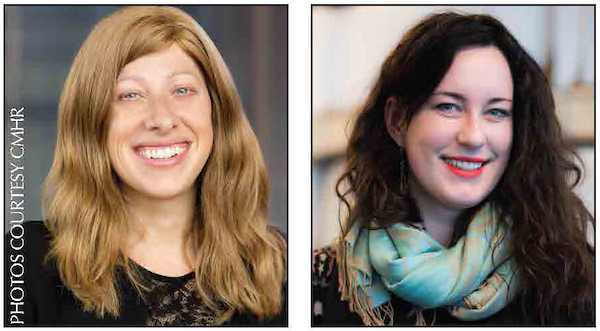
A first-of-its-kind program will give 30 Jewish social service professionals, including social workers, doctors and therapists, specialized training to better meet the psychosocial and emotional well-being of Sephardi and Mizrahi Jews. Among the participants will be two members of the local Jewish community: Harley Kushmier, a social worker in Kelowna, and Serach Aleria Sarra, a student in spiritual health at Surrey Memorial Hospital.

photo - Serach Aleria Sarra Harley Kushmier (below) are two of the 30 Jewish social service professionals who will participate in an inaugural JIMENA Sephardic Leaders Fellowship program
Serach Aleria Sarra Harley Kushmier (below) are two of the 30 Jewish social service professionals who will participate in an inaugural JIMENA Sephardic Leaders Fellowship program. (photo from JIMENA)

The program, part of JIMENA’s Sephardic Leaders Fellowship, is designed to deepen the professionals’ understanding of Sephardi and Mizrahi heritage and equip them to provide culturally responsive care. Chosen from a competitive applicant pool, fellows were accepted based on professional merit and a demonstrated commitment to serving diverse Jewish populations. JIMENA stands for Jews Indigenous to the Middle East and North Africa.

“In a post-Oct. 7 world – where so many Sephardi and Mizrahi Americans have been directly affected by events in Israel and the Middle East, and amid rising antisemitism and social strain – our research and community experience point to a clear demand for culturally responsive training for health professionals and social service providers working with Sephardi and Mizrahi Jews,” said Sarah Levin, executive director at JIMENA, in a press release. “This inaugural cohort – comprising therapists, counselors, crisis and trauma practitioners, providers for aging populations and at-risk youth, and clinical social workers – reflects that demand.”

photo - Harley Kushmier
Harley Kushmier (photo from JIMENA)

Over a series of sessions, the fellows in the social service providers cohort will explore a range of topics relevant to working with Sephardi, Mizrahi and other unique Jewish communities. These include mental health stigma in Middle Eastern and Mediterranean cultures, intergenerational trauma in immigrant and refugee families from the Middle East and North Africa, and economic vulnerability. The cohort will also engage in discussions on trauma-informed care with a focus on sexual abuse, as well as traditional Sephardi perspectives on identity, belonging and community care. This will include a dedicated session on LGBTQ+ youth, led by JQY. Additionally, participants will receive a foundational overview of Sephardi Jewish history, context and key definitions. Sessions will be led by leading practitioners in their field.

* * *

On Aug. 21, JIMENA released the study Sephardic and Mizrahi Jews in the United States: Identities, Experiences and Communities. It offers recommendations for leaders and organizations that want to more deeply engage these communities. Among the findings are that Sephardi and Mizrahi Jews in the United States have higher rates of Jewish communal participation, a stronger connection to Israel and are more likely than Ashkenazi Jews to say that being Jewish is somewhat or very much a part of their daily life.

The research was directed by Dr. Mijal Bitton and based at the New York University’s Wagner Graduate School of Public Research. As part of the research, scholars at the Cohen Centre for Modern Jewish Studies (CMJS) at Brandeis University conducted a review of existing quantitative data from national and community studies on Sephardi and Mizrahi Jews in the United States. Based on these figures, the study’s researchers estimate that approximately 10% of American Jews are Sephardi and/or Mizrahi. 

The data also show that, compared to Ashkenazi Jews, American Sephardi and Mizrahi Jews have the lowest intermarriage rates, and are more likely than Ashkenazi Jews to be born and/or raised outside the United States, to be politically moderate or conservative, and to be economically vulnerable.

Researchers examined four communities: the Syrian community in Brooklyn, NY; the Persian community in Los Angeles; the Bukharian community in Queens, NY; and the Latin Sephardi community of South Florida. Key findings include:

  While historically underrepresented in mainstream Jewish communal life, Sephardi and Mizrahi Jews have built strong, vibrant communities that maintain deep familial, religious and cultural traditions.

• Sephardi religious practice reflects a strong sense of traditionalism, combining respect for religious laws, customs, legitimations and authorities with more flexible personal and family religious observance.

• Community members want to make new lives for themselves in America, while still preferring ethnic connections, especially marriage with other community members and their own cultural traditions, and they maintain abiding connections to their Mediterranean, North African and Middle Eastern cultures.

• Most community members exhibit a notable resistance to language that frames race as their primary identity, categorizes them as Jews of colour or positions them as a minority group in need of diversity, equity and inclusion initiatives.

“The research is more than just insights and data; there’s a roadmap here that we hope will be a catalyst for change,” said Levin. “Jewish communal leaders and educators can include Sephardi and Mizrahi Jews – and our history, traditions and current customs – in meaningful, equal ways that reflect the diversity of the Jewish people.”

The report’s specific recommendations are informed by five recommended frameworks to approach diversity work in the Jewish community:

• Avoid viewing Sephardi and Mizrahi Jews only through the lens of exclusion, marginalization and victimhood narratives. Recognize that strong Sephardi and Mizrahi communal identities exist even as barriers and biases exist within Ashkenazi-majority institutional frameworks.

• Avoid centring Judaism exclusively around European Jewish experiences and Ashkenazi cultural norms as the dominant narrative (i.e. Yiddish as the primary language of Jewish tradition and denominational structures as the only legitimate form of Jewish identity). 

• Avoid creating inclusion projects that assume everyone agrees with a single set of values (e.g., liberal values) or tools for inclusion (DEI frameworks). Create inclusion projects that allow for diverse viewpoints, values, multiple religious perspectives and norms, and a plurality of political views.

• Avoid viewing diversity in Jewish spaces solely through North American racial and ethnic categories. Jewish diversity should recognize the central role of family origins and communal networks in shaping Jewish identity; the complex intersections of ancestry, ethnicity, religion and culture; and the migration patterns and geopolitical histories that shape identities, perspectives and communal structures.

• Avoid assuming that universal frameworks and solutions for inclusion will be effective for all and that shared priorities exist across all Jewish communities.

For the full report, go to sephardicstudy.org. 

– Courtesy JIMENA

Rolls’ poetic Adventures at Vancouver Fringe

The Vancouver Fringe Festival runs Sept. 4-14. For the full lineup and tickets, visit vancouverfringe.com. (photo from festival listing)

Jem Rolls brings Adventures in Canadian Parking Lots to the Vancouver Fringe Festival Sept. 5-14. “Describing the contents of the show is difficult, as it manages to cover so much ground in so little time,” writes Aiden Robert Bruce in a June post on kingstontheatre.ca. “The series of poems answers a variety of questions like: ‘Why are Canadians so good at smiling?’ ‘What is the most sellable title for a show?’ ‘How do the English view history?’ and perhaps most curiously, ‘When is he going to get to the parking lots?’ Amidst this amalgamation of individual topics, there is beautiful poetic imagery, dark science fiction, Fringe history lessons, and throughout it all there is almost always humour. The constant comedy is not only helpful in keeping the audience engaged, but also is used to create extremely powerful moments where the humour ceases and nothing but a striking verse remains.”

Community milestones … August 2025

photo - Rabbi Dr. Laura Duhan-Kaplan
Rabbi Dr. Laura Duhan-Kaplan

Rabbi Dr. Laura Duhan-Kaplan has been appointed the new dean of the ALEPH (Alliance for Jewish Renewal) Ordination Program (AOP). She will assume her role on Sept. 8.

Following the leadership of AOP’s retired founding dean Rabbi Marcia Prager, and two years of direction by Interim Dean Dr. Charles H. Silverstein, the AOP governors are pleased to welcome Duhan-Kaplan into this role.

A scholar, teacher and spiritual leader known for integrating mind and heart, Duhan-Kaplan brings decades of experience in Jewish studies, interfaith dialogue and rabbinic education. Most recently, she was professor of Jewish studies, director of inter-religious studies and interim academic dean at the Vancouver School of Theology. Ordained by ALEPH in 2005, she has served as AOP faculty,

a member of the Va’ad – the core administrative and organizational council that directs the seminary – and is rabbi emerita of Vancouver’s Or Shalom Synagogue.

Duhan-Kaplan’s many honours include the American Academy of Religion’s Katie Geneva Cannon Award for Excellence in Teaching and the Carnegie Foundation’s US Professor of the Year Award. A prolific author and editor, she has published 10 books, most recently Mouth of the Donkey: Re-imagining Biblical Animals and The Infinity Inside: Jewish Spiritual Practice Through a Multi-faith Lens.

Born in New York City, Duhan-Kaplan is a dual Canadian-American citizen and lives in Vancouver with her spouse, musician and retired psychologist Charles Kaplan. For more information about the ALEPH Ordination Program, visit aop.aleph.org.

* * *

photo - Rabbi Harry Brechner, who retires from  Congregation Emanu-El this month, was awarded an honorary doctorate from the Jewish Theological Seminary in New York earlier this year
Rabbi Harry Brechner, who retires from  Congregation Emanu-El this month, was awarded an honorary doctorate from the Jewish Theological Seminary in New York earlier this year.

After 24 years of service, Rabbi Harry Brechner retires this month and Rabbi Elisha (Eli) Herb is welcomed as the new rabbi at Congregation Emanu-El. Herb joins the Victoria community from Salem, Ore., where he has served as a congregational rabbi for nine years.

In 2024, Brechner received the King Charles III Coronation Medal for his significant contributions to interfaith connections, social justice and community dialogue in British Columbia. In 2025, he was awarded an honorary doctorate from the Jewish Theological Seminary in New York City for more than 25 years of distinguished service. A retirement party for him is planned for September and a formal installation ceremony for Herb will be held later this fall.

* * *

photo - Shayna Goldberg
Shayna Goldberg

Shayna Goldberg is the new artistic managing director of the Norman and Annette Rothstein Theatre and the Chutzpah! Festival.

From Toronto, Goldberg has lived in Vancouver for almost 12 years. She has worked in the theatre and music industries, and been involved in the Jewish community, taking on roles within Moishe House, Axis Young Professionals and Na’amat Canada.

This year’s Chutzpah! Festival is scheduled for Nov. 13-23.

* * *

The 2024 campaign of the Jewish Federation of Greater Vancouver raised $13.17 million: $9.38 million through the annual campaign, $1.78 million in additional funding directed to special projects, $1.86 million to combat antisemitism and $150,000 in additional funding thanks to corporate partners. 

With the theme “Power of Together,” the support came at a critical moment for our community. In the face of rising antisemitism and a deepening affordability crisis, community members chose to act – with tzedakah and with a commitment to collective impact.

Because of community donors, Jewish Federation and its partners can support families and individuals struggling with the rising cost of living; enhance community security at institutions and events across the region; counter antisemitism with strength and resolve; provide care and connection to Jewish seniors, Holocaust survivors, young families and those most vulnerable; and offer hope and aid to all those living in our partnership region in the Upper Galilee, most of whom were evacuated post-Oct. 7 and have only recently returned home. 

For more information, visit jewishvancouver.com.

* * *

On Aug. 7, Omatidio Media announced that production has begun in Vancouver on actor-turned-writer/director Elyse Levesque’s debut short film Hot Chocolate, which she wrote and is co-directing with Michael Driscoll. 

photo - Jay Brazeau
Jay Brazeau (photo from imdb.com)

The film, shooting in Vancouver and Port Coquitlam, features a cast including multi-award- winning musician and actor Jann Arden, Clare McConnell (Star Trek: Discovery, Murdoch Mysteries), Paul Campbell (Battlestar Galactica), Kristian Bruun (Orphan Black), Leah Gibson (Jessica Jones), Jana Morrison (Astrid and Lilly Save the World), Alvin Sanders (Riverdale), Jay Brazeau (Day of the Dead), Luisa d’Oliveira (The 100) and Paula Giroday (Family Law).

Based on a true story, Hot Chocolate centres on Margot, who is on her way to a wedding with her boyfriend Cameron, when she finds herself the plus-one to a most unexpected event: his uncle’s assisted death.

* * *

Over the past months, there have been updates about the what, when and where of JWest, but one important question remained: Who are the people behind this project?

JWest was born from a shared vision between the Jewish Community Centre of Greater Vancouver (JCC), Jewish Federation of Greater Vancouver (JFGV) and King David High School (KDHS). Several years ago, leaders from these organizations came together with the idea to not just to update the existing JCC, but to completely reimagine the space as a multi-use Jewish campus. Since then, a broad network of people has been working to bring this vision to life.

The JWest Foundation Board, the JWest Development Corp board and several volunteer committees, together with leadership from the JCC, Federation and KDHS, have been guiding the project.

JWest Foundation: Responsible for the oversight of campus development and management of future revenue. Chair: Alex Cristall. Directors: Diane Friedman, Martin Gerber, Hodie Kahn, Lana Marks Pulver, Diane Switzer and Alvin Wasserman.

JWest Development Corp: Responsible for the management of campus construction. Chair: David Porte. Vice-chair: Joe Khalifa. Directors: Andrew Abramowich, Chris Andison, Michael Berkson, Alfonso Ergas, Phil Gertsman, Geoff Glotman, Mark Gurvis, Lana Marks Pulver and Lawrence Zimmering.

The JWest staff team supports volunteers and partner organizations in delivering the day-to-day operations:

• Executive director: Emily Pritchard, who led fundraising efforts over the last four years, raising – with the efforts of the campaign cabinet – $147 million, completing the first phase of the campaign. Pritchard stepped into the ED role in July, expanding her leadership beyond fundraising to overseeing the full scope of the project.

• Director of finance: Roni Greif, who brings a strategic financial lens to the team, shaped by years of professional experience and community involvement through KDHS and Congregation Beth Israel. Greif is instrumental in building the financial systems and structures that will support JWest not only through construction, but well into the future. She is helping lay the financial foundation for this project’s long-term success.

• Vice-president, development: Maurice Ouellette. With a background in architecture and a track record in real estate development, Ouellette plays a key role in shaping and delivering the physical campus. He works closely with Acton Ostry Architects and liaises with the City of Vancouver to make sure that planning, approvals and design meet (and exceed) expectations, from sustainability to architectural excellence.

• Development manager: Hayden Kremer, who is involved across all areas of project development and operations for JWest Development Corp. Whether he’s reviewing Oakridge Energy’s proposal for the JCC’s future energy needs, working with Grosvenor on temporary parking during construction, or negotiating rezoning conditions with the City of Vancouver, he is solving problems, managing logistics and keeping everything moving forward.

To learn more about the project and explore the community of donors helping bring it to life, visit JWestNow.com and follow JWest on Instagram and Facebook.

Preparing for High Holidays

We have a new rabbi at Shaarey Zedek, our Winnipeg congregation. This is exciting as well as reassuring for many people. Why? Well, Rabbi Carnie Rose is the son of a rabbi and professor who lived in Winnipeg for many years, Dr. Neal Rose. His brother, Kliel, is a rabbi at Congregation Etz Chayim, another nearby congregation in Winnipeg. So, while Rabbi Carnie is new as a rabbi in Winnipeg, he is also a deeply familiar entity. He became a bar mitzvah at Shaarey Zedek. He went to kindergarten with the synagogue’s current executive director. 

This addition to our congregation is welcome, as Rabbi Anibal Mass and our chazzan, Leslie Emery, carry a heavy workload. They are still working hard, don’t get me wrong, but sometimes a new hire can offer support and everybody gets more breaks. I’m only observing this as a congregant and as the child of a Jewish professional. Sure, I serve on a committee, I show up to services, but I can tell there’s been a lot of work lately.

On a practical level, moving from the United States to Winnipeg is a big change. My family wanted to be supportive – after all, we too moved from the United States, in 2009 – so we’ve been helping Rabbi Carnie get his library in order. He’s got, as you might imagine, lots of books. These all got miserably jumbled in the move. While this has got to be stressful, he’s handling it all with good humour. We’ve taken pleasure at getting to look at and learn about all sorts of resources in Hebrew and English that we hadn’t seen before. Some books are like old friends, as I studied them as an undergraduate or in graduate school, but, to be honest, my books aren’t in nearly such good condition.

This experience mirrors many Jewish volunteer activities I did as a kid. As the child of a Jewish education director, who then went on to be the administrator (executive director) of my childhood congregation, Temple Rodef Shalom in Falls Church, Va., I spent many afterschool hours folding the weekly paper bulletin handed out on Shabbat, moving books or setting up chairs. While attending services or religious school were important activities, for me, the relationships I made with the rabbi and the staff and other congregants as we did these small jobs were the most meaningful ones. Along the way, I met many important guests, though it’s all a bit blurry now. For instance, I sat next to Elie Wiesel once after he spoke at our congregation. What I remember particularly is how formal and dressed up we were. Also, the dessert was good! I was allowed to stay up way past my bedtime.

Now, I’m proud that my kids are finding their way towards making their own community connections. One of my twins has gone to morning minyan many times this summer. He’s the only teen there and gets a lot of positive attention this way, including exchanging ideas with a retired provincial court judge. This judge also happens to be the father of my son’s elementary school principal, so we’re always on good behaviour with him!

My other twin isn’t getting to morning minyan much, but instead he volunteered for full weeks at a summer camp and daycare, helping little kids. He also helps on the synagogue tech team, doing accessible subtitles for prayers that are projected on screens as part of our service. This job is an important one, as it enables people to keep up with the service even if they are having a hard time hearing what’s going on or cannot read Hebrew. He’s been asked to help during the High Holidays. It’s a big honour and responsibility for a 14-year-old.

These commitments are important because they embody both the Canadian emphasis on volunteering and the Jewish one. When I was a teen, I lived for a year on a kibbutz. Volunteering was considered deeply valuable and important. Being the first to volunteer was a moral virtue. Yet, when I hear Winnipeg kids discuss accruing volunteer hours for school credits, it’s seen as an onerous requirement. Perhaps, for some, this requirement doesn’t have great value. On the contrary, in our household, we see these experiences as offering so many learning and growth opportunities.

While we moved books, searched for lost volumes and organized sets of Talmud and commentaries, we also saw the bustle behind the scenes as the congregation gets ready for Rosh Hashanah. There’s so much pageantry to the High Holidays. It’s a big deal. Some members jockey for important honours or specific seats and we listened with interest. We just wanted seats near the back, near where our kid would be in the tech booth. When I mentioned this to the new rabbi, I suggested that maybe different things matter to us. After all, I joked, I didn’t need to show off a new hat. (My mom always said this was an important part of High Holiday services when she was a kid in the 1950s!)

As for honours, we love a quiet summer Shabbat, when sometimes our kids get asked to read or are called up for an aliyah because no one reserved them in advance. These spur-of-the-moment experiences, where we might help out and take part in services, feel like the right spot for us. It may take months of practice to chant one part of the Torah portion, but we try to aim for a week when not much is happening.

A strong community is one where we can all contribute and help. Yes, big donors and fancy new hats are often part of the High Holidays. Big monetary donations keep the heat on, and status matters to many. However, a synagogue, and the Jewish community, must function throughout the year.

There’s a lot to think about when it comes to evaluating how we’ve behaved in the past year, and how we’ll make amends. To me, the most important reflections aren’t about where we are or how we behave specifically on Rosh Hashanah and Yom Kippur. In every regular weekday morning minyan, we also say “ashamu” – we are guilty. We work on ourselves all the time. Perhaps, while it’s important to have good intentions when it comes to the High Holidays, it’s also key to think about each day beforehand, and afterwards, too. Elul’s a whole month of reflection. Valuing one another and our community means making every day count. 

Joanne Seiff has written regularly for the Winnipeg Free Press and various Jewish publications. She is the author of three books, including From the Outside In: Jewish Post Columns 2015-2016, a collection of essays available for digital download or as a paperback from Amazon. Check her out on Instagram @yrnspinner or at joanneseiff.blogspot.com.

From the archives … JCC, 1937

image - clippings from JWB July 11 and 18 1937 issueIt was the big black square on the cover of the June 11, 1937, Jewish Western Bulletin that caught my attention initially. Then, as I flipped backwards and forwards through the archived papers, it was the weekly drama – that kind of left me hanging – and the sheer bluntness of tactics that drew me in to the JWB’s coverage of the 1937 campaign to raise funds for a second unit of the Jewish Community Centre, then located at Oak and 11th. (The building still exists, the home of the BC Lung Association for a long time now.)

The campaign action plan came out of a shareholders’ meeting in March of that year, at “which over one hundred men of the community were present,” according to the March 12, 1937, JWB, the JI ’s predecessor. I’ve no idea who the shareholders of the centre were. Nor if any women were at that planning meeting, but Lillian Freiman Hadassah, Council of Jewish Women and the Schara Tzedeck Auxiliary were among the organizations that helped solicit and collect pledges. 

The appointed campaign committee set a quota of $12,500 (or $271,217 in today’s dollars) and collections were divided into three divisions: donors of $100-$250 (Group A), $25-$100 (Group B) and up to $25 (Group C). The “keynote” of the campaign was “that each give according to his ability,” and every organization on the committee committed “its intention of getting whole-heartedly behind the task ahead.” Meanwhile, “The proposal submitted to shareholders by Schara Tzedeck Congregation of taking over the building has been tabled for a period of three weeks.” 

While that proposal obviously fizzled out, I couldn’t find any later mention of it. As I’ve often found when looking through the paper’s archives, it’s easy to find when things start, but harder to find out how they ended up. What is clear is that there was a hard push to raise the $12,500, and, while the March 12 article noted that, “possibly, for the first time in community history, there is no division of opinion concerning the necessity of and the urgent need for doing constructive work for [the] community Centre,” the JWB did feature some disparate views as soon as the next issue.

Rabbi J.L. Zlotnik summed up those concerns in a March 19 article: the quota was too much, given other community concerns and organizations that also needed financial support; and the quota was too little, given that actual building costs are almost always larger than planned, and the community would, therefore, become even more indebted as a result.

“After a period of ten years, twenty thousand dollars are still to be paid before this building can truly be called our own,” wrote Rabbi Samuel Cass in the March 31 issue, about the existing centre, while also pointing to the need for a second unit. He observed, “First, we must not repeat the mistakes of the past,” so the second unit should “be paid for in cash to the very last penny, before the first sod is turned. Second, the campaign must go beyond the amount necessary to erect the contemplated addition.” Lastly, he said, the whole community must agree that the debt on the first unit be paid off “even speedily, and at a near time.”

The advice seems to have gone unheeded. In the same March 31 paper as Cass’s article, the page 2 headline read, “All Organizations Endorse Second Unit Campaign.” 

The next edition’s cover blared, “2ND UNIT CAMPAIGN IN FULL SWING,” with the news that more than $3,000 had come in on the campaign’s first day, “collected from twenty men.” The building plans were also outlined in the April 9 paper: a two-storey building with a balcony was envisioned. The lower floor would be a gymnasium and banquet room, with “kitchen, showers, wash room, steam rooms, cloak-room, etc.” The upper floor would house an “Auditorium and Ball Room, cloak-room and lounge.” The balcony would be divided into small meeting rooms. “This present building is 33 feet 11 inches on 11th Ave. The addition would be 47 feet 9 inches or more than 40% larger,” the article stated.

image - clippings from multiple 1937 JWBs about JCC second unit campaignBy the April 23 issue, the A Division quota was “already assured.” A couple of weeks later, in the May 7 paper, a completely fictional piece was published on the cover, titled “Will You Make This Dream Come True?” It was written as if the second unit of the centre had opened, with a banquet, a highlight of which was the announcement of a $5,000 gift from an anonymous donor to pay for all the unit’s furnishings and appliances. The article imagined what meetings and other banquets were already being held in the new building and the great number of athletics classes available now that “the use of the gymnasium was available to all persons in the Community.”

By the end of May, though, the JWB was asking whether everyone had “done their share.” By June, the optimism hit a wall.

The cover of the June 11 issue featured the large black square that caught my eye. The label-sized caption with a white background read: “700 Jewish families in Vancouver can and must give towards the building of the Second Unit of the Community Centre.” 

The dramatic editorial choice was explained in the June 18 paper:

“The editorial staff of the Bulletin was bombarded with heated criticism for allowing such a hideous, melancholy, morbid and depressing thing to appear on the front page of the paper. Jewish people in all walks of life shouted words of rebuke, prominent Jewish business men cried ‘Shame, Shame,’ and Jewish society matrons muttered ‘Oh, how awful, it nearly frightened me to death.’

“No one, however, said ‘That little message in white, standing so pure, apart from that black hideousness was TRUE. Every body should give to the Centre – How we need that second unit – How essential it is to our Youth to have a proper meeting place.

“What our Community needs is more players, and less bench criticisizers. More workers, and less kickers.”

It concluded: “If you have a conscience, if you have the true community spirit – come through and show it. If you haven’t already given your contribution to the Second Unit – Mail it in to the Centre – tell them this article made you feel your responsibility. If you have given your donation, send in notification to the Centre to have it doubled. No matter what you give, make it as much as you can afford. Don’t let us be criticisers – LET’S BE BUILDERS.”

image - clippings from two 1937 JWBs about JCC second unit campaignOver the summer, a couple of meetings were held about the centre. There was a large notice on the cover of the July 2 paper about a July 5 meeting, but I couldn’t find a report in the paper about what transpired. Nor could I find out how the Sept. 22 “mass meeting” on “the Future of Vancouver Jewry” went – its Sept. 14 front-page notice declaring that “By your attendance … YOU SHALL BE JUDGED!”

There are no August or October 1937 papers in the bound archival collection I have, and I don’t know if they were lost to history or never published. Until June 1937, the reporting had been detailed and consistent, but the next mention of a campaign, in the Nov. 12 paper, is “the Recent Centre Drive” – not the second unit drive. In this campaign, there were seven grades, ranging from Grade A ($500 and up) to Grade G ($1 to $49). The Grade A donors were listed by name in that paper, the Grade Bs in the next issue, the Cs in the next, through to the Gs in the Dec. 24 issue, wherein the committee was congratulated for its work and the community for its “whole-hearted support to the campaign.”

Since there is no useable digital archive of the paper, sadly, my time-limited flipping came across no more mention of a second unit. The editorial two years after that campaign, on June 23, 1939, started, “Much water has gone under the bridge since our Centre Building has been re-financed. Inside and outside improvements on the building, in addition to the Amortization Plan itself has gone forward.

“Never have local Jewish efforts been more active, and the response greater, nor has the attendance within the building itself been so large. Much of the success is due to the liberal atmosphere of the Centre itself, which means the use of this building for any and all worthy Jewish efforts with but one thought – helping others to help themselves. One shudders to think of what might have happened to Jewish efforts in our city had not our fellow-Jews responded to the call for funds when it was made.”

The editorial also noted: “Some, however, have through oversight or neglect failed to send their payments in as yet.” It was hoped that “the pledgors in arrears will … see that their respective remittances are made … upon receipt of the notices.”

As far as I know, the second unit of the Oak and 11th JCC never materialized. It would be more than two decades later that a new centre would be built, at Oak and 41st, opening in 1962.