Synagogue more inclusive

At Zemer Hazayit, a Modern Orthodox congregation in Efrat, when the Torah reading is finished, the scroll is passed from the men’s side to a woman who takes it through the women’s side. (photo from David Bollag)

Ten years ago, a group of people in a Modern Orthodox congregation in Efrat, a Gush Etzion settlement, decided they wanted women to be more involved in their synagogue services. The majority of the congregation was reluctant, however, so they set out to form a community of their own.

They consulted with Efrat’s chief rabbi, Shlomo Riskin, about the idea and, he said, “Listen, I don’t think it should be the only reason why you would start a new community – the position of women. Why don’t you also make it special in terms of prayer and make it kind of a song?” So, they named the community Zemer Hazayit (Song of the Olive). “There was strong contact with the head rabbi from the very beginning,” said Rabbi David Bollag, spiritual leader of Zemer Hazayit.

Bollag, originally from Switzerland, made aliyah 25 years ago. He has been with the community for the past eight years. He still flies home eight times a year to teach at two Swiss universities, the University of Zurich and the University of Lucerne.

“My field is Jewish philosophy, but I also teach some Jewish history, Bible, whatever they need in the institutes,” he said.

“Our congregation is Modern Orthodox. In Modern Orthodoxy, in almost every aspect of life, women are fully integrated and emancipated, and have almost the same role as men – socially, professionally, in politics and at home. They have the same rights, almost the same education possibilities.”

Ever since Zemer Hazayit opened its doors, the community has been growing. It has some 200 community members today. While this community is new to Efrat, there are many like it elsewhere.

“The process that is taking place is a slow development,” said Bollag. “More and more, laymen and rabbis realize the difference between normal life and religious life isn’t sitting well with most people.” While women are intellectually engaged at schools, workplaces and in politics, he said, “when it comes to religious life, they’re treated like second-class citizens, and they are just going to leave religion or consider it something primitive. For that reason, changes have to take place.”

While people see the need, they also understand that change takes time to be accepted. “That’s why the process is very slow, sometimes very painful – there’s a lot of opposition,” said Bollag.

The tensions and discussions are not only between their community and the rest of Efrat’s Modern Orthodox communities, but within Zemer Hazayit, as well.

“We definitely have people who are more progressive, who are interested in more changes, and others who are much less,” said Bollag. “Not only do we have to find the right balance between introducing new things and making sure we remain within the limits of Modern Orthodoxy, we also have to make sure we find the right balance that’s OK for everybody in our community.”

When Bollag was asked to be the community’s rabbi, one of the first things he wanted was to have an official meeting with members of other neighborhood synagogues. “I wanted to make sure to explain to them what we’re interested in doing, to make sure they would fully accept us,” he said. “They don’t have to agree with us, but I would like them to be accepting.”
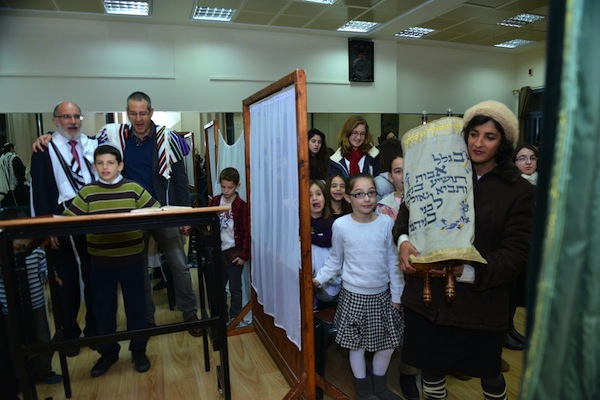
photo - Women at Zemer Hazayit return the Torah scroll to the ark
Women at Zemer Hazayit return the Torah scroll to the ark. (photo from David Bollag)

Zemer Hazayit first gets Riskin’s blessing before implementing any proposed changes. So far, these changes have included splitting the prayer room in the middle from front to back, giving women equal access to the ark and, when the Torah reading is finished, the scroll is passed from the men’s side to a woman who takes it through the women’s side and then places it back in the ark.

“One of the main issues being discussed at the moment is whether or how women can read from the Torah,” said Bollag. “So, we have, about once in two months, a reading of the Torah by women, but just among women.”

At the moment, the opinion is that they cannot have women reading for men. “So, we separate for that reading – the women are in one place and the men in another,” said Bollag. “Women read for women. We usually also do that when there’s a bat mitzvah, as most of the girls are interested in reading Torah.

“Also, women say Kaddish – that goes without saying in our community – even if there is just a woman and no man.”

According to Bollag, the ordination of women in Reform synagogues has influenced Modern Orthodox congregations, as well, noting that these communities now will hire a woman as part of the discussion, including as a rabbi/spiritual leader.

“When they approached me about being the rabbi of this community, we made it very clear that it isn’t just me, but also my wife who will be very involved in leading our community,” said Bollag. “We also put a lot of emphasis on integrating children into the services as much as we can.”

Zemer Hazayit is currently raising funds to build a synagogue, as they have outgrown the room they have been using in a local school. For more information, visit buildzemerhazayit.org.

Rebeca Kuropatwa is a Winnipeg freelance writer.
 

Golda Meir lived her beliefs

Foreign Minister of Israel Golda Meir meets with U.S. President John F. Kennedy on Dec. 27, 1962. (photo by Cecil Stoughton, National Archives and Records Administration, via commons.wikimedia.org)

Few people reach the pinnacle of power in their country of origin. Even fewer born outside their country of residence climb all the way up the political ladder of their adopted country. Finally, almost no women attain the highest positions of any national government. Yet one woman defied all these societal norms to become the fourth prime minister of the state of Israel – Golda Meir.

Meir (1898-1978) was born in Kiev, Ukraine, raised in the United States and lived in Israel for 56 years. Her long Israeli political career began in America in 1918 when she attended a Philadelphia conference. She wrote in her autobiography, My Life (G. P. Putnam’s Sons, 1975), that she “sat for hours listening, completely absorbed … [in] the excitement of the debates and of being able to cast my own vote.”

This American right to voice an opinion was a value she treasured all her political life. Hence, even in her later power-wielding positions as Israeli government minister, ambassador and prime minister, she sought the views of people from all walks of life. She saw it her duty to leave the door open to common citizens and diplomats alike. Life in the United States had given her “an understanding of the meaning of freedom, and awareness of the opportunities offered to the individual in a true democracy.”

At the time of the above conference, she was 20 years old. Though she was already planning to move to Palestine, it is unlikely she envisioned becoming an Israeli prime minister, as no Jewish state existed then. In fact, she believed young people did not need to pick a profession they would follow, so much as they needed to pick the way they would behave. When, in 1971, she met with students from her old Milwaukee, Wisc., elementary school – then called Fourth Street School, today named after her – she advised: “It isn’t really important to decide when you are very young just exactly what you want to become when you grow up. It is much more important to decide on the way you want to live.” She suggested it was enough for a young person “to be honest [and] to get involved with causes which are good for others, not only for yourselves.”

She put words into practice. By age 11, she was already involved in her first public service project. With a friend, she formed the American Young Sisters Society. The group’s goal was to raise money for youngsters who had difficulty paying for schoolbooks. With her school friends, she painted posters, held community meetings and raised the much-needed funds.

This obligation to assist others was a major part of Meir’s life. In Israel, her goal was to achieve social equality for all people, and she insisted that this would not happen unless she had the help of all citizens. She asserted that people of lesser means must not sit back and be “passive,” that they had to speak up for themselves and work to better their life situation. On the other hand, she held that people of greater means had to work to close the social and economic gaps. She believed that, for everyone’s lot to improve, there had to be a sharing of responsibility.

Still, Jewish-American feminist Letty Cottin Pogrebin criticizes Meir for not specifically advancing the case of women. On the Jewish Women’s Archive website, Pogrebin writes in the section on Meir: “She was, in current parlance, a ‘queen bee,’ a woman who climbs to the top, then pulls the ladder up behind her. She did not wield the prerogatives of power to address women’s special needs, to promote other women or to advance women’s status in the public sphere. The fact is that, at the end of her tenure, her Israeli sisters were no better off than they had been before she took office.

“Just as some Jews choose not to be Jewish-identified because they think they have the option to behave as if peoplehood doesn’t matter, Golda Meir chose not to be woman-identified and behaved as if gender doesn’t matter. But, of course, when one is Jewish and female, both facts matter.”

Meir’s career came to a relatively inauspicious end. After the Yom Kippur War, which was fought while Meir was prime minister, the government’s actions were questioned. Although the official investigation committee did not blame her for what had happened, she decided to resign. When she announced she was quitting in 1974, she said: “Five years are enough. I have come to the end of the road. It is beyond my strength to continue carrying the burden.” (reprinted in Front Page Israel: Major Events as Reflected in the Front Pages of the Jerusalem Post, edited by Ari Rath and Erwin Frenkel)

She later wrote that, while she did not feel guilty, she felt responsible for not having mobilized troops earlier in that conflict. She came to believe that she should have rejected the assessment of her military and intelligence staff. She writes in My Life: “That Friday morning, I should have listened to the warnings of my own heart and ordered a callup. For me, that fact cannot and never will be erased, and there can be no consolation…. I know that I should have done so, and I shall live with that terrible knowledge for the rest of my life. I will never again be the person I was before the Yom Kippur War.”

After 60-plus years of public service, Meir did what she had been doing since she lived in the United States. She listened to what people in the street were saying about the government’s actions, and she took responsibility for those actions.

Deborah Rubin Fields is an Israel-based features writer. She is also the author of Take a Peek Inside: A Child’s Guide to Radiology Exams, published in English, Hebrew and Arabic.

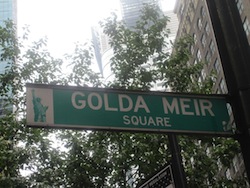
photo - In New York City, there is Golda Meir Square
In New York City, there is Golda Meir Square. (photo by Billy Hathorn (talk) via commons.wikimedia.org)

More on Meir

Looking at the current state of Golda Meir’s former places of residence, one could say they reflect the mixed feelings Israelis harbor toward her. On the one hand, not too long ago, northern Kibbutz Merchavia turned her first apartment into a small museum. Southern Kibbutz Revivim, moreover, established the Golda Meir Cultural Centre and the Golda Meir Memorial Wing, as Meir was a founding member of the kibbutz.

Her later Ramat Aviv apartment, however, stands derelict – a grimy plaque mentions she once lived there and the guard post, which once protected her, stands abandoned. Meir’s home while prime minister – the home that once served as the official residence for

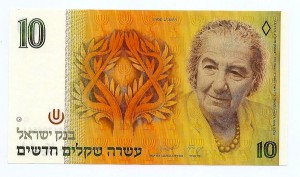
photo - Golda Meir has been commemorated in Israel in various ways, including on the new sheqalim banknote in 1992, as well as in other countries
Golda Meir has been commemorated in Israel in various ways, including on the new sheqalim banknote in 1992, as well as in other countries. (photo by Berlin-George via commons.wikimedia.org)

Israel’s prime ministers – has fared a little better, perhaps because this prime piece of real estate is looking for a suitable buyer. While living at 46 Ben Maimon (Rambam) St., Meir customarily invited members of her inner cabinet – what became known as the “Kitchen Cabinet” – for advance briefing. She prepared the coffee and cake.

* * *

Interviewed in 1973 for Ms. Magazine, Meir said: “Fashion is an imposition, a rein on freedom.” She wore sturdy, black, tie shoes with a thick low heel. In the early days of statehood, women soldiers wore similar shoes. They became known as “Golda shoes.”

– DRF

שרנסקי תומך בפדרציה על החלטתה

נתן שרנסקי (צילום: Nathan Roi via Wikimedia Commons)

הפדרציה היהודית של אזור ונקובר ממשיכה לקבל תמיכה רחבה לאור החלטתה לקיים את המופע של הזמרת אחינועם ניני, במסגרת חגיגות יום העצמאות. עתה מתברר שראשי הסוכנות היהודית בישראל שלחו אגרות ברכה לפדרציה על שהזמינה את ניני ליום העצמאות. יו”ר הנהלת הסוכנות, נתן שרנסקי, שלח אגרת אישית למנכ”ל הפדרציה, עזרא שנקן. שרנסקי מצדיע לארגון על פעילותו הענפה והישגיו למען הקהילה היהודית של ונקובר וכדי לתמוך בצורה איתנה בישראל. שרנסקי אומר: “באופן טבעי בישראל ובעולם הרחב יש הרבה דעות וויכוחים צורמים על הדרך הנכונה לשלום. אבל בשום מקרה איננו יכולים להרשות לעצמנו שהדעות השונות יחתרו ויפגעו בערכי הליבה שמאחדים אותנו, ברצוננו להגיע עתיד יהודי חזק עם מדינת ישראל יהודית ודמוקרטית במרכז. דווקא בימים קשים אלה כשאויבים מבחוץ שואפים לעשות דלגיטימציה לישראל, חייב להיות מקום למגוון דעות רחב”. לסיום דבריו מוסיף יו”ר הסוכנות: “כמו אחד שלעתים קרובות היה לו העונג להינות מהקול היוצא דופן של נועה בעלת הכישרון המרהיב, אני משבח את הפדרציה של ונקובר ואני יודע שחגיגות יום העצמאות שלכם יהיו נפלאות”. ואילו מנכ”ל הסוכנות, אלן הופמן, מציין באגרת שלו כי הסוכנות תומכת בפדרציה של ונקובר על שהזמינה את נועה להופיע ביום העצמאות. לדבריו: “קנדה וישראל חולקות את אותם ערכים דמוקרטיים המאפשרים מגוון רחב של דעות, כולל גילויים מגוונים של ציונות. דיאלוג כולל על ישראל הוא בליבה של מאמצי הסוכנות היהודית לבנות עתיד יהודי משגשג וישראל חזקה”.

הפדרציה קיבלה כאמור אגרות תמיכה רבות על הזמנתה של ניני להופיע בוונקובר, בין היתר ממנכ”ל הפדרציה של ונקובר לשעבר, מרק גורביס, שמשמש כיום סגן נשיא בכיר של הפדרציות היהודיות בצפון אמריקה, ראשי הפדרציות היהודיות של קנדה ורבנים.

שנקן אומר כי דברים מדהימים קרו בשבוע האחרון, בהם למשל ההכרזה ששגרירות ישראל והקונסוליה הישראלית יתנו חסות רשמית לאירוע יום העצמאות בוונקובר. שנקן: “הייתי בר מזל על כך שנפלה בידי ההזדמנות לדבר עם אנשים רבים אשר חולקים אהבה עמוקה למדינת לישראל, כולל חברים בקהילה שלנו, רבנים שלנו וראשי ארגונים יהודים ברחבי העולם. כל אחד מהם מראה בדרך המגוונות שלו כיצד הם אוהבים את ישראל, וכל אחד מראה באופן מדהים כיצד הם חולק את אותה אהבה לקהילה שלנו. אנו גאים בהם שהם תומכים בקהילה שלנו”.

הפדרציה היהודית גייסה למעלה משמונה מיליון דולר בקמפיין האחרון

הפדרציה של מטרו ונקובר גייסה 8.3 מיליון דולר בקמפיין האחרון לשנת 2016. בפועל גיוסו כשלוש מאות אלף דולר יותר לעומת הקמפיין של אשתקד. בפדרציה מסבירים את החשיבות שבגיוס הכספים מהקמפיין: “יש להאכיל את הרעבים, לטפל בזקנים ולטפח את הדור הבא”. בפדרציה מודים לתורמים על המחויביות שלהם לקהילה, לערכים של חסד לתיקון עולם ולצדקה. תוצאות הקמפיין מאפשרות לפדרציה ולארגונים השונים להגיע לרבים יותר בקהילה ולהגיב בצורה יעילה יותר מתמיד לצרכי הקהילה.

יו”ר הפדרציה, סטיבן גרבר, אומר: “העלות הגבוהה של החיים בוונקובר מגבירה את הקשיים של החברים רבים בקהילה להתקשר עם החיים היהודים, משתי סיבות עיקריות. או שהם אינם יכולים להרשות לעצמם לגור קרוב לתוכניות ולשירותים יהודיים, או אינם יכולים להרשות לעצמם להשתתף בהם. גיוס הכספים מתייחס לסוגיות כמו אלה, מאפשר לבנות קשרים בין חברי הקהילה לבין אזורי השותפות שלנו בישראל ומסייע ליהודים במצוקה ברחבי העולם”.