
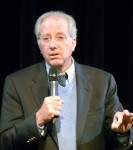
Ambassador Dennis Ross was in Winnipeg as part of the city’s Tarbut Festival to promote his new book. (photo by Rebeca Kuropatwa)
Ambassador Dennis Ross was in Winnipeg earlier this month to promote his latest book, Doomed to Succeed: The U.S.-Israel Relationship from Truman to Obama (Farrar, Straus and Giroux). He was one of the participants in the city’s Tarbut Festival.
Ross is the William Davidson Distinguished Fellow at the Washington Institute for Near East Policy, as well as a Distinguished Professor in the Practice of Diplomacy at Georgetown. He has been very involved in American peace efforts in the Middle East, especially during the administrations of presidents George H.W. Bush and Bill Clinton. Among other accomplishments, he helped Israel and the Palestinians reach an interim agreement in 1995, helped broker the Hebron Accord in 1997 and facilitated the 1994 Israel-Jordan peace treaty.
In his new book, Ross explores the attitudes and approaches of every U.S. president toward Israel, and the Middle East in general. He highlights some of the lessons that could have been learned from leader to leader, but were not, and how American presidents have shaped their country’s policies toward Israel.
Ross’ Nov. 15 talk in Winnipeg sold out a week in advance, with more than 200 in the audience at Rady Jewish Community Centre’s Berney Theatre. He began with a few words about the Paris terrorist attacks, describing them as “a sobering event.”
“This was an intelligence failure,” he said. “You had three terrorist cells that were able to operate, to acquire a substantial amount of weaponry, to wear suicide vests with explosives – to orchestrate, plan, and carry it out. My guess is they did rehearsals before they did this.”
Ross then discussed the spate of terrorist stabbings that has been occurring in Israel, referring to this as “a new normal” that we will need to get used to for the next while.
According to Ross, every administration, from Harry Truman to Barack Obama, has had people in the back office advising their president against siding with Israel. As such, to varying degrees, every president has considered Israel a problem, and not a partner.
“This mindset that tends to look at Palestinians and Arabs as something we have to be careful around … if we are going to be criticizing them, it will create a backlash against us … this is a mindset that has existed in every administration,” Ross said.
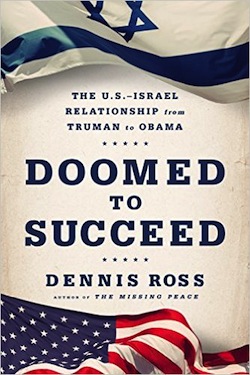 In his book, Ross conveys that the only American president who did not listen to these back-office advisors was Clinton, who saw the United States as Israel’s only friend.
“Because of that, we can have differences with Israel, but he [Clinton] believes that if we create a gap between us and Israel, it will give encouragement to Israel’s enemies,” said Ross. “With Clinton, the constituency existed, but it had no influence.”
Jumping from one president to the next, Ross provided glimpses of the eras and issues covered in his book. For example, Ross said, Ronald Reagan was “the only one to suspend [the supply of] F-16s to Israel as a punishment … because the Israelis bombed a [nuclear] reactor in Iraq. Reagan later acknowledges that it wasn’t a bad thing,” meaning Israel’s actions.
“Reagan goes back to his roots of being a very strong friend of Israel,” said Ross. “He feels a deep moral obligation to the state of Israel … going back to who he was, to his instincts. He believes the U.S. has a moral obligation to Israel.”
With the Reagan administration, Ross said, “For the first time, you have a constituency that arises with expertise that counters the other constituency, and sees Israel as a partner and not a problem … sees Israel as someone the U.S. should be working with.”
In Ross’ view, the constituency that views Israel as a problem has been guided by a set of assumptions that have endured since before Truman to today. In Doomed to Succeed, he lists three assumptions: “If you create distance from Israel, you’ll gain with the Arabs; if you cooperate with Israel, you’ll lose with the Arabs; [and] you cannot transform the Middle East unless you solve the Palestinian problem.”
Ross provided supporting evidence for each of these assumptions. “I’ll give you some examples from the book,” he said. “The most outrageous example was [Richard] Nixon. In March of 1970, Nixon decides to suspend F4 Phantoms to Israel. Now, I said that Reagan suspended F16s as a punishment. Nixon doesn’t do it as punishment. He’s trying to reach out to [Egyptian president Gamal Abdel] Nasser. He thinks if he suspends arms to Israel, he’ll gain with the Egyptians, gain with Nasser. What makes this an outrageous example is that he did it at the very moment that the Soviet Union was sending military personnel to Egypt.” While Nixon expected to be rewarded by Nasser, Nasser instead demanded more.
About the title of his book, Ross said, “Fundamentally, we [America] and Israel share interests and threats. That has always been true. It’s especially true now, as you look over the next 10 to 20 years, the struggle with ISIS and also Iran. We have two proxy wars. Who will dominate the region? The fighting is over identity. You fall back on the fundamental instincts.
“You have the Arab state system itself under threat now. Against that backdrop, there’s one state that actually has institutions – a rule of law, a separation of powers, independent judiciary, elections where the loser accepts the outcome, where there is freedom of speech, of assembly, and where women’s and gay rights are respected. Israel is the only democracy in that region and that’s why the title of the book is called Doomed to Succeed.”
The talk concluded with a few questions from the audience. Ross was asked about the Iranian nuclear deal and how he felt about it. Ross said he felt the deal needed tweaking to ensure a positive outcome.
“Sanctions would erode, eventually,” he said. “I still wasn’t prepared to favor the deal because, after 15 years, Iran gets treated as if it’s Japan or the Netherlands. They can build as large a nuclear infrastructure with no limitations at all. So, I identified, for me, five conditions that need to be met before I could support the deal. These conditions have to deal with how to bolster deterrents. I felt you can’t wait for 15 years to say, ‘Now, we are serious.’
“I wanted a firewall now if we see them moving toward a weapon. If we don’t do that, I can’t support it. I wanted us to make our declaratory policy much blunter, to make it clear they can’t use enriched uranium after 15 years. I wanted us to spell out now what happens if there are violations along the margins. For every transgression, there’s a price. They don’t escape. I wanted us to target new sanctions.
“I’ll tell you, the Iranians will cheat around the margins. They will test the verification. When they do, there has to be a price. If you buy 15 years, what do you do with it? I laid it out publicly before the deal was done. I wasn’t shy about this.”
In thanking Ross at the event’s conclusion, attendee Howard Morry said, “You asked the question, ‘Who has been the best friend to Israel for the past 30 years?’ It could be argued that you’ve been Israel’s best friend in the White House.”
Rebeca Kuropatwa is a Winnipeg freelance writer.