Category: Opinion
Canada fails to get seat
There is no way to determine definitively why Canada failed to secure a temporary seat on the United Nations Security Council last week.
Since the UN was created after the Second World War, Canada had generally been elected to one of the temporary seats once per decade. This ended in 2010, when Canada lost its bid, and last Wednesday’s vote represents the second decade of Canadian absence from the prestigious council.
Prime Minister Justin Trudeau contended that the successful countries – Ireland and Norway – had been campaigning longer. Also significant may have been the fact that Canada’s contributions to foreign aid and UN peacekeeping efforts have declined in recent years. Not to be dismissed also is the perception of Canada as an ally of Israel.
Since 2006, under Conservative and Liberal governments, Canada has voted against or abstained from the annual litany of 16 recurring anti-Israel resolutions at the UN General Assembly. That trend was broken last winter, when Canada unexpectedly endorsed a resolution condemning Israel.
Jewish and other pro-Israel Canadians have viewed Canada’s pro-Israel UN votes since 2006 as a principled position in the face of a global dogpiling – the votes are routinely passed with numbers like 160 to six, with Israel, the United States and American-aligned South Pacific micro-nations in the minority. No other country is singled out with such multiple routine censures.
Canada’s abrupt reversal of this stand last year was seen by some as an effort to distance Canada from Israel in advance of last week’s vote, particularly among the nearly 60 Arab and Muslim countries in the General Assembly.
While Trudeau made the case that Canada’s principled voice was necessary for the world in this challenging time, Opposition voices, like Conservative (and former Liberal) MP Leona Alleslev, argued that the government had betrayed its principles and, as a result, undermined its own argument for putting a Canadian representative on the Security Council.
The point is fair. To base our country’s campaign for the seat (at least partly) on the idea that we are a principled voice on the world stage and then do a 180 puts the whole venture into a weird light. For those countries who dislike our history of pro-Israel votes, the last-minute reversal must have seemed too little too late. For those (admittedly few) who admired our chutzpah, the recent vote must have been a disappointment, if not a betrayal. It’s almost a wonder that we got as many votes as we did.
The complex skin we’re in
As a young adult, I was often criticized for being too blunt. I didn’t always behave the way that my family wished I would. I would call people out when they were being inappropriate. This got me into trouble. And, to be honest, that didn’t always bother me enough to stop doing it.
Others made me feel embarrassed – because my job, throughout my teen years, was to behave properly, say the right things and “act like a lady.” In Virginia, this was necessary. My mother served the Jewish community as a director of education and, later, as a temple administrator, and her children’s behaviour was sometimes a reflection on her.
Though my mom was in charge of a $6 million renovation the year before she retired, she was often slighted in her professional life because of her gender, which affected me, too. My body and behaviour were policed, for example. I was told that I shouldn’t be running by the temple in my leggings (running clothing), as “people” looked at me. What was meant by that?
I looked like my mom, and my (in today’s view, entirely appropriate) exercise clothes caused men to look at me – and, therefore, were an embarrassment. Even as a Reform Jewish professional, my mom was a woman. That was problematic. As her daughter, my body and presence could be embarrassing, too.
Being Jewish in Virginia meant there weren’t many Jewish kids in my public school classes. Even weirder, it was being the daughter of a Jewish professional in what was then a small Jewish community that made me understand what it felt like to feel “othered.” People looked at me differently.
It also made me see those who were always treated “differently” – like people of colour. I saw how much harder things were for them. This isn’t ancient history. I graduated from high school in 1991.
After I finished university, I went into a special inner-city accelerated teacher’s program. This allowed new graduate students earning their master’s in education a chance to do their student teaching by replacing teachers who “needed training” in the Washington, D.C., public schools. This program supported an ailing inner-city school system where the (largely African-American) teachers worked longer to earn their retirement pension than anywhere else. These tired and burnt-out high school teachers lacked opportunities for continuing education and basic classroom supplies. They often just needed a break. Most of the students’ families struggled financially and, yes, most of the kids that I taught were African-American or from immigrant families.
In those classrooms, I saw how privileged I’d been in the suburbs. The D.C. public schools were underfunded and in terrible disrepair. Imagine magnificent historic buildings with high ceilings and real slate chalkboards – but it rained inside, the copiers were broken and there were no class sets of books to assign.
When there were fires, the fire trucks didn’t show up. In Anacostia High School, the African-American principal put out the fires himself. These communities weren’t offered basic city services. Instead, there were frequent arrests, for things like “driving while black,” as my friends put it.
I’ve been sad, angry and frustrated about this racial injustice for a long time. I’ve witnessed it – and Jewish tradition tells us to speak out, to pursue justice and to try to fix the world’s wrongs.
Yet, just as Judaism teaches us what it means to be set apart, or even discriminated against, ostracized and singled out, our (mostly male, white, privileged) culture has pushed us to behave according to its norms.
“Being a lady” often meant not embarrassing our families by calling out people who said racist or inappropriate things. It meant that I shouldn’t run by, entirely covered up, because my female body might be a distraction.
Being ladylike? It’s learning that how one looks is distracting, offends others, is reason enough to stay home, or feel ashamed. It’s struggling between speaking out and keeping quiet, so as not to pick a fight.
Sometimes, I’ve just chosen to keep my mouth shut, because it’s not worth the fight, it’s not ladylike, or “Honey, now’s not the time.” But it was wrong to stay quiet when I heard people making others “less” or demeaning them. It’s wrong to say nothing as someone uses degrading language, tells racist stories or implies that someone “deserved what he got” essentially by being a black person or an indigenous person in the wrong place at the wrong time.
Growing up as a Jewish person in a non-Jewish area, and as a female, gave me some insights into this discrimination, but, if I behaved the “right way,” or didn’t act “too Jewish,” (?!) I could pass where I grew up and where I live now, in Winnipeg.
In the Talmud, in Shabbat 95a, there’s a discussion about how to properly sprinkle the floor of a room on Shabbat. It’s a way of cooling a hot space, but it isn’t allowed by the rabbis on Shabbat if the floor is dirt because a dirt floor could be changed by water remolding it. If the floor were stone, it might provide cooling and still be allowed. One sage concludes that a wise woman would know how to do this and avoid breaking Shabbat rules.
The rabbis gave credit to smart women for knowing how to follow the rules and make a change for the better.
This pandemic year has been about colossal change. It might also be time to ditch the “ladylike” models in favour of those talmudic wise women, who make change happen, “cool things down” during a hot summer and find ways to do it while mostly abiding by the rules.
The rules themselves, whether talmudic or modern, are still largely made by men. It’s time to recognize that the “others” – Jews and members of other minority faiths, women, those in the LGBTQ+ community, people of colour and everyone who still faces discrimination and racism – deserve the equality and justice we are all due.
It’s time. In fact, it’s long overdue. Our history as Jewish people, as Canadians and North Americans, requires us to own this injustice and fix it. It’s time to change ingrained, prejudiced habits and speak out.
Jewish tradition teaches that we’re all made in the Divine Image, in every colour and gender. Now we must step up, say so and act as if we mean it.
Joanne Seiff has written regularly for CBC Manitoba and various Jewish publications. She is the author of three books, including From the Outside In: Jewish Post Columns 2015-2016, a collection of essays available for digital download or as a paperback from Amazon. Check her out on Instagram @yrnspinner or at joanneseiff.blogspot.com.
Thank you to all who contributed to the June 26/20 issue!!!
Racism is a Jewish issue
On June 4, New Brunswick resident Chantel Moore, originally from the Tla-o-qui-aht First Nation near Tofino, B.C., was shot to death by a police officer sent to her home to check on her well-being. On May 27, Regis Korchinski-Paquet, an indigenous-black woman, fell 24 floors from her apartment during a police incident in Toronto.
In the United States, George Floyd died on May 25, after being pinned to the ground with a knee pressed into his neck for more than eight minutes by a police officer in Minneapolis. Breonna Taylor was killed March 13 in her bed in Louisville, Ky., in what amounts to a home invasion by police. Ahmaud Arbery was chased by three armed white neighbours and murdered on Feb. 23, while he was jogging in Georgia.
The challenge in compiling a list of names of black Americans and indigenous and racialized Canadians killed by police or lynched by vigilantes is choosing which from a horrifically long list of victims’ names to include. And the structural conditions that have led to this particular moment of upheaval are not new. Similar demonstrations have occurred after particularly egregious incidents, like the killing of Michael Brown by police in Ferguson, Mo., in 2014; Trayvon Martin, who was murdered in 2012 by a cop-wannabe; and the beating of Rodney King by police in Los Angeles in 1991. Again, the list of just the most familiar incidents could fill pages. And they are not limited to the United States.
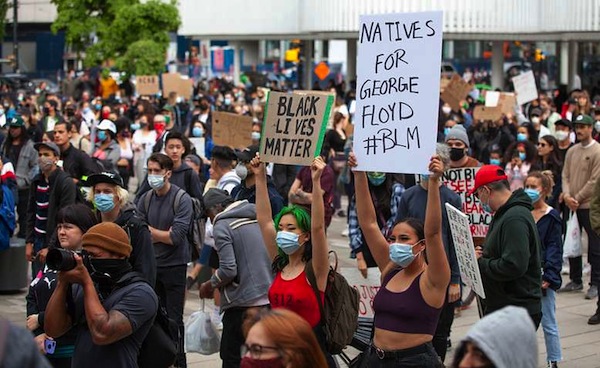
Could this time be different? One thing that some Black Lives Matter proponents are noting is the apparently unprecedented engagement of non-black allies in this moment. Is this because we all have more time on our hands right now? Or have we reached a tipping point, when the lofty language of equality has finally penetrated deep into the mainstream of North American society?
There are parallel streams happening, from the issue of police violence to the broader matter of societal behaviour toward racialized people. These are exacerbated by the unpardonable conduct of the U.S. president. When Trayvon Martin was killed, then-president Barack Obama noted that, if he had a son, he would look like Trayvon. The current president tweets threats of violence and has police forcibly clear peaceful demonstrators so he can have a photo taken in front of a church he has never entered. In a country aflame, the president’s comportment is incendiary and perilous.
This is a time for our community, the Jewish community, to consider our complacency and complicity in upholding racist systems. It is, as American historian and author Ibram X. Kendi implores, not enough to be not racist. We must be actively anti-racist. We must stand in solidarity with those who are suffering and recognize that the pain of racism is also the pain of antisemitism.
The solidarity and support we crave when we are threatened is the solidarity and support we must give other communities when they are in need. Give your time to an anti-racism organization. Donate your money to support black-owned businesses and organizations working to support the black community. Pray for the healing that is so badly needed in our society. March for equality and justice (in a safe manner). Stand up when you see injustice or hear a “casually” racist remark. Sign your name to a petition asking decision-makers to step up and rein in the militarization of policing and the funding that gets diverted from community into the over-policing of racialized communities.
Interrogate Canada’s colonial history and the lived realities of indigenous communities. Ask our educators to explore with their students global histories and the untold stories of millions, including richer views of Jewish history and the experiences and contributions of Jews who are not of European descent. Read a work of fiction by a black or indigenous author. Learn about how black culture forms the bedrock of North American culture and from where those art forms come. Explore the history of the black community here in Vancouver and how the early Jewish community, along with other minorities, together have called Strathcona home.
Absorb the teachings of Abraham Joshua Heschel, who referenced the calls of the Hebrew prophets in the struggle for civil rights in the 1960s and who marched alongside Dr. Martin Luther King, Jr., for justice. If you’re already doing all of these things, share your knowledge and example with your family, your synagogue and the organizations and schools you support.
Some Jewish observers have expressed reservations about the Black Lives Matter movement, at least partly because the umbrella organization endorses the boycott, divestment and sanctions movement against Israel. This is an unfortunate and misguided move on their part, especially since BDS harms Palestinians in addition to Israelis. But the issue of black people – and people of colour in Canada and elsewhere – being murdered by police or lynched by racists must take precedence now. We can argue over Israel and Palestine later.
If one feels the need to prioritize Jewish or Israeli concerns at this moment, then let’s prioritize the safety of black Jews and Jews of colour. The vast majority of Jews are morally affected by what is happening in our society and black Jews are immediately and personally impacted both by what is happening in the world and by what is happening in our community around this issue.
Let us not pretend that this is not a “Jewish issue.” Rather, let us live by what is referred to as one of the “eternal religious obligations” of Judaism: “Justice, justice you shall pursue.”
Rabbinic planting advice
My family plants a garden every summer. We live in a city and don’t have lots of room. Since our house is more than 100 years old, we created small raised beds, filled with compost and soil, to avoid growing veggies in what is potentially contaminated soil.
Although my husband and I have gardened together for years, when our twins were younger, we developed a haphazard technique. Before twins, we might have studied companion plants, figuring out what would grow best and where, but all that disappeared after two babies came on scene. Since then, every year, right around their birthday on June 1, we’d throw a planting party with some friends. First, we had the birthday ice cream cake and, then, we’d dig together. Within an hour, the entire garden was planted.
Sometimes, a retired history professor was in charge of bean planting. Our actor friend, who also worked as a mother’s helper for us when the kids were small, was in charge of squash. It was sometimes a surprise to see what the garden produced. We left it all to chance – what grows and what fails would be a surprise.
This year, no parties, of course. With two kids home from elementary school in mid-March, we started seeding. We planted lettuce, radish and spinach outdoors. We followed the advice of Winnipeg’s mayor, who suggested people “plant an extra row” for the food bank, as so many are out of work. We planted sprouting potato peelings as one of our home-school science projects, and filled every extra pot with potato plants.
In the Babylonian Talmud, in Tractate Shabbat, starting page 84b, the rabbis discuss how to plant a garden. What is an acceptable plan for a garden bed, which avoids the prohibition of sowing diverse kinds of seeds together, they ask? The rabbis engage in a level of landscaping planning that my gardens have never seen. In the Vilna edition, there are even illustrations and sketches provided.
This year in our garden, for the first time in awhile, we know where everything is and who planted what. I don’t have to call any of our friends to find out which variety of squash seeds they used and if they will be close enough to the others to pollinate properly!
What struck me though was that, unlike past years, we had time to spread out and enjoy the gardening experience. Yes, we’ve had virtual meetings for school and work, but the summer unfurls before us with practically nothing on the calendar – no traveling, no festivals, no big obligations. We’re still waiting to hear, but suspect there will be no summer camp or swim lessons at the lake either. Staying home is where it’s at.
Long, unplanned stretches of weekend time and summer evenings spool out ahead. We can stream services or watch a Jewish music concert from home, play on the porch or water the garden. True, we may not be able to travel to see grandparents or have big Shabbat dinners. We do miss our friends and family. However, we’ll have leisurely morning dog walks to explore new places and greet neighbours, long afternoons to help our kids learn to bike, fly kites, or just scooter up and down the block.
This scary coronavirus is stressful, don’t get me wrong. We’ve already felt its serious effects on relatives in New York and New Jersey. It continues to affect us in many ways and, even if summer’s a reprieve, the danger hasn’t passed. Yet, in the virus’s shadow, we’ve been offered a moment to adjust and experience an entirely different pace, and it’s a surprising gift on its own.
Yes, our garden is more orderly this year than it has been in at least 10 years, but it’s nothing as tidy or thoughtful as the rabbis’ landscaping guides. I suspect, if the rabbis were to see our garden beds, they would be upset. We squish way too many varieties of tomatoes, beans, peas, lettuces, cucumbers, herbs and more into these small spaces.
At the same time, our pandemic-enforced break may offer us the chance for longer conversations, more time off to enjoy family and Shabbat, and more learning, too. I can’t pretend the rabbis’ advice made us plant more tidy rows of beans, carrots or nasturtiums, but the pandemic likely gave me the time and space to read their advice, and actually think about it.
We’ve eaten two salads full of microgreens and herbs, straight from the garden, and I got to share with you what I’ve learned about 1,500-year-old planting advice. That’s not a bad start to the season. It’s also a reminder: get out in the sunshine! (With sunscreen and social distancing, of course.) Summer lies ahead – with newfound time to enjoy it.
Joanne Seiff has written regularly for CBC Manitoba and various Jewish publications. She is the author of three books, including From the Outside In: Jewish Post Columns 2015-2016, a collection of essays available for digital download or as a paperback from Amazon. Check her out on Instagram @yrnspinner or at joanneseiff.blogspot.com.
Thank you to all who contributed to the June 12/20 issue!!!
Favourable position
British Columbians, like others in much of the world, are stepping gingerly into what may be a post-pandemic period – or an “inter-pandemic” phase, if the predicted second wave bears out. Our daily briefings from Dr. Bonnie Henry, the provincial health officer, and Health Minister Adrian Dix are cautiously optimistic, tempered with the reality that some people, given an inch, will take a mile. Confusion around, or contempt for, changing social distancing guidelines has meant numerous instances of inappropriate gatherings.
All in all, though, British Columbians have so far experienced among the lowest proportions of COVID-related illnesses and deaths than almost any jurisdiction in the developed world. Each death is a tragedy, yet we should be grateful for those who have recovered and the fact that so many of us have remained healthy so far. Thanks should go to all those who have helped others make it through, including first responders, healthcare professionals and also those irreplaceable workers we used to take for granted: retail and service employees and others who have allowed most of us to live through this with comparatively minimal disruptions.
In our Jewish community, so many individuals and institutions have done so much, from delivering challah to providing emergency financial and other supports for those affected by the economic impacts of the pandemic.
Canadians, in general, seem to be making it through this time as well as can be expected. Polls indicate that Canadians are overwhelmingly supportive of the actions our governments have taken during the coronavirus pandemic. How the federal and provincial governments manage the continuing economic repercussions and the potential resurgence of infections in coming months will determine long-term consequences both for us and for their popularity.
In signs that things are returning to something akin to pre-pandemic normal, Binyamin Netanyahu, Israel’s once-and-still-prime minister, is complaining about a “left-wing coup” and asserting that “the entire right” is on trial. In fact, it is not an entire wing of the Israeli political spectrum that is on trial, but Netanyahu himself, for bribery, breach of trust and fraud. He is accused of exchanging favours to friends and allies in return for hundreds of thousands of dollars in trinkets like cigars and champagne, and favourable coverage in media. Whatever strategy his team has for inside the courtroom, his PR strategy is pure deflection: blame the media, the court system, political opponents. He’s fighting two trials: the one in the justice system and the one in the court of public opinion. Netanyahu has managed to save his political hide thus far, through three successive elections and a year of coalition-building and horse trading. Predicting what might happen next is a popular but fruitless pastime.
More signs that things are not so different came from U.S. President Donald Trump on the weekend. As the death toll in the United States approached 100,000, Trump took time off from golfing to deliver Twitter rants, including retweets calling Hillary Clinton a “skank” and smearing other female Democrats for their appearance. Trump also insinuated that MSNBC TV host Joe Scarborough is a murderer.
Sitting (mostly) comfortably in our homes watching such things from afar, it’s no wonder Canadians are feeling good about the way our various governments – federal and provincial, of all political stripes – are behaving these days.
Kugel comforts during COVID
Yerushalmi kugel by Jamie Geller. (photo from jamiegeller.com)
If I’d known the world was going to be locked down because of the COVID-19 pandemic, I would have stocked up on toilet paper, disinfecting wipes and pasta much sooner. Of course, only one of those is edible.
Desperate measures call for desperate times and, when so many restaurants have closed, cooking has become mandatory. As has self-isolation. Sure, we could order takeout, but I’m still slightly paranoid about who cooks my food. After all, you’re only as healthy as the last person you were in contact with. I rest my case.
I’ve tried to be creative in the kitchen, but, when you’re used to eating sushi at least once a week and shopping for fresh food every day, it gets challenging during a lockdown. Now we eat more pasta. Way more pasta. My husband Harvey loves it. Me, not so much.
Harvey does a Costco run every so often to stock up, but I’m loathe to send him out into the dangerous spittle-filled world of COVID coughs right now. And the regular stores are often out of the basics, at least until recently. To be completely frank, I’m sick of cooking. So, what’s an accidental balabusta to do?
I’ll tell you what I did. I handed Harvey my mother’s tattered Jewish Council Cookbook the other day and pronounced: “Make something!” So, what does he choose from all those geshmak recipes? Tuna noodle casserole. You know the one – it’s composed of Campbell’s cream of mushroom soup, Kraft Dinner and a can or two of tuna. If you want to get really fancy shmancy, you can grate some aged cheddar cheese on top. It’s the quintessential comfort food. Minus the sushi. Or, in Harvey’s case, minus the tuna.
My first dip of the fork into the ooey-gooey goodness of the tuna noodle casserole elicited a squeal of surprise. It was actually delicious. Processed deliciousness, but nonetheless yummy in the extreme. The tummy wants what the tummy wants. After a few bites, I expressed my perplexity that I didn’t taste the tuna. Harvey said it had probably sunk to the bottom, so I did a deep dive to the base of the casserole dish, and … bupkis. Harvey had a go at it and, likewise, nada. He humbly walked over to the fridge, opened it, and sheepishly admitted that he’d forgotten to put in the tuna. So, we were eating KD with mushroom soup and a crusty topping of melted cheddar. It was still superb, in a plebian sort of way. Does this count as accidental balabatishness? I didn’t think so. Even if it did, I wasn’t the balabusta who made it.
I’m not proud of what we ate. But I’m sure other people have eaten worse. Much worse. Think fried Spam. Or headcheese (whatever that is). Nobody is going to raise their hand and cop to either of those atrocities, but, trust me, I know where the bodies are buried.
In the end, a casserole that I thought was going to feed us for two nights lasted three. Kind of like a tuna-based Chanukah miracle – the “excess” tuna gave its life for a couple of sandwiches, to boot. The real victory was that I didn’t have to cook for three whole nights.
Don’t think I can’t hear you yelling, “What’s the matter with you people? Haven’t you ever heard of salads?!” Well, yes, as a matter of fact, I have. And, as much as I love salads, it’s not a mutual admiration alliance. Harvey buys pre-bagged salads for himself as a side dish, but rarely do we eat a jacked-up salad for the main course. It could very well land me in the hospital, and I choose not to take that chance. Digestion issues.
By rights, I should probably have scurvy by now, but I have thankfully dodged that bullet. To get some colour in my food, I put steamed or roasted carrots in everything. Sometimes, I even eat broccoli. Is my diet restrictive? Sure. Am I relatively healthy, nonetheless? Yes – the operative word being relatively. My body happens to do well on protein. Lots and lots of protein. Animal protein. I’ll own it: I’m a card-carrying carnivore. Don’t judge me. In case you care, I used to switch things up with more varied restaurant food before COVID-19 came calling. But now that I’m relegated to my own culinary wits, things have gotten kind of serious. And not in a good way.
I am jonesing pretty bad for some agedashi tofu and salmon sashimi, but I don’t dare eat that now. I heard that, if you get takeout food, the first thing you should do is transfer it to your own dishes and reheat it in the microwave to kill off any viruses or bacteria. That’s fine for cooked food, but I believe that eating sashimi during a COVID-19 pandemic is like sticking a hand grenade in your mouth and hoping to have a pleasant day.
Desperate for some variety, I dug through my recipes and came across one for Jerusalem kugel. It still counts as pasta, but I view it as a more cultured, genteel pasta. Usually a side dish, I knew I could convince Harvey that it’s a main (especially if I served him enough of it). I figure I’ll follow it up with a roasted carrot/yam chaser. This particular kugel is satisfyingly savoury and sweet, and the recipe is by Jamie Geller.
SWEET AND PEPPERY JERUSALEM KUGEL
1 (12 ounce) package thin egg noodles
1 cup sugar
1/3 cup oil
4 eggs
1 tsp salt
1/4 tsp to 1 tsp ground pepper
- Preheat oven to 350˚F.
- Bring a pot of water to a boil. Cook noodles according to package instructions. Strain and set aside.
- Add the sugar and oil to a large pot on low heat. Stir until sugar is dissolved and a deep golden caramel colour, but not burnt. This can take 20 minutes or more.
- Turn off the heat and add the noodles into the pot of sugar. Immediately stir with a big spoon until the noodles are coated in the caramel. Don’t worry if the sugar hardens into blobs – it will melt in the oven.
- Allow the mixture to cool for about 10 minutes. Mix in the eggs, salt and pepper. (Make sure it’s cool so the eggs don’t cook.)
- Pour the mixture into a greased springform pan or baking dish. Bake for one hour.
May this COVID-19 pandemic be over with soon. In the meantime, as Dr. Bonnie Henry says: “Be kind. Be Calm. Stay safe.” As for the Accidental Balabusta, figuring out what to cook every night should be my worst problem. Ever.
Shelley Civkin, aka the Accidental Balabusta, is a happily retired librarian and communications officer. For 17 years, she wrote a weekly book review column for the Richmond Review. She’s currently a freelance writer and volunteer.
Jewish surety in Shabbat ritual
We have two Jewish dogs. When we sing Shabbat blessings, our dogs come over, sit politely, and wait until we’re done with the Hamotzi, the blessing over the bread. Then, they each get a small chunk of challah. This is the only people food they get. We don’t feed them while we eat and they don’t beg. However, when they hear us start to sing blessings, they know what to do!
On Chanukah or Passover, we are ready with alternative treats. Every night after we light Chanukah candles, they get dog biscuits. On Passover, they get matzah.
Our lab/pointer mix, Sally, who is more than 15 years old, has been doing poorly. Bigger dogs don’t usually live this long. She’s had a good life. We love her dearly. When she started having trouble eating, despite pandemic vet visits and several medicines, we were ready to try anything. She vomited and would eat only sparingly.
Then I had an idea. We had leftover homemade challah after Shabbat ended last week. I took out a piece, broke it into smaller bits, and started reciting brachot (blessings). I sang the Hamotzi. She moved her sore joints and sat near me. She ate challah. I did it again. She ate a little more challah. I kept going. In my happy blessing voice, I sang the Shehecheyanu (“Who has given us life”) blessing, feeling grateful for having reached this moment. Challah eaten. I thanked the Almighty for making me in the divine image. Challah eaten. I sang the blessing about giving tired people the strength to go on, from the morning blessings. She ate more challah.
My husband had small luck with this approach. In the end, she ate more for me. Was it my singing? My happy fake-out training technique, after 15 years of dog training to sit for blessings? We don’t know why it worked. After a day or two, we ran out of challah and switched to dog biscuits. Now, she is eating a weird mixture of special canned dog food diet, chicken and kibble again. Things are better, for now.
I want to tell one of our relatives, Ann, in New York City, about this success – about our old Jewish dog, her many blessings and the challah – but I can’t call her. She died May 3rd from a blood disorder. Once she was admitted to the hospital in New York, she was alone. Although she didn’t die from COVID-19, she died alone because of it. Ann, may her memory be a blessing, loved dogs and Jewish tradition. She would have laughed to hear about how Sally regained her appetite because of those blessings and challah.
It feels right now like we’re wandering in the wilderness. There’s so much uncertainty surrounding the COVID-19 pandemic. Every day, things change. Many news sources refer to this virus as “the novel coronavirus.” Yes, it’s new, unlike all the other coronaviruses. Yet, in some ways, this situation, where we’re faced by terrible illness or challenge, arises repeatedly throughout the Torah, rabbinic texts and our history. It may be new to us, but it’s the same old story. How do we face these challenges? How can we behave in Jewish ways when the challenges seem so huge? We study what worked in the past – our history and traditions can help.
How do we make Shabbat (or make anything special) in a time when all the days seem hard and the same? In the Talmud, Tractate Shabbat 69, “Rav Huna said: ‘If someone was walking on the road or in the desert and he does not know when Shabbat is, he counts six days and then keeps Shabbat for one day.’ Hiya the son of Rav said: ‘He keeps one day and counts six.’ What is this dispute really about? One bases his opinion on the creation of the world, and one bases his opinion on Adam.”
The rabbis discuss whether we celebrate Shabbat after the six days of creation so, when we don’t know which day is Shabbat, we count six days and then observe one. But Rav Hiya starts with Adam, the first person, and recognizes that one starts with our creation story. Without humans, there would be no way to make Shabbat, so we celebrate first, and then we count six until the next Shabbat.
Rav Hiya’s approach reminds us that we humans are central to this Jewish observance narrative. Our family had to remember that, even if burials and shivah aren’t done normally now, Zoom memorial services and shivahs are for us, the living, to help us navigate through this uncertainty.
Sally the dog is still with us for now, thank goodness. She reminds me, every day, to keep counting (and reciting!) my blessings. Whether you count six days and then celebrate, or celebrate and then count six days, we have these very human routines to help in navigating the unknown – the road, the desert, or a global pandemic.
So, please, grab some challah, say a brachah and train your Jewish dog. Somehow, I can still hear Ann (z”l) laughing as I tell this story. Ahad Ha’am said, “More than the Jewish people have kept Shabbat, Shabbat has kept the Jews.” Our dog Sally has reminded us, too, that, once we say those blessings, a delicious treat always follows. It’s up to us to keep making the blessings and finding those Shabbat treats.
Joanne Seiff has written regularly for CBC Manitoba and various Jewish publications. She is the author of three books, including From the Outside In: Jewish Post Columns 2015-2016, a collection of essays available for digital download or as a paperback from Amazon. Check her out on Instagram @yrnspinner or at joanneseiff.blogspot.com.