Finding love in the JWB – on the occasion of the JI’s 85th

A singles ad placed in the Bulletin by father-son team Ron and Steve Freedman in 1992 led to the engagement (in 1997) of their son/brother David to Betty-Mae Coblenz, who were married in 1998.

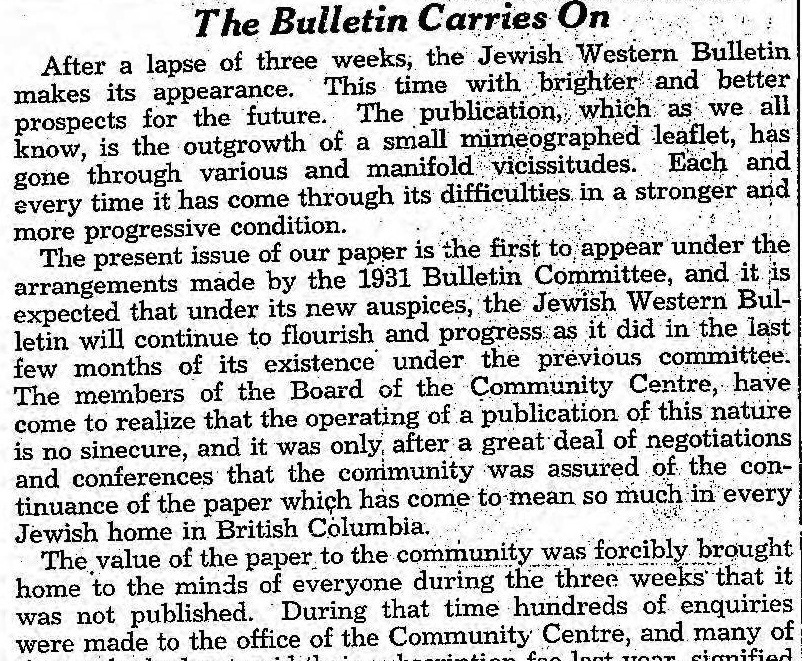
image - scan from paper The Bulletin by father-son team Ron and Steve Freedman in 1992 .Ron Freedman, who passed away in December 2014, worked for the Jewish Western Bulletin / Jewish Independent for 46 years. As we mourned his loss with his family at a ceremony celebrating his life, his son David shared the story of how his father and his brother Steve, who has worked at the paper for more than 30 years, used the power of community media to change his life.

As Alex Kliner explained in his May 15, 1998, Menschenings column:

“David Freedman was baffled. Three young women had responded to his personals column ad in the Jewish Western Bulletin. But wait! He had never placed an ad. But whatta ya’ gonna do? His curiosity was aroused. So he agreed to meet Betty-Mae Coblenz for coffee. They talked for hours. Not long ago, Betty-Mae Coblenz became Betty-Mae Freedman.

“And the mysterious ad? It seems David’s dad, Ron, and brother, Steve, (both JWB staffers) had placed it in the personals under David’s name. It was a joke! Not a bad joke, eh? And what’s more, it obviously pays to advertise in the JWB!”

Sunday’s trio of milestones

When counting blessings, our community has much to celebrate. If proof were needed, there is plenty at the newspaper. Not only have we been sorting through 85 years’ worth of the Jewish Independent in preparation for our special anniversary issue next week, but we joined hundreds of other community members this past Sunday to mark three significant community milestones.

In the early afternoon, a remarkable event took place at Mountain View Cemetery. The city-owned burial site has, since 1892, included a small section consecrated as the Jewish cemetery. In recent years, that section has declined. A dedicated group of volunteers set about to return it to the stature it deserves and, on a very sunny Sunday, the community gathered to see the results and celebrate the place. There was, it’s not inappropriate to say, a sense of festivity mingling with the solemnity of the event. While we were marking the rededication of a Jewish cemetery, we were also explicitly honoring and celebrating the lives of the people who built this community – and all those who are working to maintain and grow it.

Later that day, Temple Sholom held a siyum hasefer, marking the completion of a new Torah commemorating the congregation’s 50th anniversary. This “Torah of volunteerism,” in which the hands and spirits of so many people are ingrained in its beauty, is another symbolic and tangible act uniting the past, present and future of our community.

The day’s festivities drew to a close at the new Beth Israel, one of the oldest congregations in our community. The rebuilt synagogue provides some of the city’s best new meeting spaces and, in this case, we celebrated one of Judaism’s greatest achievements – well, of the modern era, at any rate. Canadian Friends of the Hebrew University, Vancouver chapter, convened an evening of education, entertainment and tribute in honor of that institution’s 90th anniversary.

It is hard to overestimate the impact of Hebrew University on the modern life of the Jewish people or of Israel. Founded by luminaries, including no less than Albert Einstein, it is a monument to the Jewish commitment to learning. However, to call it a monument is almost an aspersion, because it is an organic microcosm of Jewish life – and, as Jewish life has been throughout the ages – a light to the nations, welcoming scholars from around the world.

Attending these three milestones was affirming in several ways. It was a reminder of just how many people – of all walks of life, ages and affiliations – are dedicated to this community, working to make it better and trying to make sure that it has a future. It was also a reminder that, while the internet has its many advantages, there is something very special and irreplaceable about tangible records. There is something very special and incomparable to sharing a moment – joyous or sobering – with other human beings.

Headstones in a cemetery, a Torah scroll, the pages of a newspaper – they physically mark the path on our way long after we’ve made our way. We can touch them, which somehow connects us to them and each other in a way that cannot be reproduced in the virtual world. Laying a stone on a grave, scribing or reading from the Torah, even flipping through decades-old copies of the community newspaper – these present-day acts place our lives solidly in the continuum of humanity. This is both humbling and reassuring.

As we celebrate the minor miracle of the newspaper’s presence in and contribution to the community for 85 years, we are proud, not only of our own accomplishments, but those of the entire community. Together, may we go from strength to strength!


Still hoping for equality


At Israel’s Yom Ha’atzmaut celebration marking the 67th anniversary of the state of Israel, one of the 14 individuals selected for the honor of lighting torches kicking off the celebration was Lucy Aharish, a television newscaster and actor who happens to be an Arab citizen of Israel.

Of course, “happens to be” is an obfuscation given the charged nature of life in Israel and its region. The fact that she is an Arab citizen of Israel is not at all an insignificant fact. That, certainly, was the opinion of critics from across the political spectrum when it was announced that she would be among those centre-stage at the annual Independence Day ceremony at Mount Herzl Cemetery.

Her participation in the ceremony was politicized by both left and right – by the right for reasons that can hardly be described as anything but racist and by the left for reasons that seem based on the assumption that any Arab who participates in an official Israeli ceremony is a collaborator with some sort of Zionist … whatever.

Hopefully, the critics were schooled by Aharish’s magnificent, emotional words at the ceremony. Holding back tears, Aharish said that she was lighting the torch “for all human beings, wherever they may be, who have not lost hope for peace, and for the children, full of innocence, who live on this earth…. For those who were but are no more, who fell victim to baseless hatred by those who have forgotten that we were all born in the image of one God. For Sephardim and Ashkenazim, religious and secular, Arabs and Jews, sons of this motherland that reminds us that we have no other place. For us as Israel, for the honor of mankind, and for the glory of the state of Israel.”

Aharish, the only Arab lighting a torch in the ceremony, shifted into Arabic, Israel’s other official language, saying: “For our honor as human beings, this is our country and there is no other.”

A different yet parallel development occurred at the same time, when the annual Israel Prize for poetry and literature was bestowed on Erez Biton.

The Israel Prize is widely considered the country’s highest civilian honor and the jury that selected Biton described his five collections of poetry as “an exemplary, brave, sensitive and deep grappling with the wide range of personal and collective experiences, revolving around the pain of immigration, the travails of rooting oneself in Israel, and the establishment of eastern identity as an inseparable part of the full Israeli profile.”

Biton happens to be the first Sephardi Jew to receive the award in this crucial cultural category. Again, “happens to be” is a phrase that diminishes the cultural and historical realities that make this achievement one that transcends the individual and stands in for the history of neglect felt by this significant minority in Israeli society.

These two stories, each pleasant in their way yet tinged with the deep and diverse troubles of Israeli society, carry innumerable lessons for not only Israel but countries around the world.

There are people in every country who, because of the groups to which they belong, have experienced discrimination, decreased opportunities and, well, far worse. Yet within these groups are individuals who have nevertheless achieved accomplishments that suggest there is room for a better future, one that accepts diversity, that encourages creative grappling with a society’s complexities and that respects those who are unafraid to assert their rights.

Here’s hoping that this year, and in future years, a more diverse and equal world means that “happens to be” becomes the norm, not the exception.

The future to imagine

In the past several weeks, we have celebrated liberation and redemption on Passover. On Yom Hashoah, we mourned the victims of Nazism and the generations that never were. On Yom Hazikaron, we honored the brave defenders of Israel who gave everything for the dream of the Jewish people’s right to live as a free people in our own land. Then we joyously celebrated the realization of that dream on Yom Ha’atzmaut.

These four commemorations are drawn together in many ways by rabbis and thinkers. We are mere journalists, but if you give us a moment, we, too, have some thoughts that may be worthy.

There is a troubled narrative connecting the Holocaust and the creation of the state of Israel, a connection that is sometimes misunderstood and often deliberately misrepresented.

Critics have called Israel a “reparations payment” given to the Jews as recompense for the Holocaust. This formulation is a desecration, because there could be no recompense for the Holocaust. More to the point, it is false history. Israel was not given to the Jewish people. The Partition Resolution, significant as it was as a fulcrum for historical events, turned out to be another hollow United Nations vote. Israel came into being only because the Jews of Palestine, some from the Diaspora and a small group of idealistic non-Jews from abroad fought – some to the death – for the dream of a Jewish homeland.

The connection between the Holocaust and the creation of the state of Israel is not, as the popular narrative has it, because the world felt sympathy. If anything, the world wanted to create a place for the surviving remnant so that they wouldn’t have to take responsibility for them.

Where the genuine connection lies between the tragedy of the Holocaust and the joy of independence is in the realization that the Holocaust was a direct result of Jewish statelessness. Had Israel come into being a decade earlier, there may have been no Holocaust, or its magnitude would have been much diminished. That is one connection.

Another is the psychological effect the creation of the state had on Jewish people individually and collectively, in Israel and in the Diaspora.

After the Holocaust, the Jewish people worldwide could have been expected to plummet into individual and collective despair. Instead, Israel gave hope – and a future to imagine and to build after the collective future was almost destroyed. Whether Jews made aliya – or even visited – or not, Jewish Canadians helped build the state of Israel through a million acts of philanthropy and volunteerism.

Israel is many things to many different Jews. It is a resolution to 2,000 years of statelessness, the fundamental fact that was at the root of our tragedies. It is the culmination of the quest for sovereignty and freedom and, while Israel is not perfect by any stretch, we endeavor to work toward that ideal. Israel is the dream for which so many have given so much, as well as a complex, thrilling, sometimes infuriating, always cherished reality.

In the context of millennia of Jewish civilization, the comparatively new state of Israel is a part of all of us and we are all, in some way, a part of it.

Time to truly celebrate

This month – and in this issue – we celebrate Israel. Few regular readers would disagree with the assertion that the state of Israel represents a modern miracle. For whatever criticisms are fairly and unfairly leveled at Israel and its governments, this tiny country, populated mostly by refugees and their children, has accomplished and built one of the greatest societies in the world in what is, by historical standards, a blink of an eye.

There are so many quantitative examples of Israeli achievements: per capita numbers of Nobel prizes and other recognitions of achievements, world-leading academic publishing, number of businesses launched and successes reached, diverse and life-altering scientific breakthroughs and exceptional contributions across almost every discipline of human endeavor.

Then there are the incalculable measurements that are what strike so many of us when we visit Israel – or when we are visited by Israelis. In just the coming weeks alone, we are offered numerous samples of the cultural richness of the country.

The community-wide Yom Ha’atzmaut celebration on April 22 features Micha Biton, whose music is an example of the beauty that can emerge even in places and times of challenge, he being a part of the music scene in Sderot. A week-plus later, we will be treated to Ester Rada, an actress and singer who just emerged on the international scene.

These are just two of the most immediate examples of Israeli culture offered to local audiences year-round, including an embarrassment of riches during festivals like Chutzpah!, the Jewish book and film festivals, and during regular programming at the J. Israeli artists and photographers are regularly featured, as are speakers on diverse topics, brought here by local affiliates of Israeli universities and institutions.

To say that we – even 10,000 kilometres away – are enriched by the abundance of culture and knowledge that defines Israel is to underestimate the blessing it is to us. But this is not a one-way relationship. There is a greatness, too, in the way our community has mobilized for seven decades to help Israelis flourish. These bilateral connections are deep and important. From the moment the state of Israel was proclaimed 67 years ago, Vancouverites have been integrally involved with Israel in countless ways.

Before intercontinental travel became commonplace, stories appeared in the pages of this newspaper about locals traveling to Israel – as tourists, as volunteers, as dreamers seeking to see in their lifetimes the reality of a revived Jewish nation. More common still was the plethora of organizations emerging to assist in the nurturing of Israel through acts of tzedaka and volunteerism here at home. Women’s groups, youth movements, Zionist agencies of all stripes, “friends” of universities and hospitals, and so many other great institutions popped up, mobilized by the passion local community members felt for the rebirth of the Jewish nation.

Though these connections have changed, they have not diminished. Thanks to improved technologies and transportation, our community sends athletes to meet and compete with their Israeli cousins – and welcome Israelis here in return. We continue to support so many projects and institutions in Israel that “Vancouver” and local family names proudly adorn countless buildings, facilities, medical machinery, ambulances and other resources in Israel.

In a world that sometimes seems mad to us (as well as mad at us), there are few in our community who take for granted the blessing that Israel is to us and to the world.

As we celebrate Yom Ha’atzmaut this year, marking Israel’s 67th anniversary, let’s make a commitment to ourselves, a new year’s resolution of sorts for Israel’s new year.

Let’s be even more conscious of our relationship with Israel. Let’s go out of our way to buy Israeli products and support Israeli initiatives. Find an Israeli cause you haven’t yet supported – there are plenty of advocates right here in town for universities, charities and other great projects – and make it one of your causes. Take more of the opportunities offered to us throughout the year as Israeli speakers, performers and artists visit. Head to the Isaac Waldman Jewish Public Library and learn about an aspect of Israel that’s new to you. Watch more Israeli film. Take Hebrew lessons. The options are endless without even leaving the comfort of your hometown.

If you can, of course, travel to Israel. An “on-the-ground” education is invaluable. One of the best ways to express your curiosity, and support Israel is to spend time there, meeting Israelis, investigating for yourself aspects of Jewish history and culture, experiencing new tastes, sounds, smells and sights. And, while you’re there, open your heart and mind to the realities of this great country; pledge to learn more about the land, its people, its creatures, its ecology, the good, as well as the more challenging aspects that could use some work. Pack up the family, join a community mission or grab a backpack and head over on your own – the mishpacha is waiting for you.

Happy birthday Israel and moadim l’simcha.

Campus, church extremism

Last week, students at the University of British Columbia rejected a referendum question that would have urged the student society to boycott Israeli businesses and products.

But the news was by no means all good when the results came in last Friday night. In fact, more students voted yes in support of BDS (boycotts, divestment, sanctions) than voted no. The question was defeated effectively on a technicality, with the number of students voting yes failing to reach quorum. Therefore the question failed.

Students were asked: “Do you support your student union (AMS) in boycotting products and divesting from companies that support Israeli war crimes, illegal occupation and the oppression of Palestinians?” The yes side received 3,493 votes, 2,223 students voted no and 435 registered their abstentions. To pass, the vote required 4,130 yeses, representing eight percent of eligible students.

In this, too, there is good news and bad news. The low turnout indicates that students at the university have better things on their mind than the conflict between Israel and its neighbors. It has become increasingly clear in recent years that the anti-Israel movement on college campuses in North America is comparatively small. Yet the damage this narrow group of extremists can do to the comfort and security of Jewish and Zionist students – and to the broader objective of an inclusive, welcoming environment – has been serious and detrimental.

The BDS movement has had few tangible successes and plenty of failures, if measured by their effectiveness at actually boycotting, divesting from or sanctioning anything. What they have been wildly successful at is spreading messages that single out Israel as the fountainhead of all things evil.

Also mixed news is the fact that, while campaigns like BDS are finding it difficult to rustle up serious numbers of equally agitated fellow travelers, Jewish students, too, are challenged in finding substantial numbers of allies when confronted with a campaign of targeted aggression against the Jewish homeland. There might be only a few thousand out of more than 50,000 students who succumb to anti-Israel messaging, but there are even fewer who observe that messaging and are moved to come to the aid of Israel – and/or Jewish students – when it is attacked in this fashion.

Which raises another issue facing our Vancouver community.

Later this month, Canadian Friends of Sabeel will hold a conference on “overcoming Christian Zionism.” Sabeel describes itself as an “ecumenical Palestinian liberation theology centre” that is “working for justice, peace and reconciliation in Palestine-Israel.” In reality, it is a group that promotes a misrepresentation of events in the Middle East. The conference slated for Vancouver is explicitly aimed at undermining Israel among its North American Christian supporters.

Conservative Christians have been among Israel’s most reliable bloc of friends in troubled times. Like any bedfellows, the Zionist-Christian alliance brings with it complexities. While some Christians use Zionism as a back door to evangelizing or view Christianity as a “successor” religion to Judaism, for example, there are also many in the Christian Zionist movement who respect the integrity of Judaism.

The upcoming conference is co-sponsored by three Christian churches.

The United Church of Canada, for decades but especially in recent years, has adopted a heavily anti-Israel approach to global affairs. Their sponsorship of this event is not surprising. The Presbyterian Church in Canada is also supporting this event, though this, too, is not shocking, given that the American branch of the Presbyterian Church has been beset by anti-Israel agitation and last year voted to divest itself of some Israeli holdings.

What is surprising – and worrisome – is the role of the Anglican Church of Canada as co-sponsor of this conference. Two years ago, the church passed a resolution that made some attempts at balance but was marred by typical anti-Israel boilerplate. With their co-sponsorship of this Sabeel event, the Anglican church has thrown itself unequivocally off the fence.

There are parallels between these two developments – the UBC vote and the involvement of erstwhile moderate Christian groups in a blatantly anti-Israel conference. The fact is, probably most active Anglicans, Presbyterians and United churchgoers have no idea what their national bodies are up to. Of the millions of Canadians represented by these three denominations, the vast majority probably do not have an opinion on – or do not agree with – the approach of this month’s conference. As we saw at UBC, the anti-Israel movement tends to be a small group of zealots who get involved in a legitimate body and turn it into a platform, a rabidly anti-Israel tail wagging an otherwise amicable dog.

Like the impact of anti-Israel extremism on campus, the involvement of mainline Christian groups in this anti-Israel conference shows how a small group of dedicated individuals can create nasty, lasting divisions in a multicultural community.

Bibi’s self-made mess

Prime Minister Stephen Harper reiterated Canada’s support for a two-state solution in a conversation last week with Binyamin Netanyahu, the just-reelected prime minister of Israel.

The commitment to Palestinian self-determination was a subtle but clear message to the Israeli leader. Since Harper came to office, Canada has refrained from joining the global chorus of condemnation against Israel. Harper’s office issued a statement Sunday summarizing the remarks he shared with Netanyahu, which included congratulations on his success in the March 17 election.

Canada’s modest reminder to Netanyahu that the world expects a long-range resolution to the conflict that includes a Palestinian state reflects just one of the serious issues facing Netanyahu domestically and internationally.

The Israeli prime minister inherits – from himself – a political and diplomatic mess. In the last days of the election campaign, Netanyahu declared that a Palestinian state would not emerge on his watch. The context of the remarks may not have been quite as dramatic as media reports and global reaction suggest – he said they were premised on his assertion that the conditions were not ripe for a secure Palestinian state to emerge given the strength of adjacent Islamist regimes. And, in fact, immediately after the votes were counted, he began backpedalling.

But Netanyahu’s rhetoric is rarely subtle and he should not escape blame for his words and actions. On election day itself, Netanyahu sought to drive his supporters to the polls by warning of Arab-Israeli voters flocking to the polls in “droves” – a racist statement that pitted one group of Israeli citizens against another in ways utterly unbecoming the leader of a country.

Whatever it says about the Israeli electorate, these statements probably played a significant role in the surprise surge that delivered victory to Netanyahu’s Likud party.

Now that he is returning to office, Netanyahu has external as well as internal divisions to mend. Israel was already suffering from a lack of friends on the international stage before Netanyahu exacerbated already deeply strained relations with the American leader.

No one refutes the bad blood between Netanyahu and U.S. President Barack Obama, and both men bear blame for behaving like brats, rather than leaders of crucial allied states. But while Obama’s behavior toward Israel has looked passive-aggressive, Netanyahu’s behavior has been just plain aggressive, showing up in the American legislature to school the superpower on the subject of global politics.

Netanyahu may have revelled in the adulation of Republican and some Democratic lawmakers, but he was used as an obliging dupe in a domestic American partisan smackdown that verged on a constitutional calamity.

Now returning to office, Netanyahu faces a world even less amenable to his approach and weary of his belligerent manner. In these critical days of negotiation with Iran, Netanyahu is now trying to build bridges to the French leadership because he has lost leverage with the Americans.

In less than two years, the United States will have a new president, which will possibly reset the dynamic in the relationship, but the damage goes beyond a personal relationship.

Now that Israeli elections are over to Netanyahu’s satisfaction, perhaps he will allow his more diplomatic side to temper his politically expedient nature. The creation of his new coalition and cabinet will be the first major opportunity to read the tea leaves of his approach post-victory. We hope it signals a fresh approach.

Over the years, we have contended that Israeli decisions must be made based on Israeli needs, not on what makes it easiest for Diaspora Zionists to advocate for or defend Israel. But Netanyahu’s behavior during the election campaign has created genuine, real, not insignificant rifts between Israel and the people, like us, who are among its staunchest friends in the world.

It is up to Netanyahu now to demonstrate maturity and openness abroad and to repair the damage he has done domestically by pitting groups of Israelis against one another, by preordaining the failure of a two-state solution and for poking the country’s once-greatest ally in the eye.

Positivity is vital to life

The 15th annual Chutzpah! Festival of the Jewish Performing Arts concluded on Sunday with the group Diwan Saz. Their main message: music has no borders. And, “Don’t believe the news,” i.e. Israel is more than a conflict zone.

Yet, our brains are hardwired to find the negative in life. As one neuropsychologist writes, “the brain is like Velcro for negative experiences but Teflon for positive ones.” It is no coincidence that the news the media mainly reports is bad. It not only titillates, but it sticks with us. However, there are good news stories, and they should not be dismissed as “fluff,” or as less significant than the “serious” news. On the contrary.

The arts are vital to our lives, as are sports and other cultural endeavors. They are not merely for entertainment or to escape from reality. Among other things, these pursuits encourage creativity and propel innovation, they nurture our souls and provide ways in which we can connect to each other. They can be catalysts for all types of change in the world, making people aware of issues they might not otherwise consider, bringing people together to speak out against injustice or in favor of peace, for example.

The multicultural Bedouin, Israeli Arab, Turkish, Jewish Israeli (Ashkenazi and Sephardi) group Diwan Saz, comprised of nine musicians, is a prime example of how people of different places, beliefs and backgrounds can live, play and travel together – by choice, and happily, enriched by one another’s friendship and musicianship.

Since its beginnings, Chutzpah! has shown how arts and culture can bring diverse people together. In recent years, Israeli performers have graced the cover of the Georgia Straight in its Chutzpah! coverage. What better ambassadors of Israeli and Jewish culture, and the cross-cultural possibilities of the Middle East?

This week’s JI cover stories provide another couple of examples.

Twenty kids from the Canada Israel Hockey School, a joint venture of the Jewish Community Centre of Greater Vancouver and the Jewish Federation of Greater Vancouver, visited last week – Jewish Israeli, Arab Israeli, girls and boys, the hockey players see each other as teammates, playing for the love of the game. Not only are positive bonds and memories being formed among the players, but also between them and their coaches in Israel and in Vancouver, the local hockey players they met, both from the Jewish league and from the Canucks. Interviewed by CBC’s Shane Foxman, these kids were representing not just themselves, but the sport of hockey and their country of Israel – and they are cause for pride.

Sholom Scouts are also not “just” scouts. Not to put too much pressure on them, but they are Jewish ambassadors to the larger Scouts community as well as the general community. Within the Jewish community, they represent a spectrum of Jewish beliefs, all coming together to become good stewards of the land and good citizens.

It is healthy to see the negative: it helps us to be safe, to become aware of what isn’t quite right, what needs adjustment and what areas of justice still need to be pursued. As Leonard Cohen sings, “there is a crack in everything, that’s how the light gets in.” But, focusing exclusively on the negative – the crack instead of the light – isn’t healthy, not for ourselves personally or for society at large. This does not imply blocking out the reality of the suffering that does exist, but instead recognizing that we ignore the beauty, loving kindness and bright spots of reality to our detriment.

Whether it’s by being more mindful, cultivating more loving kindness, reducing stress and anxiety, re-balancing our middot, being open to new and challenging experiences or learning more about something that interests or concerns us, we can find more good. It takes time and effort to “hardwire happiness” in our brains and in our lives, but it’s possible.

It helps when we consciously draw out the positive, such as the stories mentioned here, and engage in the positive cultural and social behaviors that make us more than mere human animals, and more fully and happily human.

Netanyahu lacks leadership

At a rally in Rabin Square in Tel Aviv on March 7, calling for Prime Minister Binyamin Netanyahu to be replaced in the upcoming elections, protesters held signs saying “Change Now.” (photo by Ashernet)

This week’s pre-election tempest is over whether Israeli Prime Minister Binyamin Netanyahu supports the concept of a two-state solution. Bibi’s ponderings on the subject led his own party to contradict him – days before the high-stakes Israeli general election.

On the subject of ceding land to Palestinians, a Likud party statement released Sunday read, “Prime Minister Benjamin Netanyahu said that any evacuated territory would fall into the hands of Islamic extremism and terror organizations supported by Iran. Therefore, there will be no concessions and no withdrawals. It is simply irrelevant.”

It’s difficult to know what to make of Netanyahu’s words and actions lately, to determine how much is for consumption abroad, how much is ideological and how much is pure political expedience.

It was, for example, hard for some Israel watchers to disagree with anything he said to the U.S. Congress earlier this month, even if they disagreed with him speaking there. It was enough that he was showing “moral courage” and “true leadership.”

Of course, there were others who could find little right with what the prime minister said to Congress. Meir Dagan, for instance. Dagan, former head of Mossad, called Netanyahu’s congressional speech “bullshit.” Then, on Sunday, the outspoken Dagan addressed a rally in Tel Aviv’s Rabin Square against Netanyahu’s policies, telling the thousands-large crowd, “I am frightened by our leadership. I am afraid because of the lack of vision and loss of direction. I am frightened by the hesitation and the stagnation. And I am frightened, above all else, from a crisis in leadership. It is the worst crisis that Israel has seen to this day.”

In Israel, Netanyahu has refused to participate in debates during the campaign. While he’s not alone in his refusal – Zionist Union leader Yitzhak Herzog, too, has been absent – some have questioned why Netanyahu is willing to speak to the American public but not to his own. They are concerned with what they see as a lack of leadership and statesmanship at home.

With Netanyahu describing his prior support for a two-state solution as no longer relevant, it is unclear whether he intends to prevent the creation of an independent Palestinian state ever, or whether he means only in the current climate of regional (and global) instability. It remains to be seen whether he is just grasping at political straws, trying to convince those on the right to vote for him, or he feels so confident that he can finally say what he truly believes.

No matter who is elected on March 17, the chance of a two-state solution emerging anytime soon is miniscule – neither Netanyahu, his contenders for prime minister, nor the current Palestinian leadership seem ready to take the necessary steps. So maybe his current views are also irrelevant?

Bipartisan support of Israel

The controversy around Israeli Prime Minister Binyamin Netanyahu’s speech to the U.S. Congress this week was so fraught with partisan rancor – or at least with punditry alleging partisan rancor – that the theme at the AIPAC conference in Washington, which immediately preceded the prime minister’s address, was “all bipartisanship all the time.”

Democratic U.S. Senator Ben Cardin and Republican Senator Lindsay Graham opened the event Sunday morning with emphatic assertions that American support for Israel overrides all partisan politics. The message was repeated later in the day by top Democratic and Republican officials from the House of Representatives. Messages of cross-partisan rah-rah for Israel were featured in many of the conference speakers’ messages and on the massive 360-degree screens encircling the U.S. capital’s cavernous convention centre. The American ambassador to the United Nations made the same case.

As the country’s greatest ally in the raucous Middle East, Israel is somewhat akin in the American political culture to the U.S. military – one can criticize policies and politicians, but it is de rigueur to restate philosophical support for Israel as a great ally and for the right of Israel to defend its citizens.

This sort of bipartisanship has not always been the case in Canada, which has a very different perspective on foreign affairs and, sometimes, on Israel. But that has changed, according to a panel of Canadians who addressed the conference.

Shimon Fogel, chief executive officer of Canada’s Centre for Israel and Jewish Affairs, moderated a session featuring Jonathan Kay, editor of The Walrus magazine and former comment page editor of the National Post, and Terry Glavin, a Victoria-based commentator and author.

“Israel has won the battle of ideas in Canada,” Kay said.

While many credit Prime Minister Stephen Harper with leading the change, both men see a deeper shift in public opinion. Glavin called it “tectonic.”

The change is due to a few things, the two commentators agreed.

Anti-Zionism comes in a grab bag with anti-Americanism, Kay said, and Canadian anti-Americanism is in freefall since Barack Obama became U.S. president and Stephen Harper became Canadian prime minister. (It’s hard to condemn Americans over, say, environmental issues when Obama vetoes the pipeline Harper backs.)

The rise of social media has also played a back-door role. The CBC was routinely criticized for being anti-Israel a few years back, but the social media backlash every time biased reporting occurred – aided by groups like Honest Reporting – has led to fairer coverage.

“I actually find the CBC’s coverage of Israel pretty good,” said Kay.

The 9/11 terror attacks also provided a major impetus for changing Canadian views of friends and enemies. But the Canadian military engagement in Afghanistan perhaps drove the major shift of opinion, said Glavin. Two generations of Canadians had not seen active wartime mobilization. The fight against radical Islam, in the form of the Taliban, changed perceptions of global issues, including Israel’s struggle against nominally different but ideologically parallel enemies.

Where anti-Zionism was most successful – on university campuses – most students now roll their eyes at the “trite and ritualized” debate on both sides, said Kay. In terms of professors supporting the BDS movement, he added, it is the “least consequential” academic organizations making the case. And gay rights groups opposing Israel are “underemployed” activists who have won most of what they were demanding.

Significantly, he continued, at the national level, the elements of the Liberal and New Democratic parties that once condemned Israel for every imaginable crime have been reined in by their parties. Notoriously anti-Israel NDP MP Svend Robinson is gone from the scene. His ideological successor in anti-Zionism, Libby Davies, has announced she will not seek re-election in Vancouver East, although Kay said she has already been “defanged” by party leader Thomas Mulcair, who Kay said makes no apologies for his support for Israel.

Glavin noted that the Arab Spring, which represented the rising of 300 million more or less enslaved people, made it “difficult to make the case that Israel is the big problem in the Middle East.”

Both men noted that the shift began with Liberal Prime Minister Paul Martin, under whose leadership Canada changed its voting patterns at the United Nations. The pro-Israel position accelerated under Harper, particularly after the 2011 election when the Conservatives won a majority and John Baird was appointed foreign affairs minister. Baird, who left politics this year, was greeted with a hero’s welcome at the AIPAC conference.

While Canadians are proud to be different than Americans on many fronts, the consensus on Israel that has reigned in the United States is now dominant in Canada, as well.