Learning opportunities

While a report this spring by the New York-based Jewish Education Project showed a decline in Jewish supplementary education in North America over the past 15 years, participation in after-school and weekend educational programs in British Columbia is on the rise.

Since the 1990s, the Jewish Federation of Greater Vancouver has provided small grants to local supplementary schools; at present, it funds 11 programs. And, in 2015, Federation convened the Jewish Education Task Force to look into the state of part-time education.

“Through this work, we recognized the importance of focusing on innovation and change to attract a new generation of families,” said Shelley Rivkin, Federation’s vice-president of local and global engagement. “We were able to provide innovation grants and professional development opportunities for supplementary school educators to learn new and diverse ways to offer Jewish education. More importantly, we expanded the definition of fundable supplementary schools to include Shabbat, family and Hebrew literacy programs.”

According to Rivkin, while the Jewish Education Project report brought attention to the fall in enrolment elsewhere (see jewishindependent.ca/drop-in-jewish-learning), Federation’s experience has been that enrolment here has either remained stable or grown in the last few years.

“We have seen significant gains in supplementary school enrolment in both the regional and emerging communities, where families are seeking opportunities to connect with other Jewish parents and provide opportunities for their children to have Jewish experiences,” Rivkin said.

For example, BC Regional Hebrew Schools, operated through Chabad and funded in part by Federation, has become an important part of building Jewish community life in places like Langley, Coquitlam and Whistler. Likewise, programs directed toward Hebrew-speaking families, which have a broader focus on Israeli culture, are attracting new families who are looking for different content.

“We have seen all of our supplementary school providers adapt and change in response to changing demographics. All offer a range of activities utilizing innovative teaching methods and engaging content to appeal to a diverse group of children and their families,” Rivkin said.

The same is true for the Lower Mainland, where Federation notes that supplementary schools are making a difference as well.

“The Jewish Federation’s Supplementary School Grant helps us in many ways,” said Noga Vieman, education director of Congregation Har El in West Vancouver. “First, we believe that every child in every Jewish home deserves an enriching Jewish education and experience. The grant helps us keep the program reasonably priced, and offers us the opportunity to create scholarships for those in need, so that financial challenges will not prove a barrier to getting quality Jewish education and becoming part of the Jewish community.”

The grant also helps Har El provide its teachers with fair compensation, allowing the North Shore Jewish centre to attract and retain quality educators with a passion for working with children and building the future of the Jewish community in the region.

Further, part of the grant Har El receives is dedicated to funding classroom assistants to help increase inclusion.

“In our program, this money goes towards paying for an education assistant for a child who is blind, and also for teens who help children with different learning abilities, and who need personal support during class,” Vieman said. “This helps to create intergenerational connections, and keeps the teens involved in the community past their own education in our program.”

At the Peretz Centre for Secular Jewish Culture, the Federation grant has been used for Pnei Mitzvah, its secular humanist program for youth aged 10 to 14 that focuses on the Hebrew language, Bible stories, Jewish holidays and Jewish culture.

“We have been growing the program in recent years and have expanded it province-wide through an online cohort,” said Maggie Karpilovski, executive director of the Peretz Centre. “This growth would not be possible without Federation’s funding. It allowed us to attract expert teachers and innovate the delivery model so that it is accessible to more Jewish families throughout the region. As we are the only secular Jewish humanist organization in BC, and the Jewish community is spread out quite widely, it is important for us to make our programs accessible.”

Jen Jaffe, school principal at Temple Sholom, confirms the value of Federation’s financial support. “The grants allowed us to become more accessible to students of varying learning needs,” she said.

At Temple Sholom, the funding has been used to contribute to the school’s madrichim program and create a “learning hub” space for students with needs including sensory materials and furniture. The space is used each time school is in session.

“We need to celebrate these successes,” said Rivkin, “and applaud the educators and parents who are ensuring the survival of part-time Jewish education.”

To donate to Federation’s annual campaign, visit jewishvancouver.com.

Sam Margolis has written for the Globe and Mail, the National Post, UPI and MSNBC.

המלחמה במזרח התיכון תשפיע לרעה על חיי יהודים וישראלים בכל רחבי העולם

בשלב זה ישראל מקבלת תמיכה ממרבית מדינות המערב. אך יש סיכוי שעם ההתקדמות של מבצע צבאי של צה”ל ברצועת עזה, התמיכה תלך ותרד עם עליית הנפגעים בצד הפלסטיני
(photo by Roni Rachmani)

המלחמה הקשה שמתנהלת בימים אלה בין ישראל לחאמס ויכולה להתפשט לחזיתות נוספות, צפוייה להשפיע לרעה על חיי יהודים וישראלים הגרים בקנדה, ארה”ב, אירופה ומקומות אחרים. הם צפויים לעמוד מול איומים שונים של פלסטינים ותומכיהם שמאשימים את ישראל גם במשבר הנוכחי. תומכי הפלסטינים קוראים להקמת מדינה לפלסטינים מהנהר ועד הים – שפירושה המעשי השמדת מדינת ישראל

העולם המערבי כולל צפון אמריקה מלא כיום מיליוני מוסלמים שהיגרו ממדינות ערב לאורך שנים רבות. חלק לא מבוטל מהם ממשיך לשמור נאמנות למוצאם ודתם בצורה פנאטית ורואה בישראל כמדינת אויב

עוד שגרתי בישראל טענתי שהסכסוך בינה ובין הפלסטינים וחלק ממדינות ערב יסכן גם את חיי היהודים והישראלים הגרים מחוץ למדינה. אמרתי אז שלישראל יש גם את האחריות לשמור על היהודים והישראלים, שבחרו לגור במקומות שונים בעולם ובעיקר במערב. ומוטל על ישראל לשקול בזהירות את צעדיה שכאמור יכולים להשפיע לרעה על היהודים והישראלים שגרים בחוץ לארץ

עובדה היא שאנטשימיות נגד יהודים וישראלים ברחבי העולם הולכת וגדלה, וכבר בסכסוך הקשה הנוכחי, נרשם גידול נוסף בשנה נגדם. וזו רק ההתחלה. אני צופה להרעה משמעותית עד סכנת חיים ליהודים והישראלים בצפון אמריקה, אירופה ומקומות אחרים. כבר עתה ידוע על הפגנות גדולות קשות נגד ישראל ותמיכה בפלסטינים. אלה עלולות להחמיר לעימותים פיזיים קשים עם יהודים וישראלים ואף יותר מכך. משטרות בערים רבות בעולם הדקו את ההגנה על מוסדות יהודים שונים ובהם בתי כנסת. נרשמו כבר לא מעט איומים נגד יהודים, ישראלים ומוסדות שונים בעולם ולכן השמירה מאוד חשובה במיוחד בימים טרופים אלה

בשלב זה ישראל מקבלת תמיכה ממרבית מדינות המערב. אך יש סיכוי שעם ההתקדמות של מבצע צבאי של צה”ל ברצועת עזה, התמיכה תלך ותרד עם עליית הנפגעים בצד הפלסטיני. במקביל צפויים היהודים והישראלים ברחבי העולם לסבול מגידול משמעותי באנטישמיות, התנכלויות, ואף מאיומים פיזיים

חברת אייר קנדה מהירה לפטר טייס מוסלמי שהתבטא נגד ישראל וכתב בחשבון הטוויטר שלו: “היטלר גאה בישראל”. מוסטפא איזו השתתף בהפגנה במונטריאול בעד הפלסטינים נגד ישראל והוא אף הצטלם עם צעיף בצבעי דגל פלסטין. זו לא הפעם הראשונה שאיזו מתבטא נגד ישראל ותומך בפלסטינים אך הפעם מתברר שהוא חצה את הגבול ובאייר קנדה מיהרו לפטרו

ראש ממשלת קנדה, ג’סטין טרודו, גינה את מתקפות הטרור נגד ישראל בהתייחסו להתקפה של חמאס על עשרות ישובי עוטף עזה בה נרצחו למעלה מאלף שלוש מאות ישראלים, נפצעו למעלה מארבעת אלפים ונלקחו בשבי קרוב לוודאי כמאה וחמישים אזרחים, חיילים, ועובדים זרים. בהודעה שפרסם בטוויטר אמר טרודו כי פעולות אלימות אלה בלתי מקובלות באופן מוחלט. אנו עומדים לימין ישראל ותומכים באופן מלא בזכות להגן על עצמה.  מחשבות שלנו תמיד עם כל אדם שנפגע. חייבים להגן על חיי אזרחים, חתם טרודו את הודעתו. מנהיג האופוזיציה והמפלגה הקונסרבטיבית, פייק פוליוויר, גינה באופן חד משמעי את הפלישה של טרוריסטים של חמאס לישראל ואת האלימות האכזרית שהם הפעילו נגד אזרחים חפים מפשע. לדבריו לישראל הזכות להגן על עצמה בפני התקפות אלה ולפעול נגד התוקפים. מנהיג מפלגת השמאל אן.די.פי ג’גמיט סינג כתב בחשבון הטוויטר כי הוא מגנה את ההתקפות הנוראיות שביצע החמאס בישראל. אסור לעולם לפגוע באזרחים וכל החטופים צריכים להיות מחשוררים באופן מיידי. לדברי סינג יש חשש מההתפתחויות עתה. טרור ואלימות לא יפתרו דבר

המלחמה של ישראל

המלחמה הנוכחית שנכפתה על ישראל מציגה שני מראות עיקריים: אסון וזוועה על מה שעשו מחבלי חמאס וכישלון גדול של הממשלה בראשות בנימין נתניהו, הצבא, מערך המודיעין, השב”כ ואולי גם המוסד

החמאס הוכיח שהוא ארגון טרור רצחני ולא אנושי תוך שהוא מותיר מאות הרוגים ופצועים. אחרים נלקחו בשבי. לא מדובר רק בחיילי צה”ל אלה בעיקר באזרחים, נשים וילדים, גברים וזקנים. חלקם נטבחו, חלקם עונו וחלקם כך סתם נרצחו. החלק האחר הוא אולי במצב הקשה ביותר: נלקח בשבי על מנהרות החמאס בעזה הצפופה. מאז קום המדינה לא היה אירוע כזה בו נהרגו ביום אחד מאות רבות של אזרחים וחיילים. הפוגרום הנורא ביותר בתולדות הישוב היהודי בארץ ישראל. התמונות בערוצי הטלוויזיה ואתרי החדשות באינטרנט על הנרצחים, הפצועים ואלו שנשבו, הם קשות מנשוא. חיות אדם בסגנון דאעש אחראים לדבר הנורא הזה

במקביל הכישלון של ישראל שנתפסה מופתעת לחלוטין מתקפת הפתע של חמאס, ולאחר מכן לקח זמן רב מדי לכוחות צה”ל ומערך הביטחון להגיע אל ישובי חבל עזה, ולהציל את אלה שהמחבלים לא הספיקו להרוג. נתניהו קיבל מידע ואזהרה מהמצרים ממה שחמאס עומד לעשות והתעלם מכך. היה לו הרבה יותר חשבו לעבות את השמירה הצבאית על ההתנחלויות בשטחים הכבושים, שנציגיהם יושבים בממשלתו. נתניהו הזחוח והשחצן ייזכר לדראון עולם כראש הממשלה הגרוע ביותר בתולדות ישראל. זאת, כיוון שהוא לא מנע את האסון הגדול ביותר שקרה למדינה ולאזרחיה. “שותפים מלאים” לכשלונו של נתניהו חברי ממשלתו שאין להם מושג איך לנהל מדינה והם דואגים רק לאינטרסים האישיים שלהם. גם לצבא הגנה לישראל יש חלק גדול בכישלון הנוראי שגב המחיר קשה מנשוא. מערכת ההגנה על יישובי חבל עזה עם כל הטכנולוגיה שלה קרסה תוך דקות על ידי עשרות מחבלי חמאס שנהרו אל הישובים החשופים. מערך המודיעין של צה”ל, השב”כ ואולי גם המוסד לא ידע כלל על הכנות של החמאס לביצוע המבצע לכניסה לשטחי ישראל. לקיום מבצע שזה דרושים חודשים ארוכים תוך תיאום עם גורמים באיראן ואחרים. כל אלה הצליחו להערים על המודיעין הישראלי בקלות בלתי נתפסת

לאחר שהמלחמה תסתיים צפוי שבכירים בצבא, במערך המודיעין והרמטכ”ל, בכירים בשב”כ ובמוסד והעומדים בראשם יתפטרו עוד לפני שוועדת החקירה הממלכתית תדון בסוגיית האחריות והכישלון שאפשר לחמאס לבצע את פשעיו. לעומתם נתניהו כרגיל לא יקח שום אחריות למעשיו. בכל הקריירה הפוליטית הארוכה שלו הוא תמיד ידע להאשים אחרים. אבל שום אחריות אישית. נתניהו יעשה הכל כבעבר להמשיך ולשבת על כיסא המלך כי נתניהו דואג רק לנתניהו

נתניהו מינה חברי ממשלה חסרי יכולת לטפל בתיקים עליהם הם אחראים. לא כישוריהם הביאו אותם לשולחן הממשלה, אלא הנאמנות למנהיג נתניהו. לכן לא מפתיע לגלות את חוסר יכולתם של שרי הממשלה הנוכחית לטפל במצוקות הרבות של ישראל בימי המלחמה הקשים האלה. נשמעה ביקורת נוקבת על שרי ממשלת נתניהו שלא ביקרו פצועים בבתי החולים ולא השתתפו בהלוויות הקורבנות הרבים

בתור אחד שגר בישראל ארבעים וחמש שנים לא האמנתי שהמדינה תגיע למצב שכזה. החברה מפוררת מבפנים בעיקר לתודות הרפורמה המשפטית של נתניהו. הצבא לא ערוך לאתגרים האינסופיים שלו ואת ההנהגה תפסו פוליטיקאים קטנים שנכשלו בתפקידם. ישראל משלמת היום מחיר כבוד מאוד לאור מחדלי ההנהגה שלה. אני לא צופה עתיד ורוד בהמשך הדרך. על נתניהו מוטל לעשות רק דבר אחד: ללכת הביתה

“We are safe,” says Shanken

For safety reasons, Jewish Federation of Greater Vancouver is asking community members to avoid anti-Israel protests or events. (photo by Larry Barzelai)

“We are safe,” says Ezra Shanken. The chief executive officer of the Jewish Federation of Greater Vancouver reassured local Jews that, in light of massively increased tensions globally, there are no specific increased threats to the Jewish community in British Columbia.

Despite fears, no serious attacks or incidents of vandalism have been reported, with the exception of an incident in Surrey. Someone threw eggs at the home of Rabbi Falik Schtroks, spiritual leader of the Centre for Judaism of the Lower Fraser Valley, and a swastika was drawn in felt pen on a window of the home.

“One of the things that people who hurt the Jewish people … don’t realize, when that happens, we always come together,” the rabbi told CTV News.

“We’ve seen what happened to Rabbi Schtroks’ place,” Shanken said. “We take that very seriously. But, on the whole, we are safe.”

Jewish community organizations, under the leadership of the Jewish Federation in partnership with other agencies, especially those with physical spaces, like synagogues, schools and community centres, work year-round on security issues, ready for any possible local impacts that so frequently coincide with overseas conflicts.

Shanken credited Federation’s “very active” security committee and the professional security director, all of whom are coordinating among various Jewish agencies.

As he has at successive public events, Shanken heaped kavods on the Vancouver Police Department, the RCMP and other police agencies.

“The amount of resources they are expending on our community, to make sure that we are safe, is astronomical,” said Shanken. “I have just so much gratitude for them and for all they do for us, day in and day out.”

He encourages individuals who encounter police at the Jewish Community Centre, outside synagogues, schools or elsewhere, to take a moment to express gratitude.

“Go up, shake their hand, thank them, give them a hug, give them some cookies, give them some food, make them feel like they are being loved,” he urged.

In addition to simply being a kind thing to do, showing appreciation for the police, Shanken said, is a way to further demonstrate the moral divide between the Jewish community and those who are protesting Israel. Shanken said police working at anti-Israel rallies have been spat on and had things thrown at them.

“I want to make sure that there couldn’t be a clearer distinction in our community from those on the other side when it comes to how we treat our first responders and our law enforcement,” he said. “We are here to say thank you and to engage with them because they are keeping us safe.”

Although schools saw some understandable decline in turnout on the so-called “Day of Rage” called by Hamas against Jewish individuals and institutions worldwide for Oct. 13, Jewish British Columbians are going about their lives.

“People are coming into our JCC,” said Shanken. “They know they should come here and, if anything, they should be here so we’re sending a message that says we will not be dictated to on how it is that we can live within our community by others. We are going to come out and we are going to be strong, proud people within our communities, enjoying the things our community has to offer.”

In a message to the community in advance of the Hamas call for violence worldwide, Federation assured that “we will always act in a proactive, abundantly cautious manner when it comes to community security.”

The communication added that “we also recognize that these calls are also designed as a tool of intimidation and fear to harm our mental and emotional health. They are meant to stop us from going about our daily lives, regardless of whether there are specific security threats.”

The Vancouver Police Department, the RCMP and other security forces are maintaining a visible presence in front of high-profile organizations, including schools, synagogues and the JCC.

“Please note that there may not be a car present at all times and you may not see people in uniform,” the message noted.

Increased patrols are taking place around all Jewish institutions. In addition, Jewish organizations have been flagged by police as priority institutions, which means that any emergency call to law enforcement will result in an immediate and enhanced response, Federation said.

Federation is also working with partner organizations, as they do always, around security protocols.

For individuals and families, Federation is asking people to avoid anti-Israel protests or events. At Jewish community rallies or vigils, people are asked to not engage with protesters. At all times, people should stay aware of surroundings, and report anything suspicious to the police.

To ensure you are receiving all security updates and other communications from the Jewish Federation of Greater Vancouver, click the “Connect” button at jewishvancouver.com. The Federation website also includes resources for talking to children about the situation, and links to specific, up-to-the-minute news on events in Israel and elsewhere.

Rally and march for hostages

Hundreds marched on Oct. 22, calling for the release of the more than 200 Israeli hostages being held by Hamas and other terror groups in Gaza. (photo by Pat Johnson)

Erez, aged 12, and his sister Sahar, 16, had spent the night at their father’s house in Kibbutz Nir Oz when Hamas terrorists stormed the home. The kids jumped out the window and hid in the bushes while gunmen rampaged their community, shooting entire families in their beds and safe rooms. “Mom, be quiet, don’t move,” he texted his mom, Hadas. She texted back: “I love you forever. I hope you survive.”

Erez did not reply. For hours, Hadas called Erez’s cellphone repeatedly, even as she fought for her life, physically blocking terrorists from breaking down her safe room door. Then Erez’s older sister found an 18-second video circulating on social media. It showed Erez in a black T-shirt, being gripped by both arms and led into captivity.

In all, five members of the Kalderon family were taken: Erez, Sahar, their 50-year-old father, Ofer, their 80-year-old grandmother, Carmela, and 12-year-old cousin, Noya, were grabbed from another house in the community.

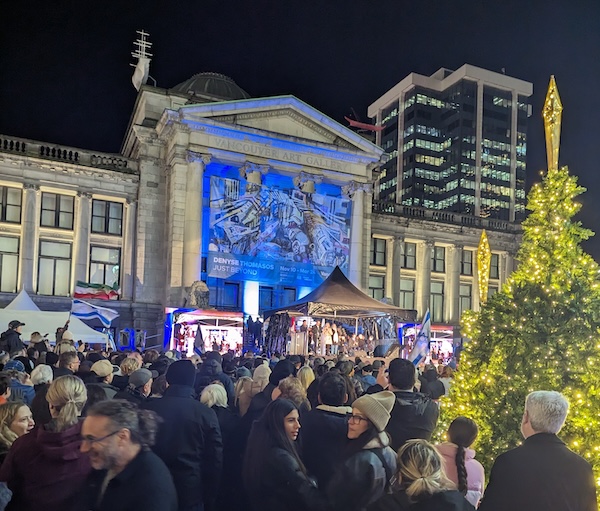
This was one of many individual stories shared at a vigil and march in Vancouver Sunday, Oct. 22, where hundreds of Vancouverites chanted “Bring them home!” and “Let our people go!” as they marched from the Vancouver Art Gallery, protected by a large police presence, along Georgia Street, over to Robson and back to the original site. The steps of the art gallery’s north side were packed with people holding posters of the hostages – and these posters represented only half of the total number of Israeli hostages held by Hamas and other terror groups in Gaza.

The faces are also seen on thousands of posters around Metro Vancouver and elsewhere. Activists in communities worldwide have downloaded and printed the sheets, plastering them around city streets. The Vancouver efforts – which have seen probably 20,000 posters distributed so far – are led by Daphna Kedem, who also initiated the Sunday afternoon event and an earlier vigil two days after the Oct. 7 terror attacks.

photo - About 20,000 posters – the cost of which was covered by two anonymous non-Jewish donors – have been put up by volunteers all around Metro Vancouver
About 20,000 posters – the cost of which was covered by two anonymous non-Jewish donors – have been put up by volunteers all around Metro Vancouver. (photo from Daphna Kedem)

Kedem is also a lead organizer of the local branch of UnXeptable, which, until the current crisis, was agitating against proposed Israeli government efforts to undermine responsible government there. Her current activism, she stressed, is done in her capacity as an individual, but she expressed gratitude to Rabbi Dan Moscovitz of Temple Sholom for helping organize, and to other synagogues, the Jewish Federation of Greater Vancouver and others for unhesitatingly jumping in to help.

Putting a human face to the hostages is the right thing to do, Kedem said.

“We have to bring it out to the public because it’s a humanitarian crisis,” she told the Independent. “Once you personalize it and you see that it’s an innocent baby or a child, you care more.”

photo - Left to right: Flavia Markman, Ezra Shanken, Anet Bernadette and William Wolff. The four are among the many volunteers who have put up around the city approximately 20,000 posters with the faces, names and ages of Israelis taken hostage by the terrorist group Hamas. For more on the Bring Them Home Now effort
Left to right: Flavia Markman, Ezra Shanken, Anet Bernadette and William Wolff. The four are among the many volunteers who have put up around the city approximately 20,000 posters with the faces, names and ages of Israelis taken hostage by the terrorist group Hamas. For more on the Bring Them Home effort. (photo by Flavia Markman)

Kedem said the cost of printing the thousands of posters was covered by two anonymous non-Jewish donors and, at the rally this past Sunday, Christian clergy spoke, including a Catholic representative and two evangelical ministers.

Nevertheless, frustration over the silence of so many others was evident in the words of Moskovitz to the rally.

“Once again, Jews are being slaughtered and violently attacked and the world is silent,” he told hundreds of attendees, many carrying Israeli or Canadian flags. “Or they say, ‘Yes, but.’ There is no ‘but’ to murder. There can be no ‘but’ to hate. There can be no ‘but’ to the kidnapping of civilians, of children, of grandparents, of pregnant mothers, of disabled people. There can be no ‘but’ to that. There can be no justification for that. This is 2023, not 1943. And yet ‘Never again’ is happening again right now. The Jewish people will not be silent. You must not be silent.”

Moskovitz slammed the moral equivocation heard in commentary and seen in street rallies worldwide.

“This was not an act of resistance,” he said. “This was not a military campaign. This was not a popular uprising. This was cold, calculated and barbaric murder and rape and kidnapping of innocent civilians, the vast majority of them Jews.”

Motioning to the posters of the hostages, he added: “We call on those in our own city who cheer and celebrate what Hamas has done to these people and thousands of others on that horrible day to stop. Stop cheering the terrorists. Stop denying our grief, our human value. Stop your whataboutism. Stop tearing down pictures of children who have been kidnapped. Stop helping the terrorists. Stop justifying their brutality. Simply, stop.… Find your moral compass. Find the compassion you have for everyone and everything except Jews. Join us in this most basic of human cries: return our children to their parents, return our families to their homes.”

A WhatsApp group, “BTH – Vancouver,” is coordinating the postering activities: to join, visit bit.ly/BTH-Vancouver. Posters are downloadable by anyone at kidnappedfromisrael.com.

Funds to help Israel pour in

Jewish Federation of Greater Vancouver chief executive officer Ezra Shanken on Victoria Rumble Room Oct. 14. Shanken has very much been the face of the Jewish community in recent days. (screenshot)

An emergency fundraising campaign in response to the devastation in Israel raised more than $15 million in Metro Vancouver in less than two weeks.

The Jewish Federation of Greater Vancouver is spearheading the Israel Emergency Campaign. In his weekly email last Friday, Oct. 20, Federation chief executive officer Ezra Shanken announced the record total that had been raised to that point. By comparison, last year’s entire annual campaign raised $10.2 million.

Shanken told the Independent that, within the $15 million-plus total, is another new record for the local community: nine gifts of $1 million and a gift of $2 million.

Despite the great success, Shanken said the money will barely begin to approach the needs created by the human and material destruction caused by the Hamas terror attacks and the ongoing aftermath.

“As excited as I want to be,” he said, “I felt like $20 million, which is where we would like to get to, is not even going to be enough. The destruction, both in human life and in physical property, is so immense in the south, the risk is so high in the north, the mental health needs are so huge over there, that those alone are multi-, multi-million-dollar needs.… The damage is so deep that it’s going to take a lot for us to be able to make an impact.”

The Jewish Federations of North America set a goal of $500 million for the combined campaign and was already well past the two-thirds mark at the end of last week. Other Israel-based and Israel-supporting charities are also raising money and delivering support through funds and on-the-ground projects.

The speed and magnitude of the local emergency fundraising effort, Shanken said, may be a consequence of the community campaign already underway for the redevelopment of the Jewish Community Centre of Greater Vancouver. He calls it the “JWest effect,” referring to the name of the redevelopment project. Sensitizing philanthropists to community needs may have sowed the field for the extraordinary generosity shown when this unanticipated catastrophe occurred. The feeling that this is an unprecedented historical moment is also a factor.

For media in British Columbia and at public events, Shanken has very much been the face of the Jewish community in recent days. Speaking personally, he described the flood of contradictory emotions he has experienced.

“This time has been a mix of incredible pride and incredible pain,” he said. “They come in different waves. I have incredible moments of pride and incredible moments of resolve and strength and incredible moments of weakness and pain and depression.”

Shanken continued: “It’s a tough time for all of us, it’s a tough time for me.… But I believe more than ever that these are the moments where we are really forged in these fires and we will be a stronger community because of what we’re going through in this moment.”

The inhumanity witnessed not only in Israel but closer to home, with protests and statements effectively supporting and celebrating the mass murders, has stiffened his resolve, he said.

“I feel a need to stand up against those who are really trying to push us down in this moment,” he said. “I feel strong, I feel determined, I feel righteous in this moment in pushing back against those who are going to minimize the deaths of these folks, that are going to make us feel that we don’t have a right to grieve, we don’t have a right to defend ourselves, we don’t have a right to care for each other. I have no stomach for that anymore and we’re not going to keep our mouths shut on this.”

Funds raised will be allocated through several different projects working directly in Israel (click here for story). While most of the devastation from the Oct. 7 attacks is in the country’s south, the Vancouver Jewish community’s partnership region, Etzba HaGalil, the Galilee Panhandle, and other parts of northern Israel, have experienced attacks from the terror group Hezbollah, from their bases in southern Lebanon. Kibbutzim, villages and towns within a several-kilometre range of the Lebanon border have been largely evacuated. In all, about 200,000 Israelis from the north and south have so far been displaced by the crisis.

“The north is a major, major concern for Israel, it’s a major concern for us,” said Shanken. “So, we are trying to get them prepped up and ready, get emergency war rooms together in community centres, those kinds of things. We’re looking at some other kind of resiliency-building pieces in subsequent tranches of money that will be sent.”

Donations to the Israel Emergency Campaign can be made at jewishvancouver.com/israel-fund.

First allocation of funds

In the Vancouver Jewish community’s Upper Galilee Partnership Region, thousands of residents have been evacuated. Funds raised here will provide emergency preparedness funding, which will be directed to strengthening preparedness with emergency war rooms for community centres. A week’s worth of food and other necessities will be delivered to vulnerable families in Kiryat Shmona in the event of an attack.

The initial transfer of $2.1 million from the $15 million raised by the Jewish Federation of Greater Vancouver’s Israel Emergency Campaign has gone to the following programs:

  • Jewish Agency for Israel Victims of Terror Fund provides immediate grants to assist victims within 48 hours of their homes being damaged by rocket fire, as well as long-term rehabilitation grants to allow those impacted by terrorism to receive the post-trauma care they require.
  • Respite for Olim Living in the South provides a five-day respite period for 2,000 olim, newcomers to Israel, from absorption centres in southern Israel, so they can sleep through the night without fear of running to shelters. Olim who do not want to leave their homes can benefit from respite activities within the absorption centres, including entertainment and educational programming for children and teens to take their minds off the current situation temporarily and allow parents a few moments to themselves to address their own needs.
  • Joint Distribution Committee Support for Disabled Populations of the South delivers services for people with disabilities, including a designated hotline staffed by psychologists and social workers.
  • Israel Trauma Coalition Direct Mental Health Care provides immediate, direct care to minimize the number of people who suffer from post-traumatic stress disorder. In addition to providing their usual crisis care, ITC is supporting bereaved families, families of the missing and abducted, and injured individuals and their families.
  • Israel Association of Community Centres Emergency Financial Aid funds community centres in two southern communities to help them meet needs such as buses to evacuate residents, day outings to amusement parks and nature excursions, overnight retreats, purchasing of emergency and medical equipment and provisions, electricity generators, recreational equipment for children, food parcels, diapers, toiletries, and more.
  • Dror Israel Evacuated and Hospitalized Teens and Youngsters offers therapeutic and educational programs for children and families in Rehovot, Ashdod, Kiryat Gat and Ashkelon, with more locations opening as soon as it is deemed safe. Daycare for children of hospital workers, day camp activities at hospitals for kids ages 3-12, as well as in-person and online programming are offered. Dror Israel is working with communities in which it is already embedded and with whom the counselors already have established trusting relationships.
  • Kedma Southern Student Communities works with mental health professionals to provide on-the-ground support to the shattered communities of the south and brings students there together as a community. This includes support and informal programming to fortify community resilience and minimize risk of post-traumatic stress disorder. Funds will support 10 communities over three months.
  • United Hatzalah Protective Gear for Volunteers and Helpers will receive funding for 40 protective gear units for 40 first responders.
  • Shalva – Supporting Disabled Residents of Southern Israel is assisting more than 1,000 evacuees with disabilities from southern Israel, who are expected to arrive at the Shalva National Crisis Response Centre over the coming days. Funding will ensure they have the clothing, medications and supplies they need, while providing them with the social services support they require to process the recent trauma.
  • Beit HaLochem – Supporting Veterans from Southern Israel supports senior veterans suffering from post-traumatic stress disorder as well as newly injured veterans.

Federation will continue to monitor the evolving situation and needs in Israel to prioritize the next round of grants.

To donate, visit jewishvancouver.com.

– Courtesy Jewish Federation of Greater Vancouver

A mission to encourage

Aren X. Tulchinsky is Vancouver Public Library’s new writer in residence. (photo by Jeff Vinnick / VPL)

As this year’s writer in residence at the Vancouver Public Library (VPL), Aren X. Tulchinsky proudly represents his two cherished identities as a transgender man and as a Jewish person.

“I bring all of my lived experience into the residency,” said Tulchinsky in a Jewish Independent interview. “I am out and proud as a member of the Jewish community and the LGBTQ2S+ community, and I bring my identities with me into the residency. I guess you could say this is a very Jewish and queer residency. The library has been very supportive of me.”

Tulchinsky wears his heart on his sleeve or, at least his right bicep, which is ringed with a tattooed chai in Hebrew letters. “We celebrated the launch of my residency with an evening of words and music, during which I read from new and previous work, and was accompanied by local klezmer musicians,” he noted.

The 65-year-old Toronto native is probably best known for the award-winning 2003 novel The Five Books of Moses Lapinsky, under his former name, Karen X. Tulchinsky, which evokes the 1933 antisemitic riot at Toronto’s Christie Pits park. He has had a varied career in film and television writing, editing and directing, and penning short and long fiction, including lesbian romance, notably the novel Love Ruins Everything.

Tulchinsky came out as lesbian as a teenager, and has been writing stories since.

Tulchinsky was named in September to the VPL post, which was launched in 2005 to promote Canadian literature. Among past resident writers are Miriam Libicki (jewishindependent.ca/drawing-on-identity-judaism), Sam Wiebe, Rawi Hage and Gary Geddes. Last year’s appointee was Black Canadian writer Harrison Mooney, author of the critically applauded Invisible Boy: A Memoir of Self-Discovery.

Tulchinsky, who lives in Vancouver, responded to the VPL’s call for applications and was shortlisted. “Then I was called in for an interview with about 10 people from the programs and learning department at the VPL central branch,” he said.

“It was a bit intimidating to be interviewed by a whole group of people, but I must have impressed them because, a few days later, the manager of the department phoned to let me know that they had chosen me for the position.”

Asked if he thought his being transgender was a factor in his selection, Tulchinsky replied: “Not really. The only way my identity as a transman was significant is that in the posting the VPL was encouraging writers from under-represented groups to apply.

“Judging from most of their past writers-in-residence, I assumed they would give the position to a more mainstream writer, so I have never applied in the past. Their encouragement for writers from diverse backgrounds … is what motivated me to apply.”

One of his chief responsibilities is acting as a mentor to emerging writers, in particular, those from marginal communities.

“It is my mission to encourage writers from marginalized communities, specifically, BIPOC, Indigenous and LGBQ2S+ writers, to attend my (free public) workshops and apply for a spot on my one-on-one consultation afternoons,” Tulchinsky explained. “I think Jews, People of Colour and queer and trans writers all have a lot to teach the mainstream world about our lived experiences. I want writers from under-represented communities to feel comfortable to come forward and let their voices be heard.

“Traditionally, Canadian literature has been dominated by white, straight, cis-gendered men (and a few women). We have a lot to catch up on. We all gain from a more diverse society and more diverse voices in Canadian literature.”

The residency will also allow Tulchinsky time for his own writing, principally, the first draft of a novel entitled Second Son, a family saga that draws on events in his own past.

The main character, Charly (formerly Charlotte) Epstein-Sakamoto, is a biracial, transgender man coming to terms with PTSD resulting from a tragedy that devastated his family decades earlier.

“The heart of the novel is based on my own journey transitioning from female to male, a child’s death in my family, and my experiences in a long-term, interracial, cross-cultural (Jewish-Japanese) relationship,” said Tulchinsky.

“Charly knows he’s a boy, even though his parents, his doctor, his teachers and all the other kids at school insist he’s a girl. When Charly’s brother (the first son and his only sibling) Joshua is killed in a tragic bike accident, his dad is so devastated he sinks into a deep depression, his mother begins an affair with her sister-in-law, and Charly finally begins to assert his true gender identity.”

Tulchinsky is also developing another novel, based on family stories and beginning in Russia in 1941.

“As I was writing the novel and researching the Holocaust, I started thinking about how many Canadians think the Holocaust began in 1939, with World War II, but the reality is the oppression of Jews by Hitler and the Nazis began years before the war, within days of Hitler becoming chancellor of Germany in January of 1933.

“I began writing another novel that begins in 1932, when Germany – Berlin in particular – was one of the most progressive places in the world. In Berlin at that time there were numerous gay clubs and cabarets, safe places for gay men, lesbians and trans people to gather, and the Jewish community was also thriving.

“That all changed overnight once Hitler came to power. I ended up with two new historical novels that I am still working on.”

Tulchinsky’s CV is lengthy, and one wonders how he has been able to be so productive.

“To be honest, part of my diverse career has to do with the fact that I found it impossible to survive as a novelist, even though I had numerous books published,” he said. “I am a graduate of the Canadian Film Centre in Toronto, which provides advanced training in film and television. Since then, I have worked as a writer and video editor on numerous television series. I have found it more possible to make a living in film and TV than I could as a novelist. The downside is I rarely have time to work on novels. This residency at the VPL is affording me time to write, which is a real gift.”

His advice to aspiring writers is be disciplined and tenacious.

“You need discipline to sit in a chair and write or you will never finish a novel. And you need tenacity to get your work published. Most writers get a lot of rejections before they find a publisher. Every time you get a rejection, just send your work out again,” he said.

Being Jewish and queer, Tulchinsky looks with growing dismay at what is happening today.

Twenty years ago, The Five Books of Moses Lapinsky reminded Canadians of a shameful history. It remains among the top 10 Canadian books ever borrowed from the VPL.

The Five Books of Moses Lapinsky follows a Jewish family living in Toronto’s Kensington Market in the 1930s and ’40s and is set against the backdrop of a massive antisemitic riot.

“On Aug. 16, 1933, at an amateur league softball game in Christie Pits park – a neighbourhood filled at the time with Jewish and Italian immigrant families – members of the antisemitic Swastika Club showed up with a giant swastika flag, which set off a riot between Jews and gentiles that involved 15,000 people and lasted throughout the night and is the largest race riot in Canadian history,” Tulchinsky said. “Unfortunately, with antisemitism, racism, transphobia and homophobia back on the rise throughout the world, the themes in the novel are just as relevant today as they were when I originally wrote the book.”

Tulchinsky thinks the current polarizing, often acrimonious, debate over sexual orientation and gender identity (SOGI) issues is “an effort on the part of the political right-wing to inflate the importance of cultural wars to distract people from the real issues we should be focusing on, such as climate change, wealth inequality and homelessness.

“I once saw a bumper sticker that read: ‘If you’re against abortion – don’t have one.’ I think it is the same when it comes to SOGI. If you are heterosexual and cis-gendered, you can either be an ally to the LGBTQ2S+ community and actively support us and fight for our rights, or you can leave us in peace.

“As an out and proud transman, I am just living my authentic life. And I hope I can serve as a positive role model to trans and non-binary kids who are struggling with their identity.”

Janice Arnold is a freelance writer living in Summerland, BC.

Between generations – Building Bridges speaker series opens Nov. 5

Kolot Mayim Reform Temple welcomes Dr. Joshua Grayson to speak on In Search of Lost Roots: How One Researcher Traced His Family Across Three-and-a-Half Centuries. The lecture will be presented on Zoom Nov. 5, 11 a.m., launching a new season of the Building Bridges speaker series on the theme of “L’dor V’dor: From Generation to Generation.”

Grayson has always been fascinated by family history and, thanks to research skills honed in a doctoral degree at the University of Southern California, as well as fluency in five foreign languages, he was able to trace one branch of his family history back to approximately 1660, and many other branches to the early 1700s. Through his research, he learned about the many contributions his family made in fields as diverse as science, art, medicine, feminism and Zionism. His efforts also led him to reconnecting with living relatives he never knew he had.

Grayson founded Lost Roots Family History, which is a website (lostrootsfamilyhistory.com), virtual museum and research service devoted to helping other Jewish families reconnect with their roots, discover their past, engage with the present and preserve their heritage for the future. On the theme of From Generation to Generation, he observed, “No matter how much things may change, something of the achievements of those who came before us – some piece of what they have built – will live on forever to inspire and educate future generations.”

Kolot Mayim’s Rabbi Lynn Greenhough added, “Many of us participate in what we call ‘Jewish geography,’ trying to establish long-lost connections with each other through familial ties. Some of us who have chosen Judaism can sometimes feel outside these geographical memories, but the information we receive from all our collective ancestors can inspire all of us to treasure what we hold today.”

Grayson’s online lecture will offer insights into the resources available for Jewish genealogical research, including archival records, immigration documents, letters, oral histories and digital databases. As well, he will provide guidance on how to navigate these resources, overcome obstacles and piece together the intricate stories of Jewish ancestry.

L’dor v’dor generally emphasizes the passing on of knowledge and experience from older to younger generations. This year’s Building Bridges series will expand the concept of l’dor v’dor as a reciprocal relationship, where learning can also be passed from younger generations to elders. Speakers will highlight the Jewish experience of resilience, survival and renewal across generations.

For the full list of speakers and to register for any of the talks, visit kolotmayimreformtemple.com.

– Courtesy Kolot Mayim Reform Temple

Celebrating defiance – Shira Herzog Symposium

The 13th annual Shira Herzog Symposium, hosted by New Israel Fund of Canada, took place on Oct. 15. Originally intended to be a discussion about the challenges facing Israeli democracy, the topic was changed to Celebrating Defiance, in light of the Oct. 7 Hamas attacks on Israel.

NIFC president Linda Hershkovitz said the new focus was an opportunity “to comfort each other, to grieve and to hear how our community in Israel is responding to this moment.”

She said, “Today, we still gather to celebrate defiance – defiance against terror and extremism, against giving up hope, and against allowing violence to drive Jews and Arabs further apart.”

Opening remarks underscored that among the more than 200 hostages taken by Hamas was ivian Silver, a 74-year-old Canadian-Israeli activist for peace and women’s rights, known to many of those in the audience.

The main speakers at the symposium were Orly Erez-Likhovski, director of the Israel Religious Action Centre (IRAC); Eran Nissan, a peace activist and executive director of Mehazkim, a progressive digital group in Israel; and Amal Oraby, a Palestinian lawyer, human rights activist and member of the board of directors of Amnesty International Israel. Journalist Andrew Cohen was the moderator.

“I stand before you with a lot of fear, a fear that our lives will never be the same and a fear for the safety of my family, my friends in Gaza, Tel Aviv and Jerusalem. In Israel, there is no room for voices who seek to see the reality with open eyes and acknowledge the occupation, and to refuse making the same mistake and expecting different results,” said Oraby, who serves as NIF’s Arabic media coordinator and has written extensively for the Israeli media.

Nissan, who was a combat soldier in the special forces canine unit, said every time there is a flare-up of violence, it represents a setback for both Israeli and Palestinian societies which will, in turn, drive more anger, animosity and distrust.

“In the days since Oct. 7, we identified narratives that we needed to push through our social media platforms,” Nissan said when asked what his organization did immediately following the attacks. “We understood that the first days after such an event are a crucial time when the heroes and the villains are being chosen.”

The Israeli government, he said, was framing the narrative as a struggle between Jews and Arabs. His counter-narrative is to highlight stories of shared experiences and heroism, such as Bedouin truck drivers who risked their lives to rescue Jews from the Hamas attacks and paramedics in the Negev fighting to save lives while under fire.

“This not a popular time to talk about a shared society or about empathy,” said Nissan. “Civil society organizations have been under attack. The amount of hatred and incitement we see is horrific. What we are trying to do is boost our capacity to tackle the challenges that we have right now.”

“We are very concerned about the rise in racism and violence,” said Erez-Likhovski, whose organization aims to defend equality, social justice and religious pluralism in Israel and serves as the public advocacy arm of the Reform movement.

“It’s important to talk about the current feeling in Israel,” she added. “People feel they have been abandoned by the government and by the state. The feeling is that the state system is not functioning. It’s a direct result of this government bringing in incompetent people to any post possible. And it’s taken its toll over the past year.”

Since the attacks, IRAC has worked to help the people who were evacuated, assisting with food and clothing, and helping with pastoral care, among other services.

Oraby was not optimistic about the latest change in the Israeli cabinet: bringing in opposition leader Benny Gantz. He views it as a “war government,” not an “emergency government,” and pointed to a strong civil society as the way to deescalate the situation. “Where Israeli and Palestinian leadership have failed, the civil society is succeeding,” he said.

Nissan agreed that the current cabinet is only setting military objectives, adding that it is not considering what will happen following the conflict.

Erez-Likhovski also commented that the new coalition was not presenting any long-term vision of how to solve the conflict.

At the end of the discussion, Nissan acknowledged the gravity of what occurred on Oct. 7 in terms of Israeli history and its effects on the national psyche. His hope, he said, is that a new story for Israel can be written out of the pain, and the crisis the country is confronting.

The event was co-presented with ARZA Canada, Canadian Friends of Peace Now and JSpaceCanada. It was held at the Toronto Reference Library and on Zoom.

Sam Margolis has written for the Globe and Mail, the National Post, UPI and MSNBC.