Sharing stories, advice

photo - Vancouver City Councilor and Deputy Mayor Peter Meiszner holds the city’s proclamation of April 19 as Raoul Wallenberg Day
Vancouver City Councilor and Deputy Mayor Peter Meiszner holds the city’s proclamation of April 19 as Raoul Wallenberg Day. (photo by Masumi Kikuchi)

The Wallenberg-Sugihara Civil Courage Society (WSCCS) hosted its 21st annual Raoul Wallenberg Day event on April 19. Held at the Peretz Centre for Secular Jewish Culture this year, its theme was “Confronting Hate Speech and Scapegoating.”

Alan Le Fevre, the society’s current president, opened the proceedings with a brief history of the organization and the annual event.

“Our name is taken from Raoul Wallenberg and Chiune Sugihara, who were two outstanding diplomats who, at great personal risk, saved thousands of Jews in World War II,” he explained. “Our aim is to recognize and remember those who have acted with similar civil courage in the present day.”

Vancouver City Councilor and Deputy Mayor Peter Meiszner read the city’s annual proclamation of April 19 as Raoul Wallenberg Day. He thanked the society “for their leadership in establishing and sustaining this important event and their dedication to recognizing those who act in defence of human dignity.” He spoke of the need for such leadership, when, “across Canada and around the world, we are witnessing the consequences of hate speech, including acts of violence that undermine the safety of our communities.”

WSCCS board member Gene Homel introduced the three speakers, starting with Kim Reclama-Clutesi (Oqwilowgwa), who has served as the elected chief of Kwakwaka’wakw (Qualicum First Nation), and is a Kwakwaka’wakw and Pentlatch knowledge holder and an ethnobiologist.

photo - Kim Reclama-Clutesi (Oqwilowgwa) speaks at this year’s Wallenberg-Sugihara Civil Courage Society Raoul Wallenburg Day event April 19
Kim Reclama-Clutesi (Oqwilowgwa) speaks at this year’s Wallenberg-Sugihara Civil Courage Society Raoul Wallenburg Day event April 19. (photo by Masumi Kikuchi)

She shared various experiences with hate and injustice, along with examples of resilience, including work that her father did to protect children in residential schools, and his family. She spoke of how she is always seeking connections. “Even if it’s a thin thread, we have to honour those connections…. A lot of what people are doing today is trying to remove those connections and putting us into different places and categories,” especially regarding treaty and land claims issues, she said.

“You have to remember that this began over 500 years ago, with the Doctrine of Discovery and the papal bull that was issued in the late 1400s,” said Reclama-Clutesi. “It gave permission for European colonizers to ‘discover’ lands if they assumed that the people were ‘not organized’ or were in need of ‘spiritual healing’ – I’m paraphrasing dramatically.” 

Prior to colonization, she explained, there was food security through traditional land and water stewardship, there were cultural practices that promoted spiritual growth and community cohesion. 

Reclama-Clutesi spoke of the need for compassion. “We share this land with many,” she said.

“The bottom line is education,” she concluded. “Not just education as in taking cultural competency courses. It’s about getting to know each other. It’s about going into each other’s sacred places and understanding them. It’s about looking at things with a different lens.” It’s also about calling out those who spread hate and deny injustices that have happened, she said.

The second speaker was Hasan Alam, a human rights and labour lawyer, president of the BC Civil Liberties Association and co-founder of the Islamophobia Legal Assistance Hotline. He addressed the fact that the relationship between the Muslim and Jewish communities has not always been easy, saying it is important to hold onto “our shared histories and our shared experiences.”

He described the power of words to engender hate, to scapegoat and to “other,” as well as the dangers of silence. As a youth in the post-9/11 era, he experienced and witnessed the increased suspicion of Muslims, including instances of detention without due process “not because of anything they had done, but because of their names and what they believed.”

This not only influenced Alam’s decision to become a lawyer, it also taught him a lesson: “Words are not neutral. They carry weight. They shape how we see each other, how institutions treat us and, when weaponized, they can strip people of their dignity, their safety and, in the worst moments in history, their lives.”

Alam discussed the Charter of Rights and Freedoms, as well as the Criminal Code. He gave the R v. Keegstra case as an example of an appropriate and successful prosecution of someone promoting hatred. His focus, however, was the injustices that occur within lawful boundaries. He noted that “the framework, as it operates in practice, too often assumes an equal playing field” between those spreading hatred and the targeted community. Yet, those with the widest platforms, such as politicians and the media, through apparent credibility and through repetition, can generate broad acceptance of their ideas, to the detriment of the “othered,” he said.

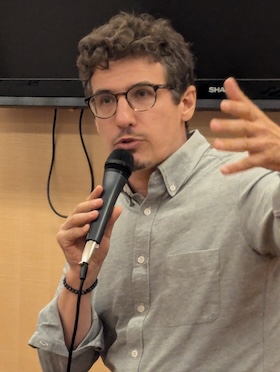
photo - Hasan Alam
Hasan Alam (photo by Masumi Kikuchi)

Alam warned that the state is not a “neutral arbiter of free expression.” Those in power can select who gets heard, “punishing certain voices while giving others a free pass,” he said, highlighting Canada’s genocide of Indigenous culture, and the internment of Japanese-Canadians during the Second World War.

The public’s “moral panic” can lead to political rhetoric that eventually results in laws or selective application of laws that target specific communities, said Alam. This can have a “chilling effect,” so that people self-censor – “freedom of expression doesn’t have to be formally taken away to be lost,” he said.

“I think real dialogue works,” he added. “The research on prejudice reduction consistently shows that when people who hold mistaken assumptions driven by fearmongering, driven by misinformation, driven by othering, or maybe just limited exposure, when they actually engage with the community they fear, those views do change.”

Making space for good-faith dialogue, where someone can admit they don’t understand something, might be uncomfortable, said Alam, but “that discomfort, when it’s honestly expressed and when honestly engaged, is often the beginning of understanding, and that’s where change lives … when the person in front of you becomes real.”

Marsha Lederman – a Globe and Mail columnist and author of two books  – spoke about how Sugihara saved some 6,000 Jews by issuing them transit visas.

Referring to a statue of Sugihara in Los Angeles that was defaced earlier this year with red paint, she asked, “How, in any way, is this statue, is this man, an appropriate target?” It’s understandable to disagree with the actions and policies of the current Israeli government, she said. “It’s quite another thing to self-righteously target a historical figure whose heroic act was saving Jewish lives.”

photo - Marsha Lederman
Marsha Lederman (photo by Masumi Kikuchi)

Since the Oct. 7, 2023, terror attacks on Israel, there has been increased hostility toward Jews and a greater acceptance of speech that is hateful, if not the legal definition of hate speech, she noted.

Acknowledging that “what is happening in Gaza is catastrophic,” Lederman does not believe it should be compared to the Holocaust. Such comparisons, she said, are being used to delegitimize the state of Israel, and she shared some of her family’s experiences and other Holocaust history as proofs of why this line of thinking is wrong.

Lederman has become a frequent target of hate speech and she read out some of the names she has been called, including “Zionist nutcase” and “blood thirsty ghoul,” and, by supporters of Israel, “traitor” and “self-hating Jew”; she has been threatened. “Both sides have accused me of weaponizing the Holocaust, which my parents survived and which my grandparents [and other family] did not,” she said.

Lederman’s strategy for dealing with hate is to continue to exercise her freedom of speech. “I refuse to stop writing about these wars, about antisemitism, about Gaza, about Oct. 7, about Iran, Lebanon, with context, nuance and, I hope, heart, always trying to come at it from the humanitarian middle,” she said.

A panel discussion and question period followed the presentations, and the program concluded with the National Film Board short For Angela, the true story of a Winnipeg mother and daughter who successfully confronted bullying aimed at their Indigenous identity. 

The April 19 event was supported by the Peretz Centre and the Vancouver Jewish Film Centre. 

Ann Daskal is an independent writer and a member of Or Shalom.

Journalist shares fears

Itai Anghel, one of Israel’s most recognizable documentary reporters, was with his wife and toddler son in New York City, celebrating his Emmy nomination for Last Stop Before Kyiv, in which Anghel and cameraman Eddie Gerald reported from Ukraine during the early months of Russia’s invasion.

As the glitter of the celebratory excursion dissipated, Anghel began receiving news from home. Thousands of terrorists from Gaza had flooded into Israel, in a cataclysm that was only beginning to be understood.

Israeli airspace shut down on Oct. 7, 2023, but, leaving his family in the safety of the United States, Anghel managed to return, and focus his camera on the catastrophe.

photo - Itai Anghel, in Vancouver, provides bleak assessment of the future
Itai Anghel, in Vancouver, provides bleak assessment of the future. (photo by Pat Johnson)

Anghel shared his story here in a lunchtime event for business community members May 29 and that evening at Shabbat services at Congregation Schara Tzedeck.

Anghel is the recipient of the Sokolov Award, Israel’s highest award for journalism, and is a university lecturer in history and international relations. He is a correspondent for the television news program Uvda, sometimes referred to as Israel’s 60 Minutes.

On arriving back in Israel, Anghel received a call from a stranger at Kibbutz Nir Oz, in the Gaza Envelope, urging him to get to their village immediately and record the atrocities committed there.

Anghel told the caller that, as far as he understood, Israeli military officials were preventing outsiders from entering the region. The stranger insisted Anghel come, telling him that, if the military tried to prevent his visit, they would shoot the soldiers. The government, the stranger told the reporter, would seek to cover up the reality of what happened and the failure of the Israel Defence Forces to intervene, and getting the reality on video was of utmost importance.

The suspicion of a government coverup may not have been based in reality, but what Anghel saw at Nir Oz was like nothing he had witnessed in war zones in Bosnia or the killing fields of Rwanda.

The Nir Oz survivors took Anghel from home to home, where he filmed the aftermath of some of Oct. 7’s most grisly atrocities. More than 10% of the community’s residents were murdered and 76 residents, almost 20% of the population, were taken as hostages to Gaza.

“They set on fire whole families, whole communities, the terrorists were in Nir Oz for seven hours and not one Israeli soldier confronted them,” Anghel said.

At a home where a mother and child were shot point blank, Anghel reflected on their final seconds.

“The last thing that this boy saw before he was shot to death was someone shooting his mother to death,” he recalled. And, if that didn’t happen, the mother saw her son murdered before she was killed.

Anghel asked for a break, maybe to have a bottle of water, but the people of Nir Oz wouldn’t let him stop witnessing and recording, insisting that he continue his documentation.

As he moved through the kibbutz, he did not process what he was seeing. He admits that his camera is a shield between him and the world. Often, he said, it is later that he begins to process what he sees. 

“It was only when I got back to Tel Aviv that I understood what I saw and began reflecting,” he said. “For the first time, I was crying.… The reflecting would come later, when I’m in the editing room.”

He has harsh words for people sitting in comfortable TV studios opining on places they have never visited or who practise, as he acidly calls it, “hotel journalism,” rather than “field journalism.”

The latter, in which Anghel embeds himself among ordinary people and even terrorist fighters, is how journalism used to be done, he said, before the 24-hour news cycle created demand for semi-qualified talking heads to discuss things of which they have only surface knowledge. 

Anghel has an American passport – his parents were students in the States when he was born – so he can go places his Israeli passport would not permit. 

“People are so focused on ‘everyone’s an enemy,’” he said, but when he interviewed people in Damascus, Syria, Israelis couldn’t believe their openness to good relations with Israel.

Being relatively fluent in Arabic opens doors for Anghel. 

“I tell them I’m from the US, but I’m not a soldier, I’m not from the army,” he said. “They are in a state of shock because they have never heard an American speak Arabic.”

He tells them he studied the language so he could communicate with people like them and, from there, he almost always finds a willingness to open up.

Anghel took special aim at the New York Times columnist Nicholas Kristof, who last month published an at least partially fictionalized account of IDF atrocities, including attack dogs allegedly trained to rape Palestinians.

“It is so radical and parts so far-fetched,” said Anghel, noting that the organization Kristof cited as the source for some of his most incendiary allegations is Euro-Med Human Rights Monitor, which Anghel and Israel’s diaspora affairs ministry characterize as a Hamas front organization in Europe.

“Anyone with very basic knowledge knows that Euro-Med is an affiliation of Hamas,” he said. “If you get information from there, at least be honest and say so.”

That the Kristof piece could pass the standards of the New York Times is, Anghel said, symptomatic of a decline in basic journalistic rigour, in which terms like “apartheid” and “genocide” are applied without qualification. 

“They know already, they’ve decided already and there is no openness to hear anything else,” he said.

On the other hand, Anghel admits to getting criticism from all sides. Some Israeli viewers condemn him for platforming anti-Israel terrorists. Israel’s government is no fan of Anghel or Uvda, either.

Anghel is blunt in his assessment of Israeli cabinet minister Itamar Ben-Gvir.

“He’s a fanatic, a criminal, in charge of law enforcement in Israel,” Anghel said.

Anghel and his TV program have also been condemnatory toward what he calls Israel’s abandonment of the Kurdish people.

“We knew that jihadists in Syria would like to crush them and we did nothing,” he said.

The relations are complicated, he admitted, but Israel prevailed upon the new Syrian regime to protect the Druze people in the south of Syria, because Israel has a special relationship with the community because of the Druze population in Israel. The Kurds, in northern Syria, who Israel has allied with at times, were left to their own devices, Anghel said.

Of all the threats to Israel’s future, Anghel said, his greatest fear is internal strife.

“Israel is divided like it has never been,” he said. “The situation is awful. You cannot make it look nicer. It is awful.”

While some Canadian Jews are thinking about leaving, he noted, in the past two or three years, 10,000 Israelis came to live in Canada. 

The schism between ultra-Orthodox, who generally do not serve in the military, and the majority of Israelis, who have been carrying the burden of service, is a particular point of division. At the same time, the birth rate among ultra-Orthodox portends a country that is demographically shifting toward that group.

Many Israelis are concluding that the current government does not care about people like them.

“You make the calculation and you realize maybe it is not the place for you to live,” said Anghel.

“I’m not afraid of Hezbollah, I’m not afraid of Syria, I’m not afraid of Iraq, I’m not afraid of Yemen’s Houthis, I’m not afraid of nuclear weapons from Iran,” Anghel said. “I’m afraid of ourselves.”

Schara Tzedeck’s Rabbi Andrew Rosenblatt thanked the Diamond family for sponsoring the event in memory of the late Charles Diamond. Josh Pekarsky interviewed Anghel. 

Skills to live together

On May 26, Rabbi Dr. Laura Duhan Kaplan gave the public lecture From Conflict to Connection: Spiritual Community in Stressful Times at the annual conference of Vancouver School of Theology’s Inter-Religious Studies Program. (screenshot)

The Walking Together: Sharing the Work and Ideas That Call to Us conference, hosted by Vancouver School of Theology’s Inter-Religious Studies Program last month, included, as it always does, a public lecture. This year’s address was given on May 26 by Rabbi Dr. Laura Duhan Kaplan, dean of the ALEPH Ordination Program, the Jewish Renewal seminary; former director of inter-religious studies at VST; and rabbi emerita of Or Shalom Synagogue. Her topic was From Conflict to Connection: Spiritual Community in Stressful Times.

Duhan Kaplan began and ended her talk with Linda Hirschhorn’s “Circle Chant,” a song about peace, human rights, environmental and intergenerational stewardship. 

“If we are talking about the world, or the community, or the variety of communities as a circle,” she said, “let’s get real – it’s not a perfect circle. We are many different people doing many different things, overlapping, intersecting, sometimes clashing. That’s the kind of circle that we have, that we are working with when we try to make things whole.”

She shared a well-known quote from Rabbi Tarfon that is found in the Pirkei Avot, which she translated as Basic Aphorisms, rather than the more common Ethics of the Fathers. She read Tarfon’s adage about the day being short and the work plentiful and, while it is not up to us to finish the work, we’re not free to avoid it.

“What is the work?” the rabbi asked. “Here are some of the kinds of work that people at this conference are going to be talking about: work in climate, food security, interfaith, multicultural community, decolonization, indigenous learning, spiritual care, nonviolence, protest, arts, ritual, refugee support, theology.”

Based on the book Liquid Times: Living in an Age of Uncertainty by Zygmunt Bauman, Duhan Kaplan said we’re living in a globalized world that has not delivered on its promises of integration and freedom.

“In fact, globalization has become primarily the work of a small group of highly wealthy, highly influential people, and what it has brought almost everyone else is increasing income inequality, more displaced people, more incarcerated people, more environmental devastation, more elite criminality, more precarity (that is, precarious life), more anxiety,” said Duhan Kaplan, summarizing Bauman’s ideas.

She spoke about the politics of fear and polarization, which are enforced through segregation: neighbourhoods are increasingly monoethnic and an increased police presence keeps people out of certain places, she contended. “At the national level, in many countries, we have a closing of borders.”

Cities, spiritual communities and social service agencies are left to deal with these global problems, she said, giving an example from her work.

“Let’s say we have a conflict in a class between students and teacher. The students say there’s so much in our religious tradition that is racist. And it’s true…. But, when the students speak to the teacher about it, the teacher says, young adults today don’t respect their teachers the way they used to. And that’s true too,” she said.

Direct dialogue between the parties would be ideal, but “because of habits of polarization, people are saying, no, we don’t even want to talk about it.” Rather than encouraging communication, people have suggested excluding individuals who hold opposing viewpoints, she said. “But why would we do that? We’re a microcosm of the world. We want to be that crazy, misshapen circle, and we want to live together. Isn’t that an essential pastoral skill?”

Duhan Kaplan gave another example.

“Two students in the program are tasked with leading a prayer service together and they want to pray for peace, but one of them identifies themself as an antizionist and the other one identifies themself as a Zionist, and they don’t know how to pray together for the worldwide community of Jews. They’re just paralyzed. And so, they appeal to us, the administration, and they say, tell them they’re wrong. And we say, well, we don’t do that. How about we sit in a room with both of you?… But the students are reticent to do that because, in our larger environment, what is modeled is cutting people off rather than building a community of difference.”

Duhan Kaplan talked more of Bauman, who realized that living together in a multi-class, multi-ethnic place requires skill.

One necessary skill is “the ability to work through miscomprehension – when you say something and you mean something, and somebody else who sees the situation in an entirely different way thinks you meant the opposite,” the rabbi explained.

“We need the ability to persevere, to keep talking in order to work through these issues,” she said, but the current social environment shuts down these skills, and so we end up in a cycle that Bauman calls myxophobia.

“We start off with a fear of the unknown … and it takes skill to deal with that: inner strength, communal support, faith in the future,” she explained. “When we don’t have those things, our fear of the unknown searches for a target. Oh, if only that unknown thing were known or, worse, if only that unknown thing were removed.”

Limiting immigration might make people safer for a period, for example. But, when there are fewer new people in a person’s life, anyone new will seem even more scary, she said, and a person’s epistemic courage, courage to learn, diminishes.

To stop the cycle, we must question propaganda, and become skilled in hearing what is uncomfortable, she said, pointing to a couple of tendencies that make this hard, including “the hasty generalization fallacy.” This is when we make broad conclusions from a small piece of information, like judging every Iranian based on how you feel about your uncle from Iran, who you don’t like.

Generalizations help us protect ourselves, Duhan Kaplan acknowledged, “but we also have to realistically ask: Is this a situation in which I need to protect myself? What is at stake here? If we are not talking our immediate protection, then we can think critically.”

Another hurdle, she said, is the “false dichotomy, false bifurcation, the either-or fallacy … claiming that there are only two options when in fact there are many more. Like the students trying to figure out how to pray. Should we pray for the well-being of Israelis? Or should we pray for the well-being of Palestinians? We can’t do both because that’s too complicated. How will we work out the words? Of course, if you’re training to be a clergy person, it is your job to work out the words, and those skills will come, even if they haven’t come right now.”

Duhan Kaplan also discussed the “bandwagon effect,” which she described as “the 53 million people can’t be wrong fallacy. Oh, yes, they can.”

She has adopted a principle: “If everyone agrees on something, I say, wait a minute, isn’t there also another way to look at this? And there’s a mythical teaching in our tradition about the Sanhedrin, ancient Jewish court, when a death penalty case came before this jury of 70 judges. If there is a unanimous guilty verdict, the person is freed, because there couldn’t possibly have been a unanimous verdict without groupthink. And, when people’s lives are at stake, we don’t want groupthink. We want something nuanced, something we can work together on.”

The rabbi talked about how to listen: “What is the inner work that we do? We quiet the mind. And, to quiet the mind, that takes courage, because you have to say to yourself, I trust that I’m going to be able to understand what I’m hearing…. I trust I’m going to be able to respond.”

Listening, feeling what another person is feeling, hearing what’s important to them, might engender strong reactions, she warned. “Conflict resolution work, courageous work, meeting difference, solving problems, doesn’t always feel good … you might not be happy with what you learn about other people, you might not be happy with what you learn about yourself…. And, of all the points that I made tonight, that’s the one I want people to most take to heart: there’s nothing wrong with you if the work is hard.”

One of Duhan Kaplan’s strategies in this time of heightened anxiety is to recite the 13 Attributes of Compassion.

“Where these come from is in the Bible, when Moses is at Mount Sinai, and he says to God, show me your face, and God says, you can’t see my face, but you can see my after-effects…. What is my true essence? This is what is revealed: God, the ineffable one, compassion, tenderness, patience, forbearance, kindness, awareness. I’m carrying love for thousands of years; lifting guilt, letting go of mistakes; allowing freedom and a fresh start.

“Not immediately,” she said. “Takes time. In fact, the Bible says it might take four generations for all these processes to work through, but, the point is, when I find myself angry and constricted, I will pause and I will recite this mantra.”

Another thing Duhan Kaplan does, when she needs it, is “the Examen, the examination of consciousness,” as taught by St. Ignatius of Loyola (1491-1556), founder of the Jesuit order.

“You find as quiet a space as you can find,” she said. “You allow yourself to become aware of divine presence, whatever that means to you…. And then you review the day with gratitude … you pay attention to your emotions … just notice. And then choose one thing that’s on your heart and mind and pray in the way that you pray…. And then, at the end, you look toward tomorrow and you say whatever it is has come out of your reflection.”

In the Jewish tradition, she said, Aaron “is the consummate peacemaker” and one of his lessons for us is that, if we do the work of peacemaking, “some kinds of peace will come.”

She circled back to Rabbi Tarfon: “we don’t have that much time, there’s so much to do.… It’s not up to you to finish the work … but you have to do something.” 

Road to independence

The 96-year-old history of the Jewish Independent, which serves as a continuous record of Jewish communal life in British Columbia, was the topic of the second lecture in the Peretz Centre for Secular Jewish Culture’s 2026 Doikayt Speaker Series.

In a webinar titled “A Labour of Love: A Brief History of the Jewish Independent,” publisher Cynthia Ramsay discussed how the paper might even be more than 100 years old. 

In 1925, there was a mimeograph – copies were printed using a hand-cranked machine – called the Vancouver Jewish Bulletin. Its connection to the 1928 mimeograph called the Centre Bulletin, the known origins of the JI, are unclear. Regardless, it wasn’t until the newspaper, by then called the Jewish Western Bulletin, was launched in tabloid form in 1930 that the clock on its history began.

image - Dr. JI Gorosh (pictured here in the Jewish Western Bulletin in 1952) was the first printer and editor of a local Bulletin, in 1925. That publication’s connection to the Jewish Independent’s predecessor, the JWB, first published in tabloid form in 1930, is unclear
Dr. JI Gorosh (pictured here in the Jewish Western Bulletin in 1952) was the first printer and editor of a local Bulletin, in 1925. That publication’s connection to the Jewish Independent’s predecessor, the JWB, first published in tabloid form in 1930, is unclear.

In its early years, the paper had to compete for local readers with a few other publications, both in English and Yiddish. Volunteers from the Vancouver Jewish Administrative Council, a precursor to the Jewish Federation of BC, initially oversaw the running of the paper.

“In 1937, one of the sales guys, Harry Musikansky, had the idea that the paper’s costs could be shifted over to a publisher, and the publisher could get all the advertising and keep all of the revenue, while the council kept editorial control,” Ramsay said.

This model, despite facing continual monetary challenges, endured into the 1960s. While David Sears took over as publisher for a year, in 1939, Musikansky took over the position and held it until 1945. There were several different editors during the publication’s early decades.

One subsequent publisher, Goodman Florence, demonstrated his frustration with trying to please the community in a 1949 editorial, shortly before he resigned. Florence observed that though “readers want everything under the sun and up to date, I have yet to be able to completely sell the simple fact that to do all of this requires considerable revenue.”

In 1949, Abe Arnold took over the reins of the paper as publisher, while his wife, Bertha, handled advertising. “As is the case in the newspaper in the early years, the male counterpart is front and centre. [Abe] Arnold ran the paper, but Bertha was in the background doing a hell of a lot of stuff,” Ramsay said.

The couple stayed on until 1960. Their 11-year tenure was filled with issues concerning revenue and salary, criticisms over the direction of the newspaper’s coverage, and debates on editorial partiality and council’s control over editorial decisions. In the 1950s, the main controversies seem to have been the United Jewish People Order’s expulsion from council (Zionist/right versus left) and kashrut-related letters/ads (orthodoxy versus other forms of Judaism), said Ramsay.

In 1960, Sam and Mona Kaplan came in from Winnipeg to steer the paper, and they would remain at the helm for 35 years. By 1962, the couple were able to turn down the decades-old community subsidy.

“The Kaplans really didn’t want to be at all connected financially to the council. There continued to be a publications committee; however, its role seemed to be reduced. The council still was able to put pretty much any advertising and event listings into the paper, but it seems like they really didn’t have much control over the paper,” Ramsay said.

The Kaplans used this independence to advocate for Soviet Jewry, Syrian Jews, Israel, Jewish education and other Jewish causes and institutions.

Ramsay’s history with the paper started in the summer of 1998, when she arrived as a proofreader. (For a short time in the late 1990s, an American publishing company managed the paper after the Kaplans retired.)

An economist by training, Ramsay’s intention was to return to Ottawa after her temporary position had ended. However, the lure of journalism proved too strong, and she decided to stay. In 1999, she, along with Pat Johnson and Kyle Berger, purchased the paper.

Johnson and Berger eventually moved onto other work, and Ramsay became the sole owner. In 2005, she chose to change the name, for several reasons. (See jewishindependent.ca/oldsite/archives/july05/archives05july22-11.html.)

“We had a contest for names,” she told the Peretz audience. “I didn’t like any of the names, so I picked the Independent. I had wanted to do the Optimist, but found out there was the Delta Optimist already.”

Ramsay shared a quote from the initial manifestation of the community publication, when Dr. JI Gorosh penned an editorial on July 15, 1925. He said the Bulletin would “work steadfastly and faithfully for the welfare of the Jewish community as a whole.” The aim then, as it is now, was to be the medium through which the Jewish community can express its ideals and announce its activities.

“We will strive not to deteriorate into a mere social gossip sheet, but to be a real service paper with a definite place in the life of the community,” Gorosh wrote.

Echoing that sentiment, Ramsay wrote in an editorial for the 95th anniversary issue of the paper: “While not ignoring the hurtful, the divisions, the controversies in our community or the larger universe, we try to cover stories in a way that doesn’t depress and paralyze action, but rather opens the door for solutions or at least positive attempts at change. We don’t want readers to put down the newspaper in despair, but rather to think about what they can do to contribute to a better world, whatever that means to them.”

The Independent may be the longest continually running Jewish newspaper in Canada, as countless other publications across the country have come and gone, or merged, over the last 96 years.

Ramsay said she would like to pass the paper on to another owner or owners after the paper celebrates its 100th anniversary in 2030, when she’ll be 60 and ready to retire.

“I’d like to get it to that point,” she said. “I truly think it is a treasure. I do want its future to be long, so I’ll be very careful with who I pass it on to. Hopefully someone wants it, because it is a labour of love at the end of the day.” 

Sam Margolis has written for the Globe and Mail, the National Post, UPI and MSNBC.

Legal help for students

StandWithUs Canada executive director Jesse Primerano and lawyer Anita Bromberg, director of the organization’s new legal department. (photos from SWU)

StandWithUs Canada has just launched a new legal department to help students navigate the climate on Canadian campuses.

StandWithUs Canada is an educational organization that works to inspire and educate people of all ages about Israel, challenge misinformation and fight antisemitism within schools and communities. While the organization has always helped students navigate legal challenges, up to now, according to executive director Jesse Primerano, the organization has had to outsource cases to volunteer lawyers on a case-by-case basis. Cases have included incidents of human rights complaint violations by, for example, a university or a student union. With a staff lawyer leading a new department, StandWithUs aims to have greater reach in the legal realm.

Anita Bromberg is a lawyer with extensive practice experience in human rights and constitutional law, including religious freedom, censorship and freedom of speech cases. She has done research and teaching, worked with B’nai Brith Canada as a human rights officer and legal counsel, and served as executive director of the Canadian Race Relations Foundation. She has argued before the Supreme Court of Canada.

After Oct. 7, 2023, Bromberg rededicated herself to the Jewish community and fighting antisemitism, heading the Canadian Antisemitism Education Foundation.

“I hope that, in my position, I will bring that expertise and connections and networking to StandWithUs,” Bromberg told the Independent. “And, most importantly, to me, is to find a way to bring our community together so that we are a lean, mean fighting machine that parallels the type of support that we’re seeing the anti-Israel crowd getting.”

Anti-Israel organizations have lawyers on call, according to Bromberg and Primerano, and Jewish students and their allies need parallel defences. 

Students are being confronted on campus, including in classrooms, with aggressive harassment not only from student activists but from professors and faculty advisors, said Bromberg. 

In addition to being harassed, students are being doxxed – having their personal information, like home addresses, made public – and access to public spaces like tables and room rentals on campus is being denied to Jewish students based on their political views, said Primerano. Jewish students are being silenced, he said, based on justifications that events, for example, cannot go forward for their own protection, based on security concerns.

“They need legal support to understand what they can do to defend themselves against a machine that’s trying to take them down,” said Primerano.

Launching the legal department has been a longtime goal of StandWithUs Canada, said Primerano. 

“It required not only funding, but it required us to make sure the rest of our infrastructure was immaculate,” he said. 

Legal avenues are often the only option for students who feel harmed by the actions of an institution or its representatives, he said.

“At the end of the day, very little holds universities to account outside of the law itself,” Primerano said. “That is the one thing that they say that they respect.”

The new legal department, with a single employee, is just the beginning, he maintained. The organization envisions a future with multiple lawyers and several staff members, collaborating with lawyers across the country.

“We’re not planning to solve this problem on our own,” said Primerano. “We’re looking to build a network of pro bono lawyers across Canada who are willing to support us here and there.”

The goal, ultimately, is to make sure that students have somebody they can call that is specifically focused on their issues. From there, StandWithUs might engage with community partners as appropriate, such as the Centre for Israel and Jewish Affairs and others.

“Our goal is to build a real network,” he said. “Our fundamental belief is that the community is stronger when we work together, but we also know that the university students need a point of contact, and all we’re trying to establish here for them is a point of contact with expertise and reliability that can then utilize the rest of the infrastructure that exists, especially with Anita being based in Toronto, to speak to lawyers in Vancouver and say, ‘You’ve already been having these conversations. Let’s work together to make sure that we can effect a change.’” 

Bromberg’s deep roots in the Jewish community and legal experience mean she can hit the ground running on complex issues.

“I think that was one reason why I got the nod for this position,” said Bromberg, “because I’ve been in the community, I’ve networked with pretty much every organization and I’ve always adopted a cooperative measure. I think that the unity in the community is probably the most important thing that we have to develop.”

Students can access a reporting tool through the StandWithUs website (standwithus.com) and social media.

“The goal is not entirely reactive,” Primerano added. “Anita will also be developing resources, workshops, webinars and ways for students and community members at large to be aware of what their rights are and how they can defend them.… We’re also trying proactively to help people get a better understanding of what they’re entitled to as Canadian citizens.” 

Symposium on antizionism

At the first World Symposium Against Antizionism, left to right: Jacob Smith, Eyal Jacoby, Nick Matau and Anastasia Zorchinsky. (photo by Dave Gordon)

The first World Symposium Against Antizionism took place on May 17 in Toronto, with some 30 speakers, from educators and lawyers to influencers and politicians and other activists in the pro-Israel space.

Ben Shapiro, an American pundit and broadcaster, told the thousand people gathered that “antizionism is evil, it is wrong, it is predicated on lies, and it requires violence to achieve the ends it seeks.”

photo - The first World Symposium Against Antizionism took place on May 17 in Toronto, with some 30 speakers, including Ben Shapiro
The first World Symposium Against Antizionism took place on May 17 in Toronto, with some 30 speakers, including Ben Shapiro. (photo by Dave Gordon)

He said, “Antizionism argues that the Jewish state of Israel, a thing that … exists in the world today and has 10 million citizens, some two million of them Muslim, another 200,000 Christians, should be destroyed; that Israel ought to be treated unlike any other country, because Israel is somehow uniquely evil.

“Now, in order to make that case, antizionists must lie…. The antizionists must claim that Israel is an apartheid state, despite the citizenship of two million Arab Israelis…. The antizionist must lie that Israel discriminates against Christians and Muslims, despite it being the only state in the Middle East that provides the highest level of rights to both.”

He added: “the people who argue that Israel ought to be eliminated are antisemitic, for whatever that’s worth. They believe that Israel ought to be destroyed and, to accomplish that purpose, they lie incessantly, and then they spread the biggest lie of all – that global Jewry has bamboozled the population, taken over the institutions and used its magic mind lasers to control the world.”

The symposium was produced by Tafsik Organization and Stop Antizionism.

Syrian-born Rawan Osman, who has a large following with her online advocacy, shared the stage with fellow Arabs United Arab Emirates-based Loay Alshareef and Damascus-born Abraham Hamra, who lives in New York.

Years ago, before befriending Jews in France, she said she was “one of Hezbollah’s biggest fans,” someone who “hated the Israelis, the Zionists and the Jews, and I repeat the three terms because, in the Arab world, we do not make a distinction between the three.”

Growing up in Lebanon, Osman saw the “bombardment” of indoctrination against Jews. That same hatred has been spread in the West, she told the Independent. Her “red line” for engagement is anyone who “justifies or denies Oct. 7.”

“Because they are so deeply indoctrinated that they cannot summon any sympathy for the Israelis, including children …  I will not go that close, and I’ll let others fight them,” she explained. “I would rather focus on something else. The same way I think many Jews would not have a conversation with someone who denies the Holocaust, especially if they are descendants of Holocaust survivors.”

She drew a sharp contrast with Abraham Accord countries, like UAE, where their culture has “taught children to tolerate others, to be accepting. You, as a Jew, are safer wearing a kippah walking in Dubai and Abu Dhabi than you are in Paris and in London,” she said.

photo - Left to right: Loay Alshareef, Abraham Hamra, Rawan Osman and Ali Siadatan
Left to right: Loay Alshareef, Abraham Hamra, Rawan Osman and Ali Siadatan. (photo by Dave Gordon)

Lebanon-born Gad Saad, a former professor at Concordia University and author of Parasitic Mind and Suicidal Empathy, argued that antisemitism “in a sinister way, is akin to the immune system, and that it so evolves into new variants of Jew-hatred.” In modernity, that means Jews are blamed for open borders that let in rapists, profiting from the COVID vaccine, and even poisoning the minds of sharks, he said.

Toronto lawyer Leora Shemesh shared the stage with American law experts Matthew Schweber, Rona Kaufman and Mark Goldfeder (via Zoom). Shemesh noted that certain small groups in the country have been attempting to mainstream antizionism. “We have an entire political party, the NDP, that ran on a platform of being antizionist,” said Shemesh. “A Jewish guy, Avi Lewis, ran on that platform, and he joined forces with Independent Jewish Voices of Canada, and they have attempted, and have been somewhat successful, to intervene in certain cases.”

Montreal-based Anastasia Zorchinsky, a Concordia Student Union councilor and co-founder of StartUp Nation Montreal, an Israeli organization at Concordia and McGill universities, moderated the panel called NXT GEN: Future Advocates. 

“We really try to do lots of events that collaborate between different cultures, so I think the first step is really to take that step to reach out to those other communities,” she told the JI of her organization’s educational initiatives. “If we just approach people with the thought, with the optimism, that, yes, they will accept us or, maybe, they don’t have to agree, but we can still talk, then maybe that’s something that we should keep in mind.” 

Dave Gordon is a Toronto-based freelance writer whose work has appeared in more than 100 publications around the world. His website is davegordonwrites.com.

Making soccer political

Palestinian Football Association president Jibril Rajoub talks to reporters at the FIFA Congress, held in Vancouver on April 30. (Screenshot youtube.com/@thebreakernews)

While the World Cup doesn’t kick off until June 11 – at Mexico City’s Estadio Azteca when Selección de fútbol de México faces off against the South African squad, nicknamed Bafana Bafana (the Boys, in Zulu) – penalty cards have already been drawn. Palestinian Football Association (PFA) president Jibril Rajoub, general secretary Firas Abu Hilal and vice-president Susan Shalabi Molano were initially denied entry to Canada to attend the FIFA Congress on April 30, and the Asian Football Confederation confab two days earlier – both events were held at Vancouver Convention Centre.

Ultimately, Immigration, Refugees and Citizenship Canada (IRCC) allowed the three sports bureaucrats to attend, and Rajoub, 72, has made the Mondial into a political football. Since 2024, he has repeatedly raised the issue of Israeli football clubs allegedly playing illegal matches in what the PFA argues is occupied territory that Israel captured in the 1967 Six Day War.

In March, FIFA (which stands for Fédération Internationale de Football Association) issued a report on the issue, ruling it would “take no action” over the PFA’s claim. The report noted that resolving “the final legal status of the West Bank remains an unresolved and highly complex matter under public international law.”

At the FIFA annual meeting in Vancouver, Rajoub – who also serves as secretary general of Fatah’s Central Committee – snubbed FIFA president Gianni Infantino, who attempted to orchestrate a handshake between the heads of the Palestinian and Israeli delegations. Following individual addresses toward the end of the assembly, both Rajoub and the Israel Football Association’s vice-president, Basim Sheikh Suliman, were summoned to the stage by the FIFA president.

“We will work together … let’s work together to give hope to the children. These are complex matters,” he said. But Rajoub refused to stand alongside Sheikh Suliman. Instead, he pledged to take his complaints to the Court of Arbitration in Sport, based in Lausanne, Switzerland. No date has been set for the hearing.

“I refused to shake hands. Sport is sport … for me that should be respected,” he told Reuters. “But, if the other side is representing a criminal like Bibi [Netanyahu] … how can I shake hands or have a photo with such a man?”

The PFA’s three-member delegation wasn’t the only one held up by the IRCC. Iranian soccer federation president Mehdi Taj said Canadian officials cleared him to enter the country for the FIFA Congress, but Iran’s delegation chose to turn back after being held for three hours and questioned at Toronto’s Pearson International Airport, Iranian media reported on May 1.

Rajoub, also known by the nom de guerre Abu Rami, has long been connected to Palestinian terrorism. In September 1970, he was arrested for throwing a grenade at an Israel Defence Forces bus near Hebron. Tried and convicted of this attack and of membership in an armed group, he was sentenced to life in prison. Fifteen years later, he was one of 1,150 security prisoners Israel released in exchange for three hostages held by the Popular Front for the Liberation of Palestine – General Command.

Re-arrested in 1987 for his activities during the First Intifada, Rajoub was deported to Lebanon in 1988. Relocating to Tunisia, he served as an advisor to Fatah deputy leader Khalil al-Wazir. After Wazir’s assassination by Israeli agents, he became a lieutenant of Yasser Arafat, then head of the Palestinian Authority (PA), and was allegedly behind a 1992 plot to assassinate Ariel Sharon.

Rajoub was allowed to return to the West Bank in 1994, following the signing of the Oslo Accords. He served as head of the PA’s Preventive Security Force until 2002. The following year, Arafat appointed him national security advisor.

The FIFA Congress was the 76th since FIFA was founded in 1904. It brought together more than 1,600 international delegates from 211 FIFA member associations.

This summer’s 48-team competition – the most widely watched sporting event in the world – takes place in multiple cities in Canada, the United States and Mexico from June 11 to July 19. Neither the Israeli nor the Palestinian team qualified for the tournament. 

Gil Zohar is a journalist and tour guide who lives in Jerusalem.

City recognizes Vrba’s legacy  

Geoffrey Druker, left, and Glen Steinman hold the City of Vancouver proclamation of April 7, 2026, as Rudolf Vrba Day. (photo from Vrba Projects / VHEC)

The Vancouver Holocaust Education Centre (VHEC) welcomes the City of Vancouver’s Proclamation designating April 7, 2026, as “Rudolf Vrba Day.” 

In the proclamation, Mayor Ken Sim notes that Rudolf Vrba, who was deported to Auschwitz at age 17, escaped from the camp on April 7, 1944, and risked his life to expose the reality of Nazi atrocities. His actions helped bring forward one of the earliest and most authoritative eyewitness accounts of the Holocaust. Vrba later made Vancouver his home, where he lived and worked for nearly four decades as a distinguished professor at the University of British Columbia.

photo - Rudolf Vrba
Rudolf Vrba (photo from Vrba Projects / VHEC)

The proclamation further recognizes that the report produced by Vrba and co-escapee Alfred Wetzler – now known as the Vrba-Wetzler Report – is widely credited with helping halt the deportation of Hungarian Jews and contributing to the saving of more than 100,000 lives. 

The VHEC recognizes this proclamation as honouring the historic legacy of Vrba and his continued relevance today as a man who devoted his life to the power of the individual to seek justice. Remembering Vrba is not only an act of historical necessity – it is a reminder of the moral courage ordinary individuals must summon, and of our shared responsibility to value and present the truth on behalf of humanity. 

The VHEC is grateful to the City of Vancouver and Sim for making this proclamation. The centre also acknowledges the contributions of Vrba’s friends and supporters in Vancouver, including those who established a memorial monument to Vrba in Schara Tzedeck Cemetery. The proclamation was further supported by the efforts of Vrba Projects, a local group of volunteers – led by Geoffrey Druker, John Gruetzner and Glen Steinman – working to promote local, national and global recognition of Vrba. VHEC also thanks Robin Vrba, the widow of Vrba.

Vrba believed that history must be told without euphemism, distortion or sentimentality. He was a moral witness and a warrior for truth, guided by a strong internal code and a profound sense of personal responsibility. His memoir, I Escaped from Auschwitz, was first published in 1964 and remains one of the most important survivor accounts of the Holocaust. 

In recent years, there has been renewed international recognition of Vrba’s legacy, including the publication of two major biographies: The Escape Artist: The Man Who Broke Out of Auschwitz to Warn the World by Jonathan Freedland, and Holocaust Hero: The Life and Times of Rudolf Vrba by Vancouver author and journalist Alan Twigg, who also curates the website rudolfvrba.com. (For more, also see jewishindependent.ca/new-bio-gives-vrba-his-due and jewishindependent.ca/vrba-monument-is-unveiled.)

The first English translations of the Vrba-Wetzler report, received by the US government in October 1944, are now preserved in the Records of the War Refugee Board at the Franklin D. Roosevelt Presidential Library. 

– Courtesy Vancouver Holocaust Education Centre

Organ donation saves lives

Jordan Zwicker and Debbie Litvack after Zwicker’s kidney transplant last November. Litvack donated the organ. (photo from JMABC)

When Debbie Litvack found out her longtime friend Jordan Zwicker needed a kidney, her decision was instant.

“Jordan needed one. I had two. It felt like the right thing to do and not a big deal. Every single donor I speak to feels the same way,” Litvack said. “I have such good fortune with my health, that I wanted to share it.  In addition, the community has been very kind to my family over the years. It’s a case of what goes around comes around.”

Litvack found out her friend was in need of a transplant shortly after she noticed his medical alert bracelet. He explained he is a Type 1 diabetic and, as a dialysis social worker, knowing the link between Type 1 DM and kidney disease, she asked about his kidney function. He denied any concerns although later learned he was in kidney failure and needed a transplant.

Zwicker is a “good guy” and someone who has had an outsized impact in the Vancouver Jewish community, said Litvack. As a DJ, he has mentored many of the community’s teens by hiring and training them in the event and DJ business.

Litvack said some people, like her, donate to someone they know. Others donate to family members. Others give the gift of life to someone they don’t even know. Either way, she sees it as pikuach nefesh, an active, sacred duty per halachah (Jewish law) to save a life. If you save one life, you save an entire world.

It took a battery of tests over the course of a year, including multiple and repeat blood tests, X-rays, mammogram, CT, renogram and more. There were also meetings with a nephrologist, a urologist and an anesthesiologist, as well as a comprehensive social work assessment. These assessments are vital to ensure both Litvack’s health and that she was a match. In fact, the transplant team had never seen such a strong match between a recipient and an unrelated donor.

“From the moment I decided to donate, I knew we would be a match,” she said. “It wasn’t a question of if I would donate, it was when.”  

A potential donor and recipient go through the process separately. Because Litvack and Zwicker are  friends, they shared a lot of their journey that is not normally shared. They also spoke often and at length about the “what ifs” in case the transplant was unsuccessful and about advanced care planning.

The transplant went ahead on Nov. 24, 2025, at Vancouver General Hospital, where Litvack works. The experience was quite different than being a professional at work and it has helped her connect in different ways with patients. She and Zwicker realized that there was an entire community of support that made the whole donation process possible.

Zwicker summed up his experience as life-changing.

“It’s given me the opportunity to continue my passion of working with people, an opportunity to be there for my son and family and a real opportunity to have the next 30 years of quality of life,” he said.

Litvack’s life-saving donation inspired the Jewish Medical Association of BC to highlight their member’s story by partnering with Temple Sholom, King David High School, BC Transplant, the Kidney Foundation of BC/Yukon and the Jewish Federation of BC to host an event that will look at organ donation from multiple angles – religious, ethical, medical, as well as personal perspectives from Litvack and Zwicker and other donors and recipients. The session will include information on how to become a donor.

The Gift of Life: Organ Donation from a Jewish Perspective takes place June 17, 7:15 p.m., at Temple Sholom. Registration is required for the free event: templesholom.ca.

Litvack encourages everyone from the Jewish, medical and local community with an interest to attend. “I really hope we will inspire someone at our event to donate,” she said. “And give the gift of life.” 

– Courtesy Jewish Medical Association of British Columbia

Donors needed

There was an organ donation awareness and swab drive held at Beth Tikvah Synagogue May 25. It highlighted the work of Renewal Canada, which helps match people in kidney failure with donors to save their lives. An inspiration for the event was Jewish community member Robert Moutal’s need of a living donor kidney transplant. If you or someone you know is interested to learn how to be a living donor, visit transplant.bc.ca/organ-donation/living/kidney-donation, email donornurse@providencehealth.bc.ca or call 604-806-9944. You can also contact Renewal Canada for more information: renewalcanada.org/moutal.

Other community members are also in need.

Temple Sholom member Libby Goszer has been diagnosed with end-stage renal failure requiring a kidney transplant. Her blood type is A+, which corresponds to an ideal donor of A+ or O blood type. Even if you do not have these blood types, it is still possible to pursue donation through the Living Donor Paired Exchange Program, where you donate to another person in exchange for a matched kidney for the recipient. If you or someone you know is interested in investigating being a living donor, go to renewalcanada.org/libbygoszer.

Additionally, last year, Daphne was diagnosed with myeloproliferative neoplasm (MPN), a rare blood cancer, and her only hope for a cure is a stem cell transplant from a matching donor. All that’s needed is a simple cheek swab to see if you are a match. To order a kit, go to blood.ca/en/stemcells/donating-stemcells/stem-cells-questionnaire (ages 17-35) or giftoflife.org/dc/daphne (ages 36-60).

– from various community organization enewsletters