
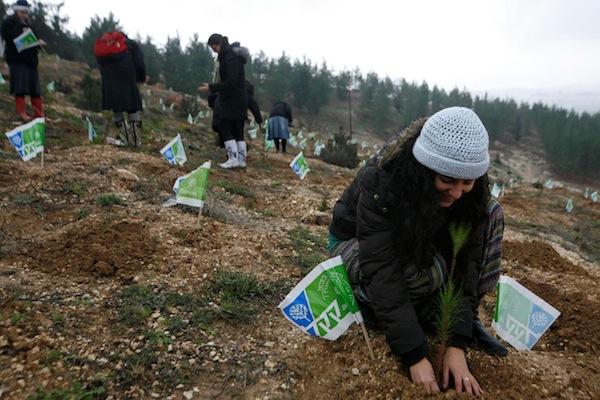

In Israel, Tu b’Shevat is a day for planting saplings. (photo from JNF via israel21c.org)
“Keep a green tree in your heart and perhaps the singing bird will come.” This lovely quotation is not from our sages, but is an old Chinese proverb. Nevertheless, it seems appropriate for Tu b’Shevat, the New Year of the Trees, which falls this year on Jan. 21.
Of course, we have our own Jewish sources. For example, “When you see handsome people or fine trees, pronounce the benediction, ‘Praised be He who created beautiful things.’” (Tosefta: Berakot 7:4) Trees have a great significance in Judaism and, long before “ecology” became a popular word, Jews were commanded, even in times of war, when besieging a city, to not destroy its trees. (Deuteronomy 20:19)
Trees were sacred to many people. Pagans believed that gods inhabited them and took their forms. They were druidic, rising out of the earth and tossing their hair. They cooled, sheltered and calmed. It is easy to understand reverence for the splendor and dignity of trees, but only Judaism has a new year for them, which falls on 15th day of the Hebrew month of Shevat (Tu b’Shevat).
In Israel, this date once marked the time from which to count the age of the tree for reasons of tithe or taxes, and also to indicate the maturation of the fruit of the tree. Even today, fruit cannot be eaten until the fourth year, so Tu b’Shevat standardizes the birthday of trees.
The holiday doesn’t commemorate any great historical event, and there are no special prayers in the synagogue. It is a lovely time, ushered in by blossoming white almond trees with their promise of warm summer weather.
Tu b’Shevat is traditionally a time for planting every variety of tree. The Talmud mentions “the joyous planting” on happy occasions. There was a delightful custom of planting a cedar when a boy was born and a cypress sapling at the birth of a girl. When a couple married, the wood of the trees would be used as poles to support the wedding canopy.
In Israel, it is a day for children and teens to go with their teachers into the hills and valleys and plant tens of thousands of saplings. There is also a custom to eat all the fruits of Israel – olives, dates, grapes, figs, citrus, apples, bananas, nuts and pears, which grow in great abundance.
Many scholars stay up late on the eve of Tu b’Shevat, reciting biblical passages dealing with the earth’s fertility. They read from Genesis how trees were created along with all the plants; from Leviticus how the Divine promised abundance as a reward for keeping the commandments; and from Ezekiel 17, the parable of the spreading vine, symbolizing the people of Israel.
Many people hold a special seder to celebrate the holiday, the New Year of the Tree of Life. They drink four cups of wine, beginning with white wine and ending with red, with the second cup a mixture more of white and the third more of red wine. It is rather like the landscape, as it changes from white (pale narcissus and crocus) to red (anemones and tulips) as Tu b’Shevat approaches.
As well as being a birthday, Tu b’Shevat is also a day of judgment for the trees, which ones will thrive and be healthy, which ones will wither and die. Chassidim pray for the etrogim, that they may grow in beauty and perfection for Sukkot.
Planting trees is very significant for Jews, the indestructible people for whom faith in the future is almost an emblem. We plant trees whose fruit we will not eat and in whose shade we will not sit. The one who fears that the world will end tomorrow or next year does not plant trees.
As well, Tu b’Shevat affirms that the soil of Israel is holy. The people and the land have a mystic affinity in Judaism, and the New Year of the Trees reminds us every year of the wonder of God’s creation.
Dvora Waysman is a Jerusalem-based author. She has written 14 books, including The Pomegranate Pendant, which was made into a movie, and her latest novella, Searching for Sarah. She can be contacted at dwaysman@gmail.com or through her blog dvorawaysman.com.



