Seniors are being left behind

Investing in home care is not just compassionate, it’s economically sound, argues Jeff Moss, executive director of Jewish Seniors Alliance of British Columbia. (photo from yahhomecare.com)

Let’s stop pretending our seniors are a priority. The proof is out there to show they aren’t. Despite all the platitudes from politicians about “valuing elders” and “aging with dignity,” the truth is glaring. Successive British Columbia governments have been abandoning their commitment to seniors and punting the issue down the road for 30 years or more. We have long known of the coming bubble in seniors that might risk the Canada Pension Plan. How can we not have planned for the needs of seniors’ care and support when we all knew this crisis was coming? The cost to us all is financial, moral and systemic.

The crisis is no longer looming, it’s here. Right now, more than 3,000 seniors are languishing on waitlists for long-term care (LTC) beds. By 2040, that shortfall is projected to balloon to 30,000 beds. The government’s response? Studies and painfully slow progress. Since 2020, only 380 of the promised 3,300 new LTC beds have been built. This is critical, with ramifications we experience today.

The Jewish Seniors Alliance of British Columbia is actively lobbying the provincial government to make changes that would increase access to home support immediately. JSABC’s seniors-led committee has created short videos sent to politicians to further raise awareness of the issue. Using the videos as a platform, JSABC has met with more than 20 MLAs from across the political spectrum, including Minister of Health Josie Osborne and Parliamentary Secretary for Seniors’ Services and Long-Term Care Susie Chant. Meetings with the Conservative critics for health and seniors have also been successful.

These meetings have not amounted to change. Yet.

While the Ministry of Health is reviewing bed planning to ensure “value for public investment,” seniors are dying in hospital hallways and are also trapped in expensive alternate level of care (ALC) beds with nowhere to go. And seniors are dying at home, too, lonely, isolated and lacking the support they need. This is not a system that’s strained, it’s a system collapsing under the weight of political inertia. Well-meaning as they are, our elected officials are paralyzed by changing economics and the hope the systemic hurdles will just go away. 

It doesn’t take a policy expert to understand the math. Building LTC beds at $1 million each is unsustainable. The Office of the Seniors Advocate estimates it would take $17 billion over the next decade to catch up. This massive number reflects how far we’ve fallen behind – not because it’s an impossible investment, but because successive governments have delayed, deferred and deflected. Action needed to be taken at least 15 years ago, not five years in the future.

Our seniors are left behind facing a decision between paying for rent, food or home support – having all three is a luxury many can’t afford. But there is a solution staring us in the face: radically expand free home support services.

Most seniors want to age in their own homes. By providing essential services – housekeeping, meal preparation, personal care – free of charge, we can drastically reduce demand on LTC and hospital beds. This isn’t a pipe dream: Ontario and Alberta already provide an hour of daily home support to seniors at no cost.

In British Columbia, a senior earning $30,000 a year could be forced to pay up to one-third of their income just to receive basic home support. It’s a shameful policy that penalizes seniors for wanting to live independently and it crowds our LTC homes with people that can be better served at home. Moving to LTC is a personal choice that many families and individuals need to make, but it should not be a forced choice to save money because the cost of care at home is too high.

Investing in home care is not just compassionate, it’s economically sound. Home support reduces hospital readmissions, prevents premature institutionalization and frees up desperately needed acute care beds. British Columbia has the highest rate of overpopulation of LTC beds by those who could be cared for at home with just a couple of hours of care daily. Yet, every year, reports from the Seniors Advocate highlight the same issues and, every year, the gap between need and availability widens. We advocate that family doctors be able to prescribe home support for seniors to reduce the burden on our overworked social workers.

The Ministry of Health boasts of past “recommendations adopted” and new federal-provincial funding agreements, but where is the action plan? Where are the benchmarks, timelines and deliverables? Families are being forced to shoulder caregiving burdens they are ill-equipped for, quitting jobs, exhausting savings and compromising their own health because the government has downloaded its responsibilities onto them. The toll on family caregivers is an immense burden not accounted for in traditional studies.

The impact of these failures on family caregivers is felt cross-culturally, impacting families as they try to support aging loved ones. Family support leading to burnout is felt equally among the Jewish population as it is across multiple faith and cultural backgrounds.

The failure to invest in home support and community-based care isn’t a policy debate – it’s a moral failure. If we continue down this path, we will soon see wards filled with seniors waiting to die, while the promised LTC beds are perpetually “under review.” The backlog will grow, hospitals will become gridlocked, and the human cost will be immeasurable.

Additional study is meaningless when there is no sense of urgency, no detailed plan and no political will to make the bold decisions needed now. The ministry’s token investments – $354 million over three years and a $733 million federal agreement – are a drop in the ocean compared to what’s needed. Without a clear commitment and path to expanding home support now, every new bed built will still leave us desperately behind.

We cannot allow this crisis to deepen for another 15 years while seniors suffer as political collateral. The government must:

1. Immediately make home support services free and universally accessible.

2. Develop a transparent LTC expansion plan with real timelines beyond 2030.

3. Set measurable wait-time reduction targets for LTC placement.

4. Increase community-based respite and adult day programs to relieve families.

5. Provide public accountability with regular progress reports and public data.

British Columbians need better. Seniors deserve better. If we don’t act now, the future will be one of overcrowded hospitals, overwhelmed families and government scrambling to explain why it didn’t act sooner.

The time for reports is over. It’s time for action. 

Jeff Moss is executive director of Jewish Seniors Alliance of British Columbia.

The bodycheck’s a wake-up call

Our family caught a big summer cold this August. We went to two crowded pavilions at Folklorama, Winnipeg’s international festival, earlier in August and I got sick. For all kinds of reasons, moms “can’t” get sick. I was cooking and doing carpool and canning pickles and chutney while feeling worse every day. Fatigued, with a stuffed nose and goopy cough to boot. It wasn’t COVID and I soldiered on. My husband helped when he could. 

Of course, after me, one twin got sick, then my husband and, finally, twin #2 began to get sick. This cold might last for weeks in our household. Families know how this story goes. We spent Labour Day weekend in the usual way: I lined up an appointment at a walk-in clinic for a twin who might now have an ear infection. Our only long weekend outings were to walk the dog around the neighbourhood. At least we’re not dealing with the “broken bone on three-day weekend” story yet. 

This situation has more in common with Rosh Hashanah than one might think. In the lead-up to Rosh Hashanah, during Elul, we’re supposed to reflect and repent for what’s happened over the last year. We need to be accountable for what we’ve done.

“The King is in the field” – this phrase is supposed to mean that G-d is nearby to help. Maybe we’re able to engage with this divine project more easily outdoors. For those of us who can get out into nature, even to an urban park or residential neighbourhood, we’re surrounded with gardens, produce, flowers and leaves in their last grand hurrah at this time of year. In Winnipeg, due to our dry smoky summer, we’re already beginning to see dead leaves. Time is short, we need to take advantage of this rich harvest season.

This accounting every year for Rosh Hashanah has us debating how we’ve wronged others, failed in our relationships to our families, our communities and with the Creator. However, if we circle back again to the story of the sniffling mom, we can ask ourselves something else. How have we wronged or failed ourselves? What can we do to improve our closest relationships, to ourselves and to our families?

During this summer season, I’ve had ample time to examine things because, in the end, my family didn’t travel anywhere. We weren’t even outside that much. I feel a little like we’ve been robbed. We had Winnipeg’s smokiest summer ever. I have asthma, so I had to be indoors more than I would have liked. My husband, a professor and associate department chair, had a heavy burden of administration, as well as research students in his lab, which resulted in him going into work while theoretically on vacation. Somehow, I signed kids up for a patchwork of camps. They enjoyed themselves but I spent a lot of time dropping off and picking up kids and didn’t get much of a break when they were home either. Of course, the ongoing war in Gaza, the Canadian response to it and the rise in antisemitism offers an underlying current of stress, too. Plus, we had some challenges about where the twins would end up for high school this fall.

Long story short, catching a cold? It’s a wonder we made it this far, to be honest.

All around me, I see others struggling in the 24/7 bad news feed. Meanwhile, I was grasping for positive conclusions, hopeful signs and a change for the better. My sign came suddenly – and in a way I didn’t expect.

My son and I were out on a dog walk in the neighbourhood. Our historic area has a kilometre loop that’s a frequent track for runners, bikers and families but, this year, it’s under construction so it’s less busy. (Oh yeah, did I mention the torn-up roads, dust, noise and diggers?)

We meandered on the narrow sidewalk, chatting, as the dog sniffed and read the “pee mail.” Out of the blue, we heard someone run up behind us and say an abrupt, “Excuse me!” My kid jumped into the grass. I pulled our large dog close and scooted to the right.

Nonetheless, a large male runner bodychecked me as he ran by. I stood, stunned. The man could have detoured on the grass. He could have chosen the empty street. Instead, he barreled into me, because we didn’t get out of his way fast enough. There are so many issues here: right of way, safety, courtesy, male power plays and respect for others. For me, though, maybe it took this incident to remind me that before I can repent for anything big, I need to focus on repairing my relationship with myself.

I shouldn’t have to get bodychecked on the sidewalk near my house. I deserve better than that. And, maybe, I – and my household – also need more vacation, breaks from stress and better self-care.

Examining how we got to where we are is the first step towards making better plans. I have learned a few things. When we leave the fun vacation trip planning to the last minute, the trip never happens. When the smoke or the stress is bad, I’m more prone to sickness. When it looks like something bad is barrelling towards us, I need to do a better job of getting myself out of the way.

Don’t get me wrong, I think the runner was wrong. He shouldn’t have done what he did. He should have apologized at the least. He should do his own repentance. But, as I jokingly remind my kids, “G-d helps those who help themselves.” Maybe if I’m hoping 5786 will be a better year, I need to make changes and apologize to myself, too.

Self-reflection and teshuvah (repentance) is hard work, but sometimes the outcome might be surprising. Perhaps the reflection will also mean taking better care of ourselves.

Wishing you a healthy, happy, meaningful new year, full of safe sidewalks, peace and good things! 

Joanne Seiff has written regularly for the Winnipeg Free Press and various Jewish publications. She is the author of three books, including From the Outside In: Jewish Post Columns 2015-2016, a collection of essays available for digital download or as a paperback from Amazon. Check her out on Instagram @yrnspinner or at joanneseiff.blogspot.com.

What’s old is new again

image - Rabbi Samuel Cass, spiritual leader of Congregation Beth Israel from 1933 to 1941, writing in the Jewish Western Bulletin’s Sept. 26, 1935, Rosh Hashanah edition“At a time when we are all wishing each other a Happy New Year we may well pause to consider what we mean by happiness and what we shall do to attain it. There is one thing that holds true of all of us: there is nothing that we think so much about, care so much for, aim so much at, as somehow to be happy. Yet happiness remains one of the most elusive objects in the world, and even when we stop chasing it long enough to think about it, we find ourselves confused as to what we mean by being happy, anyway.”

“Let us talk friendly with ourselves as we face the New Year,” continues Rabbi Samuel Cass, spiritual leader of Congregation Beth Israel from 1933 to 1941, writing in the Jewish Western Bulletin’s Sept. 26, 1935, Rosh Hashanah edition. “What is it that we’re trying to overcome? Why does that call of renewal of vitality come as a refreshing sound to our ears?”

Cass contends that “many of us” in that day and age were in a “state of boredom,” despite the “many avenues of excitement that modern civilization has to offer to us for the enjoyment of our leisure hours.” Hours that “ancient man” – who, “when he did not toil, he slept” – did not have.

“Modern man, thanks to a machine civilization with its labor-saving device, enjoys a greater amount of leisure than man had ever enjoyed before, aside from the enforced leisure of unemployment. Yet our leisure hours are the most boring we enjoy. Just an endless round of movies, cards, games.”

Cass goes on to recount a display at the World’s Fair a couple of summers earlier: “the electric marvel of our age, Captain Televox, the mechanical man. This electrical mechanism, when addressed in the proper pitch, gives correct information, and executes various commands. It can start a vacuum cleaner, turn on the electric lights, sets the radio at the proper station.” 

The engineer who created “Mr. Televox” predicted “the day when housewives will be able to be away from the house all day and manage the household duties in absentia, by merely calling up the mechanical man and giving it orders.”

Cass laments that life in the 1930s was “reduced to a mechanical existence” with alarm clocks, radios, cars – even newspapers! “Our music comes from the radio, our dramatic entertainment from the motion picture, our philosophy from newspapers,” he writes.

His solution for happiness? 

“Find an ideal somewhere and let it life [sic] you above the mechanics of living, let it give you true freedom and stir within you new fountains of personality. We need not seek very far for it. We are living in a world teething with problems, teething with causes that demand to be taken up!”

He asks readers to “embrace some great human ideal in the New Year, and in it experience the blessedness of a Happy New Year.”

This Rosh Hashanah message – and most of those throughout the JWB/Jewish Independent’s 95-year history – hold up remarkably to the test of time. The language differs, of course, but the problems are variants on sadly consistent themes: war, economics, technology, assimilation, antisemitism, etc. And the “solutions” are also relatively consistent over the years: the need for Jewish education, a renewed embrace of  Judaism’s ideals, unity, engagement, financial and physical support of community institutions, self-reflection. This year’s missive contains some of these same ideas.

In addition to holiday-related articles and editorials, Rosh Hashanah papers over the years have featured local and Israel year roundups, games and puzzles for kids, crosswords, recipes, reflective pieces, and more. The front covers generally gave some indication that the New Year’s issue would be special in some way – another tradition we continue to uphold.

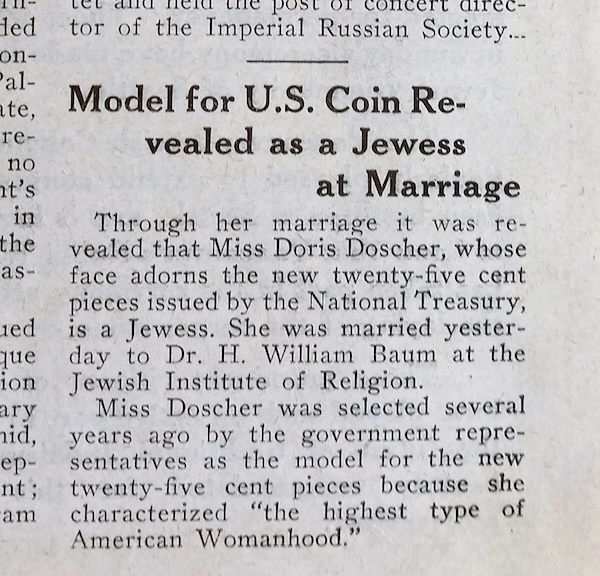
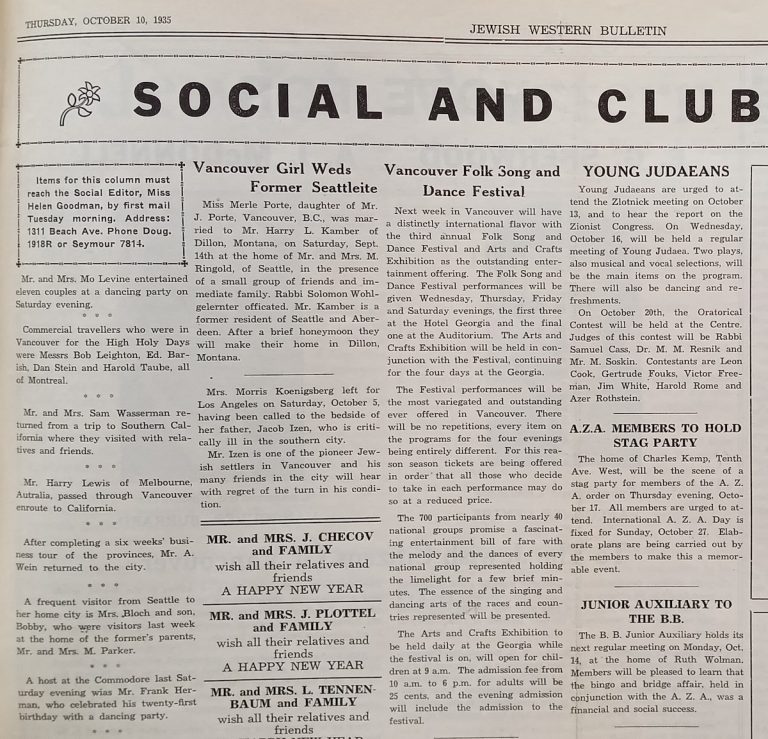
images - editorial, years in review, and other assorted clippings from the JI archives related to Rosh Hashanahimages - JWB/JI Rosh Hashanah issue covers over the years

Tolerating intolerance

It was mayhem outside the BC Provincial Court, near Main and Hastings, Aug. 20, as anti-Israel protesters screamed, chanted and shouted into megaphones to drown out the words of Dallas Brodie, member of the BC Legislature for Vancouver-Quilchena and leader of the upstart OneBC party.

Brodie attempted a media conference outside the courthouse before filing a “private prosecution” against Charlotte Kates, the Vancouver woman who is international coordinator for Samidoun, a group the government of Canada has designated a terrorist entity.

Kates was arrested by Vancouver police in April 2024 under suspicion of public incitement of hatred and wilful promotion of hatred, a criminal offence in Canada, after a public rally where she led a crowd in a chant of “Long live Oct. 7,” called the Hamas attack “heroic and brave” and described designated terrorists as “heroes.”

She was released on condition that she refrain from participating in any protest activities. Those conditions expired Oct. 8, 2024, when the BC Prosecution Service and the assistant deputy attorney general had not approved the charges recommended by police. It was a week later that her organization, Samidoun, was officially designated as a terrorist entity by the government of Canada. 

Brodie’s prosecution – an obscure legal move similar to a citizen’s arrest – is unlikely to have a direct impact on the case, though it might refocus the spotlight on the failure of authorities to follow through on a criminal prosecution.

In a statement, the Centre for Israel and Jewish Affairs noted that a report to Crown counsel has been sitting on the desks of relevant officials for more than a year.

“Every day they do not press charges,” said CIJA’s Pacific region vice-president Nico Slobinsky in a statement, “she acts with increasing impunity, including by flying to Iran to receive a ‘human rights’ award from its government and attending the funeral of Hezbollah leader Hassan Nasrallah in Lebanon. Our legal system must send a clear message: antisemitism and hate have no place in British Columbia or anywhere else in Canada. Charges must be pressed without delay.”   

Ezra Shanken, chief executive officer of the Jewish Federation of Greater Vancouver, observed that more than two-thirds of the BC Jewish community have reported experiencing an antisemitic hate incident. 

“Individuals and organizations like Charlotte Kates and Samidoun have exacerbated this dramatic wave of antisemitism, which is why our community has been calling for accountability since her despicable remarks on April 26, 2024, on the steps of the Vancouver Art Gallery,” Shanken said. “Justice delayed is justice denied.”

We wrote in this space recently about an incident at the Jewish Community Centre of Greater Vancouver that clearly violated existing laws banning political protests at locations where official school functions are taking place. Police did not recommend charges in that instance. 

The inner workings of the Crown prosecutors’ office and other components of the judicial process are not entirely transparent, the sensitivity of the issues they address necessitating a degree of privacy. However, some observers have suggested that there is a systemic problem up the ladder of the process. Police often do not pursue instances of apparent offences because they have seen prosecutors decline to charge. Prosecutors are said to hesitate to lay charges because they have seen courts throw out cases they presented.

There has been a great deal of hand-wringing about a massive spike in antisemitism, including violent incidents. There are many remediative and preventive opportunities that do not involve criminal charges – public awareness campaigns and restorative justice and diversion programs among them. But, at some point, the laws on the books to prevent the spreading of hatred and incitement to violence must be tested. If they do not stand up in court, then we as a society need a dialogue about what we will tolerate. 

We may find that we need new laws that courts will uphold, so that Crown prosecutors will be empowered to lay charges, so that police will know that enforcement is not a waste of energy, and so that Canadians will recognize what is acceptable and what is not in our country. 

What is not tolerable is doing nothing. 

Preparing for High Holidays

We have a new rabbi at Shaarey Zedek, our Winnipeg congregation. This is exciting as well as reassuring for many people. Why? Well, Rabbi Carnie Rose is the son of a rabbi and professor who lived in Winnipeg for many years, Dr. Neal Rose. His brother, Kliel, is a rabbi at Congregation Etz Chayim, another nearby congregation in Winnipeg. So, while Rabbi Carnie is new as a rabbi in Winnipeg, he is also a deeply familiar entity. He became a bar mitzvah at Shaarey Zedek. He went to kindergarten with the synagogue’s current executive director. 

This addition to our congregation is welcome, as Rabbi Anibal Mass and our chazzan, Leslie Emery, carry a heavy workload. They are still working hard, don’t get me wrong, but sometimes a new hire can offer support and everybody gets more breaks. I’m only observing this as a congregant and as the child of a Jewish professional. Sure, I serve on a committee, I show up to services, but I can tell there’s been a lot of work lately.

On a practical level, moving from the United States to Winnipeg is a big change. My family wanted to be supportive – after all, we too moved from the United States, in 2009 – so we’ve been helping Rabbi Carnie get his library in order. He’s got, as you might imagine, lots of books. These all got miserably jumbled in the move. While this has got to be stressful, he’s handling it all with good humour. We’ve taken pleasure at getting to look at and learn about all sorts of resources in Hebrew and English that we hadn’t seen before. Some books are like old friends, as I studied them as an undergraduate or in graduate school, but, to be honest, my books aren’t in nearly such good condition.

This experience mirrors many Jewish volunteer activities I did as a kid. As the child of a Jewish education director, who then went on to be the administrator (executive director) of my childhood congregation, Temple Rodef Shalom in Falls Church, Va., I spent many afterschool hours folding the weekly paper bulletin handed out on Shabbat, moving books or setting up chairs. While attending services or religious school were important activities, for me, the relationships I made with the rabbi and the staff and other congregants as we did these small jobs were the most meaningful ones. Along the way, I met many important guests, though it’s all a bit blurry now. For instance, I sat next to Elie Wiesel once after he spoke at our congregation. What I remember particularly is how formal and dressed up we were. Also, the dessert was good! I was allowed to stay up way past my bedtime.

Now, I’m proud that my kids are finding their way towards making their own community connections. One of my twins has gone to morning minyan many times this summer. He’s the only teen there and gets a lot of positive attention this way, including exchanging ideas with a retired provincial court judge. This judge also happens to be the father of my son’s elementary school principal, so we’re always on good behaviour with him!

My other twin isn’t getting to morning minyan much, but instead he volunteered for full weeks at a summer camp and daycare, helping little kids. He also helps on the synagogue tech team, doing accessible subtitles for prayers that are projected on screens as part of our service. This job is an important one, as it enables people to keep up with the service even if they are having a hard time hearing what’s going on or cannot read Hebrew. He’s been asked to help during the High Holidays. It’s a big honour and responsibility for a 14-year-old.

These commitments are important because they embody both the Canadian emphasis on volunteering and the Jewish one. When I was a teen, I lived for a year on a kibbutz. Volunteering was considered deeply valuable and important. Being the first to volunteer was a moral virtue. Yet, when I hear Winnipeg kids discuss accruing volunteer hours for school credits, it’s seen as an onerous requirement. Perhaps, for some, this requirement doesn’t have great value. On the contrary, in our household, we see these experiences as offering so many learning and growth opportunities.

While we moved books, searched for lost volumes and organized sets of Talmud and commentaries, we also saw the bustle behind the scenes as the congregation gets ready for Rosh Hashanah. There’s so much pageantry to the High Holidays. It’s a big deal. Some members jockey for important honours or specific seats and we listened with interest. We just wanted seats near the back, near where our kid would be in the tech booth. When I mentioned this to the new rabbi, I suggested that maybe different things matter to us. After all, I joked, I didn’t need to show off a new hat. (My mom always said this was an important part of High Holiday services when she was a kid in the 1950s!)

As for honours, we love a quiet summer Shabbat, when sometimes our kids get asked to read or are called up for an aliyah because no one reserved them in advance. These spur-of-the-moment experiences, where we might help out and take part in services, feel like the right spot for us. It may take months of practice to chant one part of the Torah portion, but we try to aim for a week when not much is happening.

A strong community is one where we can all contribute and help. Yes, big donors and fancy new hats are often part of the High Holidays. Big monetary donations keep the heat on, and status matters to many. However, a synagogue, and the Jewish community, must function throughout the year.

There’s a lot to think about when it comes to evaluating how we’ve behaved in the past year, and how we’ll make amends. To me, the most important reflections aren’t about where we are or how we behave specifically on Rosh Hashanah and Yom Kippur. In every regular weekday morning minyan, we also say “ashamu” – we are guilty. We work on ourselves all the time. Perhaps, while it’s important to have good intentions when it comes to the High Holidays, it’s also key to think about each day beforehand, and afterwards, too. Elul’s a whole month of reflection. Valuing one another and our community means making every day count. 

Joanne Seiff has written regularly for the Winnipeg Free Press and various Jewish publications. She is the author of three books, including From the Outside In: Jewish Post Columns 2015-2016, a collection of essays available for digital download or as a paperback from Amazon. Check her out on Instagram @yrnspinner or at joanneseiff.blogspot.com.

From the archives … JCC, 1937

image - clippings from JWB July 11 and 18 1937 issueIt was the big black square on the cover of the June 11, 1937, Jewish Western Bulletin that caught my attention initially. Then, as I flipped backwards and forwards through the archived papers, it was the weekly drama – that kind of left me hanging – and the sheer bluntness of tactics that drew me in to the JWB’s coverage of the 1937 campaign to raise funds for a second unit of the Jewish Community Centre, then located at Oak and 11th. (The building still exists, the home of the BC Lung Association for a long time now.)

The campaign action plan came out of a shareholders’ meeting in March of that year, at “which over one hundred men of the community were present,” according to the March 12, 1937, JWB, the JI ’s predecessor. I’ve no idea who the shareholders of the centre were. Nor if any women were at that planning meeting, but Lillian Freiman Hadassah, Council of Jewish Women and the Schara Tzedeck Auxiliary were among the organizations that helped solicit and collect pledges. 

The appointed campaign committee set a quota of $12,500 (or $271,217 in today’s dollars) and collections were divided into three divisions: donors of $100-$250 (Group A), $25-$100 (Group B) and up to $25 (Group C). The “keynote” of the campaign was “that each give according to his ability,” and every organization on the committee committed “its intention of getting whole-heartedly behind the task ahead.” Meanwhile, “The proposal submitted to shareholders by Schara Tzedeck Congregation of taking over the building has been tabled for a period of three weeks.” 

While that proposal obviously fizzled out, I couldn’t find any later mention of it. As I’ve often found when looking through the paper’s archives, it’s easy to find when things start, but harder to find out how they ended up. What is clear is that there was a hard push to raise the $12,500, and, while the March 12 article noted that, “possibly, for the first time in community history, there is no division of opinion concerning the necessity of and the urgent need for doing constructive work for [the] community Centre,” the JWB did feature some disparate views as soon as the next issue.

Rabbi J.L. Zlotnik summed up those concerns in a March 19 article: the quota was too much, given other community concerns and organizations that also needed financial support; and the quota was too little, given that actual building costs are almost always larger than planned, and the community would, therefore, become even more indebted as a result.

“After a period of ten years, twenty thousand dollars are still to be paid before this building can truly be called our own,” wrote Rabbi Samuel Cass in the March 31 issue, about the existing centre, while also pointing to the need for a second unit. He observed, “First, we must not repeat the mistakes of the past,” so the second unit should “be paid for in cash to the very last penny, before the first sod is turned. Second, the campaign must go beyond the amount necessary to erect the contemplated addition.” Lastly, he said, the whole community must agree that the debt on the first unit be paid off “even speedily, and at a near time.”

The advice seems to have gone unheeded. In the same March 31 paper as Cass’s article, the page 2 headline read, “All Organizations Endorse Second Unit Campaign.” 

The next edition’s cover blared, “2ND UNIT CAMPAIGN IN FULL SWING,” with the news that more than $3,000 had come in on the campaign’s first day, “collected from twenty men.” The building plans were also outlined in the April 9 paper: a two-storey building with a balcony was envisioned. The lower floor would be a gymnasium and banquet room, with “kitchen, showers, wash room, steam rooms, cloak-room, etc.” The upper floor would house an “Auditorium and Ball Room, cloak-room and lounge.” The balcony would be divided into small meeting rooms. “This present building is 33 feet 11 inches on 11th Ave. The addition would be 47 feet 9 inches or more than 40% larger,” the article stated.

image - clippings from multiple 1937 JWBs about JCC second unit campaignBy the April 23 issue, the A Division quota was “already assured.” A couple of weeks later, in the May 7 paper, a completely fictional piece was published on the cover, titled “Will You Make This Dream Come True?” It was written as if the second unit of the centre had opened, with a banquet, a highlight of which was the announcement of a $5,000 gift from an anonymous donor to pay for all the unit’s furnishings and appliances. The article imagined what meetings and other banquets were already being held in the new building and the great number of athletics classes available now that “the use of the gymnasium was available to all persons in the Community.”

By the end of May, though, the JWB was asking whether everyone had “done their share.” By June, the optimism hit a wall.

The cover of the June 11 issue featured the large black square that caught my eye. The label-sized caption with a white background read: “700 Jewish families in Vancouver can and must give towards the building of the Second Unit of the Community Centre.” 

The dramatic editorial choice was explained in the June 18 paper:

“The editorial staff of the Bulletin was bombarded with heated criticism for allowing such a hideous, melancholy, morbid and depressing thing to appear on the front page of the paper. Jewish people in all walks of life shouted words of rebuke, prominent Jewish business men cried ‘Shame, Shame,’ and Jewish society matrons muttered ‘Oh, how awful, it nearly frightened me to death.’

“No one, however, said ‘That little message in white, standing so pure, apart from that black hideousness was TRUE. Every body should give to the Centre – How we need that second unit – How essential it is to our Youth to have a proper meeting place.

“What our Community needs is more players, and less bench criticisizers. More workers, and less kickers.”

It concluded: “If you have a conscience, if you have the true community spirit – come through and show it. If you haven’t already given your contribution to the Second Unit – Mail it in to the Centre – tell them this article made you feel your responsibility. If you have given your donation, send in notification to the Centre to have it doubled. No matter what you give, make it as much as you can afford. Don’t let us be criticisers – LET’S BE BUILDERS.”

image - clippings from two 1937 JWBs about JCC second unit campaignOver the summer, a couple of meetings were held about the centre. There was a large notice on the cover of the July 2 paper about a July 5 meeting, but I couldn’t find a report in the paper about what transpired. Nor could I find out how the Sept. 22 “mass meeting” on “the Future of Vancouver Jewry” went – its Sept. 14 front-page notice declaring that “By your attendance … YOU SHALL BE JUDGED!”

There are no August or October 1937 papers in the bound archival collection I have, and I don’t know if they were lost to history or never published. Until June 1937, the reporting had been detailed and consistent, but the next mention of a campaign, in the Nov. 12 paper, is “the Recent Centre Drive” – not the second unit drive. In this campaign, there were seven grades, ranging from Grade A ($500 and up) to Grade G ($1 to $49). The Grade A donors were listed by name in that paper, the Grade Bs in the next issue, the Cs in the next, through to the Gs in the Dec. 24 issue, wherein the committee was congratulated for its work and the community for its “whole-hearted support to the campaign.”

Since there is no useable digital archive of the paper, sadly, my time-limited flipping came across no more mention of a second unit. The editorial two years after that campaign, on June 23, 1939, started, “Much water has gone under the bridge since our Centre Building has been re-financed. Inside and outside improvements on the building, in addition to the Amortization Plan itself has gone forward.

“Never have local Jewish efforts been more active, and the response greater, nor has the attendance within the building itself been so large. Much of the success is due to the liberal atmosphere of the Centre itself, which means the use of this building for any and all worthy Jewish efforts with but one thought – helping others to help themselves. One shudders to think of what might have happened to Jewish efforts in our city had not our fellow-Jews responded to the call for funds when it was made.”

The editorial also noted: “Some, however, have through oversight or neglect failed to send their payments in as yet.” It was hoped that “the pledgors in arrears will … see that their respective remittances are made … upon receipt of the notices.”

As far as I know, the second unit of the Oak and 11th JCC never materialized. It would be more than two decades later that a new centre would be built, at Oak and 41st, opening in 1962. 

The school year ahead

Back to school is a time of excitement and anxiety for parents and kids. It is a time of new beginnings. For Jewish people, it generally coincides, as it roughly does this year, with the new year and the High Holidays. This confluence creates a somewhat chaotic frenzy in many households.

Jewish tradition is deeply tied to cycles of time, weaving renewal and return into every layer of life. The turning of the calendar is reflected not only in Shabbat, the progression of holy days and the annual cycle of Torah reading, but also in agricultural rhythms, the monthly sanctification of the new moon and daily prayers mapping sunrise, midday and nightfall.

This year, as we move from the beginning of the school year through the procession of holidays, we approach the anniversary of Oct. 7, and the terrible realization that the surviving hostages in Gaza have been held for nearly two years – as well as the continued reality facing Israelis, Palestinians, Jews worldwide and everyone who cares about human life.

As the new school year begins, Jewish families have additional anxieties, knowing as we do that the public school system – not least some teachers’ unions in Canada, including the one in British Columbia – in many cases have not only failed to address the unique challenges faced by Jewish students but exacerbated existing problems while creating new ones. Almost everyone has heard anecdotally of insults and distress faced by Jewish students in public schools, and the situation on post-secondary campuses locally and internationally has been in the news for all the wrong reasons for most of the past two years. 

Additionally, this school year marks the first in which British Columbia’s education system officially mandates the teaching of the Holocaust. Most students did learn about the Holocaust before, but it had been left up to the discretion of individual teachers. Now, the Social Studies 10 curriculum requires that the topic be included. (See jewishindependent.ca/teaching-about-shoah.) This is something that the Jewish community and others have long promoted.

It does, however, create new openings for challenges. Given the allegations of genocide in Gaza, and overheated rhetoric against Israel in the public discourse – often invoking the memory of the Holocaust, the mantra “never again” and the appropriation of Jewish historical experiences for political advantage – there is a real possibility that individual teachers in the comparative privacy of their classrooms will attempt to inculcate anti-Israel narratives in the guise of genocide education. We expect there will be reports of inappropriate comparisons made between the Jewish experience in the Shoah and current tragedies in the Middle East – and we know that most such incidents will never be reported. 

It should never have come to this with regard to antisemitism, but powerful new generations of Jewish leaders have been forged on university campuses and, yes, in high schools and even elementary schools, rising to occasions they should never have had to meet, but doing so in ways that often have surprised even themselves. As tough as the past two years have been, all evidence so far points to young Jews continuing to rise to every challenge.

When all is said and done, we hope that the next generation of our community grows up stronger, smarter and more determined, individually and collectively. To students and parents: May you go from strength to strength this year and always. 

What to do with all our stuff

Recently, I was in the car with one of my twins and we were discussing how easy it is to accumulate too much stuff. We’d just had a conversation with a neighbour who mentioned that his sibling had moved into their parents’ house as an adult. It was a large, old home, now sadly so full of stacks of papers and other belongings that one had to turn sideways to navigate some of it.

I commiserated with my neighbour, misunderstanding the level of hoarding. I imagined how hard it must be to move, as an adult with a household, into a home already full of one’s parents’ belongings. Alas, our neighbour said, it was a mental health issue. It’s sometimes referred to as a hoarding disorder or Diogenes syndrome. It was serious. 

In the car with my kid, we found ourselves understanding how people get to this point. He said, quite astutely, that our society pushes “more, more, more.” We both agreed that it is hard to resist the siren song of acquisition that we’re constantly hearing. Choosing to stop, clean, tidy and cull things and acknowledge what we don’t need is even harder than resisting new acquisitions.

I was faced with my own “hoarding” scenario. My personal, free email account is more than 20 years old. Suddenly, I got a warning about a month ago that the storage on these accounts would be slashed dramatically. I could choose to pay a fee every month or delete a lot of messages. My husband got a similar warning, but his account was not as old or big as mine. Even so, we commiserated, because deleting some of these saved emails felt painful. Save the baby photo elsewhere and then delete the message? One by one, it didn’t seem to make a dent. Eventually, I figured out how to move older messages to a folder on my computer and I didn’t have to delete messages from people I’d loved who have now died; I didn’t have to cull every family photo.

Still, this exercise made us look around. My kids, about to start high school, decided that they didn’t need about 75 books on their shelves, acquired over the years from Scholastic book fairs, PJ Library and elsewhere. They are making plans to sell or donate the books.

Each kid, getting ready for a new school year, worked to empty out enormous middle school binders. They recycled tons of paper. They acknowledged that we no longer needed a Grade 5 workbook leftover from those pandemic days of learning at home. Both kids realized we needed to make space in their backpacks: for new intellectual growth and a new school year. 

As my kids grow physically this summer, I’m knitting as fast as I can to make them new sweaters for winter but I’m knitting a sweater now out of “stash” yarns that I acquired when they were infants. Both kids are now bigger than me. The sweaters I make from now on will likely be too big for me when they outgrow them.

This is a balancing act, of course. It’s normal in our household to get some new things for a new school year, even if we reuse the old stuff, too. This celebration of something new even has a word for it in Modern Hebrew. We might say “Tithadash!” or “May it renew you!” when you see someone with new belongings. 

At the same time, I’ve been studying the Babylonian tractate of Avodah Zarah. It explores how Jews are to interact with non-Jews or those who might worship idols. One of the concepts it covers is whether one can reuse anything that might have been used by someone who engaged in idol worship. This is a complicated topic. It involves both “decommissioned” idols and whatever was used to sacrifice to the idol. One also must consider whether any of these items might be ever “reused” in Jewish worship or sacrifice, in the days when the Temple still stood in Jerusalem. It goes even farther, examining what one does about an idol created by Jews in the first place, like the Golden Calf. The tractate is sometimes confusing because it’s in so much detail.

That said, I returned to something else the text seemed to be telling us. In some cases, these items can be reused. The underlying message explores what we waste or throw away, versus how we can give things “new lives” even if their first use wasn’t ideal.

Nobody is worshipping idols at our house, but we’re discussing reuse, as well as the acquisition of new things for the upcoming school year. I see 14-year-olds evaluating their lunch bags and considering making themselves new ones. There was a pile of shirts in the give-away pile after we cleaned up today. I even saw a completely tidy sock drawer. This may never happen again!

I’m not sure how to always resist or even push back against our consumerist culture. However, the talmudic debate over physical leftovers from idol worship and what might be used again and/or refurbished made me realize that this struggle isn’t new. Just as we hope our kids are off to learn more with each school year, we also hope they’ll hold onto the good, sweet things that they embodied at younger ages, too. New, shiny ideas and things are tempting, but there’s something powerful and potentially meaningful about reuse, too. 

Joanne Seiff has written regularly for the Winnipeg Free Press and various Jewish publications. She is the author of three books, including From the Outside In: Jewish Post Columns 2015-2016, a collection of essays available for digital download or as a paperback from Amazon. Check her out on Instagram @yrnspinner or at joanneseiff.blogspot.com.

From the JI archives … education

Not surprisingly – “People of the Book,” and all – education is an always-relevant topic that has been covered in the Jewish Independent / Jewish Western Bulletin. The paper seems to have steered clear of editorially supporting any particular Jewish school or type of Jewish schooling, but rather consistently stressed the need for Jewish education, especially for children, but also for youth and adults.

A 1956 editorial noted that “an estimated 50 percent of Jewish children in Canada do not get any Jewish education whatsoever.” While admitting that there were no data to suggest Vancouver fared better than other Canadian cities in this regard, it noted that there were several types of schooling available here, day school, evening classes, religious and secular options. “Only the anti-Semites try to cast all Jews in a common mold, a hateful mold,” it noted. “But the Jews among themselves have always followed diverse paths in the perpetuation of their history, ideals and spiritual heritage.” So, it concluded, “Register your child in the Jewish school of your choice. And, if your child is already enrolled, remind your friend or neighbor about enrolling his child.”

image - clippings from the JI at 95 years about education

An ever-changing city

Summer is a time when our routines are happily disrupted. Kids are out of school and many of us take time off from work to enjoy the hometown that draws tourists from around the world. Maybe we wander off the beaten path and see parts of our own city we usually miss on our repetitive commute. Perhaps we leave town for a week or two and return with fresh eyes.

Anyone who has lived in Vancouver and environs for more than a few years can’t help but see change at every turn. Many of us are watching our old elementary and high schools being replaced with new structures, memories being ploughed under with the old bricks. Community centres throughout the city are seeing replacements. Canada’s oldest business, the Hudson’s Bay Company, is being liquidated, leaving another gaping hole (for now, at least) in the retail landscape at the heart of downtown. Woodward’s is a distant memory. And, of course, what old-timers call “the new Oakridge” is being redeveloped into the new new Oakridge, as anyone trying to navigate by car or bus along 41st or Cambie cannot help but be reminded.

Not everyone likes change, put mildly. But, it is inevitable.

It is simplistic to say there is only one way to go – up. There is an alternative, albeit not a good one. We could continue a 20th-century trend to suburban sprawl, in which we lay housing and concrete across precious arable land. 

Novelties like laneway houses have attempted to increase capacity in erstwhile single-family neighbourhoods. Along arteries like Oak, Cambie and Granville, single-family homes are giving way to four-, six- and eight-unit developments. As was always the plan, mixed residential and commercial hubs are skyrocketing from the ground up around transit stations, as evidenced most profoundly around Brentwood, Metrotown, Marine Drive and Oakridge.

Which brings us back to what, for most of the past century, has been the “Jewish neighbourhood.”

That term is a bit of a misnomer. A place where most Jews live does not equate to a place where most people are Jews. Even in the most Jew-dense neighbourhoods, we remain single-digit or low-two-digit proportions of the population. Emotionally, traditionally, spiritually and institutionally, since the 1950s at the latest, the rough area around Oakridge, down Oak and Granville and the surrounding blocks, have been home to Metro Vancouver’s Jews.

This reality began fraying about three decades ago, when housing prices began their notorious upward escalations. (Great for homeowners. Not great for first-time buyers.) And the Jewish community became more geographically dispersed, with inevitable positive and negative consequences.

While the City of Vancouver still holds the largest share of the BC Jewish population (at 58%), other municipalities now have significant Jewish populations, including, in order of size, Richmond, Surrey, the District of North Vancouver and Burnaby. Greater Vancouver’s proportion of the BC Jewish population has decreased, though, from 81% in 2011 to approximately 75% in 2021. (For much more data, see jewishindependent.ca/quick-look-at-canadian-jews.)

For Jewish institutions, this reality has demanded accommodations, with services becoming less geographically rooted. Many agencies, notably the Jewish Federation of Greater Vancouver, Jewish Family Services and even the Jewish Community Centre, which by its nature is geographically rooted, are successfully delivering programs across the region.

For Metro Vancouver’s Jews, and for every cultural group, this relentless change has personal and collective impacts.

The JWest development on the 41st and Oak JCC site will include – among other things – hundreds of new homes, notably purpose-built rentals, the scarcity of which is a major contributor to the crisis in the housing market. These hundreds of new homes will not, of course, all be occupied by Jews. But they will be a dramatic increase in available homes in what was, and may again become, the heart of a “Jewish neighbourhood.”

This does not take into account the thousands of other new homes being developed within a radius of a few kilometres, not least at the Oakridge site. Will these be affordable housing? In Vancouver, that term has perhaps lost all meaning. Everything is relative. But volume and variety of housing options are the key to what approaches the concept of affordability. 

We can only remotely predict the sociological impacts these dramatic physical changes in our city will have on our day-to-day life, including the vibrancy of Jewish life – not only here, but around the Lower Mainland and the rest of the province.