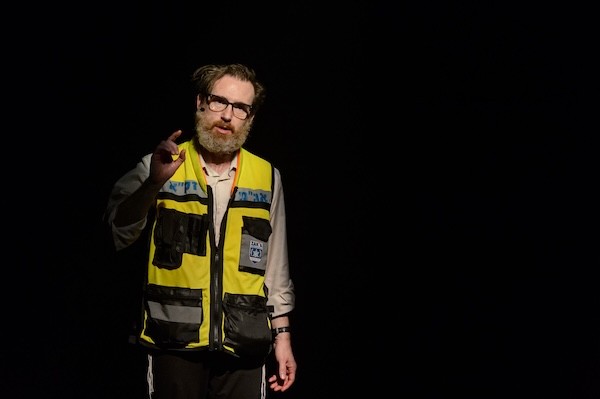
Pride in being “just a Jew”

There is an age-old question that frequently nags at us along our journey of life: “Who am I?” I’ve struggled with it, and perhaps you have as well. When you ask yourself “Who am I?” you probably start by listing superficial things about yourself. In my case, I’m from Argentina, I play music, and people say I have a great sense of humour. Even though I always knew who I was on the surface, a deeper layer eluded me. There is still more to learn about myself.

When I was young, well, younger than now, I constantly pressed my father with the similar question that was scrambling in my head: “Who are we?” I was trying to find a simple way to get my answer, to avoid spending my own time navigating the question so I could do something (seemingly) more productive, like playing video games. I figured that, by asking my dad, I may very well be who he is, given I’m his son, an extension of him, in many ways. But, every time, my father would reply in the same cryptic way and always with a smile on his face: “Son, we are Jews.”

I was never quite able to comprehend why he couldn’t just give me a plain answer, rather than that infuriating, puzzling and annoying explanation. I was not going to give up and, with my insistent character, I continued asking. I posed the question from different angles, wanting him to elaborate, but he would just say, “Uriel, it’s simple. We are Jews. You and I are solely Jews.”

When my dad couldn’t satisfy my curiosity, I turned to my school’s rabbi, Rabbi Stephen Berger. When I asked Rabbi Berger, his answer was just as confusing and mysterious. He kindly stated that he could not provide me with the answers I sought; I had to embark on this road of self-discovery myself, with the help of my loved ones. Then, about halfway through the year, he introduced me to StandWithUs Canada, an organization that would help me better understand who I was by putting me in touch with other Jewish teenagers from around the world.

I now realize why I couldn’t access a fast-food solution to a philosophical question. I finally found the answer I’d been seeking.

Last August, as I joined 190 of my peers from high schools throughout the United States and Canada at the StandWithUs conference in Los Angeles, I found myself on a path leading to enlightenment that has reshaped my understanding of Jewish identity. The sessions were informative and interesting, but it was when we reached the segment focusing on what Jews were before the dark chapters of persecution during the Holocaust – they were highly contributing members of society, and more – that everything started to click.

A single statement truly hit home: Jews have been forcibly expelled from about 109 countries throughout history. It was a stark reminder that, regardless of our accomplishments and contributions, we would always be seen as “Just a Jew.” It became clear that the essence of being Jewish transcended any specific occupation or societal role. We are a resilient and diverse community with a history of triumphs and tragedies. 

This knowledge instilled a sense of pride in my identity, not as a limitation but as a source of strength and unity. Thanks to StandWithUs Canada, I learned that, at the end of the day, embracing who we are, with all our complexities and contributions, is a powerful testament to the enduring spirit of the Jewish people. I felt a sense of pride but a pride that could be taken away from me at any moment. This is when I decided to become a more invested member of the community by being on the board of NCSY, the Orthodox Union’s youth group.

Talking to politicians and people who can truly make a difference became an essential component of my advocacy. I understood how dialogue and education could change people’s perspectives. 

My aim in sharing the history of the Jewish expulsions and the resilient spirit of our community is to raise awareness and foster understanding. My tool against bigotry and ignorance is teaching. I am committed, every day, to teaching people about the rich history of the Jewish people.

Uriel Presman Chikiar is in Grade 12 at King David High School and is a board member of NCSY.

Inspiration is nearby

Light amid darkness is a common theme in the winter festivals of many wisdom traditions. As befitting a Jewish holiday, the meanings of Hanukkah are many and varied, among these the resilience of the Jewish people and the imminence of miracles. These are welcome themes this year.

At vigil after rally after menorah lighting after social media post after dinner table conversations during Hanukkah, the theme has been reprised endlessly over the past days: in a world of darkness, we are called upon to generate light, even to be the light. 

Finding the light – let alone being the light – is not easy. It is understandable to respond to events in the world today with hopelessness. A dramatic spike in antisemitic incidents locally and internationally is only an iceberg’s tip. It does not require a physical assault or desecrated property to be victimized by the tsunami of hatred sweeping over the world.

In the face of this conflict and the ensuing uptick in hatred, what have Canadian Jews done? In British Columbia and across the country, we have joined with Jews around the world to volunteer, donate and do whatever is necessary to repair, as much as it can be, the brokenness that happened on Oct. 7 and since. 

This is the light we are called upon to be. This is the resilience that is not just a word, but an actualized embodiment of Jewish values.

It is worth remembering that the greatest period of growth and expansion of our own local community occurred in the late 1940s and early 1950s. Even as the magnitude of the unprecedented historic trauma was just beginning to be understood, new synagogues were constructed, new day schools opened, social service agencies launched, refugee aid groups mobilized. Hillel welcomed students for the first time at the University of British Columbia mere months after the end of the Second World War.

In the shadow of unfathomable darkness, Jews in Vancouver redoubled their commitment to nationhood. Similar epochs of regeneration took place worldwide, not least being the fulfilment of the ancient dream of Jewish self-determination as a free people in our own land. 

This extraordinary burst of collective local regeneration was, of course, due in part to the influx of refugees, as well as the greatest period of sustained economic growth in human history. But, it was, first and foremost, an expression of the determination of the surviving remnant to plant for the future generations even while mourning those who had planted for them.

The chalutzim, the pioneers, who built the foundations of the community we live in today remain with us – some only in spirit, some very much still with us at advanced ages. Likewise, the founders who built the state of Israel are present, some in body but all in spirit, as we rededicate ourselves to girding the defence, strength and future of that country. Together, the examples of these forces of resilience are models for us to emulate as we struggle in these dark times.

We do not need to search hard for inspiration to get us through and embolden our commitment to carry on, to be the light. It is in the example of our families, our community and millennia of being a people that the poet Yehuda Amichai called “infected with hope.” May we merit to grow in hope, compassion, resilience and light in the coming days and weeks. 

Torts and the Jewish holidays

I’m that grown-up who jumps to catch a kid who is about to fall off a playground slide, even if the kid isn’t mine. I’m saying, “Hey, be careful!  You don’t want to hurt your bum,” or whatever concern is applicable. Some feel I’m overprotective. Rather than using unkind words like “hovering,” I prefer “proactive worrier.”

I felt isolated with this habit. Then I got to know the contractors for our home renovation better. The brothers who worked for us were also parents. They did everything possible to keep kids, dog and parents safe as they worked on the house with us living in it. The older brother, the electrician, would spell out exactly which hazards he was trying to avoid. He would close a door, put up a sign saying “Please stay out” or another proactive way to avoid problems. The day they installed a big new bathtub was a good example. After caulking it, the tub was filled with water to weigh it down and create a good seal. We knew the kids and dog would be very tempted to check it out – we imagined kids falling in in their clothing, playing with rubber duckies, a dog jumping in and flooding the room. We strategized how to keep everyone away from the tub until the caulk hardened.

I was surprised when I started studying Bava Kamma, a Babylonian talmudic tractate dedicated to civil law, particularly the law of damages and compensation owed. In “fancy” legal vocabulary, this is tort law, which “provides damages to victims in compensation for their losses.” The rabbis of the Talmud thought through these issues. They used examples from their day. They talked about oxen that gored, camels that fell (and caused a stumbling block) and other unpredictable situations. I’d heard sermons where people laughed about this level of detail, but my brain returned to those playground moments. Perhaps others don’t take these examples seriously because they’ve never interacted with large, stubborn livestock or a fussy, heavy toddler or two.

Here’s an example of a question posed in a baraita in Bava Kamma 29: “If one’s jug broke and he did not remove its shards, or if his camel fell and he did not stand it up, Rabbi Meir deems him liable to pay for any damage they cause. The rabbis say that he is exempt according to human laws, but liable according to the laws of Heaven.” So, the understanding is, if you create a dangerous situation, you’re obligated to clean it up. If you don’t clean it up, you’re still responsible for it. You’re guilty even if you don’t owe money as compensation.

Examples like these keep popping up. This tractate is a Jewish rabbinic lesson in taking responsibility for our actions. How might something we do harm someone? What if it’s an accident, like dropped pottery? What if you purposely left broken glass or pottery that could harm others?

This ancient rabbinic text can seem dry, as law texts might be, but also relevant. In the last few days, many communities have started to use law as an excuse to exclude public acknowledgement or celebration of Hanukkah. Moncton, N.B., made a name for itself in this way. A Hanukkah candlelighting has been customary there for 20 years. Suddenly, this year, the mayor and council felt it interfered with the separation of church and state. They canceled the event, although Moncton City Hall decorates with angels, a Christmas tree and wreaths. A last-minute petition with many opposing voices succeeded in forcing a new vote that overturned this decision, so the menorah and candlelighting were reinstated.

Other communities wrestling with this include Williamsburg, in my home state of Virginia. Organizers there suggested that a menorah lighting couldn’t be allowed unless it was under a “ceasefire now” banner. In Britain, a London town council reversed their decision to cancel a public menorah lighting after an outcry. Back in Canada, in Calgary, Alta., the mayor canceled her attendance at the city’s public menorah lighting. 

Suddenly, the rabbis’ detailed discussions in Bava Kamma make more sense. Their debates explore when someone is wronged by accident, and if they owed compensation. However, they also include the question of responsibility when someone is wronged “on purpose.” For example, when a government uses the law to suppress a minority religious observance, like Hanukkah. When this kind of action takes place, it does harm. It does harm beyond whether Jews are legally allowed to light a hanukkiyah in a public place. The message it sends causes bigger damage and fear. 

After all, if Jews in Canada or the United States aren’t allowed to publicly celebrate their religious rituals, it feels unsafe to be Jewish in these places. Where is it safe? Most Jews would then think about Israel as being the place where it’s truly safe to be Jewish. The people who want to withdraw public observance of Jewish traditions due to the Israel/Hamas war send a message to Jews living in North America – it’s not OK with them to have a Jewish homeland in Israel. It’s also not OK with them for Jews to observe their religion openly here. They probably missed the irony, as their message is that it’s especially not OK when the Jewish holiday is about religious freedom.

Laws about compensation for damages can sound uninteresting. It becomes more intriguing when imagining an unsafe play structure, a broken piece of pottery or a camel that won’t budge. It gets even more pertinent – and uncomfortable – when the law is used to keep us from celebrating our religious traditions freely, in public, without fear, in a democracy.

While Hanukkah is ending, it’s still the time of year when many indulge in more sweets and tortes than we’d planned. Sadly, it’s a different kind of tort this year, one where we consider how to compensate for the potential loss of religious freedom. 

Joanne Seiff has written regularly for CBC Manitoba and various Jewish publications. She is the author of three books, including From the Outside In: Jewish Post Columns 2015-2016, a collection of essays available for digital download or as a paperback from Amazon. Check her out on Instagram @yrnspinner or at joanneseiff.blogspot.com.

Writing in praise of neoteny

Campers being silly at Rockbrook Camp for Girls. (photo from rockbrookcamp.com)

Today, the word of the day is neoteny. It’s really a term from evolutionary biology, but it describes the retention of childlike attributes in adults. You might think of a grown-up who has a “baby face,” or is generally “cute.” When you are talking about these kinds of physical features, we tend to think it’s a good thing to have “young looking skin” or the “energy of youth,” for example. Neotenic people are usually attractive. Being neotenous is mostly considered a good thing.

But what about personality traits, attitudes or approaches to the world? What about these ways of being childlike? Think about what life is like as a child. The world is magical, full of curiosities, almost always kind and wondrous. As kids, we spend so much time being creative and playing. We feel so many more things – joy, excitement, anticipation, and the broad sensuous world around us. All of this probably makes it so easy to make friends (“Come on! Let’s play!”).

You’ve also noticed what usually happens when we grow up. We get serious, we latch on to patterns of behaviour, we get scared, we feel the need to protect what we believe, we accept responsibilities and feel pressure to perform and “be” someone in particular. As adults, we spend almost all of our time, mostly alone, working to stay organized and fighting opposing forces. We’re all too consumed by those adult things we’ve grown to accept as important, and it ain’t easy.

photo - Kids at Rockbrook Camp for Girls with soapy hair
(photo from rockbrookcamp.com)

It’s no surprise to see that being an adult overpowers those childlike traits. Sadly, to grow up often means losing touch with what we used to be, those aspects of being human we loved as kids. As adults, we have a harder time feeling what makes the world wonderful, a harder time making friends, and a much harder time playing and having fun. Of course, there are exceptions to this, but that’s the point. They are exceptions. And that’s too bad.

Let’s remember the value of being childlike even as adults.

Let’s be joyful as we’re responsible.

Let’s be curious when encountering opposing beliefs.

Let’s be friendly and playful, cooperative and excited about learning new things.

Let’s strive to foster our innate neotenous instincts.

Bringing this back to camp.… Summer camp is a place where kids can really be kids. It’s a special time when they are encouraged to play, make friends, be creative and explore the world around them. Separate from the forces of home and school (which are fundamentally about forming “adults”), camp provides a wonderful opportunity to strengthen our “kid selves.” It celebrates and fosters the neotenous traits. Camp is a joyful break from all that training, and that’s a big part of why it’s so fun.

Maybe we could say…. Camp helps you learn how to be a really great kid so that, later in life, you’ll be a really great (happy, satisfied, remarkable) adult.

Camp’s power to strengthen these “kid traits,” I suspect, will be a big part of that success. 

Jeff Carter is director of Rockbrook Camp for Girls, which is in the western part of North Carolina. For more information, visit rockbrookcamp.com.

A time for miracles

Hanukkah is a reminder that darkness can be transformed into light, and that miracles are possible.

With so much conflict, misery, anxiety and hopelessness in the world, we need some miracles.

There have been a few rays of hope in Israel in recent days – the release of hostages from Gaza has brought a world of relief to the families and friends of those freed and to Jews and others abroad. As a people, we will not rest until all those who have been kidnapped are returned home safely.

Even then, the war will likely continue, with the stated goal of eradicating Hamas. As catastrophic and heartbreaking as the war and the atrocities that sparked it have been, this is a single battle in a longer conflict that seems destined to go on, at least for the time being.

When we look at today’s events in the context of a larger history, it is understandable to conclude that things are not getting better, but worse. Silver linings in such a situation seem few and far between. To be honest, in this space we try to find something constructive and hopeful in every topic we confront, and it has rarely been more difficult than in the past two months.

As students of history, we can only offer this piece of hope: many times, in our individual lives, in the story of the world and in the 3,500 years of history of the Jewish people, seemingly intractable problems have been resolved in stunning and unexpected ways.

Consider three massive geopolitical examples that have happened in the living memory of most of us.

Many of us grew up under the shadow of nuclear catastrophe. Some of us may recall practising hiding under our desks in preparation for a nuclear explosion. All of us who are middle-aged or older certainly remember a world viewed as a binary of “us” (the capitalist West) and “them” (the communist East).

From the perspective of the child cowering under the desk, the idea that the defining global status quo would end not in a bang – the ultimate bang – but with the relatively peaceful dismantling of the Soviet Union and its client regimes, would have seemed unimaginable. The Cold War, which defined our worldview and, at times, threatened our very existence, ended peacefully more than 30 years ago. Just a short time before it did, nobody could have foreseen the unfolding of events.

Likewise, the end of the racist regime in South Africa and its apartheid institutions. One of the most venal systems ever imagined was ended not by bloody revolution, but by a relatively peaceful, collaborative transition to democratic majority rule.

A third example, the Irish conflict, understatedly referred to as the “Troubles,” largely ended with the successes of the Good Friday accords of 1998.

In all three of these instances, the resolution of what seemed like intractable, even existential, challenges were overcome with remarkably sudden and unanticipated events.

It should be noted as well that, in all three cases, events played out very much because of specific leaders who were involved, who took immense risks, were willing to compromise, and placed an immense amount of hope in the goodwill of their people to make their societies and, by extension, the world a better place.

We might say that we don’t see great figures on the horizon on either side of the conflict that presently consumes us with such intensity. But this is precisely the point. Vast historic changes have happened when least expected because movements and visionary individuals emerged and ushered in changes, upending the seemingly rigid status quo.

The Israeli leadership has promised that the current war will eliminate the terrorist autocrats who have run Gaza. The leadership in the West Bank is inevitably going to change before long as well, if only because the current president is aged 88.

Not incidentally, when this horrible war finally ends, Israelis will be undertaking a very serious review of recent events. It is entirely reasonable to expect significant changes at the top of both Israeli and Palestinian power structures in the very near future.

The truth is, in change there is hope. And, indeed, change is the only thing that is inevitable.

It might be also time to dig up an old chestnut from David Ben-Gurion, who said something that is relevant here not only because of the time of year – Hanukkah – but because of the time of history.

“In Israel, in order to be a realist, you must believe in miracles.” 

Growing and sharing our inner light

If we fear “advertising” our identities, we should do everything we can to maintain our inner light and self-worth in trying times. (photo from PxHere)

Years ago, my husband lost both his grandmother and his great aunt. Several years apart, he traveled to the Lower East Side in New York to attend their funerals at the same funeral home. There was a rabbi there who officiated at both funerals. This rabbi told the same story twice. Perhaps he had only the one funeral teaching, but my husband remembered it. This rabbi suggested that a famous rabbi taught that the worst of the plagues against the Egyptians was darkness. Why was darkness the worst? It was all encompassing, overwhelming, and seemingly permanent. No one knew if the sun would ever return. This rabbi used this to talk about death, but the metaphor stayed with us.

Despite our efforts to find the source for this story, we couldn’t track down its origin. While looking for it, I thought about darkness and what we can learn from it as we celebrate Hanukkah this year.

There are parallels between the Hanukkah story and our current struggles. Before Oct. 7, Israelis were distracted by potential changes to their court system and very divided politically. While that political turmoil didn’t disappear in the face of the massacre and the war, Israelis have immediately united in the aftermath to work together. Israelis I know have said that it isn’t the government that is taking care of those who are displaced, but rather nongovernmental organizations and volunteers from every corner of Israeli society. Israelis are cooking meals for soldiers, for moms managing as single parents for long periods of time, and for those who have been evacuated or made homeless by the conflict. Israelis and the Jewish people worldwide have also worked together as a people to take care of one another.

The military conflict of Hanukkah is a story of division and unity. There were Jews at this time, around 200 BCE, who had become increasingly assimilated and Hellenized. They cooperated with the Seleucid Empire. There was societal upheaval. Others were more traditional in practice and offended by the changes made by more “liberal”-minded Jews and King Antiochus. The Maccabees represented the traditional or more orthodox Jewish tradition. They rose up against King Antiochus’s pagan practices and the more assimilated Jews who had adapted to Hellenistic practice.

We know now that the Maccabees won these battles. They rededicated the Temple in Jerusalem. This is a military victory and a story around religious or national liberation. The rabbis tried to focus the religious observance on the miracle of the light (the “ner tamid,” the holy flame in the Temple that should not go out) rather than on the military situation. However, we wouldn’t have Hanukkah without these historical cultural conflicts or the Maccabees’ wars.

The historical details of this struggle are in the books of the First and Second Maccabees, which describe the Hanukkah story. While there are many references to the holiday in the Mishnah, the detailed story has been maintained through the Catholic and Orthodox churches, which kept First and Second Maccabees as part of their Old Testament. Protestants don’t include these books in their bibles. We study these texts to understand Hanukkah, but they don’t hold any official status in Jewish tradition.

This, too, has a parallel to our modern experience. While we know our traditions around Hanukkah, some of the context comes from many historical texts preserved by others. During this war against Hamas, we are being forced to defend ourselves against antisemitism, and also to defend the existence of the state of Israel. The worldwide Jewish community doesn’t have to use our personal experiences to educate others about this. The historical contexts for understanding both antisemitism and the need for the existence of the state of Israel are embedded in world history. Learning about the historical roots of Christian antisemitism in Europe or in the dhimmi law of Islamic empires is part of the greater history. Information about when the Romans conquered Israel and destroyed the second Temple can be found in multiple sources, including on the Arch of Titus in Rome. The creation of the modern state of Israel in 1948 is also part of a much broader historical context.

The rabbis chose, in creating the rules around the holiday of Hanukkah, to focus on light and miracles rather than military victories. Rabbi Lord Jonathan Sacks (z”l) wrote in “8 Short Thoughts for 8 Hanukkah Nights” about the ways in which the light is emphasized. His fifth short thought focuses on Maimonides’ teaching about how to fulfil the mitzvah of Hanukkah. Maimonides teaches that lighting candles on Hanukkah is precious and that one must sell something or borrow to fulfil this commandment. Yet, if one finds Shabbat is coming and you have only one candle? Light it for Shabbat. In this case, Maimonides teaches: “The Shabbat light takes priority because it symbolizes shalom bayit, domestic peace. And great is peace because the entire Torah was given to make peace in the world.” Sacks suggests that, “in Judaism, the greatest military victory takes second place to peace in the home.” He points out the great victory is a spiritual and not military one.

For Israel today, too, the great victory must be the notion of continuing to pray and negotiate for peace while also navigating difficult military situations.

Sacks makes several points that could be articles on their own, but the ones I felt most drawn to remain relevant. The Hanukkah candles should be lit so that people can see them outside, but if one is afraid of inviting hate, it has long been taught that it is OK to light the candles indoors, out of public view. Still, we are meant to be public about our “light” more generally and fight for it, if necessary. If we fear “advertising” our identities, we should do everything we can to maintain our inner light and self-worth in trying times.

Finally, Sacks discusses a story in the Talmud in which Rav and Shmuel, third-century rabbis, disagree over whether you can use one Hanukkah candle to light another (if you lack an extra candle, a shamash, the helper candle, that is used to light the other eight candles). Rav suggests that you may not, as this might diminish the light of the first candle. Shmuel disagrees, and halachah (Jewish law) follows Shmuel, who teaches that you can use one Hanukkah candle to light another because it helps the light grow and brings us more light. Using your light to enlighten others is the best practice.

I bumped into a rabbi I admire who lives in Winnipeg, where I live. We were each dropping off kids at a Jewish youth group activity. He wore a ball cap, as he was “off duty.” I thanked him for his contribution to a news article about the war and local protests, and he responded, “These are dark times.”

Like the plague of darkness in Egypt, we don’t know exactly how or when things will lighten. We need Hanukkah’s message and rituals to offer that light. Maybe we won’t put our Hanukkah candles on public display this year, but we can draw wisdom and comfort from our long history and rabbinic teachings. These teach us to reach deep to find the messages of hope, faith and peace from a story about a war. This time around, we need to act individually like Hanukkah candles. We can lend our inner lights to volunteer, to speak out, to support others and to kindle others’ lights during a hard time. Even during times of war and hate, we can be the light. 

Joanne Seiff has written regularly for CBC Manitoba and various Jewish publications. She is the author of three books, including From the Outside In: Jewish Post Columns 2015-2016, a collection of essays available for digital download or as a paperback from Amazon. Check her out on Instagram @yrnspinner or at joanneseiff.blogspot.com.

The omission of antisemitism

Many Jewish students are worried to go to campus in view of threatening and hateful messages and even open hostilities at some Canadian campuses. These are taking place within a wider context of antisemitic incidents in the wake of the eruption of the Hamas-Israel war.

The silence of some Canadian universities in addressing antisemitism, in particular when considered alongside otherwise active approaches toward equity, diversity, inclusion, decolonization (EDID) and racial justice needs to be explicitly addressed.

Legal action has recently been filed against some Canadian universities for failing to address antisemitism.

Anti-Palestinian racism, antisemitism

I’m an education scholar whose work centres on equity, diversity, inclusion, decolonization and anti-racism.

My engagement in this work has been shaped by my own background migrating to Canada from Israel 12 years ago. My graduate studies in Jewish history, with focus on Holocaust memory, made me attuned to injustice.

My migration was informed by concern my children wouldn’t be able to grow up without absorbing the racism against Palestinians that is pervasive in Israeli society. I now fear that my children, and students, will be absorbing antisemitism.

Antisemitism in society at large, on campus

Antisemitism — the prejudice, hatred, and oppression of Jews and one of the oldest forms of racism — is an ongoing concern in Canada.

There has been work at some post-secondary institutions to consider how EDID frameworks need to address antisemitism and also Islamophobia and anti-Palestinian racism both in the context of Israel and Palestinian issues and in the everyday.

But many EDID frameworks — both of specific institutions, and larger guiding frameworks — do not explicitly address these problems. For example, the Federation for the Humanities and Social Sciences’ 2021 “Charter on EDID,” which states the need for “a more resolute effort to achieve [EDID] in our disciplines [and] fields of inquiry,” mentions categories of race, ethnicity and does not name antisemitism.

Addressing covert and explicit discrimination

Because racism and discrimination are often covert in higher education institutions, EDID initiatives focus on creating systemic and institutional changes in all levels and aspects of institutions, including through policies, leadership, hiring, curriculum and student experiences. But this frame is also applied to specific discrimination cases and complaints in higher education.

Universities’ equity, diversity, inclusion and decolonization initiatives are emerging and should rightfully comprehensively respond to specific forms of racism and discrimination. For example, in 2020, work on the Scarborough Charter on Anti-Black Racism and Black Inclusion in Canadian Higher Education was launched and multiple universities have since signed it, pledging “shared recognition of the realities of anti-Black racism.”

Focus on decolonization

Inspired by the Truth and Reconciliation Commission and its 94 Calls to Action, decolonization and Indigenization of Canadian higher education plans have become central for conceiving EDID work.

For example, the second part of the Social Sciences and Humanities Research Council’s Igniting Change 2021 report, from the Advisory Committee on Equity, Diversity, Inclusion and Decolonization, focuses on “Principles, Guidelines, and Promising Practices of Decolonization.”

In Canadian universities, an EDID focus on issues of decolonization and racism is important, given histories and legacies of colonial oppression, racism, exclusion and marginalization affecting Black, Indigenous and people of colour in Canada.

Yet this focus, in specific institutional approaches to EDID, fails to address and at times downplays the history of antisemitism and its ongoing reality in Canada.

Whiteness and Jews’ ambivalent racialized status

Several factors have contributed to this. The majority of North American Jews self-identify as white. “Whitening” allowed white-passing Jews to become part of a white Christian mainstream in ambivalent ways.

This process has reduced Jewish heritage to simply a religious/faith affiliation, even while Jews remain vulnerable to pernicious white supremacist and antisemitic beliefs about Jewishness being “in the blood.”

No doubt, it is complex to identify Jews as a category under “race,” since such a categorization is reminiscent of Nazi ideology. On the other hand, if we understand race as a social construct, the absence of naming antisemitism in EDID frameworks is deeply problematic.

Tools to acknowledge antisemitism

This prevents scholars and educators from acknowledging the historical, institutional, ideological and cultural underpinnings of antisemitism.

Academics working on anti-racism issues trying to bring up antisemitism are often told this is not part of the EDID agenda.

A report by a senior adviser on antisemitism at the University of Toronto’s medical school described how instances of antisemitism were dismissed as political activism against Israel, protected under academic freedom even while this activism was rife with antisemitic dog whistles (such as seeing Jews as “controlling the media” or “owning the university.”)

This conflation points to EDID settler-colonial discourses that position Jews as white colonial forces.

This framing fails to acknowledge the historical, cultural, and spiritual ties of Jews to the land of Israel and also erases the reality that Jews both in Israel and in diasporic communities globally are not a uniform ethnic group. For example, about half of the Jewish population of Israel are “Mizrachi”, descendants of Jews from the Middle East and North Africa.

Not about shielding Israel from critique

Addressing the complexity of Jewish identities doesn’t mean justifying Israeli state politics or shielding Israel from critique.

Critiquing Israel is not antisemitism. Many Jewish and Israeli scholars have strong criticisms toward Israeli politics, just as many Jews object to the killing of civilians in Gaza, and support “free Palestine.”

CBC news video announcing the death of Canadian Israeli peace activist Vivian Silver who was killed in the Hamas attacks.

Unpacking history and current events is important for EDID work.

But portraying Jewish peoples as the embodiment of colonial oppression is an antisemitic trope that legitimizes hate and violence.

Antisemitic tones, slogans in political calls

Antisemitism was seen after Oct. 7 when some academics publicly celebrated the Hamas massacre as a form of decolonizing and liberation, while victim-blaming those murdered and kidnapped.

Colleagues shared video with me of people at University of British Columbia marching and chanting “there is only one solution: Intifada revolution.” For many Jews, this chillingly evokes the “final solution.”

In other protests, demonstrators have carried signs saying: “Keep the world clean,” portraying a trash can with a Star of David in it.

Including all experiences

The failure of EDID to address antisemitism makes Jewish students targets of microaggression and hate on campuses.

Universities must aim to create educational institutions in which all lived experiences are included.

A good way to address antisemitism would be for specific universities and the higher education sector to launch a task force. In so doing universities would also need to address hard political conversations surrounding Israel and settler colonialism. Universities have tended not to address this because of complexity, but this can no longer be avoided.

Jewish students should not be made to feel less than or illegitimate as they attend university. We have a responsibility to condemn and actively address antisemitism as part of our commitment to EDID.The Conversation

Lilach Marom, Assistant Professor, Faculty of Education, Simon Fraser University

This article is republished from The Conversation under a Creative Commons license. Read the original article.

As we light the hanukkiyah 

When we look at our calendars – especially that darkest of recent days, Saturday, Oct. 7, 2023 – it’s hard to imagine that that now-infamous date is part of a millennia-long continuum. 

About 2,200 years ago, the Maccabean revolt against the Greeks controlling Judea succeeded in the rededication of the Second Temple in Jerusalem. From this ancient victory, we celebrate Hanukkah, lighting candles over eight nights to honour our brave ancestors then and those who have followed. 

Now, more than two millennia later, we call on the Israeli Defence Forces to protect Israel from Hamas who, on Oct. 7, murdered more than 1,200 (mostly) civilians, injured more than 5,400 and abducted more than 240 elderly women, men, children and other civilians. Since that day, 200,000 Israelis have had to flee their homes and all in the entire country are living under constant threat of thousands of indiscriminately fired rockets launched by Hamas from Gaza. 

Operation Iron Swords is the Israeli response fighting for the safety of its people and, in fact, for its very existence. Is it Israel’s right to defend itself? Yes. But it’s much more than that. It is Israel’s obligation to its citizens, as it would be any country’s that wants to call itself a state. 

This operation, so necessary and yet so treacherous both on the ground and in the world of public opinion, has been used as an excuse for a disgusting surge in anti-Israel and – let’s be truthful – anti-Jewish rhetoric, threats, anarchy and vandalism. We’ve seen this before, in the May 2021 Gaza War and its aftermath, and we are seeing it again, only now the campaigns are emboldened and expanded by years of online Jew-hate that has made its way from the fringes to the centre.

photo - Judy Zelikovitz
Judy Zelikovitz (photo from CIJA)

What can we do? As descendants of the Maccabees – and generations more of intrepid survivors – we can rally, finding strength and comfort in our collective calls for civility, tolerance and bedrock Canadian values. 

We can stay informed and stay connected. 

We can, as thousands young and old across Canada have done already, donate to our local federation’s emergency campaigns supporting Israelis. How proud we can be that Canada’s diaspora has already raised more than $100 million in response to the emergency. Federations have already sent millions to support victims of terror, evacuees and those in need.

We can say something if we see something. The Centre for Israel and Jewish Affairs tracks hate-based incidents at cija.ca, under the Get Involved link. If you witness an antisemitic incident, report as many details as you can remember and, if it’s safe to do so, take pictures. If there is a threat or a crime, contact your local police. Many have officers specializing in this kind of report. 

Just as we honour our forebears who protected our lives, our culture and our values, we will honour those who were injured or died on Oct. 7. We will keep the Canadians who lost their lives in our hearts and remember their bravery in saving the lives of others.

At CIJA’s Antisemitism: Face It, Fight It conference in mid-October, most among the 1,000+ attendees were Jewish. But hundreds were not. We are not alone in fighting antisemitism.

As we light our hanukkiyah candles this year, let us celebrate the courage of those who went before us, of those who served us in sacrifice over thousands of years, and let’s ensure that those protecting Israel now feel our support and our gratitude. Let us be the light!

Wishing you and yours a joyful, meaningful Hanukkah. 

Judy Zelikovitz is vice-president, university and local partner services, at the Centre for Israel and Jewish Affairs.

Mental wellness focus

For Jews everywhere, including here in British Columbia, recent weeks have been among the most painful in most of our living memories. Not only are we in deep grief from the events of Oct. 7 and in fear for the well-being of the 240 hostages and those we know who are serving in the Israeli army, many feel abandoned by some of our erstwhile friends, whose silence has been deafening, or whose confident utterances, lacking compassion or knowledge, have been galling.

We have been stunned at not just the moral equivocation between Israeli military actions and the deliberate atrocities perpetrated by Hamas, but by the implicit and explicit celebration of those atrocities by people locally and worldwide. Many of us are struggling to reconcile the critical need to end the reign of Hamas, whose main mission is to kill all Jews, with the losses of thousands of innocent lives in Gaza. We have few safe spaces to share our grief, frustration, confusion, to discuss what possibilities might exist for a better future not only for Israelis and Palestinians, but for all of us who are facing the incredible amount of antisemitism that has, apparently, been waiting for an excuse to be unleashed.

Every day, there is news coverage or social media comments that jerk us into another paroxysm of shock and disgust, be it the insensitive, lopsided remarks by a political leader or the online rantings of antisemites and terror supporters. Faced with this deluge, it is understandable to want to commiserate with like-minded people. In our experience, there has been a vast amount of sharing on email, social media and WhatsApp groups of the most atrocious and often grisly imagery, posts and ideas. For our own sake, and the well-being of those we care about, let’s stop doing this.

It’s time to recognize and correct habits that harm our mental wellness and that of those around us. Avoiding the darkness of feeling alone at times like these is one of the most important pieces of advice, as each of us struggles individually with assimilating the new world we inhabit.

The Vancouver community came together on Nov. 7 to mark 30 days since the brutal murder of more than 1,200 Israelis, mostly Jews, including a local young man and other Canadians, and the kidnapping of 240 others. Weekly vigils are continuing – and attendance is not waning, presumably because hundreds of people feel the necessity to unite in shared pain and for the inherent strength of community. Attending a rally or vigil is one way to harness the social support that is so important in times of struggle.

There are other steps that many of us could take to heart.

It’s important, of course, to remain aware, to be engaged citizens and activists, to be informed of current events. But there is a line between being informed and being unable to look away. We need to recognize the limitations and consequences of consuming endless amounts of information. It is neither necessary nor healthy to ensure that we – and everyone around us – are aware of every single outrage each and every day. Set aside time to review the news, but do not hit “refresh” repeatedly. Set a timer, if you think it would be useful. Stay accountable to yourself or ask someone who cares about you to remind you to set down the phone or remote. And be that person for your loved ones, when asked to assist them in being less fixated on the news. A crucial antidote to hopelessness is action. Be involved, for sure, but forwarding distressing emails to people who share your views (or not) is likely not constructive involvement.

Likewise, social media. Contesting and correcting false and hateful information on social media can feel important, but we need to put our abilities in perspective. The impacts that an individual can have on social media are a tiny ripple in the ocean, while the impact that social media can have on an individual is like a tsunami. Being bombarded by messages that remind us that there are many in the world who hold despicable views or are gleeful at the destruction of Israel and/or the Jewish people predictably impacts our emotional, psychological and spiritual wellness. If you are tempted to share horrendous posts with family and friends, consider what is to be gained by doing so.

Also, let’s pick our fights. We have plenty to be concerned about close to home. We do not need an incessant barrage of calls to sign petitions against things that are happening at universities in another country, or in response to offensive comments by never-before-heard-of activist groups or D-list celebrities. If we want to have an impact and have the internal resources for the fight, devote those resources to where they are going to have the most impact. Get involved with organizations doing work you believe in, join the many events taking place, both addressing the issues at hand, but also just finding comfort and strength in such things as the social and cultural events offered by our community, which allow us to come together without being completely gripped by fear and despair.

On an individual level, take time for quiet contemplation. Take a walk around the neighbourhood or in the park without headphones. Consider what your deeply held values are and find strength in that foundation. Stay open to hope, to possibilities not yet discovered and to finding paths to more compassion for yourself, for your loved ones, for your community and for those who are different from you or hold views that challenge your own. Do not exclusively dwell on the tragedies of the past and present, but spend time and effort to envision a future that is better for Israelis, Palestinians and all peoples – and how your values and actions today can hasten that better world. This, at root, is the heart of what it means to be Jewish. It is, perhaps, the only path through this pain.

Universities have obligations

My mom left Brooklyn, NY, to attend Cornell University in the early 1960s at age 16. Among other things, women students had nighttime curfews. This type of legal responsibility or intervention, called in loco parentis (in place of a parent), was common, but, by the time my mother graduated, in the mid-1960s, times had changed. Curfews became a thing of the past.

When I got to Cornell in the 1990s, some things were the same. Cornell impressed upon its new students that “actions have consequences” and that “with rights and privileges come responsibilities.” That is, you were privileged to be there. If you did something stupid, you were held responsible. All this hit me while watching North American college campuses’ turmoil since the Oct. 7 Hamas massacre of Israelis.

I have a front row seat to the drama. My husband is a professor in Manitoba. Between the two of us, we have six degrees from five different universities. We’ve got insider knowledge. I watched some of the behaviour on campuses with horror during the first days after the attack, including seeing Dr. Russell Rickford, a Cornell professor, speak of his “exhilaration” in response to Hamas’s actions. I’m not listing all of the concerning antisemitic events that continue to occur at North American universities. We’re all seeing it on social media and the news.

The first good news I read was from an article written by Rob Eshman in the Forward, which covered Dartmouth University’s response. Dartmouth is a small school. Its academic experts on the Middle East collaborated quickly. On Oct. 9, they announced two public teach-ins, with expectations of a small crowd. Hundreds attended, and there were thousands of YouTube views. What’s the primary responsibility of a university? To educate and encourage students to be critical thinkers. Dartmouth rose to the challenge.

There are other universities following this educational approach, with mixed results. Some universities don’t have the academic firepower or the will to provide an appropriately diverse panel of experts. Some attempts have been derailed by harassment or protest. Other institutions have made poor educational efforts by platforming only one side (usually the pro-Hamas/genocide/apartheid side) of the conversation.

Most professors are evaluated for their performance and tenure on several measures: teaching, research and service. To do these aspects of their job, many feel that free speech is essential and that, while the university employs them, the administration may not hamper their speech as it pertains to teaching or research. Since early October, many professors have felt stifled when expressing their political views, particularly when it comes to anti-Israel political rhetoric about the war.

I recently read a Canadian university faculty union’s stance. The document stated all members had a right to academic freedom and free expression and the union would defend that. However, that right comes with “the responsibility to respect the rights and freedoms of others” and “does not confer legal immunity from hate speech and other violations of the law.” It also doesn’t protect a professor from criticism or condemnation from others.

This document reminds academic professionals what I was taught as an undergraduate: actions have consequences, and they must take responsibility for any consequences that may occur.

Many Jewish students are being physically harassed, verbally assaulted and intimidated on college campuses. Some universities are trying to take action. Cornell had a situation where a student made death threats towards Jewish students at the kosher dining hall. The FBI was quickly involved, the student was arrested. Soon after, the president of the university and the New York State governor sat down to eat in that dining hall with students. Rickford, the professor who spoke out about the Hamas attack as an exhilarating sign of liberation, is now on leave.

Other US universities have responded with less force. Some, like George Washington University, suspended student groups who used pro-Hamas rhetoric. Others, for example, MIT, have suspended students who participate in violent or disruptive protest from all non-academic activities. There are efforts to offer antisemitism education and awareness at some universities. Hillel, the Jewish student organization on many American and Canadian campuses, offers support and advocacy for struggling Jewish students.

Universities now also face legal action when they fail to protect Jewish students. The US Department of Education is opening investigations of antisemitism (and Islamophobia) at US schools such as Cornell, Columbia, Cooper Union, University of Pennsylvania and Wellesley College. There’s a lawsuit being brought against McGill in Montreal, with support from B’nai Brith Canada, and the University of British Columbia, York University, Toronto Metropolitan University and Queen’s University have had class action lawsuits filed against them for alleged antisemitic incidents.

Where does this lead? Consider again the notion that actions have consequences. In some widely circulated video clips, university students or professors scream obscenities and tear down posters of kidnapped victims of the Hamas attack. Some cover their faces; others sneer at the camera. Sometimes, a student is seized by regret later and begs others not to post the images. These choices, caught on video and distributed online, may affect students’ careers forever – and I think that’s OK.

Yes, university students are often (but not always) still adolescents. Perhaps, according to the research, their brains are still developing and they have poor impulse control. But they are also adults in our society. These are people who legally drink, drive, vote and fight in wars. These students are old enough to work, marry and have kids. With all these rights and also the privilege of attending university, they have the responsibility to behave appropriately. Think you might be embarrassed to be caught vandalizing posters of missing persons? Don’t do it.

University leadership and professors have an important role to play “in loco parentis.” It appears many have forgotten this. Students attend universities to get an education, to become critical thinkers and to contribute to leading and shaping our future society. They deserve more than “free speech” from their teachers. They need to learn multiple perspectives, history and policy, and that includes understanding nuance.

While most universities no longer impose curfews or other restrictions, professors owe it to their students to be mentors and role models. Professors should be upstanding community members beyond academic research and teaching. They should behave with integrity. The obligation to do service means different things in various academic disciplines, but, in every case, professors shape the next generation’s professionals beyond giving exams and classroom lectures. Teaching students how they should behave, with compassion and respect for others, matters.

Don’t get me wrong, it’s OK to speak out. Academic freedom is important, but universities have an obligation, too. They should expect students to behave with dignity and respect for the law, even when speaking out. Alumni can pressure universities to do better, as can lawsuits.

There’s no “one size fits all” answer. However, we should expect that every student should have access to education without discrimination. All students – Jewish and non-Jewish – deserve nothing less.

Joanne Seiff has written regularly for CBC Manitoba and various Jewish publications. She is the author of three books, including From the Outside In: Jewish Post Columns 2015-2016, a collection of essays available for digital download or as a paperback from Amazon. Check her out on Instagram @yrnspinner or at joanneseiff.blogspot.com.