Skip to content
  • Home
  • Subscribe / donate
  • Events calendar
  • Business Directory
  • FAQ
  • News
    • Local
    • National
    • Israel
    • World
    • עניין בחדשות
      A roundup of news in Canada and further afield, in Hebrew.
  • Opinion
    • From the JI
    • Op-Ed
  • Arts & Culture
    • Performing Arts
    • Music
    • Books
    • Visual Arts
    • TV & Film
  • Life
    • Celebrating the Holidays
    • Travel
    • The Daily Snooze
      Cartoons by Jacob Samuel
    • Mystery Photo
      Help the JI and JMABC fill in the gaps in our archives.
  • Community Links
    • Organizations, Etc.
    • Other News Sources & Blogs
  • JI Chai Celebration
  • JI@88! video

Recent Posts

  • SFU honours Gloria Gutman
  • Lifting people’s spirits
  • Wedding a ray of light
  • Indigeneity and Zionism
  • Rule of law broken: councilor
  • Football and its roles
  • The burden of defence
  • Fish Café returns after fire
  • All right in what goes wrong
  • Nuns & mermaids at TUTS
  • Camp offers holiday retreat
  • Students and mentors inspire
  • Once-in-a-lifetime trip
  • 100 dancers, one heart
  • Money for the sciences
  • What “Jewish food” means
  • Have a cookie, schnitzel too
  • Federation now across BC
  • Israel fighting for its existence
  • Deal strengthens Iran
  • Patriotic belonging diminishes
  • A campaign to engage
  • Upstanders’ first live event
  • Responding to Carney
  • Having your own home
  • Music a family tradition
  • Musical to warm heart
  • Community milestones … June 2026
  • Sharing her passion for Israel
  • Or Shalom reopens its doors
  • JFS from past to future
  • Need holistic approach
  • Sharing stories, advice
  • Journalist shares fears
  • Skills to live together
  • Road to independence

Archives

Follow @JewishIndie
image - CJN box ad Rockowers 2026

Category: Local

Giving back to others

Giving back to others

Courtney Cohen delivers donations to Jewish Family Services as part of this year’s Rose’s Angels. (photo from Rose’s Angels)

Since 2012, Rose’s Angels has donated more than 7,000 care packages to date in honour of Rose Lewin and Babs Cohen, Courtney Cohen’s grandmothers.

Rose’s Angels falls under the umbrella of the Kehila Society of Richmond, where co-founders Courtney Cohen and Lynne Fader, co-executive director of the Kehila Society, established the passion project together.

A Holocaust survivor, Rose Lewin met the love her life, Joseph Lewin, in Vancouver, where they started a family. She raised her children and grandchildren with love and support, instilling the importance of giving back to those in need.

“Every Sunday, dinner was hosted at my grandmother’s home and it was an open door policy for bringing whoever we wanted…. There was never a shortage of home-cooked food to be had and love to be shared,” said Cohen.

With the support of donors and community members, Rose’s Angels was able to donate to 13 not-for-profit agencies this year. Some of the recipient agencies were Turning Point Recovery, Heart of Richmond AIDS Society, Mamas for Mamas, Pathways Clubhouse, Richmond Family Place, Jewish Family Services and Chimo Community Services.

With inflation, agencies are seeing more and more families needing support for basic items. Every year, the agencies are asked what their clients would like to receive and, this year, the consensus for what was most-needed included personal hygiene items, baby formula, and gift cards to grocery stores or pharmacies – gift cards allow Rose’s Angels recipients the freedom to purchase what they need on their own.

Organization of this year’s event began in January, with donation letters sent out to partner agencies, family friends and community members. In February, monetary and physical donations were collected, Richmond Jewish Day School hosted a hygiene collection drive and grocery gift cards were purchased. Last month, all the donations were delivered with the help of volunteers.

“Giving back can set a positive example for others in the community, particularly children and youth. It can inspire others to get involved and make a difference in their own way. Having given birth to a daughter this past year, it has made me more aware of why community events like ours are so important to continue,” said Cohen. “Donating to those in need can make a significant difference in someone’s life. It can provide hope, support and a sense of community for those who may be struggling.”

Rose’s Angels hopes to bring back its in-person packaging event in 2024. To learn more or donate to Rose’s Angels, email [email protected] or call the Kehila Society at 604-241-9270.

– Courtesy Rose’s Angels

Format ImagePosted on April 28, 2023April 26, 2023Author Rose’s AngelsCategories LocalTags Courtney Cohen, Kehila Society, Lynne Fader, tikkun olam

Positives of being older

While some seniors see growing old as a negative, it really is an adventure, said clinical psychologist Miguel Mendez, a facilitator for the Jewish Seniors Alliance of Greater Vancouver’s Peer Support Services program.

Mendez was the featured speaker at the March 28 JSA-Snider Foundation Empowerment Series lecture, which took place over Zoom. His theme? The “Positive Adventures of Being an Older Adult.”

The program was cosponsored by JSA, Jewish Family Services and the Peretz Centre for Secular Jewish Culture. It was opened by Gyda Chud, coordinator of the JSA’s program committee, and concluded with a Q&A facilitated by Tamar Stein, coordinator of the seniors group at JFS.

Mendez shared how he was close to his grandmother and how well she had organized the last 10 years of her life: she volunteered at a stationery shop, loved to dance with her grandchildren and to travel and visit family; she was passionate about talking with people.

How should we feel about growing older? he asked. Should we be afraid, uncertain, reluctant or should we interpret the changes in a positive way? To get to the answers of these questions, he asked another: What is the difference between an emotion and a feeling? The difference is in the interpretation, he said.

The cultural value placed on beauty and youth contrasts with the wisdom and guidance that comes with aging, Mendez argued. All of us will die eventually and ageism ignores this fact, he said. In his view, we need to regard aging as a gift and an opportunity to age with vitality. Seniors definitely experience loss of energy and of physical abilities, he admitted, but they can maintain vitality with friends and family.

Purpose is the most important part of aging (and life overall), said Mendez. If we lose purpose, we can lose our sense of well-being. Currently, there is an epidemic of loneliness among seniors that can lead to physical and cognitive decline. To try and avoid this decline, Mendez suggested “the three Gs”: grow friendships, good relationships and get along well. We should continue making new friends and developing worthwhile relationships, he said. We need to laugh, have fun and enjoy life – take risks. These efforts will give purpose to life, he said, and attitude follows purpose in making life enjoyable.

In the Q&A, Grace Hann, JSA senior peer support services trainer and supervisor, asked about combating ageism. Mendez said that ageism is learned behaviour and that we should listen to our own values and not societal ones.

Tammi Belfer, JSA board president, asked about strategies to keep a person engaged and participating. While Mendez suggested that people should make an effort to participate in activities, because it is, generally, good for them, people should also make sure to give themselves breaks from taking part, ie. take some days off.

Larry Shapiro, an immediate past president of JSA, stressed that there should be purpose in people’s activities and that people shouldn’t do things just to keep busy. We need to feel fulfilment, he said.

Stein wrapped up the event, thanking the speaker and the 60 participants. She noted that the talk had been recorded and would be on JSA’s website in May.

Shanie Levin is a Jewish Seniors Alliance Life Governor. She is also on the editorial committee of Senior Line magazine.

Posted on April 28, 2023April 26, 2023Author Shanie LevinCategories LocalTags aging, education, health, Miguel Mendez, peer support, seniors
Decline of Polish Jewry

Decline of Polish Jewry

Dr. Kamil Kijek of the University of Wrocław, in Poland. (photo from University of British Columbia)

For Polish Jews who survived the Holocaust, the question of where to begin life anew after the cataclysm was not as clear as it might seem in hindsight.

Looking back at the successive tragedies of postwar life for Jews in Poland, it might seem obvious that the blood-soaked homeland held little hope for the future. The choices for survivors limited their options, though, and the faith that, surely, the worst had passed played a role in the decision by tens of thousands to try rebuilding their families on the soil of their ancestors.

The disastrous history of Jews in postwar Poland was the subject of a special presentation at the University of British Columbia by Dr. Kamil Kijek, an assistant professor in the Jewish studies department at the University of Wrocław, in Poland. Speaking virtually from Poland to students in-class and to a wider audience online, Kijek addressed the decision faced by Polish Jewish communities to stay in or leave post-Holocaust Poland. He was speaking to a class led by Dr. Ania Switzer, a sessional lecturer at UBC, who was born in communist Poland and who is a translator and historian specializing in Jewish studies and Holocaust education.

“Most of Poland did not become the desert of Jewish life right away,” said Kijek. “It happened over time.”

About 50,000 Jews survived the Holocaust in Polish territory. In early 1946, about 136,000 Polish Jews returned from the Soviet Union, where they had survived the war, and a few thousand others found their way back from other parts of Europe. By July 1946, there were about 200,000 Jews in Poland, compared with about 3.3 million in 1938.

The vast majority of Jews who remained in or returned to Poland after the war did not take up life in the places they had been born. The borders of the country had shifted enormously, with the Soviets taking large swaths of what had been eastern Poland and Poland being compensated with formerly German lands in the west. Jews, along with other displaced Poles, were encouraged to take up residency in these newly acquired places in the west of the country, replacing Germans who were expelled.

“It is almost impossible to understand the tragedy of the people the moment when they are freed,” said Kijek. “We need to understand that the end of the war and so-called freedom actually was a time of psychological collapse for most of these people.… These people, when they come back to the places [of their origin], they see their whole communities destroyed and it’s the first time they are sure that most of their friends and family were killed.”

Significant American and other Western funds flowed into the Jewish communities of the country, intended to rebuild Jewish society there. Hebrew schools, synagogues and other institutions were constructed and supported by the Jewish Joint Distribution Committee and other international Jewish welfare and aid agencies.

The postwar period saw continuous upheaval in Poland, with civil war between pro- and anti-communist forces. It was not immediately clear that Poland would fall to communism, nor was it apparent at the time that, even if that did transpire, an Iron Curtain would fall across the continent. Polish Jews in the immediate aftermath of the war maintained close and supportive personal and institutional connections with family and Jewish organizations abroad. A degree of political pluralism revived before the country fell into the Soviet orbit.

Government oppression was not the only concern, though. On July 4, 1946, a pogrom in the southern Polish city of Kielce saw 42 Jews murdered and more than 40 injured. This was just the most deadly and well-known of a series of attacks against Jewish survivors after the war. The immediacy of antisemitic violence by their Polish neighbours disabused many Jews of the hope that they could rebuild a life in the country of their birth.

An exodus followed, but Kijek noted that, while contemporary observers might have seen abandoning Poland as an obvious choice, for people then, there were many considerations. They may not have had any money to facilitate relocation. At middle age or later, it might be natural to resist relocating to a place where one’s language is not spoken and one’s work experience is not transferable. And the prewar barriers that left European Jews to their fate remained largely in place: Western countries still did not open their borders to refugees.

Events unfolded quickly as the communists gained the upper hand in the country, the Cold War arose and the state of Israel was founded, providing at least a place where fleeing Polish Jews could find a welcome.

About 100,000 Jews were still in Poland in 1948, when an estimated 30,000 made aliyah. There was a tremendous amount of judgment, even suggestions of sedition, toward Jews who remained in Poland when Israel existed as an alternative, said Kijek.

“For Zionist leaders, any decision to stay in Poland was an act of a kind of national treason or an act of not understanding the lessons of the Holocaust,” he said, adding that those who remained were not all driven by ideological commitment to communism. The remaining Polish Jews represented a cross-section of Jewish society, including Orthodox, socialist and Zionist individuals. Eventually, even Zionist organizations accepted that not all Jews would make aliyah.

About one-third of Polish Jews who survived the war remained in Poland by 1950, but the emergence of the Cold War isolated them from Jews worldwide.

“All these ties are suddenly cut off in the end of 1948 and 1949,” said Kijek. The burgeoning of Hebrew schools and Jewish cultural organizations was stanched by a communist crackdown on “Zionist” institutions. The state nationalized much of the Jewish community’s remaining assets.

A liberalization occurred after the Stalin era and a number of Jews were able to flee Poland in the late 1950s. Those Jews who remained in Poland into the 1960s were, to a large extent, living a non-Jewish life and may have believed that their identity was no longer a barrier to whatever success they could attain in the country. However, following the 1967 Six Day War, in which Soviet-backed Arab countries were defeated by Israel, and 1968 student demonstrations that posed a genuine threat to the continued dominance of the communist regime, the scapegoat of “Zionism” emerged again, with Jews being accused of disloyalty to Poland, some being forced from their jobs, and the final mass exodus of Polish Jews occurred.

When the communist regime fell, in 1989, there were an estimated 5,000 to 10,000 Jews in Poland, the last remaining of a millennia-old civilization.

Format ImagePosted on April 28, 2023April 26, 2023Author Pat JohnsonCategories Local, WorldTags antisemitism, emigration, history, Holocaust, Kamil Kijek, Poland, UBC, University of British Columbia, University of Wrocław

Hope as commitment

Rabbi Suzanne Singer of Temple Beth El in Riverside, Calif., ended the 2022-23 Hineini lecture series in April on a distinctly positive note. Her Zoom talk, hosted by the Victoria congregation Kolot Mayim, focused on “finding hope in a world of unending problems.”

photo - Rabbi Suzanne Singer
Rabbi Suzanne Singer (photo from endoflifechoicesca.org)

Singer began with the story of the golden calf. When Moses is delayed on Mount Sinai, the people, fearing he won’t return, make an idol to worship – a terrible sin. However, said Singer, God was prepared for this transgression and offered a means to repentance: instructions for the tabernacle.

“The Mishkan was built as a place for God to dwell and to bring God’s presence back among the people,” she said. “By offering the Israelites the opportunity to use their gold for a higher purpose, God is giving them the opportunity to redeem themselves and to resume their intimate relationship to God.”

Yet, she pointed out, the instructions for the tabernacle were given before the calf appears. Among the possible explanations for the inverted order is the notion of hope.

“It’s almost a 100% certainty that, at some point, every human being is going to commit a transgression,” said Singer. “But God is prescient enough to understand this, so, underlying God’s instructions for the Mishkan is the reality of sin. God knows that people are going to sin, but God wants to guarantee that there’s always a possibility of redemption, that there’s always a tabernacle available for every golden calf.”

According to Singer, this knowledge can allow us to live our lives understanding we have the ability to make amends. With all the problems in the world – climate change, wars, economic disruption, gun violence – people need to remember that the tools are there to repair the world (and the soul).

“God is telling us that we can transform our idolatry, our egoism, our greed, our thirst for power into something sacred,” said Singer.

Singer defines hope as a commitment that allows us to picture the future and provides us the energy to build it. Hope requires action and a stubborn determination to produce a positive outcome.

She cited several examples in which hope persevered against extraordinary odds, from the pear tree outside the World Trade Centre that survived the Sept. 11, 2001, terror attacks to the Ethiopian Jews who trekked through dangerous terrain to reach the airlifts to Israel.

“Resilience is linked to the belief that we can make a difference in our lives and the lives of others. Hope really gives us the will to not only heal ourselves, but to make the world a better place,” she said.

The rabbis of our tradition, said Singer, tell us that, when we arrive in heaven, we will be asked seven questions: the most important one is, did you live with hope?

Using the words of Rabbi Jonathan Sacks, Singer noted that Judaism is the only civilization whose golden age is in the future. “If we don’t like what we see in our society or in our world, we have the capacity to make things better,” Singer said. “The Exodus story tells us that our circumstances do not define us, and that we can change those circumstances for a better future.”

Quoting Sacks again, she added, “To be a Jew is to be an agent of hope. In a world serially threatened by despair, every ritual, every mitzvah, every syllable of the Jewish story is a protest against escapism, resignation or the blind acceptance of fate.”

Even in the polarized political climate of our age there is hope, Singer said, offering Derek Black as an example. A decade ago, Black was a rising figure in the white supremacist movement. After engaging with and getting to know an ethnically diverse group of students during Shabbat dinners at a Florida university, he renounced his racist worldview.

Acknowledging that many serious problems exist, Singer noted that war is rarer now, genocides are fewer, life expectancy is higher and hunger has diminished.

“No one knows the wars that don’t happen, the family members who aren’t claimed by disease, the children who don’t die in infancy,” she said.

“Hope is a strategy, not a feeling, and it’s within our power to call it forth,” she concluded. “One needs to believe in and build a future, even if we may not be there to experience it.”

Singer, who was a student rabbi at Kolot Mayim in the early 2000s, is active on many fronts. She serves as a member of the Reform movement’s Commission on Social Action and as president of Pacific Area Reform Rabbis.

Sam Margolis has written for the Globe and Mail, the National Post, UPI and MSNBC.

Posted on April 28, 2023April 26, 2023Author Sam MargolisCategories LocalTags Hineini, hope, Judaism, Kolot Mayim, lifestyle, Suzanne Singer
Diaspora voices its concerns

Diaspora voices its concerns

The message on the Facebook post of this video from UnXeptable, who have been gathering weekly at Robson Square to protest the Israeli government’s proposed judicial reforms, reads: “Rain never stops Vancouver 🇨🇦 from supporting you in your struggle ❤️🇮🇱” (screenshot from Facebook.com/DefendIsraeliDemocracy)

Reverberations from the political tumult in Israel continue to rumble across the Diaspora, including here in British Columbia.

For 10 weekends in a row now, a few dozen Vancouver-area residents, many of them Israeli expats or Israeli-Canadians, have gathered in downtown Vancouver. On March 30, an “emergency meeting” took place at Or Shalom synagogue, titled Saving Israeli Democracy.

Daphna Kedem, one of the organizers of unXeptable, which is behind the rallies, told the group at Or Shalom that similar events are now taking place in more than 50 Diaspora communities.

“There is a point to going out in the street and saying we are here and we care and we want a lot of others to share what we feel,” she said, noting that between 20 and 50 people tend to show up at the weekly gathering at Robson Square.

“It would be great to be 200,” she said, adding that the masses of Israelis taking to the streets have forced a delay in the government’s proposals, but the fight is far from over.

The protests in Vancouver, in Israel and around the world centre on so-called “judicial reforms,” which would remove an existing multifaceted process of appointing Supreme Court justices and centralize it in the hands of the government executive, the cabinet. Among the reams of related proposals is a bill that would allow the Knesset to overturn Supreme Court decisions by majority vote.

Dr. Erez Aloni, an associate professor at the Allard School of Law at the University of British Columbia, said the proposals are “not a legal reform” and that it is “not a joke” to call what the government of Binyamin Netanyahu is attempting to do “a revolution.” Aloni is one of some 200 signees to the “Statement by Canadian jurists on proposed transformation of Israel’s legal system,” which was issued Feb. 9.

“A democracy needs checks and balances and these checks and balances include checks and restrictions on the government so we can enforce laws against the government, so we make sure that the government doesn’t abuse its right, in particular against minorities,” he said. “In Israel, the only checks, the only restrictions on the government, on the executive, is the Supreme Court.”

The power of the cabinet, the lack of a second chamber of parliament, the strictness of party discipline, the absence of a presidential veto, and the lack of a written constitution all combine to put extraordinary reliance on the Supreme Court to rein in any potential overreach by elected officials, said Aloni.

The proposals, which would give the government effective veto power over Supreme Court appointments, is a dramatic step, he said.

“The coalition, the executive, is going to be almost solely responsible for selecting judges by themselves,” Aloni explained.

Not only would this impact the Supreme Court, he argued, but any lower court judge with aspirations of appointment to the highest judicial body would presumably consider political repercussions when handing down decisions.

In addition to the proposals to alter the judiciary, Aloni told the audience that the government is also threatening “independent public broadcasting, control of academia, immunity for IDF soldiers and police actions, increasing jurisdiction of the rabbinical courts and so forth.”

Video-recorded remarks from Achinoam Nini, the well-known Israeli singer commonly known as Noa, were aired at the meeting, with portentous background music.

“The situation is not good,” said Nini. “In fact, Israel is on the verge of the worst tragedy in her short history, worse than any war so far: the death of her democracy and a total system breakdown. The so-called judicial reform … is no such thing. It is rather an antidemocratic coup, a grab for limitless power by a democratically elected government composed of convicted criminals, messianic zealots, corrupt opportunists and ultranationalists, turning democracy against itself and against the citizens of Israel.”

Dr. Lisa Richlen of the David Abraham Centre for International and Regional Studies at Tel Aviv University spoke of the impacts the proposals would have on nongovernmental organizations, especially those she works with that serve non-Jews, non-citizens and asylum-seekers. She addressed the apparent absence of Arab citizens of Israel in the demonstrations.

“I want to make the point that, for them, they haven’t felt that it’s a democracy since even before this,” she said, adding that the apparent attack on minorities has struck a chord with mainstream Israelis.

“When you start with weaker social groups,” said Richlen, “what you have is what you see today, where the mainstream of Israeli society is starting to feel increasingly threatened.”

Dr. Itai Bavli of UBC’s School of Population and Public Health echoed Richlen’s concerns for the rights of those outside the Green Line. He also disputed the idea that opponents of the government’s proposals are overstating the threat to democracy.

“Democracy is disagreeing and I get it that you have political differences, that’s the idea of democracy,” he said. “But these people, they don’t want democracy.… We have to oppose, we have to fight against these forces and support democracy in Israel.”

Rabbi Hannah Dresner, spiritual leader of Or Shalom, spoke and David Berson emceed.

The gathering was only one of many discussions in Jewish communities worldwide, some more public than others, around events in Israel and their impacts inside and outside that country. A February poll commissioned by JSpaceCanada and the New Israel Fund of Canada showed that, while three-quarters of Canadian Jews are emotionally attached to Israel, 73% oppose the judicial reforms (jewishindependent.ca/opposition-to-policies).

“Tensions that had been brewing for months in Israel came to head earlier this week, with the prime minister ultimately postponing the judicial reforms until the next legislative session,” wrote Jewish Federation of Greater Vancouver chief executive officer Ezra Shanken in his March 31 community email. “It is a very welcome decision, and, if our calculations are correct, it gives all parties until sometime in the summer to work out a compromise. A pause is not a halt and we implore the parties to come to the table with President [Isaac] Herzog, which is what we have advocated for since the start.”

The Jewish Federations of North America, the umbrella of 146 Jewish federations and more than 300 communities, released a brief open letter to Israel’s prime minister and opposition leader in February, stating, in part: “[W]e urge you to make clear that a majority of just 61 votes of the Knesset is not sufficient to override a decision of the Supreme Court. The essence of democracy is both majority rule and protection of minority rights. We recognize that any system of checks and balances will be different than those in our own countries, but such a dramatic change to the Israeli system of governance will have far-reaching consequences in North America, both within the Jewish community and in the broader society.”

On March 27, the Centre for Israel and Jewish Affairs, the advocacy voice of Jewish federations in Canada, lauded the Israeli government’s decision to delay the judicial reform legislation and urged more consensus on any changes.

Shimon Koffler Fogel, president and chief executive officer of CIJA, issued a statement, which noted, “The government’s decision must be met with a good faith effort on the part of the opposition parties, engaging in a constructive dialogue and ensuring people feel part of the policy process. Israel was founded on the principle of inclusion and must reaffirm those values at every opportunity. While there may not be uniformity around every decision, Canadian Jews must express unity around the existence of Israel and her contributions to the world, and acknowledge healthy debate is part of a continually evolving and growing democracy.”

Format ImagePosted on April 14, 2023April 12, 2023Author Pat JohnsonCategories LocalTags Achinoam Nini, CIJA, Daphna Kedem, David Abraham Centre, democracy, Erez Aloni, Ezra Shanken, governance, Israel, Itai Bavli, Jewish Federation, JSpaceCanada, judicial reform, Lisa Richlen, New Israel Fund Canada, Nini, Shimon Koffler Fogel, UBC, UnXeptable
Creating opportunities

Creating opportunities

The Jerusalem Business Development Centre (MATI) helps people create or expand businesses in Jerusalem. Two leaders of the Israeli organization visit Vancouver on May 11 as part of a Canadian tour. (photo from CFHU Vancouver)

Every year, the Jerusalem Business Development Centre, known in Hebrew by the acronym MATI, helps thousands of people create or expand businesses in Jerusalem. It does this through a range of services – from personal mentoring to training in various fields to the granting of loans – focusing its efforts on new immigrants, the ultra-Orthodox and residents of East Jerusalem.

On May 11, as part of a Canadian tour, Michal Shaul Vulej, deputy chief executive officer of MATI, and Reham Abu Snineh, MATI’s East Jerusalem manager, will be in Vancouver for “a conversation about shared living in Jerusalem, about mentoring and creating entrepreneurial opportunities for women and promoting diversity as strength.”

Abu Snineh joined MATI in 2011, as a project coordinator for a program to promote women’s entrepreneurship in East Jerusalem. Today, she heads the East Jerusalem branch, leading a team of seven employees.

“The beginning was challenging,” she told the Independent. “The decision to join an Israeli organization was inconceivable. I was afraid of the reactions and criticism of those around me. It also took me awhile to get comfortable with the staff. In addition, I did not speak Hebrew. I grew up in East Jerusalem and studied for my law degree and, later, further degrees in Jordan. All of my studies were in Arabic and I had never considered working with an Israeli organization. I realized that, if I ever wanted to really be able to help my community, I had to find a way to move forward and, over time, things settled down and today I feel completely part of the team.”

For Abu Snineh, it’s the social impact of MATI that most excites her – “The feeling that I am helping people in a difficult socioeconomic situation; helping individuals, families and women to improve their economic situation in general.”

For Shaul Vulej, it’s the “combination of social welfare and the entrepreneurship and business development – the stories of the women who manage to start a business, make a living and be financially independent, and even employ other women.”

MATI measures success by the number of participants, the number of businesses that develop, the number of businesses that expand and the number of new jobs that are created in Jerusalem because of its activities. All MATI’s programs include participant feedback, an annual review and an evaluation process.

Abu Snineh and Shaul Vulej shared one of MATI’s success stories with the Independent, that of Hiba, a fashion design instructor. They said Hiba, 36, grew up in East Jerusalem in a traditional Muslim family and was married at age 16. Despite various factors hindering her progress, she studied fashion design and proceeded to hold several jobs. She wanted to establish a sewing and fashion design school, so she joined some of MATI’s programs: the business establishment and management course, a digital marketing workshop and, recently, a program for import/export from Turkey, which will allow her to import fabrics herself. Together with her artisan husband, she rented an apartment and currently trains several groups, as part of a professional training project for teenagers, and promotes her business.

About 60% of MATI’s clientele are women, who have a range of educational backgrounds. The organization focuses on residents of East Jerusalem who are looking for employment, people who want to start a business, and existing business owners who need assistance to take the next step.

Abu Snineh described some of the challenges people living in East Jerusalem face. Difficulty communicating in Hebrew contributes to a “difficulty in being able to develop entrepreneurship and businesses that can be relevant also in Western Jerusalem, a barrier in the ability to market and sell goods and services to the Hebrew-speaking public, a barrier in dialogue with institutions and authorities in the business framework.”

A lack of trust in the Israeli government system, which does not recognize many of the East Jerusalem businesses as legal entities, has “created a situation where legal business owners in the country received grants, [while] many of the businesses in East Jerusalem (mainly small and medium-sized ones) were left without the financial security granted to others,” said Abu Snineh.

Other factors include the political and security situation, digital barriers that make it difficult to market outside of East Jerusalem or online, insufficient knowledge about business laws, “which blocks the ability to make the business legal and granting rights alongside obligations,” and “a lack of domestic and foreign tourism.”

When asked how Vancouverites could help or participate in MATI, Abu Snineh and Shaul Vulej said, “To help us establish the first hub in East Jerusalem…. A hub would provide the appropriate and technology atmosphere similar to other areas in the world.”

Also needed, they said, is support for “all the ongoing programs that provide for the progress of Arab society in East Jerusalem” and for “a program for the advancement of women in East Jerusalem.”

The May 11 event is presented by the Jerusalem Foundation in partnership with Canadian Friends of Hebrew University, and it is sponsored by the Asper Foundation, as well as the Canadian Memorial United Church. It takes place at the Canadian Memorial Centre for Peace, 1825 West 16th Ave., starting at 7 p.m. To reserve a spot, visit cfhu.org/upcoming-events or call 604-257-5133.

Format ImagePosted on April 14, 2023April 12, 2023Author Cynthia RamsayCategories Israel, LocalTags Asper Foundation, business, Canadian Friends of Hebrew University, CFHU, economy, education, equality, Jerusalem, Jerusalem Foundation, justice, MATI, women
Creating a life of inspiration

Creating a life of inspiration

Near-fatal war injuries led Anat Yahalom to decades of mutual support for injured soldiers and others. (photo from Jewish Federation)

In 1973, when the Yom Kippur War broke out, Anat Yahalom was a young Israel Defence Forces recruit in the Battle of the Sinai.

“I was 18-and-a-half years old and the state of Israel was 25,” she said. “We were both young and at the beginning of our lives.”

A sudden Egyptian air attack changed her life forever.

“When they rushed me to the rescue helicopter, badly injured and bleeding, hovering between life and death and begging for my life, I used my last remaining strength to mumble, ‘Don’t let me die,’” Yahalom recounted in an email interview with the Independent. “That desire to remain alive and to live has always been with me. Over the years, every time that I’ve faced a crisis, I am reminded of that moment, and again I have that incredible desire to live – to never give up.”

Yahalom is to share her story of near-death, recovery and a life of dedication to others as part of the Israel@75 celebration in Vancouver. She will speak at Congregation Beth Tikvah, in Richmond, on Friday, April 28, 6 p.m., with an Israeli-style Shabbat dinner.

“Being wounded in battle is very different to being injured in an accident,” said Yahalom. “Many of the shrapnel pieces and explosives that caused my injuries have remained inside my body and will accompany me for the rest of my life. Being wounded in battle causes injuries that are external and internal, resulting in a complete breakdown of the body’s system, and to extensive scar tissue that needs a long, slow and complex rehabilitation.”

Shrapnel that remains in her body can cause recurring infections that require regular treatments to allow her to function.

In the decades since her injuries, Yahalom has founded Etgarim, an association supporting the integration of disabled children through sports, and the IDF women with disabilities forum. She is an athlete, hand-bike marathon rider for people with disabilities, wife and mother of three sons.

“Israel has a large proportion of people who have been wounded in battle and disabled,” she said. “Because of this, Israel’s healthcare system has developed the most innovative and effective medical treatments that have allowed many of the injured to return to society, to their families, to work. This is the essence of rehabilitation. Rehabilitation is not only physical, but also emotional. While these are very different, they are equally important. Most of the time, society doesn’t differentiate between the two. Emotional injuries are often initially expressed in the form of depression, anger, impatience. Later on, they are also expressed by smaller things such as slamming doors, raised voices, threatening language, or senses that recall the battlefield. For me, the height of this was when my sons joined the IDF. I began experiencing an endless and overwhelming anxiety. Every small thing could trigger a huge reaction in me – from deep anger, to complete withdrawal.”

Yahalom said that those, like her, who were injured in battle found that the best way to deal with challenges and thrive was through social rehabilitation.

“We came to support and rely on one another like family,” she said. “We involved each other in all the small details, offered and received help of any and every kind. But, mostly, we made sure to meet regularly, to talk, to listen, to offer and seek advice. It was this process and this starting point that the idea of establishing centres for wounded IDF veterans was born, recognizing that social rehabilitation was the very essence of our strength.”

The messages of her life and of the organizations she has founded, she said, are unequivocal: “We can recover from any crisis if we stand together.”

“War is a terrible crisis, being injured is an endless struggle, and being disabled is with you forever,” she said. “Sometimes it is extremely difficult, and sometimes a little easier. But it is always there, a companion for life. A reminder for me that life and the desire to live is more important and can conquer anything.

“My family, the one that I created following my injury, my friends that are my chosen family, and the family of Eretz Israel, all accompany me throughout my life,” said Yahalom. “They allowed me to return to the world of the living, they help with the rehabilitation of my friends, and it is them that makes me continue to want to help in every way possible, to embrace, to encourage and to fill my heart and theirs with hope and faith that every crisis will pass.… This is the message that I bring to your community. In these stormy days of upheaval and crisis at home in Israel, I know that even this storm will pass and we will still be there. We will remember that life is more important, more precious and stronger than anything else. I’ve known this since that fateful day, Oct. 6, 1973, when I was given my life back – and I received it as a gift.”

Yahalom’s visit is one of many events taking place through May marking Israel’s 75th anniversary. The celebrations culminate in the Yom Ha’atzmaut, Israel Independence Day, concert May 14 at Queen Elizabeth Theatre, featuring the band Teapacks. Full details of all events are at jewishvancouver.com.

Format ImagePosted on April 14, 2023April 12, 2023Author Pat JohnsonCategories Israel, LocalTags Anat Yahalom, Israel, veterans, Yom Kippur War

Supporting arts, community

Residents of Prince George might be forgiven for thinking there is more than one person named Eli Klasner in their midst. Among his many concurrent pursuits, the Toronto native is directing the Community Arts Council of Prince George, leading a fundraising initiative for Ukrainian refugees and serving on the board of the Jewish Museum and Archives of British Columbia.

Living in Prince George is the fulfilment of a lifelong dream for Klasner. Since childhood, he had entertained the notion of living on the Canadian frontier or the Far North. When he was younger, he also made a commitment to himself that, by the time he celebrated his 40th birthday, he would do whatever it was that excited him.

photo - For philanthropist Eli Klasner, living in Prince George is a dream come true
For philanthropist Eli Klasner, living in Prince George is a dream come true. (photo from Eli Klasner)

As events unfolded, he was able to do just that after running businesses in Toronto and Vancouver. In 2017, while Klasner was working for a nonprofit, the possibility of moving to Prince George presented itself.

“I was just charmed by the roughness and climate adversity and, significantly, by the opportunities I saw both as a participant in arts and culture but also to identify that there are Jewish people here and in this area,” Klasner told the Independent.

The friendliness and accessibility of locals reaffirmed his desire to stay. “Soon after I was here, I visited City Hall and asked who is the mayor? ‘Well, that’s his office there. If you want to say hello, just go on in and introduce yourself.’ I like that. Coming from Toronto, you don’t just walk in and put your feet up on the mayor’s table. I thought that was very appealing,” Klasner recalled.

His executive director position with the arts council quickly transformed into a full-time schedule as he came to realize that the city could use support with its arts facilities. Klasner’s role in Prince George’s artistic rejuvenation includes working on a new creative hub, a new performing arts centre and, in March, the gala opening of a retired heritage church that was turned into a concert hall.

“Taking the executive director job here helped solidify that I need to settle down and find a place to live permanently. At that point in my life, I thought a lovely arts council with a lovely little gallery and gift shop would be a lot of fun,” said Klasner, who during his youth studied music in various European capitals.

For two years of his stay in Prince George, Klasner lived in a cabin in the woods, along with two hound dogs and two cats. “I moved a little off the grid,” he said. “That, for me, was the boyhood dream of living in the woods, chopping wood, growing a garden in the summer and being close to wildlife and nature. It was an amazing experience.”

Then came 2020. Klasner contracted the coronavirus at the outset of the pandemic. “COVID is an interesting part of the journey of being up here in this odd, unusual place,” he said. “It was certainly a challenge, but, also, when you live through something like that, you really come to appreciate life when you have good health, and the bounty that comes with good health.”

From a Jewish cultural perspective, one of Klasner’s recent projects has been the performance of Different Trains, a piece written for string quartet, with pre-recorded tape, by American Jewish composer Steve Reich that revolves around the Second World War and the Shoah. After being approached last year by the Prince George Symphony Orchestra, Klasner was able to arrange to have the work performed to mark Holocaust Remembrance Day this past January.

“I found it to be a remarkable process of respect and inclusion and terrifically ambitious for a small-town symphony to want to take on such a challenging and groundbreaking piece of music,” Klasner said.

Afterwards, several members of the local Jewish community were invited on stage to say a few words. The crowd, according to Klasner, was very moved by the event. “People got to sit, ask questions and talk about Holocaust and persecution. I found it a unique thing to happen in a place like Prince George. Where else is something like this done in Canada that does not have a significant Jewish population?”

Prince George, like other parts of northern British Columbia, Klasner noted, used to have a thriving Jewish community, starting with the immigrants who arrived in the 1880s. Many of the first local businesses were started by Jews, and the first Jewish female elected to public office in Canada was in Prince George, when Hanna Director became chair of the city’s school district.

From the Second World War to the 1970s, the community dwindled. The Sefer Torah that was in Prince George was sent down to Vancouver and is in storage.

However, there has been a resurgence in Jewish life, Klasner said. “What we started to do is hold community events around holidays and festivals, wanting to expose the young generation to the culture and history of Jewish celebrations and milestones, holidays and festivals. We are quite open to people who might want to come but who are not Jewish to see a Hannukah celebration and what kind of foods we eat around Rosh Hashanah, etc. There has been a lot interest in the community.”

The Jewish Museum and Archives, Klasner said, helped him understand some of the history and heritage of the Jewish community in the area. This, in turn, helped Klasner get other members of the community involved to share stories about what life in Prince George was like at one time or another. For example, there were photos of a seder in Prince George just after the war, when so many Jews wanted to be involved that a community hall had to be used.

“When there was an opening on the board of the Jewish Museum and Archives, I thought it was an opportunity to help them have province-wide representation, rather than just the Lower Mainland, the Island and the Okanagan,” he said.

Jewish values were integral in Klasner’s recent efforts to assist Ukrainian refugees in his community. When a new endowment fund was created to help the newcomers, he reached out to the organizers to help propel their fundraising.

“I was overwhelmed at the possibilities of life when people open up their hearts to strangers in their land and by the idea of opening up one’s heart and mind and wallet to people in the community – and what a Jewish attribute as well. Our families were once accepted here as refugees,” he said. “Our life on earth depends on the fact that Canada accepted refugees.”

From June 9 to 11, Prince George will host another of Klasner’s ventures, the B.C. Gourmet Arts Festival. Now in its second year, the event features scores of local artisans and presents culinary delights of the region and country.

“I love life and the opportunity to be busy and creative and help people and get involved,” Klasner said. “Life is awesome.”

Sam Margolis has written for the Globe and Mail, the National Post, UPI and MSNBC.

Posted on April 14, 2023April 12, 2023Author Sam MargolisCategories LocalTags arts, British Columbia, Community Arts Council, culture, Eli Klasner, history, Jewish Museum and Archives, JMABC, music, philanthropy, Prince George
Creating a new home

Creating a new home

Khalid Aziz (photo from Khalid Aziz)

Khalid Aziz got out of Afghanistan about six weeks before the government fell. Eighteen months later, he has a job here at a local café/bakery and works part-time with a local advisory group on refugees called Diverse City. In his spare time, he volunteers with Jewish Family Services, who he considers family, and attends JFS events.

“Khalid is amazing. He just lights up the room when he walks in,” said Emi Do, former supervisor of the Community Kitchen.

Recently, Aziz planned and led a JFS Community Kitchen event, where he taught participants to cook Afghan dumplings.

“It’s all about community building, celebrating and sharing skills and knowledge about food,” said Stacy Friedman, director of food security at JFS, about Community Kitchen events, where people meet and cook together. She hopes the program will pick up again later this spring.

“Khalid has a very warm presence and is a good communicator,” she said.

But how did Aziz connect with JFS in the first place?

When he was still new to Vancouver, Aziz found the JFS and Jewish Federation of Greater Vancouver websites. He also heard on the news that Israel was taking in 150 to 200 Afghan refugees. That caught his attention and he wanted to find out more about the local Jewish community, so he contacted JFS and spoke to case manager Corrina Frederick. He was going through a rough time and Frederick was happy to listen to him.

“She showed so much empathy towards me … it was unbelievable,” Aziz said.

Soon after, Aziz was invited to a JFS Community Kitchen event, where he chatted with one of the other volunteers.

“While having our coffee, my friend asked me whether I was a Jew. I replied with Muslim. She was surprised and happy that I was among them, sitting next to each other in a beautiful atmosphere, with no hesitation, which was quite amazing to me,” he said.

Since then, Aziz has learned a lot about the Jewish people.

“Obviously, Judaism believes in one God. And its history is phenomenal. And what I learned and liked about the Jewish people is that they practise fasting, almsgiving and follow the dietary laws.” He also learned that Judaism uses the word kosher in the same way that Muslims use the word halal.

Aziz’s gratitude to JFS knows no bounds.

“The JFS assisted me with employment sources and invited me to their educational programs, as well as different events, to have the utmost experience in B.C. It really gives me pleasure to be a part of the Jewish Family Services, which helps others to achieve their goals and live peacefully.”

This is in stark contrast to his life in Kabul, where he received letters containing death threats from the Taliban for his work at the National Bank of Afghanistan, on U.S. embassy projects and at the United Nations, where he supervised and led 16 staff members involved in agriculture projects.

“Definitely, like many others, my life was in danger, without a doubt,” he said. And so were the lives of most of his family members, who were working with other organizations.

While most of his family are now living safely in different countries around the world, Aziz, 30, is still reeling from his experience getting here, and finding food and shelter.

To escape from Kabul, in July 2021, Aziz traveled to Pakistan to apply for a student visa in the United States. He successfully passed his interview at the U.S. embassy and was granted a visa one week before the Afghan government fell. With the help of family and friends, he traveled to the United States to live with his sister.

Due to the financial crisis in Afghanistan, his bank account was frozen. He waited five months for support from the American government. When that fell through, he decided to come to claim asylum in Canada.

It was nightfall and Aziz was able to avoid the U.S. border guards.

“Luckily, I made it to the border and entered Canada with happiness and hope for a better life and leaving all my stress and anxiety behind the crossing line,” he said.

The Canada Border Services Agency stopped him and cuffed him, but told him not to be afraid. They also told him that there was homelessness in Canada and he had better be prepared for that.

Aziz has no ill feelings towards the CBSA, saying they were kind in changing his handcuffs around so that he could have a drink of water.

Even though he had $1,000 when he reached Vancouver, all the hotels he found would only accept debit or credit cards. “After one hour of roaming and looking around for hotels, I ended up spending my night on a footpath downtown in the cold weather of February,” he said.

It was a tough month for Aziz, staying at shelters. “I wasn’t able to sleep well in my first month due to the inappropriate place, with no privacy and I was emotionally and mentally disturbed and stressed about what was going to happen next,” he said.

Aziz finally was able to rent a room and he bought job interview clothing while managing at the same time to volunteer for the Muslim Food Bank as a case worker and translator for refugees – he speaks several languages, including Pashto, Farsi, Urdu, Hindi and basic Arabic.

After about four months, Aziz found a job and, today, lives in a two-bedroom apartment with a roommate in Burnaby.

Aziz hopes to engage in more refugee-related work locally, as well as with the United Nations High Commissioner for Refugees.

Cassandra Freeman is an improv teacher and performer living in Vancouver.

Format ImagePosted on April 14, 2023April 12, 2023Author Cassandra FreemanCategories LocalTags Afghanistan, Community Kitchen, immigration, Jewish Family Services, JFS Vancouver, Khalid Aziz, refugees, volunteerism
Tikva gets new building

Tikva gets new building

Al and Lola Roadburg (photo from Tikva Housing)

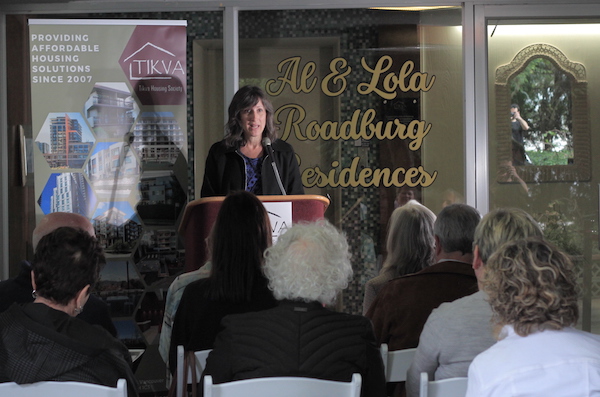
With the help of a $10 million donation from the Al Roadburg Foundation, a four-storey apartment building has been purchased that will allow Tikva Housing Society to offer more affordable housing in Vancouver’s Jewish community.

Situated on West 41st Avenue in the Kerrisdale neighbourhood, the 20-unit building will be home to nearly 30 individuals. Tikva currently provides housing solutions to more than 300 people, in 128 rental units in Vancouver and Richmond. With this recent addition and 20 new units in Burnaby to be completed by summer 2023, Tikva will expand its portfolio to 168 units in seven housing developments. However, the need for affordable housing is enormous – there are 302 applicants on the Jewish Housing Registry waiting for affordable homes, including 65 people with disabilities.

“This addition will be a huge step forward to providing more people with safe, secure and affordable homes,” said Anat Gogo, executive director at Tikva Housing Society. “The building was acquired through an extraordinary and unparalleled donation of $10 million by the Al Roadburg Foundation. It is the single largest donation received by Tikva and is critical to address housing insecurity.”

In gratitude for the donation, Tikva has named the building the Al and Lola Roadburg Residences.

“Secure housing is essential for individuals and families to thrive,” said Robert Matas, chair of the Al Roadburg Foundation. “We’re deeply honoured to be part of a broad network of Tikva Housing Society supporters who contribute to making housing within the Jewish community more accessible for individuals and families throughout Greater Vancouver.”

“By acquiring an existing apartment building, we are preserving a property that still has many years of life, rather than demolishing and building new,” added Alice Sundberg, director of housing development at Tikva. “Also, we are protecting rental affordability for the future. Al and Lola Roadburg Residences will be a long-term community asset protected from the pressures of our escalating real estate market.”

Al Roadburg (1913-2002) and Lola Roadburg (1922-2011) had a lifelong commitment to Israel and to Jewish organizations in Vancouver. The Al Roadburg Foundation aims to ensure their estates are used to create a legacy that benefits the community where they lived and raised their family.

– Courtesy Tikva Housing

Format ImagePosted on April 14, 2023April 12, 2023Author Tikva HousingCategories LocalTags affordable housing, Al Roadburg Foundation, Alice Sundberg, Anat Gogo, philanthropy, Robert Matas, Tikva Housing

Posts pagination

Previous page Page 1 … Page 56 Page 57 Page 58 … Page 182 Next page
Proudly powered by WordPress