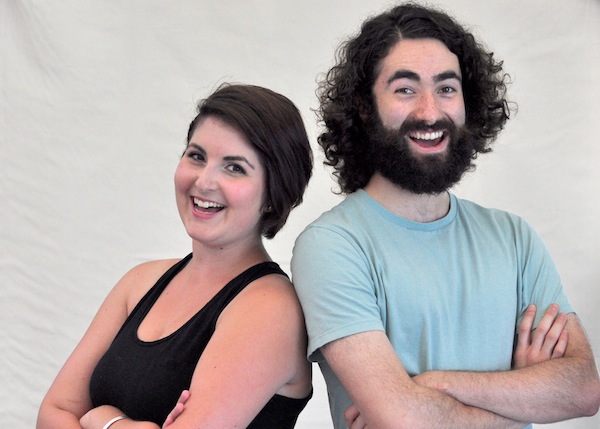
Aubrey Joy Maddock as John the Baptist, left, Andrew Cohen as Judas and Jennifer Copping as Jesus in Arts Club Theatre’s Godspell. (photo by David Cooper)
Before I attended Godspell, I was not familiar with the story or with the parables of the Gospel of Matthew, from which much of the content is taken. I did, however, know what a parable was, I knew that the play has been extraordinarily successful and I recognized the name of at least one song – “Day by Day” – so I assumed I had nothing to worry about.
I was wrong. By the end, I still didn’t get why this play has been so popular.
Godspell is essentially a series of vignettes that draw analogies between Matthew’s words and day-to-day life. It includes lessons such as, “Judge not, lest ye be judged,” “He that is without sin among you, …” the Prodigal Son, etc. Jesus relates these didactic stories to a group consisting of nine people that include a police officer, a waitress, an architect and a vamp. Judas and John the Baptist round out the cast of 12.
In each presentation of Godspell, the setting of the play, the costumes and some of the characters change. Updated scripts allow for the inclusion of cultural or geographic references that are familiar to the audience.
In the Arts Club production, the cast meet in a train station and the play unfolds as a game show where contestants participate based on the color of the shoes they’ve been given. Gospel analogies are acted out using modern story lines, including characters from Star Wars or rap songs.
To me, the play came across as a bunch of children’s shows that had been stitched together. I felt like I was back in elementary school, only instead of Smokey the Bear talking about forest fires, it’s Jesus and he wants you to avoid being stoned to death.
I found some of the skits infantile. In one case, the cast sing and talk like goats; in another scene, an audience member is pulled up to participate on stage resulting in some bad improv. And don’t get me started on the slapstick.
Godspell was an instant hit. It went from being a college student performance at Carnegie Mellon University to an experimental theatre production in Greenwich Village to being re-scored and opening off Broadway in 1971. John-Michael Tebelak originally wrote the play for his master’s thesis, having become enamored with the Gospels. Stephen Schwartz, a Carnegie Mellon alumnus was brought in to score. The award-winning Schwartz has become famous for his work in Wicked, as well as Enchanted and The Prince of Egypt. Tebelak was actually named most promising director of 1971 by the New York Drama Desk, but passed away at age 35 of a heart attack.
The show ran for five years off Broadway with an astounding 2,100 performances. The 2015 run in Vancouver is its sixth revival.
It had a particularly famous yearlong run in Toronto in 1972 with a cast that included Victor Garber, Gilda Radner (in her stage debut), Martin Short, Paul Shaffer, Eugene Levy, Andrea Martin and Dave Thomas. When I read about this production, I thought what an amazing show it must have been – staged at the Royal Alexandra Theatre, with that magnitude of talent. Maybe a show about the Bible needs a venue of biblical proportions, along with fire-and-brimstone effects that stun the audience with shock and awe. Perhaps the performance at the Arts Club was just too small.
Either way, despite my lack of interest in this particular telling of the parables, I have to tip my hat to the high calibre of quadruple-threat talent (singing, acting, dancing and, in many cases, playing an instrument) on stage. Andrew Cohen in particular stands out in his supporting role of Judas.
Godspell runs at the Arts Club Granville Island stage until Aug. 1 (artsclub.com).
Baila Lazarusis a freelance writer and media trainer in Vancouver. Her consulting work can be seen at phase2coaching.com.
One would be hard-pressed to find anyone involved in human rights around the world who has not heard of David Matas.
A Winnipeg-based lawyer, Matas has helped countless victims of human rights violations, and written or co-written numerous books on various atrocities in an endeavor to shed light on them and educate the general public about them. In his latest publication, he aims to explain why he has chosen the work that he has, in the hope of motivating others to get involved in human rights advocacy and create change. Why Did You Do That? The Autobiography of a Human Rights Advocate (Seraphim Editions, June 2015) is his first autobiography.
David Matas (photo from David Matas)
Matas was moved to pursue a career in refugee, immigration and international human rights law for a number of reasons.
“I started doing it because different people asked me to do it, including people at the law firm,” he explained in an interview. “It’s also something I’m interested in, because I’m interested in politics and human rights. So, I’d say, it was a coincidence of an opportunity to do the work and an interest in it that got me into it.”
Matas had refugees from around the world coming through his doors every day, seeking help. “My immediate effort was to try to get them protection, but the ultimate solution to their problems was the ending of the human rights violations that caused them to flee,” he said. “I felt trying to help them in some sort of systemic way, that I should be directed to that as well.”
Around this time, Matas also ran as a candidate in the federal election for the Liberal party (in 1979, 1980 and 1984) and B’nai Brith Canada approached him, requesting that he chair the local BBC League for Human Rights, largely because of the profile he had developed through his candidacies.
“But, again,” said Matas, “it’s something that, once I got into it, struck a chord of response in me. I got interested in it, involved much more, given the opportunity, because of the resonance it had with me.”
Also around that time, Kenneth Narvey – someone Matas knew from university – was scheduled for a speaking engagement in Manitoba on war-crime issues. Unsure if he would be able to make it, Narvey asked Matas if he would be willing to substitute for him, which Matas agreed to do. As it happened, Narvey ended up being able to attend the lecture, which gave him the opportunity to hear Matas speak and, Matas said, “He [Narvey] really liked it.
“At this time, Irwin Cotler had just become president of the Canadian Jewish Congress [CJC]. Irwin had appointed a chair for a war-crimes committee, as he wanted to do something about the issue himself, and the chair had resigned.”
Narvey lobbied Cotler to have Matas appointed as chair, and Cotler did just that. “So, I got involved in that issue, too, again sort of by coincidence or circumstance,” said Matas.
Another chance encounter was with Harry Schachter, a friend of Matas’ who was involved with Amnesty International, which had been holding meetings throughout the country. Through Schachter, Matas became involved with Amnesty International, which fit well with everything else he was doing.
“The combination of these events, more or less all at the same time, is what really got me into human rights in a very systemic and wholehearted way,” said Matas.
The Holocaust also influenced Matas’ life path. “I, personally, wasn’t affected by the Holocaust, my family wasn’t,” he said. “But, it just struck me. I thought, from an early age, that if the Axis rather than the Allied powers had won World War Two, I nor any other Jewish person would be alive today.”
He explained, “Generally, what I’ve been trying to do is learn the lessons of the Holocaust and act on them, which I saw as protecting refugees, bringing war criminals to justice, combating hate speech and protesting human rights violations around the world wherever one may find them. So, I’ve been trying to act on those four fronts simultaneously throughout my career.”
In his previous books, Matas has focused on specific atrocities or topics related to human rights – from hate speech, to trying to bring Nazi war criminals to justice, to humans rights violations, to refugees, to organ harvesting, and other topics. His autobiography was launched on June 9 at McNally Robinson Booksellers in Winnipeg.
“I go through the various issues I’ve been involved in and explain why I’ve been involved with them, issue by issue,” said Matas about Why Did You Do That? “There’s a chapter on refugees, so I explain what I did in terms of trying to help refugees. And then the rest is why people should help refugees, why everybody should do it. That’s the way it’s structured, chapter by chapter.”
For Matas, this book is a way for him to answer the most frequent question he is asked, “Why are you doing this?”
“I would say the 20th century was a century of genocide,” said Matas. “It wasn’t just the Holocaust. There was one genocide after another. My hope is we will be better, but I don’t think that it comes from hope. It comes from action. So, I’m trying to mobilize people to make things better, so we don’t repeat in the 21st century the vast array of tragedies we saw.”
In Matas’ view, people tend to focus on the problems immediately in front of them.
“People will get really worked up if their neighbor doesn’t mow their lawn, but they get less worked up if people in China are getting killed for their organs,” he explained. “I think there’s a real problem with distance, culture, language and geography, which really makes it difficult to mobilize concern for human rights violations – which is what the Jewish community faced with the Holocaust.”
Why Did You Do That? The Autobiography of a Human Rights Advocate can be purchased online from Seraphim Editions, Amazon and various other booksellers online and in bookstores.
Visitors at the opening of the traveling exhibition at the Schwartz/Reisman Centre in Toronto last month. (photo by Helena Yakovlev-Golani)
The exhibit A Journey Through the Ukrainian-Jewish Encounter: From Antiquity to 1914 opened last month in Toronto. It has since been held in Winnipeg (until June 27), will return to Toronto in July and then head to other cities.
The exhibit is being put on by the Ukrainian Jewish Encounter (UJE), which its website describes “as a collaborative project involving Ukrainians of Jewish and Christian heritages and others, in Ukraine and Israel, as well as in the diasporas. Its work engages scholars, civic leaders, artists, governments and the broader public in an effort to promote stronger and deeper relations between the two peoples.”
Prior to the exhibit’s opening in Winnipeg at the Oseredok Ukrainian Cultural Centre, one of its curators, Alti Rodal, an historian, writer, former professor of Jewish history, and former official and advisor to the Canadian government, spoke with the Jewish Independent.
Rodal was born in Chernivtsi (Czernowitz), Ukraine, and received her early schooling in Israel. Later, she was educated at McGill, Oxford and Hebrew universities in the fields of history and literature.
“UJE was established in 2008 by two people from Canada and the United States, both Jewish and non-Jewish Ukrainian background,” said Rodal. “It’s now a multinational organization with representatives in Ukraine, Israel, the U.S. and Canada.”
UJE’s purpose is to promote greater comprehension of the Ukrainian-Jewish relationship over the centuries, including an understanding of the co-experience of the two peoples and their interactions over the centuries, with a view to the future.
The organization has held many roundtables of scholars from Israel, Ukraine, Canada, the United States and much of Europe, each aimed at understanding a different period in history.
“To have a truthful account of the past, we’ve had a scholarly dimension unfold over the last few years in which we’ve brought together roundtable discussions among scholars of various backgrounds,” explained Rodal. “We’ve identified chunks of the history that need to be explored together and each of these roundtables addressed a different period.” The historical periods explored to date stop at the First World War.
“The exercise is one that leads to a shared historical narrative,” said Rodal. “With this we mean a single text on which the participants largely agree. If there are aspects they don’t agree on, it is stated in the single text, indicating what kind of research would be needed to advance knowledge on these issues.
“By looking to the past, we hope to obtain personal acknowledgement of what happened and to address stereotypes that both Jews and Ukrainians, at the popular level, have about each other. Some of these stereotypes are in the history books, so our aim is to produce more credible accounts and address stereotypes.”
UJE hopes that, with the help of other researchers, some of the information being taught in Ukrainian schools will be amended.
Three years ago, they entered into an agreement with the Government of Canada to do four main projects on the topic, including two publications, developing the content of their website, and the traveling exhibit, the research for which began seven years ago.
The exhibit’s first stop was in Toronto at the Schwartz/Reisman Centre and when it returns to that city, it will be to downtown’s St. Vladimir Institute, the Ukrainian cultural centre.
“These are community exhibits rather than museum exhibits, so we have them at the community centres and try to engage people from the community to participate,” said Rodal, noting that the exhibit will also go to Edmonton and Montreal.
“We’ve been approached by the Jewish community and the Ukrainian community in Ottawa and there’s been interest also from Vancouver,” she said. “We don’t have a commitment to do it, but we’ll consider it…. So, Vancouver and Ottawa are under consideration.”
The exhibit consists of text, images and video. “The first venue in Toronto consisted of 36 panels placed on moveable walls, and four videos that we created ourselves,” said Rodal. “I’m not telling you about the topics, just the physical [aspects] and the number of ethnographic maps.”
One of the images displayed in the exhibit is this one of Jewish children playing in Kremenets, Ukraine, circa 1913. The photograph was taken during the ethnographic expedition led by S. Ansky in the Jewish Pale of Settlement in 1912-14. (photo from YIVO Institute for Jewish Research (New York City) Photograph Collection)
The panels go through history, from antiquity to the First World War chronologically, but there is a segment that deals with the Chassidic movement on Ukrainian lands, one on Hebrew-Yiddish printing, and another on literature and how Jews are depicted in Ukrainian writing and how Ukrainians are depicted in Jewish writing.
The videos also deal with diverse topics. One is marketplaces and taverns, where Ukrainians and Jews encounter each other, and there is a video on Jewish artisans on Ukrainian lands. Another is on ethnographic photographs, largely taken between the 1880s and 1914 on S. Ansky’s expeditions.
“Ansky was an ethnographer who led expeditions around these times, visiting many communities accompanied by a musicologist/photographer, his own nephew,” explained Rodal. “They took pictures and collected folksongs and folklore and objects, which then they put in the museum in St. Petersburg.
“When the Soviets came, it was put in the warehouse and stayed in the warehouse in the 1990s, when the St. Petersburg Historical Centre made these photographs accessible. So, a selection of these photographs of Jewish life from the 1890s to 1914, and also a collection of similar ethnographic photographs of Ukrainian life in various regions, is one of the videos.”
The videos are comprised of photographs with effects accompanied by appropriate music, including a recording made more than 100 years ago on wax cylinders.
UJE’s first objective was to explain that the presence of Jews on Ukrainian land dates back to antiquity. “It didn’t just appear in the 18th century or even the 16th century, but was there in the very first centuries or even earlier, as merchants in colonies co-founded with Greeks,” said Rodal.
“There was also lots of significant cross-cultural interaction between the Jews and the Slavic peoples in the language, folklore, music and cuisine … so that what one thinks is Jewish cuisine, you delve a little and you see the Ukrainians are eating the same things with different names.
“The vast majority of Jews lived in areas where the vast majority of Ukrainians lived. They had more interactions with Ukrainians than with other Slavic peoples…. People who’ve come to North America from what they say [is] Russia, they mean czarist Russia, these places that are coming from Galicia … and the Ukrainian lands that were part of the czarist empire … are now Ukraine.
“Another important message, which is an offshoot of the other, is that the stories of these peoples are intertwined, that we have the motto that the history of one is incomplete without the history of the other. That is the goal – to treat this historical experience in all its complexity – including the periods of crisis and violence.
“We state very clearly that not addressed in this exhibition are the horrible events of the 20th century. And we may do more about this in a different format rather than a visual exhibition. We are certainly doing it in the form of the shared narrative exercise.”
U.S. Secretary of State John Kerry, right, with Michael Oren, then the Israeli ambassador to the United States, at Ben-Gurion International Airport in Tel Aviv on April 9, 2013. (photo from U.S. State Department via jns.org)
It’s safe to say that in the coming weeks you’ll be reading a great deal about the memoir Ally: My Journey Across the American-Israeli Divide (Random House, June 2015), authored by Israel’s former ambassador to the United States, Michael Oren.
Oren spent the years 2009-13 as Israel’s envoy in Washington. Once a dual national of both the United States and Israel, the New Jersey-raised Oren had to surrender his U.S. passport at the American embassy in Tel Aviv before taking up his ambassadorial post – an emotionally wrenching episode that he describes in detail. Oren’s complicated identity as an American and an Israeli is a theme that runs throughout the book, and his treatment of this subject is a welcome tonic to the dreary and rather smelly charges of “dual loyalty” that too often accompany examinations of the relationship that Jews in the Diaspora have with the Jewish state.
The main attraction of the book, of course, is its account of the Obama administration’s Middle East policies, and Oren’s candor has already gotten him into trouble. Dan Shapiro, the current U.S. ambassador to Israel, who makes several appearances in Oren’s memoir, told Israel’s Army Radio that Ally is “an imaginary account of what happened,” belittling Oren for having, as a mere ambassador, a “limited point of view into ongoing efforts. What he wrote does not reflect the truth.”
This is a serious charge, and it remains to be seen if Shapiro will attempt to substantiate it. In the meantime, it should be pointed out that what makes Ally such a fascinating read is that it provides, from Oren’s perspective, a detailed sense of the bitter atmosphere in both Washington and Jerusalem that underlay diplomatic efforts on the issues we are all intimately familiar with, from the negotiations over Iran’s nuclear program to the stalled Israeli-Palestinian peace process. Unlike other diplomats, Oren didn’t wait 20 years to publish his story – most of the key individuals in his book, most obviously U.S. President Barack Obama and Israeli Prime Minister Binyamin Netanyahu, are still in power, and the bilateral tensions that Oren agonizingly explains haven’t been lessened since his departure from Israel’s Washington embassy. Diplomats aren’t supposed to be this transparent, which is why Oren will be regarded in many circles as a man who broke “omertà,” the code of silence which ensures that we ordinary mortals are kept in the dark about what our leaders are saying in private.
While it’s true that Obama comes in for heavy criticism, Oren rubbishes the claim that the president is “anti-Israel.” The reality is more complex; as Oren writes, “the Israel [Obama] cared about was also the Israel whose interests he believed he understood better than its own citizens.” One might add that this paternalistic approach has informed Obama’s stance on the entire region, resulting in a sly policy that presents itself to Americans as a much-desired withdrawal from the Middle East’s endless bloodshed while, at the same time, fundamentally redistributing the region’s balance of power in favor of Iran, whose rulers have spent almost 40 years chanting, “Death to America.”
The board of directors of the Vancouver Writers Fest has appointed Nicole Nozick as executive director, effective June 22.
“Nicole brings to the Writers Fest extensive experience in festival management, journalism and communications, a collaborative approach to her work, and many business skills. We are excited to welcome her to our team,” said board chair Sandy Jakab. Nozick takes over from the Vancouver Writers Fest’s current executive director, Camilla Tibbs, who will move to her new role as executive director of the Richmond Gateway Theatre.
“I am honored to be joining the team at the Vancouver Writers Festival – a festival whose accomplishments I have long admired,” said Nozick. “With its sterling international reputation as one of North America’s premier literary events, the VWF is a cornerstone of Vancouver’s festival scene, well reflecting the energy, curiosity and vibrancy of our city. I am looking forward to working with the VWF board and artistic director Hal Wake, in co-leading this remarkable literary showcase that enriches the lives of so many.”
Nozick holds a BA in English from University of Cape Town and a post-graduate diploma in journalism from Tel Aviv University. Most recently, she was director of the Cherie Smith JCC Jewish Book Festival.
Emanuel Ringelblum (left), Rachel Auerbach (third from the left) and other Jewish intellectuals in Poland, 1938. (photo from whowillwriteourhistory.com)
Many Vancouverites will remember the 2008 traveling exhibit hosted by the Vancouver Holocaust Education Centre called Scream the Truth at the World: Emanuel Ringelblum and the Hidden Archive of the Warsaw Ghetto. It provided an overview of Warsaw historian Ringelblum and a secret group, Oyneg Shabbes (Joy of Sabbath), who during the Holocaust worked to document and preserve material relating to their experiences. The artifacts they buried in milk cans and metal boxes – some 30,000 items – were found in the rubble of the Warsaw Ghetto in 1946.
Now, Katahdin Productions is raising funds to make a feature documentary about Ringelblum and the Oyneg Shabbes archive. The film, Who Will Write Our History, is based on the book of the same name by historian Samuel Kassow.
Writers, artists, scholars, journalists, poets and diarists, more than 60 diverse people, handpicked by Ringelblum, collected and recorded as much as possible about every aspect of life in the ghetto – poems, paintings, photographs, underground newspapers, essays on hunger, smuggling, the Jewish police, clandestine schools and literary evenings and more. Their common goal was to ensure that the truth would survive even if they did not, as was the case with Ringelblum.
Only three members of Oyneg Shabbes survived the war. Among them was Rachel Auerbach, a prolific writer who would spend the rest of her life memorializing Ringelblum and Oyneg Shabbes. It is Auerbach’s writing and point of view that will provide the narration and narrative structure of the film. She will be voiced in the film by Academy Award-nominated actress Joan Allan.
In 1946, before Auerbach left Poland for Israel, she and the other two Oyneg Shabbes survivors led rescuers to the location of the first cache of the ghetto archive. The rescuers unearthed 10 metal boxes that had been buried on the eve of the Warsaw Ghetto Uprising. A second cache of two milk cans was discovered when Polish construction workers were building new apartment buildings on the site of the former ghetto. The third cache was never found and is believed to be buried under what is now the Chinese embassy in Warsaw.
Directed and produced by Roberta Grossman with Nancy Spielberg as executive producer, Who Will Write Our History (whowillwriteourhistory.com) will make the story accessible to millions of people around the world. Katahdin Productions’ documentaries include Blessed is the Match: The Life and Death of Hannah Senesh, which won the audience award at 13 film festivals, was broadcast on PBS, nominated for a Primetime Emmy and shortlisted for an Academy Award; Hava Nagila (The Movie), which was the opening or closing night film at more than half of the 80 film festivals where it screened, and was released theatrically; and Above and Beyond, about Jewish-American pilots who volunteered to fly for Israel in its War of Independence, which earned 20 audience awards and critical acclaim. (For an article on the latter, visit jewishindependent.ca/spielberg-opens-film-festival.)
The goal of the Indiegogo fundraising campaign is to raise $100,000 to fund 10 days of shooting in Warsaw in fall 2015. On average, each day of shooting costs $10,000. Some days are much less expensive; for example, shooting exteriors of streets in Warsaw involves only a small crew. Other days are quite involved. For example, shooting recreations of key events in the story with props, costumes, actors, lighting, sets, stages, etc., requires a crew of 20+ people and costs as much as $20,000 per day. If the $100,000 goal is not reached, it will mean fewer filming days in the fall; if it is exceeded, there will be more, as needed to complete production.
A screenshot from Gad Aisen’s documentary, which has its Canadian première at the Rothstein Theatre June 28.
After the Holocaust and the Second World War, the British government that controlled Mandate Palestine severely limited Jewish immigration, continuing the restrictive policies from before the war. But the Jewish underground in pre-state Israel was operating a steady movement of illegal transports bringing Jews – mostly Holocaust survivors – from Europe to the Yishuv.
In November 1946, the ship code named Rafiach set off from Yugoslavia with 785 passengers. Twelve days into the voyage, a storm forced the ship to seek refuge in a bay on the tiny Greek island of Syrna but it ran aground and, within an hour, sank. The vast majority of passengers survived, crawling from the water onto the island, which is little more than a craggy rock, or jumping from the ship before it was fully immersed. It is not known exactly how many passengers drowned.
Among those who survived and eventually made it to Palestine were Lili and Solomon Polonsky z”l. Their daughter, Tzipi Mann, lives in Vancouver. She knew that her parents and some of their friends had been on the ship, but she had never delved into details. By the time her curiosity was piqued, her parents had passed away. But her quest to uncover the story of the Rafiach and its passengers has led to a documentary film that will screen here in its Canadian première on June 28.
Code Name: Rafiach is directed by Israeli filmmaker and television personality Gad Aisen, but he credits Mann as being the driving force behind the project.
Aisen is the creator of a TV show on Israel’s Channel 10 called Making Waves, about nautical topics. He served seven years in the Israeli navy before obtaining an MFA in cinema from Tel Aviv University. He had never heard of the Rafiach before he was approached by a student of Mevo’ot Yam Nautical School, who thought it would make a good topic for Aisen’s TV show.
Code Name: Rafiach is a story about Holocaust survivors finding a place in the world and also about the Jewish underground risking their lives to smuggle Jews into Mandate Palestine. There are many narratives of this sort, Aisen acknowledged, but the Rafiach’s tragedy and the rescue make this one especially poignant.
Because it is not possible to produce a story of nearly 800 people, the filmmaker decided to focus on a few individuals. One is Shlomo Reichman. Known to the circle of people around the film as “Shlomo the baby,” Reichman, now a grandfather, was thrown to safety from the ship.
“This man’s story was particularly touching because he was a newborn,” Mann said in a telephone interview. “He was three weeks old and he was tossed onto the rocks, but he wasn’t sure who tossed him. Was it his father, or was it someone else? For Shlomo, this has been sort of the core of his existence – who tossed me onto the rocks?”
The fact that the passengers were Holocaust survivors magnifies the impact of the incident, Mann said.
“If you can imagine Holocaust survivors having to deal with this,” she said. “There were so many personal, emotional issues attached to everything.”
In interviews, Mann and Aisen learned that adults who first made it to shore from the listing ship lay on the rocks to create a softer landing for those coming after.
For Mann, the Rafiach became a sort of obsession.
“In 2010, just one morning I thought, I need to find out more about this,” she said. “My intention was originally to try to write a book and I thought the only way I can do this is by being in Israel.”
She made arrangements to head for Jerusalem and enlisted the help of her cousin, Sara Karpanos, who lives there. They put an ad in an Israeli newspaper and the response was so overwhelming the pair had to rent a hotel space for a reunion of 200 Rafiach survivors and, in some cases, their children and grandchildren.
Unbeknownst to the two women, Aisen was already on the story. After being turned on to the history of the ship, Aisen had connected with an instructor at Israel’s naval high school who had led his students on a dive and recovered a couple of artifacts from the hulk of the Rafiach.
From what had seemed like lost history, Mann saw the story of the Rafiach begin to reveal itself. “A complete mystery was unraveling in front of me,” she said.
For Aisen, the story of the Rafiach “captured my heart, and I feel particularly connected to this story from many aspects, as a sailor, an Israeli and Jewish.”
To tell the history of the Rafiach in a documentary, he decided to use animation, which allowed him to be more creative than merely showing interviews with survivors.
“It enabled me to present the film in the present tense and not as a memory from the past,” he said. “It took me about six years to create the film, five journeys abroad, months in the archives, 300 hours of footage and a year’s work of three animators. But one of the more challenging things was to get to the wreck of the Rafiach and to dive and film inside.”
In a way, Aisen said, making the film let him vicariously live the life of an underground commander of an immigrant ship.
The Vancouver Jewish Film Centre presents Code Name: Rafiach on June 28, 7 p.m., at the Rothstein Theatre. Tickets are $10 and available at vjff.org.
Tara Cheyenne Performance’s how to be, part of Dancing on the Edge. (photo by Wendy D Photography)
This year’s Dancing on the Edge festival, which runs July 2-11, once again features the talents of many Jewish community members. The Jewish Independent asked several of them to describe the work they are presenting in the festival and to explain what makes it “edgy.” Their responses appear in the order in which their work appears in the festival.
Vanessa Goodman (photo by Jeff Pelletier)
Container, choreographed and performed by Vanessa Goodman, with original sound composition by Loscil, is a new work “that explores heritage, culture and resilience.” (Part of Edge 1, July 3 and 4, 9 p.m., at Firehall Arts Centre.)
“What makes the work ‘edgy’? Well, I am not 100% sure that I would categorize the work as edgy,” said Goodman. “However, I would say that the physicality/embodiment shifts between different extreme states, taking the witness/audience on a journey of my experience within the work.”
Re:Play: a duet choreographed by Naomi Brand and performed by Hilary Maxwell and Walter Kubanek. (Part of Edge Up, July 5 and 6, 8 p.m., at Firehall Arts Centre.)
“The piece is a playful exploration of the space between two bodies in dialogue,” said Brand. “It looks at what we choose to display and disclose and what gets hidden and smoothed over in conversation. The element of play is a theme that drives the duet as the dancers show and tell, watch and listen, repeat, respond and react to one another. The piece is set to a sound score that brings the process to light, with dancer Walter Kubanek practising Chopin’s Nocturne Op. 9 No. 1 on piano, and sound clips of the dancers in rehearsal. Playing on the edge between cooperation and competition, the dancers engage in a dynamic negotiation of space.”
Hilary Maxwell and Walter Kubanek in Re:Play. (photo by Chris Randle)
Feasting on Famine: choreographed by Shay Kuebler, Radical System Art. (Part of Edge 5, July 9 and 11, 7 p.m., at Firehall Arts Centre.)
“This performance looks into the extremes of bodybuilding culture and how it references capitalism and the corporatization of the human body – growth edges out all other aspects of self. One man’s physically charged journey into the depths of extreme health and fitness will leave the audience on the edge of their seat.
“The work combines theatre, dance, and martial arts to construct an edgy and modern look at the extremes of society,” said Kuebler.
Duck Dances “promises to be a whimsical exploration of curious imagery, woven together with the color red to reveal a charming tableau of events within the framework of Dusk Dances,” reads the description on Dancing on the Edge’s website. (July 9, 10 and 11, 7 p.m., at Portside Park.)
“I am creating a piece in collaboration with Jennifer Mascall and Susan MacKenzie for Dusk Dances. We’re calling it Duck Dances,” Amber Funk Barton told the Independent. “For me, this work is ‘edgy’ because I have never created a site-specific work and our intention is that our performers will also be all ages and abilities. Using Crab Park as a studio instead of a studio is not only inspiring but challenging me to work outside of my comfort zones and creativity.
how to be is “the latest ensemble creation to emerge from the strange mind of Tara Cheyenne Friedenberg (Tara Cheyenne Performance). The piece examines how we think we should ‘be,’ how we think others should be and how impossible and futile it all is. Using ideas found in malignant social media, cultural restrictions, and the ceaseless voices in our heads, how to be traces five characters as they navigate how to be.” (Part of Edge 6, July 10, 7 p.m., and July 11, 9 p.m., at Firehall Arts Centre.)
“I consider this piece ‘edgy’ because it plays with text, audience relationship, what is ‘appropriate’ in life and in performance,” said Friedenberg. “This is not a typical dance piece, but it is a piece only highly trained dancers could do. I expect to tiptoe very near the edge of extremely uncomfortable and deliciously funny.”
What a mouth on Minnie! And I don’t mean it pejoratively. (I just wanted to get your attention.) Grandma Minnie Bloch is articulate and sensitive as she meticulously narrates the three-generational story that includes her own early life with her husband, their move to the United States from Eastern Europe, and the family she creates.
Minnie is the narrator/observer – acting almost like a Greek chorus – in the stirring new novel Prayers for the Living (Fig Tree Books, 2015), written by veteran novelist and National Public Radio literary critic Alan Cheuse.
Although she is not educated (in the formal sense), her intelligence and life experience enables her to depict for us so many living characters: her son Manny, who is a Reform rabbi and a businessman; his psychologically impaired wife, Maby; their problem-laden daughter, Sarah; and Manny’s mistress, Florette, a Holocaust survivor and a member of Manny’s congregation. Into this mix, we must also include Maby’s brother, Mord, who takes brother-in-law Manny into the family business.
How does Minnie narrate the rise and fall of this middle-class Jewish family? By telling her story to friends during occasional coffee-klatch meetings, portraying with motherly calm and painterly skill all the people she has encountered. Minnie has not personally experienced all the events she narrates, but she assembles them from talks with her son and other family members, from overheard conversations, and even from information discovered by reading pertinent private journals, which she cleverly doesn’t call “snooping” but “learning.”
Behind the voluble narrator, who speaks always from the heart, and often with poetic grace, stands the artistry of Cheuse, a sharp-eyed writer who brilliantly is the voice behind the voice.
Although the central narrator in Prayers for the Living (an ironic title, an inversion of the Kaddish, known as the Mourner’s Prayer, or Prayer for the Dead) is Minnie, the protagonist of the book is Manny, well-regarded by his congregation, who splits his duties between rabbinic work and business, ultimately not a happy partnership.
As the novel progresses, we learn of daughter Sarah’s missteps in college, Maby’s mental imbalance and alcoholism, and Manny’s visits to Florette, who is ostensibly painting her rabbi’s portrait but has other non-esthetic designs on him. In her telling, Minnie does not hide her family members’ flaws. The character of the book’s heroes, often shaped by earlier events, in combination with the exigencies of the present, leads them to their destined paths.
Cheuse plans the suspense, gives the hints of things of come, and arranges for Minnie to occasionally offer remarks akin to: “But I’ll tell you about that a bit later….” By so doing, he achieves a unique fluidity of time zones.
Minnie is the bedrock of the family, the only solid and trustworthy character in the book. She has perfect pitch for the rhythms of speech of Jewish women of a certain age, and faithfully reproduces the conversations of other characters in Prayers for the Living. This enables Cheuse to penetrate the psyches of his characters, their hopes and tremors.
Some central events are tiny sparks that build up to the conflagration that follows. Among them: Minnie, in Europe, fleeing from a groom that has been forced upon her; an accident in New York involving Minnie’s husband, which her son, Manny, witnesses; and Sarah, caught strumming a guitar on Yom Kippur by her rabbi dad.
By the riveting end of the book, whose intricacies and trajectory you have to discover for yourself, you can’t wait for one page to lead to another. You have a sense of what is going to happen – Minnie gives you little choice – but you still hope it won’t happen. Maybe a surprise will come your way. Perhaps
Minnie’s assessment is wrong. But even if you suspect what will happen and you know why, you still don’t know how it will happen.
Thank you, Minnie, for sharing with us your words and thoughts, your motherly wisdom and compassion. Yes, it all comes from Minnie’s mouth – to our ears and to our hearts.
Curt Leviant’s most recent book is the short story collection Zix Zexy Stories. This review was previously published on nyjournalofbooks.com.
Left to right, Susan Skemp, Ken Charko and James E. Taylor are making a movie about Dunbar Theatre’s history. (photo by 5U54N & J4M35 Productions)
To celebrate Dunbar Theatre’s 80th anniversary, the theatre is making a short film about its history to enter into film festivals around the world and for film and music awards in Canada. One of the goals is to raise awareness of the theatre, one of the few independent theatres still around.
“Our short film will showcase all eight decades the theatre has been playing movies for the Dunbar community. With the use of old movie clips, newsreels, actors, models, music and their resident ghost, Delores, we intend on making a very entertaining film,” said Susan Skemp (producer, writer and songwriter) in an email to the Independent.
The production team includes Skemp, Ken Charko (executive producer and owner of the Dunbar Theatre) and James E. Taylor (director, writer, editor). One of the many participants in putting together the film is Jewish community member Adam Abrams, who will voice one of the newsreels.
“I came up with the idea to make the film last December when Ken Charko and I were discussing what to do to celebrate the theatre’s 80th,” Skemp explained. She said she suggested making a movie about a movie theatre and Charko liked the idea; then Taylor joined the production team as director.
“We have assembled a wonderful group of people and I have likened us to Orson Welles and his Mercury Players group,” said Skemp.
“My idea for the script really came from the theatre and the people from the community who have passed through its doors and the films that have played on the screen. Even though the film is a history of the theatre, our goal is to make it as entertaining as possible,” she stressed. “The fact that the theatre has a ghost helps.”
The crowdfunding goal to bring the film to fruition is $20,000. Contributions to the fundraiser at fundrazr.com/campaigns/fxGG2 come with different perks for each donation level: from a DVD and an invitation to a red-carpet screening ($25), to those items plus two tickets to any film at the Dunbar ($100), to a film credit as an associate producer ($500), to listing as a producer ($2,500).