Different perspectives

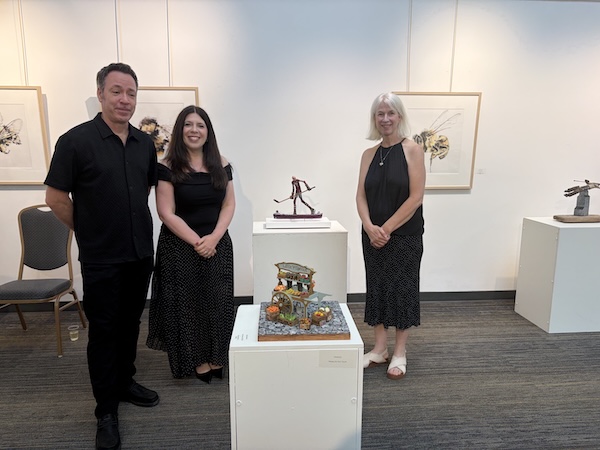
Left to right, artists Sean Thompson, Kathy Marliss and Darcy Mann. (photo by Sarah Dobbs)

Figurative art usually concentrates on the subject matter: flowers, landscapes, portraits, still life. But the current group show at the Zack Gallery, Size Matters, focuses on size as the main vehicle of its esthetics. The subject matter becomes not unimportant but secondary. That’s one reason the creations of the artists participating in the show – Darcy Mann, Kathy Marliss and Sean Thompson – are so different.

“This was one of those rare opportunities when three artists approached us together,” gallery curator Sarah Dobbs told the Independent. “They submitted their group proposal, and the art committee and I were captivated by it. It was so unusual a pairing, and we loved it – the play on the ideas of size and perspective.” 

As a curator, she was less interested that the work was smaller or larger than life, but rather in what that deviation from reality did. She noted that “the scale changes the viewer’s behaviour, attention or understanding, and the miniatures become an artistic strategy…. Scale here isn’t just a physical property but part of the artwork’s meaning. Personally, I like the idea of perspective, especially at these times of world turmoil and climate upheaval.”

The idea of the show belongs to Mann, the only full-time artist of the three. “I always liked art,” she said. “When I turned 10, I got a birthday gift from my mother – a pencil and some drawing paper. It was the best birthday gift of my childhood.” 

Mann studied art in British Columbia and Nova Scotia, and later received her MFA, in Texas. In 1987, she spent a few months in Israel, and it made a huge impression on the young artist. Since then, her work has undergone several transformations in terms of subject and media.

photo -  “Fly” by Darcy Mann
 “Fly” by Darcy Mann (photo by Sarah Dobbs)

Zack regulars might remember her forest landscape paintings from her solo show in 2014. In this current show, her focus is flies and bees, hugely enlarged and stylized, almost abstract, but still recognizable. No zoological details manifest in her bees, which sometimes resemble fantastic flowers and sometimes science fiction cubism, but the viewer has no doubts: those are bees and flies. The colours are unmistakable: blue flies, black-and-yellow bees.  

“In the 1990s, I was working with still life,” Mann explained about the roots of her poetic insects. “I had a plate with a fish in front of me, and a fly landed on the fish. And I thought: the flies are amazing. I started drawing them, but nobody wanted to buy them. About five years ago, I switched to bees.”

Her images seem fluid, symbolic rather than photographic. “I like to take things apart artistically and then see them coming back together, and changing, always changing. In this approach, the subject matter becomes secondary, subordinate to size and shape.”

The notion of a show centred around size felt inevitable, and she shared it with Thompson and Marliss.

“I’ve admired Sean’s art for a long time,” Mann said. “I’ve always wanted to have a show together, but I couldn’t come up with how to mesh our pieces. My bees and his hockey players seem too far apart. Then I saw Kathy’s miniatures and thought, this is perfect. My drawings are larger than life. Their little sculptures are smaller. It makes sense to bring them together, to draw attention to size rather that to the subject.” 

Marliss is a self-taught artist and miniaturist, with her beginnings in the latter coming when she was 13 years old. “I was visiting a friend’s house, and her mother was a miniaturist,” Marliss recalled. “I saw her art, and I was entranced by her miniature rose trellis. She noticed my interest and called my mother. She said: maybe your daughter could be a miniaturist, too.”

Her mother bought her a set of multicoloured polymer clay. “I still use such clay today,” said Marliss, who makes her living as a web and marketing designer. Miniatures are her hobby and her joy. “I come home from work tired, and make my miniatures for fun,” she said. 

Marliss has been selling them all over the world from her Etsy store. “Especially my Judaic miniatures are popular,” she said. “Not many artists make them.” 

photo - “Tea Time” by Kathy Marliss
“Tea Time” by Kathy Marliss (photo by Sarah Dobbs)

While Marliss has participated in specialized miniature shows, the Zack exhibition is her first in a general art gallery.

“I see my miniatures as moments in time, snapshots of memories and dreams. I made all of them on display here specifically for this show, and they are all centred around food. I like food,” she said smiling.

Her veggie stall is stuffed with fruits and vegetables. Baskets of strawberries and cherries, rows of preserves, boxes of potatoes and carrots, they all burst with colour and culinary possibilities. Each individual strawberry, each tiny clove of garlic is made separately. 

“My kitchen miniature – I made it in memory of my grandmother,” said Marliss. “She lived downstairs in our house, and I loved the smells of her cooking.”

Her bakery miniature is dedicated to her daughter. “She is a pastry chef,” said Marliss. “She wants to open her own bakery. She described it to me, and I made it for her.” The eclairs and pies and tortes of her imaginary bakery crowd the tiny shelves, all bright with wonder, promising uncounted delights to any sweet tooth.

Thompson’s art could also be considered miniatures – his figurines of old-time hockey players are much smaller than a person, but the stories the artist tells with them are large and involved. 

“I’m not a full-time artist,” Thompson said. “I don’t have a studio, so all my art pieces are small, both paintings and sculptures, to fit in my apartment. My full-time job is art in video games, has been for 33 years. Not as creative as my sculptures, of course, but I’m approaching retirement. After I retire, I want to become a full-time artist.”

Historic hockey is one of the dominant themes in his art. “As a kid, I didn’t like hockey. I was more into art and music,” he recalled. “Even now, modern hockey doesn’t interest me much, but I’m into the hockey of 1930s to 1960s, when the players weren’t paid those huge amounts of money. It was more personal, at least for me. I like old stories.”

Each one of his figurines is a pair: a hockey player and an object. The objects differ greatly: a suitcase, a radio, a spool of red thread, a ship.

photo - “Northwest Passage” by Sean Thompson
“Northwest Passage” by Sean Thompson (photo by Sarah Dobbs)

Thompson enjoys fiddling with puzzles, providing subtle clues embedded in his sculptures. “But I don’t want to give a description beside the sculpture. I want my viewers to come up with their own interpretation, their own story. It is part of the fun.”

His sculpture “Northwest Passage,” for example, depicts a hockey player skating among icebergs. It is based on Lawren Harris’s painting “Icebergs, Davis Strait.”

“This was one of many paintings Harris made on his trip to the Canadian Arctic in 1930,” Thompson explained. “One of the clues here is the number 7 on the jersey – for Harris’s place in the Group of Seven.” 

The idea of another sculpture, “The Wreck,” came to the artist from a song.

“I created a replica of the real freighter [the SS Edmund Fitzgerald] that sank in a storm on Lake Superior in 1975,” he said. “The number 29 on the jersey is for the 29 sailors lost in that disaster.” 

One more sculpture – “The Passenger” – which includes a suitcase, doesn’t have such a detailed story. 

“This one is more about a person at a crossroads, where he has little control over the circumstances,” said Thompson. “The player seems helpless and unsure, and the suitcase represents his uncertainty. He even has a little compass crest on his jersey.… You can tell I love stories and Canadian history, and I weave as much of it as I can into my work.”

The show runs until Sept. 7.  

Olga Livshin is a Vancouver freelance writer. She can be reached at olgagodim@gmail.com.