In the Beginning, the solo show of Gillian Armitage, now at the Zack Gallery, demonstrates the range of the artist’s perception and moods: from striking black-and-white prints to mischievous pastel renderings, both inspired by Giotto, a renown 14th-century Italian artist and architect.
“I knew I wanted to be an artist since I was 3 years old,” Armitage told the Independent. “I grew up on a farm in England. My mom would send me to play outside, but all I wanted was to draw. My parents were wonderful – they supported my decision to enrol in a local art college in Yorkshire. It was closest to our home. I took a train every day there and back.”
Over the years, as a professional artist, she experimented with many artistic forms and media. She taught a lot, too: from geography and history in a school in England early in her career to university-level art classes.
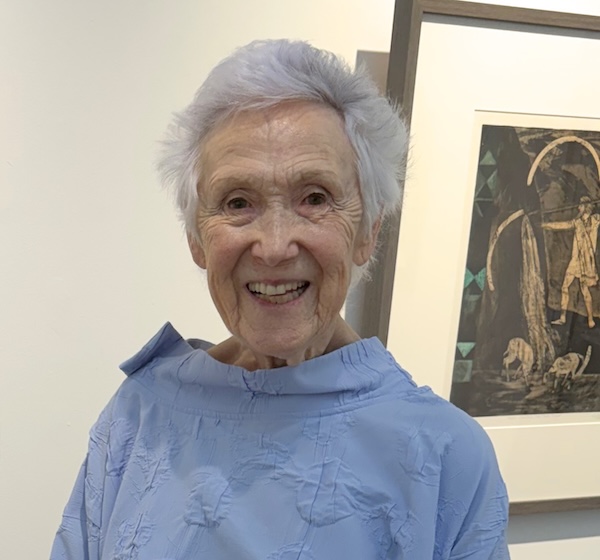
“I like teaching, and I always had good relationships with my students,” she said. “I was teaching printmaking in a college when I had cancer and needed cancer treatment. I lost my hair then, had to wear a baseball cap. One of the students told me that he was going to do some work with chemicals and suggested I wait on the other side of the room. They cared for me.”
In 1974, Armitage and her husband immigrated to Canada, and she enrolled in a printmaking course at Western Washington University in Bellingham. That was her in-depth immersion in printmaking, which later became the “love of her life,” artistically speaking.
“Printmaking is versatile,” she said. “It is also changeable. In painting, once you paint an image, it is done. But printmaking allows for countless changes. You make your plate. You print a proof. If you don’t like it, you make changes and print a proof again. And again. Until you’re satisfied.”
Her artistic career reflects a mastery of the form. She has exhibited her prints worldwide and taught printmaking at Kwantlen and Emily Carr. She was an instructor at Malaspina Printmakers on Granville Island for years. She was also elected president of Malaspina twice, 1982-1984 and 2005-2008.
Her fascination with Giotto started at about the same time as her printmaking. “I was browsing a book sale and came across the book The Complete Paintings of Giotto, published by Abrams in 1966. As I looked at the illustrations, I became thoroughly bewitched by Giotto’s works. One British critic called his frescos ‘a language of lines.’ They are both monumental and profoundly human, even lyrical. Giotto was one of the most influential artists in Western art. He portrayed people as they are, with wrinkles and all, which was innovative in his time.”
Armitage started a series of stone lithographs based on Giotto’s religious frescos and developed the series over many years.
“Some of my pieces show the same cast and architectural components as Giotto’s, the same stories from Genesis, but they are mirror images, due to the nature of the printing process. I make intaglio – ‘second surface’ in Italian – where the ink is in the incised grooves instead of the surface of the plate,” she explained.
As to the content, she expanded on Giotto’s famous frescos instead of copying them in different media. “I love the naturalness and equilibrium of Giotto’s constructions,” she said, “and the eloquence, clarity and dramatic intensity of his storytelling.”
Armitage’s current show is a treasure trove of storytelling. Her black-and-white interpretations of biblical tales veer towards the emotional complexities of the characters, not their religious attributes. “I researched these stories and was delighted to find how rich the narrative is. For example, Elijah was such a good man that God invited him to Heaven while he was still alive. A whirlwind hastened his journey – there was a lightning storm, and an angel played a bugle.”
Another lithograph follows Moses as he leads his people to freedom. The large image is solemn, even grim, full of adversity and turmoil, but the artist doesn’t focus only on the dark. Half of the exhibit comprises upbeat, coloured drawings, echoing another aspect of the Bible – its lighthearted humanity.
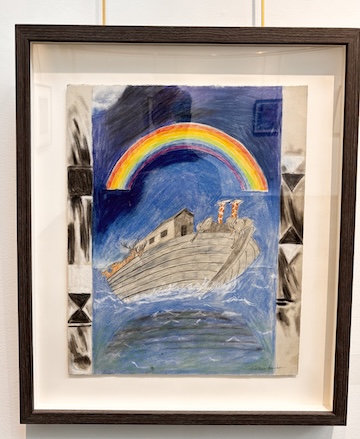
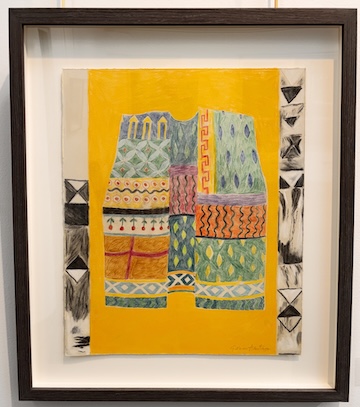
Curious giraffes stand watch in the bow of the ark in “The Great Flood.” Jacob’s multicoloured coat sports many frivolous design elements, and “Jacob’s Dream” invites everyone to witness the angels climbing a workman’s ladder towards the cloudy sky. The drawings are playful, almost primitive, as if guided by a child’s imagination, exhibiting another side of the artist’s complex and multifaceted creative vision. She isn’t afraid to experiment, to explore the new, sunny-spirited direction inside the same biblical themes.
“These drawings are all very recent,” said Armitage. “I applied to the Zack Gallery for a show of my Giotto lithographs and was accepted before I realized that I didn’t have enough material for a solo show. So, I drew new works in coloured pencils and pastels.”
“I have always admired Gillian Armitage as an artist of great integrity and talent,” said Sarah Dobbs, the gallery curator. “In her original proposal, I was struck by how these prophets and leaders represent foundational moments in Judaism. Her choice to portray their stories is dramatic and deeply symbolic, highlighting their central role in the relationship between God and the Jewish people.… On the other hand, the drawings are so playful. They are very recent and weren’t part of the submission. Artists sometimes change what they submit and, if they are good artists, like Gillian, I trust them.”
The show opened on Sept. 9 and will continue until Oct. 5. To learn more about Armitage and her work, go to gillianarmitage.com.
Olga Livshin is a Vancouver freelance writer. She can be reached at olgagodim@gmail.com.