I recently visited some of the small historical Jewish communities of Italy. My travels took me to the regions of Marche, Umbria and Emilia-Romagna and, specifically, to Rome, Urbino, Ancona, Senigallia, Bertinoro, Ravenna, Bologna, Soragna, Modena and Ferrara.
Jews have lived in Italy since before Christianity emerged, and were a well-established, if small, minority before Catholicism took root in the country. Historically, Jews were considered responsible for the death of Jesus and the Catholic Church treated them accordingly. In Italy (and elsewhere) Jews had to pay extra taxes and were limited in the professions they could hold. Over the centuries, Jews were restricted as to where they could live. At times, they were forced into ghettoes – the word ghetto originated in Italy. At other times, they were made to convert.
Despite their oppression, Jews led a rich communal life in Italy. One expression of that life is seen in the community’s ketubot, or marriage contracts. Italy is not the country where ketubah illustration began; in fact, the practice reached Italian Jewry centuries after it had been popular in other communities. But their ketubot surpassed those of other communities in several aspects, notably in their use of a wide selection of motifs and designs, including ones from the high and folk art of their neighbours and the inclusion of provocatively “non-Jewish” elements, such as nude female figures, mythological scenes and even the image of God. (While the Second Commandment prohibits the making of graven images, it was not followed in Jewish Italian art, apparently.)
An example of this originality is a ketubah produced in an area south of Rome by Elisha of Ascoli, a 17th-century Jewish artist, calligrapher and scribe – the illuminated Mantuan Ketubbah, which he created for an Aug. 31, 1629, wedding. While it was common for one person to illustrate and another person to write the contract’s text, it seems that, for this particular ketubah, Elisha did both the illustrations and the calligraphy.
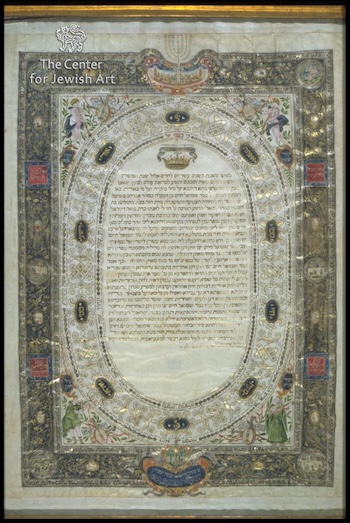
Elisha’s August 1629 ketubah is his most famous one. Created for the wedding of Samuel Hayyim and Eve Ravenna, it was drawn up in the town of Carpi and intended for a Mantuan union.
While it is adorned with flowers, garlands and colourful floral patterns, which were commonly incorporated into illuminated Italian ketubot, there is much more to it. The text of the contract is framed by an oval border inside a rectangular border. There are inscriptions in all the borders of the ketubah and, at the top centre, there is a drawing of Jerusalem, a menorah coming out from it and a crown seen below it. The decorations on the outer border include the coats of arms of the marrying couple (suggesting they were well-to-do, rather than members of the nobility) and six biblical scenes enclosed in roundels, which are found in the margins.
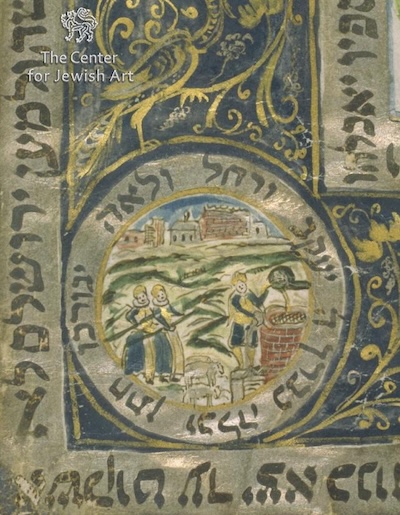
Biblical images are another common feature of ketubot of the time. Among the scenes painted into the 1629 contract, two are from Megillat Esther, one of Esther talking to the king and one of Mordechai being triumphantly led on a horse. Another picture of mounted transport shows Isaac first meeting Rebecca, as she rides in on camelback. Still another small picture shows Adam and Eve taking the apple from the Tree of Knowledge, Abraham welcoming the three angels, Jacob at the well, along with the two sisters, Leah and Rachel, both of whom he will later marry. At least four of the six scenes point to couplehood. All these figures are portrayed in more of a cartoon than realistic style.
As Michael Camille points out in Image on the Edge: The Margins of Medieval Art, manuscripts of this time would contain both strictly pious illustrations, as well as designs not connected with the story. The motifs in the margin reference one another, not the contract text.
The six biblical images might be what Camille calls the pious illustrations but of special interest are the four small pictures of characters with musical instruments. The upper two drawings show identical (wingless) cherubic creatures playing long horns while lutes lay nearby. These drawings may be purely ceremonial. After all, horns have a long history in the Hebrew Bible. Or perhaps, by sounding their horns, these creatures are meant to herald the new bride and groom.
The two other pictures show a man playing a violin and a woman playing a lute. They are loosely associated with the bride and groom – in the margin by the male figure, it reads “the voice of the bridegroom” (kol chatan) while it reads “the voice of the bride” (kol kallah) by the female figure. Both phrases are taken from Jeremiah the Prophet.
The lute has a pear or teardrop shape, which was widely likened to a woman’s breast, while the circular sound hole (often called the “rose”) and the overall opening of the instrument were frequent metaphors for female genitalia. Furthermore, the lute can symbolize a pregnant woman and, because the instrument has to be cradled and “strummed” or “fingered” to make music, playing the lute was frequently used in poetry and literature as a direct metaphor for sexual intercourse and physical intimacy. In his PhD dissertation, Prof. Shalom Sabar noted that, for a period of time, it was common for the human senses to be depicted in a ketubah, with hearing depicted by a man playing a lute.
Because the violin bow is long and cylindrical, it is occasionally viewed by Freudian interpreters as phallic, while the body of the violin represents that of a woman. In some classic literature, the act of bowing an instrument has been used as a metaphor for sexual energy and passion.
Both the male and female musicians are wearing green, which symbolizes balance, nature, spring and rebirth across so many cultures. It’s a near-universal symbol of prosperity, freshness and progress. Significantly, during the reign of the Tang Dynasty in China, it became fashionable for brides to wear green to their weddings, perhaps as a nod to the springtime clothing of the previous Han period. All these sexual overtones suggest what will take place once the marriage has taken place.
The ketubah is stored in Modena, Italy, in the archives of Estense University Library. It can be seen online at the Bezalel Narkiss Index of Jewish Art and Material Culture, which can be accessed from the Centre for Jewish Art, Hebrew University of Jerusalem, cja.huji.ac.il.
Deborah Rubin Fields is an Israel-based features writer. She is also the author of Take a Peek Inside: A Child’s Guide to Radiology Exams, published in English, Hebrew and Arabic.