More than just a rom-com

Noa Koler in The Wedding Plan, which screens Nov. 9 at Fifth Avenue Cinemas. (photo from Roadside Attractions)

The grin-inducing trailer for The Wedding Plan nonetheless suggests one question – did Israeli filmmaker Rama Burshtein sell out?

The Orthodox writer-director’s acclaimed debut, Fill the Void, was an uncompromising story of a young Orthodox woman grappling with her parents’ and community’s expectations regarding her prospective husband. In contrast, The Wedding Plan, while also being chuppah-bound, appears from the trailer to be a romantic comedy designed to entertain.

In fact, The Wedding Plan is a high-stakes emotional journey about an observant woman in her 30s who’s so unhappy that she resolves to wed on the last night of Chanukah – with no groom in sight – after her fiancé breaks up with her mere weeks before their appointed date. Michal’s family and friends counsel against such a bold, risky and potentially devastating strategy, but she remains undeterred.

The film contains plenty of witty one-liners but, as the Israeli trailer conveyed, it’s not a disposable sitcom. Burshtein has assuredly not sold out. She simply trusted her U.S. distributor’s marketing strategy, even if some ticket-buyers are misled.

“If you think you’re going to see a romantic comedy and you get something more, that’s good,” said Burshtein. “You get something stronger and that’s OK.”

The Wedding Plan screens on Nov. 9, 4 p.m., at Fifth Avenue Cinemas as part of this year’s Vancouver Jewish Film Festival.

Both of Burshtein’s films raise a curtain on the lives of Orthodox women, in part through honest conversations they have among themselves when men aren’t around. The characters reject the idea that Orthodox women are subservient to men and, unsurprisingly, so does their creator.

“For me,” said Burshtein, “being religious is liberating. It’s not killing or closing or not letting me express my thoughts.”

Burshtein goes even further, asserting that women are the creative force.

“The art world is women,” she said. “[Orthodox] men don’t make films, they don’t cook, they don’t paint.”

Burshtein originally pitched The Wedding Plan as a television series, but, after getting the green light and embarking on the script, she decided it would be a feature film. Although she doesn’t say it, a movie is seen by more people around the world than an Israeli TV show.

“I’m writing from my world to the outside world,” the filmmaker explained in a phone interview during a press day in Washington, D.C. “Not [just] to secular people but to non-Jews. It opens a window to my world to people who know nothing about my world.”

Burshtein was born in New York and became religious while she was in film school in Jerusalem in the 1980s. She admits she didn’t expect the attention her films have received abroad, but at the same time isn’t surprised they touch audiences far beyond Tel Aviv and New York.

“We live in an age when women find their partner pretty late,” she said. “And sometimes they don’t. It’s very hard to find someone that you really want to share your life with. [My films] connect to that. All over the world, it’s the same thing, the same heart.”

The Wedding Plan is unmistakably and unapologetically set in the Orthodox community but the crux of the film is Michal’s urgent personal quest. Although her ostensible goal is to get married, a raw and powerful opening scene makes it clear that what she really craves and seeks is the respect of a committed partner.

Michal’s striving is universal and at times absurd, which spawns the film’s humour. Because she has no time to waste, Michal (played by the fearless Noa Koler) confronts every prospective suitor with direct questions and shockingly honest confessions that derail and discomfit them.

Michal’s pain and desperation are palpable through the laughs, to the point where she makes a pilgrimage to Ukraine to the grave of Rabbi Nachman of Breslov. That’s not an incidental detail, for Burshtein is a proponent of Rabbi Nachman’s philosophy.

“We can handle despair, and we can handle hope,” she said. “The film is that movement between the two. You should be a fighter in the movement, and not get lost in the movement.”

The Vancouver Jewish Film Festival runs Nov. 2-9 at Fifth Avenue Cinemas and Nov. 10-12 at the Rothstein Theatre. For tickets and the full schedule, as well as the trailer for The Wedding Plan, visit vjff.org.

Michael Fox is a writer and film critic living in San Francisco.

Orthodox and in love?

Kosher Love’s director Evan Beloff, left, with Michael Gamliel, his wife, Miriam. (photo from cbc.ca/firsthand/episodes/kosher-love)

To all those who believe in marrying for love, Montreal-based matchmaker Rabbi Yisroel Bernath asks, “What happens when the romance fails?”

Bernath is spiritual director at Chabad of Notre-Dame-de-Grâce and a chaplain at Concordia University. Known by some as “the Love Rabbi,” he is at the centre of the documentary Kosher Love, which can be see at this year’s Vancouver Jewish Film Festival on Nov. 5, 4 p.m., at Fifth Avenue Cinemas.

The film’s mostly light tone and creative compilation, which includes animation, make for an interesting peek into the ultra-Orthodox world and how its members meet one another, marry and start a family. Bernath seems like an affable man, even though he divides North America’s Jews into only three groups – those who watch Seinfeld and eat bagels, those who are Orthodox and those who are Chassidim – never mind the scores of other affiliations and levels of observance.

What is particularly compelling is that Bernath is open to hearing, if not being swayed by, different points of view. There is one scene between the rabbi and a married couple he matched, in which the woman is comfortable and confident enough to strongly present her opinion that love is a vital part of a relationship. She doesn’t back down when Bernath accuses her of being overly romantic, but rather digs her heels in and tells him, with some vehemence, that she doesn’t agree with him.

Viewers also meet a nightmare mother and son. The mother, whose daughters have both married, is quite obnoxiously desperate to marry off her 33-year-old son. But the man-child YoNatan, a DJ, is clearly more in love with himself and his music than he could ever be with anyone else. YoNatan was never going to add to Bernath’s total of 50-plus successful matches.

As the Montreal Gazette noted in its review, “Regardless of the personalities in Kosher Love, it really transcends religion in touching on universal themes. It is the view of Bernath that love develops over time, but that in today’s fast-paced world, few have the patience to wait.” When and how love develops, and how it can be nurtured, are all worthwhile ideas to consider, and director Evan Beloff offers a charming and engaging introduction to some Jewish thoughts on the subject.

Beloff will be at the film festival’s Nov. 5 screening. For tickets and the festival schedule, visit vjff.org.

More than a mere contract

An outer space-themed ketubah designed by thisisnotaketubah.com.

Judging from its ritual text, the ketubah (marriage contract) that is read aloud during a Jewish wedding ceremony isn’t the most exciting, romantic or joyous document. It spells out a husband’s fundamental Jewish legal obligations to his wife – food, clothing, conjugal rights – and guarantees the sum that the husband will pay his wife in the event of a divorce. Yet, increasingly, today’s ketubah designs are anything but dry and transactional. Going beyond placing a plain document in a basic picture frame, or using common designs such as a view of Jerusalem or the kabbalistic Tree of Life, ketubah artists and consumers alike are developing more elaborate and personalized tastes.

Morgan Friedman, chairman and “lead muse” of thisisnotaketubah.com, calls his initiative “the first company to do outlandish ketubot,” starting in 2011. Friedman said he “wanted a ketubah with super-crazy modern art” leading up to his wedding in 2010, but couldn’t find one. He approached his wife-to-be’s friend, Argentine artist Yael Magenheim, and she designed a ketubah to match his wedding, whose theme was the colour orange. Today, Magenheim is the artistic director for thisisnotaketubah.com, which has created 3,000 ketubot to date. Most customers order designs that the website already offers, but Friedman has a separate site, bespokeketubah.com, featuring commissioned artworks.

“My official reaction and what I tell [customers] is, ‘Whatever makes you happy.’ What makes the world a wonderful place is that different people have different preferences,” Buenos Aires-based Friedman told JNS.org, reflecting on some unique ketubot he has designed, such as one commissioned for a dragon-loving couple who are Game of Thrones fans.

Adriana Saipe was also inspired to enter the ketubah art business through the process of designing her own ketubah, in 2013. For customized ketubot – which make up 20% of her business on inkwithintent.com, the rest coming from existing designs – the Vermont-based artist said she often starts “with a place that has significance” for the couple. She asks them questions like where they met, where they’re living and where they’ve traveled together. For instance, one ketubah the artist is currently working on features landscapes from Miami, Pittsburgh and Providence, three cities where the couple has lived.

Saipe also hides “little secrets” in her designs. In a ketubah for a couple that enjoys rowing, she added boathouses along a river amid a nighttime Philadelphia cityscape; the average observer might not notice the small boathouses, but they are there for the couple to appreciate, Saipe explained, describing this design choice as the difference between the “outer layer that’s art on the wall” and the “inner story for the couple.”

Although Friedman cites 2011 as the advent of the “outlandish” ketubah, other artists estimate that elaborate, unique or customized ketubot were popularized at least two decades ago.

“The current trend to have modern art ketubahs began around the end of the 1990s,” said San Antonio-based artist Nishima Kaplan, who runs artketubah.com. “I was one of the first few artists to be involved in this trend, which was customer-driven. In the 1990s, the technology didn’t allow for just-in-time ketubah prints, so people who wanted an artistic piece with a unique text had to commission a handmade piece. I made a lot of these in the early 2000s. Now, there is such a wide selection of artistic designs on the internet that can be ordered with any text, so there is less demand for handmade pieces that are artistic but not personal, the unique designs that reflect a couple’s life continue to be desired.”

Jerusalem-based artist Danny Azoulay took up ketubah design nearly 20 years ago, when Israel’s tourism minister asked him to design award certificates for companies slated to be named as the top 50 businesses for tourism in the Jewish state. At least 10 people who saw examples of the certificates in Azoulay’s store commented that they would make for compelling ketubot, prompting the artist to pursue that niche.

Azoulay, who runs ketubahazoulayart.com, recalled that, when he first began designing ketubot, most Judaica production took place in China and India, where manufacturing costs are lower than they are in Israel. He understood that he couldn’t compete with sellers of standard mass-produced Judaica items, and needed a niche such as the ketubah. Simultaneously, more customers were asking him to produce commissioned ketubot.

Saipe, who has produced about 1,000 ketubot, said that, based on her conversations with consumers of various ages, the trend of elaborate designs began “somewhere between the 1980s and 2000.”

“There’s a really interesting dichotomy among ketubah artists themselves,” she said, noting that, on the one hand, there are “well-established” artists who produce ketubot with a classic old-world feel, and, on the other hand, there has been the emergence during the last five years of “contemporary” artists who employ “modern symbolism and modern times” in their designs.

What’s the reason behind the trend? The artists agree that customized ketubot are simply indicative of the popularity of personalized art in general, in addition to reflecting the personalization of various aspects of weddings.

“Everyone loves personalized art. This is not a new thing,” said Kaplan, who has created more than 3,000 ketubot since 1998. That said, some couples’ desire to alter and personalize the ketubah’s age-old Aramaic ritual text may also play a role in the trend of commissioned designs, she said.

“Once a couple begins thinking about a text they want that is different from the traditional one on their parents’ ketubah, it may be a natural next step to wanting an art ketubah,” said Kaplan.

Read more at jns.org.

Join the wedding party

Left to right, Laura Luongo (Mindy), Melanie Preston (Georgeanne), Michelle Weisbom (Meredith), Devon Oakander (Tripp), Christine Reinfort (Trisha) and Yvette Benson (Frances) in Metro Theatre’s production of Five Women Wearing the Same Dress. (photo by Tracy-Lynn Chernaske)

The wedding reception thrown by Metro Theatre Vancouver will be one of the most engaging and fun that you’ve attended – without the hangover or other morning-after regrets. Well, not necessarily, anyway.

Five Women Wearing the Same Dress is at Metro to March 12 and it is well worth seeing. Not only will you be supporting a wonderful theatre space but some very entertaining theatre, as well.

Two Jewish community members are among the five women at this over-the-top Knoxville, Tenn., wedding – Michelle Weisbom as Meredith and Melanie Preston as Georgeanne. Meredith is the younger sister of the bride, Tracy, who none of the bridesmaids, including Meredith, like. Georgeanne was a friend of Tracy’s in high school but Tracy’s then fiancé, Tommy, caused a lasting rift. And Tommy is a recurrent topic among the bridesmaids – he is what you would call a real shmuck.

We meet the bridesmaids after the wedding, just as the reception at Tracy’s parents’ home is starting. The women are decked out in teal sleeveless taffeta dresses that wouldn’t look half bad but for the huge sash with a bow that wraps about the butt, and the hat with a bow to match.

Frances (Yvette Benson) is the first to take refuge in Meredith’s bedroom. Tracy and Meredith’s cousin, Frances is a believer, and every time she is offered a drink, a smoke, a joint, she declines, giving as her reason, “I’m a Christian.” One of the best exchanges in the play is between Frances and Trisha (Christine Reinfort), another former high school friend of the bride, who describes herself as “the reigning queen of the bad rep.” They argue about the difference between having the right to an opinion versus imposing your opinion on others, and Frances’ accusation at one point, “That is secular humanism talking!” is hilarious – and thought-provoking – in context.

Rounding out the bridal party is the groom’s sister, Mindy (Laura Luongo). A lesbian whose coming out was almost universally poorly received, except by her cousin Tripp, Mindy is high-strung and somewhat defensive. She is also clumsy and a compulsive eater, at least in stressful situations, which this wedding is for her and her fellow bridesmaids.

The one man in the cast is Tripp (Devon Oakander), who we meet late in the play, though we hear about him earlier, as Trisha finds him attractive and talks about him with the other women. She tries to resist his charms, as she has slept with many, many men to date and been hurt many times. The scene between Trisha and Tripp is delightful, though it is one spot at which the play loses a bit of its momentum. It is unclear why playwright Alan Ball (whose credits include American Dream, True Blood, Six Feet Under) needed have a male character in the play at all. Perhaps to defend his sex? Show clearly that there are some good men out there?

The only criticisms of Metro’s Five Women lie with the writer. He touches on a number of themes – religion, homophobia, AIDS, sexual abuse, drug use, race, wealth, etc. – and the points are sometimes lost. As well, there are a few moments where the story drags a bit. But director Don Briard has done a fantastic job with this production overall. All of the actors have just enough of a Southern twang that the play is well-situated geographically, and the set of the play, which premièred in 1993, puts it firmly in its temporal space. The actors have a great chemistry and interact with each other convincingly. You really will feel as if you’re the sixth bridesmaid in the room – though much more comfortably dressed.

Five Women is recommended for audiences age 16+. For tickets ($24/$21, two for $35 every Thursday), call 604-266-7191 or visit metrotheatre.com.

Abrahamic faiths’ traditions

A chuppah in Jerusalem. (photo by Nikki Fenton)

Mazal tov. Mabrouk. Congratulations. No matter one’s religion or language, a wedding is generally a joyous occasion.

While there is no apparent consensus, varying reports say that between 60% and 80% of all marriages in the United States are performed in a religious ceremony. Where do the religious wedding traditions come from? What are the similarities and differences between the marriage traditions of the three Abrahamic religions – Judaism, Christianity and Islam?

The most obvious similarity between Jewish, Christian and Islamic marriages is that, in each case, the tradition requires that the union be between a bride and a groom of the same religion. In other words, according to the letter of the religious law, intermarriage is forbidden.

The Torah, New Testament and Quran indulge in many stories designed to warn men against marrying women who worship foreign gods or are nonbelievers.

Deuteronomy 7:3-4 states, “Do not intermarry with them. Do not give your daughters to their sons or take their daughters for your sons, for they will turn your children away from following me to serve other gods, and the Lord’s anger will burn against you and will quickly destroy you.” For Christians, 2 Corinthians 6:14-17 explains that one should not be “yoked together with unbelievers,” and should “touch not the unclean thing” if one wants to be received by the Lord. In Sura 60:10, Muslims learn, “Do not maintain your marriages with unbelieving women.”

In Israel, where couples can wed only through religious ceremonies administered by the Chief Rabbinate, the intermarriage rate is relatively low. The 2015 Israeli Democracy Index survey found more than one-third of both Jewish (36%) and Arab (38.8%) Israelis support organizations that work to prevent Jewish women from marrying Arab men, even if their activities are radical and/or violent.

In the United States, however, intermarriage is almost the norm. The 2013 Pew Research Centre survey of American Jews found an intermarriage rate of 58%, up from 43% in 1990 and 17% in 1970. Among non-Orthodox Jews, the intermarriage rate is 71%.

How do these intermarried couples plan their weddings? Are the traditions similar enough to make it work?

The modern idea of a secular marriage based on love is rooted in Christianity. But, according to Karen Armstrong’s The Gospel According to Woman, the first detailed account of a Christian wedding in the West dates back to the ninth century and was identical to the old nuptial service of ancient Rome. This is likely because, at its core, Christianity looks down upon marriage.

In the New Testament (Matthew 22:23-30), Christians are taught that in heaven there are no marriages. St. Paul describes marriage as a last resort for those who cannot restrain themselves, saying that being chaste is the ideal.

In contrast, there are deep Jewish and Islamic marriage traditions that begin even before engagement. Arranged marriages – or the use of a shadchan (matchmaker), in Jewish terms – is something that’s not only condoned, but encouraged by both faiths.

Rabbi Etan Mintz, leader of B’nai Israel Synagogue in Baltimore, said matchmaking is experiencing a resurgence. There are now any number of religious- and secular-rooted websites helping couples meet and match. Likewise, there’s a growing phenomenon of executive matchmakers.

In the time of the Talmud, Jewish engagement (erusin) looked very different than it does today, Mintz explained, as engagement and marriage nuptials (nissu’in) were different ceremonies that took place about one year apart. When a man wanted to marry a woman, he would ask her father for permission, and documents of commitment would be signed. During that time, the couple was able to plan their lives, but no direct or immodest contact was allowed.

Today, the erusin and the nissu’in ceremonies generally happen at the same time – under the chuppah (wedding canopy). The ceremonies are divided by the reading of the ketubah (marriage contract).

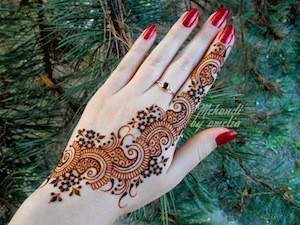
photo - An Islamic bride’s hand is decorated as part of the henna pre-wedding ritual
An Islamic bride’s hand is decorated as part of the henna pre-wedding ritual. (photo by Ibtisam Mahameed)

This is not too different from how Muslim engagement practices look today, in some circles. Ibtisam Mahameed, a Muslim woman from the village of Faradis in Israel, told JNS.org that, in order for a couple in her town to get engaged, the man and his family must meet with the woman’s family.

“The boy has to come and sit in the parents’ house and say he wants to marry the daughter. The parents have to agree. If they don’t agree, the couple cannot be married,” she explained.

If the parents agree, then the village sheikh will come to the house of the woman’s parents and go over Muslim marriage law – what is owed to the bride and groom, the obligations of the man to the woman, and the ramifications of divorce.

“The rights are fully explained before the wedding,” Mahameed said.

Both Muslims and Jews enjoy rich pre-wedding rituals.

The Jewish bedeken (veiling ceremony) is “so powerful,” said Mintz. Often marking the first time a bride and groom are seeing each other after a week of separation before the wedding, the bedeken is wrought with emotion.

While one understanding of the bedeken is that it relates to the fact that the biblical patriarch Jacob was forced to marry Leah instead of Rachel when the brides were switched by their father Laban – and, by extension, today, the groom symbolically makes sure he is marrying the right bride by checking and then veiling her – Mintz said there are other more spiritual interpretations of ritual.

“Rabbi Shlomo Carlebach asks, ‘If the purpose is to make sure she is the right one, why does he veil the bride at the bedeken? Shouldn’t he be taking the veil off?’ Carlebach says the radiance of the bride is so powerful under the chuppah, so beautiful, that the chatan (groom) veils her. That intensity, that beauty, is just for the two of them in their own personal space,” Mintz said.

Mahameed described Islam’s “henna” ceremony as powerful and intimate, too. She said the groom’s best friends and relatives gather in his home to mix and paint the henna dye. Then, they mix more of the dye to deliver to the bride. Carrying a uniquely woven basket with a golden plate of henna, the groom and his mother walk hand-in-hand to make the henna delivery to the bride.

Read more at jns.org.

One-stop planning and sharing app

Wedivite founder and groom-to-be Ben Novak. (photo from israel21c.org)

Within a couple months of its alpha launch in June last year, more than 7,000 couples around the world had already used Wedivite, the first free socially integrated digital platform exclusively for weddings. As of last week, nearly 36,000 couples had used it.

Conceived and built by Israeli groom-to-be Ben Novak, Wedivite enables sending invitations via email, Facebook, Twitter, Google+, SMS or WhatsApp, or adding a QR code to a printed invitation. There’s an option to create a custom page for a wedding registry, too.

Guests can click to RSVP, add the event to their Google calendar, get directions to the wedding, send greetings and gifts, recommend songs for the playlist and add photos to the online album and live wedding slideshow.

Additional features have since been added, such as a dedicated gift registry, integration with Google contacts and Dropbox (for photo storage and printing), text reminders for guests and designer invitation templates.

“We’re connecting everything to make it more comfortable for couples to engage guests and to make it cheaper and fun,” said the 29-year-old founder, who is bootstrapping the venture by working as a digital marketing consultant.

From Israel with love

Wedivite’s website and mobile app were launched in beta in January 2013 and became an instant hit with couples in India, the United States, South Africa, the United Kingdom and Canada. A Spanish-language version was added before the alpha launch, due to demand from users in Spain, Latin America and the United States.

Novak also introduced a Korean beta version of Wedivite, he said.

“Three months ago [prior to August 2014], a wedding organizer from South Korea emailed me and said online mobile invitations are big in Korea but they don’t have everything I am offering, and she wanted to translate all the material for me [in return for putting] her link on my website in Korea,” he explained.

While his fiancée was scouting out a gown and a hall for the couple’s May 2015 nuptials, Novak was knee-deep in the technical side of pending matrimony, learning that vast cultural differences require him to tweak Wedivite for specific audiences.

In South Korea, for instance, nobody uses PayPal or Google Maps, which are integral to Wedivite. And because Koreans don’t dance at weddings, there’s no need for a song-suggestion feature.

“One of my dreams is to create a big infographic or PDF with cultural differences between weddings that I have learned about,” said Novak, a Tel Aviv resident.

But some things are universal, such as the increasingly digital components surrounding the romance of engagements and weddings.

Mashable’s social and tech wedding survey in 2012 revealed that “relationship status” is the digital age’s version of flaunting a new diamond ring, as 31 percent of engaged women update their status within hours of accepting a marriage proposal.

Other trends show that couples are forgoing classic wedding formats in favor of ceremonies and receptions that reflect their personal tastes and create a positive experience for guests while keeping costs down.

“Wedivite is here to re-set the standard of wedding invitations from the traditional to the digital,” said Novak. “By putting social-media integration at the forefront of our platform, we recognize the influence that social media and digital presence has in the lives of today’s couples.”

Novak was inspired to start Wedivite by a conversation with a newly married friend whose wedding photographer had failed to take a picture of the groom’s mother. Though many guests take their own photos at weddings, these couldn’t easily be added to an official album.

“My idea was to make a shareable photo album for weddings, but I decided, why not make it a lot cooler?” Novak said. “Eventually, it became what it is today.”

Novak possessed the requisite skills to realize his idea, because he has been a graphic designer and web developer since age 14, and has experience working for an ad agency and as marketing director for New Media College in Tel Aviv.

“I always had my own businesses on the side, but now I am 100 percent working on Wedivite around the clock,” he said. That, and planning his own wedding.

For details, visit wedivite.com.

Israel21C is a nonprofit educational foundation with a mission to focus media and public attention on the 21st-century Israel that exists beyond the conflict. For more, or to donate, visit israel21c.org.

***

In addition to the wedding invitation and all its aspects, wedivite.com also offers a lot of other information for planning your big day. Among its blog categories are love quotes, if you’re looking for inspiration, or a few pithy phrases to round out your vows; do-it-yourself ideas on a host of topics, such as reception themes, food offerings, flower decorations, etc.; and wedding tips on photography, budgeting and more. It is from this latter section that the following advice on budgeting comes.

One of the first things that you will notice when you begin perusing wedding magazines and guides is the amount of cash that most people sacrifice to their big day. If the average $27,000 price tag has you rethinking your nuptials, rest assured that there is a better – and less expensive – way.

Beginning married life with a burden of debt may not be in the best interest of your relationship, so find some ways to have a fabulous time within a beautiful venue without breaking the bank.

Choose an off-season date

Not only will this offer you greater availability of the locations and services that you would like to reserve, you are likely to get a better price than you would if you were married in the peak month of June. You will also enjoy savings when you plan your honeymoon.

Select a gorgeous venue

This may seem counterintuitive since a lovely location may come with a hefty price tag. However, if you choose a venue that is beautiful as-is, you can skip the decorations and make the most of what your venue offers. Historic sites and outdoor locations are wonderful choices for venues that do not require additional décor.

Bargain shop

Chances are that your marriage will be just as amazing if you are married in a dress from last year’s collection for a fraction of the price of the latest styles. This single purchase offers you the opportunity to save hundreds of dollars. Shop clearance racks, online sales and reusable party supply sites for great deals on the stuff you need.

Get creative with catering

What are your priorities when it comes to food at your reception? If a sit down, multicourse meal is a necessity, be sure to budget for it. This is a potential area to save serious money by planning a buffet. Consider your favorite restaurants as caterers rather than only those who specialize in weddings.

Forget the favors

Party favors are one of those things that everyone buys and nobody wants. Your guests will not feel less loved or important if they do not go home with a piece of tchotchke that will collect dust for a few weeks before they finally through it in the trash.

Use a Wedivite invitation

Save hundreds of dollars in printing costs and postage by using Wedivite’s digital wedding invitations to communicate with guests rather than old-fashioned snail mail. It’s free and comes with a lot of cool features like a social wedding album, songs suggestion, directions for guests, wedding registries and more.

 – From wedivite.com