
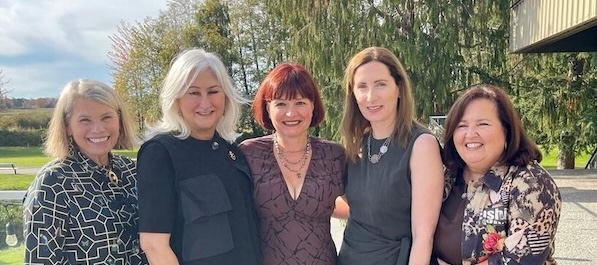

“Across Canada, our CHW community shares a common purpose, and that is improving lives,” said Tova Train, CHW (Canadian Hadassah-WIZO) national president, at CHW Vancouver Centre’s Opening Luncheon & Fashion Show Oct. 18.
“In Israel and Canada, CHW supports vital health care, education and social services programs,” she said, noting initiatives that help women and families affected by violence and trauma. “The impact of this work is made possible, of course, by your generosity and your dedication to the projects that we support,” she said.
“Although we give the bulk of our money to projects in Israel, we are also cognizant that people … need us here in Canada and we like to promote their projects as well,” said outgoing CHW Vancouver Centre president Toby Rubin in her welcome remarks, before introducing Train.
Rubin highlighted some of CHW’s Canadian projects, such as Franny’s Fund, which provides financial and other resources for abuse victims navigating the criminal justice system. Franny’s Fund helps support the Treehouse Vancouver Child & Youth Advocacy Centre, for example.
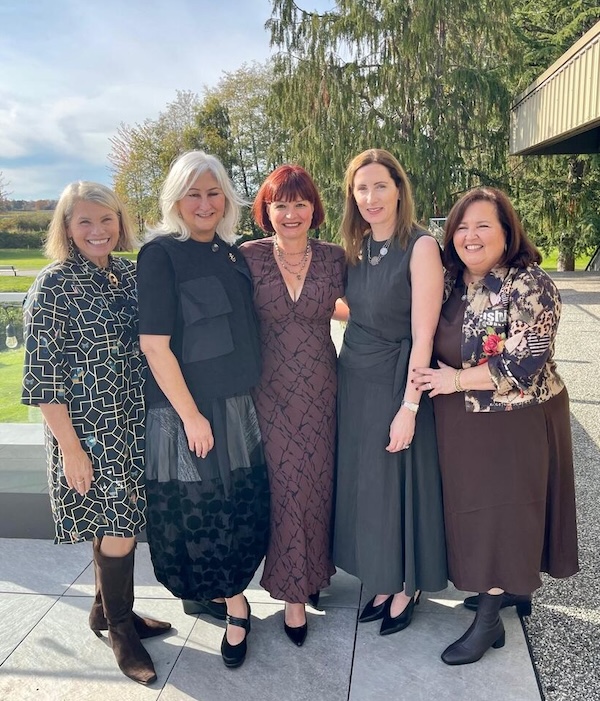
A video summarized CHW’s current projects, including those helping to close gaps in mental health care, a need that increased in Israel after the Oct. 7, 2023, Hamas attack, with “an estimated 5% of the population expected to suffer from severe PTSD,” according to the video. Rubin later wondered whether that figure would turn out to be much larger.
CHW projects in Israel include Michal Sela Forum (founded to prevent domestic violence), HaGal Sheli (using surfing as a mode of trauma intervention), Her Academy (job training and placement for women escaping prostitution and violence) and the Edan Association (trauma-focused care for girls and women in the northern Negev and Gaza Envelope regions).
The video also noted that CHW is contributing to Shamir Medical Centre’s limb reconstruction unit and to Hadassah Hospital for research on personalized cancer care using artificial intelligence. The latter is a new project for CHW and the Oct. 18 event featured Prof. Dr. Shai Rosenberg, a senior neuro-oncologist at Hadassah University Medical Centre and an associate professor in the Hebrew University of Jerusalem’s faculty of medicine, who is using AI to try and improve cancer treatment and outcomes.
“This is groundbreaking work and it will save lives worldwide,” said Train about Rosenberg’s research.

Rosenberg spoke to the audience virtually from Israel, but, before he did, Dr. Karen Gelmon, a professor of medicine at the University of British Columbia and a medical oncologist at BC Cancer, who attended the event in person, explained the concept of “precision medicine,” which, she said, has been talked about for decades now.
“Precision medicine,” she said, “is when we try to treat the individual and their disease – rather than just treatment like everyone sitting in a row, we try to individualize the treatment. Why is that important? First of all, some people don’t respond to our treatments, so, for those people who aren’t going to respond, we need to individualize to have the right treatment for that person. As well, we increasingly know that we treat some people with too much therapy. If we could determine right at the beginning they were going to do well, we don’t have to give them as much therapy and toxicity and disrupt their lives.”
Rosenberg offered a brief overview of what cancer is – normal cell division is disrupted by genetic mutations, allowing cells to multiply unchecked, leading to tumour formation and cancer.
By using genomic mapping, large data sets, artificial intelligence and clinical knowledge, researchers like Rosenberg are developing ways in which to understand an individual patient’s type of cancer, predict the treatments most likely to be effective, and even identify potential new therapies.
“Every new cancer patient in the world teaches us something and we can learn from it,” said Rosenberg.
In the Q&A with Gelmon that followed, Rosenberg described some of the benefits of AI, such as its ability to process enormous amounts of data, which can be verified by clinical trials and other means – “and always there will be a human in the loop.” He didn’t seem too concerned with privacy and other potential problems like AI taking over from humans, but he did say that one of the potential drawbacks of AI is that people may stop thinking deeply about issues, “and I see it every day,” he said, with students relying on AI perhaps too much.
After Rosenberg’s presentation and the luncheon portion of the event, Rubin was honoured with the Claudia Goldman Award for Excellence in Leadership, which celebrates individuals whose dedication and service have made a meaningful difference to CHW. While Goldman could not be there to present the award, she sent remarks, which were read by Train.
“Toby, you define this award,” wrote Goldman. “Volunteer work requires commitment, generosity and the ability to bring people together, and you truly are a born leader. I know that your dedication has helped strengthen this community and your contributions will only continue to have a wonderful impact.”
Sylvia Cristall, a past president of CHW Vancouver, presented Rubin with flowers and a token of appreciation from the organization.
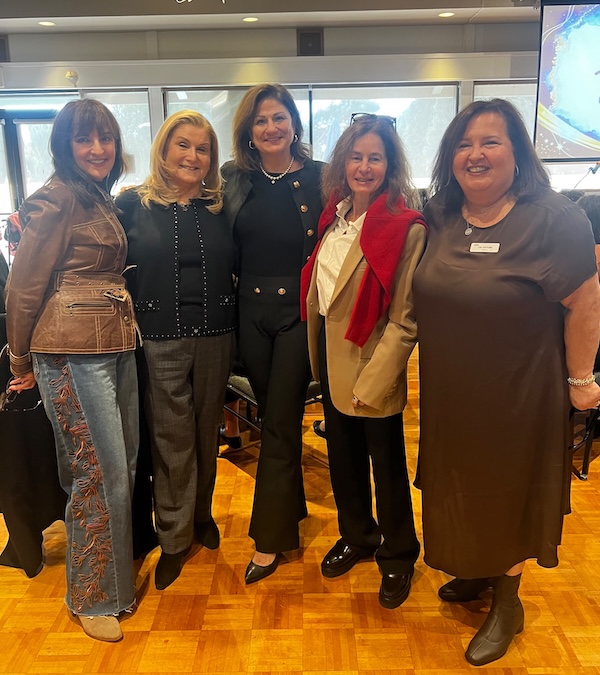
Rubin has been a CHW supporter for almost 35 years, according to the event booklet, “the third of four generations of women in her family to support CHW”; her daughter, Lauren, is on the local board.
Rubin, who continues to serve on the national CHW board, was on the Vancouver Centre executive for some eight years and just completed four years as the local president. She thanked past and current directors with whom she has worked and works, as well as the professional staff of the organization, and her family. The feeling of gratitude was mutual – a video included several of these people and others thanking Rubin for her work, intelligence, kindness, dedication, and more.
At the October event, Jocelyn Brown and Pam Wolfman were welcomed as the new leaders of CHW Vancouver Centre.
“You guys are so fortunate to have them as co-presidents,” said Rubin. “They both bring a wealth of excitement and Zionism and ideas for the organization, and it’s been a sheer pleasure to have had them shadow me this past year to learn their jobs.”
“Although I’ve been a life member of CHW for 36 years, this is my first major leadership role within the organization,” said Wolfman. “Over the years, I’ve been involved with several community organizations in Vancouver, including the Jewish Federation, the JCC, Jewish Seniors Alliance, and the Vancouver Israeli Folk Dance Society.”
“I also come from a background of leadership in Jewish organizations, most recently with Hillel BC and the Vancouver Jewish Film Festival,” said Brown. “CHW is relatively new to me.”
Both Brown and Wolfman said it was Rubin who encouraged them to join the executive. They spoke of the positive difference CHW makes in people’s lives, not just the people it helps through its projects, but the members themselves, the friendships formed and the mutual support. Wolfman pointed out how the organization has evolved to meet members’ changing needs, as more women joined the labour force and wanted more say in where their donation dollars were directed.
While CHW’s funding focus is health care, women and youth, its events are open to everyone, said Brown.
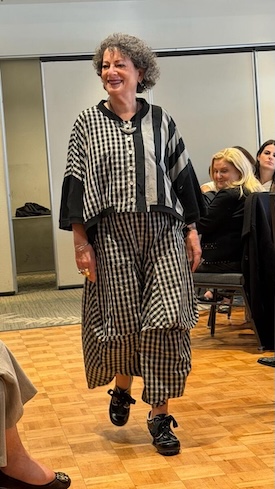
The event concluded with a fashion show of Alembika clothing. The brand was started in 2005 by fashion designer Hagar Alembik-Hazofe and anthropologist Dr. Judy Fadlon, and is represented by the Ordel Group Agency – Eryne Ordel narrated the models’ walks down the “runway.” Walking that line of space between the tables, sporting various outfits, were Brown, Wolfman, Daniella Givon, Laura Lewko and Laura Mossey.
In addition to the fashion show, there was a silent auction featuring a range of items.
For more information on CHW’s work, projects and events, go to chw.ca.